Home › O › Orchideæ (Sp spl jn au Pu History Use)
Orchideæ (Sp spl jn au Pu History Use)
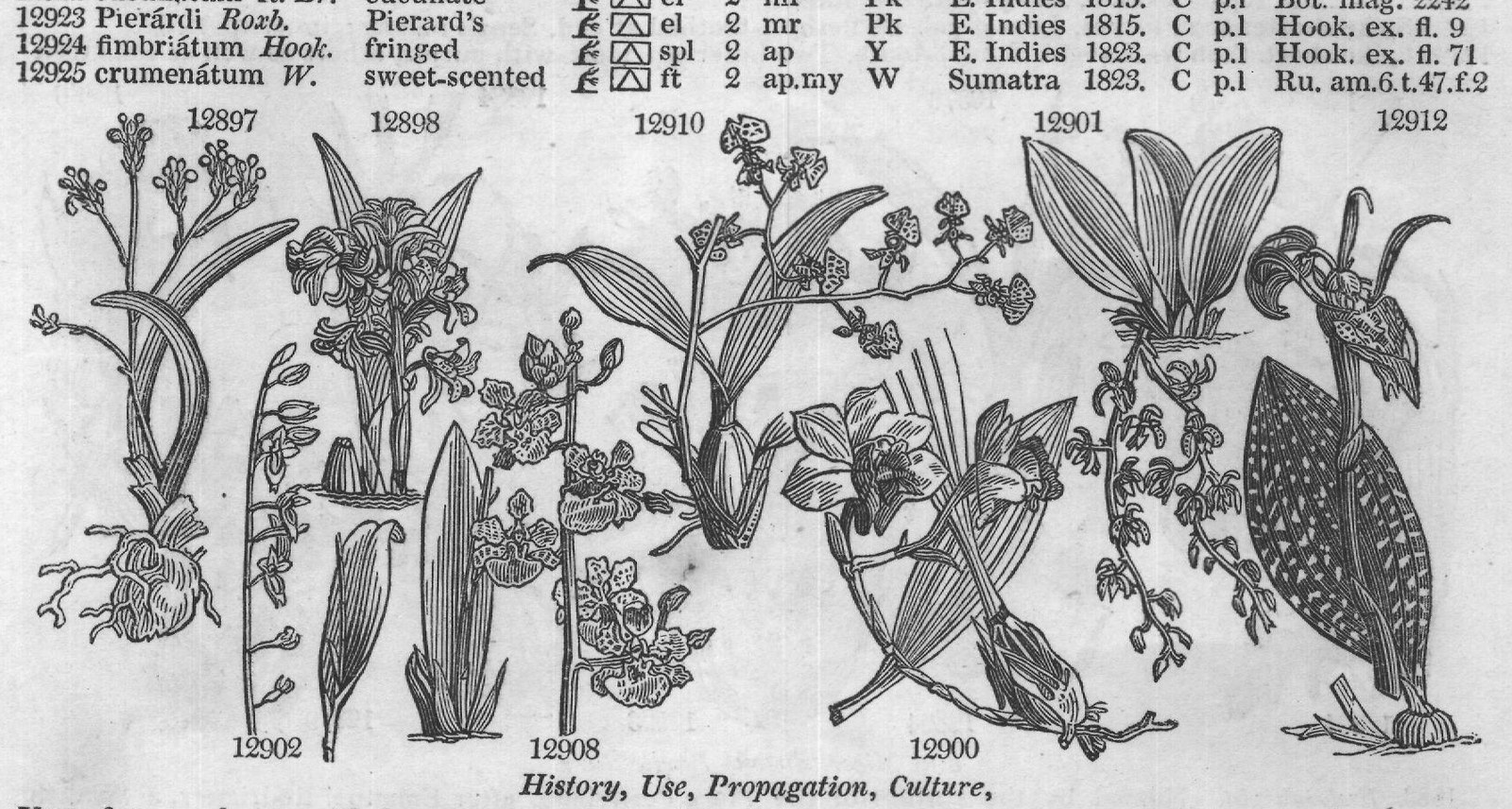
Sp. 9-17. spl 1 jn.au Pu 12902 12908 12900 History, Use, Propagation, Culture, Very fine epiphytes, with large bulbous roots, plaited leaves, and fine, often spotted, flowers of a greenish purple color. The bulbs contain a quantity of viscid juice, which is used, when fresh, in Brazil, for the purpose of sealing letters. The plants are there called Cebolleta. 1890. Trizeuxis. So called by Mr. Lindley without explanation. We suppose the name has been formed from τρεiς, three, and ζεuξiς, union, in allusion to the remarkable union of three segments into one, which takes place in this genus. A very singular epiphyte, which is with difficulty kept alive in the stove by being placed in finely pulverised decayed wood. 1891. Xylobium. From ξuλov, wood, in allusion to the substance upon which it grows. A curious Brazilian bulbous epiphyte with plaited leaves. This is of easy cultivation. 1892. Maxillaria. So called by the authors of the Flora Peruviana, as they inform us, because the labellum when looked at sideways, resembles the Maxillæ of some insects. All fine South American plants, with plaited leaves and showy flowers. They are cultivated like other epiphytes, and not with much difficulty. 1893. Notylia. So called, we presume, from vωτoς, the back, and τuλoς, a hump, in reference to a singular callosity at the back of the stigma, which Mr. Lindley, the author of the genus, considers very curious. An unostentatious epiphyte without bulbs, and with solitary leaves, out of the bosom of which grows a pendulous raceme. 1891. Pleurothallis. From πλεuρa, a rib, and θaλλεω, to flower, in allusion to the one-sided disposition of the flowers. Singular little epiphytes with solitary leaves, no bulbs, and flowers of a green color. They grow rarely in decomposed wood.
ORDER I.
GYNANDRIA MONANDRIA. 12895 Spike length of leaves erect, Flowers globose, Sepals rounded 12896 Perianth. spreading, Lip opened out saccate crested 12897 The only species. Flowers very small in little heads upon a branched scape 12898 Bulbs conical truncate, Flowers close, Leaves lanceolate plaited about 3-nerved twice as long as scape 12899 Leaves about 3 oblong nerved seated on a bulb, Scape about 1-flowered sheathed 12900 Lvs. solitary lanc. plaited, Raceme 2-fl. Perianth. very large wavy spreading, Lobes of lip recurved crisp 12901 Spikes pendulous lax as long as the narrow oval nerved leaves 12902 Stem long 1-leaved, Scape erect longer than obl. emarginate leaf, Fls. racemose 1-sided 12903 Stem long 1-leaved, Leaf ovate-lanceolate, Flowers clustered in the bosom of the leaf 12904 Sepals 5 lanceolate longer than lip, Scape panicled 12905 Sepals 5 obovate unguiculate a little shorter than lip, Scape panicled 12906 Sepals 4 obov. wavy, Lip long. than sep.: midd. lobe dilated reniform-bifid, Scape racem. Bulbs 2-leaved 12907 Sepals 4 acute, Middle lobe of lip roundish undivided, Scape racemose, Leaves 3-cornered 12908 Leaves ellipt. acute, Scape upright branched, Sepals wavy retuse spreading nearly equal, Lip reniform 12909 Lvs. fiat obl. lanc. Sepals 5 obovate undulate blunt, Lip transverse shorter than seg. bearded in the middle 12910 Lip 2-lobed spotted much longer than the sepals, Bulbs ovate comp. leafy at base and end, Scape panicled 12911 Lvs. rigid oval oblique, Panicle thyrsoid length of lvs. Sep. obov. Lip 3-lobed crested, Wings of col. ent. 12912 Lvs. solitary oval dotted spread. Scape jointed 2-edged few-fl. Upper sepals lin. very long, Col. 2-horned 12913 Lip narrow clawed: lateral lobes divaricating longer than the middle which is hollowed out 12914 Lip ventricose: lateral lobes shorter than middle which is crested and callous 12915 Bulbs fascicled, Lvs. lanc. atten. at base, Sepals lanc. finely dotted, Midd lobe of lip acute, Crest obsolete 12916 Bulbs and leaves coriaceous and shining 12917 Lvs. twin obl. lanc. spreading, Fls. terminal solitary, Inner sepals filiform, Lip fringed with two crests 12918 Bulbs 1-leaved: leafy at base, Leaves oblong 3-nerved, Spike erect shorter than leaves 12919 Leaves lanceolate keeled solitary on their bulb, Spike imbricated radical very little longer than the bulb 12920 Stems erect 2-3-leav. at end, Lvs. oval obl. shorter than many-fl. terminal raceme, Sepals narrow oblong 12921 Stems creep. Lvs. oval blunt depressed fleshy several times shorter than raceme, Sepals long linear acute 12922 Stems pendul. Lvs. bifarious lanc. acum. Ped. opp. the leaves about 2-fl. Lip undivided ov. cucul. at base 12923 Stems pendul. Lvs. bifarious broadly lanc. Pedunc. about 2-fl. Lip undivid. tubul, oblique almost truncate 12924 Leaves lanc. striated, Racemes many-fl. Lip undivided obliquely campanulate fringed 12925 Stem branched somewhat compr. tuberous at base, Leaves ovate-lanc. Spikes erect, Fls. remote alternate 12919 12913 12914 12920 12917 12918 12921 12923 and Miscellaneous Particulars. 1895. Oncidium. From oyzos, a tumour, on account of the callosities with which the disk of the labellum is covered. Among the most beautiful of epiphytous plants, conspicuous by their long loose panicles of olivecolored or yellow flowers. Oncidium altissimum grows to the height of three or four feet. O. Papilio, the curious Butterfly-plant of Trinidad, has large yellow and red blossoms poised on slender footstalks, and dancing about in the air like some gaudy insects. All the species are cultivated without any difficulty in almost any soil, with plenty of heat and moisture. 1896. Cyrtopodium. From κuρτoς, convex, and 785, a foot, in allusion to the labellum of the original species. 'These are handsome bulbous plants, growing either upon the ground or upon trees. They are rather difficult to manage well, and are seldom seen in collections. Their flowers, which are handsome, are rarely produced. 1897. Cælogyne. So named by Mr. Lindley, from κoiλoς, hollow, and γuvή, a female, on account of the form of the stigma, which is peculiar for an Epidendrum. Some of the species, natives of Nepal, which have not yet been introduced into our gardens, are most beautiful bulbous epiphytes, with shining fleshy leaves, and spikes of gorgeous flowers proceeding from a rigid imbricated scaly base. 1898. Macradenia. From μaκρoς, long, and aδηv, a gland, on account of the long subulate process to which the pollen-masses are attached. A singular little epiphyte with yellowish brown flowers. 1899. Anisopetalum. From a, without, iσoς, equal, and πετaλov, a petal, on account of the inequality of the sepals, or petals as they commonly called. A curious Nepal plant, with bulbous roots, and little erect spikes of brownish flowers. 1900. Dendrobium. From δεvδρov, a tree, with reference to the habit of the species in growing upon trees. In the woods of the East Indies they climb and twist themselves about the branches of live trees, or throw 3C4 GYNANDRIA MONANDRIA.
CLASS XX. 12926 émulum R. Br. aspiring 12927 monilifórme W. glassy pr pr Pu N. S. W.
China 1824. D p.r.w 12928 rígidum R. Br. rigid cu N. Holl. 1824. D p.r.w Kæmpf. t.865 1824. Dp.r.w 12929 ochroleúcum Lindl. pale-yellow 1901. CAMARKDIUM. Lindl. CAMARIDIUM.
Dendrobium álbum Hook.