Important: Safety Warning
This page offers rules for telling edible mushrooms from poisonous ones. No such rules are reliable, and these identifications predate modern mycology. Deadly species closely resemble edible ones, and mistakes are regularly fatal. Never eat a wild mushroom on the strength of this text.
This information has been left in for historical purposes but should not be acted upon.
Home › T › The A (Bulbosus of Hudson and Ray)
The A (Bulbosus of Hudson and Ray)
bulbosus of Hudson and Ray is referred by Withering to A. violaceus of Linnæus; which has fixed purple gills, numerous, eight in a set; long gills, sometimes cloven, and a few of them decurrent: purple pileus, soft, smooth, firm, convex, but centrally depressed with age, and cracking at the edge, which is somewhat turned down, from half an inch to five inches over: stem solid, cylindrical, purple, bulbous at the base, from one to four inches high, and from a quarter to one inch in diameter; and curtain like a cobweb. In maturity it plentifully emits a powder of the color of Spanish snuff. It is not uncommon from October to December, in Edgbaston and Barr plantations, in the woods near Bath, and at Powick, near Worcester. With much broiling and duly seasoned, it is esteemed as delicious as an oyster. Another variety, which is the A. varius of Bolton, is found on grass-plats and new-mown fields in July. It has chocolate gills, from brown to black, ORD. IX. TRIBE I.
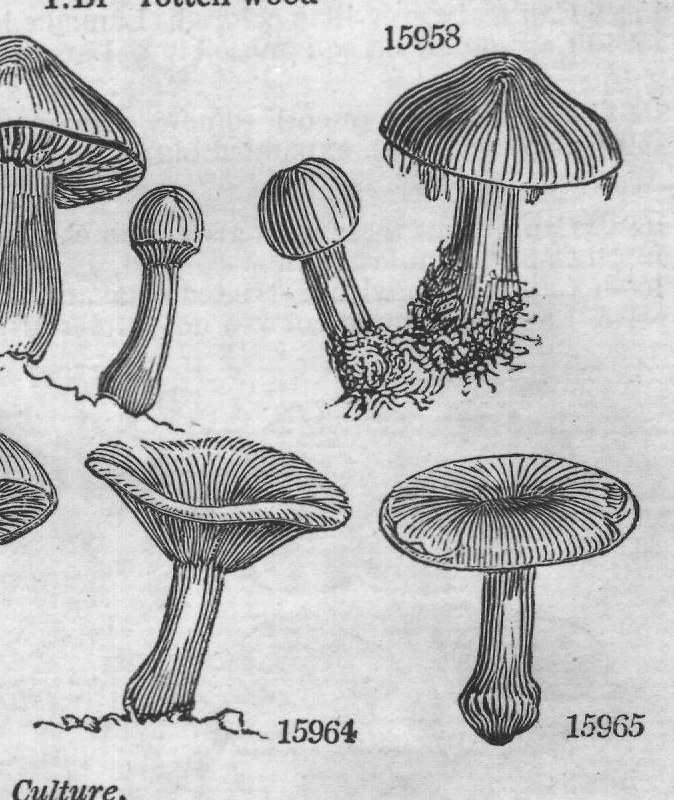
FUNGI HYMENOMYCETES. 15953 Cap obt. fibrous hoary testac. Lamellæ adn. purple, An annulus sheath. stipes which is violet at upp. end 15954 Cap bluntly umbon. somew. fibr. pale umb.-color, Lamel. adnate umb.-col. Stipes somew. bulb. striat. paler 15955 Cap somew. fleshy purp.-brown becom. fibrous testac. and hoary, Lamel. violet-pur. Stipes long eq. violet 15956 Cap scaly testaceous olivecolor, Lamellæ yellowish cinnamon, Stipes bulbous scaly, Veil fuscous 15957 Cap obtusely umbon. smth. bright-brown when dry testac. Lamel. cinnam. Long bulb. stipes and veil white . bright-brown when dry testac. Lamel. cinnam. Long bulb. stipes and veil white 1. Cap always dry, scaly, or fibrous, obtuse or umbonate, never depressed. 15958 Cap very convex dull or brownish-violet, Lamellæ distant violet, Stipes spongy greyish violet within , Lamellæ distant violet, Stipes spongy greyish violet within 15959 Cap umbonate squarrose with hairy sooty scales, Lamellæ compact violet becoming clay-colored, Stipes with hairy sooty scales, Lamellæ compact violet becoming clay-colored, Stipes scaly transversely banded with black 15960 Cap umbon. smooth. pale-brown, Lamel. compact violet discolor. Stipes taper. varieg. with brown scales scaly transversely banded with black 2. Cap smooth, humid, viscid, always obtuse, finally depressed, Stem blue, becoming white. 15961 Cap equal viscid, Lamellæ compact olive-purple, Stipes attenuated bulbous 15962 Cap equal viscid smooth, Lamellæ compact violet-purple, Stipes bulbous becoming white from violet Lamellæ compact violet-purple, Stipes bulbous becoming white from violet 15963 Compact rounded, Cap olivaceous or brownish-grey glutinous while young, Lamellæ reddish-brown olivaceous or brownish-grey glutinous while young, Lamellæ reddishbrown tinged with violet, Stipes thick tinged with violet 15964 Firm, Cap yellow somew. scaly humid viscid, Lamel. compact serrat. whit.-cæsious, Stipes tapering white 15965 Cap smooth viscid yellow or tawny, Lamellæ compåct quite entire yellowish-cinnamon, Stipes bulb. white or tawny, Lamellæ compact quite entire yellowish-cinnamon, Stipes bulb. white 1. Cap scaly or fibrous, Stem same color as the cap or paler. GROWING ON THE EARTH. * Cap fleshy, at first convex. 15966 Cap slightly fleshy somew. scaly, and stipes (which is thin and eq.) dull sang. Lamel. affix. more dull-color. 15967 Cap glabrous subcarnose obtusely umbonate cinnamon-color, Lamellæ numerous adnate yellow-cinnamon, Stipes yellowish rarely straight often with a few remains of the veil attached 15968 Cap pale reddish-buff umbonate subfarinaceous, Lamellæ cinnamon-color broad numerous, Stipes whitish Stipes yellowish rarely straight ** Cap somewhat fleshy, at first campanulate. 15969 Cap somew. fleshy becom, umbon. smoothish brown-purple, Lamel. affix ventric. ferrugin. Stipes fuscous 2. Cap smooth, but with a few surface-fibres, Stem white. GROWING ON THE EARTH. 15970 Cap bluntly umbonate pallid, Lamellæ compact cinnamon-colored, Stipes solid tapering upwards white 15971 Cap somewhat fleshy convex becoming bluntly umbonate chesnut-colored, Lamellæ affixed compact violet-testaceous, Stipes short firm 3. Cap smooth, dry, Gills affixed. 15972 Cap convex humid orange-colored or fulvous, Lamellæ yellow, Stipes hollowish 15973 Lamellæ brown-yellow, Cap deep-yellow bossed in the centre, Stipes scored yellow thickset downwards 15974 Lamellæ reddishbuff, Cap pale-yellow bossed, Stipes pale-yellow 15975 Fulvous, Cap fleshy: scales few hairy, Lamellæ annexed, Stipes solid smooth, Annulus small 15976 Cap pitted lemon-colored hairs white; disk uniform with scatter. scales towards disk, Stipes solid white : hairs white; disk uniform with scatter. scales towards disk, Stipes solid white 15977 Compact, Cap yellow scales scattered appressed, Stipes solid fibrous long-rooted 15978 Cap fleshy brownish or reddish-yellow scaly with fasciculat. filam.: scales revol. Stipes squarr. with scales 15979 Cap fleshy dry yellow scales hairy scattered, Lamellæ at first yellow, Stipes equal squarrose 15980 Cap slightly fleshy obt. fulvous-yellow vill. with stalked scales, Lamel. adnate: at first yell. Stipes fistul. 15981 Cap scarcely fleshed glabrous striate: when moist dull cinnamon-color becoming pale, Lamellæ subdecurrent numerous reddish -brown, Stipes hollow subincurved 15982 Cap yellow-brown bluntly conical, Lamellæ brown, Stipes brown scurfy, Veil permanent Lamellæ brown, Stipes brown scurfy, Veil permanent 15967 15970 15974 15981 15969 15972 15975 15978 and Miscellaneous Particulars. mottled, and in pairs; pileus mouse-color, conical, and pointed; stem of the same color, cylindrical, and firm. This, though a common, is a very beautiful species. In a summer morning it is covered with a bloom like that of a plumb, having often a glittering spangled appearance ; its form is regular, and the fringe of the curtain often a glittering spangled appearance; its form is regular , and the fringe of the curtain peculiarly delicate. Another variety, with the stem of a dark mulberry color, is found in wet gravel where Another variety, with the stem of a dark mulberry color, is found in wet gravel where no grass grows, and sometimes on cow-dung, in which case the stem, under the shelter of long grass, is covered sometimes on cow-dung, in which case the stem, under the shelter of long grass, is covered with a white hoariness which is easily rubbed off. $19. Inoloma. A name with the same meaning as Tricholoma, §5., to which the species are analogous. They are large, firm, somewhat succulent, autumnal, and terrestrial, but not as far as is known, eatable. §20. Dermocybe. From δερμη, a skin or membrane, and κuβη, a head, in allusion to the nature of the pileus. Analogous to Clitocybe, § 8. Of middle size, or small; scarcely eatable. A. cinnamomeus has gills, four in a set, broad about the middle, tawny red, and fixed by claws pileus convex, but bossed, of a rich middle, deep tawny red, and fixed by claws; pileus convex, but bossed, of a rich cinnamon color, from one and a half to three and a half inches diameter; the stem hollow, cylindrical, and a half to three and a half inches diameter; the stem hollow, cylindrical, silky, shining, two inches high, thick as a goose-quill, of a fine full yellow color. This is a species that is high, thick as a goose-quill, of a fine full yellow color. This is a species that is readily distinguished by its cinnamon color. It is found in woods in September and October, and has a good cinnamon color. It is found in woods in September and October, and has a good flavor. 21. Pholiota. From φoλiς, a scale. Species of various habits. Some are terrestrial, others grow upon wood; some large, others of a smaller size. 15984 longicaúdus Fries §23. HEBELO'MA. Fries. 15985 fastíbilis Pers. multiform stinking 22. MYXA CIUM. Fries. 15983 collinítus Sowerby besmeared long-tailed flexuosus With.
CRYPTOGAMIA.
CLASS XXIV.
Sowerby, t. 9 Tann. pine woods 5 jl.nov. Or woods solitary membranous 4 oct. 2 jl.nov. Wsh everywhere Schæff. t. 221. gilvus §24. FLAMMULA. Fries. 15986 flávidus Scheff: yellowish 15987 ínopus Fries connate cæspitose 2 au.no. Ysh subcæspitose 2 sep.oc. Ysh trun. of trees Schæff. t. 35 trun, of trees Bol.t. 148.radicato-ram. connátus With. 15988 spumósus Batt. frothy gregarious 3 au.no. Ysh on earth, &c. Battarra, t. 22. C. 25. INO CYBE.
Fries. 15989 scáber Sowerby rough solitary 1½ aug. Sooty pine woods Sowerby, t. 207 15990 plumósus Bolton feathery solitary 4 aut. Gr woods Bolton, t. 33 15991 lanuginósus Bull. woolly solitary 3 jul.sep. Brsh way sides Bulliard, t. 370 15992 rimósus Bull. cracked variable 2 jn.sep. Y.Br woods Grev. crypt. 3. 128 15993 geophýllus Sowerby earth-leaf variable 2 jul.oct. Wsh woods Sowerby, t. 124 15994 furfurósus With. scurfy watery 1 june Y.Br hedges §26. NAUCO'RIA. Fries. 15995 conspérsus Pers. sprinkled gregarious 1½ jn.oct. Cinn damp woods Pers. ic. t. 12. f. 3 15996 furfuráceus Pers. mealy gregarious 2 au.oc. Cinn dead lvs. &c. Sch.t.226. pulverulentus viridárius With. 15997 hippopínus With. rounded crooked aut.
Pa. Br Sco. fir cones §27. GALE'RA. Fries. 15998 cólus With. campanulate brittle 6 jl.oct. Pa. Br hea. of rubb. 15999 téner Schaff tender brittle 4 my.no. Y.Br grassy places Sowerby, t. 33. 16000 hypnórum Schrank Moss small 1 jl.nov. Ferr. among moss Sch. t.63. campanulatus 16001 atrorúfus Bolton dark-brown slender 3 aut. Br pastures Bolton, t. 51. f. 1 16002 núceus Bolton hazel-nut slender 4 oct.
Pa.Br fir woods Bolton, t. 70 § 28. TAPINE'A. Fries. 16003 involútus Batsch involute compact 3 au.no. Ferr. woods Sower. t. 98. contiguus adústus With. 29. CREPIDOʻTUS. Fries. 16004 auránt.-ferrugi. Wi. orange-brown solitary 2 aut.
Or. Br roots of oaks 16005 fœ'tidus With. fetid solitary 2 aut.
Dl.Br old willows 16006 vulpínus Sow. foxy gregarious 2 aut. 16007 móllis Schæff. soft solitary 16008 haustelláris Fries resupinate smali Tawn. hollow trees Sowerby, t. 361 au.oc. pa.Cin trun. of trees Sowerby, t. 98 au.oc. Pa.tar rotten branc. resupinátus With. 16009 variábilis Pers. variable solitary aut. W rotten trees Sowerby, t. 97. niveus §30. VOLVA RIA. Fries. 16010 bombycínus Schæff. silky 16011 cepæ stipes Sow. patchy eatable tufted 6 jl.aug. W trun. of trees Schæff. t. 98 4 sum. W bark of trees Sowerby, t. 2 $31. PSALLIO'TA.
Fries. 16012 cretáceus Bull. chalky Mushr. eatable 3 au.no. W meadows Bull. t. 374 16013 campéstris L. comm. Mushr. eatable 2 my.oc. Wsh meadows Grev. crypt. t. 161 15983 15985 15987 15986 15989 15991 15992 15993 15996 15990 History, Use, Propagation, Culture, 22. Myxacium. So called from μuζa, mucus, on account of the nature of its surface. The species are large, solitary, terrestrial, mucous, inodorous, and not eatable. 23. Hebeloma. From ήβη, down, and λωμa, a margin. The only species has a nauseous taste. Its lamellæ are serrated, and distil drops of a peculiar fluid. Its varieties are infinite. Common in woods. serrated, and distil drops of a peculiar fluid. Its varieties are infinite. Common in woods. 24. Flammula. So named in allusion to their color, which is a pale yellow, the color of a weak flame. The species are gregarious, subcæspitose, firm, persistent, rather bitter, and all eatable. A. socialis and ilicispecies are gregarious, subcæspitose, firm, persistent, rather bitter, and all eatable. A. socialis and ilicinus are both eaten at Montpellier, where they are known by the names of nus are both eaten at Montpellier, where they are known by the names of Pivoulade d'eouse and Frigoule. §25. Inocybe. From iva, fibres, and κuβη, a head. A tribe which can scarcely be compared to any other. It consists of fungi of middle-size, or smaller, solitary, growing on the ground during the summer, and not consists of fungi of middle-size, or smaller, solitary, growing on the ground during the summer, and not known to be poisonous; although, on account of their nauseous odor, they are suspicious. 26. Naucoria. Small gregarious epiphytous fungi, growing upon stipules, leaves, wood, and even muddy earth, fragile, and without any smell. Their stature is that of Collybia, but their veil is of the same nature as , fragile, and without any smell. Their stature is that of Collybia, but their veil is of the same nature as that of Lepiota, resembling the kernel of a nut (naucum), whence they are named.
ORD. IX. TRIBE I.
FUNGI HYMENOMYCETES. 15983 Cap fleshy smth. orange-brown, Lamel. pur.: then ferrugin. Stipes part. across into bluish gelatin. scales 15984 Cap somewhat fleshy smooth, Lamellæ cinnamon-colored, Stipes long smoothish 15985 Cap somewhat repand opaque, Stipes scaly white, Sporidia clay-color 15986 Cap smooth yellowish, Lamellæ adnate yellow-ferruginous, Stipes fibrous 1. Cap dry, Gills adnate, Tufted. GROWING ON WOOD. 15987 Cap smooth yellowish, Lamellæ affixed yellow , Stipes fibrous pallid solid 2. Cap viscid, Gills adnate, Not tufted. GROWING UPON BOTH WOOD AND EARTH. 15988 Yellowish, Cap smooth viscid, Lamellæ adnate, Stipes hollow tapering at base 1. Stem fibrous or scaly with fibres. 15989 Cap fleshy obtuse scaly brownish-grey, Lamellæ free or nearly so, Stipes solid fibrillose 15990 Cap somew. fleshy hemispherical mouse-color, Stipes solid thin long scaly squarr. Lamel. somewhat loose 15991 Cap somewhat fleshy convex scaly-villous, Lamellæ loose and solid: then fibrous, Stipes solid 2. Stem nearly at the top with white scales. 15992 Cap dry campanulate at length nearly plane: surface splitting longitudinally pale shining-brown, Stipes solid somewhat tuberous at the base 15993 Cap conical at length expanded umbonate silky, Lamellæ subadnate, Stipes solid slender sprinkled with white pulverulent particles 15994 Cap yellow-brown scaly, Gills watery white irregular, Stem yellow-brown crooked scored 15995 Cap somew. fleshy scurfy scaly rufous cinnam.-color. Lamel. emarg. lin. cinnam.-color. Stipes scaly at end 15996 Cap somew. fleshy: then umbilicat. scaly or silky, Lamel. somew.decurr. cinnam.-color. Stipes fistul. scurfy 15997 Cap darkbrown convex, Lamellæ light-brown, Stipes light-brown 15998 Cap somewhat membranous smooth pallid, Lamel. somewhat loose saffron-color. Stipes long villous white 15999 Cap obtusely conical stri. when moist: when dry smth. ochrac. Lamel. adnate lin. Stipes long glab. fragile 16000 Minute, Cap campanulate striate: when moist reddish-buff becoming pale, Lamellæ adnate rather broad 16001 Cap somewhat conical: when dry elastic, Lamellæ few trifid, Stipes very long and slender 16002 Cap globose chesnut-color lobed and incurved at edge, Lamel. trifid wavy, Stipes slender white fistulous distant, Stipes somewhat crooked filiform 16003 Compact, Cap depressed ochrey-brown with a tomentose involute margin, Lamellæ mostly dichotomous, Stipes thick often excentrical 16004 Cap convex scaly cracked and irregular, Lamellæ orange-brown, Stipes stout somewhat lateral 16005 Cap conv. viscid becom. wrinkled dull-brown: marg. invol. Lamel. adnate yellow. Stipes hard thick black 16006 Imbricated sessile fulvous, Cap fleshy obovate scaly towards the margin 16007 Cap subsessile smooth flaccid pale, Lamellæ watery cinnamon-colored 16008 Cap reniform villous pale tan-color, Lamellæ rounded ferruginous, Stipes lateral tapering upwards white 16009 Cap membranous reflexed silky downy white, Lamellæ whitish 16010 Cap silky white, Lamellæ flesh-colored, Stipes solid tapering incurved, Volva lax 16011 Cap campanulate with scattered scales, Stipes hollow ventricose smooth below 16012 White, Cap dry smoothish, Lamellæ loose broadest in front, Stipes hollow smooth, Annulus ascending 16013 Cap white fleshy dry subsquamose or sericeous, Lamellæ free ventricose pink changing to dark-fuscous, Stipes solid white with an annular veil 15999 16000 16002 16003 16006 16007 16009 16011 and Miscellaneous Particulars. 16013 27. Galera. From galea, a helmet, in reference to the figure of their pileus. The species are slender, fragile , tolerably permanent, mostly growing on the ground, and for the most part choosing humid stations.
They have neither smell nor use. 28. Tapinea. Fungi of various natures, deriving their name from τaπεivoω, to depress. Mostly terrestrial and permanent, but scarcely fit for food. 29. Crepidotus. These plants form a transition to Pratella. They grow on wood or trees, and are hardly eatable. A. olearius, a species which grows upon olives in the south of Europe, a poisonous species, exhibits a . A. olearius, a species which grows upon olives in the south of Europe, a poisonous species, exhibits a phosphoric appearance in the night. A. translucens, a French species, is eaten by the poor of Montpellier. $30. Volvaria . So called from the magnitude of their volva. The species grow in fertile manured spots, or on wood, are soft and soon perishable. The larger are fit for food. 31. Psalliota. Mostly eatable. Named from ψaλλiov, a chain-bit, in the same sense as Armillaria. To this place belongs the common Mushroom, another eatable kind. It is found all over Europe, the north of Asia, and of Africa, and in North America. oom, A. campestris, so called from Mouceron, the French name of 16014 Geórgii Sowerby St. George's eatable CRYPTOGAMIA.
CLASS XXIV. 4 aut. Wsh mead.& woo. Sowerby, t. 304 16015 præ'cox Pers. early tufted 2½ spr. su. Ysh among grass ẞ appendiculátus Sow.appendaged tufted 2 spr. su. Ysh among grass Sowerby, t. 324 y delicatus With. delicate solitary 2 spr. su. Ysh 16016 semiglobatus Batsch half-rounded gregarious 3 my.no. Y 16017 squamósus Pers. scaly solitary 4 sep.no. Y among grass Bolt. t. 67. f. 1. durus meadows Sowerby, t. 248 woods 16018 versícolor With. changeable-col. spongy 2 july G.Br groves 16019 æruginósus Fl.lond. verdigrease pretty 13 au. no. Y.G woods Sowerby, t. 264 16020 littóreus With. sea-shore solitary 1 oct.
Y.Br woo. & fields 32. HYPHOLO'MA. Fries. 16021 lachrymabúndusSow.weeping fragile 2 au. no. W.Br on ground Sowerby, t. 41 16022 laterítius Schæff. one-sided cæspitose 2 my. oc. Fulv. trun. of trees Bolt. t. 5. pomposus 16023 fasciculáris Huds. bundled cæspitose 1½ my.no. Ysh decay. trees Sowerby, t. 285 33. PSILO CYBE. Fries. 16024 myosótis Fries olive gregarious 3 sep.no. G.Ol damp places 16025 stercorárius Schum. adnate brittle 4 jul.oct. Liv. Y cow dung adnátus Hudson 16026 ericæ'us Pers. heath variable 4 jul.oct. Br damp places Schæff. t. 210. helvolus 16027 fusco-purpúreus Wi. brown-purple twisting 2 aut. Pa. Br among grass 16028 callósus Fries callous gregarious 3 au. no. Y way sides Sow. t.248.f.1. semiglob.
ẞ várius Bolton various 34. PSATHY'RA. Fries. gregarious 3 au. no. Livid way sides Bolton, t. 66. f. 1 16029 stipátus Pers. stalked tufted 3 jl. nov. Br 16030 tentáculum Sower. slender fragile 3 au.no. Brsh trun. of trees Bolt. t. 15. concinnus gardens Sowerby, t. 385. f. 1 16031 cuspidátus Bolton cuspidate thin 4 aut.
R. Br pastures Bolton, t. 55 35. COPRINA'RIUS. Fries. 16032 semiovátus Sowerby half-ovate coronátus With. 16033 fimipútris Bull. shield-headed fragile upright 6 sum. Wsh cowdung 16034 papilionáceus Bull. butterfly unpleasant 16035 Boltóni Pers.
Bolton's 16036 titubans Bull. fragile delicate 3 spring Y 3 au.sep. Y dunghills dunghills 16037 papyráceus Pers. papery semitranspar. 3 aut.
Wsh oak trees 16038 disseminátus Pers. scattered gregarious 1 spr. au. Ysh 2366. COPRI NUS. Link. COPRINUS.
Sp. 10-24. 16039 comátus Link. maned gregarious 2 au. oct. W gardens A. cylindricus Sowerby, t. 189 16040 picáceus Fries ventricose subsolitary 16041 atramentárius Link inky tufted 5 sep. oc. Wsh 6 jn. dec. Br shady woods Sowerby, t. 170 trun. of trees Sow. t 188. A. fimetarius 16014 16015 16016 16019 4 au. oct. Ciner. horse dung 3 my.no. Sooty dunghills Sowerby, t. 131 Bolt. t. 57. clypeatus Bulliard, t. 58 Sower. t. 96. flavidus Sowerby, t. 128 Bolt. t.11. membranace. trun. of trees Sowerby, t.166. striatus Grev. crypt. fl. t. 119 16023 16021 16022 16026 16028 History, Use, Propagation, Culture, Of all the species of agaric, one only has been selected for cultivation in our gardens, viz. the A. campestris, or common mushroon, or champignon. The gills of this species are loose, pinky red, changing to a liver-color, in contact with the stem, but not united to it very thick set, irregularly disposed, some forked next the stem, some next the edge of the pileus, some at both ends, and in that case generally excluding the intermediate smaller gills. The pileus is white, changing to brown when old, and becoming scurfy; regularly convex, fleshy, flatter with age, from two to four inches, and sometimes nine inches in diameter, and liquefying in decay; the flesh white. The stem is solid, white, cylindrical, from two to three inches high, half an inch in diameter the curtain white and delicate. When this mushroom first makes its appearance, it is smooth and almost globular; and in this state it is called a button. This species is esteemed the best and most savoury of the genus, and is much in request for the table in England. It is eaten fresh, either stewed or boiled, and preserved either as a pickle, or in powder; and it furnishes the sauce called ketchup. The field plants are better for eating than those raised on artificial beds, their flesh being more tender; and those who are accustomed to them can distinguish them by their smell. But the cultivated ones are more sightly, may be more easily collected in the proper state for eating, and are firmer and better for pickling. The wild mushrooms are found in parks and other pastures, where the turf has not been ploughed up for many years; and the best time for gathering them is August and September. Dr. Withering mentions four varieties.