Important: Safety Warning
This page offers rules for telling edible mushrooms from poisonous ones. No such rules are reliable, and these identifications predate modern mycology. Deadly species closely resemble edible ones, and mistakes are regularly fatal. Never eat a wild mushroom on the strength of this text.
This information has been left in for historical purposes but should not be acted upon.
Home › T › The A (Georgii of Linn us resembles)
The A (Georgii of Linn us resembles)
Georgii of Linnæus resembles the former, but is much inferior to it in flavor. Its gills are yellowish white; the pileus yellow, convex, hollow in the centre; the stem yellow, thickish, and smooth; the juice yellow, which flows plentifully from it when wounded. It is gathered in September in woods and pastures. A variety of this is found on the seacoast of Cornwall, of a large size, with the button as big as a potatoe; ORD. IX. TRIBE I.
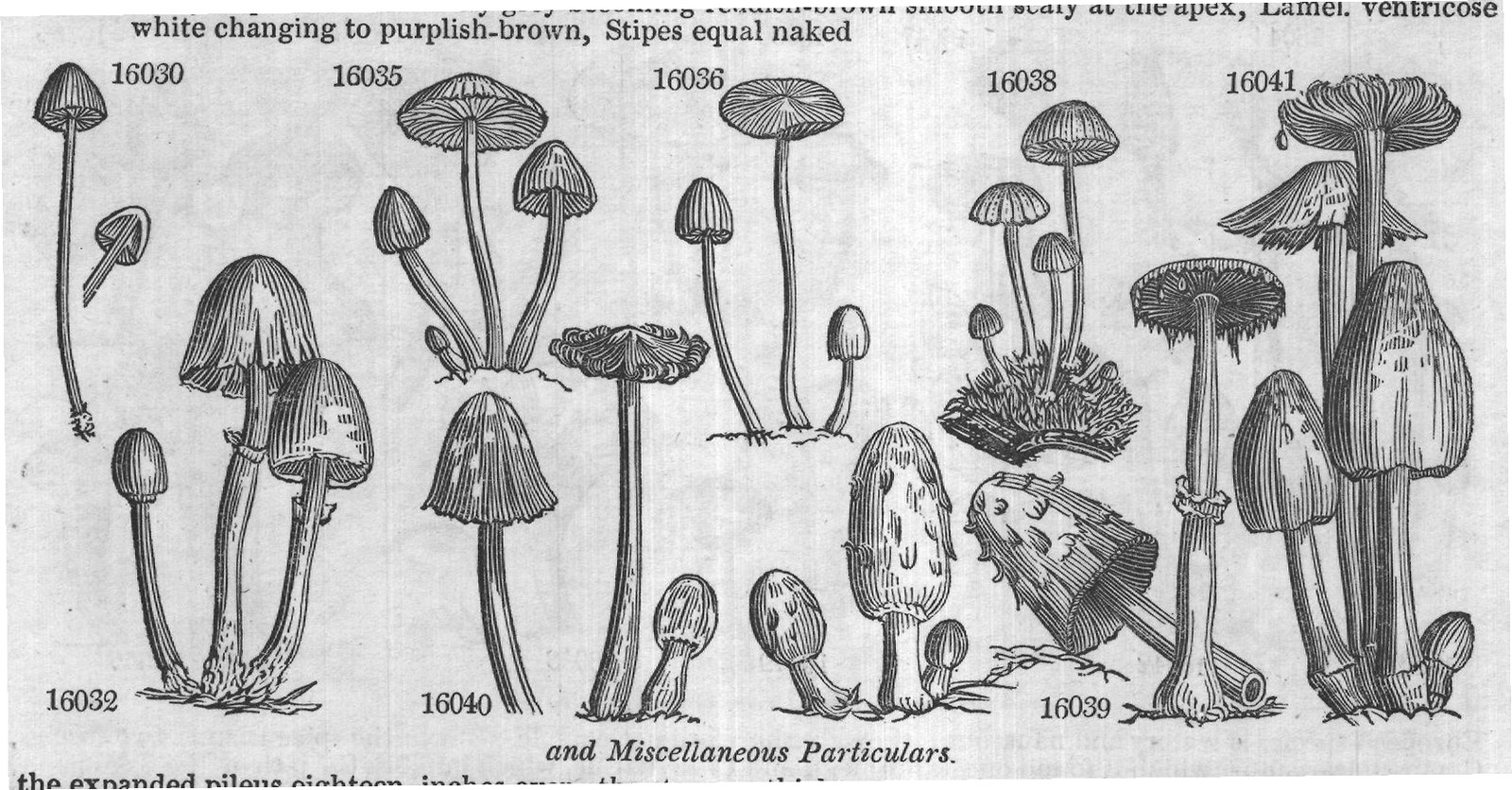
FUNGI HYMENOMYCETES: 16014 Cap very fleshy convex white or pale-yellowish mostly smooth, Lamellæ broad whitish at length deep purple-brown, Stipes thick with a persistent collar 16015 Cap fleshy smooth yellowish tan-color, Lamellæ annexed with a decurrent tooth pale-brown, Stipes nearly solid smooth white 16016 Cap hemispher. smooth glutin.redd.-yell. Lamel. adnate mostly horizont. darkly mott. Stipes holl. squam. 16017 Cap somewhat viscid yellow: scales scattered concentrical, Lamellæ adnate blackish, Stipes solid 16018 Cap scaly greenish-brown, Lamellæ decurrent becoming rufous-brown, Stipes solid bulbous 16019 Cap fleshy yell. but being cover. with a blue slime appear. green. Lamel. adnate purple-brown, Stipes holl. [squamose 16020 Stipes solid white, Annulus persistent, Cap yellow-brown, Lamellæ adnate reddish-grey 16021 Cap fleshy very fibrous pale yellow-brown, Lamellæ dull reddish-brown exuding a thin grey fluid, Stipes hollow fibrillose thickest at the base 16022 Cap fleshy obt. brown-orange, Lamel. slightly green. Stipes filled with a spongy mass stained by the veil 16023 Cap somew. fleshy umbon. ochrace. or redd.-orange , Lamel. green. numer. Stipes holl. rather long slender 2 16024 Cap convex viscid, Lamellæ adnate whitish-brown, Stipes long fibrous 16025 Cap obtuse smooth viscid livid-yellow, Lamellæ broad decurrent brown, Stipes long naked 16026 Cap convex smooth shining, Lamellæ broad adnate blackish, Stipes long naked 16027 Cap light-brown semiglobular, Lamellæ purplish-brown broad thin, Stipes reddish-brown 16028 Cap conical dry, Lamellæ adnate ascending dark-purple, Stipes tough smooth pale 16029 Cap somew. fleshy smooth fuscous-brown pallid, Lamel. adnate numer. brown. flesh-color. Stipes smooth 16030 Cap somewhat membranous campanulate obtuse, Lamellæ very broad at back adnate cinereous-blackish : margin pink, Stipes thin smooth 16031 Cap cinnamon-color conical, Lamellæ dusky-brown, Stipes brownish cylindrical smooth 16032 Cap somewhat fleshy obtusely campanulate glutinous yellowish or brownish-white, Lamellæ adnate greyish-black, Stipes long white, Veil annular entire colored at edge, Stipes long rufous, Annulus ragged white at edge, Stipes long rufous striated at end length brown flesh-color, Stipes equal shining 16033 Cap somewhat fleshy campanulate humid cinereous pallid, Lamellæ adnate cinereous-black whole- 16034 Cap somewhat fleshy campanulate dry blackish soot-colored pallid, Lamellæ adnate cinereous-dark 16035 Cap convex somewhat umbonate viscid yellow, Lamellæ annexed pallid, Stipes attenuated smooth yellow 16036 Cap membranaceous plicate viscous yellow, Lamellæ scarcely attached to the stipes pale purplish at 16037 Cap hemispherical smoothish whitish, Lamellæ loose blackish-purple, Stipes naked white 16038 Gregarious small, Cap ovato-campan. plicate, Lamel. subadnate whit. at length grey, Stipes incurv. glab. 16089 Cap somewhat fleshy white scaly, Lamellæ white changing to red-purple and to black, Stipes subbulbous, Veil annular moveable 16040 Cap membranous white separating into broad scales, Lamellæ blackish, Stipes bulbous naked 16041 Tufted, Cap somewhat fleshy grey becoming reddish-brown smooth scaly at the apex, Lamel. ventricose white changing to purplish-brown, Stipes equal naked 16030 16032 16035 16040 16036 16038 16039 16041 and Miscellaneous Particulars. the expanded pileus eighteen inches over, the stem as thick as a man's wrist, the gills very pale, the curtain tough, and thick as leather, and the juice yellowish. A plant of this kind, as Dr. Withering informs us, was gathered on an old hot-bed in a garden in Birmingham, which weighed fourteen pounds.
Greville says, "A. Georgii derives its name, according to Parkinson, from springing up about the time of St. George's day. It is unquestionably the largest of the British agarics. It has been known to weigh fourteen George's day. It is unquestionably the largest of the British agarics. It has been known to weigh fourteen pounds. Mr. Hopkirk mentions one that weighed five pounds six ounces, and measured forty-three inches in circumference; but Mr. Stackhouse found it to attain the enormous size of eighteen inches in diameter, which is fifty-four in circumference, having a stem as thick as a man's wrist. The best distinguishing marks are, the extreme paleness of the lamellæ at the period of the bursting of the veil, compared with the true mushroom; the greater convexity and thickness of flesh at the same period; and shortly afterwards, the more yellowish and tough pileus.". 32. Hypholoma. So called, from ύφaς, a cup, and λωμa, an edge. Wood species growing in patches. 33. Psilocybe. From Tidos, thin, and xußn, a head. A very natural assemblage. The species are for the . Psilocybe. From ψiλos, thin, and κuβη , a head. A very natural assemblage. The species are for the most part terrestrial, inhabiting fertile and somewhat fenny places, growing either solitary or in groups, not part terrestrial, inhabiting fertile and somewhat fenny places, growing either solitary or in groups, not eatable, and subject to much variety of appearance. $34. Psathyra. So called, from ψaθuρoς, fragile, on account of their remarkable brittleness. Many species are found upon moist wood, and in grassy places on a fertile soil. found upon moist wood, and in grassy places on a fertile soil. 35. Coprinarius. All the species are found on dung, whence their name, from κoπρia, dung. 2366. Coprinus. Named for the same reason as the last. The species are gregarious and fugacious. They Coprinus. Named for the same reason as the last. The species are gregarious and fugacious. They are found on dunghills, rich grassy places, and in the hollow trunks of decayed trees. The taste of the found on dunghills, rich grassy places, and in the hollow trunks of decayed trees. The taste of the CRYPTOGAMIA.
CLASS XXIV. 16042 congregátus Fries clustered tufted 3 my.no. Ferr. trun. of trees Sowerby, t. 261 16043 níveus Pers. snowy variable 3 au.no. W horse dung 16044 cinéreus Fries cinereous solitary 4 jul. oct. Cin. dunghills Bolt. t. 156. tomentosus 16045 domésticus Fries domestic pretty 3 wet w. Sooty walls Bolton, t. 26 16046 plicátilis Fries plaited tender 2 sum. Cin. damp places Sowerby, t. 364 16047 ephémerus Pers. ephemeral fugacious 2 my. oc. Br dunghills 16048 radiátus Bolt. radiated very delicate 2 my.oc. Cin. dung Sow. t. 262. stercorarius Bolton, t. 39. f. C. 2367. GOM'PHUS. Fries. GOMPHUS. 16049 glutinósus Fr. glutinous solitary 3 jl. nov. Pu 16050 rútilus Fr. sparkling solitary 2368. CANTHAREL/LUS. Adans.
CHANTARELL. 16051 umbonátus Pers. umbonate 16052 aurantíacus Fr. orange 16053 cibárius Fries eatable esculent 16054 cinéreus Fries cinereous tufted 1½ oct.
Blsh gregarious poisonous Sp. 2-4. 3 au. oct. Brsh Sp. 8-43. 3 au.no. Cin. 2 au.no. Or. Y 1 jl. nov. Y among moss Jacq. coll. 2. t. 16. f. 1 Jacq. coll. 2. t. 14. f. 5 Sow.t.46.A.cantharellus among moss Bolt.t.34.infundibularis pine woods Sowerby, t. 7 pine woods Sowerby, t. 105 fields fields 16055 cornucopioides Fries purplish elastic 2 au. no. Br woods Sowerby, t. 74 Merúlius purpurátus With. 16056 undulátus Fries wavy tough 314 all sea. Pale on ground Sower. t. 75. floriformis 16057 lobátus Fries lobed tough spring Brsh humid places Bo.t.177.membranaceus 16058 lutéscens Fries yellowish spirit-scented 2 jul. no. Ysh humid places Sow.t.47.A.cantharelloi. 2369. MERU'LIUS Haller. DRY-ROT. 16059 láchrymans Schum. common ẞ obliquus Bolton oblique 2370. SCHIZOPHYL/LUM. Fries. 16060 commúne Fr. 2371. DÆDA'LEA. Pers. DÆDALEA.
Sp. 1-10. parasite 4 all sea. Y.Br decay. wood Sowerby, t. 113 parasite 4 all sea. Y.Br decay. wood Bolton, t. 74 SCHIZOPHYLLUM.
Sp. 1. common gregarious 2 wet w. Grsh trun. of trees Grev. crypt. t. 61 Sp.7-30. 16061 quercína Pers. 16062 biénnis Fries oak variable 0 all sea. Pa.Y oak trees Sowerby, t. 181 biennial three inch. br. 1 all sea. Ferr. rotten wood Sowerby, t. 190 16063 betulína Pers. birch smaller 0 all sea. Pallid birch trees Sowerby, t. 182 16064 confragósa Pers. broken woody 0 all sea. Brsh service trees Bolton, t. 160 16065 unícolor Fries whole-colored imbricated 0 aut.
Sooty 16066 gibbósa Pers. gibbous six inches br. 0 aut.
Wsh 16067 angustáta Fries tapering two inches br. 0 aut.
Cin. trun. of trees Sowerby, t. 325 trun. of trees Sower. t. 194. sinuosus poplar trees Sowerby, t. 193 2372. POLYPO'RUS. Micheli. POLYPORUS. §1. FAVOʻLUS. Beauv.
Sp. 35-143. 16068 squamósus Fr. scaly 3-18 inc. wide 2 jn.nov. Ochr. trun. of trees Grev. crypt. 207 16069 heteróclitus Fr. variable 16044 24 inches wide 0 aut. 16047 Or 16050 on earth Bolton, t. 164 16058 16056 16046 16042 16049 16055 16053 History, Use, Propagation, Culture, European species is watery and nauseous; they are therefore not eatable. But in the spice islands, two species, C. moschocaryanus, which is found on the nutmegs, and C. saguarius, which inhabits the pith of the Sago palm, are said to be most delicious. C. cinereus is extremely rapid in its growth, attaining perfection and dissolving in the course of a few hours. At its first appearance, it is covered with the delicate frosted remains of the veil . 2367. Gomphus. So named from their form, from γoμφoς, a club. Large Fungi, scarcely fit for food , with little taste or smell. 2368. Cantharellus. An alteration of the French Chantarelle. C. cibarius is one of the best of our eatable mushrooms. The best way of preserving the plants for use is to string them in rows, after they have become flaccid, and to hang them in a dry place where they can have plenty of air. They then form a delicious ingredient in rich gravies, &c. 2369. Merulius. A name applied by the ancients to the common morel, Morchella esculenta. Natives of rotten wood, which they soften and finally destroy. M. lacrymans, the dry rot, is a pest to the wood of dwelling houses, which it speedily destroys. It is said to be destroyed by a wash of diluted sulphuric acid. The whole plant is generally resupinate, soft, tender, at first very light, cottony and white. When the veins appear, they are of a fine yellow, orange, or reddish-brown, forming irregular plicæ, most frequently so arranged as to have the appearance of pores, but never any thing like tubes. Sometimes the pileus or substance of the plant, , from its situation, produces pendent processes like inverted cones. " The whole fructification often forms a circle of 1-8 inches in diameter." Except in favorable situations, it does not produce fructification, and resembles a dry pithy cottony substance, whence it has been called the dry rot. When in a perfect state, its sinuses contain drops of clear water, which have given rise to the specific name. 2370. Schizophyllum. From σχiζω, to cut, and φuλλov, a leaf, in allusion to its lacerated appearance. Found ORD. IX. TRIBE I.
FUNGI HYMENOMYCETES. 16042 Tuft. Cap membranac. furrow. furfurac. brown-orange, Lamel. pale chang. to black, Stipes equal fragile 16043 Cap campan. farin. with min. scales, Stipes snow-white tomentose, Lamel. narrow at length brown.-black 16044 Cap furrowed subtomentose cinereous smooth on the summit, Lainel. lin. Stipes tall attenuated upwards 16045 Cap obtuse scaly scurfy wavy-furrowed sooty, Lamellæ numerous linear blackish, Stipes somewhat silky 16046 Very tender, Čap conical at length plane umbilicated plicate, Lamellæ not reaching to the stipes distant dark-grey, dark-grey, Stipes smooth weak 16047 Ovato-campanulate scaly while young afterwards glabrous becoming expanded and revolute grey or tinged with brown very thin splitting, Lamellæ distant 16048 Very delicate and fugacious, Cap grey furfuraceous at length splitting in a radiated manner glabrous brownish in the centre, Stipes filiform 16049 Cap obtuse glutinous purptish-brown, Lamellæ whitish cinereous 16050 Cap umbonate somewhat viscid rufous-brown, Lamellæ purple umber-colored 16051 Cap slightly fleshy umbonate cinereous-blackish, Stipes solid paler, Plaits straight white 16052 Cap fleshy rather depressed downy and solid, Stipes orange-yellow, Plaits straight orange-colored 16053 Rich buff yellow, Cap fleshy irregular smooth: veins tumid, Stipes solid attenuated at the base 16054 Cap funnel-shaped pervious scaly and hollow, Stipes blackish, Plaits distant cinereous 16055 Cap tubeform pervious scaly black umber-color: wrinkles obsolete 16056 Cap coriaceous membranous depressed wavy pallid rugose beneath, Stipes solid 16057 Horizontal sessile lobed membranaceous dilute brown, Veins branched 16058 Cap submembranac. funnel-shap. waved yellowish or olivac. brown, Veins anastomosing, Stipes holl. yell. 16059 Effused large yellow ferruginous or deep orange: margin white and cottony, Veins large forming irregular pores by their sinuosity 16060 The only species 16061 Sessile pale with a woody aspect, Cap suberose rugose glab. Hymenium contorted sinuose anastomosing 16062 Cap somewhat corky depressed rather velvety subferruginous, Hymenium composed of labyrinth-like pores grey flesh-color, Stipes irregular central or nearly lateral 16063 Sessile pallid, Cap coriaceous banded downy, Lamellæ straight somewhat branched 16064 Sessile, Cap corky-coriaceous banded rough brownish, Recesses labyrinth-like cinereous 16065 Sessile cinereous, Cap coriaceous villous banded, Recesses unequal somewhat flexuose becoming ragged 16066 Sessile whitish, Cap corky villous projecting and gibbous at base, Pores linear straightish 16067 Sessile, Cap corky downy banded brownish-cinereous, Pores long narrow olive-yellow 16068 Large, Cap fleshy pale dirty-yellowish with broad dark-colored scales, Pores large angular whitish becoming mere reticulations at the base, Stipes very short 16069 Sessile orange-colored, Cap imbricated lobed villous, Pores large deformed 16059 16060 16062 16061 16063 16066 16068 16069 and Miscellaneous Particulars. upon the trunks of leafy trees through all Europe and Asia, the Gold Coast, Cape of Good Hope, North America, the Antilles, and South America. 2371. Dædalea. So called from its sinuosities, which appear as if arranged with Dædalean art. Most of the species grow upon wood. The dried substance of D. quercina is a good styptic. D. suaveolens has, according to Bolton, a smell like aniseed; and Linnæus mentions, that the Laplanders carry it about them when they visit their mistresses, in order to render themselves more agreeable. From the powder of the plant is prepared an electuary which is said to have been used with success in cases of phthisis. The dose from a scruple to a drachm. 2372. Polyporus. From πoλuς, many, and πoρoς, a pore, on account of the multitude of pores which constitute its hymenium. P. squamosus is a common species on trunks of willows, oaks, walnuts, &c. From this was extracted, by Braconnot, the Fungic acid. It is colorless, does not crystallize, has a very sour taste, and when evaporated to dryness, deliquesces upon exposure to the air. The fungates of potash and soda do not crystallize, are very soluble in water, but not in alcohol. The fungate of ammonia crystallizes in regular six-sided prisms. The fungate of lime is not altered by exposure to the air, and is soluble in about eighteen times its weight of water at seventy-three degrees.
P. Tuberaster, a species common in Italy, in various parts of the kingdom of Naples, and the Pontifical states, is held in the highest esteem as an article of Neapolitan cookery. P. annosus, a Swedish species, is used by the peasantry as a cure for the bite of snakes. Fries says, that he saw the blood which was flowing from the mouth of a kid which had been hurt stopped in a short space of time by its application. From P. dryadeus, the Boletus pseudo-igniarius of Bulliard, Braconnot obtained his Boletic acid. The color of this principle is white; it is not altered by exposure to the air, and its crystals are regular four-sided prisms. Its §2. MICROPO'RUS. Beauv. 16070 leptocéphalus Jacq. small-capped 16071 brumális Pers. winter 16072 perénnis Fr. perennial 16073 strobilifórmis Dicks. cone-like 16074 pellúcidus With. pellucid 16075 variegátus Sower. variegated ẞ várius Pers.
B. lateralis Bolt. 83 variable y nummulárius Bull. moneywort 16076 lúcidus Fr. 16077 frondósus Fr. 16078 velutínus Fr. 16079 gigantéus Fr.
CRYPTOGAMIA. one inch wide 1 aut. Gr 1-4 inch. wide 2 all sea. Sooty thin 3 aut. Cinn. lumpish two inch. br. patches patches patches 2 aut. aug.
Br Br 21229 all sea. Br 2 all sea. Grsh 2 all sea. Wsh variable 1 or 0 sum. Ysh broad patches 2 sep. oc. Sooty 2 spr.au. Wsh CLASS XXIV. on wood Jacq. misc. 1. t. 12 trun. of trees Schæff. t. 281. pileus trun. of trees Sowerby, t. 192 trun. of trees Crypt. brit. t. 3. f. 2 old wood trun. of trees Sowerby, t. 368 trun. of trees Grev. crypt. 202 trun. of trees Sower. t. 368. fig. min. trun. of trees Sowerby, t. 134 roots of oaks Schæffer, t. 127 shining leafy velvety thin trun. of trees gigantic tufts 24 sum.
Pa. Br beech trees Sow. t. 86. imbricatus 16080 sulphúreus Fr. 16081 betulínus Fr. sulphur-color. tufts 24 sum.
Rsh. Y oak trees Grev. crypt. 113 birch acid 2 sum. 16082 spúmeus Fr. 16083 cæ'sius Fr. 16084 híspidus Fr.
Bol. velutinus Sowerby, 345 16085 cuticuláris Fr. 16086 adústus Fr. 16087 ulmárius Fr. 16088 suavéolens Fr.
B salicínus Fr. 16089 versícolor Fr. 16090 radiátus Fr. 16091 palléscens Fr. 16092 abietínus Fr. 16093 fomentárius Fr. 16094 igniárius Fr. frothy thick 3 aut.
Wsh cæsious very thin 2 aut.
Bsh hispid spongy 6 sum. cuticular imbricated 3 aut. scorched imbricated 2 aut. elm 3-4 inch. wide 0 aut.
Anise-scented fragrant 3 aut.
W willow fragrant 3 aut:
W changeable tufted 1 su. aut. Bsh radiated imbricated 1 aut.
Y.Br pallid imbricated 2 aut. pine-tree imbricated 1½ aut.
Brsh birch trees Sowerby, t. 212 trun. of trees Sower. t. 211. stipitatus trun. of pines Sower. t. 226. albidus Ferr. oak trees Grev. crypt. 14 Ferr. trun. of trees Sower. t. 195. impuber Pa. Br trun. of trees Sower. t. 231. carpinus Pallid elm trees Sowerby, t. 88 willow trun. Sowerby, t. 228 willow trun. Sowerby, t. 227 trun. of trees Sowerby, t. 229 trun. of trees Sowerby, t. 190 pa. Oc. trun. of trees Sow. t. 250. pelleporus Wsh dead pines Dicks. crypt. t. 9. f. 9 soft tinder spongy 6 all sea. Sooty beech trees Sowerby, t. 133 hard tinder hard 6 all sea. Ferr. trun. of trees Sowerby, t. 132 16095 spongiósus Fr. spongy tufts 2 aut. Ferr. trun. of trees Bolt. t. 165. resupinatus 16096 medúlla pánis Fr. bread-crumb thick 4 aut. W fallen timber Bolton, t. 166. f. 1 16097 vulgáris Fr. common fragile 12 all sea. W fallen timber Bolt. t. 166. proteus 16098 ferruginósus Fr. rusty unequal 1 sum. Ferr. alder trees Grev. crypt. 155 16099 mollúscus Fr. slippery variable 3 all sea. W dead trees Sow. t.326. Medul. panis 16100 incarnátus Fr. pink firm 3 sum. Pk pine wood 16101 reticulátus Nees. netted §3. POLYSTIC TA. 16102 carmichælianus Gr, min. hon.-com. crust-like 2373. BOLETUS. Dill. BOLETUS. very delicate 2 sum.
W pine wood Nees crypt. f. 225 3 aut. W decay. trun.
Grev. crypt. 224 Sp. 8-20. 16103 lúteus L. yellow 3 inch. broad 2 aut.
Y 16104 lactífluus With. milky 2-4 inches br. aut. Buff old trees pastures Grev. crypt. 183 16105 piperátus Bull. peppery 16106 subtomentósus L. downy 2½ inch. broad cracked woods woods B sanguíneus With. bloody cracked 16107 lúridus Schaff. lurid B. rubeolus Sower. 150 16108 esculentus Per. 16109 scáber Fr.
B aurantíacus Sow. ybovínus Schæff. esculent 1½ su. aut. Ysh 2 jn. oct. Ol 2 jn. oct. Crim. woods 6 inches broad 2 su.aut. Ol.G groves cracked 4 su.aut. Sooty woods rough 3 inches broad 4 su.aut. W woods orange-colored 3 inches broad 4 su.aut. Ruf. woods glutinous 3 inches broad 4 su.aut. Sooty woods bluish frosted 3 su.aut. Straw woods 16110 cyanéscens Fries 2374. FISTULI'NA. Bull. FISTULINA. 16111 hepática Bull. liver-like 16071 16072 patches Sowerby, t. 34 Bulliard, t. 393 Sow. t. 225. commutatus Grev. crypt. 121 Sowerby, t. 111. edulis Bolt. t. 86. procerus Sowerby, t. 110 Sowerby, t. 175. scaber Bulliard, t. 369 Sp. 1. 6 aut. 16076 Crim. oak trees 10679 Sowerby, t. 58 16099 16073 16084 16089 16093 16094 History, Use, Propagation, Culture, taste is similar to that of tartar. It is soluble in 180 times its weight of water, at a temperature of sixty-eight degrees, and in forty-five times its weight of alcohol. The aqueous solution reddens vegetable blues. It combines with the different bases forming boletates, which have been but little examined. The boletate of ammonia crystallizes in flat four-sided prisms, and is soluble in twenty-six times its weight of water at sixtyeight degrees. The boletate of potash is very soluble in water, and crystallizes with difficulty. The boletate of lime crystallizes in flat four-sided prisms, and is soluble in about 110 times its weight of water at seventytwo and a half degrees. Polyporus fomentarius is much used on the continent for making Amadou; also very generally in the Highlands of Scotland for the same purpose by the shepherds, who manufacture it for themselves. ORD. IX. TRIBE I.
FUNGI HYMENOMYCETES. 16070 Cap fleshy coriaceous thin smooth brownish, Pores very small roundish white, Stipes short pallid 16071 Cap soft fleshy somewhat umbilicated villous sooty pallid, Pores somewhat angular white, Stipes pallid 16072 Cap coriaceous velvety zoned, Pores minute at length lacerated, Plant cinnam.-col. Stipes central 16073 An obscure species scarcely known 16074 Cap concave rich brown scaly, Pores white very short, Stipes whitish thick short 16075 Cap rigid glab. smooth, Pores minute round. pallid, Stipes short smooth pallid abruptly black downwards Cap rigid glab. smooth, Pores small round. pale, Stipes short smooth pale becom. suddenly black at base Cap yellow ochre-color or whitish 16076 Cap corky and stipes smooth shining, Pores minute round pale 16077 Much branched, Caps halved rugose sooty-grey, Pores white [Pores excessively short min. round whit. 16078 Imbricated scarcely reflex. whit. or brown.-grey, Cap betw. corky and coriac. thin velvety obscure. zoned, 16079 Imbricated multiplied, Caps very broad somewhat banded pale-brown, Pores unequal pale 16080 Multiplied subsessile, Caps broad imbricated smoothish reddish-yellow, Pores minute flat sulphur-colored 16081 Cap subsessile not dimidiate compact smooth pale whitish-brown, Pores white small unequal 16082 Whitish, Cap fleshy rugose hispid obtuse, Pores short roundish 16083 Cap fleshy subsericeous white changing to bluish, Pores minute white irregular lacerated 16084 Cap dimidiate large somew. fleshy thick villous ferrugin. Pores yellowish pale and fringed at the orifices 16085 Caps fleshy corky downy ferruginous, Pores shining greyish ferruginous 16086 Caps fleshy tough villous pale: margin straight blackish, Pores minute round cinereous 16087 Cap fleshy corky not banded glabrous pallid, Pores small equal 16088 Cap fleshy corky not banded villous white, Pores largish brownish [brown short irregular 6 Sess. or dimid. bet. suber. and coriac. round. smooth white at length brown. Pores white becom. yellow.- 16089 Cap mostly reflexed coriaceous villose variegated by zones of different colors, Pores round white short 16090 Caps coriaceous streaked in rays somewhat velvety brownish-yellow, Pores minute 16091 Caps coriaceous smooth not banded pale ochre-color, Pores equal [lacerating 16092 Effused but at length mostly reflex. Cap thin coriac. vill. white, Pores violet at length brown. and toothed 16093 Cap subtriangular glabrous dark brownish-grey soft within: margin pale glaucous as well as the pores (which are very minute) but at length ferruginous 16094 Hard, Cap thick obtuse smoothish mostly ferruginous blackish at the base banded: margin convex, Pores minute greenish at length cinnamon-color 16095 Effused coriaceous-spongy ferruginous, Pores straight round minute 16096 Effused somewhat wavy hard smooth dry white, Pores middle-size 16097 Broadly effused thin dry smooth white, Pores minute subequal 16098 Effused thick portions sometimes growing out horizontally ferrugin. Pores round. very uneq. Flesh none 16099 Effused thin soft white with a fibrous circumference, Pores thin unequal 16100 Effused coriaceous very thin submarginate, Pores orange flesh-color minute round suboblique 16101 Very fine resembling byssus fugacious white, Pores distant cupulæform powdery 16102 Effus. entirely resupin. very thin white: marg. membran. laciniat. Pores min. subhexagonal very shallow 16103 Cap glutinous varying from bright-yellow to fulvous: tubes adnate yellow, Stipes firm with an annular veil 16104 Cap red-buff, Pores yellow, Stipes bright-yellow, Juice like milk 16105 Cap redd. or brownish-yell. smooth: tubes adnate somew. decurr. large ferrugin. Stipes smooth deep-yell. 16106 Cap round. dry subtoment. reddish or olivaceous: tubes adnate large angul. yell. Stipes very firm smooth 16107 Cap convex subtomentose mostly olivaceous: tubes nearly free round yellow; the orifices crimson-red, Stipes thick reticulated with crimson-red 16108 Cap convex smooth cinereous yellow or brown: tubes nearly free roundish minute whitish at length 16109 Cap convex glabrous: tubes free round whitish, Stipes firm attenuated upwards scabrous yellowish, Stipes thick reticulated: flesh white not changing color ẞ Cap somewhat rufous with black scales Cap slightly glutinous reddish-brown thin: tubes adnate compound yellowish, Stipes smooth 16110 Cap compact somewhat downy: tubes loose round equal, Stipes solid smooth ventricose 16111 The only species 16101 16105 16103 16106 16111 16108 16109 16107 16110 16108 16109 and Miscellaneous Particulars. 16107 16110 2373. Boletus. Pliny, Cæsalpinus, Porta, and others, call these plants Suilli. The Boleti (from βωλoς, a field, in allusion to the places where they are found) of the Romans were terrestrial Fungi, and more particularly Agaricus cæsareus. By Tournefort these were called Phalloidei; by Micheli, Morchellæ. The species grow singly upon the ground, are succulent, and have their parts in the greatest perfection of any fungi. B. granulatus is eatable, according to Persoon; so is Boletus subtomentosus. Boletus edulis is excellent when cooked, 2374. Fistulina. So called from the fistulous nature of its tubes; the genus is just intermediate between Boletus and Hydnum, to the former of which it bears the same resemblance as Schizophyllum to Agaricus. There is only one species, and it is said, by Persoon, to be eatable. 3 T 16116 gelatinósum Scop. gelatinous 16117 erináceum Bull.
Hedge Hog 2375. HYD'NUM. L. 16112 imbricátum L. 16113 repándum L.
ẞ squamósum Fr. 16114 ruféscens Pers. 16115 auriscálpium L.
HYDNUM. imbricated repand scaly brownish ear-pick CRYPTOGAMIA. esculent esculent esculent eatable curious curious variable Sp. 13-87. 1 sep. oc. Umb. 1½ su. aut. Ysh 14 su. aut. Ysh 3 su. aut. Pksh 2 all sea. Bl 1-23 CLASS XXIV. pine woods Greville crypt. 71 woods Greville crypt. 44 woods Bolton,t.88.imbricatum beech woods Bolton, t. 89. repandum pine cones Greville crypt. 196 aut. 3 oct.
Fusc. pine woods Jacq. aust. t. 239 W beech trees Bulliard, t. 34 16118 coralloídes Scop. coralloid tufts 1 aut.
W trun. of trees Sowerby, t. 252 16119 críspum Schæff. crisp 4 inches wide 0 oct. Brsh dead wood Schæff. t. 147. f. 1 16120 ochráceum Pers. ochre-colored variable 2 all sea. Ysh pine wood Sowerby, t. 15. Daviesii 16121 mínimum Bolton least curious aut. Taw. rotten oak Bolton, t. 171 16122 membranaceum Bull.membranous effused 0 sum.
Ferr. pine wood Sowerby, t. 327 16123 Bárba Jóvis Bull. Jew's Beard 12 inches wide 0 sum.
Wsh hollow trees Sowerby, t. 328 spatulate cloth-like gregarious 16124 spatulátum Fr. 2376. SISTOSTRE MA. Fries. SISTOSTREMA. 16125 cónfluens Pers. confluent gregarious 2377. PHLEBIA. Fries. PHLEBIA. 16126 vága Fries wandering membranous 2 sep.no. Sul. alder trees 2378. THELEPHORA. Ehr. THELEPHORA. 16127 pannósa Fr. 16128 caryophyllæ'a Fr. clove very delicate 0 all sea. W pine trees Nees syst. f. 231 Sp. 1. 1 au. no. Wsh way-sides Sowerby, t. 112 Sp. 1-4.
Sp. 33-75. 2 aut.
Pallid on ground Sowerby, t. 155 tough 1½ aut. Psh among grass Schæffer, t. 325 16129 terréstris Fr. terrestrial gregarious 14 aut.
Brsh on ground Bul. t. 268. caryophyllæa 16130 laciniáta Fr. ragged gregarious 1 aut.
Ferr. on ground Bol. t. 173. caryophyllæa §1. MERISMA. Fr. 16131 palmáta Fr. palmate stinking 2 wet au. Psh pine woods Greville crypt. fl. t. 46 ẞanthocéphala Fr. flower-headed stinking 2 wet au. Ferr. pine woods Sowerby, t. 156 16132 cristáta Fr. crested crust-like 16133 tuberósa dwarf tuberous solitary 3 au. oct. Pallid 11 aut. Rsh damp places Sow. t. 158. laciniata bare ground Greville crypt. 178 16134 rubiginósa Schr. rusty woody 2 all sea. Bt. Br 16135 tabacína Fr.
Tobacco elegant 6 su. aut. Ferr.
Auric. nicotiána Bolton, t. 174 16136 hepática Fr.
Liver imbricated 4 aut. Dl.Br 16137 hirsúta W. hairy firm 16138 ochroleúca Fr. pale-yellow membranous 16139 purpúrea Schum. purple wavy 3 aut. Pu 16140 intybácea Pers. endive-like 3 all sea. Ysh 3 aut. Wsh very irregular 6 au.spr. Rsh Sow. t. 26. Au. ferrugin. bran. of trees Sowerby, t. 25 trun. of trees Sow.t.388.f.2. Aur. lævis trun. of trees Sow. t. 27. Au. reflexa trun. of trees Sow.t.349. Au.papyrinus trun. of trees So.t.388.f.1. A. persistens stumps of tr. old oaks 16141 sínuans Pers. sinuous gregarious 1 au. wi. Y. Br oak branches 16142 corýlea Pers. 16143 córium Pers.
Hazel-Tree imbricated leathery thin 6 all sea. Ochr. 6 aut. Buff decay. hazel dead trunks Greville crypt. 147 16144 ochrácea Fr. yellow-ochre 16145 radiáto-rimósa Grev, cracked 16146 sanguinolénta Fr. bloody very broad confluent 12 aut.
Ochr. rotten trun. 4 aut.
R.Br damp fir tim. very gregar. 2 nov.
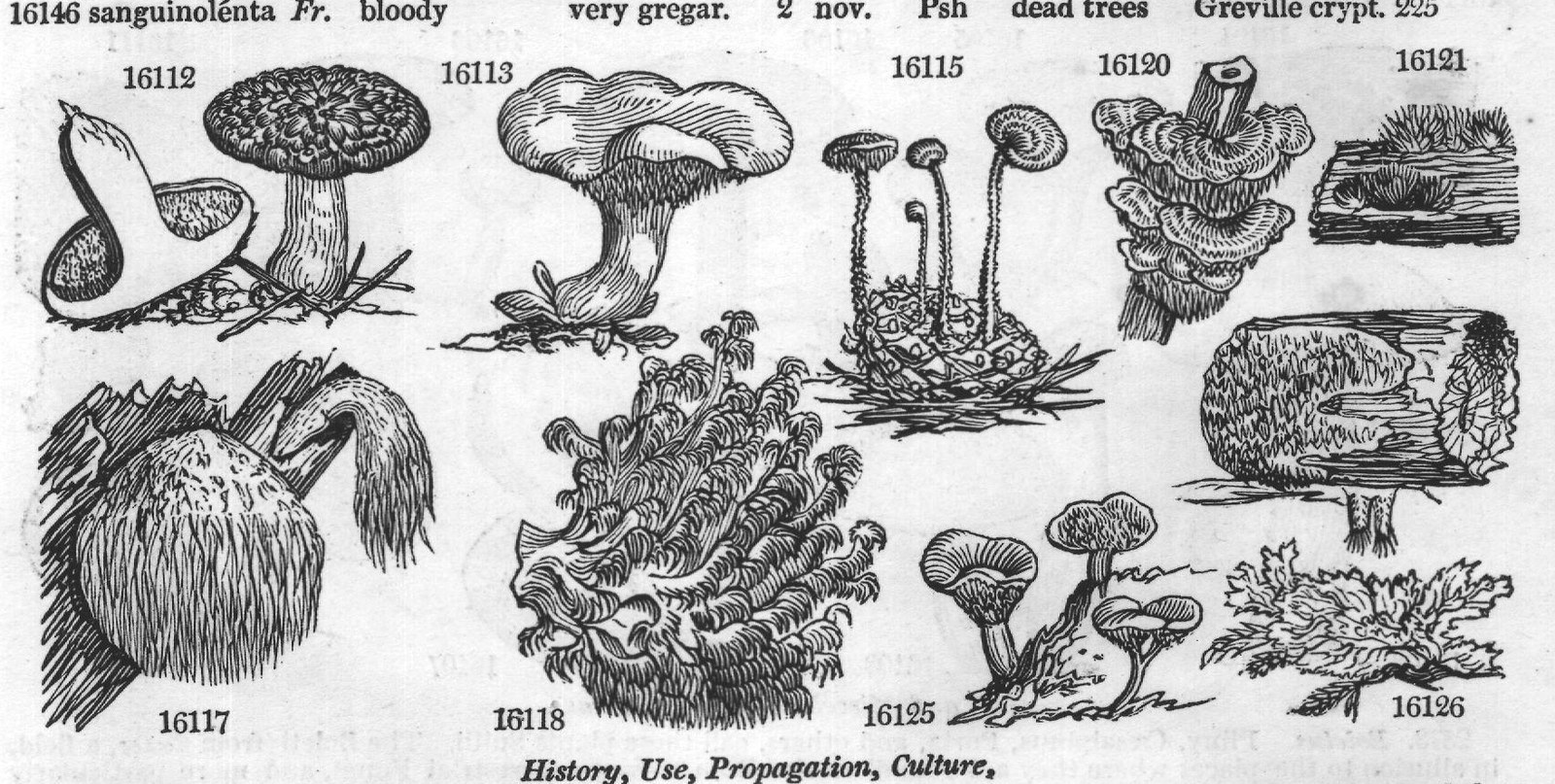
Psh dead trees Greville crypt. 225 16112 16113 16115 16120 16121 16117 16118 16125 16126 History, Use, Propagation, Culture, 2375. Hydnum. The Greeks had their ύδva and δiδva, tumours, which were analogous to the tubers of the Romans. H. coralloides is eatable; so is H. leoninum, a Swedish species. A very extensive genus of fungi, chiefly found in moist situations upon the trunks of trees. The pileus is furnished on its lower surface with numerous awl-shaped bodies, which Linnæus compares to the prickles of a hedgehog; they are soft, solid, , conical or cylindrical substances, emitting sporules from every part of their surface. 2376. Sistostrema. So named from σuviς ημi, part. σuvεςως, compounded, and τρημa, an orifice, in allusion to the regular rows of pores. Intermediate between the Agarics and Hydna. Gregarious, becoming concrete, fragile, scentless, white, becoming yellow in age. The pilei are thin, somewhat fragile, from half to one inch ORD. IX. TRIBE 1.
FUNGI HYMENOMYCETES. 1. Stem perpendicular, Cap distinct, round, nearly entire. GROWING ON THE GROUND. 16112 Cap fleshy flat tessellated scaly not banded umber-colored, Processes buffish-cinereous, Stipes short 16113 Cap fleshy smooth subrepand buffish, Subulate processes of hymenium unequal pale, Stipes unequal thick 16114 Cap fleshy orbicular somewhat tomentose brownish.. flesh-color, Processes nearly equal, Stipes thin equal 16115 Cap coriaceous tomentose, Stipes lateral tomentose 2. Stem simple, somewhat horizontal, Cap halved, or out of the centre. FLESHY. GROWING ON WOOD. 16116 Cap gelatinous papillose, Processes soft pyramidal glaucous, Stipes short lateral 16117 Very large heart-shaped white becoming rather yellow, Cap subsessile fibrous torn, Processes very long 3. Cap confounded with the stem, obliterated. FLESHY. GROWING ON WOOD. 16118 Much branched white becoming yellow, Branches entangled tapering, Processes unilateral subulate 4. Cap sessile, lateral. GROWING ON WOOD. 16119 Cap coriaceous lobed scaly plaited rufous brown projecting behind, Processes imbricated pale rufous 16120 Effuse-reflexed, Cap coriaceous thin banded ochre-colored, Processes minute numer. ochre-flesh-colored 16121 Coriaceous woody spherical orange-color, Processes short erect 5. Cap resupinate, effuse. GROWING ON WOOD. 16122 Effused thin glabrous tawny-ferruginous, Processes in the middle straight 16123 Effused downy pale-white, Processes rounded pubescent at the end bearded with orange 16124 Effus. white at length yellow. with a byssoid marg. Process of hymen. oblique subent. compr. vill. at apex 16125 The only species 16126 Effused soft sulphur-colored: the circumference expanded and byssoid, Plaits distant irregular 1. Cap entire, with a stem. TERRESTRIAL. 16127 Corky pale, Cap dep Cap depressed scaly beneath smooth somewhat pilose 16128 Somew. tuft. stipit. or sess. Cap irregul. rarely quite ent. striato-fibr. purplish-brown: marg. often laciniate 2. Cap lateral, somewhat stipitate. TERRESTRIAL. 16129 Irregularly tufted dark fuscous, Cap rather thick striato-fibrous sessile often imbricated sometimes with a very short lateral stipes 16130 Ferruginous brown, Caps fibrous scaly ragged and crisp at their edges 3. Cap and stem confounded, running into compressed branches. TERRESTRIAL. Merisma. Pers. 16131 Erect purple-brown, Branches compressed palmate folded paler at the summit ẞ Somewhat ferruginous, Branches glabrous obtusely ragged fastigiate 16132 Subdecumbent pale greyish or yellowish, Branches effused plane expanding fimbriato-laciniate 16133 Erect distinct stipitate reddish-grey, Cap with branches of nearly equal length, Stipes bulbous at base 4. Cap sessile, lateral. GROWING ON WOOD. 16134 Imbricated rigid somewhat zoned purplish reddish-brown glabrous, Hymenium papillose minutely velvety rubiginous paler at the margin 16135 Effuse-reflexed thin silky ferruginous margined downy beneath 16136 Somewhat imbricated bandless smooth on each side very smooth dull-brown 16137 Effuse-reflexed coriaceous strigose, Hymenium smooth yellowish or orange-buff 16138 Effuse-reflexed somewhat membranous striated pubescent beneath smooth and ochraceous 16139 Imbricated subcoriaceous zoned hirsute, Hymenium smooth purple 16140 Imbricated velvety zoned pale reddish-buff, Hymenium smooth irregularly papillose buffish at length ferruginous sometimes shooting out into rude stems anastomosing and producing irregularly caps 16141 Round. thick often conflu. Marg. waved splitting, Hymenium tuberculose yellow. or reddish-brown crack. 16142 Broadly effused thickish, The margin slightly reflexed, Hymenium ochraceous uneven unequally papillose 16143 Coriaceous broad thin, Margin free with the surface tomentose, Hymenium smooth minutely reticulated buff becoming darker in age 16144 Effus. very broad thin, Hymen. somew. of an ochrey pale-yell. smth. or with scatter. uneq. false papillæ 16145 Resupinate, Margin free whitish hirsute, rsute, Hymenium fuscous smooth somewhat shining and faintly zoned towards the margin cracking in a radiated manner 16146 Circular effused, Margin sometimes free rarely reflexed, Hymenium pale whitish-brown pruinose silky and minutely byssoid at the margin turning red when wounded 16130 16127 16131 16133 16135 16137 and Miscellaneous Particulars. 16136 16143 16138 16146 broad, somewhat depressed, flexuose, and apt to grow to one another. The only species is found in August and November by the side of sandy paths in pine-groves. 2377. Phlebia. So called, from φλεψ, a vein. As the last was intermediate between Agaricus and Hydnum, so is this between Cantharellus and Thelephora. As that differed from Dædalea, does this from Merulius. The species are all found upon bark, late in the year. No species was described before the writings of Fries. P. merismoides is an elegant little plant, distinguished by its reddish-flesh-colored hues. It is found occasionally spreading over wood and smooth bark; and sometimes runs with its papillose veiny branches among mosses. 2378. Thelephora. So called, from θηλη, a nipple, and φερω, to bear, in allusion to the papillose surface of 3T2 CRYPTOGAMIA.
CLASS XXIV. 16147 quercína Pers. oak brittle 6 spr.au. Blsh fallen oaks Greville crypt. 142 16148 fraxínea Pers. ash thin 1 aut. Grsh dead ashes 16149 Tíliæ Pers. lime irregular 2 aut.
Cin. woods 16150 epidérmea Pers. bark irregular 3 nov.
Pa. Bu dead trunks 16151 incrústans Pers. incrusting spreading 3 aut.
Ysh earth,tr., &c. 16152 cálcea Pers. chalky cracked 6 aut.
W decay. wood 16153 Sambúci Pers.
Elder Tree membranous 4 aut.
W decay. elders §2. PHYLACTERIA. Pers. 16154 biénnis Fr. biennial plaited 4 aut.
Wsh on ground Bulliard, t. 436 §3. HIMAN'TIA. Pers. 16155 doméstica Pers. household smooth 6 wet w. Br da. pla. in ho. 16156 fúsca Fr. brown rugose 2 aut.
Vi. Br 16157 láctea Fr. milk-white very thin 2 aut.
W trun. of trees trun, of trees Sow.t. 387.f.1. F. stellata H. cándida Pers. §4. LEIOSTRO'MA. Fr. 16158 cinérea Fr. cinereous uneven 4 spr. au. Cin. elder tree Sowerby, t. 388 Division II. Clavati. 2379. CLAVA'RIA. Vaill. CLAVARIA.
Sp. 23-66. 16159 Botrytis Pers. bunched much branch. 3 sum.
Wsh beech woods 16160 fláva Pers. yellow delicious 3 aug.
Y woods 16161 coralloídes L. coral-like very smooth 3 aut.
W on ground 16162 abietína Pers. pine-wood gregarious 3 aut.
Ochr. fir woods Sch.t.176 acroporphyria Schæffer, t. 175 Sowerby, t. 278. fig. sup.
Greville crypt. 117 16163 cristáta Pers. crested polymorph 2 aut.
W woods Greville crypt. 190 16164 cinérea Pers. cinereous tufted 3 sum.
Cin. damp places Greville crypt. fl. t. 64 16165 córnea Pers. corneous gregarious aut.
Y dead fir trees 16166 stricta Pers. erect thin 1 au. oc.
Brsh trunks Schæffer, t. 286. pallida 16167 pratensis Pers. meadow 16168 corniculáta Schæff. horned viscid 1 aut.
Y meadows solitary 3 aut.
Y meadows Bolton, t. 114. muscoides Sow. t. 157. muscoides 16169 rugósa Bull. rugose toughish 2 aut. W damp earth So.t.278. fig.inf. coralloi. 16178 hélvola Pers. 16170 pistilláris L. 16171 Ardénia Sowerby flexuose 16172 fusifórmis Sowerby fusiform 16173 ceranoídes Pers. wrinkled 16174 inæquális Fries unequal 16175 frágilis Pers. brittle C. gracilis Sowerby, 232 16176 acúta Sowerby acute 16177 fimbriáta With. fringed 16179 vermiculáris Fries worm-like pistillary largest 12 au. no. Ysh beech woods Sowerby, t. 277 opaque 6 sep. Brsh bran. of lime Sowerby, t. 215 regular tufts 3 sep.
Y among grass Sowerby, t. 234 much tufted 3 aut.
Ysh upon trees Sowerby. t. 235. rugosa gregarious 2 aut.
Y meadows Sow. t. 253. vermicularis gregarious 1 aut.
Ysh damp places Greville crypt. 37 gregarious 2 aut.
W upon trees Sowerby, t. 333 polymorph. 2 aut.
W upon trees pale-red flexuose 1½ aut.
Y meadows crowded tufts 3 aut.
W mea. & past. 16180 unciális Grev. dwarf very gregar. 1 aut.
W rotten twigs Greville crypt. 98 16181 sétipes Grev. bristle-footed gregarious aut. W dead leaves Greville crypt. fl. t. 49 2380. CALO CERA. Frics. CALOCERA.
Sp. 2-6. 16182 tuberósa Fries tuberous root roundish 2 aut.
Y 16183 córnea Fries horny tufted jl. dec. Y 2381. GEOGLOSSUM. Pers. EARTH-TONGUE.
Sp. 4-9.
Clavaria Sow. 16184 hirsútum Pers. 16147 hairy 16157 solitary 2 aut. Bl 16158 und.ba. of tr. Sowerby, t. 199 various trees Sowerby, t. 40 bogs & mea. Greville crypt. 185 16159 16154 16169 16170 16168 1616 16160 History, Use, Propagation, Culture, of the pileus of all the species. T. caryophyllæa is very common upon the exposed roots of old firs in the autumn. The substance is tough and somewhat woody; the color a chocolate brown. The plants often grow in masses, attached by their upper side to sticks, old bark, &c. and are from one to three inches in diameter. 2379. Clavaria. So called, from the simple clavate form of the species. Some are eatable; as for instance C. flava, which is said to be delicious; C. cinerea, which is frequently eaten in France; C. pyxidata is said by Persoon to be tolerably good. Loureiro has also an eatable species found in Cochin-China, growing upon elephant's dung. ORD. IX. TRIBE I.
FUNGI HYMENOMYCETES. 16147 Resupinate rigid nearly black beneath, Hymenium flesh-color rugose and papillose at length cracking 5. Cap obliterated, resupinate. GROWING ON WOOD. obliterated, resupinate. GROWING ON WOOD. 16148 Very thin effused cracking and becoming invol. very dark ben. Hymen. brown.-grey minutely farin. papill. 16149 Effus. extremely thin, Marg. appress. minutely vill. Hymen . purp.-grey cover. with small uneq. papillæ 16150 Effused thin smooth, Margin delicate and byssoid, Hymenium whitish at first at length very pale-buff, Papillæ scattered or none 16151 Effused spreading over moss, &c., Margin fibrous, Hymenium very unequal tuberculose yellowish 16152 Effused unequal in thickness hard, Hymenium white glabrous cracked in different directions so as to be often tessellated obtusely papillose 16153 Effused membranaceous thin, Margin entire, Hymenium very white glabrous subpapillose 16154 Membranous smooth plaited at base whitish becoming blackish 16155 Effused membranous smooth pale beneath white with cobweb-like down 16156 Effused somewhat rugose soft of a violet-brown: at the margin and beneath downy 16157 Mostly on dead leaves, Filaments very fine white radiating dilated at the extremities in a plumose manner 16158 Broadly effused thin dry smooth glabrous cinereous Division II. Clavati. * Much branched, Stem thick. 16159 Deformed, Stipes decumbent very thick pale, Branches short somewhat wrinkled red at ends 16160 More erect, Stem thick white, Branches straight round fastigiate yellow 16161 White erect, Stipes thick, Branches elongated irregular unequal mostly acute 16162 Dull ochrey-yellow much branched white and tomentose at the base turning green when bruised, Branches erect crowded slightly rugose with acute often forked summits 16163 White or ciner. tuft. branch. smooth, Branch. dilat. at summ, and jagged or shortly but acutely laciniate 16164 Grey often with a bluish or a purplish tinge much branched unequally incrassated rugose often subcompressed, Summits either very obtuse or somewhat acuminate 16165 Yellow half an inch high branched or nearly simple viscous, Stipes of several plants connected at the base ** Branched, Stem thin. 16166 Much branched pale brownish, Branches and branchlets straight appressed acute 16167 Yell. tuft. Stipes short producing numer, short geniculate divaricate branches: the ramuli subfastigi. obt. 16168 Yellow erect much branched in a dichotomous manner, Branches slender with acute summits 16169 White gregarious incrassated rugose simple or branched, Branches few short obtuse *** Simple, clavate. 16170 Solitary large glabrous yellowish-brown thickened upwards and obtuse 16171 Very long hollow thickened upwards brownish downy at base 16172 Heaped fascicled yellow, Branches nearly equal incurved yellow 16173 Fascicled unequal subdivided hollow yellowish-brown at end [irregular at the apex 16174 Yell. or yell.-white tuft. or gregarious fragile uneq. ventric. deformed somew. acum. often bifurcate and 16175 Yellow or white gregarious sometimes subcæspitose solid or hollow very brittle rather firm attenuated at the base subrugose in age and often crooked 16176 Straight white, Head distinct round acuminate as long as stipes 16177 Stem slender villous, Branches long compressed, Branchlets numerous setaceous cut 16178 Yellow gregarious cylind. equal smooth obt. slender below and paler, apex frequently of a cinnamon-color 16179 Pure white tuft. crowd. subul. flexuose solid but with a small perforat. mostly somew. connected at base 16180 White gregarious round club-shaped obtuse much attenuated at the base smooth not brittle 16181 White minute, Hymenium oblong or ovato-clavate passing suddenly into a filiform pilose stipes 16182 Tough yellowish nearly simple, Stem tuberous long-rooted 16183 Tufted smaller simple and branched viscid yellow connate at base 16184 Stipes hirsute deep-black, Hymenium somewhat plicate 16171 16175 16172 16181 16173 16176 16180 16182 16184 16183 and Miscellaneous Particulars. 2380. Calocera. From κaλoς, beautiful, and κερaς, a horn, in allusion to the divisions of the plants. They grow on wood, and are either brown or yellow; but their sporidia are generally white. C. viscosa is at once distinguishable by its beautiful gold color. Some of the species adhere to paper when dry. 2381. Geoglossum. From γη, the earth, and γλωσσa, a tongue; earth-tongue: in allusion to the simple form of species, which all grow upon earth, and are of a blackish or dark-green color. Fries considers the genus to be scarcely distinct from Clavaria. the species, which all grow upon earth, and are of a blackish or dark -green color. Fries considers the genus to be scarcely distinct from Clavaria. 3T3 16185 glábrum Pers. smooth gregario. 1 sum.
Bish 16186 viscósum Pers. viscid cylindric. 1½ aut.
Bl 16187 víride Pers. green gregario. 2 aut.
G among grass moist meadows moist meadows 16188 flávida Pers. 2382. SPATULA'RIA. Pers. SPATULARIA. 2383. MI'TRULA. Fries. MITRULA.
Sp. 1. yellowish variable 1½ aut.
Ysh Sp. 1-5. 16.89 paludósa Fries. marshy hollow 1 my.au. Y 16190 minúta Fries minute gregario. sum.
Y 16191 abíetis Fries fir-wood dry aut.
CRYPTOGAMIA.
Clavaria Sow. dead leaves Clavaria Sow. Leotia Pers.
CLASS XXIV.
Bolton, t. 111. fl. f. 2 Greville crypt. fl. t. 55 Greville crypt. 211 Greville crypt. 165 Sowerby, t. 293 wet ditches brac.of Dips. pilos.
Sow. t. 84. ferruginea Cinn, fir woods Sowerby, t. 391 16192 phacorhíza Fr. 16194 ténuis Fr. 16195 filiformis Fr. 16196 quisquiliáris Fr.
Leotia mitrula Grev. 81 2384. TY PHULA. Fries. TYPHULA. 16193 erýthropus Fr.
Sp. 4-11.
Clavaria Sow. tuberous flexuose 2 aut.
W woods Sowerby, t. 253 red-footed gregario. aut.
W sticks and leaves thin gregario.sum.
Blsh on wood Gre. cry.43. Phacorhiza Sowerby, t. 386. f. 5 filiform creeping aut.
Cin. dead leaves 2385. PISTILLA'RIA. Fries. PISTILLARIA.
Sp. 1-7. obtuse gregario. aut.
W Clavaria Sow.
Gre. cry.93. Phacorhiza dead fern leaves Sow. t. 334. f. 1. obtusa Class II. UTERINI v. ELVELLACEE. - Division I. Mitrati. 2386. MORCHEL/LA. Dill. MOREL. 16197 esculénta Pers.
B vulgáris Pers. esculent eatable 2387. HELVEL/LA. L. HELVELLA.
Sp. 3-14. 3 spring Wsh 3 spring Wsh 3 spring Wsh 3 spring Ysh Greville crypt. 68 Sow. t. 51. fig. sinistr.
Sower. t. 51. fig. dextr.
Sower. t. 51. fig. med.
Grev. crypt. 89. hybrida Gre. cry. 143. leucophæa Grev.crypt.fl.t.36. Mitra Schæffer, t. 160 a rotúnda Pers. round common 16198 pátula Pers. spreading eatable on the earth on the earth on the earth on the earth 16199 semilíbera Dec. half-separate cap brown 4 spring Wsh woods Sp. 5-15. 16200 críspa Fr. crisp solitary 4 aut.
Ysh borders of fields 16201 lacunósa Afz. pitted solitary 4 aut.
Livid hedge banks 16202 esculénta Pers. esculent eatable 3 mr. my Brsh pine woods 16203 In'fula Schaff: brown eatable 4 aut. 16204 elástica Fr. elastic slender 4 su. aut. Blsh damp places Sower. t. 154. fuliginosa 2388. VER'PA. Swz.
VERPA. 16205 cónica Swz. conical fistular 3 aut.
Sp. 1-6.
Br on ground Sowerby, t. 11. Relhani 16186 16187 16189 16190 16191 16192 16194 Cinn. damp scorch. places Flora danica, t. 835 16188 Valll 16196 16195 16193 History, Use, Propagation, Culture, 2382. Spatularia. A very distinct genus, named from its spatulate form. The only species known is an autumnal epiphyte, common on fallen leaves, decaying mosses, &c. Its color is at first pallid; afterwards various it , &c. Its color is at first pallid; afterwards it becomes yellow and ferruginous : but the stipes retains its paler color. It is found in plantations in various parts of England. In a state of perfect maturity, the head, on being touched, throws up its sporules in the form of smoke, which rises with elastic force, and glitters in the sunshine like particles of silver. 2383. Mitrula. So called from its mitrate form. The species are small epiphytes with a simple stem. 2384. Typhula. A diminution of Typha, a well-known marsh plant, the heads of fructification of which this genus resembles in miniature. All the species are delicate, and are found upon decayed leaves, or even occasionally upon Sclerotias. 2385. Pistillaria. So called from its pistil-like form. The species are all small, delicate epiphytes, appearing in the autumn. 2386. Morchella. A name altered by Dillenius from Morchel, the German name of the plant. Fungi of a large size, appearing in the spring upon the earth. The eatable morel is one of the most valuable of fungi for purposes of cookery; but is more frequently used in a dried state for sauces, than when fresh. It is found in greatest abundance in places where trees have been burned, which led in Germany to a practice of burning down masses of forests for the sake of the future morels. This practice proved so injurious, that it became down suppress it by law. The morel is subject to many variations of figure and color, which are all referable to four principal forms. But there are also some legitimate species which have been distinguished by modern botanists. Of these it is not ascertained which are natives of England; but it is probable, that they are all to be found if sufficiently sought for. Without , therefore, absolutely inserting them in the list of British species, it cannot be otherwise than useful, considering the importance of an accurate knowledge of the eatable fungi, to enumerate the two principal in this place. 1. M. Deliciosa is found in the spring, among grass and bushes by the sides of fields in France, and is said to be much superior in flavor to the M. esculenta. Its stipes is hollow, and shorter than the pileus, scarcely ever so much as an inch long, about three or four lines thick, nearly equal in the whole length, but sometimes thickened and compressed at the base; under a lens covered with a slight downiness. Pileus is conical-cylindrical, from one inch to two inches and an half long, with nearly parallel ribs, which can scarcely be to long, with nearly parallel ribs, which can scarcely be said to ORD. IX. TRIBE I.
FUNGI HYMENOMYCETES. 16185 Glabrous dry blackish, Stipes somewhat scaly [thin and attenuated downwards 16186 Smooth very slimy in moist weather black, Hymen. cylind. round. at apex confluent with stipes which is 16187 Green somewhat fasciculate, Hymenium distinct, Stipes minutely scaly 16188 The only species 16189 Yellow subgregarious, Cap orange-yellow obtuse hollow: margin connate with the stipes 16190 Very small, Head lanceolate yellow, Stipes equal paler 16191 Gregarious solid, Hymenium ovate yellow cinnamon, Stipes slender dark-brown flexuose at the pase 16192 White filiform elongated somewhat villose at the base radicular tuber dark fuscous lenticular 16193 Gregarious min. Hymenium smooth white short terminat. in an elongated filiform dark pink-red stipes 16184 Simple smooth dark thickened at end 16195 Somewhat branched spadiceous, Heads thickened whitish 16196 Thickened towards the extremity white confluent with the stipes Class II. UTERINI v. ELVELLACEÆ. - Division I. Mitrati. 16197 Cap round, or oval: marg. contract, round the stipes, Areolæ much hollow. Stipes white dilat. tow. base a Cap and areolæ round Cap oval, Areolæ quadrangular [thick white 16198 Cap obtuse separate as far as the middle, Areolæ rhomboid, Stipes smooth 16199 Cap short conic. spread. at base, Areolæ shall. partly formed by longitudin. parallel ribs, Stipes long equal * Cap waxy, membranous, at first united, afterwards wavy in plaits. 16200 Cap irregularly deflexed free often variously lobed yellow.-white, Stipes deeply sulcate and lacunose white 16201 Cap dark-livid inflated deflex. and partially adnate with stipes, Stipes deeply furrow. and lacunose white 16202 Cap inflated deformed wavy wrinkled in circles brown, Margin villous adhering to the smooth stipes 16203 Cap deflexed lobed adnate about cinnamon-colored, Stipes smoothish villous pale ** Cap somewhat membranous, smooth, always separate. 16204 Cap loose smooth inflated becoming sharply lobed, Stipes long thin tapering pruinose 16205 Cap campanulate smoothish fuscous somewhat sinuated at the edge: beneath and the stipes yellow 16205 16197 16198 16204 16199 16203 16200 16201 16202 and Miscellaneous Particulars. anastomose, but which are united by transverse rugosities. The color is usually yellowish, rarely of a pale livid hue. 2. M. elata has a longer stipes than the last, an inch and more thick, very hollow and brittle, with irregular cavities. The pileus is ovate-conical, two or three inches long, but of a far more delicate texture than any of the others. The longitudinal ribs are much elevated, membranous, flaccid, with very few anastomoses, but united by transverse costæ, which give the spaces between a sort of misshapen rhomboidal figure. The color is a soft brown. The flavor is watery and vapid, and in decay becomes so fetid as to be unfit for food. This is found in pine-woods, erpecially in humid places. It is a rarer kind than the last and like it, appears in the spring.
M. patula and semilibera are readily known from the true morels by their pileus not being attached to the stipes by the base, but altogether separate from it. They are distinguished from each other by the latter having a much longer stipes, and a shorter pileus, which is more conical and acute. M. patula is considered by Fries to have been confounded, in Mr. Sowerby's fine work on Fungi, with Helvella esculenta. 2387. Helvella. A name employed by Cicero, as the name of a fungus. The species of the modern genus are permanent, somewhat fragile fungi, ngi, with little odor or taste, but always innocuous. They grow on the earth or upon very wet wood, and are chiefly found in the autumn. H. crispa is excellent as an article of cookery. H. lacunosa, which is confounded with it, is by no means so good. H. esculenta has a good flavor, and is commonly eaten, but is far inferior to Morchella esculenta. Its qualities are nearly the same as those of the latter plant, and it is popularly confounded with it under the name, in Sweden, of Stenmurkla, and in Germany, of Gemeine Morchel, Stumpf Morchel, and Stockmorchel. H. infula, a large species, with an inflated smooth pileus of various hues of brown, is also esculent. This last plant is the true H. Mitra of Ruppius, and old botanists; a name which, having been applied by one writer or other to every species of Helvella, is now abandoned altogether in order to avoid further confusion. 2388. Verpa. An old Roman name synonymous with Phallus, and restored to modern science by Swartz. The species are meteoric, terrestrial, and intermediate between the Morels and Leotia. The hymenium is covered, as is the case with many Mitrati, with a frost-like flocculence, which Swartz mistook for sporules, but which more recent observation has shewn to have been a mistake. 3T4 CRYPTOGAMIA. 16207 nána With. 16208 lúbrica Pers. 1½ aut. 16219 mácropus Pers. 16220 tuberósa Bull. tuberous slender 16221 cupuláris L. cupped fringed 16222 argillácea Sowerby argillaceous scattered 16223 granuláta Bull. granular gregario. sum. Or.R 16224 reticuláta Grev. netted very fine 4 spring Br 16225 erécta Sowerby erect patches 16226 humósa Fries earth scattered aut. 2389. LEO'TIA. Hill. LEOTIA. 16206 infundibuliformis Fr.funnel-form. solitary 3 oct.
Sp. 3-11.
Cin. dwarf subsessile aut.
W slippery gregario. 2 aut.
Oi Division II. Cupulati. 2390. PEZI'ZA. Dill.
PEZIZA. § 1. ALEU'RIA. Fries. 16209 acetábulum L. saucer 16210 bádia Pers. brown 16211 leporína Batsch Sp. 45-300. clustered 16212 onótica Pers. 16213 aurántia Fl. dan. 16214 concínna Pers. 16215 cochleáta Huds. 16216 cérea Sowerby 16217 vesiculósa Bull. 16218 repánda Fr. hare's-ear rosy orange neat cochleate waxen bladdery repand spring Sooty damp woods tufted 1 su. aut. Br gregario. 1 aug.oc. Brsh gregario. 1 aug.oc. Brsh beautiful very broad 1 aut. Or grassy places on ground dead leaves sandy places dead leaves fields Sooty dunghills Wsh dunghills sum. Lem. brittle 2 su. aut. Y.Br gregario. sum. crowded 2 aut. fleshy large-footed solitary Wsh on ground shady woods shady woods Pa. Br scorched earth aut. Ysh shady woods Crim. damp earth Sowerby, t. 59 Bolton, t. 99. cochleata Schæffer, t. 156 Sowerby, t. 79. leporina Sowerby, t. 78, coccinea Bolton, t. 175. vesiculosa Sowerby, t. 5 Sowerby, t. 3 Greville crypt. 107 Greville crypt. fl. 59 Bolton, t. 96. hispida Sowerby, t. 63 Bull. t. 396. f. 3 Sowerby, t. 148 Bull. t. 438. f. 3 Greville crypt. 156 Sowerby, t. 369. f. 10 Sowerby, t. 369. f. 2 on ground on trees moist woods CLASS XXIV.
Sowerby, t. 153 Greville crypt. 56 2 su.aut. Cin. 2 mr. ap. Br aut. aut. Ysh clay cow dung on ground 16227 fis'sa Fries. split solitary wint. Br hazel bark §2. LACH'NEA. Fries. 16228 coccínea Scop. scarlet subgrega. spring W P. epidendra Sow. 16229 melastoma Sower. blk.-mouth. solitary 16230 radiculáta Sower. rooting clustered 16231 hemisphærica Wig. hemispheric. scattered 0 16232 hírta Schum. hairy scattered 2 16233 cerína Pers. smooth much crowd. su. aut. Sul. jn. dec. Brsh aug.oc. Brsh spr.au. Ysh 16234 scutelláta L. scutellate beautiful spr.au. Or 16235 Nídulus Pers. bird's-nest punctif. 0 aut. Br 16236 cærúlea Bolton blue punctif. aut. Bsh 16237plano-umbilicata Gr.plano-convex hairy 16238 stercórea Pers. dung 16239 albo-spadícea Grev. pallid gregario. handsome 16240 sulphúrea Pers. sulphur pretty 0 aut. 0 su. aut. W spr. su. Taw. aut. R.Br Y 16241 virgínea Batsch virgin solitary aut.
W 16242 bícolor Bull." 16243 variécolor Fries. 16244 papilláris Bull. 16245 villósa Fries villous 16246 plúmbea Grev. leaden 16247 anómala Pers. anomalous 16248 doméstica Sowerby domestic 16249 Waúchii Grev. woolly 16250 fúsca Grev. brown spots 0 ap.my. Gr 16206 16208 feb.mr. Pa. Br two-colored beautiful aut. W variable pimpled gregario. 0 all sea. Ysh gregario. O all sea. W crowded 0 aut. W dead branches heaths earth in gardens earth in woods earth decayed dry wood old cow dung Greville crypt. 171 Sowerby, t. 149 Sowerby, t. 114 Sowerby, t. 147. hispida Sow. t. 369. f. 1. hybrida Sowerby, t. 24 Bolton, t. 108. f.
Sowerby, t. 352. equina Greville crypt. fl. 83 Sowerby, t. 65. nivea Sowerby, t. 17 Sower. t. 178. hydnoidea Sowerby, t. 177 dead herbac. stems Sower. t. 389. f.1. sessilis crowded 0 aut. Fu. ol, rotten wood crowded all sea. DI.Y minute 0 all sea. Ruf. beautiful aut. Pa. Br 16217 dead branches Greville crypt. fl. 11 Sower. t. 369. f.3. rugosa Sowerby, t. 351 Greville crypt. 139 Greville crypt. 192 16220 decayed stems pine trees decayed nettles cow dung bare earth decay.herbac.stems rotten sticks larch twigs rotten wood upon wood fallen branches damp walls dead wood 16216 5 १९ History, Use, Propagation, Culture, 16223 2389. Leotia. Named by Sir John Hill, of famous memory, for no known reason. Gregarious terrestrial substances of the middle size, appearing in summer or autumn, without smell or taste. They are most nearly akin to Helvella and Verpa, from which they differ in form and substance. The species are not known to be eatable, with the exception of L. amara, a native of Cochin-China, which is capable of being deprived of its native bitterness by long stewing.
ORD. IX. TRIBE I.
FUNGI HYMENOMYCETES. 16206 Cap depressed cinereous livid smooth on each side, Stipes solid smooth 16207 Dwarfs, Cap rugose white beneath smooth brown, Stipes solid cylindrical white 16208 Tremellose, Cap tumid spread. olivac.: margin rounded, Stipes orange-cylindr. or unequally compressed Division II. Cupulati. 1. Cupule always open, or when young conniving, Veil superficial, Sporidia with two smaller sporidia. HELVELLOIDEE. 16209 Cyathiform sooty veiny on the outside arising from a short fistulous pitted stipes ear-s 16210 Subsess. ent. flexuose brown, Margin at first involute externally pruinose paler and somew. olive-colored 16211 Substipitate lengthened on one side ear-shaped somew. ferrugin. mealy outside smooth inside at the base 16212 Substipitate lengthened on one side ear-shaped farinaceous outside pink inside becoming rugose at base 16213 Gregarious fiexuose very brittle white externally, Hymenium fine orange 16214 Cæspitose large very brittle externally lemon-colored becoming wrinkled pale flesh-color inside 16215 Gregarious cæspitose variously contorted externally yellowish-brown, Hymenium dull reddish-brown 16216 Large funnel-shaped repand yellowish villous and whitish outside and upon the stipes-like base 16217 Gregar. cæspit. glob. at first with mouth conniv. at length campan, splitt. externally whit. and toment. at 16218 Sessile solitary or somewhat tufted large at first hemispherical and concave at length nearly plane sub- [base rugose and brown within the outer surface farinose whitish, Margin crenate 2. Cupule at first closed, Veil innate, Sporidia simple. GEOPYXIS. 16219 Subgregarious large: the pileus hemispherical slightly hairy and verrucose ash-colored; the hymenium mouse-colored at length pale, Stipes very long incrassated below 16220 Thin, Cupule funnel-shaped brownish pallid, Stipes long seated on a black deformed root 16221 Subsessile thin globose campanulate brownish or pale mealy outside crenate at edge 16222 Sessile yellowish smooth at first urceolate afterwards cracked and torn with hairs about the root outside 16223 Sessile minute flattish orange-red externally granulated with pimples [Stipes usually short and thick 16224 Centre plicate and reticulat. without whit, and pruin. Cap invol. at margin variously split somew. spread. 3. Cupule a little fleshy, small, Veil floccose only at the edge, or fugacious, Sporidia with a solitary little sporidium. HUMARIA. 16225 Sessile clustered subcylindrical smooth somewhat yellow becoming dilated with an erect subciliated orifice 16226 Sessile fleshy plano-convex smooth crimson entire at margin 4. Membranaceous, bursting forth with a separating veil, Sporidia simple. ENCÆLIA. 16227 Subcæspitate sessile coriac. membran. Margin split ragged externally scurfy and brown, internally white 1. Cupule fleshy, or fleshy-membranous. Crust none. SARCOSCYPHE. 16228 Stipitate large subinfundibuliform externally white and tomentose, Hymenium crimson-red 16229 Cupule fleshy, Disk urceolate black externally rubiginous-flocculent, Stipes short down dense dark strigose 16230 Subcæspit. fleshy sess. from hemispher. becom. flatten. Disk sulph. external. and thick root white and vill. 16231 Sessile hemispherical wavy brownish externally covered by dense fascicled hairs, Disk glaucous white 16232 Sessile subhemispher. externally fuscous hairy with a somewhat inflexed margin, Vermilion colored inside 16233 Min. sess. or subsessile hemispher. externally tomentose-pulverulent yellowish-olive, Hymen. dull ochrac. 16234 Sessile gregarious or scattered nearly plane: external surface of the margin hispid with black rigid hairs, Hymenium orange-red 16235 Sessile gregarious very minute orbicular somewhat depressed substrigose brown or nearly black 16236 Plane ciliated blackish externally, Hairs pale, Disk blue [at margin, Hymenium gently umbonate 16237 Small sess. gregar. whole plant white glob. concave at length quite plane ciliate with horizont. white hairs 16238 Gregarious concave tawny externally surrounded near the edge with straightish brown hairs [white 16239 Sess. gregar. glob. at length quite plane, exter. surface and marg. strig. with redd.-brown hairs, Hymen. 16240 Sessile gregarious small globose at length plane: the strigose external surface yellow, Hymenium white 2. Cupule waxy, dry, villous, Crust none. Epiphytes. DASYSCYPHE. 16241 Stipitate gregarious small, Stipes rather long, Pileus hemispherical subpatulose villous, whole plant white 16242 Subsess. small gregar , externally very white vill. Mouth contract. Hymen. varying from dil. yell. to orange 16243 Sessile hemispherical orbicular rather firm flocculent, Disk urceolate whitish 16244 Sessile distinct concave villous hairy milk-white on each side granulated at edge 16245 Sessile very minute gregarious white subglobose villous, Mouth more or less connivent 16246 Sessile minute gregarious depressed externally fusco-olivaceous villose, Hymenium smooth bluish-grey 3. Cupule waxy or coriaceous, seated on a downy crust. TAPESIA. 16247 Substipitate much crowded form. a crust, Cupules turbinate vill. light bistre-colored: disk urceol. whitish 16248 Sessile gregarious obovate strigose rufous 16249 Sessile gregarious ovate globose golden-yellow strigose with a subjacent woolly paler web 16250 Carn. sess. Cup. concave brown at length plane grey: marg. glab. attach. by fibres to a wide toment, web 16226 1000000000 16228 16229 16242 வீச 16243 and Miscellaneous Particulars. 2390. Pexiza. Pliny had a tribe of Fungi which he called Pezica, from which the modern name has been corrupted. The present genus is very extensive, but almost wholly of modern creation. The species are found . The present genus is very extensive, but almost wholly of modern creation. The species are found in various situations, but chiefly on decayed wood. They are remarkable for their leathery texture, and for emitting their sporules in the form of smoke from the bottom of their cup.
CRYPTOGAMIA. 3. PHIA LEA. Pers. 16251 fir Pers. firm gregario. 1 aut.
Oc. Br rotten sticks 16252 Persoónii Moug.
Persoon's 16253 fructigéna Bull. fruit 16254 serotína Pers. late clustered 16255 infléxa Bolton infiexed aggreg. clustered aut. gregario. aut. Wsh aut. R Ysh spring Y bogs on Equisetum nuts, &c. in woods damp shady places rotten sticks 16256 pedicelláta Sow. stalked solitary Wsh rotten sticks 16257 túba Bolt. tubular gregario. aut.
Y fallen branches 16258 calýculus Sow. cupped gregario.aut.
Or.Br rotten wood 16259 æruginósa Fl. dan. verdigrease destruct. 0 su.aut. Bt. G damp wood Uggleved Swed. 16260 Aspegrénii Fr.
Aspegren's gregario. aut. Ysh damp wood 16261 citrína Batsch lemon-color. crowded aut.
Y fallen branches cyathoides Wither. 16262 palléscens Pers. pallid numer. three-color. scattered 0 aut.
Pa. Y old trees bell delicate aut.
W porous curious 1 aut.
Bl bright-yell. punctif. 0 aut.
Y dotted punctif.
Herb 0 aut.
Y crowded aut.
W Sooty trunks of trees dead twigs sandy places decayed wood dead leaves dead herbac. stems CLASS XXIV.
Sower. t.115. ochroleuca Greville crypt. 162 Sowerby, t. 117 Bolton, t. 98 Sowerby, t. 306 Sowerby, t. 369. f. 4 Bolton, t. 106. f. 1 Sowerby, t. 116 Sowerby, t. 347 Sower. t. 369. f.7. bicolor Sowerby, t. 150. aurea Sowerby, t. 151. citrina Sowerby, t. 369. f. 6 Nees syst. t. 38. f. 295 Greville crypt. fl. 63 L pine-cone gregario. 0 au. sp.
W pine cones Fu. Or posts & rails cinereous Sowerby, t. 152 Sowerby, t. 64 common patches 0 wint.
Wsh dry bark transparent scattered 0 wint.
Sycam.-peti. scattered 0 aut.
Tran.
Cæs.
Sowerby, t. 389. f. 7 16274 ochrácea Grev. 16275 atrovirens Pers. 16276 Abbottiána Sow.
Pers.
Oc. Br fallen trunks scattered 0 aut.
G rotten wood Sea G wood 1-434 aut. 16263 trícolor Sow. 16264 campánula Nees 16265 cribrósa Grev. 16266 clarofláva Grev. 16267 punctáta Grev. 16268 herbárum Pers. 16269 conigéna Pers. 16270 chrysócoma Bull. 16271 cinérea Batsch 16272 vulgáris Fries albella With.
ẞ diaphana Sowerby 16273 erúmpens Grev. §4. HELO'TIUM. yellow-hair. crowded 0 aut. ochrey puckered 0 aut. dark-green crowded 0 aut.
Abbott's 16277 fibulifórmis Fries button-shap. 16278 aciculáris Pers. needle-like gregario. 2391. AS COBOLUS. Pers. ASCOBOLUS.
Y au.dec. W rotten wood stalks of Sycamore Greville crypt. 99 trunks of elms hollow oaks Sp. 1-11. 16279 furfuráceus Pers. scurfy gregario. O all sea. Brsh old cow dung 2392. BULGARIA. Fries. BULGARIA. 16280 in quinans Fries dirty 16281 sarcoídes Fries fleshy 2393. DITIOLA. Fries. DITIOLA. 16282 radicáta Fr. gelatino. 0 au. wi. polymor.
Umb Sp. 2-6. 0 au. wi. Umb. dead oaks Pu.R decaying trees aut.
Sp. 1-5. rooting gregario. ap. jn. Gold. barked pines 2394. CENAN'GIUM. Fr. CENANGIUM. 16283 quercínum Fr. oak Sphœ'ria collapsa Sow. 16284 Prunástri Fr. 16285 Cérasi Fr. 16286 Aucupáriæ Fr. 16287 ferruginósum Fr. 2395. STIC'TIS. Pers. 16288 radiáta Pers. 16251 Sp. 5-30.
Greville crypt. 5 Sowerby, t. 389. f. 8 Bolton, t. 176 Sow. t.57. agariciformis Sowerby, t. 428 Bolton, t. 101. f. 2 Fl. dan. t. 1378. f. 2 dead oak branches Sowerby, t. 373. f. 3 dead plum branches dead cherry branches dead mountain-ash branches Scotch fir branches Greville crypt. 197 gregario. all sea. Cin.
Plum crowded 0 aut. Bl Cherry crowded 0 all sea. R.BI Mount. Ash tufted ferruginous patches 0 aut. BI 0 aut. R.Bl Sp. 1-23. spots bark of trees Sowerby t. 16 16264 16273 STICTIS. radiating 0 au. spr. W 16253 16259 16267 16270 History, Use, Propagation, Culture, 16271 2391. Ascobolus. From ascus, one of the forms of theca in which the sporules are retained among Fungi, and βaλλω, to emit, in allusion to the principal peculiarity of the genus. Small gregarious soft plants, without roots, but not very perishable, growing upon dung, and most obvious during rainy weather. 2392. Bulgaria. An intermediate genus between Peziza and Exidia, named from bulga, a leather bag, on account of the saccate form of the species. Scentless, insipid, mucilaginous, rootless, soft fungi, tolerably permanent, and generally breaking forth in clusters from the bark of trees during the winter and autumn. Miller is said to have succeeded in obtaining glue from B. inquinans, but subsequent attempts have failed of success. 2393. Ditiola. From δiς, double, and ioλoς, down, in allusion to the nature of the pubescence of the velum. The species of this genus are gregarious, firm, permanent, without smell, flourishing upon dry wood from the ORD. IX. TRIBE I.
FUNGI HYMENOMYCETES. 1. Cupule somewhat membranous, distinctly stalked, Hymenium distinct. HYMENOSCYPHE. 16251 Rather large ochrey-brown infundibulif. at length concavo-rep. or very plane, Stipes elongat. dark at base 16252 Cap smooth urceolate orange-color with a prominent membranous pale margin, Stipes cylindrical pink 16253 Gregar. yell. or redd.-white subinfundibulif.: surface of hymen. plane, Stipes long subflexu. and attenuat. 16254 Bright-yellow, Cupule plano-convex thinnish, Stipes short firm thickish 16255 Stipit. glab. white or yellow. subinfundibulif. Margin fringed with inflexed teeth, Stipes elongated curved 16256 Stipitate campanulate, Margin smooth, Stipes straight 2. Cupule flcshy, waxy, firm, obconical, somewhat stalked, Hymenium distinct. CALYCINE. 16257 Yellow, Cupule turbinate: disk flat; margin tumid, Stipes long slender [orange-brown 16258 Gregarious globoso-infundibulif. slightly concave, Stipes rather short attenuat. whole plant ferrugin. or 16259 Æruginose, Cupule turbinate becoming expanded and flexuose: disk whitish, Stipes short 16260 Cupule subrepand smooth: disk yellow exteriorly white as well as the somewhat ascending stipes 16261 Yell. crowd. apparently sess. but having a short thick obconical stipes carnose, Hymenium plano-concave 16262 Crowded smooth pale-yellow or whitish, Cupule concave, Stipes short thickish pallid 16263 Hemispherical margined, Disk yellowish externally sooty, Stipes very short whitish 16264 Gregarious white rather small very membranaceous campanulate unequal, Stipes filiform short 16265 Black solitary rather large very concave, Hymen. cribriform or full of lacerat. irregular pores or sinuses 16266 Yellow gregarious minute obconical at length somew. plane, Margin raised obt. externally somew, paler 16267 Yellow very minute gregarious punctiform globular at length plane or subconvex, Margin minutely cren. 16268 White gregar. carnose at length convex but sometimes depress. in centre turning reddish in age and decay 3. Cupule waxy, soft, watery, sessile or obconical, Hymenium confluent. MOLLISIA. 16269 White gregarious excessively minute orbicular subimmarginate 16270 Fulvous orange gregarious crowded minute nearly plane subtremella-like 16271 Grey gregarious depressed waved subtremellose, Margin obsolete 16272 Sessile somewhat tufted membranous soft smooth whole-colored all over and whitish ẞ Scattered flattish-urceolate whitish transparent [in wet weather 16273 Minute ceraceous glab. sess. grey connate within the semiputrid petioles of the Sycamore and burst. forth 4. Cupule waxy, dry, sessile, flat at base or innate edged. PATELLEA. 16274 Ochrey-brown min. gregar. carnose thick obconic. Hymen. minutely granul. at length plane or subconvex 16275 Green gregarious minute subtremellose hemispherical at length plane becoming black in decay 16276 Sessile dry patellate cæsious on the outside, Disk yellow 16277 Firm, Head convex yellow black-brown beneath, as is the short thick villous stipes 16278 White smooth, Head convex, Stipes long equal 16279 Sessile gregarious somewhat concave olive-green or brownish externally furfuraceous 16280 Turbinate firm, externally rugulose scaly umber-colored, Disk flattish blackish 16281 Polymorphous cæspitose subgelatinous somew. firm purplish-red externally subvenose, Hymen. concave 16282 Disk flattish golden-yellow, Stipes thick villous white long-rooted 16283 Simp. gregar. long flexu. at first closed pruin. and blackish-cinereous, afterw. open with a broad pale disk 16284 Substipitate opake rigid black marginate, Hymenium concave 16285 Coriaceous reddish-black at first closed at length expanded and plane 16286 In round. tufts, Caps stipit. subturbin. concave with round. marg. intermix. with digit. or subul. processes 16287 Gregarious between membrane and leathery subsessile rugose somewhat pruinose, The orifice compressed inflexed: when moist spreading 16288 Immersed orbicular, Limb snow-white ragged pulverulent 16280 16274 16276 16281 16277 16282 16278 16279 16283 16288 16287 and Miscellaneous Particulars. autumn until the spring. They are to be considered noxious fungi from the injury they bring to the timber upon which they vegetate. Their mucilaginous roots insinuate themselves between the fibres of the wood, and separate and soften them. Their tubercles burst forth, and filling the wood with clefts, and rendering its interior accessible to wet, soon destroy it. D. radicata is one of the species of dry rot. 2394. Cenangium. From κεvoς, hollow, and uγγiov, a capsule or vessel, in allusion to the hollow nature of the receptacle. Chiefly distinguished from Peziza by substance, and the coriaceous nature of the cupules. receptacle.
Chiefly distinguished from Peziza by substance, and the coriaceous nature of the cupules. From Tympanis it is distinguished by its closed cupules and smooth permanent hymenium. The species are small and deformed, growing upon the bark of trees, either singly or in tufts, and mostly produced in winter. 2395. Stictis. So named from the punctiform appearance of many of the species, from 5iztos, a dot. Very simple, minute, gregarious fungi. clustered CRYPTOGAMIA. 2396. CRYPTOMYCES. Grev. CRYPTOMYCES. 16289 Waúchii Grev.
Willow firm 2397. TREMELLA. L. TREMELLA. 16290 mesentérica Rtz. 16291 al bida Huds. 16292 intuméscens E. B.
Sp. 1. 0 su. aut. Br Class III. TREMELLINI.
Mesent.-like subsolit. 2 whitish clustered 1 tumid twisted lobes 2 16293 clavariæfórmis Pers. Clavar.-like gregarious 1 §1. CO'RYNE. Nees. 16294 sarcoídes Fries fleshy §2. PHYLLOP'TA. Fries. 16295 biparasítica Fries parasitical deformed sept. BI CLASS XXIV. willow branches Greville crypt. 206 Eng. bot. t. 2450 Sp. 4-18. aut. sp. Y aut. Wsh wet w. Br su. aut. Dl. Or fallen branches Eng. bot. t. 709 fallen branches trunks of trees Eng. bot. t. 2117 Eng. bot. t. 1870 juniper stems Jacq. ic. t. 648 aut. Pu rotten wood dead Agaric 2398. EXI DIA. Fries. EXIDIA.
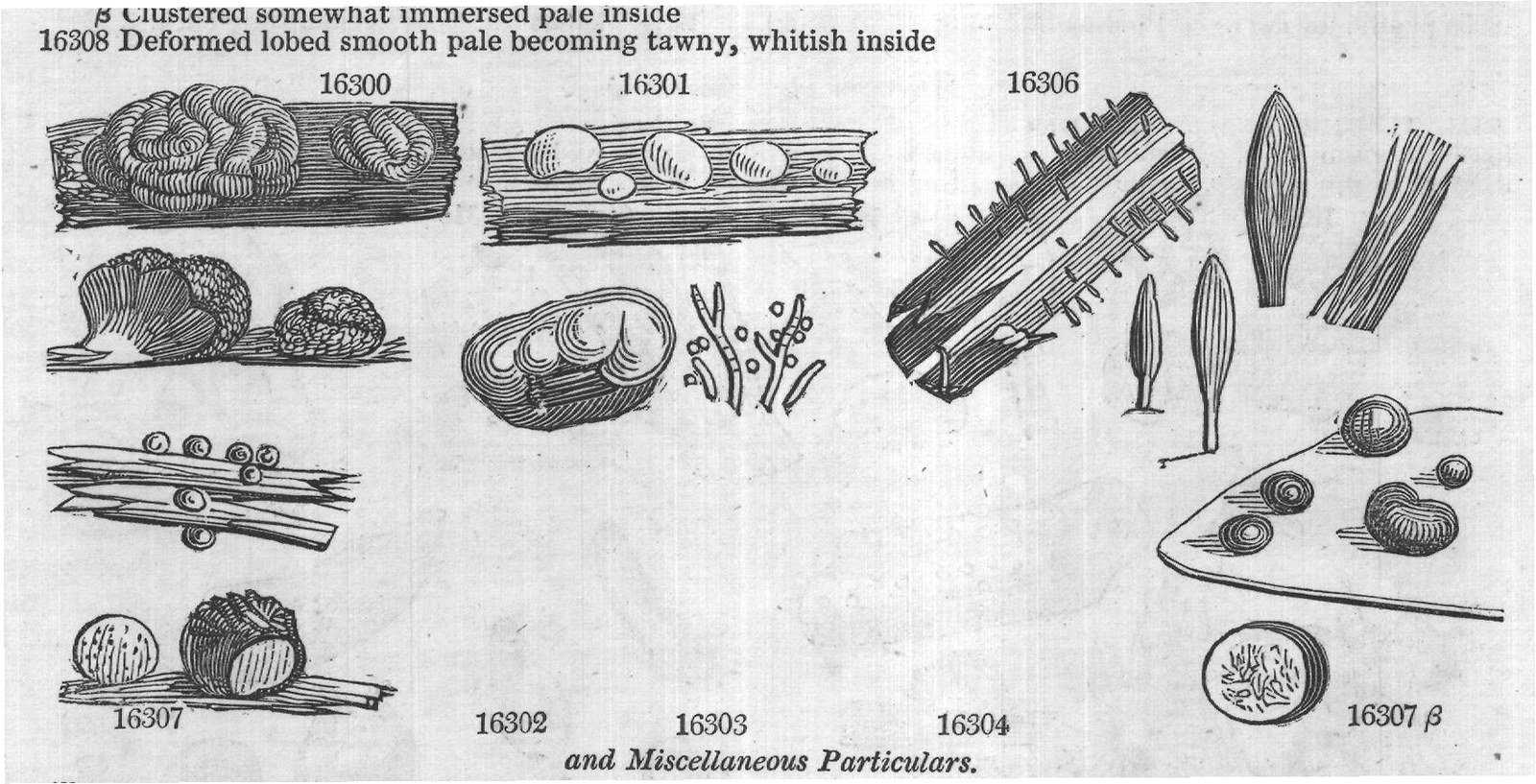
Sp.3-14. 16296 aurícula Júdæ Fries Jew's-ear ẞ rubescenti-fúsca Fr. redd.-brown tufted 3 aut.wi. Blsh elder trunks Bolton, t. 107 16297 recísa Fr. 16298 fláccida E. B. cut-back gregarious flaccid thin 16299 glandulósa Fr. very gelat. 2 aut. 2399. DACRYMY CES. Nees. DACRYMYCES. 16300 morifórmis Fr. mulberry-like sessile 16301 stellátus Nees glandular 0 aut. trickling very soft T. deliquéscens Grev 2400. AGY'RIUM. Fr. AGYRIUM. 16302 cæ'sium Fr. cæsious punctif. 2401. HYMENEL/LA. Fr. HYMENELLA. 16303 vulgáris Fr. common tumid aut. 2402. NÆMATELIA. Fr. NÆMATELIA. all sea. Or. Y rotten wood 0 all sea. Cæs. dead pine wood 16304 encéphala Fr. monstrous deformed aut.
Sp. 1-4.
Blsh nettle stems Sp. 1-3.
Flesh dead pine wood SCLEROTIACEI.
Eng. bot. t. 2447 E.b. t.1819. boletiformis Eng. bot. t. 2452 E. b. t. 2448. T. arborea Eng. bot. 2446 Grev. crypt. 159 3 aut.wi. Rsh elder trunks winter Brsh dead willows winter Dark oak bark Br dead trees Sp. 2-7.
Bl dead wood Sp. 1-6.
Class IV.
Sp. 2-5. aut.
Ruf. putrid Agarics Bulliard, t. 256 aut.
Sp. 12-60. 2403. ACROSPERMUM. Tode. ACROSPERMUM. 16305 cornútum Fr. cornute gregarious 16306 compréssum Tode dk. narr.-stem. scattered 2404. SCLERO'TIUM. Tode. SCLEROTIUM. 16307 sémen Tode Mustard Seed hard Turnip Seed hard Brassica Bolt. 16308 fungórum 16289 Blsh dead herbac. plants Grev. crypt. 182 wi.spr. W.Y dead leaves wi.spr. W.Y dead leaves Fungus roundish 0 aut. Br gills of dead Agarics 16291 16294 Grev. crypt. 144 Sowerby, t. 393 16297 16290 16292 16296 16298 History, Use, Propagation, Culture, 2396. Cryptomyces. Upon this curious addition to the British Flora, Dr. Greville has the following remarks. " This very curious plant, I have little hesitation in placing as a new genus among the true Fungi. It is difficult to say, with what it has nearest affinity. In general habit, it might be supposed to resemble some species of Thelephora, but there the comparison stops. Our plant, besides being produced under the epidermis, seems to belong to a more perfect group, when its structure is examined. The hymenium is a quite distinct substance from that of the receptacle. The fructification is fully and beautifully developed, a good deal similar to that of the Helvellæ. The receptacle is carnose and white; ; and the whole exhales a very strong odor, precisely like what is universally known under the name of a fungus-like smell. Till the plant is perfected, perfected , it remains concealed beneath the epidermis; and on this account, I have named the genus Cryptomyces. The epidermis, in fact, scarcely seems to crack by the swelling of the fungus, more than by the natural consequence of being killed by its separation from the subjacent bark. A cluster of willows, which was attacked in the beginning of the season by this plant, has been nearly destroyed by it; and, from the rapidity of its progress, I have no doubt that a whole plantation might, in the course of a couple of seasons, be rendered good for nothing. At a little distance, the affected branches look as if they were dry, scorched, and rotten." 2397. Tremella. Large or middle-sized fungi, rooting at the base, which is considerably contracted between the bark and the wood of trees. Dillenius named the genus on account of its soft, tenacious, tremulous substance, but his name was applied in a far more extensive sense than at present. The section called Phyllopta is an aberrant form of the genus, and should perhaps be separated. 2398. Exidia. From εξεiμi, to proceed from a thing; with reference to the manner in which the sporidia exude as it were from their receptacle. This genus differs from Tremella, to which it is nearest, in its horizontal Peziza-like receptacle in its hymenium being superior, the lower surface being dissimilar and either ORD. IX. TRIBE I.
FUNGI HYMENOMYCETES. 16289 Suborbicular olivaceous at length nearly black white within, Thecæ elor.gated obtuse Class III.
Class III. TREMELLINI. 16290 Sessile roundish orange-yellow variously lobed and plicate 16291 Sessile roundish or spreading and somewhat expanded obtusely lobed and plaited whitish 16292 Sessile clustered tumid plaited shining-brown 16293 Gregarious distinct tender gelatinous simple lingulate dull-orange pulverulent towards the apex 16294 Sessile gelatinous reddish-purple at first club-shaped then rounded lobed plaited or curled finally blackish 16295 Cartilaginous lobed somewhat wrinkled black 1. Pezizoid, plicate, villous beneath, or dotted with roughness, Tubes half inferior, distinct. AURICULE. 16296 Sessile concave flexuose blackish plaited on each side with veins: beneath downy olive-grey 16297 Very soft truncate-flat subrepand fuscous beneath dotted scabrous, Stipes very short oblique out of centre 16298 Thin flaccid very dark, externally opaque, internally wrinkled 2. Somewhat flattened, wavy, rugose beneath, Tubes half-inferior, obsolete. GLANDULOSÆ. 16299 Sess. round, rather spread. thick not goyrose plicate ben.: the surface bear. min. white-headed processes 16300 Conglobated sinuous dark opaque fleshy and purple inside 16301 Gregarious entire round depressed pulpy orange-yellow 16302 Gregarious nearly separate convex whitish cæsious 16303 Long various smooth whitish when dry becoming brown: the circumference adhering 16304 Subsessile pulvinate plaited-rugose pale flesh-color becoming dry Class IV. SCLEROTIACEI. 16305 Horn-like smooth when dry furrowed rufous becoming paler at the end 16306 Stipitate mostly lanceolate somewhat obtuse subcompressed of a dark olivaceous color 16307 Separate spherical whitish-yellow becoming wrinkled and black, white inside ẞ Clustered somewhat immersed pale inside 16308 Deformed lobed smooth pale becoming tawny, whitish inside 16307 16300 16302 16301 16303 16304 16306 16307 β and Miscellaneous Particulars. villous or rugose, and ribbed in a peculiar manner; in the conoid papillæ of the disk; in the tubes, which must be esteemed rudimentary asci, containing the sporules; and in the elastic manner in which the sporidia are produced. The species are simple, rarely growing in patches, of a large or middle size, and generally inhabiting wood; when dry they are membranous, but nearly regain their original form upon being moistened. 2399. Dacrymyces. From δaκρu, a tear, and μuκη, a fungus; in allusion to their deliquescent nature. Tremella deliquescens of Bulliard, a yellow confluent mass found chiefly upon pine-timber in the spring, is the type of the genus. deliquescens of Bulliard, a yellow confluent mass found chiefly upon pine-timber in the spring, is the type of the genus. 2400. Agyrium. Apparently from aγuρiς, a crowd, in allusion to the clustered disposition of the individuals; although Fries, the author of the name, expressly declares that it has been named " ob superficiem nunquam Fries, the author of the name, expressly declares that it has been named "ob superficiem nunquam non lævem." Small dot-like gregarious plants growing upon wood, perennial, seated upon a crust-like spot, and resembling some species of Lecidea. 2401. Hymenella. This genus consists of plants growing upon plants, generally upon the stem, having the habit of Sclerotium durum, but softer, more tender, and bearing sporidia within their surface, for which of Sclerotium durum, but softer, more tender, and bearing sporidia within their surface, for which reason they seem as if they consisted only of a kind of elementary hymenium, whence their name. 2402. Næmatelia. From vaiμa, gelatine, and εiλεω, to enwrap, on account of the nucleus, which is of various figures, enclosed in the receptacle. 2403. Acrospermum. Minute fungi of a rigid habit, parasites upon decaying vegetables. From azços, the summit, and oxegun, seed, on account of the apex of the plants becoming tumid, and emitting the sporules. , and σπέρμη, σπέρμη, seed, on account of the apex of the plants becoming tumid, and emitting the sporules. 2404. Sclerotium. From σκληρoς, hard, in allusion to the remarkably firm substance of the species. All the species are parasites upon other plants, and some are very destructive. Willow 16309 muscórum Pers.
Moss 16310 salicínum Pers. 16311 popúlneum Pers. 16312 Ptéridis Pers. 16313 scutellátum Alb. 16314 nítidum Pers. 16315 dúrum Fr.
Poplar Bracken shield-like shining hard 16317 quercínum Pers. blistered Oak 16318 frúctuum Grev.
Fruit 16316 bullátum Dec.
CRYPTOGAMIA. irregular spring Or. Y patches 0 aut.wi. Rsh patches 0 all sea. Rsh punctiform 0 aut. sp. Bl button-like 0 spring Br less crowd. 0 wi.spr. Bl corneous 0 wi.spr. Bl confluent 0 aut. Bl scattered 0 aut.
Bl crowded 0 aut. 2405. RHIZOCTOʻNIA. Dec. RHIZOCTONIA. stems of mosses Salix caprea leaves Populus tremula lvs. dead Pteris aquilina leaves of trees dead herb. stems dead herb. stems rotten gourds dead leaves Wsh putrid fruit Sp. 1-4. 16319 crocórum Dec. Crocus-blight clustered 0 all sea. Ruf. saffron roots Thanatophyta crocórum Nees CLASS XXIV.
G.cr.101. subterraneum