Thymelaa
Sp. 1. 5525 linteária P. S. lace-bark cu 6 ja.d W Jamaica 1793. C l.p Lam. ill. t. 289 910. DAPΉNE, W. 5526 Mezéreum W.
DAPHNE.
Thymelææ.
Sp. 13-34.
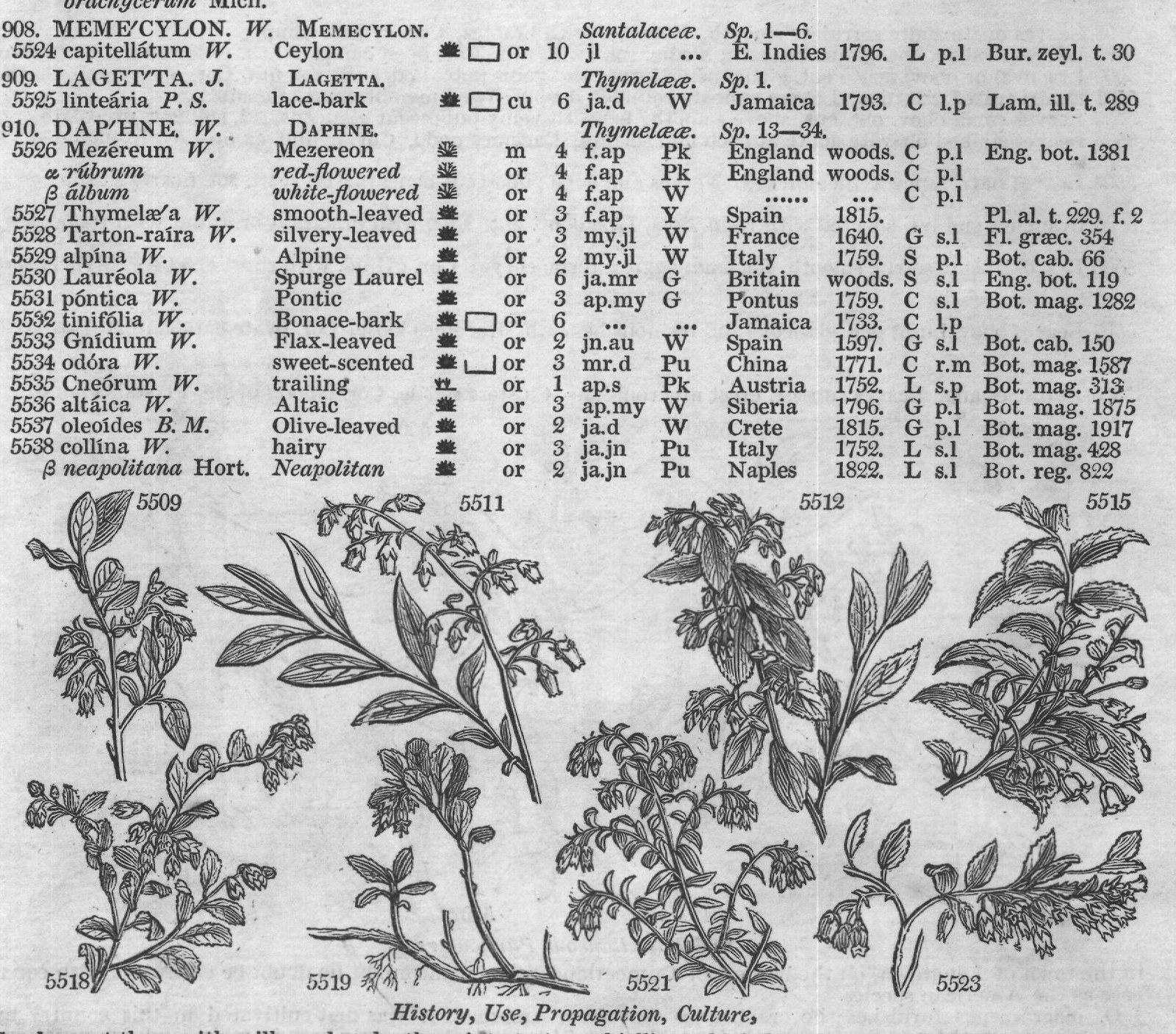
Mezereon m 4 f.ap Pk a rúbrum ẞ álbum 5527 Thymelæ a W. 5528 Tarton-raíra W. 5529 alpína W. 5530 Lauréola W. 5531 póntica W. 5532 tinifólia W. 5533 Gnídium W. 5534 odóra W. 5535 Cneórum W. red-flowered or 4 f.ap Pk white-flowered or 4 f.ap W ......
England woods. C p.1 England woods. C p.l Eng. bot. 1381 ... smooth-leaved or 3 f.ap Y silvery-leaved or 3 my.jl W Spain 1815.
France Alpine or 2 my.jl W Italy Spurge Laurel Pontic or 6 ja.mr G or 3 ap.my G Bonace-bark or 6 ... ...
Flax-leaved or 2 jn.au W sweet-scented or 3 mr.d Pu Spain China trailing or 1 ap.s Pk 5536 altáica W.
Altaic or 3 ap.my W Siberia 5537 oleoídes B. M.
Olive-leaved or 2 ja.d W Crete 5538 collína W. hairy or 3 ja.jn Pu Italy ẞ neapolitana Hort. Neapolitan or 2 ja.jn Pu Naples 5509 5511 1640. G s.1 1759. S p.1 Britain woods. S s.1 Pontus 1759. C s.l Jamaica 1733. C 1.p 1597. G s.l 1771. Cr.m Austria 1752. L s.p 1796. G p.l 1815. G p.1 1752. L s.l 1822. L s.l 5512 Pl. al. t. 229. f. 2 Fl. græc. 354 Bot. cab. 66 Eng. bot. 119 Bot. mag. 1282 Bot. cab. 150 Bot. mag. 1587 Bot. mag. 313 Bot. mag. 1875 Bot. mag. 1917 Bot. mag. 428 Bot. reg. 822 5515 5518 5519 5521 History, Use, Propagation, Culture, 5523 landers eat them with milk, and make them into tarts and jellies, which last they mix with whisky to give it a relish to strangers."
V. uliginosum grows taller than the common bilberry, and has large globular, black, glaucous fruit. These have less flavor, but abound with a weak acid juice. (Eng. Bot.) In large quantities it occasions giddiness, and a slight head-ache, especially when full grown and quite ripe. (Linn. Suec. and Withering.) Many vintners in France are said to make use of the juice to color their wines red. (Withering.) They furnish an ardent spirit which is highly volatile and intoxicating. The Alpine birds feed upon the fruit, and it is very common in their haunts. (Villars.) V. Vitis idæa is of very humble growth and almost herbaceous, though evergreen. The berries are red, acid, astringent, and bitter. They are scarcely to be eaten raw, and though made into pies in Derbyshire, where they are called cow-berries, their fiavor is far inferior to the cranberry. Their best use is for making a rob or jelly, which is eaten with all kinds of roast meat in Sweden, and is far preferable to that of the red currant as a sauce for venison. It is also an excellent medicine in colds, sore throats, and all irritation of the mouth or fauces. (Smith, Brit. and Eng. Bot.) Linnæus says, that they are sent in large quantities from West Bothnia to Stockholm for pickling, and the same thing is confirmed by Dr. Clarke. Miller was informed that this plant was used for edgings in Norway. V. tenellum is a very good fruit.
ORDER I.
OCTANDRIA MONOGYNIA. 5509 Lvs. stalked obl. oval blunt entire beneath resin. Racemes lateral one-sided, Cor. ovate conical 5 angular 5510 Fl. branches leafless, Lvs. obl. oval acute at each end ent. young ones downy on both sides, Rac. short scaly 5511 Flowering branches leafless, Lvs. obl. acute at each end smooth, Racem. clust. bract. Cor. cylind. Cal. refl. 5512 Flowering branches oblong leafl. Lvs. lanc. acute at each end serrul. smooth, Rac. sess. corym. obl. bract. Cor. cylind. contracted at mouth 5513 Lvs. sessile cuneate-lanc. serrul. veiny pubes. Clust. sess. Cor. ov. much contracted at mouth, Style exsert. 5514 Branches angular green, Leaves sess. ovate lanc. mucronate, Fasc. clustered term. sessile, Cor. ovate 5515 Flowers racemose, Leaves crenulate ovate smooth 5516 Leaves ovate obl. acute serrate flat shining, Racemes terminal erect, Cor. prismatical 5517 Creeping very smooth, Leaves stalked oval shining, Clusters axill. sessile few-flowered, Cor. glob. camp. 5518 Spread. Lvs. obl. lanc. acute at each end serr. rigid smooth, Racem, term. corymb. Fl. nodd. Cor.open camp. 5519 Dwarf, Leaves obovate emarginate serrulate shining above dotted beneath, Cor. cylind. camp. 5520 Stem creeping hispid, Leaves roundish oval acute bristly at edge 5521 Erect much branched, Leaves evergeen obl. lanc. acute at each end rigid, Cor. open camp. deeply 5-toothed 5522 Leaves very small sessile oval mucron. beneath hairy dotted, Clusters term, and lat. Cor. obl. ovate 5523 Dwarf, Leaves obovate crenate toothed smooth, Filam. gland, Stigma cap. Cor. short ovate 5524 Leaves ovate stalked, Umbels capitate axillary sessile 5525 Spikes panicled terminal, Leaves ovate acute 5526 Flowers sessile three on the stem, Leaves lanceolate deciduous 5527 Flowers sessile axillary, Leaves lanceol. Branches simple 5528 Flowers sessile lateral aggregate at the base scaly, Leaves obovate nerved silky 5529 Flowers sessile lateral aggregate, Leaves lanceolate obtuse downy beneath 5530 Racemes axillary 5-flowered, Leaves lanceolate smooth 5531 Pedunc. lateral 2-flowered, Leaves lanceol. ovate 5532 Racemes compound erect, Flowers terminal clustered, Leaves oblong 5533 Racemes term. panicled, Leaves linear lanceolate cuspidate 5534 Head terminal sessile many-flowered, Leaves scattered obl. lanceol. smooth 5535 Flowers fascicled term. sessile, Leaves lanceol, naked mucronate 5536 Flowers term. subsessile, Leaves opp. obl. lanceol. obtuse narrowed at base glabrous 5537 Flowers twin terminal sessile, Leaves elliptic lanceol. smooth 5538 Flowers fascicled terminal, Leaves obovate obtuse above very smooth beneath villous 5528 5524 5530 5525 5536 5526 5538 5533 and Miscellaneous Particulars. 908. Memecylon. The Greek name of the fruit of the Arbutus. The shrub now so called has a certain degree of resemblance to the Arbutus. Young cuttings plunged in sand in heat and covered with a handglass will root freely. 909. Lagetta. This plant in Jamaica is called Lagetto. Ripened cuttings will root in sand under a handglass. 910. Daphne. The Greek name of the Laurel. This is a genus of diminutive shrubs, mostly evergreens of great beauty and fragrance in the flower, and with a peculiar velvet texture in the leaf. It is mentioned by Linnæus as a characteristic of the genus, that the terminating buds of the shoots produce leaves, and the lateral ones flowers. This affords a hint to the cultivator to be sparing of his knife. D. Mezereum (Mâdzaryoun is the Persian name according to Richardson), Laureole gentille, Fr., Kellerhals, Ger., and Laureola femina, Ital., is an old inhabitant of the shrubbery, and deservedly much admired for its precocity and fragrance. It thrives well in loamy soil, and will grow in the shade and even drip of other trees. It is a native of all parts of Europe from Lapland to Sicily, but was first received from Elbing before it was observed to be a native. The roots of Mezereon acquire a very large size in proportion to the branches, and have more the character of the fusiform or ramose roots of a herbaceous, than of a ligneous vegetable. Th They are remarkably hot and acrid, and have long and in most countries been a popular topical Y2 STELLERA.
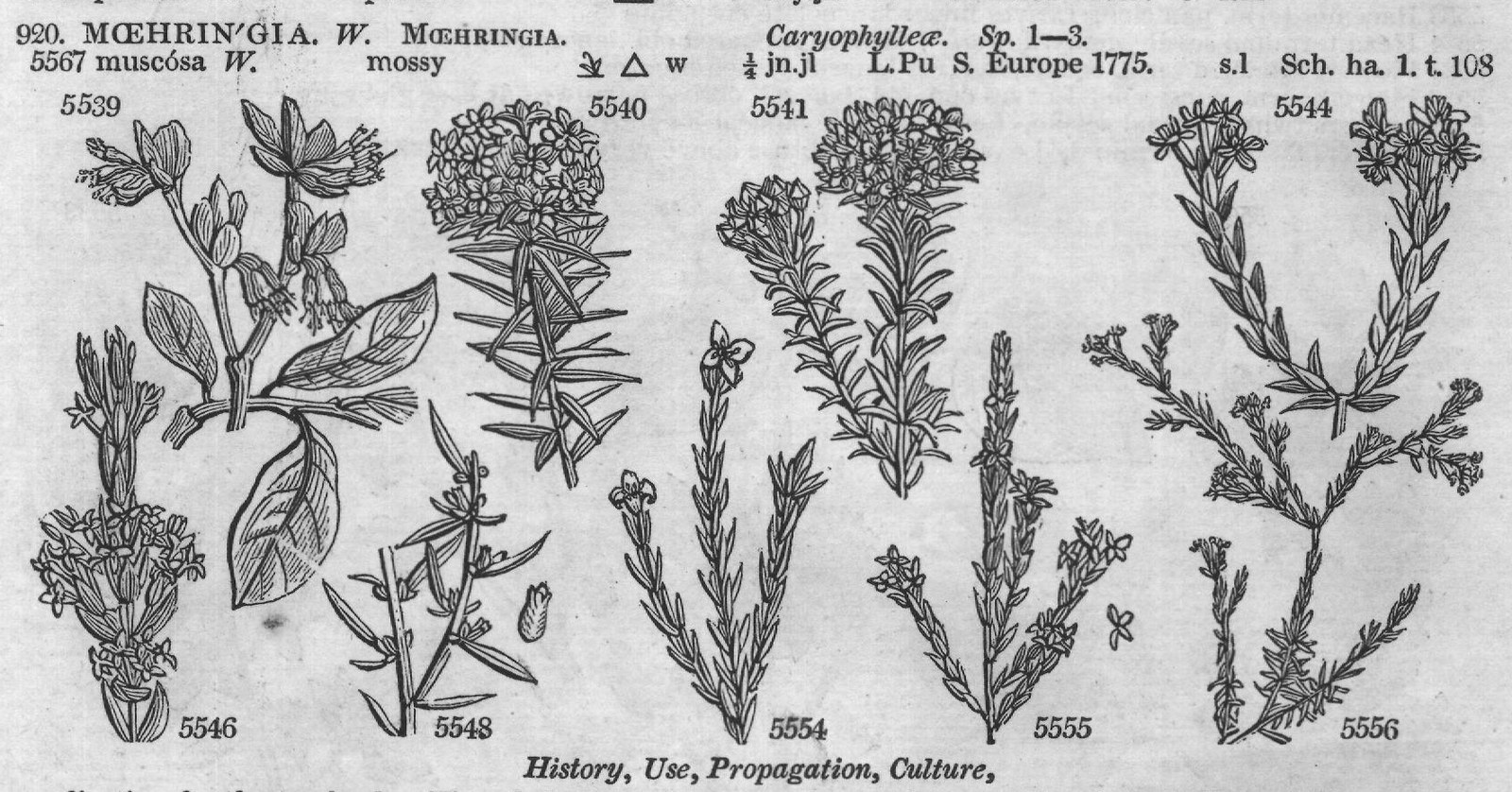
Flax-leaved cu SPARROW-WORT. filiform cu shaggy cu slender-flower. headed cu 1 jn.o one-flowered great-flowered cu spiked cu lax cu 911. DIR CA. W. 5539 palústris W. 912. GNI DIA. W. 5540 pinifólia W. 5541 imbérbis H. K. 5542 símplex W. 5543 capitáta W. 5544 oppositifólia H. K. 5545 serícea H. K. 5546 denudáta Lindl. 5547 lævigáta Thunb. 913. STELLE'RA. W. 5548 Passerína W. 914. PASSERI'NA. L. 5549 filiformis W. 5550 hirsúta W. 5551 tenuiflóra W.en. 5552 capitáta W. 5553 uniflóra W. 5554 grandiflóra W. 5555 spicáta W. 5556 láxa W.
OCTANDRIA MONOGYNIA.
LEATHER-WOOD. marsh GNIDIA.
Pine-leaved smooth-scaled Flax-leaved purple-twigged ec pr pr el