Important: Safety Warning
This page prescribes plants as medicine according to pre-modern medical theory. Several of the plants named are toxic, correct identification is difficult, and the doses given have no scientific basis. Do not ingest or apply any preparation described here.
This information has been left in for historical purposes but should not be acted upon.
Home › T › Turritis Loesilii R
Turritis Loesilii R
Br. 8975 canariénse R. Br.
Canary 8976 hispánicum Dec.
Spanish 8977 vulgáris R. Br. common 8978 præ cox R. Br. 1385. NOTO ĆERAS. R. Br. NOTOCERAS. 1386. BARBARE'A. R. Br. WINTER CRESS.
Acul 1 my.au Y cul 1 ap.o Cruciferæ.
Sp. 2-4. un au.s Y Canaries 1779. S co Jacq. ecl. t. 111 un au.s Y Spain 1821. S co Cruciferæ.
Sp. 4-6.
Britain rub. D co Eng. bot. 443 Belleisle Cress Y 8979 ibérica Dec.
England brooks. D co Eng. bot. 1129 Barbarea-lvd. 8980 plantagínea Dec.
Wintercress-lv. un 1 my.au Y un Iberia 1816. C l.p jl.s Y Levant 1799. D co Sisymb. barbareæ L. 1387. BRAY'A. Stern.
BRAYA.
Cruciferæ.
Sp. 1. 8981 alpína Stern. alpine cu jn Pu Carinthia 1823. S p.l 1388. PAR'RYA. R. Br. PARRYA. 8982 árctica R. Br. northern cu Cruciferæ.
Pu Sp. 1. ... 1389. TURRITIS. R. Br. TOWER MUSTARD.
Cruciferæ.
MelvilleI. 1820. S p.1 Sp. 1-3.
Parry's append. 8983 glábra L. long-podded W 1390. AR'ABIS. L.
WALL CRESS. 1½ my.jn W Cruciferæ.
England gr.pa. S co Eng. bot. 777 Sp. 32-65. 8984 vérna R. Br. vernal W 1 my.jn Pu 8985 alpína L.
Alpine 8986 álbida Sted. early-flowering Apr mr.my W.Y prja.o W France 1710. S s.l Switzerl. 1596. D p.l Caucasus 1798. D s.1 Barr. ic. 476 Bot. mag. 226 Jacq. ecl. t. 71 A. caucásica W. 8987 toxophýlla Bieb. 8988 auriculáta Lam. bow-leaved auricled E pr 1 jl.au W Volga 1823. S co 8989 saxátilis All. 8990 crispáta W. stone crisp O un my un W S. Europe ...
Sco W. & Kit.1. t.59 3 my Apr 1 my W W Switzerl. ...
Sco Vill. daup.3. t.37 Carniola 1816. D co 8991 sagittáta Dec. 8992 hirsúta Scop. sagittate hairy W 8993 Alliónii Dec. un 1 my.jl W S. France ...
Sco upright W 2 my.jn W Italy Britain rocks. D s.l Eng. bot. 587 1804. D co Turritis stricta W. 8994 murális Bert. wall un 8995 strícta Huds.
Bristol ciliated pr hispid-stalked un common W thyme-leaved un 8996 ciliáta R. Br. 8997 incána Roth. 8998 Thaliána L. 8999 serpyllifólia Vill. 9000 pubescens Desf. 9001 præ'cox W. & K. 9002 híspida L. 9003 lyráta L. 9004 arenósa Scop. 8970 pubescent early short-podded lyrate purple 8977 Apr my Cr jn.jl W my.jn W ap.my W jn.jl W un 1 ap.my W un W un jn.jl W my.jl Pu my.jl W Pk Oprjn.jl Italy England rocks. D s.1 Ireland ir.sh. S s.l Switzerl. 1816. S s.l Britain walls. S s.1 S. France 1823. S co Barbary 1825. S co Hungary 1820. D co Britain al.roc. D s.l N. Amer.
S co Germany 1798. S s.1 8978 ...
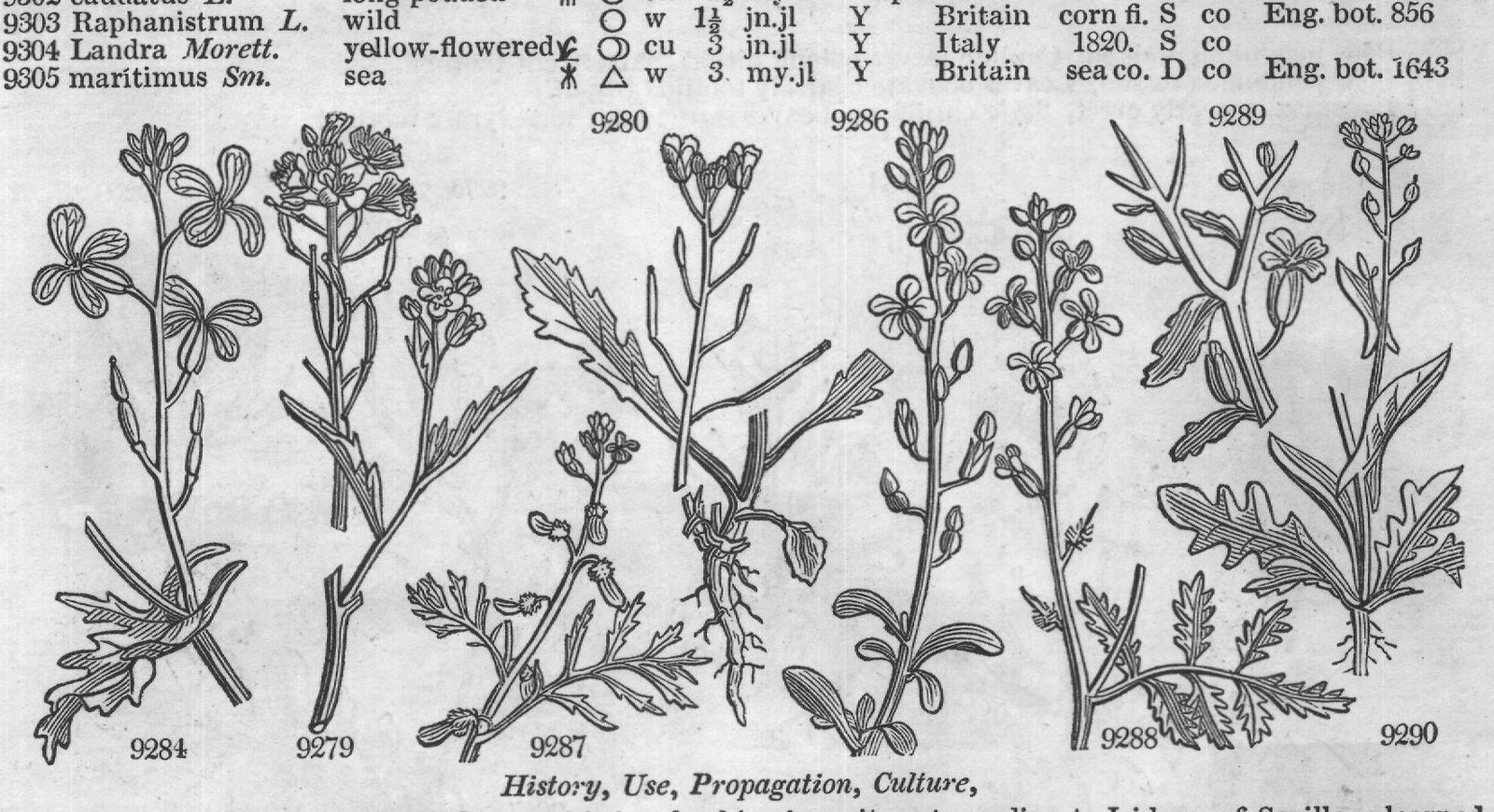
Eng. bot. 901 Vil.dauph.3.t.37 Desf. atl. t. 163 Eng. bot. 469 Scop. carn. t. 40 8933 my.jn W 1824. D co Eng. bot. 614 Eng. bot. 1746 8974 8982 8981 8975 History, Use, Propagation, Culture, not find their way into the plantation. Near Rickmansworth, in Hertfordshire, there is a fine stream of water on a chalky bottom, in which one cultivator grows five acres, and sends a supply to London every large plantations at Uxbridge, Gravesend, and other places.
Some market-gardeners, who can command a small stream of water, grow the water-cress in beds sunk about a foot in a retentive soil, with a very gentle slope from one end to the other. Along the bottom of this bed, which may be of any convenient length and breadth , chalk or gravel is deposited, and the plants are inserted about six inches distance every way. Then, according to the slope and length of the bed, dams are made six inches high across it, at intervals; so that when these dams are full, the water may rise not less than three inches on all the plants included in each. The water, being turned on, will circulate from dam to dam; and the plants, if not allowed to run to flower, will afford abundance of young tops in all but the winter months. A stream of water no larger than what will fill a pipe of an inch bore, will, if not absorbed by the soil, suffice to irrigate in this way an eighth of an acre. the plantation should be laid dry two or three times a year, and all weeds and decayed parts removed, and vacancies filled up. Cress grown in this way, however, is far inferior to that grown in a living stream flowing over gravel or chalk.
As some of the plants are apt to rot off in winter, The water-cress has lately been cultivated in the neighbourhood of Paris, and also near Edinburgh. 1384, Leptocarpaa. From λεπτoς, slender, and κaρπov, fruit. A genus distinguished from Sisymbrium by its accumbent cotyledons.
CLASS XV.
TETRADYNAMIA. 8969 Radical leaves stalked obovate or lyrate, Cauline amplexicaul pinnatifid, Lobes linear entire 8970 Leaves obl. lanc. pinnatifid or serrated, Root fibrous, Petals larger than calyx, Silicules ellipsoid 8971 Leaves obovate cuneate toothed at end, Pods roundish subturgid, Bractes a little shorter than pods 8972 Lvs. smooth: rad.stalked pinnatif.; caul. stem-clasping cut serr. Pods roundish, Pedic. bracteate very short 8973 Lvs. ovate lanc. toothed backwards acuminate at each end smooth, Pods roundish 4 times as long as stalk 8974 The only species. Leaves stalked pinnatifid sublyrate with cut toothed acuminate lobes 8975 Pods 2-horned, Petals equal, Leaves entire, Hairs strigose fixed by their middle 2-parted appr. scattered 8976 Pods 2-horned, Petals unequal, Leaves ent. Hairs strigose fixed by their middle 2-parted very numerous 8977 Lower leaves lyrate: terminal lobe roundish; upper obovate toothed 8978 Lower leaves lyrate: terminal lobe ovate; upper pinnatifid with linear oblong entire lobes 8979 Radical and lower leaves pinnatifid-lyrate: lateral lobes ovate; terminal cordate entire 8980 Lower leaves toothed lyrate: lateral lobes dentiform; terminal very large subcordate, upper ovate 8981 Leaves linear narrowed at base smooth acute 8982 Pods lin.-oblong, Anthers oval, Leaves entire, Peduncles smooth 8983 Rad. leaves toothed hairy: cauline stem-clasping entire smooth, Pods erect 6 times as long as stalk 8984 Cauline lvs. cord. stem-clasping rough with 3-parted down, Pedicels shorter than cal. Stigma somew. emarg. 8985 Leaves many-toothed villous with branched hair lanc. acute: rad. somew. stalked; caul. cord. stem-clasp. 8986 Leaves few-toothed hoary with branched hairs: rad. obov. oblong; cauline cordate sagitt. stem-clasping 8987 Lvs. pubesc. with minute stellate down: rad. obl. stalked sinuate toothed; cauline sagittate lanceol. entire 8988 Lvs. somew. toothed rough with branch. hair: lower oval narr. into a stalk; cauline bluntly cord.-auricled 8989 Lvs. somew. toothed rough with branch, hair: lower oval narr. into a stalk; cauline acutely cord.-auricled 8990 Lvs. acutely toothed lanc. stem-clasping wavy rough with branching hairs: rad. narrowed into the stalk 8991 Lvs. somew. toothed rough: rad. ovate or obl. narrowed into the stalk; cauline lanceol. sagittate cordate 8992 Lvs. toothed rough with generally branched hairs: radical obov. obl. narr, into the stalk; caul. ovate lanc. 8993 Lvs. smooth: radical ovate-oblong somewhat toothed narrowed at base; cauline sessile ovate serrated 8994 Leaves hairy with branched pubescence: radical spatulate bluntly toothed; cauline ovate acutely toothed 8995 Leaves rough with scattered bifid down: radical obov. toothed; cauline obl. nearly entire, Raceme erect 8996 Leaves somewhat toothed smooth ciliated: radical subsessile oval oblong; cauline oblong, Raceme erect 8997 All the lvs. sessile somew. toothed hoary with branched hairs: radical obov. obl.; cauline obl. Rac. erect 8998 Leaves hairy somewhat toothed: radical stalked ovate oblong, Stem branched, Pods ascending 8999 Leaves nearly entire rough with branched hairs: radical and caul. oval narrowed at base, Raceme lax 9000 Lvs. pubesc. coarsely toothed: rad. spatulate lanc. narrowed into the stalk; caul. lanc. Pods pubescent 9001 Leaves oblong acute sessile entire smooth, Stems strigose, Runners creeping, Pods spreading 9002 Leaves nearly smooth: radical cut; cauline oblong linear entire, Stem generally branched 9003 Rad. leaves lyrate pinnatifid smooth or ciliated: cauline linear, Stem hispid at base somewhat branched 9004 Lvs. vill. with forked down: rad. lyrate pinnat.; caul, cut toothed, Stem branched hisp. with simple hairs 8985 8986 8995 8988 8996 9000 9002 8992 and Miscellaneous Particulars. 1385. Notoceras. From vωτoς, the back, and κερaς, a horn. The structure of the pod of this genus is intermediate between Erysimum and Capsella. The species are small annuals, with very minute flowers, which are sometimes apetalous. 1386. Barbarea. A name used by Dodoens, because the plant had been called the herb of St. Barbara by some preceding botanists. B. vulgaris is sometimes cultivated as a spring salad, but is much less delicate than the common cress, and has nothing in flavor to recommend it. B. præcox, the American or Belleisie cress of gardeners, is preferred to the other, and cultivated in a number of gardens. 1387. Braya. A curious little plant, with the habit of Arabis cærulea. Leaves are linear, racemes terminal, flowers purple. The genus is not completely known; but it appears to be intermediate between Siliquosæ and Siliculosæ; related to Draba on one hand, and Arabis on the other. It is a native of the Carinthian alps, where it was found by Dr. Hoppe, who named it after Count Bray, a German nobleman. 1388. Parrya. Named by Mr. R. Brown, after Captain Edward Parry, the commander of the British expeditions to discover the north-west passage round America. It was found upon Melville island, and once was raised from seeds brought home by some of the officers, but it never flowered, and is now lost. 1389. Turritis. From turris, a tower; the leaves and seeds giving the stem a pyramidal form. This genus is principally distinguished from Arabis by its seeds being in two rows, and by its habit. 1390. Arabis. Native of Arabia, according to De Theis; but this is a forced explanation, and scarcely the true root of the word. Distinguished from all the neighbouring genera by its linear compressed siliques, and flat valves. 9017 asarifólia L.
Kidney-leaved 9019 resedifólia L.
Rocket-leaved 9020 africána L.
African 9021 trifólia L. three-leaved 9022 chilénsis Dec.
Chili 9023 granulósa All. granular 9024 amára L. bitter 9025 prórepens Fisch. creeping 9026 pratensis L.
Cuckoo-flower ẞ plena double-flowered 9028 hirsúta L. hairy 9029 parviflóra L. small-flowered 9030 impátiens L. impatient 9031 latifólia Vahl. broad-leaved or 1 jn.au Pu 9032 chelidónia L.
Celandine-lvd.or 1393. PTERONEU'RON. Dec. PTERONEURON. 9033 græcum Dec. Grecian un Haller's 9006 cebennénsis Dec. Montpellier tower Mustard pendulous polished TETRADYNAMIA. 9005 Halléri L. 9007 Turríta L. 9008 péndula L. 9009 lævigáta Dec. 9010 canadénsis L. 9011 nútans W. sickle-podded nodding 9012 bellidifólia Jacq.
Daisy-leaved 9013 cærúlea Wulf. blue Apr jn.jl 9014 collína Ten. hill 9015 lúcida L.
Sco un 1 jn.jl W Switzerl. un 1 jn.jl Pa.pu S. France 1820. S co 1 ap.my Sul England walls. S s.1 Oun 1 my.jl W Siberia 1759. Ss.l Aun 1 my.jn W N. Amer. 1821. D co un 2 my.jl W N. Amer. 1768. D s.1 Apr mr.ap W Switzerl. 1658. D co pr my.jn W.Y Switzerl. 1773. D p.l Pa.B Switzerl. 1793. D co unjn.jl W Naples 1824. D co Hungary 1790. D p.l shining-leaved Apr jn.jl W 1391. MACROPO'DIUM. R. Br. MACROPODIUM. 9016 nivále R. Br.
Siberian 1392. CARDA'MINE. L. LADY'S SMOCK. 9018 bellidifólia Crantz. Daisy-leaved 9027 pennsylvánica L. Pennsylvanian Cruciferæ. Sp. 1.
Apr 1 jn.s W Cruciferæ.
Apr jn.jl W prap.jn W O un از W Siberia 1796. D co Sp. 16-55.
Italy 1710. D p.l Scotland sc.al. D s.l Germany 1658. S co C. G. H. 1691. D co Switzerl. 1629. D p.1 Chile 1825. D co Italy 1820. D co wat.pl. D p.l 1821. D co me.pa. D m.s D co Britain Siberia ... ...
N. Amer. 1818. D co Britain mo.s.p. S m.s France Sco al. roc. S co 1710. S co 1739. D co Britain Spain CLASS XV.
Wal.& Kit. t.120 Eng. bot. 178 Jac. vind. 3. t. 34 Plu. alm. t.86.f.8 Jac. aust.3. t.281 Jac. aust.3. t.280 Al.ped.1. t.40.f.2 Pall. it.2. ap. t. U Bot. mag. 1375 Eng. bot. 2355 Al.ped.1. t.57.f.2 Her. parad. 202 Bot. mag. 452 Eng. bot. 100 Eng. bot. 776 Eng. bot. 492 Gmel. sib. t. 64 Eng. bot. 80 Her. parad. 203 Pl.rar.hu.2.t.140 Boc. sic. t. 44. f.2 un 1 my.jn W Apr 1 mr.ap W Aun mr.ap W Aun 1 ap.my W prap.my W Aun ap.my. W pr ap.my Pu r 1 ap.my L.P Britain Aun 1 my.jn W un 1 ja.d W un 1 ap.my W O un 1 ap.jn W 1 jn.au Pu Italy Cruciferæ.
Sp. 1-2. jn.jl Pa S. Europe 1710. S co Cardámine græ'ca L. 1394. DENTA'RIA. L. DENTARIA. 9034 enneaphýlla L. nine-leaved 9035 diphýlla Mich. el two-leaved 9036 máxima Nutt. large 9037 trifólia W. & K. three-leaved 9038 pentaphýlla Scop. five-leaved 9039 pinnáta Lam. el el el Cruciferæ. Sp. 7-16. 1 my.jn Pa. Y Austria 1656. my.jn W.pu N. Amer. 2 my.jn Pa.pu N. Amer. 1823. 1 my.jn W Hungary 1824. el 1 my.jn Pa.pu Switzerl. 1656. D s.p seven-leavedel 1 my.jn Pa.pu Switzerl. 1683. D s.p Jac. aust.4. t.316 Bot. mag. t.1465 D s.p D s.p 9040 bulbífera L. bulbiferous el 1 ap.my Pu England sha.pl. D s.p Wal.& Kit. t.139 Garid. prov. t. 29 Garid. prov. t.28 Eng. bot. 309 1395. LUNA'RIA. L.
HONESTY.
Cruciferæ. Sp. 2. 9041 redivíva L. perennial 9042 biénnis Dec. annual or or 3 my.jn L.P Germany 1596. D co Lam.ill.t.561.f.1 4 my.jn L.P Germany 1570. S co Lam.ill.t.561.f.2 ánnua L. 1396. RICO'TIA. L.
RICOTIA.
Cruciferæ. Sp. 1. 9043 ægyptiaca L.
Egyptian cu jn.jl L.P Egypt 1757. S s.p Bot. reg. 49 1397. FARSE/TIA. Turr. FARSETIA.
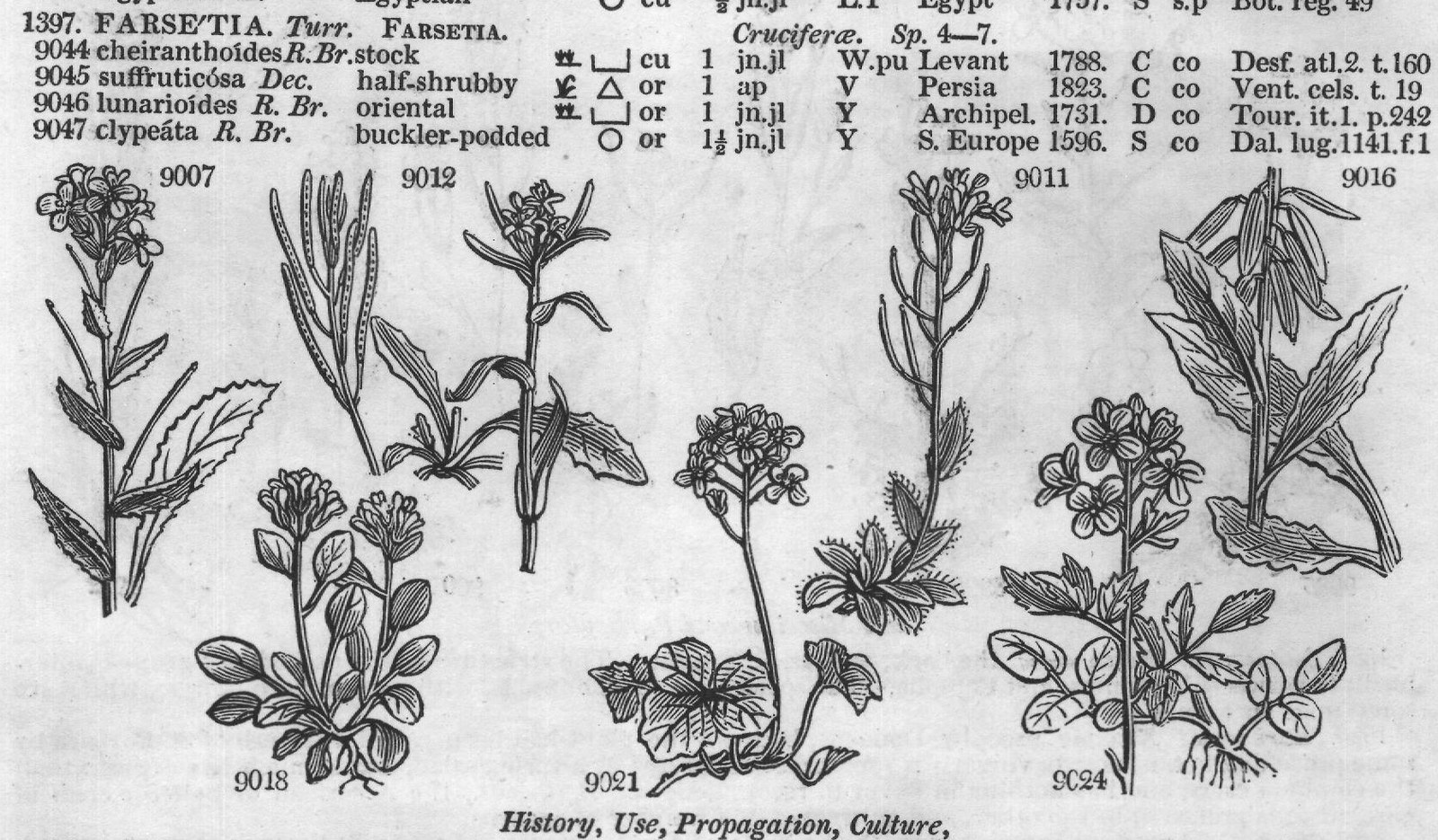
Cruciferæ. Sp. 4-7. 9044 cheiranthoides R. Br.stock cu 1 jn.jl W.pu Levant 9045 suffruticósa Dec. half-shrubby or 1 ap V 9046 lunarioídes R. Br. oriental or 1 jn.jl Y 9047 clypeáta R. Br. buckler-podded or 1½ jn.jl Y 9007 9012 1788. C co Persia 1823. C co Archipel. 1731. D co S. Europe 1596. S co 9011 Desf. atl.2. t. 160 Vent. cels. t. 19 Tour. it. 1. p.242 Dal. lug.1141.f.1 9016 9018 1391. Macropodium. and πες, a foot or stalk. thickened at the base. flowers. 9021 History, Use, Propagation, Culture, 9024 So named because the pod is elevated above the receptacle upon a stalk ; μaκρoς, long, A genus differing from Arabis chiefly in its stalked pod, and its calyx being a little A little, smooth, erect, simple herb, with ovate, lanceolate, acuminate leaves, and white 1392. Cardamine. From κaρδia, the heart, and δaμaω, to strengthen, in allusion to its supposed stomachic qualities. The leaves of C. pratensis were formerly used in salads. C. impatiens is so named from the sudden bursting of the seed pods, being ripe and pressed between the fingers. C. pratensis frequently has double flowers. C. hirsuta and, it is said, other species, produce young plants from the leaves. All that is necessary is to lay the leaf on a moist grassy surface, or on moss kept moist. The plant propagates itself extensively in this way in moist soils. 1393. Pteroneuron. From πτερov, a wing, and vεuρov, a nerve, in allusion to the winged nerves of the pods, by which it is distinguished from Dentaria and Cardamine. CLASS XV.
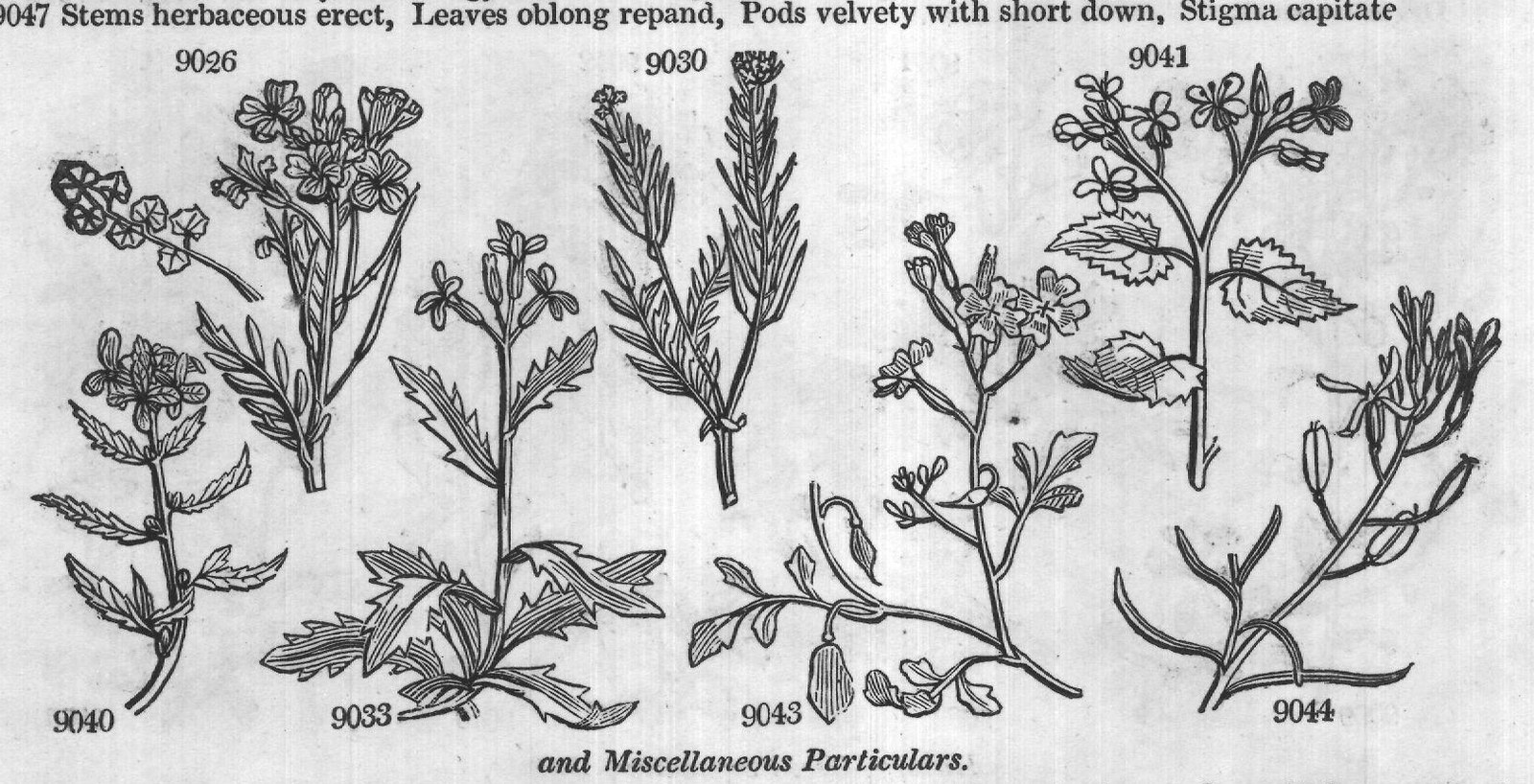
TETRADYNAMIA. 9005 Lower lvs. stalked lyrate: terminal lobe ovate; upper lanceolate cut, Stem branched weak softly villous 9006 Leaves all stalked ovate acumin. coarsely toothed velvety with very fine down, Pedic. and pods spreading 9007 Lvs. stem-clasping acum, somewhat toothed pubescent, Pedicels length of calyx, Pods 1-sided decurved 9008 Leaves stem-clasping toothed oblong dilated and cordate at base, Stem furrowed hispid, Pods pendulous 9009 Cauline leaves linear sessile smooth: lower somewhat toothed; radical obovate, Pods erect 9010 Cauline leaves sessile oblong lanceolate acuminate somewhat toothed, Pods pendulous falcate [stalk 9011 Lvs. roughish nearly ent.: rad. obov.; caul. ov. or obl. Rac. nodding, Pods erect 3 times as long as their 9012 Lvs. smooth nearly entire: rad. obovate; cauline ovate, Raceme erect, Pods 4 times as long as their stalk 9013 Leaves smooth nearly entire: rad. oblong obovate; cauline few oblong, Raceme nodding, Pods. erect 9014 Lvs. hoary with stellated down obl. sinuate toothed: rad. stalked; caul. sess. Pods 8 times as long as their 9015 Leaves stem-clasping shining 9016 Leaves ovate lanceolate acuminate subserrate, Raceme terminal long [stalk 9017 Lvs. smooth stalked cordate roundish subsinuate toothed, Stem erect, Pods erect twice as long as stalk 9018 Leaves smooth thickish: radical stalked ovate entire; cauline few entire or 3-lobed, Pods erect 9019 Leaves smooth membranous stalked: radical undivided; lower cauline 3-fid, upper 5-lobed, Pods erect 9020 Leaves smooth 3-fid, Segments stalked ovate acuminate toothed, Pods spreading 9021 Lvs. smoothish 3-fid, Segm. sess. rhomb. roundish tooth. Scape naked, Lower branches root-like creeping 9022 Leaves above downy trifid, Segments somewhat stalked ovate lanceolate crenate, Stem ascending 9023 Radical leaves stalked ovate subcordate: cauline pinnatifid with oblong entire lobes, Root granular 9024 Leaves pinnatifid, Segments of radical roundish; of cauline toothed angular, Stem rooting at base 9025 Lvs. pinnatifid, Segm. ovate nearly entire: term. round. 3-lobed, Runners creeping, Stem ascend. pubesc. 9026 Lvs. pinnatifid, Segm. of rad. roundish: of cauline linear or lanc. entire, Style very short, Stigma capitate 9027 Leaves pinnatifid or lyrate, Lobes oval angular toothed blunt, Stem erect, Petals oblong linear 9028 Leaves pinnatifid, Segm. of radical roundish mucronate stalked, of the upper oblong subsess. Petals obl. 9029 Leaves pinnatifid, Lobes sessile obl. linear entire the lowest distant from the stem, Petals oblong linear 9030 Leaves pinnatifid, Segm. oval oblong somewhat toothed, lowest close to the stem acute stipule-like 9031 Leaves pinnatifid smooth, Segm. 3-7 roundish toothed angular, Pods erect a little longer than stalk 9033 Leaves pinnatifid nearly smooth, Segm. stalked ovate toothed lower pinnatifid, Segm. 3-4 9033 Segm. of leaves somewhat stalked roundish tooth-lobed nearly equal 9034 Leaves 3 whorled stalked trifid, Segm. oval lanceolate acuminate serrated, Stamens length of petals 9035 Leaves 1-2 alternately shortly stalked 3-fid, Segm. ovate lanceolate coarsely and unequally serrate lobed 9036 Leaves many alternate stalked trifid, Segm. broad oval cut toothed, Axillæ without glands 9937 Leaves many alternate stalked trifid, Segm. ovate-lanceolate remotely toothed, Axillæ with glands 9038 Caul. lvs. many alternate stalked palmate 5-lobed, Segm. oblong lanceolate acuminate coarsely serrated 9039 Cauline leaves alternate stalked pinnatifid, Segm. oblong acuminate serrate toothed 9040 Cauline leaves alternate pinnatifid: upper undivided mostly bearing bulbs in the axillæ 9041 Pods lanceolate narrowed at each end 9042 Pods elliptical blunt at each end 9043 Leaves sub-bipinnatifid, Lobes oblong sinuate angular 9044 Stem shrubby erect, Leaves linear with close hairs 9045 Stem half-shrubby at base erect, Leaves lanceolate downy 9046 Stems half-shrubby ascending, Leaves oblong obovate stalked and pods hoary with down 9047 Stems herbaceous erect, Leaves oblong repand, Pods velvety with short down, Stigma capitate 9040 9026 9033 9030 9043 9041 9044 and Miscellaneous Particulars. 1394. Dentaria. From dens, a tooth; its roots are furnished with projecting angles, which resemble the molar teeth of quadrupeds. Plants with broad palmate or pinnate leaves, and shewy white, yellowish, or purple flowers. The dried root of D. diphylla is used instead of mustard by the Americans, under the name of pepper root. 1395. Lunaria. Derived from luna, the moon, in allusion to the broad round silvery silicles. Large hairy plants, with alternate or opposite cordate leaves, and large lilac flowers. 1396. Ricotia. A word, the meaning of which is no where explained. It was probably formed after some obscure botanist. Small weak branched annual plants, with variously lobed foliage, and pale lilac flowers. 1397. Farsetia. In memory of Philip Farseti, a noble Venetian, celebrated for his botanical erudition. A small genus, with hoary entire leaves, and yellow or dirty-white flowers. 1398. BERTERO'A. Dec. BERTEROA. 9048 incána Dec. hoary Farsétia incána R. Br. 9049 mutábilis Dec. changeable Farsétia mutábilis R. Br.
TETRADYNAMIA.
Cruciferæ. Sp. 3-5. or 1½ jl.s W Europe 1640. S s.l CLASS XV.
Dal. lug. 1181. f.2 or 1 jl.au W.pk Levant 1802. D co Vent. cels. 85 9050 oblíqua Dec. oblique 业 or 1 jl W Sicily 1823. C co Flora Græca, 623 1399. AUBRIETIA. Adans. AUBRIETIA. 9051 deltoídea Dec. purple or Cruciferæ. Sp. 1-2. mr.my Pu Levant 1710. C p.l Bot. mag. 126 Farsetia deltoidea R. Br. 1400. VESICA'RIA. Lam. VESICARIA.
Crucifera. Sp. 3-10. 9052 utriculáta Lam. smooth or 1 ap.jn L.Y Levant 9053 sinuáta Poir. sinuate-leaved or 1 ap.jn L.Y Spain 1739. D s.l 1596. C s.l Bot. mag. 130 Clu.his.2.134. f. 1 9054 crética Poir.
Cretan or my.au Y Crete 1739. D s.l Alp. exot. t. 118 1401. ALYS SUM. L.
Cruciferæ. Sp. 18-52. 9055 saxátile L. rock or 1 ap.my Y 9056 Gemonénse L.
Austrian or 1 ap.my Y 9057 argénteum W. silvery or 9058 Bertolónii Desc.
Bertoloni's or 9059 murále W. & K. wall or cu 9061 alpéstre L. alpine cu 9062 montánum L. mountain 9063 rostrátum Stev. beaked 9065 campéstre L. field 9066 calycínum L. calycine 9067 mínimum W. small Y un 1 jl.au un 1 jl.au L.Y un L.Y un 1 jl Y 9069 marítimum Lam. sweet un 1 jn.s W 9070 rupéstre Tenore. rock un jn.s W 9071 halímifólium W. purslane-leav'd ☐ ☐ un jn.s W 9072 spinósum L. thorny un jn.au W Cruciferæ.
Sp. 1-3. 9073 Ion Thlaspi L. annual cu my.jl Y 1403. PELTA'RIA. L.
PELTARIA.
Cruciferæ. 9074 alliácea L.
Garlic-scented pr 1 my.jl W 1404. PETROCAL/LIS. R. Br. PETROCALLIS. 9075 pyrenáica R. Br.
Pyrenean cu Cruciferæ. my.jn Pk Sp. 1.
Pyrenees 1759. D s.l Bot. mag. 713 1405. DRA'BA. L.
Cruciferæ.
Sp. 11-60. 9076 aizoídes L. sea-green Apr f.ap Y Wales rocks. D s.l Eng. bot. 1271 9077 ciliáris L. ciliate-leaved prf.ap W 9078 aizóon Wahl. evergreen 9079 alpína L. alpine Apr my Aprap.my Y Y Switzerl. 1731. D s.1 Carinthia 1823. D co Bot. mag. 170 9080 hírta L. hairy pr my.jl W 9081 rupéstris R. Br. rock pr my.jl W 9082 stelláta Jacq. stellate pr my.jl W 9083 incána L. twisted-podded pr my.jn W 9084 confúsa Ehr. confused pr my.jn W Lapland 1820. D co N. Europe 1823. D co Scotland al.roc. D s.l Pyrenees 1820. D co Britain al.roc. S s.l N. Europe Sco Wah.lap.t.11.f.4 Wah.lap.t.11.f.3 Eng. bot. 1338 Eng. bot. 388 .. 9085 nemorális Ehr. wood pr my.jn Y 9086 murális L.
Speedwell-lvd. pr my W Europe 1759. S s.l England moun. S s.l Flora Dan. t.130 Ho. sys.4.t.60.f.1 Eng. bot. 912 1406. ERO'PHILA. Dec. EROPHILA.
Cruciferæ. Sp. 1-5. 9087 vulgáris Dec. common W mr.ap W Britain walls. S s.1 Eng. bot. 586 Draba verna L. 9051 9052 9055 9060 tortuósum W. & K. twisted 9064 micropétalum Fisch. small-petaled 9068 edéntulum W. & K. toothless Aor jl.au Y un my.jl Y 4 un my.jl 1402. CLYPEOLA. W. TREACLE MUSTARD.
L.Y Switzerl. 1823. D co Hungary 1820. D co Hungary 1804. D s.1 S. Europe 1825. D co Germany 1713. D s.1 Crimea 1823. S co Siberia 1823. S co France 1768. S s.p Austria 1740. S s.p Spain 1791. C s.l Hungary 1820. Sco England sea co. Cs.l Naples 1825. C co S. Europe 1820. C co S. Europe 1683. C s.l S. Europe 1710. S co Sp. 1-3.
All. ped. t.54. f.3 Wal. & Kit. t.91 All. ped. t. 18. f.2 Bot. mag. 419 St.ac.p.3.t.15. f. 1 Barr.ic. t.912. f.2 Jac. aust. t. 338 Tratt. thes. t. 35 Wal. & Kit.1.t.92 Eng. bot. 1729 Tenore nap. t.60 Bocc. mus. t. 39 Barr. ic. 808 Cav. ic. 1. t.34.f.2 Austria 1601. D s.l Jac. aust.2. t. 123 1 ap.my Y Europe Switzerl.
Candia 1710. C s.l C co ...
Bot. mag. 159 Jac. ic. 3. t. 503 D co ... 1 ap.my Y 1 ap.my Y Wal. & Kit. 1.t.6 1 jn.jl Y 1 jn.jl Y 9059 9062 9048 9073 History, Use, Propagation, Culture, 1398. Berteroa. Named after Charles Joseph Bertero, a pupil of Balbis, and a friend of M. Decandolle, who speaks in high terms of his merits. A genus distinguished from its allies by its bifid petals and peculiar habit. 1399. Aubrietia. Named by Adanson, after Aubriet, the famous French botanical draughtsman. A genus very distinct in habit, and sufficiently different from Berteroa in its entire petals, and from Alyssum in its bisaccate calyx and oblong fruit. 1400. Vesicaria. From vesica, a blister or bladder. The silicles of this genus are inflated like small bladders. This is a genus which combines species with bisaccate and an equal calyx, with entire and toothed stamens, with edged or not edged seeds, and with a deciduous or persistent calyx. It will, therefore, require division hereafter. 1401. Alyssum. From a, privative, and λuσσa, rage; the Alyssum passed among the ancients for a plant which possessed the properties of allaying anger. The alvooor of Dioscorides is referred by Sprengel to possessed the properties of allaying anger. The aλuσσov of Dioscorides is referred by Sprengel to A. alpestre.
The species are shewy plants, of easy culture. A. saxatile is very ornamental early in the season. CLASS XV.
TETRADYNAMIA. 9048 Silicles pubescent somewhat ventricose 9049 Silicles compressed flat elliptical smooth 9050 Silicles flat elliptical downy 9051 Pedicels longer than calyx 9052 Calyx bisaccate, Leaves oblong entire smooth; lower ciliate subspatulate 9053 Calyx equal somewhat spreading and leaves velvety oblong entire or sinuate toothed, Stem herbaceous 9054 Calyx deciduous, Leaves oblong entire or repand wavy hoary with down 9055 Stems 9056 Stems 9057 Stems 9058 Stems 9059 Stems 9060 Stems shrubby at base subcorymbose, Leaves lanc. entire downy, Pods obov. orb. 2-seeded, Seeds edged shrubby at base panic. Leaves lanc. nearly entire velvety, Pods roundish 2-4-seeded, Seeds edged shrubby at base hoary with stellate down, Lvs. obl. spatul. silvery beneath, Pods ovate roundish shrubby at base hoary with stellate down, Leaves obl. obov. silvery beneath , Pods elliptical shrubby at base hoary with stellate down, Leaves obl. nearly acute whitish beneath, Pods ovate shrubby at base twisted diffuse hoary, Leaves hoary sublanceolate, Racemes corymbose 9061 Stems shrubby at base diffuse hoary, Leaves obovate hoary, Racemes simple, Pods ovate oblong 9062 Stems diffuse pubescent, Leaves hoary: lower obovate; upper oblong, Racemes simple 9063 Stem erect, Flowering branches panic. Lvs. lanceol. downy, Pods roundish elliptic. little longer than style 9064 Stem erect, Leaves lanceolate, Pods hirsute in long racemes twice as long as style 9065 Stems diffuse, Leaves lanceolate or somewhat linear hairy, Pods roundish rough 6 times as long as style 9066 Stems diffuse, Leaves linear lanceolate hoary, Cal. persistent, Pods four times as long as style 9067 Stems diffuse, Leaves linear lanceolate hoary, Pods roundish emarginate smooth 9068 Stem erect, Leaves velvety oblong sinuated: upper linear, Cal. spreading, Petals bifid 9069 Stems half shrubby at base procumbent, Leaves lin. lanceol. acute somewhat hoary, Pods oval smooth 9070 Stems half shrubby at base somewhat erect, Rad. lvs. obl. -lanc. acute silvery: caul, few lin. Pods woolly 9071 Stems shrubby ascend. Lvs. obl. obt. narrowed at base scaly, Pods roundish smooth twice as long as style 9072 Stem shrubby, Branches and old peduncles spiny, Leaves obl. linear silvery, Pods round smooth 9073 Stems diffuse or ascending 9074 Cauline leaves sagittate stem-clasping, Pods flat smooth 9075 Leaves sessile 3-5-fid at end cuneate at base 9076 Scapes naked smooth, Leaves rigid linear lanceolate keeled ciliated, Stamens as long as petals 9077 Scapes naked smooth, Leaves long linear keeled ciliated, Stamens scarcely as long as calyx 9078 Scapes naked smooth, Leaves linear keeled rigid ciliated, Style as broad as hairy pod but twice as short as broad as hairy pod but twice as short 9079 Scapes naked downy, Leaves lanceolate flat hairy, Hairs branched, Pods oblong, Style very short 9080 Scapess downy with 2 toothletted leaves, Rad. leaves obl. nearly entire downy, Pods smooth 9081 Scapes naked or 1-leaved downy, Leaves lanc. hairy nearly entire, Pods lanceol. pubescent 9082 Scapes 1-leaved pubescent, Leaves ovate obl. with a short starry down, Pedicels downy, Pods oblong a short starry down, Pedicels downy, Pods oblong 9083 Stem leafy branched velvety with starry down, Leaves ovate toothed, Pod obl. smooth somewhat twisted toothed, Pod obl. smooth somewhat twisted 9084 Stem leafy branched velvety with starry down, Leaves obl. somewhat toothed, Pods obl. pubescent 9085 Stem branched leafy downy, Leaves ovate toothed downy, Pods ellipt. obl. many-seeded (32-36) velvety Pods ellipt. obl. many-seeded (32-36) velvety 9086 Stem branched leafy downy, Lvs. ovate toothed subcord, stem -clasping somewhat hairy, Pods smooth few- 9087 Pods elliptical shorter than stalk, Scapes 5-15-flowered [seeded (12-16) 9074 9081 9083 9075 9084 9076 9086 9077 9087 and Miscellaneous Particulars. 1402. Clypeola. From clypeus, a buckler, in allusion to the form of its silicle. A little annual plant, hoary, with stellate pubescence. 1403. Peltaria. A name with the same meaning and application as the last; πελτη signifies in Greek a small buckler. 1404. Petrocallis. From πετρov, a rock, and κaλoς, beautiful, in allusion to the rocky places where it grows, and which it enlivens with its elegant tufts of rose-colored flowers 1405. Draba. From δρaβη, acrid, biting, according to Linnæus. Little annual or perennial plants, found, for the most part, in the cold mountainous countries of Europe; a few are also found in America. Some of the species have siliques, others silicles. 1406. Erophila. Á genus divided from Draba, on account of its bifid petals; and deriving its name from ης, the spring, and φiλέω, to love, in allusion to the time of the year when it appears.
Nn.. 1407. COCHLEA'RIA. L. SCURVY GRASS. 9088 saxatilis R. Br. rock A un jn.jl W 9089 Armorácia L.
Horse-radish 9090 macrocárpa W.&K. large-capsuled A cul 3 my W un 3 jl W 9091 glastifólia L.
Woad-leaved un 1 my.jl W 9092 ánglica L.
English ec my W 9093 officinális L. common ec ap.my W Britain 9094 grönlándica L.
Greenland ec my.jn F 9095 dánica L.
Danish O ec my.jn W 9096 acaúlis Desf. stemless Aunja.ap W 1408. THLASPI. L.
SHEPHERD'S PURSE.
Cruciferæ.
Sp. 7-17. 9097 latifólium Bieb. broad-leaved un 1 mr.ap W 9098 ceratocárpon L.
Siberian W 1½ jl W 9099 arvénse L.
Penny-Cress W jn.jl W 9100 alliáceum L.
Garlic-scented W my.jl W 9101 perfoliátum L. perfoliate W ap.jl W 9102 montánum L. mountain w jl W 9103 alpéstre L. alpine W my.jl W TETRADYNAMIA.
Cruciferæ. Sp. 9-30.
Austria 1775. D. s.l England wat.pl. D s.l Hungary 1806. D s.l Germany 1648. S co Britain sea sh. S co sea sh. S co Scotland sc. al. D co Britain sea sh. S co Portugal 1824. D co Crimea 1822. D co Siberia 1779. S co Britain corn fi. S co S. Europe 1714. S co England sto.pa. D s.1 Austria ...
S s.l England m.pas. D s.l CLASS XV.
Jac. aust. 2. t.128 Eng. bot. 2223 Wal.& Kit. t.184 Mo.his.2. t.21.f.3 Eng. bot. 552 Eng. bot. 55 Eng. bot. 2403 Eng. bot. 696 Jacq. ecl. t. 132 Scop. ins. 1. t. 4 Eng. bot. 1659 Jac. ic. 1. t. 121 Eng. bot. 2354 Jac. aust.3. t.237 Eng. bot. 81 9104 búrsa pastóris Mön. common 1409. CAPSEL/LA. Mönch. SHEPHERD'S PURSE. 1410. HUTCHINSIA. R. Br. HUTCHINSIA. 9105 rotundifolia R. Br. round-leaved Cruciferæ.
Sp. 1.
W 1½ f.n W Britain road si. S co Eng. bot. 1485 Cruciferæ. Sp. 4-11. 9106 stylósa Dec. 9107 alpína R. Br. 9108 petræa R. Br. long-styled Alpine rock 9110 reguláris Sm. 1412. IBE'RIS. L. 9112 gibraltárica L. 9113 saxátilis L. 9114 pubéscens W. 9115 sempervirens L. 9116 amára L. 9117 intermédia Dec. 9118 pinnáta L. 9119 odoráta L.. 9120 umbelláta L. 9121 linifólia L. rock pubescent narrow-leaved intermediate naked-stalked regular CANDY-TUFT. 9111 semperflórens L. broad-leaved Gibraltar 1411. TEESDAʼLIA. R. Br. TEESDALIA. 9109 nudicaúlis R. Br. [[ OO ODOD pr pr ap.jn W mr.my W my.jl W.pu Switzerl. 1759. D co pr lin my.jl W pr All.ped.1.t.55.£2 S. Europe 1824. D co Germany 1775. D co England rocks. S co Jac. aust.2. t.137 Eng. bot. 111 Cruciferæ.
Sp. 2. pr my.jl. W Britain gra.pa. S co Eng. bot. 327 prf.my W S. Europe 1824. S co Cruciferæ. Sp. 16-24. ft or or ap.jn W or ap.jn Pa. V or ap.jn W Candia bitter or 1 jn.jl W or 1 jn.jl W wing-leaved ft 1 jn.au W sweet-scented ft 1 jl.au W purple or 1 jn.jl Pu Flax-leaved 9122 ciliata All. ciliate-leaved 9123 taúrica Dec.
Taurian সসস or 1 jl.au Pu or 4 jn.jl W or 9124 violácea R. Br. blunt-lvd.-purp.or jn.jl W jn.jl Pu ..... 9125 nána All. dwarf or jn.jl Pu 1½ ja.d W Sicily 1679. Cr.m Zanon.hist.t.165 1 my.jn W.pk Spain 1732. C co S. Europe 1739. C co ...... 1731. Cco England chal.fi. S co France 1823. S co S. Europe 1596. S co Geneva 1806. S. co S. Europe 1596. S co S. Europe 1759. C p.1 Caucasus 1802. C co Caucasus 1823. S co 1782. S co Dauphiny 1822. Sco Bot. mag. 124 Garid.prov.t.101 Riv. tetr. 224. f.2 Eng. bot. 52 Bul.ph. n.82.t.21 Lob. ic. 218 Clu.his. p.132.f.1 Bot. mag. 106 Garid. pro. t. 105 Bot. mag. 1030 All. auct. t.2. f.1 9126 Tenoreána Dec.
Tenore's or jn.jl Pa.pu Naples 1823. D co 1413. BISCUTELLA. L. BUCKLER MUSTARD.
Cruciferæ. Sp. 14-25. 9127 auriculata L. ear-podded un 1 jn.jl 9128 erigerifólia Dec.
Erigeron-leav'd un 1 jn.jl 9129 híspida Dec.
Pa. Y S. Europe hispid un 1 jn.jl Y 9130 lyráta L. lyre-leaved Oun 1 jn.jl Y 9131 raphanifólia Poir. radish-leaved un jn.jl Y Pa.Y S. Europe 1683. S co Sco S. Europe 1824. S co 1799. S co Spain Sicily 1822. S co Lam.ill. t.560.f.2 ...
Barr. ic. t. 230 9091 9108 9093 9099 : 9088 9102 9104 History, Use, Propagation, Culture, 9109 1407. Cochlearia. From cochlear, a spoon. The leaves are hollowed and concave like the bowl of a spoon. neglected. The annual species were formerly used as spring salads and antiscorbutics, but are now generally . The annual species were formerly used as spring salads and antiscorbutics, but are now generally neglected.
C. armoracia, the horse radish, is cultivated as a condiment to roast beef. It is called upon the continent Cran, Cran de Bretagne, Raifort, Reeredyck, &c. &c. Two excellent modes of cultivating it have lately Cran, Cran de Bretagne, Raifort, Reeredyck, &c. &c. Two excellent modes of cultivating it have lately been described in the Horticultural Transactions , by Knight, a nurseryman, and Judd, a gardener. Both agree in trenching the soil to a considerable depth, and putting the manure at the bottom of the trench; but Knight plants the sets on the surface, and calculates on the root that strikes down to the dung for produce. Judd, on the other hand, makes holes quite to the bottom of his trenched soil, and in each drops a set, filling up the hole with wood ashes, rotten tan, or sand, calculating for produce on the shoot made from the set at the bottom of the hole, up through the sand or ashes to the surface. Judd's mode is the most ingenious, and appears the best, but either will do extremely well. A moist soil increases the bitter and alkaline flavor of this and all the Cruciferæ.
Common scurvy-grass has powerful medical properties, as antiscorbutic and sialagogue, and stimulating the digestive organs. For ample details respecting its qualities, consult Wier Cochl. Descr. lib. 1,, Basileæ, 1567. Moellenoroch Cochl. Cur., Lipsiæ, 1674. Murr. App. Med. 2. p. 420, &c. digestive organs. For ample details respecting its qualities, consult Wier Cochl. Descr. lib. 1., Basileæ, 1567. Mællenoroch Cochl. Cur., Lipsiæ, 1674. Murr. App. Med. 2. p. 420, &c. CLASS XV.
TETRADYNAMIA. 9088 Pods lentiform smooth, Rad. leaves obl. toothed hairy; cauline linear oblong 9089 Pods ellipsoid, Rad. leaves obl. crenate; cauline long lanceolate toothed or cut, Root large fleshy 9090 Pods ellipsoid, Rad. Ivs. obl. crenate; cauline lanc. toothed, Teeth cartilaginous, Root fleshy, Sepals erect 9091 Pods roundish, Cauline leaves cordate sagittate stem-clasping acuminate entire 9092 Pods ovate roundish with netted veins twice as short as stalk, Rad. leaves stalked ovate entire; caul. obl. 9093 Pods ovate globose twice as short as stalk, Rad. leaves stalked cordate; cauline ovate toothed angular 9094 Pods ovate the length of stalk, Rad. leaves stalked reniform entire; cauline scarcely any 9095 Silicles ellipsoid the length of pedicel, Leaves all stalked subdeltoid 9096 Silicles roundish emarginate, Pedicels and petioles radical long, Leaves ovate rounded entire 9097 Radical leaves on long stalks cordate repand-toothed; cauline ovate cordate on short stalks 9098 Rad. lvs. somewhat stalked obovate-obl.; cauline oblong at the base hastate stem-clasp. with acute auricles 9099 Leaves oblong toothed, Stems erect, Silicles obovate orbicular shorter than pedicel 9100 Lvs. obl. tooth. blunt: lower stalked; upper sagit. stem-clasp. with acute auricles, Silicles subov. ventricose 9101 Lvs. somew. tooth.: rad. stalk.; caul. cord. stem-clasp. Stem branch. Pet. length of cal. Silicles obcordate 9102 Lvs.somew. fleshy ent.: rad. obov. stalk.; caul. obl. sagitt. stem-clasp. Pet. larg. than cal. Silic. obc. 4-seeded 9103 Lvs. nearly entire: rad. ovate stalked; caul. obl. stem-clasp. Pet. as long as cal. Silic, obcord. 8-12-seeded 9104 Radical leaves pinnatifid, Silicles obcordate [twice as short as silicle 9105 Lvs. somew. fleshy entire: lower stalk. obov.; caul. ovate obl. somewhat stem-clasp. Stam. petals and style 9106 Lvs. somew. fleshy: lower stalk obov. obl. entire; caul. obl. Stamens petals and style about length of silicle 9107 Lvs. pinnated smooth, Pet. twice as long as decid. cal. Silicles acute at each end, Style very short exserted 9108 Lvs. pinnated, smooth, Pet. scarcely longer than calyx, Silicles blunt at each end 4-seeded, Stigmas sessile 9109 Petals unequal: outer largest 9110 Petals equal 9111 Shrubby, Lvs. cuneate or spatul. blunt ent. smooth, Flowers corymbose, Silicles truncate subemarg. at end 9112 Shrubby, Leaves cuneiform obtuse somewhat toothed at end a little ciliated, Flowers corymbose 9113 Shrubby, Leaves linear entire somewhat fleshy rather acute smooth or ciliated, Flowers corymbose 9114 Shrubby, Leaves ciliated blunt linear spatulate; lower somewhat toothed at end, Flowers corymbose 9115 Shrubby, Lvs. obl. blunt narrowed at base smooth, Fls. in long racemes, Silic. emarg. with a narrow recess 9116 Herbaceous, Lvs. lanc. acute somew. toothed, Fls. corym. becoming racem. Silic. obcord. narrowly emarg. 9117 Herbaceous, Lvs. lanc. blunt smooth entire or the rad. somew. toothed, Fls. finally racem. Silic. ovate trun. 9118 Herbaceous smooth, Leaves pinnatifid, Racemes corymbose but little elongated after flowering [style 9119 Herb. smooth, Lv. lin. tooth. ciliat. at base dilat. at end, Silic. round. Lobes of end acute spread. short. than 9120 Herbaceous smooth, Leaves lanc. acuminate: lower serrate; upper entire, Silicles umb. acutely 2-lobed 9121 Herbaceous smooth, Leaves linear entire: radical somewhat toothed, Silicles corymbose 2-toothed 9122 Herb. smoothish, Lvs. lin. entire ciliated at base, Silic. corymb. emargin. with blunt lobes as long as styles 9123 Herb. smoothish, Leaves ciliat. somew. fleshy: lower spatul. 2-tooth. at end; upp. lin. Silic. corymb. emarg. 9124 Herb. smoothish, Lvs. stalked spat. blunt toothed and ent. ciliat. Corymb somew. umbel. Cal. hairy at back 9125 Herbaceous smooth, Lvs. round. spatul. ent. rather fleshy, Silic. corymo. emarg. with a broad blunt recess 9126 Half-shrubby at base pub. Lvs. rather fleshy cren.: lower ob. narr. at base; ur obl. lin. Sil. somew. corymb. [emarginate 9127 Cal. bluntly 2-spurred, Silicles smooth rough with elevated dots in centre, Lobes of end meeting over style 9128 Cal. bluntly 2-spurred, Silicles smooth even, Lobes at the end somewhat meeting over the style Cal . bluntly 2-spurred, Silicles smooth even, Lobes at the end somewhat meeting over the style 9129 Cal. acutely 2-spur. Silic. smooth with elevat. rough points on disk, not overhang. style at end, Stem hispid 9130 Silicles hispid hispid on each disk, Radical leaves lyrate 9131 Silicles smooth even, Radical leaves lyrate 9112 9118 9116 9127 9120 9129 9122 and Miscellaneous Particulars. 1408. Thlaspi. From Draw, to compress. The Thlaspi, says Pliny, bears seeds like the lentil, and compressed, whence its name. T. arvense, when rubbed, has the smell of garlic. 1409. Capsella. A diminutive of capsula. This, which is the common shepherd's-purse, has been separated from Thlaspi on account of its valves not being winged at back. 1410. Hutchinsia. Named after Miss Hutchins, to whom Sir James Smith was indebted for many communications of submarine algæ during the progress of his English Botany. 1411. Teesdalia. Named after Mr. Robert Teesdale, author of a Catalogue of the Plants growing about Castle Howard, in the North Riding of Yorkshire, published in the Transactions of the Linnean Society. Small annual smooth herbs, with revolute leaves, and simple scapes of small white flowers. 1412. Iberis. From the country called Iberia, now Spain. Most of the species grow in such countries. They are generally pretty plants, and some of them are commonly cultivated in gardens as hardy annuals, under the name of Candy-tuft; a name which was originally applied to the I. umbellata only, which was first discovered in Candia, and called Thlaspi Candiæ by Lobel and Dodonœus. 1413. Biscuteva. From bis scutella, a double shield, in allusion to the form of its seed-vessel when bursting. Small annual or perennial hispid plants, with small bright yellow flowers. The species are nearly related to each other, and difficult to distinguish.
Nn2 9132 marítima Tenore. 9133 ciliáta Dec. sea-coast ciliated Y un 1 jn.jl Y 9134 Colum'næ Tenore. Columna's O un 1 jn.jl Y S. Italy 9135 A'pula L. spear-leaved un 1 jn.jl Y 9136 lævigáta L. smooth-podded un 1 jn.jl Y Italy Italy alpéstris W. & K.
Hungarian Aun 1 jn.jl Y 9137 coronopifólia All. buck's-horn-lv.
A un jn.jl Y 이 9138 ambígua Dec. doubtful unjn.jl Y 9139 saxátilis Dec. stone Aun jn.jl Y 9140 sempervirens L. downy-leaved un jn.jl Y 1414. EUCLIDIUM. R. Br. EUCLIDIUM. 9141 syríacum R. Br. Syrian cu TETRADYNAMIA.
Oun 1 jn.jl Naples 1824. S co S. France 1820. S co 1823. S co 1710. S co 1777. D co Hungary 1816. D co Italy 1790. D co S. Italy 1820. D co S. Europe 1821. D co Spain Cruciferæ. Sp. 1-2. jl.au W CLASS XV.
Ten, nap. t. 61 Dec. ic. gall. t.39 Col.ecp. t.284.f.1 Lam. ill. t.560.f.1 Jac. aust. 4. t.339 Pl.rar.hu.3.t.228 Dec. diss. t. 18 Dec.diss. t. 11.f.1 1784. C s.l Barr. ic. t. 841 Levant 1778. Sco Jac. aus. 1. t. 6 1415. OCHTHODIUM. Dec. OcntHODIUM. 9142 ægyptíacum Dec. Egyptian cu au Y Cruciferæ. Sp. 1.
Egypt 1787. S co Jac.vind.2. t. 145 Bunias ægyptiaca L. 1416. ANASTAʼTICA. L. ROSE OF JERICHO. 9143 Hierochun'tia L. common cu Cruciferæ. Sp. 1. jn.au W Levant 1597. D co Jac. vind. 1. t. 58 1417. CAKI'LE. Tourn.
CAKILE. 9144 marítima Scop.
Sea Rocket un Cruciferæ. jn.s Pu Sp. 1-3.
Britain sea sh. S s.l Eng. bot. 231 1418. RAPISTRUM. Desv. RAPISTRUM.
Cruciferæ.
Sp. 3-5. 9145 perénne Dec. perennial Aun 1 jl Y Germany 1789. D s.l Jac. aust.5. t. 414 Cakile perennis Lher. 9146 rugósum All. wrinkled Oun 1 jn.jl Y S. Europe 1739. S s.1 All. ped. 1. t. 78 Cakile rugosa Lher. 9147 orientále Dec. oriental un 1 jl Y Levant 1795. S co Flo. Græca,t.612 Myagrum orientale L. 1419. CHORISPO'RA. Dec. CHORISPORA.
Cruciferæ. Sp. 2-4. 9148 tenélla Dec. purple un jn.jl Pu Siberia 1780. S co Pall. it. 3. t. L. f.3 2 arcuáta bowed un jn.jl Pu Siberia ...
Sco Raphanus arcuatus W. 9149 sibírica L.
Siberian un jn.jl Y Altai 1823. S co 1420. MALCO'MIA. R. Br. MALCOMIA.
Cruciferæ. Sp. 9-15. 9150 africána R. Br.
African or jn.jl Pu Africa 1747. S s.l Bocc.sic. t.42. f.1 9151 taráxacifólia Dec.
Dandelion-lvd. or 3 jn Pu Siberia 9152 láxa Dec. lax or 2 jn Pu Siberia 1795. S 1.p 1820. S co 9153 Chía Dec. dwarf branching or 1 jn Pu Chio 1732. S s.1 Dil.el.t.148.f.178 9154 marítima R. Br. dwarf annual or my.jn V S. Europe 1713. S s.1 Bot. mag. 166 9155 arenária Dec. sand or jn.jl V Algiers 1804. S s.1 Desf. atl. 2. t. 162 9156 parviflóra Dec. small-flowered or jn.jl V 9157 lyráta Dec. lyrate or 9158 littórea R. Br. small sea or 131 jn.jl jn.n 1421. HES PERIS. L.
ROCKET. 9159 trístis L. night-smelling 9160 laciniata All. jagged or 9161 runcináta W. & K. runcinate 2 S. Europe 1823. S co 1820. S co Pu. Cyprus W.Y S. Europe_1683. S s.l Cruciferæ. Sp. 6-20. or 1 ap.jn D.Pu Austria 1629. S s.1 1½ my.jn Pu S. France ...
Sco or 1 jn.jl W.pu Hungary 1804. S s.1 Dec. ic. gall. t.35 Flor. Græc. t.635 Lob. ic. t.331. f.1 Bot. mag. 730 All. ped. t.82. f.1 Pl. rar. h.2. t.200 ẞ bituminósa Savi. clammy or 1 jn.jl W.pu ... 9162 matronális L. common or 4 my.au Pu Italy Binodóra L. scentless or 4 my.jn Pk Britain 9163 apríca Poir. exposed or my.jn Pu Siberia 1816. S s.l 1597. D p.l past. S s.1 1822. S co Lam.ill. t.564.f.1 Eng. bot. 731 9164 arabidiflóra Dec. naked-stalked or mr.my Pu Siberia 1798. D s.l Amæ.ac. t. 4.f.20 Arabis grandiflóra L. 9135 9141 9142 9143 9136 9144 History, Use, Propagation, Culture, 9145 1414. Euclidium. From ev, well, and κλεiδoω, to shut up, because of the firmly closed seed vessel. 1415. Ochthodium. So called from όχθωδης, warted, in allusion to the surface of the pods. 1416. Anastatica. Derived from avaστaσiς, resurrection. This plant has been so called because it has the curious property of recovering its original form, however dry it may be, upon immersion in water. The common people believe that if you put this in water at the time when a woman first experiences the pains of childbirth, it will expand at the precise moment when the infant is brought into the world. Commonly called Rose of Jericho. It grows in the arid wastes of Arabia and Palestine, where it is called kaf maryam, that is to say, Mary's hand. 1417. Cakile. An Arabic word employed by Serapio. Smooth fleshy annual plants, with pinnatifid leaves, and white or purple flowers. They all grow upon the sandy coasts of the northern hemisphere. C. maritima is said by Anguillara to be a powerful cathartic.
CLASS XV.
TETRADYNAMIA. 9132 Silicles even ciliated at edge, Radical leaves lyrate 9133 Silicles even ciliated at edge, Stem erect elongated leafy, Leaves sessile oblong remotely toothed [at base 9134 Sil. rough on edge and disk with a very fine down, Rad. lvs. obov. cun. acute tooth. Stem somew. nak. hisp. 9135 Silicles rough on the edge and disk with a very fine down, Leaves lanc. serrate, Stem leafy branched hairy 9136 Silicles smooth even, Rad. leaves rough with hair oblong narrowed into stalk : cauline linear few entire 9137 Silicles smooth even, Leaves rough with hairs, generally radical pinnatifid with 2-3 rem. lobes on each side 9138 Šil. smth. even, Lvs. rough with hairs: rad. sin.-tooth. nar . at base; caul. very few cord. at base stem-clasp. 9139 Silicles smooth rough with elevated dots on the disk, Leaves hairy generally radical oblong 9140 Silicles smooth rough with elevated dots on disk, Lvs. mostly radical erect linear lanc. hoary nearly entire mostly radical erect linear lanc. hoary nearly entire 9141 Silicles scabrous with a persistent subulate style, Cauline leaves stalked lanceolate 9142. The only species 9143 The only species 9144 Upper joint of the silicle ensiform 9145 Silicles smooth: upper joint ovate longer than style, Leaves pinnatifid, Lobes toothed cut acute 9146 Silicles downy: upper joint round rugose shorter than style, Leaves blunt toothed; radical sublyrate 9147 Silicles furrowed smooth, Leaves oblong toothed sinuated 9148 Silique and leaves smooth: upper lanceolate toothed; lower pinnatifid 9149 Siliques and leaves nearly smooth, Leaves all sinuate pinnatifid 9150 Stem branched diff. Lvs. lanc, somew. toothed, Down 2-4-parted, Pedi. shorter than persist. cal. Siliq. rough 9151 Stem erect simple, Lvs. obl. cut tooth. Down 3-parted, Pedi. shorter than decid. cal. Siliq. smth. about 4-cor. 9152 Stem branched somew. hairy at base, Lvs. ov. acute toothed angul. and siliq. smooth, Pedi. shorter than cal. 9153 Stem erect branch. Lvs. obov. ent. Down 2-parted app. Pedi. length of cal. Siliq. round. pub. Style very short 9154 Stem erect branched, Lvs. ellipt. blunt ent. narr. at base, Down appr. 2-4-parted, Pedicels shorter than cal. 9155 Stem erect branched, Lvs. lanc. acute lower toothed sess. Down stel. Pedi. very short, Pods torulose subul. 9156 Stem erect branched, Lvs. obl. blunt nearly ent. Down tom. stel. Pedicels finally as long as cal. Pods pubesc. 9157 Stem erect branched, Lower lvs. lyrate stalked blunt, Down app. 2-part. Pedicels length of cal. Pods pubesc. 9158 Stem compound erect, Leaves lanceolate linear nearly entire hoary, Pedicels length of cal. Pods hoary 9159 Pedicels very long spreading stiff as broad as silique which is thickened at each edge, Petals obl. oblique 9160 Pedicels shorter than cal. Petals obovate oblong, Leaves obovate cut-toothed, Stem hispid 9161 Pedic. longer than cal. Petals obov. somew. pointed, Lvs. downy lower lyrate runcinate upper lanc. acum. Lvs. downy: lower lyrate runcinate; upper lanc. acum. 9162 Pedicels length of cal. Petals obov. Siliq. erect torose smooth not thickened at edge, Lvs. ovatelanc. toothed 9163 Pedicels glandular hairy length of cal. Petals obovate, Leaves oblong blunt and stem simple ciliate hispid 9164 Pedic. scarcely so long as cal. Petals obovate, Leaves somewhat radical somewhat fleshy lanc. Scape simple 9162 9150 9153 9148 9154 9161 9155 and Miscellaneous Particulars. 1418. Rapistrum; that is to say, resembling Rapa. A genus very near Cakile, from which it differs in having yellow flowers, and leaves not fleshy, and more or less hairy. 1419. Chorispora. From χωρiς, separately, and σπoρa, seed; each seed being enclosed separately in the pod. This differs from Raphanus in having flat decumbent cotyledons, not folded incumbent ones. Little annual in having flat decumbent cotyledons, not folded incumbent ones. plants. 1420. Malcomia. Named after Mr. William Malcolm, an eminent nurseryman in the neighbourhood of London, and a person of some botanical acquirements. M. maritima is a common annual, which, sown at different times, or left to sow itself, will be in flower nearly all the year. 1421. Hesperis. From ἑσπερuς, the evening. The flower is more fragrant towards evening than at other periods of the day. H. matronalis, in its double varieties, is rather difficult to keep, and requires to be yearly renewed by cuttings. It prefers a strong loamy soil ; and it has been remarked, that it neither thrives in the neighbourhood of London or Paris.
Nn3 1422. SISYM'BRIUM. L. SISYMBRIUM. 9165 officinále Scop. 9166 strictíssimum L. 9167 júnceum Bieb.
Hedge-Mustard W spear-leaved rushy 9168 hispánicum Jacq.
Spanish 9169 obtusan gulum W. obtuse-angled 9170 sinapoídes R. Br.
Pyrenean Y 9171 austríacum Jacq.
Austrian Oun 1 jn.au Y ẞ Eckartsbergénse W. Austrian 9172 I'rio L.
London Rocket un 1 jn.jl Ow1 my.au Y Y 9173 Colum'næ Jacq.
Columna's un jn.jl Y ẞ altíssimum L. tall un 2 au Y r orientále L. oriental un 2 jl.au Y 9174 pannónicum Jacq. Hungarian 9175 ásperum L. rough-podded un 2 jl.au un my.jn Y 9176 Sophía L.
Flix-weed un 1 jl Y 9177 millefolium H. K. Milfoil-leaved pr 1 my.s Y 9178 tanacetifólium L.
Tansy-leaved un 3 jn.jl Y 9179 supínum L. dwarf un jn.jl W 9180 polycerátium L.
Dandelion-lvd. 9181 rígidum Bicb. un stiff un jn.jl Y jn.jl W 9182 bursifólium L. various-leaved un jn.jl W 9183 pinnatifidum Dec. pinnatifid un jn.jl W 9184 integrifólium L. entire-leaved unin 1423. ALLIA'RIA. Adans. HEDGE GARLIC. 9185 officinális Andrz. common W Erysimum Alliaria L. 9186 brachycárpa Bieb. short-fruited un Iberia TETRADYNAMIA.
Cruciferæ. 1½ my.jl Y un 3 jn.au Y un 2 my.jn Y un 1 my.jn Y Oun 1 my.au Y un 1 jn.jl ...
Sp. 20-58.
Britain was.gr. Sco Switzerl. 1658. D co Hungary 1820. S co Spain S co Switzerl. 1823. S co Pyrenees 1791. S co Austria 1799. S co Austria 1799. S co England walls. S co Italy 1796. S co Siberia 1759. S co Levant 1739. S co Pa. Y Hungary 1787. S co S. France 1778. S. co Britain was.gr. S co Canaries 1779. C co Italy 1731. D co S. Europe 1778. S co S. Europe 1633. S co Crimea 1824. S co S. Europe 1732. Sco S. Europe 1820.
D co W.pu Siberia 1822. S co Cruciferæ. Sp. 2. 3 my W Britain 1 jl.au W CLASS XV.
Eng. bot. 735 Jac. aust.2. t. 194 Wal.& Kit. t.234 Jac.ic.ra.1. t. 124 Mor. s.3. t.5. f.10 Jac. vind. 3. t. 97 Jac. aust. 3. t.262 Eng. bot. 1631 Jac. aust.4. t.323 Walth.hort.t.22 Jac. ic. 1. t. 123 Bauh.his.858.f.3 Eng. bot. 963 Jac. ic. 1. t. 127 Zanon.hist. t. 72 Isn.act. par. t.18 Jac. vind. 1. t.79 Dil.el.t. 148.f.177 All. ped. t.57. f.3 hed. D co Eng. bot. 796 1824. D co 1424. ERY'SIMUM. L.
HEDGE-MUSTARD.
Cruciferæ.
Sp. 15-41. 9187 sessiliflórum R. Br. sessile-flowered Aun 2 jn.jl Y Siberia 1794. D co 9188 angustifolium Ehr. narrow-leaved un 2 jl.au Y 9189 cuspidátum Dec. cuspidate 9190 odorátum R. Br. fragrant 9191 virgátum Roth. twiggy un 2 my.jn Y un 1 jl.au un 1 jl Y Y 9192 ibéricum Dec.
Armenian or 1 my Y Hungary 1800. S co Hungary 1822. S co Austria 1795. D co Portugal 1807. D co Armenia 1803. C l.p L'He.stir.1. t.44 Pl.rar.hung. t.98 Bux. cen.t.33.f.1 Bot. mag. 835 Cheir, armeniacus Sims. 9193 cheiranthoídes L. treacle un 1 jl.au Y 9194 repándum L. small-flowered 9195 helvéticum Dec.
Swiss un 1 my.jn Y un 1 my.jn Y 9196 diffúsum Ehr.
Alpine 9197 lanceolátum R. Br. spear-leaved 9198 dúbium Dec. doubtful 9199 ásperum Dec. rough 9200 alpínum Baumg.
Aun 1 my.jl Y un 1 my.jl P.Y Oun 1 my.jl Y Oun 1 my.jn Y ......
Alpine Brassica alpina L.
Aun 1 my.jn W Britain fields. S co Spain 1772. S co Switzerl. 1793. S s.p S. Europe 1731. D co S. Europe 1597. S co 1823. S co N. Amer. 1822. S co Germany 1793. D s.1 Jac. aust. 1. t. 22 Jac. vind. 3. t. 9 Jac. aust. 1. t. 75 Jac. aust. 1. t. 74 Vil.dauph.3.t.36 Eng. bot. 942 9201 orientále R. Br.
Hare's Ear austriacum Baumg. 1425. CAMELI'NA. Crantz. GOLD OF PLEASURE. 9202 satíva Crantz.
Oun 1 jn W England cliffs. S co Eng. bot. 1804 Cruciferæ.
Sp. 3-6. cultivated 9203 dentáta Pers. ec 1 my.jl Y tooth-leaved un 1 my.jl Y 9204 austríaca R. Br.
Austrian un 1 jn.jl Y Britain Europe Austria corn fi. S s.l 1806. S s.1 1795. S s.l Eng. bot. 1254 Bauh. his. 2.893 Jac. aust. 2.t.111 1426. NES LIA. Desv.
NESLIA.
Cruciferæ.
Sp. 1. 9205 paniculáta Desv. panicled Oun 1 jl.au Y Europe 1683. S co Gært. se. 2. t.141 Myagrum paniculatum L. 1427. COROʻNOPUS. Smith. WAR'T CRESS.
Cruciferæ.
Sp. 2. 9206 dídyma Sm. lesser W 9207 Ruellii All.
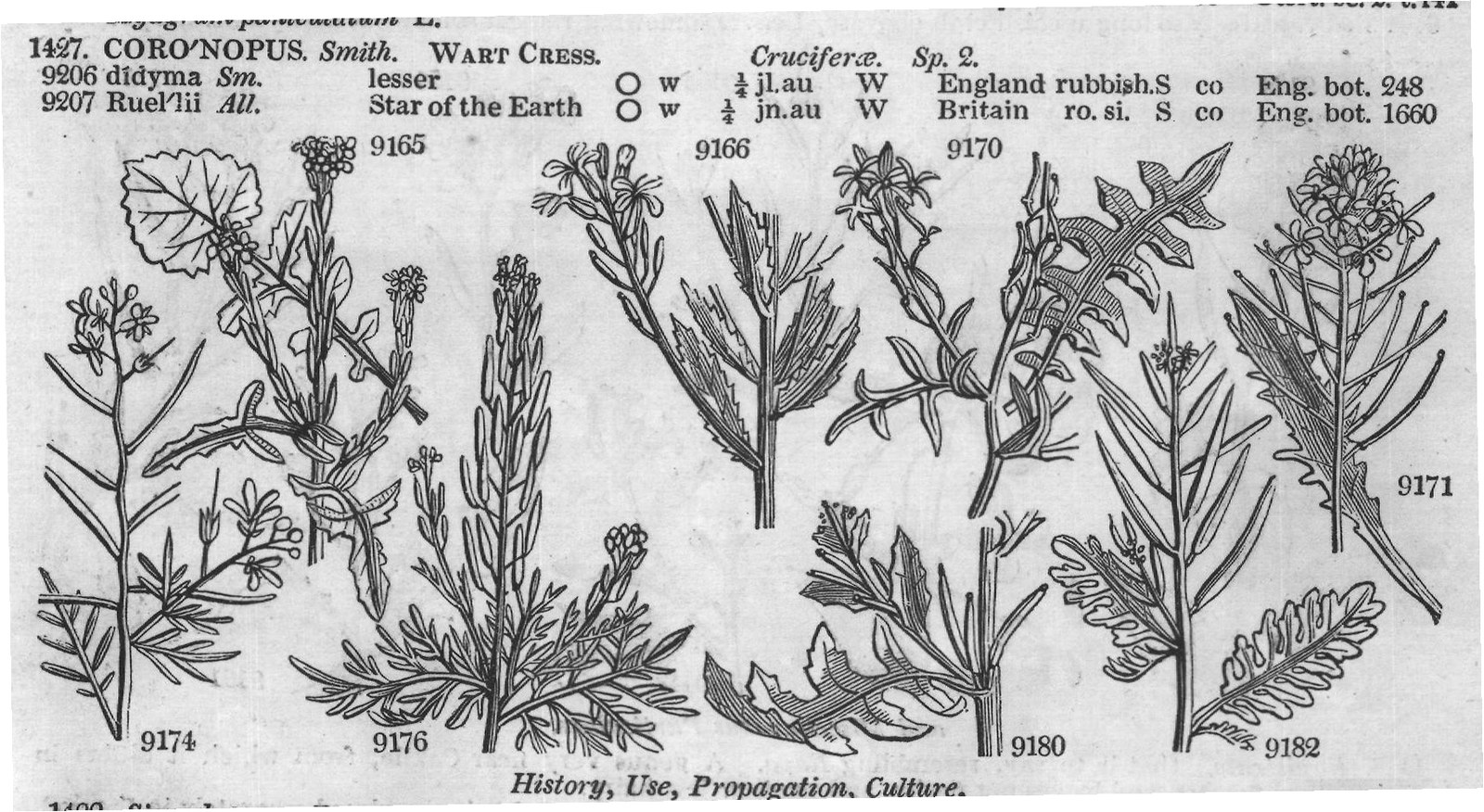
Star of the Earth w jlau W jn.au W 9165 9166 England rubbish.S co Britain ro. si. S. co 9170 Eng. bot. 248 Eng. bot. 1660 9174 9176 9180 9182 9171 History, Use, Propagation, Culture, 1422. Sisymbrium. Σiσύμβρiov was the name given by the Greeks to some aquatic plant not now recognized. It appears to have had an agreeable smell. Ovid advises that Venus should be propitiated with garlands appears to have had an agreeable smell. Ovid advises that Venus should be propitiated with garlands of myrtle, of roses, and of Sisymbrium. S. officinale is a celebrated medicinal plant, and esteemed diuretic, the French call it Herbe aux chantres. 1423. Alliaria. From allium, garlic, in allusion to the smell of the leaves of this plant, for the sake of which it was formerly used in salads. 1424. Erysimum. From εξvω, to cure, on account of the salutary effects of this plant in medicine. It is even now reckoned a powerful cure for the sore throat. The plant of the ancients appears to have been our garden reckoned a powerful cure for the sore throat. The plant of the ancients appears to have been our garden cress; for Pliny says the Gauls called his Erysimum velar, and the garden cress is to this day called vilhar in CLASS XV.
TETRADYNAMIA. 9165 Leaves runcinate hairy, Stem hairy, Siliques subulate appressed to the rachis 9166 Leaves lanceolate stalked toothed pubescent 9167 Leaves smooth glaucous: lower stalked runcinate pinnatifid; upper linear lanceolate entire 9168 Leaves lanc. toothed sessile smooth, Stem branched divaricating, Siliques erect roundish smooth 9169 Leaves pinnated, Lobes oval oblong blunt sinuate-toothed with rounded recesses, Stem hispid backward [base at sinuate-toothed with rounded recesses, Stem hispid backward at 9170 Stem and lvs. smth. : rad. runcin. ; caul. pinnatifid, Lobes and recesses acute, Cal. much spread. Pods rough 9171 Stem pods and lvs. smooth : rad. runcin. ; cauline cut or pinnatifid, Lobes and recesses acute, Cal. spreading 9172 Stem and leaves smooth runcinate pinnate, Lobes toothed terminal elongated, Cal. and pods spreading erect 9173 Stem villous somew. hoary, Leaves runcinate pubes. Lobes toothed or ent. acute, Pods nearly erect, Cal. lax 9174 Lower leaves runcin. hispid with toothed lobes : upper pinnated smooth with lin. ent. lobes, Pods spreading 9175 Lvs. smth. pinnat. with obl. blunt somew. tooth. lobes, Pedic. very sh. Pods muric. rough point. with sh. style 9176 Leaves bipinnate with oblong linear cut lobes, Pedicels 4 times as long as calyx, Petals smaller than calyx 9177 Leaves about 3-pinnate hoary with very small blunt lobes, Stem 1 shrubby, Petals larger than calyx very small blunt lobes, Stem shrubby, Petals larger than calyx 9178 Lvs. pinnated, Segm. lanc. cut serrated outer confluent, Petals larger than calyx, Pods shorter than stalk confluent, Petals larger than calyx, Pods shorter than stalk 9179 Pedic. axillary very short solitary, Pods erect downy, Leaves sinuate pinnatifid, Stem downy backwards 9180 Pedic. about 3 axill. very short, Pods erect smooth, Lvs. sinuate runcin. Lobes acute toothed lowest largest 9181 Pedic. very short axill. or naked, Pods and stems erect hispid, Leaves smoothish obl. acutely runcin.-pectin. 9182 Leaves lyrate pinnatifid smooth, Stem erect leafy, Pedicels thick shorter than calyx 9183 Rad. leaves lyrate: cauline pinnat. Lobes linear ent. term. largest, Pedic. slender almost shorter than alyx 9184 Leaves linear entire, Branches and pedicels glandular and hairy, Pods glandular 9185 Leaves cordate, Pods prismatical much longer than pedicel 9186 Leaves ovate roundish, Pods lanceolate the length of their stalk 9187 Pods length of style: when young covered by the persistent calyx, Fl. sessile, Leaves linear entire 9188 Pods much longer than style when young having a persistent calyx, Fl. subsessile, Leaves linear entire having a persistent calyx, Fl. subsessile, Leaves linear entire 9189 Pods thrice as long as style 2-edged naked, Fl. on short stalks, Leaves oblong lanceolate sinuate toothed 9190 Leaves lanc. toothed pubescent with a 3-parted down, Stem branched, Pods lax, Stigma 2-lobed [of pod 9191 Lvs. obl. lanc. somew.tooth.pub.with 3 -part. down, Stem straight round, Length of style great. than breadth 9192 Lower leaves runcinate toothed upper lanc. undivided, Fl. branches and pods comp. 4-cor. erect spreading 9193 Lvs. lanc. somew. toothlet. roughish green, Pods erect spread. twice as long as stalk, Stigma small subsessile 9194 Leaves linear lanc. repand-toothed, subpubes. Pods spreading torulose scarcely thicker than short pedicel 9195 Lvs. lin. entire and stem cinereous with appressed 2-parted hair, Pods somew. erect, Stigma stalked emarg. . 9196 Lvs.lin.ent.or somew.tooth.somew. hoary with 2-part. hair, Claws long. than cal. Pods erect, Stig. near sess, 9197 Lower lvs. lanc. toothed upper somewhat linear entire, Petals roundish obovate, Claws longer than calyx 9198 Leaves lanceolate toothed narrowed at base, Petals obovate oblong, Pods spreading, Style scarcely any 9199 Leaves lin. obl. : lower toothed runcin. and stem pubesc. rough, Pods spreading, Style very short and thick 9200 Leaves membranous smoothed cauline cordate sagittate stem-clasping oblong; radical stalked ovate 9201 Rad. lvs. obov.: cauline cordate stem-clasping, all blunt smooth glauc. Sides of square stalk without nerves 9202 Pods cuneate pyriform with 4 ribs and a longish style, Leaves lanceolate nearly entire 9203 Pods roundish pyriform with 4 ribs and a longish style, Leaves repand toothed 9204 Pods globose, Leaves oblong serrate toothed bluntly stem-clasping at base, Stem smooth serrate toothed bluntly stem-clasping at base, Stem smooth 9205 The only species 9206 Leaves pinnatifid, Lobes oblong toothed or cut, Pods compressed twin netted 9207 Lvs. pinnatifid, Lobes ent. toothed or pinnatifid, Pods somew. acute compressed with crested rugose valves or pinnatifid, Pods somew. acute compressed with crested rugose valves 9185 9193 9201 9205 9206 9188 9196 and Miscellaneous Particulars. 9202 the Basque tongue, and in other dialects of France beler or veler. From the seeds of E. perfoliatum, a plant not known in this country, oil for lamps is expressed in Japan. 1425. Camelina; that is to say, chama-linum, dwarf flax. C. sativa is cultivated in many parts of Europe for the seeds, from which oil is obtained. For the method of its culture see Parmentier, in Roz. Cours d' Agric., obtained. For the method of its culture see Parmentier, in Roz. Cours d'Agric., v. xi. p. 291. Bosc. Dict. d'Agr. 3. p. 45. Galliz. Bot. Agr. 3. p. 170. 1426. Neslia. A name first employed by M. Desvaux, but not explained by him. A genus allied to Camelina, but well distinguished by its one-seeded indehiscent silicles. 1427. Coronopus. From κoρωvη, a crow, and πες, a foot. The leaves are deeply cut, and resemble the feet of a bird. Coronopus Ruellii was formerly gathered and used as a salad, but has long since been deservedly neglected. C. niloticus is said, by Delile, to be used in Egypt for the same purpose. Nn 4 un jn.jl un 1 s un 1 jn.jl un jl.au un 1 jn.jl un 1 ap.au un ijn.jl 9223 bonariénse L.
Oun 2 my.jn W 9224 piscídium Forst. ec 1 S 1428. LEPI/DIUM. L.
PEPPERWORT. 9208 Drába L.
Whitlow 9209 chalepénse L.
Aleppo 9212 satívum L. 9210 glastifólium Desf. woad-leaved 9211 coronopifólium Fisch. Buckshorn-lv. 9218 campéstre R. Br. 9214 hírtum Smith. 9215 spinósum L. 9216 virgínicum L. 9217 subulátum L. 9218 ruderále L. 9219 vesicárium L. 9220 perfoliátum L. 9221 Cardámines L. 9222 divaricátum H. K. common Cress hoary field hairy prickly Virginian awl-leaved narrow-leaved bladdery various-leaved Spanish Cress close-spiked Buenos Ayres Fish-poison TETRADYNAMIA. 业 Cruciferæ.
Aun 1 my.jn W un 1 my.jl W un my.jl W Oun 1 my.jl W cul 1 jn.jl W Sp. 23-56.
Europe 1596. D co Aleppo 1798. S co Barbary 1823. S co Siberia CLASS XV.
Jac. aust. 4.t.315 Desf. atl. t. 147 Zorn. ic. 16 1824. D co W 1548. S co W Britain fields. S co Eng. bot. 1385 1 jn.jl W Britain fields. Sco Eng. bot. 1803 1385 W Levant 1787. S co W America 1713. Sco Sch. han. 2.t. 180 W Spain 1739. S p.1 W Britain sea co. S co D. Asso ar.t.6.f.3 Eng. bot. 1595 W Crimea 1820. S co Bux. cent. 1.t.26 unjl W Austria 1640. S co Jac.aust. 4. t.346 W Spain 1789. C co Arduin.sp.1.t.18 un 1 my.au W C. G. H. 1774. C p.l W S. Amer. 1732. S co Society Isl. 1779. S co Dil.el.t.286.f.370 9225 oleráceum Forst. eatable O cul 3 s W N. Zeal. 1824. S co 9226 lyrátum L. lyrate Oun 2 jn.jl W Levant S co 9227 latifólium L. broad-leaved Aun 2 jn.jl W Britain sea co. D co Eng. bot. 182 9228 crassifólium W.&K. thick-leaved 9229 graminifólium Cav. bushy 9230 I'beris L. diandrous 1429. ETHIONEMA. R. Br. ÆTHIONEMA. 9231 saxátile R. Br. rock 9232 Buxbaúmii Dec.
Buxbaum's 9233 monospermum R. Br.one-seeded 440.000 A un my.jn W Hungary 1820. D co Aun 2 au.s W un 1½ jl.au W Europe 1683. D co Germany 1793. S co W. et kit. 1. t. 4 Cav. ic. 151. f. 2 Lob. ic. 223 Cruciferæ. Sp. 3-9. cu jn.jl F cu jn.jl cu jl.au 1430. ISA'TIS. L.
WOAD. 9234 arména L.
Armenian 9285 lusitánica Brot.
Portugal or or jl.au Y 1 my Y 9236 alpína All.
Alpine 9237 præcox Kit. early or 1 my.jn Y 9288 littoralis Stev. sea side or 1½ my.jn Y 9239 tinctória L. 9240 campéstris Stev. field or 9241 canéscens D. C. hoary or 1½ my.jn Y 1 my.jn Y 3 ibérica Stev.
Iberian or 9242 aléppica Scop. oriental or 1 my.jn Y 1 jn.jl Y 1431. MYA'GRUM. L.
MYAGRUM. 9243 perfoliátum L. perfoliate pr jn.jl Pa. Y France 1432. BRASSICA. L.
CABBAGE. 9244 olerácea L. common 9208 cu 9210 S. Europe 1759. S co Pa.pu Levant 1823. S co Pa.pu Spain 1778. S co Cruciferæ. Sp. 9-17. or jn.jl Y common dyer's ag 4 my.jl Y Levant 1825. S co Portugal 1822. S co Italy 1800. D s.l Hungary 1822. Sco Tauria 1823. D co England corn fi. S s.l Persia 1824. D co S. Europe 1822. S co Iberia 1823. S co Levant 1739. S s.1 Cruciferæ. Sp. 1.
Cruciferæ. Sp. 12-34.
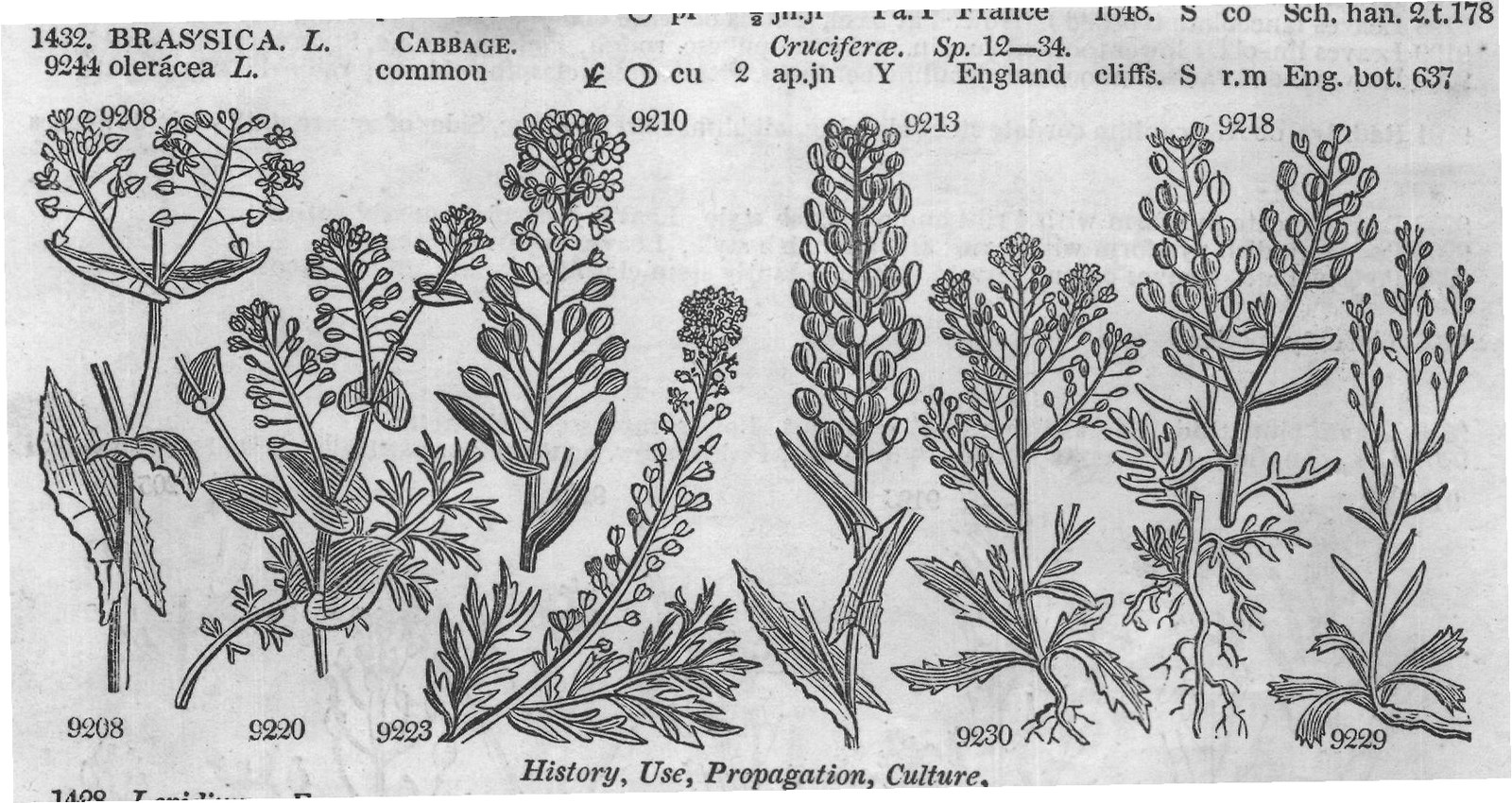
Jac.aust.3.t.236 Bu. cen. 1.t.5.f. 1 Desv. 3. t. 25. f.6 Buxb cent. 1.t.5 2 ap.jn Y England cliffs. Sr.m Eng. bot. 637 All. ped. t. 86.f.2 Eng. bot. 97 Scop. ins. 2. t. 16 1648. S co Sch. han. 2.t.178 9213 9218 9208 9220 9223 9230 9229 History, Use, Propagation, Culture, 1428. Lepidium. From λεπiς, a scale. The form of the silicles is that of little scales. L. piscidium is used by the natives of the Society Islands for the purpose of catching fish by inebriating them. It was used by the the natives of the Society Islands for the purpose of catching fish by inebriating them. It was used by the English voyagers as a salad, but it was very pungent. L. oleraceum is a powerful antiscorbutic, and is found of great service to the crews of ships visiting New Zealand; it resembles lettuce in taste, and acts as a moderate aperient. IL.. sativum, the common garden cress, is a salad-plant known to every one, and which even the cook can cultivate on moistened cloth or wool in a moist heat. cook can cultivate on moistened cloth or wool in a moist heat. Watering with water, impregnated with mudevelopement of the seeds. 1429. Æthionema. So named by Mr. R. Brown, apparently in allusion to some tawny or sunburnt tinge in the stamens. From aiθω, to scorch, and vημa, a stamen. Smith . 1430. Isatis. From iσάζω, to render equal. The plant was believed to destroy, by its simple application, all roughness and inequalities of the skin. It was formerly called glastum , from the Celtic glas, blue, whence Glastonbury derived its name. The ancient Britons colored themselves with the blue preparation obtained from this plant, whence they received their appellation, Britho being the Celtic word for to paint. The Picts were so named by the Romans for the same reason. On account of the brightness of its manufactured colors Anglo-Saxons obtained their name of waad or wad, and the English the word woad. I. tinctoria is in occasional cultivation for its leaves, from which a dye, as a substitute for indigo, is obtained. The seeds are sown on well prepared land in good heart; fresh broken old pasture land is preferred; and the great object is to have large leaves ; for which purpose, as Miller observes, the culture given by the best gardeners to spinage should be imitated, that of sowing on a very rich well pulverised soil, thinning the plants so as they may not touch each other , keeping them perfectly clear of weeds, and frequently stirring the soil between the plants. The culture applied to the turnip in Northumberland would succeed well with woad. The seeds are sown in July, and the plants, when they come up, weeded and thinned; next July, or earlier, the first crop of leaves may be gathered , and two or three others will be ob- CLASS XV.
TETRADYNAMIA. 9208 Pods cordate somewhat turgid entire at the end exceeded by the style, Leaves stem-clasping lanc. toothed 9209 Pods elliptical twice as long as stalk, Style filiform, Leaves with acute stem-clasping lanceolate auricles 9210 Pods ellipt. smooth shorter than stalk, Style filif. Leaves with blunt stem-clasping obl. bluntly toothed auric. 9211 Pods ellipt. ent. somew. downy pointed with style, Cal. somew. persistent, Rad. lvs. pinnat. : caul. lin. ent. 9212 Pods orbicular winged, Leaves variously divided and cut, Branches not spiny 9213 Pods ovate winged emarginate scaly, Cauline leaves sagittate toothed 9214 Pods ovate winged emarginate hairy, Cauline leaves sagittate villous nearly entire 9215 Pods oblong winged emarginate about 2-horned smooth, Radical leaves pinnatifid with cut lobes 9216 Pods orbic. emarg. shorter than stalk, Flowers with 2-4-stamens, Caul. lvs. lin. lanceol. cut-serrate smooth with 2-4-stamens, Caul, lvs. lin. lanceol. cut-serrate smooth 9217 Pods ovate somewhat emarginate, Leaves subulate entire, Stem shrubby 9218 Pods ovate emarg. spreading shorter than stalk, Leaves smooth: radical pinnatifid, Fls. diandrous apetal. 9219 Pods elliptical slightly emarginate, Leaves pinnatifid, Lobes linear, Joints of stem inflated 9220 Pods ellipt. slightly emarg. Lower lvs. stalked pinnatifid with multifid lobes upper cord. amplexicaul entire pinnatifid with multifid lobes: upper cord, amplexicaul entire 9221 Pods oval somewhat emarginate, Leaves pinnatifid with oval entire lobes terminal large roundish 9222 Pods oval somew. emarg. approximat. Lower leaves pinnati. with spread. acute lobes, Stem much branched Lower leaves pinnati. with spread. acute lobes, Stem much branched 9223 Pods orbicular emarginate, Flowers diandrous, Leaves all pinnately multifid minutely ciliated 9224 Pods oblong obovate emarginate, Stigma exserted, Leaves oval-oblong toothed outwardly or entire exserted, Leaves oval-oblong toothed outwardly or entire 9225 Pods ovate acutish, Leaves smooth ellipt.-oblong deeply serrated upper entire somewhat serrated at end deeply serrated: upper entire somewhat serrated at end 9226 Pods ovate pointed with stigma, Lower lvs. stalked lyrate pinnatifid, Lobes cut toothed term. very large 9227 Pods ovate pointed with the stigma, Leaves ovate lanceolate undivided subserrate, lowest on long stalks 9228 Pods ovate pointed with stigma, Leaves smooth somew. fleshy entire, Rad. stalked ovate caul. sess. sagitt. . 9229 Pods elliptical pointed with stigma, Stems 1/22 shrubby, Radical lvs. obov. obl. toothed cauline linear entire 9230 Pods ovate pointed with stigma, Rad. leaves cut or pinnatifid cauline linear entire, Stem much branched 9231 Silicles 2-celled many-seeded obcordate, Valves winged at back and entire, Racemes in fruit lax 9232 Silicles 2-celled 2-seeded round emarg. at base and end, Racemes very close, Valves winged at back and ent. and end, Racemes very close, Valves winged at back and ent. 9233 Silicles 1-celled 1-seeded not opening emarginate at end, Leaves oval or obovate 9234 Silicles round cordate at base with a wide margin pointed with the style 9235 Silicles obov. with a broad edge cuneate at base very blunt and emarginate at end, Stem and leaves smooth 9236 Silicles oval-oblong blunt at each end with a leafy winged margin 3 times as long as broad 9237 Silicles elliptical blunt at each end with a coriaceous winged edge three times as long as broad 9238 Silicles obl. cuneate very blunt truncate emarginate narrowed at base, three times as long as broad narrowed at base, three times as long as broad 9239 Silicles cuneate accuminate at base somewhat spatulate at end very blunt three times as long as broad spatulate at end very blunt three times as long as broad 9240 Silicles oblong narrowed at base bluntish at end four times as long as broad [at end 9241 Silicles elongate-cuneate downy four times as long as broad and twice as long as the stalk which is obconical 9242 Silicles lin. blunt vill. with reversed down eight times as long as broad and three times as long as their stalk 9243 The only species 9244 Lvs. covered with glaucous pollen somew. fleshy repand or lobed even in their youngest state quite smooth 9231 9236 9239 9241 9242 9243 and Miscellaneous Particulars. 9244 tained during the season. The end of the second year the plants may be ploughed down, as the third year they will run to seed, and yield but small leaves. The leaves are pressed, and the juice treated as in making indigo (see Indigofera); but such is the cheapness of the latter article, that no British farmer can afford to raise any sort of substitute. 1431. Myagrum. An ancient plant, so named from its properties of catching flies, which the modern plant does not possess ; μuia, a fly, aγρa, capture. 1432. Brassica. The etymology of this word has been explained with great learning and ingenuity by Vossius, Ray, Dalechamp, and others. It comes, however, from the Celtic bresic, which signifies a cabbage. This genus affords the well known pot herbs and roots, and also the oil plant rape, extensively cultivated in agriculture. There is scarcely an instance in the vegetable kingdom of a plant that produces varieties so different in appearance and qualities as the B. oleracea ; comparing the original plant as it is found on our shores, with wavy sea-green leaves, no appearance of a head, and flowering like wild mustard or charlock, with the red cabbage or cauliflower, the difference is astonishing. A new arrangement of the cultivated species of Brassica has been made by Professor Decandolle (Hort. Trans. vol. 1., and in his Reg. Veg.), whose varieties, or races of B. oleracea, are stated above.
The colza of the Dutch he makes a distinct species (B. campestris), and also the turnip (B. rapa); the rape (B. napus), and the summer rape of the Germans (B. præcox). In Hungary, in the territory of Alba, the B. elongata is cultivated for its oil, for which purpose it is said to be better adapted than any other species.
The culture of all the Brassica tribe is so universally known that it would be a waste of space in a work of this sort to enlarge on it. They all prefer a loamy soil, well enriched with manure; and manures of the strongest kind, as nightsoil, offals from the shambles, blood, &c. are not found too powerful for common cabbage or cauliflower. The turnip prefers a lighter soil than the cabbage tribe, but it must be well manured, and if the Chou Palmier, &c. field ag 2 in Swedish Turnip Oag 13 jn Turnip cul 2 ap Rape ag 2 my Kohl-reps ag 2 my cul 4 jl un jn.au ẞ acephala Dec.
Cavalier Cabbage Thousand-headed Cabbage Chou möellier 9245 campéstris L.
ẞ rutabága Dec. 9246 Rápa L. 9247 Nápus L. 9248 præ'cox W. & K. 9249 chinénsis L. 9250 repánda Dec.
Chinese repand TETRADYNAMIA.
Garden Varieties.
Borecole Chou de Milan costata Dec.
Chou à grosses côtes CLASS XV bullata Dec.
Savoy Cabbage Brussels Sprouts, &c. &c.
England fields. S s.1 Eng. bot. 2234 Cove tronchuda Y Y Sweden ...
S co Y England corn fi. S r.m Eng. bot. 2176 Y Y Britain dit. ba. S co Europe Eng. bot. 2146 1812. S co Y Y China 1770. S s.l D co ... 9251 Richérii Vill.
Richer's un 1 jl Y ... 9252 monénsis Huds.
Isle of Man O un jn.au Y 9253 erucástrum L. runcinate-leav'd un 1 jn.au Y 9254 elongáta Ehr. stalk-leaved un 3 my.jn Y 9255 cheiranthiflóra Dec. stock-leaved Ráphanus cheir.W. 1433. SINA'PIS. L. 9256 nígra L.
ẞ túrgida Pers. 9257 lævigáta L. 9258 integrifólia W. 9259 júncea L. turgid smooth un 1 jn.au Y MUSTARD.
Cruciferæ. common ag 4 my.jn Y ag 4 my.jn Y entire-leaved fine-leaved 9260 chinénsis L.
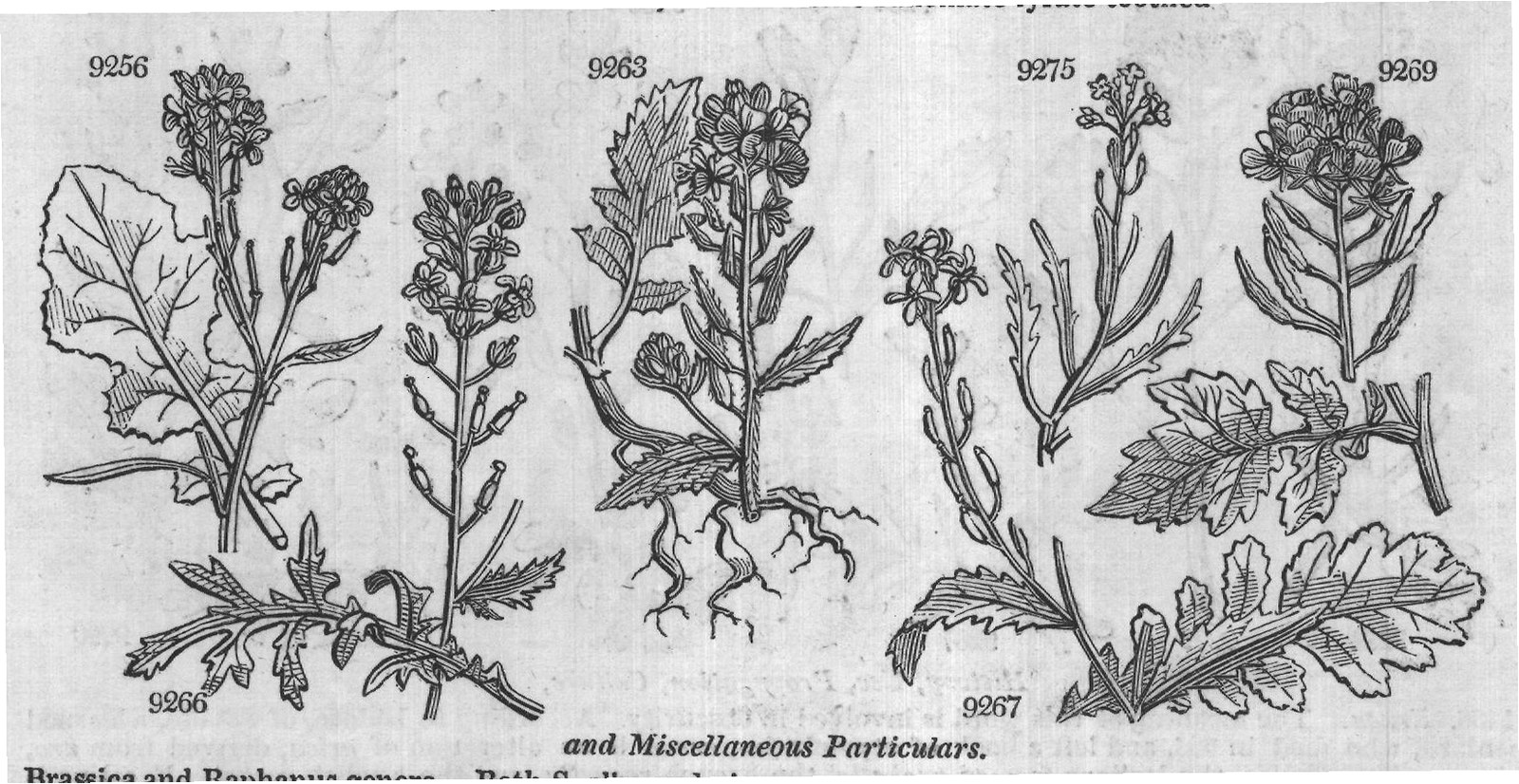
Chinese 9261 brassicáta L. cabbage-leaved Oun 1 jl.au Oun 1 jn.jl Y cul Oun 1 un 2 jn.jl Y Y Y 9262 pubéscens L. 9263 arvénsis L. downy Charlock Aun 2 jn.jl Y Ow 1 my.jl Sicily Y 1782. S co 1801. S co 1789. Dr.m Britain corn fi. S s.1 jn.jl Y S. Europe S. Europe Britain sea sh. S s.l S. Europe 1790. S s.l Hungary 1801. S s.1 Spain 1806. S co Sp. 18-51.
Vil. dauph. 3. 39 Vil.dauph.3.t.36 Eng. bot. 962 Bull.herb.331 Pl. rar. hu. 1.t.28 W.hort.ber. t.19 Britain corn fi. S r.m Eng. bot. 969 Britain corn fi. S r.m Spain 1769. S co E. Indies 1804. S co China 1710. S co China China Wil.hor.ber.t.14 Jac. vind.2.t.171 Ard. spec. 1. t.10 D co 9264 orientális L. oriental Oun 1 jn.jl Y Levant 9265 Káber Dec.
Persian O un 1 jn.jl Y Persia 9266 Alliónii Jacq.
Allioni's Oun 2 jn.jl Y ...... 9267 incána L. hoary-jointed Y 9268 heterophylla Lag. various-leaved 9269 álba L. white 9270 híspida W. hispid 9271 dissécta Lag. cut 9272 foliósa W. leafy 9273 frutéscens H. K. shrubby 9245 un 2 jl un 1 mr.ap Y Spain un 1 ap.my Y cu 1 jn.d Y Levant Brássica arvénsis L. 1434. MORICAN DIA. Dec. MORICANDIA. 9274 arvensis Dec. 1435. DIPLOTAX'IS. Dec. DIPLOTAXIS. 9275 pendúla Dec. 9276 híspida Dec. 9277 erucoídes Dec.
Sinápis erucoides L.
Cruciferæ.
Sp. 1-3. cabbage-flower.w 1½ jn V S. Europe 1739. co Boc.sic.t.25.f.3,4 Cruciferæ. pendulous hispid dwarf 9246 Oun 1 f.mr un Y ap.my Y Sp. 9-13.
Barbary 1823. S co Egypt un 1 jn.jl W.pu S. Europe 1736. r.m Jac. vind. 2.t.170 Desf. atl. t. 156 ... co un 3 jl un 14 my.jn Y ag 3 jn.jl Y Y 1778. S s.1 Sco 1789. S co S. Europe 1771. S co Jac. vind.2.t.169 Spain 1822. Sco Britain corn fi. S r.m Eng. bot. 1677 Morocco 1804. Sr.m Scho. Maroc. t.4 1820. S co Madeira 1777. C s.l Ardui.spec.1.t.9 Eng. bot. 1748 Sch. han. 1.t.186 ...
Jac. vind.2.t.168 Sco ... 9247 9252 9254 9255 9274 History, Use, Propagation, Culture, manure be well fermented, so much the better for the garden turnip; in the fields, where it is buried in rows or drills, more littery dung will succeed The field culture of the turnip is become an important part of the agriculture of light soils; the best mode is by drills, as in Berwickshire and Northumberland, where are produced crops of treble the weight of those grown drills, as in Berwickshire and Northumberland, where are produced crops of treble the weight of those grown in the broad-cast manner in Norfolk. In the latter county a crop weighs from five to fifteen tons per acre twenty-five to thirty tons; and in Ayrshire as many as sixty tons have been raised on the statute acre. (Encyc. of Agric.) The cabbage has been tried as a field plant; but, though it has been said by Sinclair (Hortus Gram. Wob.) to produce more nutritive matter than either turnips or field beet, professional farmers have not found it to answer. more nutritive matter than either turnips or field beet, professional farmers have not found it to answer. Of all the Brassica tribe it may be observed, that they attain to much the greatest perfection in temperate climates, such as those of Britain and Holland. Without constant and liberal supplies of water, they are small , such as those of Britain and Holland. Without constant and liberal supplies of water, they are small in size, and rigid or stringy in texture. In France and in Italy, and warm climates, it is only the cauliflower and broccoli that attain a large size; and that, in Italy at least, is during the coldest months of the year, and aided by liberal waterings. But in Tarragona the cauliflower is said to reach the enormous weight of 40 lbs. 1433. Sinapis. In Greek σivaπi, said to be derived from nap, the Celtic designation of all plants resembling the turnip or cabbage. Our English word mustard, and the French moutarde, are modernizations of mustum turnip or cabbage . Our English word mustard, and the French moutarde, are modernizations of mustum ardens, hot must; the sweet must of new wine being one of the ingredients of the French mustard for the table. The seeds of all the species are hot, acrid, and will afford an oil by expression, and a powder or meal by drying and grinding, which might serve as the condiment mustard, S. nigra is more particularly adapted for the latter purpose, though it is often mixed with the seeds of S. alba and arvensis, and often with those of the CLASS XV. & capitata Dec.
Battersea Cabbage Early York Cabbage Early Dwarf Cabbage TETRADYNAMIA.
Garden Varietics.
Sugar-loaf Cabbage Penton Cabbage Red Cabbage, &c. &c. caulo-rapa Dec.
Chou-rave, or Kohl Rabi Chou-rave crépue, &c. &c. n botrytis Dec.
Cauliflower Brocoli, &c. &c. 9245 Lvs. fleshy with glaucous bloom: the lower when young somew. hispid or ciliat. lyrate toothed; the others [cordate amplexicaul acum. 9246 Rad. leaves lyrate without glauc. bloom rough; cauline cut: upper entire 9247 Lvs . smooth cœsious: radical lyrate; cauline pinnatifid and cren. cord.; upper lanc. stem-clasping 9248 Lvs. smooth cœsious : radic. and lower cauline lyrate; upper cord. lanc. stem-clasping cren. Pods erect 9249 Lvs. oval nearly entire: floral amplexicaul lanc. Cal. longer than the claw of the petals 9250 Radic. leaves fleshy smooth repand toothed, Scapes naked, Style slender distinct from silique 9251 Leaves smooth : lower stalked obl. somewhat toothed; upper linear ianc. few 9252 Leaves smooth somewhat fleshy glauc. pinnated with linear distant somewhat toothed lobes 9253 Leaves runcinate somewhat smooth, Lobes unequal bluntly sinuated, Stem hispid at base 9254 Leaves stalked: lower sinuate pinnatifid hispid; upper smooth toothed, Stem smooth 9255 Rad. leaves stalked lyrate pinnatifid somewhat hispid: cauline few with entire acute lobes 9256 Pods smooth about 4-cornered pressed to the peduncles, Lower lvs. lyrate: upper lanc. entire ẞ Pods turgid veiny diverging with a conical striated beak 9257 Smooth, Lvs. stalked lyrate pinnatifid with acute lobes, Petiole not auricled at base 9278 Smooth, Lvs. ovate lanc. undivided acutely toothed, Pods erect torose with a subulate style 9259 Smooth , Lower leaves ovate lanc. coarsely serrated: upper lanc, entire, Branches fascicled 9260 At the base and nerves hairy, Lvs. blunt cut pinnatifid, Lobes toothed, Pods erect pointed with the style 9261 Smooth, Caul. Ivs. cord . amplexicaul obl. entire: lower lyrate pinnatifid toothed, Pods spreading with a 9262 Lvs. pubesc. villous lyrate pinnatifid, Terminal lobe large ovate, Pod hairy Lvs. pube [conical beak 9263 Pods smooth with many angles torulose three times as long as their slender two-edged beak, Stem and lvs. 9264 Pods hairy backwards about 4 -cornered torulose shorter than the slender beak 9265 Pods smooth round with smooth valves twice as long as the conical beak 9266 Pods smooth ovate-oblong, Valves smooth scarcely longer than conical beak [hairy 9267 Pods smooth appressed to the raceme somew. torose, Stem branch. rough at base, Lvs. lyrate rough 9268 Pods downy appressed to raceme somew. torose, Stem bran. rough at base, Lvs. lyrate pinn. hispid on nerves 9269 Pods hispid spreading a little narrower than the ensiform beak, Lvs. lyrate and stem nearly smooth 9270 Pods hispid spreading a little narrower than the ensiform beak, Lvs. lyrate rough, Stem hispid backwards 9271 Pods suberect torulose shorter than the ensiform beak, Lvs. pinnat. Lobes narr. cut-toothed or pinnatifid 9272 Beak compressed very rough longer than the hispid pod, Lvs. lyrate repand angular smooth 9273 Calyx bisaccate, Lvs. coriaceous: lower oblong lanc. narrowed at base somewhat toothed 9274 Pods about 4-cornered, Cauline leaves cordate amplexicaul entire 9275 Pods pendulous stalked, Cauline leaves oblong hispid coarsely cut-toothed 9276 Pods pendulous sessile, Leaves obovate coarsely toothed hispid 9277 Pods sessile nearly erect, Style ensiform, Leaves sessile runcinate lyrate toothed 9256 9266 9263 9267 9275 9269 and Miscellaneous Particulars.
Brassica and Raphanus genera. Both S. alba and nigra are grown as small salads to be eaten with cress; they are sown as thick as the seeds will lie, in pots or boxes, or in the area of forcing-houses, in the winter season, and forced, or in beds in the open air, and cut as soon as the seed leaf is fully expanded. For flower of mustard, or for the seed for oil or medical purposes , both white and black sorts are sown in the fields in rich: well pulverized soil, in March or April, and kept free of weeds. The crop ripens in July and August, and is either threshed immediately or stacked like other grain. It is like other oleiferous seeds, exhausting for the soil, and such seeds as drop and are buried, will retain their vegetative qualities for an unknown length of time; so that where mustard has once been grown, it will come up occasionally for a century or more afterwards. If the seeds, Dr. Cullen observes, be taken fresh from the plant and ground, the powder has little pungency, but is very bitter; by steeping in vinegar, however, the essential oil is cooled, and the powder becomes pungency, CXis very bitter; by steeping in vinegar, however , the essential oil is cooled, and the powder becomes extremely pungent. In moistening mustard-powder for the table, it may be remarked, that it makes the best appearance when rich milk is used; but the mixture in this case does not keep good for more than two days. The seeds of both the black and white mustard are often used in an entire state medicinally. Half or a quarter of a wine glass of mustard seeds, swallowed fasting, about five in the morning, is the most powerful tonic and strengthener of the digestive organs which is known. 1434. Moricandia. Named by Decandolle, after his friend Stephen Moricand, author of the Flora Veneta, and an excellent Italian botanist. M. hesperidiflora is a favourite food of the camel, notwithstanding its intense acridity. 1435. Diplotaxis. From δiπλoς, double, and τaξiς, arrangement, on account of the double rows of seeds in each cell. 9278 cathólica Dec. Spanish 279 tenuifólia Dec. fine-leaved Sisym'brium tenuifólium L. 9280 murális Dec. sand Sisymbrium murale L. 9281 Barreliéri Dec. small TETRADYNAMIA. un 1 ap.my Y CLASS XV.
Spam 1822. S co un 1 jl.o Y England walls. D s.l Eng. bot. 525 Oun 1 jl.s Y England san.pl. S co Eng. bot. 1090 un jn.jl Pa.Y S. Europe 1770. S co Barr. ic. 1016 9282 vimínea Dec. twiggy un my Y S. Europe ...
S co Bocc. sic. 10 9283 saxátilis Dec. rock un jn Y S. Europe D co ... 1436. ERU CA. Tourn.
ROCKET.