Important: Safety Warning
This page prescribes plants as medicine according to pre-modern medical theory. Several of the plants named are toxic, correct identification is difficult, and the doses given have no scientific basis. Do not ingest or apply any preparation described here.
This page presents medical treatment from an era before modern medicine. The remedies described are ineffective against the conditions named, and some of the ingredients or doses are harmful. Do not use them to treat any illness; consult a qualified medical professional.
This information has been left in for historical purposes but should not be acted upon.
Home › T › Thymelææ (Sp jl au W Thymel S s C s p C)
Thymelææ (Sp jl au W Thymel S s C s p C)
Sp.1-3. 1 jl.au W Thymelææ. 1750. S s.1 1768. C.s.p 1792. C s.p 1786. C s.p 1788. C s.p 1783. C s.p 1786. C s.p 1820. C s.p 1822. C s.p ...
CLASS VIII.
Bot. reg. 292 Bot. reg. 19 Bot. mag. 1463 Bot. mag. 812 Bot. reg. 2 Bot. rep. 225 Bot. reg. 757 Jac. ic. 1. t. 68 S. Europe 1759. C s.p Sp. 8-19. 1 jn.au W C. G. H. 1752. C s.p Wen. ob. t.2.f.15 1 jn.s W S. Europe 1759. C p.1 Bot. mag. 1949 cu jn.s W C. G. H.
C s.p W C. G. H. 1789. C s.p Wen. ob. t.2.f.17 cu ap.my W C. G. H. 1759. C s.p Wen. ob. t.2.f.18 1 my.jn W C. G. H. 1789. C s.p Bot. mag. 292 1 my.jn W C. G. H. 1787. C p.1 Bot. cab. 311 jn.jl W C. G. H. 1804. C p.1 Bot. cab. 755 cab. 311 915. LACHNE'A. W.
LACHNEA.
Thymelaa. Sp.5-28. 5557 conglomeráta W. clustered 5558 eriocéphala_W. woolly-headed 5559 purpúrea H. K. purple-flowered 5560 glaúca H. K. glaucous 5561 buxifólia Lam. green-box-leav. or ככככך or 2 jn.jl W C. G. H. 1773.
S r.m or 2 jn.jl WC. G. H. 1793.
C p.1 Bot. mag. 1295 or 2 jn.jl Pu C. G. H. 1800. C p.l Bot. mag. 1594 or 2 my.jl W C. G. H. 1800. C p.l Bot. mag. 1658 2 my.jl W C. G. H. 1800.
C p.1 Bot. mag. 1657 916. COMBRETUM. W. COMBRETUM.
Combretacea. Sp. 2-20. 5562 purpúreum W. purple or 15 jn.d S Madagasc.1818. Cr.m Bot. mag. 2102 5563 comósum Hort. comose உ or 20 ...
S. Leone 1821. Cr.m Pu DIGYNIA. 917. GALENIA. W.
GALENIA.
Chenopodeæ.
Sp. 1-3. 5564 africána W.
African cu 2 jn.au W C.G. H. 1752. C p.1 Lam. ill. t. 314 918. APHANAN'THE. Lk. APHANANTHE. 5565 celosioídes Lk.
Amaranthacea. Sp. 1.
Cock's-comb 业 cu 1 jl W.G Brazil 1813. C p.l 919. WEINMAN(NIA. L. WEINMANNIA. 5566 pinnáta L.
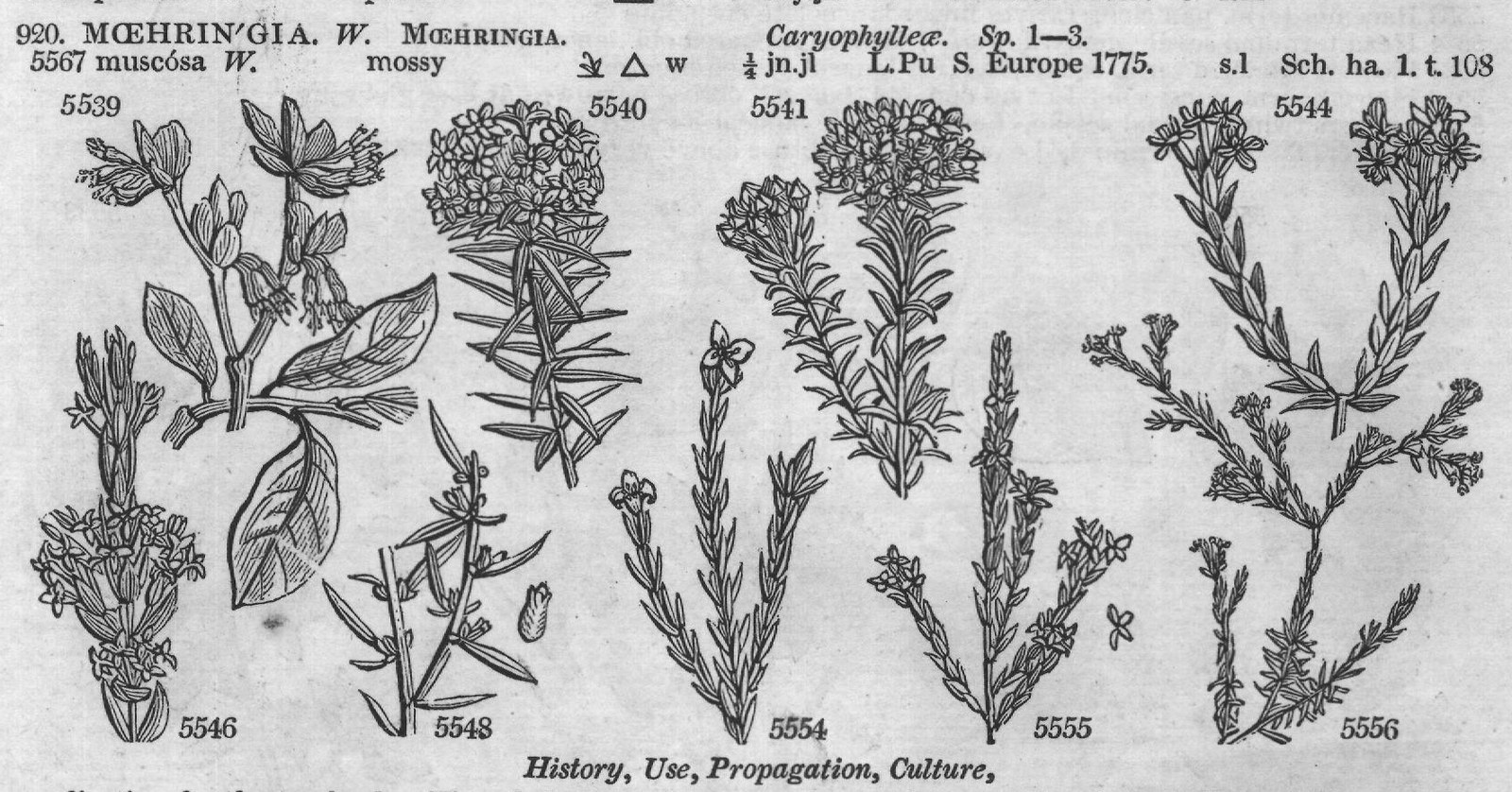
Saxifrageæ. Sp. 1-12. pinnate or 6 my.jn W Jamaica 1815. Cr.m 920. MEHRIN'GIA. W. MOEHRINGIA. 5567 muscósa W. mossy W Caryophylleæ. Sp. 1-3. jn.jl L.Pu S. Europe 1775. 5539 5540 5541 s.l Sch. ha. 1. t. 108 5544 5546 5548 5554 5555 5556 History, Use, Propagation, Culture, application for the toothach. The whole plant is extremely acrid, especially when fresh, and if retained in the mouth excites great heat and inflammation, particularly of the throat and fauces. The berries when swallowed prove a powerful poison, not only to man, but to many quadrupeds. Both the bark and the berries of Mezereon in different forms have been long used externally in cases of obstinate ulcers and ill-conditioned scres. In France the bark is used as an application to the skin, which, under certain management, produces a serous discharge without blistering, and is thus rendered useful in chronic cases of a local nature, answering the purpose of what is called a perpetual blister, while it occasions less pain and inconvenience. In our own country the Mezereon has been principally employed in syphilitic cases. The branches make a good yellow dye.
D. Laurecla is valuable in the shrubbery as thriving under the shade and drip of other trees, and never growing to an unshapely size and figure, and in the nursery as affording stocks for the more rare species. The roots and other parts of the plant possess similar qualities to those of the Mezereon. 911. Dirca. From δiρκa, a fountain. A plant which grows in watery places. Bois de Plomb, Fr. This shrub grows in hilly swamps in North America: it is in all its parts remarkably tough, and the twigs are in consequence used for rods, and the bark for ropes, baskets, &c. Layers are generally two years in rooting; cuttings do not succeed, and it does not ripen seeds here. Snails, Sweet observes, are particularly fond of this plant. 912. Gnidia. One of the names given by the ancients to the Daphne. These plants "thrive well in a sandy peat soil, with their pots well drained with broken potsherds: care must be taken not to over water them, or to let them flag for want of water, as their roots are very tender and are easily killed; the tenderest kinds are G, oppositifolia, and G. pinifolia. (Bot. Cult. p. 198.) ORDER I.
OCTANDRIA MONOGYNIA. 5539 The only species. Flowers appearing before the leaves 5540 Leaves scattered 3-cornered, Flowers in umbellate heads, Scales four bearded 5541 Leaves scattered 3-quetrous linear acute: floral lin. lanc. shorter than heads, Scales eight beardless 5542 Leaves all linear acute, Flowers terminal sessile, Scales four and cor. smooth 5543 Leaves scattered lanc, smooth, Flowers capitate surrounded by bractes, Peduncle naked 5544 Leaves opp. lanceolate tomentose, Flowers terminal, Scales 4 5545 Leaves opp. ovate tomentose, Flowers terminal, Scales 8 5546 Leaves ovate oblong imbricated hairy with naked nerves 5547 Leaves opp. ovate smooth, Fl. terminal subcapitate 5548 Leaves linear, Flowers axillary sessile 4-cleft 5549 Leaves lin. convex imbricated in 4 rows, Branches downy 5550 Leaves fleshy smooth outside, Stems downy 5551 Leaves linear smooth, Fl. sessile in terminal filiform silky heads 5552 Leaves linear smooth, Heads stalked downy 5553 Leaves lin. opposite, Flowers term. solitary, Branches smooth 5554 Quite smooth, Leaves oblong acute concave rugose outside, Fl. term. sessile solitary 5555 Leaves ovate villous, Flowers lateral solitary 5556 Leaves ovate scattered, Flowers capitate, Branches lax cernuous 5557 Heads clustered, Leaves loose 5558 Heads solitary woolly, Flowers imbricated in four rows 5559 Leaves opp. imbricated 4 ways, Heads smooth 5560 Leaves scattered elliptical ovate, Heads woolly 5561 Leaves oval sessile very smooth, Fl. capitate woolly 5562 Leaves opposite ovate acute, Racemes one-sided bracteate, Bractes shorter than peduncle, Fl. decandrous 5563 Leaves opp. oblong hairy, Racemes numerous terminal one-sided DIGYNIA. 5564 Erect shrubby, Leaves linear fleshy 5565 Flowers loosely spiked very minute, Bractes lanceolate membranous 5566 Leaves pinnate, Leaflets obovate crenate smooth 5567 Leaves linear connate, Sepals flat the length of the stem-joints lanceol, acute 5558 5564 5559 5565 5567 5562 5561 5566 and Miscellaneous Particulars. 913. Stellera. So named by Gmelin, in memory of Georg. Wilh. Steller, adjunct of the academy at Petersburg, who collected plants in Kamtschatka, and died in Siberia, in 1746. An inconspicuous plant resembling the next genus and requiring the same culture. 914. Passerina. From passer, a sparrow. Its seed has an appendage at the end like the beak of a sparrow. Young cuttings root freely under a bell-glass in sand. 915. Lachnæa. Derived from λaχvη, wool, on account of the woolly heads of flowers. 916. Combretum. A name employed by Pliny. The plant of the ancients could have no relation to the plant now called by this name, which is a genus of splendid climbing shrubs, with beautiful branches of flowers which are often crimson or purple, and sometimes white. A number of species are found at Sierra Leone. They are all stove plants. 917. Galenia. So named by Linnæus from the famous physician Claudius Galenus, born at Pergamus, 133 years before the Christian æra. A coarse-looking shrub, with the leaves obscurely papillose or bladdery, and the stem round. 918. Aphananthe. A name contrived from a, privative, φaivω, to be remarkable, and avθoς, a flower: that is to say, a plant which is not remarkable for the beauty of its flowers. A curious little Brazilian weed. 919. Weinmannia. In honor of John William Weinmann, a German botanist, who published in 4 vols. folio, his Phytanthoza Iconographica, about the middle of the last century. Handsome shrubs, with pinnated leaves. 920. Mæhringia. So named by Linnæus, from Paul Henry Gerard Moehring, a physician, author of Hortus Proprius, 1736. A little inconspicuous weed-like plant. It suits very well for rock-work, or to be grown in small pots.
Y 3 OCTANDRIA TRIGYNIA.
CLASS VIII. 921. POLYGONUM. W. PERSICARIA.
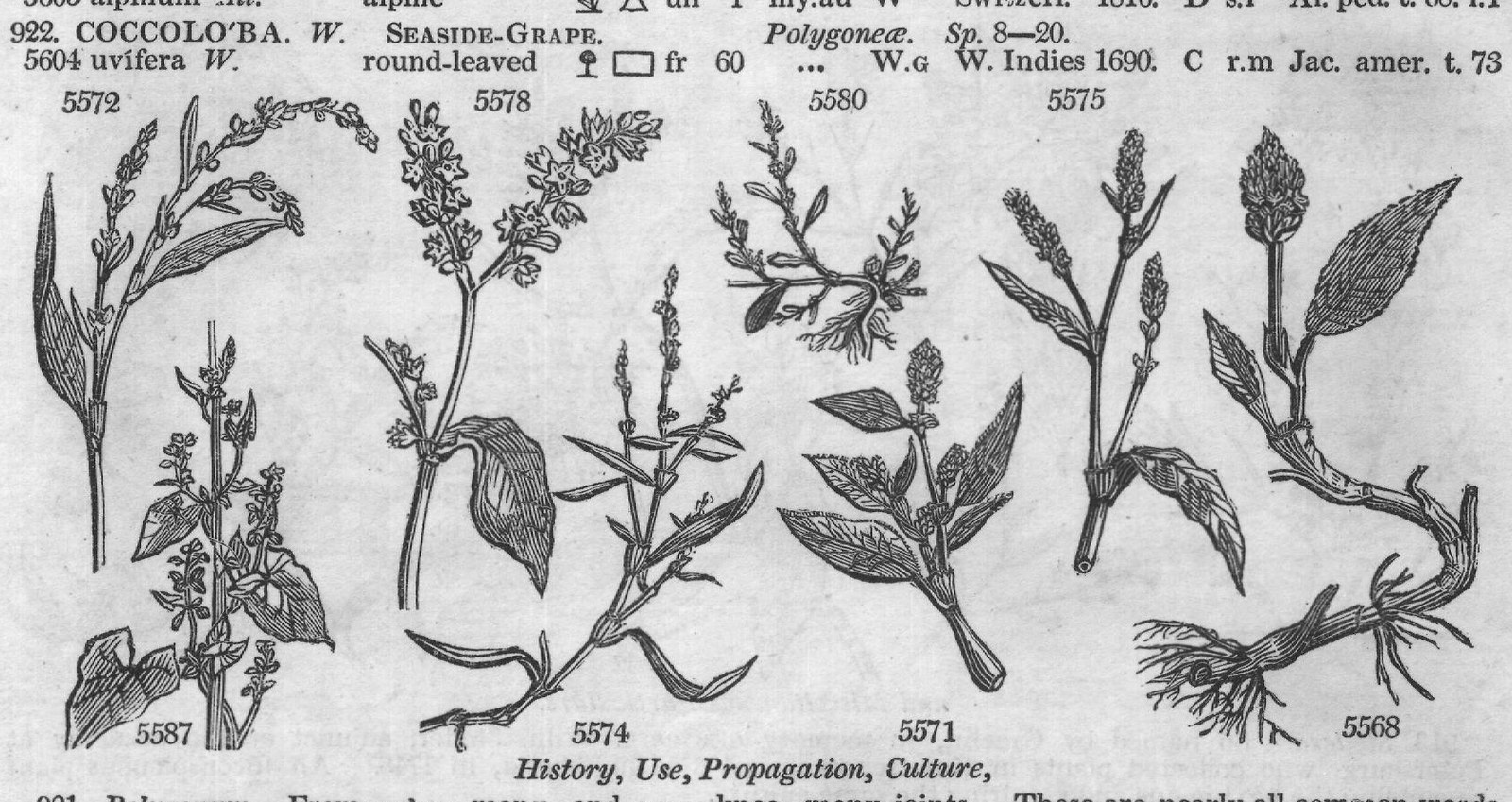
Polygoneæ. Sp. 36-60. 5568 amphíbium L. amphibious W 1 jn.au Pk 5569 ocreátum L. spear-leaved pr 2 jn.s 5570 virginiánum L.
Virginian W 3 au,s W.G W Britain dit. D s.l Siberia 1780. D s.l N. Amer. 1640. D s.l 5571 lapathifólium H. K. pale-flowered W 1 jn.s G 5572 Hydropíper L. Water Pepper w 1 jl.s R 5573 tinctórium Loureiro dyer's dy 2 jl.au R 5574 mínus W. small W au.s Pk 5575 Persicária L. spotted W 2 jl.au Pk 5576 incánum Schmidt hoary 5577 barbátum L. bearded * 5578 orientále L.
ẞ álbum common white-flowered ১৪০০ W 2 jl.au W cu 2 jn W or 6 jl.o R or 4 jl.o England dungh. S s.l Britain wat. pl. S s.l China 1776. C s.l England wat.co. S s.1 Britain dit. S s.l Germany 1804. S s.1 China 1819. S s.l E. Indies 1707. S co W.G E. Indies 1781. S co Eng. bot. 436 Gmel. sib. 3. t. 8 Pa. th. 857. f. 6 Eng. bot. 1382 Eng. bot. 989 Eng. bot. 1043 Eng. bot. 756 Pet. h. br. t. 3.f.8 Bot. mag. 213 5579 frutéscens W. 5580 aviculáre L. 5581 arenárium Bieb. 5582 élegans Tenore. 5583 eréctum L. 5584 chinénse W. 5585 sagittátum W. 5586 arifólium W. 5587 Convólvulus L. elegant upright Chinese shrubby or 2 jl.au Pk Siberia 1770. L s.l Bot. reg. 254 Knot-grass sand W 3 ap.o G W 1 my.au Pu W 1 jlau P.R arrow-leaved dy 6 jl.au cu 6 jl.au W.G W.G 5588 dumetórum L. bush un 12 my.s W 5589 scándens L. 5590 littorále Lk. 5591 Bellar'di All. 5592 acetósum Bieb.
American-clim. un 12 jl.s sea-shore Pk Bellardi's sour Aun 1 jn Aun 1 jn.jl Oun d 5593 críspulum B. M. 5594 Bistórta L. upright Apr 1 jl.au Snake's-weed 5595 vivíparum L. 5596 divaricátum L.
Alpine-Bistort pr my.s divaricating Aun 2 jl.au 5601 emarginátum Roth. notch-seeded 5597 undulátum L. 5598 acídulum W. en. 5599 salígnum W. en. 5600 tatáricum L. 5602 Fagopýrum L. Buck-Wheat 5603 alpínum All. alpine 922. COCCOLO'BA. W. SEASIDE-GRAPE. 5604 uvífera W. round-leaved 5572 5578 wave-leaved ✓ un 3 jn.jl narrow-leaved Willow-like Tartarian Aun 2 jn.jl un 4 my.au un 2 jl.au O cu 2 jl.au ag 2 jl.au Pk Pk pr 2 ap.au W.G Arum-leaved cu 6 my.o common-climb.w 3 my.s Am 1½ my.s W.G Britain rubble. S co Hungary 1807. S co Naples 1824. D co N. Amer. 1792. D s.l China 1795. S s.1 N. Amer. 1759. S s.1 W.G N. Amer. 1816. S s.1 Britain corn.fi. S s.1 S. Europe 1803. S co N. Amer. 1749. D co W.G S. Europe W.G S. Europe ...
W.G Crimea 1820. S co W.pk Siberia 1800. C s.l Pk Britain me. pa. D co W.G Britain W.G Siberia al. pas. D s.l 1759. D co 1789. D s.1 1816. D s.l 1816. D s.l 1759. S s.l China 1796. S s.l England corn.fi. S s.l Switzerl. 1816. D s.1 Sp. 8-20.
W.pk Siberia un 1 my.au W Polygoneæ. fr 60 ...
W.G 5580 Pl. rar. hu. t. 67 Bur. in. t. 30. f. 3 Lin. hor. cl. t.12 Pl. am. t. 398. f.3 Eng. bot. 941 Flor. dan. t. 756 Pl. al. t. 177. f. 7 W. Indies 1690. Cr.m Jac. amer. t. 73 5575 Eng. bot. 1252 Sco Sco ...
W.G Siberia W.G Siberia W.G Siberia Bot. mag. 1065 Eng. bot. 509 Eng. bot. 669 Gm. si. 3.t.11.f.1 Gmel. sib. 3. t.10 Gm. si. 3.t.13. f.1 Eng. bot. 1044 Al. ped. t. 68. f.1 5587 5574 5571 History, Use, Propagation, Culture, 5568 921. Polygonum. From πoλuς, many, and you, knee, many joints. These are nearly all common weeds of temperate climates. P. Bistorta, being one of the strongest vegetable astringents, might well be applied to the purpose of tanning leather, if it could be procured in sufficient quantity. The young shoots were formerly eaten in herb-puddings in the north of England, where the plant is known by the name of Easter Giant, and about Manchester they are substituted for greens under the name of Patience Dock. (Curtis, Withering.) The root was formerly considered to be alexipharmic and sudorific. P. viviparum is so named on account of the flowers frequently changing into vegetable bulbs. The roots have the same qualities as those of P. Bistorta, and are eaten in Sweden and Lapland, Siberia and Tartary. P. amphibium is one of the most difficult weeds to eradicate from recovered alluvial lands, and has no equal in this respect unless Equisetum. The roots, which in the water are properly stems, are found to a great depth in such soils; and though by fallowing or otherwise stirring the surface, the leaves may be prevented from showing themselves for several years; yet if the field be allowed to lie a year in grass, the surface will be found abounding with Polygonum. Many tracts in Scotland which have been recovered from rivers and estuaries for an unknown series of years still abound with this plant, and as under such circumstances it never advances so far as to flower and seed, the individuals must be the same which formerly were suspended in the water. As an aquatic, it has a gay, showy appearance, when in flower. P. Hydropiper is a powerful diuretic, and will dye woollen cloth of a yellow color, P. tinctorium, and also chinense and aviculare, are cultivated in China for dying cloth of a beautiful blue or green.
ORDER I.
OCTANDRIA TRIGYNIA. §1. Flowers pentandrous. 5568 Half digyn. Spike ovate, Stipules lacerate, Leaves oblong or lanceolate 5569 Flowers trigynous, Leaves lanceolate 5570 Flowers half digynous, Cor. 4-cleft unequal, Leaves ovate 2. Flowers hexandrous. 5571 Flowers digynous, Stipules unarmed, Pedunc. rough, Seeds depressed on each side 5572 Flowers half digynous, Leaves lanc. wavy not spotted, Spikes filiform nodding 5573 Flowers trigynous, Spikes twiggy, Stipules smooth truncate ciliated, Leaves ovate acute smooth 5574 Flowers nearly monogynous, Leaves lin. lanceol. flat, Spikes filiform erect, Stem rooting at base 5575 Flowers half digynous, Spikes ovate-oblong erect, Pedunc. smooth, Stipules ciliated 5576 Flowers digynous, Spikes oblong, Leaves obl, lanceolate pubescent beneath 5577 Flowers trigynous, Spikes twiggy, Stipules truncate ciliated, Leaves oblong acute smoothish §3. Flowers heptandrous. 5578 Flowers digynous, Leaves ovate, Stem erect, Stipules hairy hypocrateriform §4. Flowers octandrous. * Stem twining. 5579 Leaves lanceolate narrowed each way, Stipule lanceol. shorter than the joint. - TRAGOPYRUM. Bieb. 5580 Flowers axill. Leaves ellipt. lanceol. rough at edge, Nerves of stipules remote 5581 Flowers trigynous, Spikes term. leafless, Leaves lanc. lin. Stems angular declinate herbaceous 5582 Flowers large axillary, Spike compact, Stem stout sheathed 5583 Flowers trigynous axillary, Leaves oval, Stem erect herbaceous 5584 Flowers trigynous, Peduncles rough, Leaves ovate stalked, Bractes cordate sessile 5585 Leaves sagittate, Stem prickly 5586 Leaves hastate, Stem prickly 5587 Leaves cordate sagittate, Stem angular, Segm, of cal. obtusely keeled 5588 Leaves cordate, Stem smooth, Leaves keeled winged 5589 Leaves cordate, Raceme simple axillary, Stem smooth 5590 Stem procumbent, Leaves oblong acute veiny fleshy, Stipules ciliated much shorter than the joints 5591 Flowers axill, trigynous, Leaves ellipt. lanceol. Sheaths ciliated 5592 Flowers trigynous axillary, Leaves lanceolate fleshy veinless, Stipules 2-parted * Stem not twining. 5593 Leaves stalked obovate mucronulate smooth with a crisp revolute edge 5594 Stem simple one-spiked, Leaves ovate wavy running down the stalk 5595 Stem simple one-spiked, Leaves revolute lanceolate at edge 5596 Flowers trigynous racemose, Leaves lanceolate smooth, Stem divaricating spreading smooth 5597 Flowers trigynous panicled, Leaves lanceolate wavy rough above pubescent beneath 5598 Flowers trigynous racemose-panicled, Leaves linear lanceolate smooth 5599 Flowers trigynous racemose-panicled, Leaves linear lanceolate smooth acuminate ciliated at edge 5600 Leaves cordate sagittate, Stem unarmed, Seeds toothed 5601 Leaves cordate sagittate, Stem unarmed, Seeds truncate at end emarginate winged 5602 Leaves cordate sagittate, Stem unarmed, Angles of seeds equal 5603 Flowers trigynous racemose-panicled, Leaves ovate lanc. smooth ciliated at edge 5604 Leaves cordate roundish shining 5602 5593 5595 5594 5596 5604 5588 and Miscellaneous Particulars.
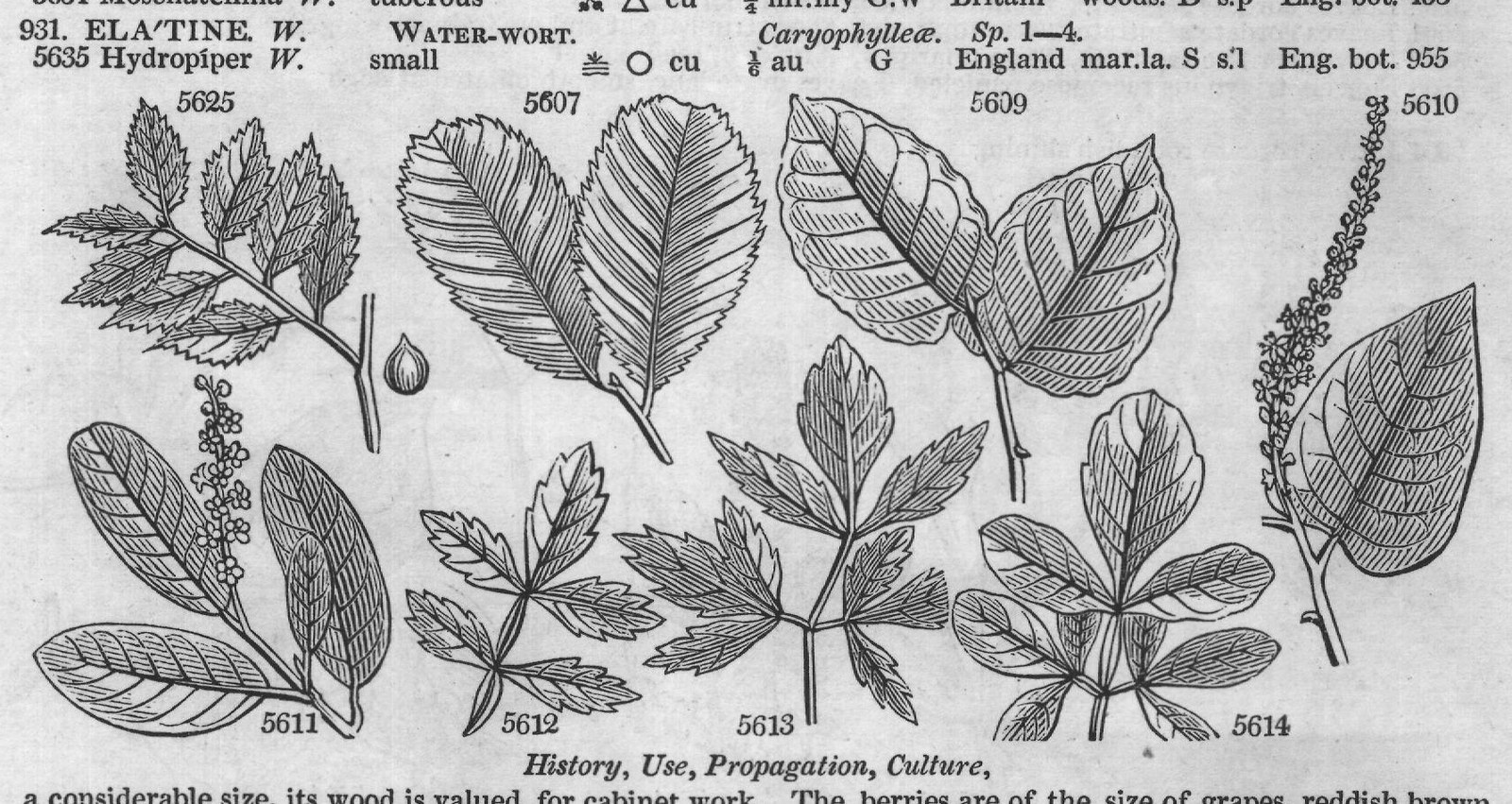
P. orientale is a well known annual, showy, and fit for shrubberies. The seeds were first sent to Europe by Tournefort, who saw it growing in the garden of the monks of the three churches near Mount Ararat. They cultivate this plant there, not only for the beauty of the flowers, but for its medicinal qualities, which are the same with those attributed to our common species. (Mill. Fig.) The seeds are farinaceous. P. aviculare is so named from the gratefulness of its seeds to small birds; the English name, knot-grass, from the knottiness of the stem, and because it is eaten by cattle; many such plants having obtained the name of grass, though they bear no similitude to real grasses. Hogs eat it with great avidity, and hence it is known in many countries by the name of hogweed. All other domestic quadrupeds are said to eat it. The seeds are useful for every purpose in which those of buckwheat are employed, but they are much smaller. P. Fagopyrum, (Fagus, beech, and πuρoς, corn, its grain is like the mast of beech,) properly beechwheat, Bled noir or Sarrazin, Fr. Buckwheat is considered a native of Asia and not of Europe, though sometimes found in a seemingly wild state. It will not, however, bear the frosts of our springs or the severity of winter. In China and other countries of the East, it is cultivated as a bread corn. The flower is also used in cookery and bread-making in various parts of Europe, to make cakes and crumpets in England, and as rice or gruel in Germany and Poland. The seed is said to be excellent for horses and poultry, the flowers for bees, and the plant green for soiling cows, cattle, sheep or swine. As an agricultural plant it is valuable, as standing only a short time on the ground; but it produces little straw for manure. 922. Coccoloba. From zozzoς, fruit, and λoβoς, a lobe; the fruit has three lobes. C. uvifera is a common tree in most of the sugar colonies, generally near the sea. It is remarkable for its large leaves, and when of Y.4 5605 latifólia Lam. broad-leaved or 20 5606 pubéscens W. 5607 excoriáta W. downy tm 70 oval-leaved tm 80 5609 barbadénsis W. 5611 laurifólia Jacq. 5608 punctáta W. 5610 diversifólia Jacq. 923. PAULLI'NIA. W. PAULLINIA. spear-leaved or 15 Barbadoes tm 60 various-leaved or 20 au laurel-leaved or 20 au 5612 pinnáta W. winged-leaved or 15 ... 5613 curassávica W. shining-leaved ☐ ☐ or 18 ... 5614 barbadénsis W.
Barbadoes or 16 ... 5615 polyphýlla W. 5616 caribæ'a Jac.
Supple-Jack or 20 ...
Caribæan or 10 ... 5617 meliæfólia Juss.
Beadtree-lvd. or 12 ...
OCTANDRIA TRIGYNIA.
W.G S. Amer. 1812.
W.G W. Indies 1690.
W.G W. Indies 1733.
W.G W. Indies 1733.
W.G Barbadoes1790.
W.G St. Dom. 1818.
W.G Caraccas 1822.
Sapindaceæ. Sp. 6-39.
W.G W. Indies 1752..
W.G S. Amer. 1739.
W.G W. Indies 1786.
W.G W. Indies 1739.
W.G W. Indies W.G Brazil 1819. ...
CLASS VIII.
Cr.m La. il. t. 316. f. 4 Cr.m Pl. phy. 222. f. 8 Cr.m Pl. ic. t. 146. f. 1 Cr.m Jac. am. 114.t.77 Cr.m Jac. obs. 1. t. 8 Cr.m Hook. ex. fl. 102 Cr.m Jac. sch. 3. t. 267 Cr.m Jac.ob.3.t.62.f.12 Cr.m Jac. ob. 3.t.61.f.8 C s.p Jac. ob. 3.t.62.f.9 Jac.ob.3.t.61.f.10 Jac. ob. 3. t.62.f.7 Hook. ex. fl. 110 R s.p Cs.p C s.p 924. SERIAʼNA. W.
SERIANA.
Sapindaceæ. Sp. 2-21. 5618 sinuáta W. sinuate-leaved ☐ 5619 caracásana W. 925. CARDIOSPERMUM. W. HEART-SEED. tooth-leaved 8 or 15 ...
W.G S. Amer.
C co ...
Jac. ob.3.t.61. f.2 or 15 ...
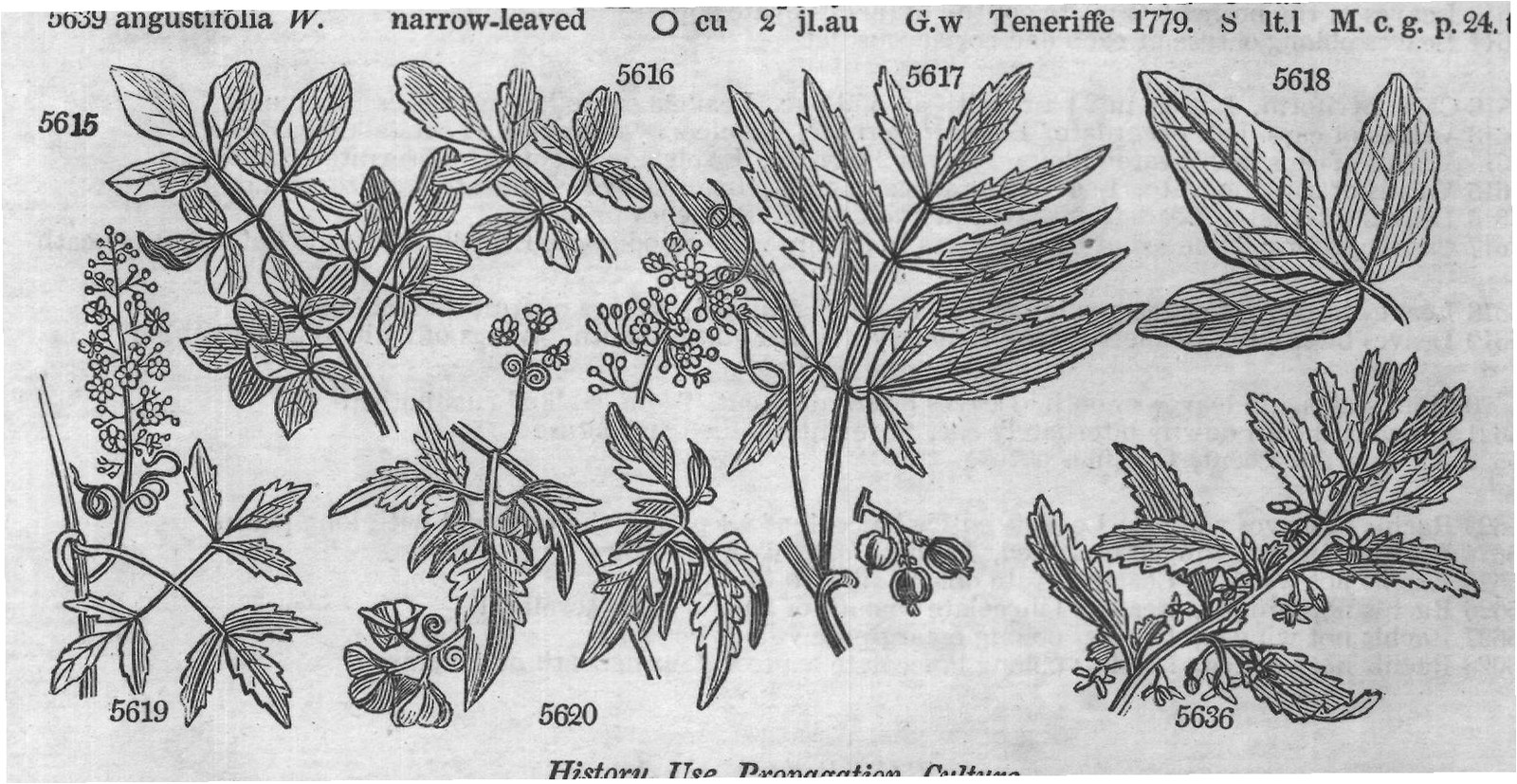
W.G Caraccas 1816. C co Jac. sch. 1. t. 99 Sapindaceæ. Sp. 3-12. 5624 marginatus W. en. edged 5626 longifólius Vahl. 5627 emarginátus Vahl. emarginated 5628 rubiginósus Roxb. rusty 5620 Halicácabum W. smooth-leaved 5621 Coríndum W.
Parsley-leaved 5622 pubéscens Lag. downy 926. SAPIN'DUS. W.
SOAP-BERRY. 5623 Saponária W. common 5625 rígidus W. cu 4 از W.G India 1594. S co Bot. mag. 1049 Ash-leaved long-leaved 11 어어어어어어 cu 4 jl.au W.G. Brazil 1750. S co cu 6 jn S N. Spain 1823. S co Sapindaceæ. Sp. 6-18. ec 20 ...
W.G W. Indies 1697. S p.1 Com. hort. t. 94 or ...
W.G Carolina ...
S p.l or 25 jl.s W.G America 1759. S p.1 Pl. alm. t.217. f.7 or 16 ... or 12 ... or 15 ...
W.G E. Indies 1820. S co W.G E. Indies 1822. Sr.m W.G E. Indies 1821. S p.l TETRAGYNIA. 927. VE REA. W. 5629 laciniáta P. S. 5630 crenáta W.
VEREA.
Semperviveæ.
Sp.3-8. cut-leaved Vere's 5631 acutiflóra Haw. white-flowered ΠΠΠ or 2 jl.au Y E. Indies 1781.
Ls s.l or 2 jl.s Y S. Leone 1793.
Ls s.l Plant. grass. 100 Bot. mag. 1436 or 2 jl.s W E. Indies? 1806.
Ls s.l Bot. rep. 560 928. BRYOPHYLLUM.
Sal. BRYOPHYLLUM.
Semperviveæ. Sp. 1. 5632 calycínum Sal. large-cupped ☐ cu 2 ap.jl G.Pu E. Indies 1800. Ls s.1 Par. lond. 3 929. PA'RIS. W.
PARIS.
Asphodeleæ? Sp. 1-2. 5633 quadrifólia W.
Herb cu my.jn G Britain woods. D p.1 Eng. bot. 7 930. ADOX'A. W. 5634 Moschatellina W. 931. ELA TINE. W. 5635 Hydropíper W.
MOSCHATEL. tuberous Saxifrageæ. Sp. 1. cu mr.my G.w Britain woods. D s.p Eng. bot. 453 WATER-WORT.
Caryophylleæ. Sp. 1-4. small cu au G England mar.la. S s.l Eng. bot. 955 5625 5607 5609 5610 5611 5612 5613 5614 History, Use, Propagation, Culture, a considerable size, its wood is valued for cabinet work. The berries are of the size of grapes, reddish brown or purplish without, with a thin pulp, rather astringent, and a large stone within. All the species grow freely in light loamy soil; and ripened cuttings, taken off at the joint, and placed under a hand-glass, in a pot of sand, will root freely: one cutting under a glass is sufficient, as the leaves must not be shortened. (Bot. Cult. 41.) 923. Paullinia. So named by Linnæus, from Simon Paulli, professor of botany at Copenhagen; author of Botanicum Quadripartitum, 1640, and Flora Danica, 1648. P. polyphylla affords a well known walking-stick. In the woods of Jamaica it rises with a slender, woody, tough, flexile stalk, and ascends among the bushes to a considerable height. When the wood is ripe it is cut down, barked, and used as riding or walking sticks. All the species succeed well in a light loamy soil; and large sized cuttings root in sand under a handglass. 924. Seriana. Named by Schumacher, after one Paul Serjeant. Cuttings root in sand under a hand-glass. 925. Cardiospermum. From κaρδia, a heart, and σπερμa, seed, in allusion to its round seeds, which are marked with a spot like a heart. The plant is remarkable for its inflated membranous capsule, from which it is sometimes called balloon vine. 926. Sapindus. A syncope of sapo-indicus, Indian soap. Its fruit is covered with a pulp, which is used in America for washing linen. S. Saponaria bears a berry as large as a cherry, inclosing a nut of a shining black when ripe. These nuts were formerly brought to England for buttons to waistcoats; some were tipped with silver, and others with different metals; they were very durable, as they do not wear, and seldom broke. The skin or pulp which surrounds the nut is saponaceous, and is used in America to wash linen; but it is very apt to burn and destroy it, if often used, being of a very acrid nature. The whole plant, especially the seed-vessel, being pounded and steeped in ponds, rivulets, or creeks, is ob- ORDER III.
OCTANDRIA TRIGYNIA. 5605 Leaves entire very broad contracted at base 5606 Leaves orbicular pubescent 5607 Leaves oblong-ovate acute cordate at base, Racemes pendulous 5608 Leaves lanceolate ovate 5609 Leaves cordate ovate wavy 5610 Leaves of the branchlets ovate, of the branches ovate cordate 5611 Leaves oblong obtuse at each end coriaceous flat 5612 Caps. pyriform, Leaves in 2 pairs with an odd one, Leaflets ovate lanceolate sessile crenate 5613 Valves of caps. half obcordate, Leaves 2 ternate, Leaflets oval crenate, Footstalk edged 5614 Valves of caps. half ovate villous, Leaves 2 ternate, Leaflets oval entire and serrated coriaceous 5615 Valves of caps. obovate, Leaves supradecompound, Leaflets ovate cuneate crenate at end 5616 Leaves biternate, Leaflets oval toothletted at end, Branches prickly 5617 Caps. pyriform 3-winged at end, Leaves in 3 pairs with an odd one, Leaflets subsessile pubescent beneath 5618 Leaves ternate, Leaflets ovate lanceol. toothed sinuated, Wings of fruit dilated behind 5619 Leaves biternate, Leaflets oblong remotely toothed quite smooth, Wings of fruit rounded behind 5620 Stem stalks and leaves smooth, Leaves biternately cut, Segm. stalked cut-toothed 5621 Leaves beneath downy biternately cut, Segments stalked cut obtuse 5622 All over pubescent, Capsules obtuse 5623 Rachis of leaves winged, Leaflets entire lanceol. of 3-4 pairs: the terminal with long points 5624 Rachis of leaves winged unarmed, Leaflets lanceolate of 6 pairs 5625 Rachis not winged, Leaflets ovate oblong smooth of 3 pairs 5626 Rachis not winged, Leaflets lanceolate smooth of 5 pairs: one terminal 5627 Rachis not winged, Leaflets oblong emarginate villous beneath 5628 Rachis not winged, Leaflets oblong lanceolate acute villous beneath of 3-5 pairs TETRAGYNIA.. 5629 Leaves 3-parted toothed: the floral linear entire 5630 Leaves obovate doubly crenate 5631 Leaves broad lanceolate opposite crenate thick, Segm. of cor. acute 5632 Leaves oval crenate, Flowers long pendulous cylindrical 5633 All the parts of the plant green and in fours 5634 The only species 5635 Leaves opposite, Flowers alternate stalked tetrapetalous 5634 5631 5635 5629 5630 5623 and Miscellaneous Particulars. 5633 served to intoxicate and kill the fish. Loureiro celebrates the berries, slightly bruised and steeped in water, as a very excellent soap; and remarks that it is only required to use them with prudence, all abstergents being in some degree corrosive. 927. Verea. So named after the late James Vere, Esq., a gentleman of fortune, who patronized gardening, and had once a fine collection of living plants. The species thrive best in sandy loam, and should be plunged in the bark pit to make them flower. The leaves placed on a pot of mould, or on the tan, will shoot out young plants from the notches of the margin. (Bot. Cult. 33.) 928. Bryophyllum. From βρω, to grow, and φuλλov, a leaf. If the leaves are laid upon damp earth their notches push forth roots, whence proceed young plants. This plant requires very little water, and the pot to pot to be well drained: it flowers best plunged in a tan heat; rich loamy soil suits it best. 929. Paris. According to some authors, this word is derived from par, equal; in allusion to the regularity of the parts of the plant. Few plants are more readily distinguished than this, by the proportion and regularity of all the parts. The regular number is four, or some aliquot part or multiple of that number. There are, however, sometimes only three leaves, and they are even said to vary from one to seven. The calyx also has sometimes three leaves. The leaves and berries are said to partake of the properties of opium; and the juice of the juice of the latter to be useful in inflammations of the eyes. Linnæus says, the root will vomit as well as ipecacuanha, given in a double quantity. It is a suspicious plant, which has nevertheless been used in medicine in a great variety of ways. 930. Adoxa. From a, privative, and δoξa, glory - inglorious. This plant is minute, and by no means beautiful, and grows in obscure places. 931. Elatine. From ελaτη, a fir, in Greek. Its fine leaves have been compared to those of a fir-tree. OCTANDRIA TETRAGYNIA. 932. HALO'RAGIS. W. HALORAGIS. 5636 Cercódia W.
Halorageæ. Sp. 1-5.
CLASS VIII.
G.R New Zeal.1772. C s.p Jac. ic. 1. t. 69