Home › T › Terebintaceæ (Sp ndica W)
Terebintaceæ (Sp ndica W)
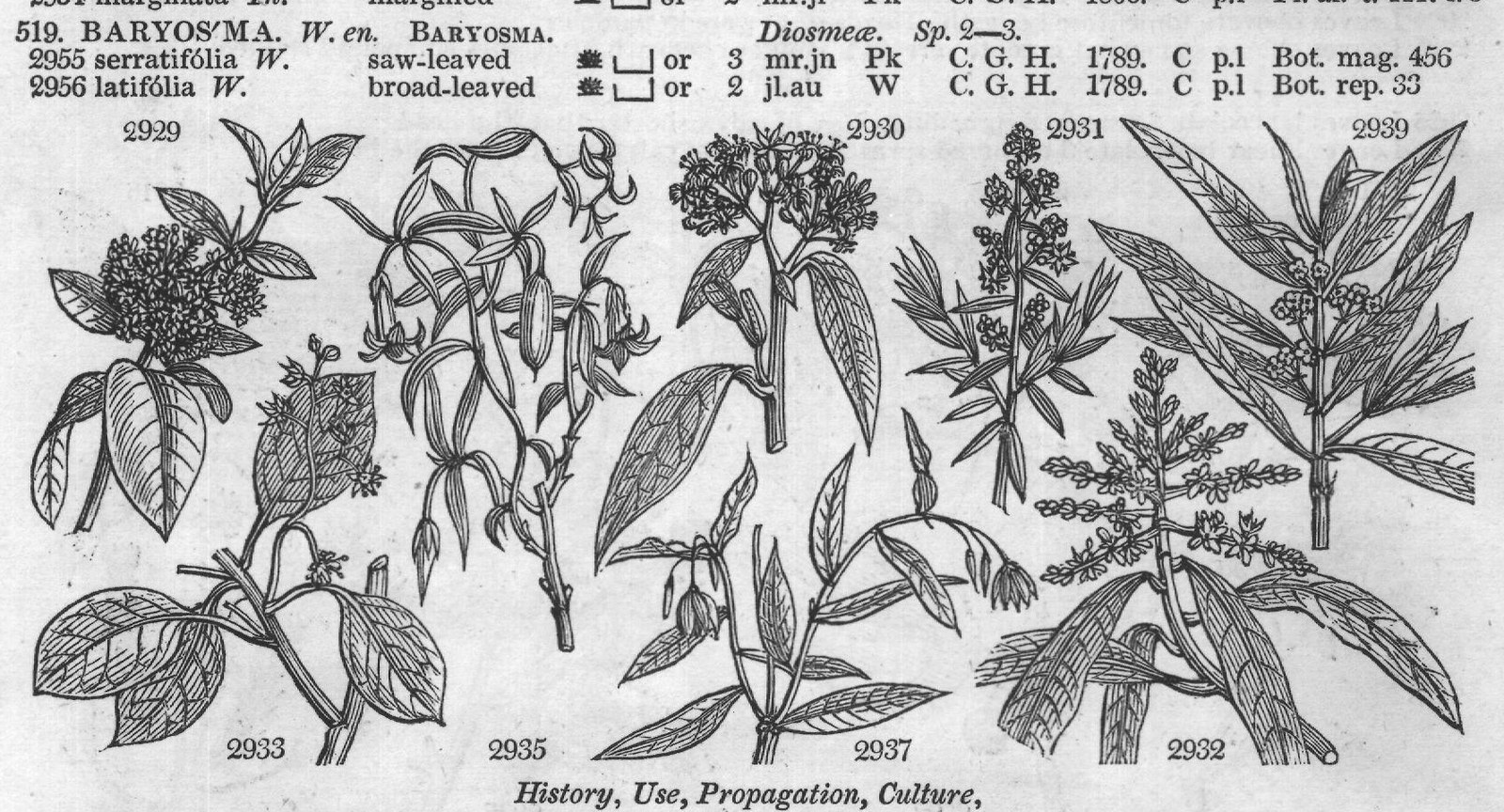
Sp. 1-3. 2932 índica W.
Indian 오 fr 514. SCHRE BERA. Retz. SCHREBERA. 2933 álbens Retz. whitish climbing 2935 mutábilis H. K. changeable 515. BILLARDIERA. Sm. APPLE-BERRY. 2934 scándens W. or 12 jn.au G 8 jn.s 2936 longiflóra Lab. blue-berried 2937 fusifórmis Lab. spindle-fruited 20 jn.s R.G E. Indies 1690. Sr.m Bot. rep. 425 Celastrince. Sp. 1.
G ...
Ceylon 1824. C p.l N. ac. h. 2. t.4.f.1 Pittosporeæ.
Sp. 4.
N. S. W. 1790. S s.p Bot. mag. 801 Pu N. S. W. 1795. S s.p.
Bot. mag. 1313 or 20 jn.s G V. Di. L. 1810. S s.p Bot. mag. 1507 or 8 jn.au B V. Di. L. 1823. S s.p Lab. n. h. 1. t. 90 516. ELÆODEN DRUM. W. OLIVE-WOOD. 2938 A'rgam W. 2939 orientále W. 2940 austrále H. K. 517. DIOSMA. W.en. 2941 oppositifólia W. 2942 lineáris W. 2943 hirsúta W. 2944 pectináta W. en. 2945 ericoídes W.
Rhamni. Sp. 3-6. spiny or 15 jl G.Y oriental or 12 W ... thick-leaved or 3 jn.au W Morocco 1711. C l.p Mauritius 1771. C p.l N. S. W. 1796. C s.1 Com. hor. 1. t. 83 Jac. ic. 1. t. 48 Vent. malm. 117 DIOSMA.
Diosmeæ.
Sp. 9-36. opposite-leaved or 3 mr.jl W C. G. H. 1752.
C p.1 Com. rar. 1. t. 1 linear-leaved or 1 mr.jl W C. G. H. 1800. C p.1 hairy-leaved or 4 mr.jl Pk C. G. H. 1731.
C p.1 Com. rar. 3. t. 3 pectinated or 1 ap.jn W C. G. H. 1812.
C L.p We. co. pl. 1. t. 8 Heath-leaved or 2 mr.jl W C. G. H. 1756.
C p.l Bot. mag. 2332 2946 cupressína W.
Cypress-leaved or 1½ jn.jl Pk C. G. H. 1790.
C p.l Pl. al. t. 279. f. 2 2947 tenuifólia W. en. slender-leaved or 2 ap.jn W C. G. H. ...
C p.l 2948 succulénta W. en. succulent-lvd. or 2 ap.jn W C. G. H. ...
C p.l We. co. pl. 1. t. 1 2949 capitáta W. pale-purple or 2 my.jn Pu C. G. H. 1790.
C p.1 518. ADENAN'DRA. W. en. ADENANDRA. 2950 uniflóra W. en.
Diosmeæ.
Sp. 5-8. one-flowered 2951 umbelláta W. en. umbel-flowered 2952 frágrans B. M. red-flowered 2953 álba Th. white-flowered 2954 margináta Th. margined 519. BARYOSMA. W.en. BARYOSMA. 2955 serratifólia W. saw-leaved 2956 latifólia W. broad-leaved コココココ ココ or 1 ap.jl Pk C. G. H. 1775.
C p.1 Bot. mag. 273 or 2 ap.jl Pk C. G. H. 1789.
C p.l Bot. mag. 1271 or 3 my.jl Pk C. G. H. 1812.
C p.l Bot. mag. 1519 or 2 mr.jl W C. G. H. 1800.
C p.l or 2 mr.jl Pk C. G. H. 1806.
C p.l Pl. al. t. 411. f. 3 Diosmeæ.
Sp. 2-3. or 3 mr.jn Pk C. G. H. 1789. C p.1 Bot. mag. 456 or 2 jl.au W C. G. H.
C.G.H. 1789. C p.l Bot. rep. 33 2929 2930 2931 2939 2933 2935 2937 2932 History, Use, Propagation, Culture, 512. Pomaderris. From πῶμa, a lid, and δεῤῥiς, a skin, on account of the membranous lid with which the cells of the capsule are covered. New Holland shrubs, with the habit of Ceanothus, from which they are distinguishable only by their fruit. Cuttings root freely in sand under a hand-glass. 513. Mangifera. From Manga or Manghos, the vernacular name of the fruit, and fero, to bear. This is a large spreading tree, bearing a fruit in great estimation in the East. The wood is brittle, brown, and used only for indifferent works. The leaves are seven or eight inches long, and two or more broad, lanceolate, entire, of a shining green, and sweet resinous smell. The flowers are produced in loose bunches at the ends of the branches. The fruit is a berried drupe, large, flattened like a lens, kidney-shaped; the flesh soft and pulpy, like a damascene plum; the shell almost kidney-shaped, of a leathery crustaceous substance, and onecelled. This fruit, when fully ripe, is yellow and reddish, replete with a fine agreeable juice; some are full of fibres, and the juice runs out of these on cutting, or with a little handling; but those which have few or no fibres are much the finest; they cut like an apple, but are more juicy, and some are as big as a large man's fist. It is esteemed a very wholesome fruit, and, except very fine pine-apples, is preferable to any fruit in India; gentlemen there eat little other fruit in the hot months; but if no wine be drank with it, the Mango is apt to throw out troublesome boils, at least with new comers, which are, however, conducive to health. In Europe we have only the unripe fruit brought over in pickle. Loureiro remarks, that there are many varieties, differing chiefly in the figure, size, color, and taste of the fruit, as apples and pears do in Europe. Retzius, on the contrary, affirms, that there are certainly several distinct species; the number of stamens in some being double; the racemes in others compound; the fruit kidneyshaped, globular, fleshy, almost juiceless, &c. According to Sweet, "the Mango ripens fruit in this country, when the plants are of a good size. Sandy loam, or a mixture of loam and peat, is most suitable to it, and the pots should be well drained, as the plants are apt to get sodden with too much water. Fresh seeds from the West Indies vegetate freely. The plant may also be increased from cuttings, which root best in sand under a hand-glass." (Bot. Cult. 77.) Knight, Hallet, and some other horticulturists are at present cultivating this tree with a view to its fruit. Knight recommends for such trees, training the shoots downwards, and at no great distance from the glass. There are trees in the garden of Earl Powis which must bear very soon. 514. Schrebera. Named after John Chr. Daniel Schreber, a German botanist, chiefly known by an edition of ORDER I.
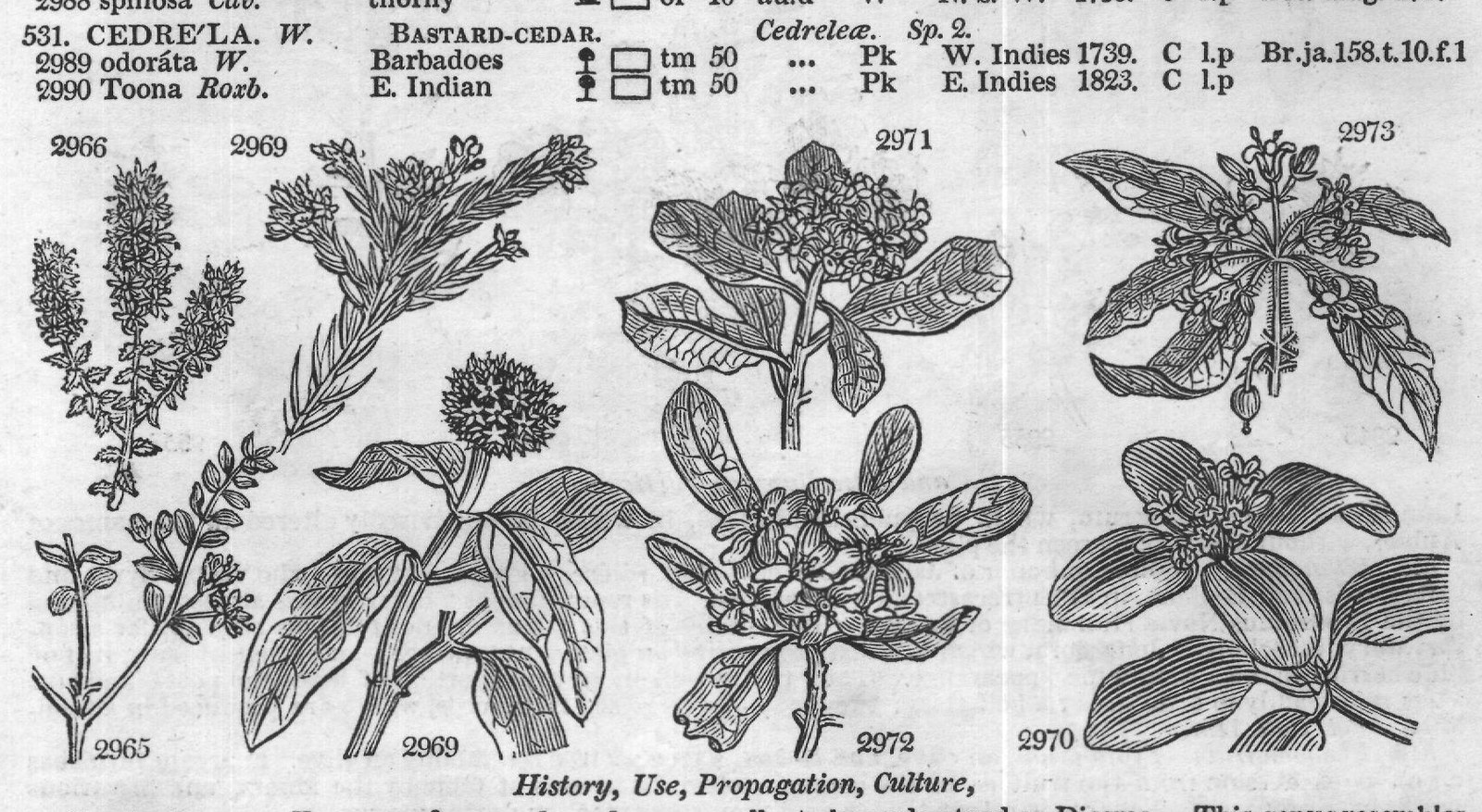
PENTANDRIA MONOGYNIA. 2928 Leaves ovate-oblong doubly-serrated tomentose beneath, Flowers apetalous in racemes 2929 Leaves oval tomentose beneath, Heads of flowers in umbels panicled 2930 Cymes panicled terminal, Leaves ovate lanceolate entire coriaceous rusty beneath 2931 Leaves linear, Flowers in axillary clusters as long as leaves 2932 Leaves lanceolate wavy, Panicles terminal many-flowered, Stamen 1 2933 The only species 2934 Peduncles solitary 1-flowered, Leaves somewhat hairy 2935 Leaves lanceolate linear, Peduncles solitary 1-flowered smooth, Fruit smooth 2936 Leaves smooth, Cor. cylindrical, Peduncles solitary 1-fl. Petals very long rolled inwards at edge 2937 Panicles fewflowered, Leaves somewhat hairy, Anthers connivent 2938 Branches spiny, Leaves ovate obtuse 2939 Leaves lanceolate acute with red veins 2940 Leaves elliptical coriaceous toothletted, Petals and stamens four 2941 Leaves 3-cornered obtuse ciliated, Flowers terminal 2942 Leaves linear obtuse smooth spreading, Flowers terminal solitary 2943 Leaves linear carinate mucronate villous, Pedunclés 1-flowered terminal corymbose 2944 Leaves 3-cornered acute dotted ciliated 2945 Leaves 3-cornered obtuse smooth, Flowers terminal solitary 2946 Leaves oblong lanceolate carinate appressed rough at edge, Flower terminal nearly solitary 2947 Leaves linear carinate mucronate ciliated upright, Peduncles 1-2 flowered corymbose terminal 2948 Leaves linear carinate acute thickish fringed upright, Flowers terminal subsessile solitary or 4 together 2949 Leaves 3-cornered villous-hispid imbricated, Flowers in spiked heads 2950 Leaves lanceolate smooth, Flowers terminal solitary, Calyxes fringed 2951 Leaves oblong smooth ciliated, Flowers terminal in umbels, Calyxes smooth 2952 Leaves ovate oblong glandular scattered, Peduncle glutinous aggregate terminal twice as long as leaves 2953 Leaves linear carinate mucronate at the edge cartilaginous and rough, Flowers axillary and solitary 2954 Leaves cordate, Lower ovate, Upper lanceolate, Umbels terminal 2955 Leaves linear lanceolate serrulate 2956 Leaves ovate crenate pubescent, Peduncles lateral 1-flowered, Branches downy 2945 2941 2950 2955 2952 and Miscellaneous Particulars. 2951 2956 Linnæus's Genera Plantarum, which he published in 1789, in which he unadvisedly altered all the names of Aublet, without ever having seen the plants. 515. Billardiera. Named in honor of Jacques Julien Labillardiére, a French botanist, who visited Syria, and afterwards New Holland, in D'Entrecasteaux's expedition. His reputation as a botanist was almost annihilated by the Prodromus Novæ Hollandiæ of Brown. The species of this genus are desirable as climbers for a conservatory, especially B. longiflora, which is a fast grower and an abundant flowerer; and when in fruit, its fine blue berries make a handsome appearance. They thrive well in an equal portion of loam and peat; and cuttings root readily in sand under a bell-glass: they may also be raised from seeds, which are produced in abundance. (Bot. Cult. 149.) 516. Elæodendrum. From ελaia, an olive, and δεvδρov, a tree; a tree resembling an olive. E. argam furnishes an oil by expression from the fruit as in the common olive: it is used at table by the Moors, and in various works by Europeans. The tree is rather tender, and requires protection during winter. E. australe, and the stove species, "grow freely in a mixture of loam and peat; and ripened cuttings will soon root in sand under a hand-glass." (Sweet.) 517. Diosma. From δioς, divine, and oσμη, smell; that is to say, a smell divine among the Hottentots, who rub their greasy bodies with the powdered leaves of all the species, which they call Bucku. To Europeans the smell is unpleasant. This is a genus of handsome shrubs, bearing a general resemblance to heaths, but with larger leaves. The flowers are in corymbs at the ends of the branches. D. ericoides, and other species, are the kinds chiefly used by the Hottentots to scent the ointments with which they anoint their skin. Young cuttings root freely in sand under a bell-glass. 518. Adenandra. From ἀδηv, a gland, and avης avδρoς, a male; or, in composition of botanical names, a stamen; on account of the appendage of the stamens. This is a very natural genus, easily recognized by its glandular anthers. Sweet "found it succeed best in sandy peat, but some prefer mixing a little sandy loam with it. The young tender tops strike best, made into cuttings, and planted in a pot of sand under a bell-glass: it does not require to be plunged in heat." (Bot. Cult. 127.) 519. Baryosma. From βaρuς, strong, and όσμη, smell, in allusion to its fetid leaves. Plants with the habit of Diosma. Cuttings root readily, taken off in ripened wood, and planted in sand under a bell-glass. N3 PENTANDRIA MONOGYNIA. 520. AGATHOS MA. W.en. AGATHOSMA.
CLASS V.
Diosmeæ.
Sp. 12. 2957 híspidum W. rough-leaved 2 or 1 jn.au V C. G. H. 1786. C p.l 2958 ciliátum W. ciliated #or 2 ap.my W C. G. H. 1774. C p.l 2959 villósum W. shaggy or 1 jn.au V C. G. H. 1786. C p.l We. co. pl. 1. t. 2 2960 imbricátum W. imbricated or 3 ap.jn Pk C. G. H. 1774. C p.1 We. co. pl. 1. t. 9 2961 acuminátum W. en. acuminate or 5 ap.jn V C. G. H. 1812. C p.1 We. co. pl. 1. t.28 2962 cerefólium Ven. Chervil-scented or 2 ap.jn W C. G. H. 1790. C p.1 Vent. malm. 93 2963 pubescens W.en. pubescent or 1 my.au W C. G. H. 1798. C p.1 We. c.p.1.t.13,14 2964 crenátum W. crenated or 2 ja.mr W C. G. H. 1774. C p.l 2965 ovátum W. oval-leaved or 2 f.s W C. G. H. 1790. C p.l Bot. mag. 1616 2966 pulchéllum W. blunt-leaved or 3 f.s Pu C. G. H. 1787.
C p.1 Bot. mag. 1357 2967 rúbrum W. red or 2 f.my R C. G. H. 1752.
C p.1 Bot. rep. 451 2968 tetragónum W. square-branch.or 1 jl.au W C. G. H. 1789.
C p.l 521. NAU CLEA. W.
NAUCLEA.
Rubiacea.
Sp. 1-12. 2969 orientális W. oriental 오 or 30 Y E. Indies 1800. Lr.m Rhe. mal. 3. t. 33 522. PITTOSPORUM. W. PITTOSPORUM.
Pittosporeæ.
Sp. 6-11. 2970 coriáceum W. thick-leaved or 10 my B Madeira 1787. L. p.l Bot. rep. 151 2971 viridiflórum B. M. green-flowered or 6 my.jn G C. G. H. 1806. C p.1 Bot. mag. 1684 2972 Tobíra H. K. glossy-leaved or 6 mr.au W China 1804. C p.1 Bot. mag. 1396 2973 undulátum H. K. wave-leaved or 3 f.jn W.Y N. S. W. 1789. C s.p Bot. reg. 16 2974 revolútum H. K. downy-leaved or 6 f.ap Y N. S. W. 1795. Gs.p Bot. reg. 186 2975 ferrugíneum H. K. rusty-leaved or 6 f.my Y Guinea 1787. G s.p 523. LASIOPETALUM. Smith. LASIOPETALUM.
Büttneriacea.
Sp. 2. 2976 parviflórum L. T. small-flowered or 3 ap.jl Br N. Holl. 1810. C 1.p L. t. v. 10.t.19.f.2 2977 ferrugíneum B.R. rusty or 4 ap.jl Y N. Holl. 1791. C s.p Bot. mag. 1766 524. THOMAʼSIA. Gay. THOMASIA.
Büttneriacea.
Sp. 3. 2978 purpúrea Gay. purple or 3 ap.jl Pu N. Holl. 1803. Cs.p 2979 solanácea Gay.
Solanum-like or 3 ap.jl Pu N. Holl. 1803. C s.p Bot. mag. 1755 Bot. mag. 1486 2980 quercifólia Gay. oak-leaved or 3 ap.jl Br N. Holl. 1803. C s.p Bot. mag. 1485 525. SERIN'GIA. Gay.
SERINGIA.
Büttneriacea.
Sp. 1. 2981 platyphýlla Gay.
Nettle-tree-lvd. or 12 ap.jl W N. Holl. 1802. C s.p Mem. mu. vol. 7 526. BUTTNERIA. W. 2982 scábra W.
BUTTNERIA.
Büttneriaceæ. Sp. 2-14. 2983 microphýlla W. rough-leaved small-leaved 业 cu 6 jl Pu W. Indies 1793. C p.l cu 5 W.pu S. Amer. 1816. C L.p Ca. d. 5. t. 148.f.1 Ca. d. 5. t. 148. f.2 527. AYE/NIA. W.
AYENIA. 2984 pusílla W. small 2985 İævigáta P. S. smooth cu 业 cu 528. CALODEN DRUM. W. CALODENDRUM. 2986 capénse W. 529. TODDA'LIA. Lam. TODDALIA. 2987 asiática Lam. prickly Scopolia aculeata Sm.
Cape or 40 ...
H. na. h. 4. t. 22 or 6 E. Indies 1790. C s.p Lam. ill. t. 139 530. BURSA'RIA. Cav.
BURSARIA.
Pittosporeæ. Sp. 1. 2988 spinósa Cav. thorny ☐ or 10 au.d W N. S. W. 1793. C s.p Bot. mag. 1767 531. CEDRE'LA. W.
BASTARD-CEDAR.
Cedrelea. Sp. 2. 2989 odoráta W.
Barbadoes 2990 Toona Roxb. 2966 E. Indian tm 50 tm 50 Pk ... ...
Pk W. Indies 1739. C l.p Br.ja.158.t.10.f.1 E. Indies 1823. C l.p 2969 2971 2973 ...
Malvaceæ. Sp. 2-4. 1 jl.s Pu 2 ...
Jamaica 1756. Cr.m Mill. ic. 79. t. 118 S Jamaica ...
Cr.m C. G. H. 1789. C l.p Rutaceæ. Sp. 1.
Pk