Thelephora
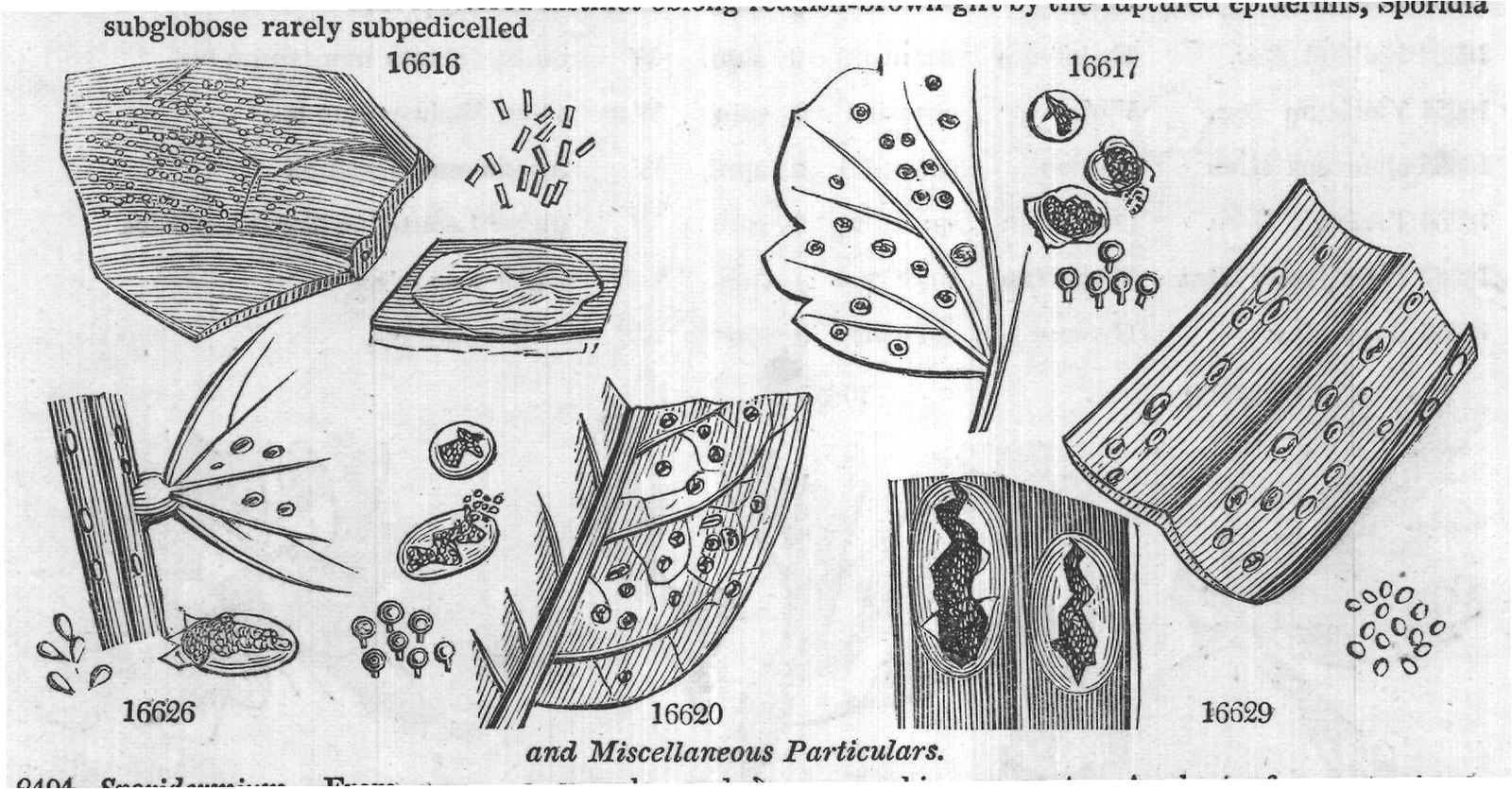
Specimens from Captain Carmichael, as well as those found by Dr. Greville, occurred on Thelephora vulgaris. 2495. Næmaspora. From vημa, a thread, and σπoρa, a sporule. The species resemble distorted threads filled with minute sporules. 2496. Cylindrosporium. In allusion to the cylindrical form of the sporules. Found on both surfaces of living cabbage leaves (Brassica oleracea). eracea). Frequent in May and June. A very extraordinary plant, forming minute speck-like heaps of an oblong shape, but otherwise very irregular, and projecting into little angles and processes. They are disposed in a concentric manner, are pure white, and change in decay to a dirty yellow. Sporules naked, very numerous, cylindrical, truncate at each extremity, pellucid. 2497. Uredo. An old Latin name, from uro, to burn or scorch, applied to those occasional discolorations of the surfaces of plants which were attributed to blasts or injuries of the atmosphere or heavenly bodies, and are 3X 2 16630 Sálicis Dec. 16631 Vitellínæ Dec. 16632 farinósa Pers. 16633 Tussiláginis Pers. 16634 Seneciónis Dec.
Willow CRYPTOGAMIA.
Golden Osier pimpled powdery mealy Colt's-foot gyrose Ragwort confluent Cinquefoil 16635 cónfluens Pers. 16636 Potentillæ Dec. 16637 Rósæ Pers.
Rose 16638 Rubórum Dec. 16639 effúsa Grev. 16640 gyrósa Rebent Bramble effused concentric CLASS XXIV. under Salix pentandra lvs. under Sal. vitellina lvs.
Pa. Y under Sal. Caprea lvs.
Or under coltsfoot lvs. mottled 0 aut. 0 my.aut Y 0 aut. 0 sum.
Y Or blotches 0 sum. gyrose 0 sum. powdery 0 sum. mottled 0 sum. very powd. 0 sum. spreading 0 sum.
Y under Senecio lvs. on Mercurialis lvs.
Gol. Y on Fragaria sterilis lvs.
Or under rose lvs.
Gol. Y under bramble lvs.
R.Or gyrose 0 spr. su. Y 16641 Alchemillæ Pers. Lady's Mantle spreading 0 my. jn. Or 16642 Rhinanthacearum Dec. bt-yellow spots under Rosaceæ lvs. Grev.crypt. fl. t. 19 on raspberry lvs. under Alchemilla lvs.
Scrophularineæ Linum cartharticum Grev. crypt. fl. t. 31 Saxifrage 0 su. aut. R.Y 16643 Líni Dec.
Flax shining 0 sum.
Or. Y 16644 Saxifragárum Dec. Saxifrage brilliant 0 sum.
Or 16645 Campánulæ Pers.
Campanula bright 0 sum.
Or under Campanula Ivs. 16646 Py'rolæ Grev.
Winter Green minute 0 sum.
Gold. under Pyrola lvs. 16647 Helioscópiæ Dec. 16648 lineáris Pers.
Euphorbia round linear very com. 0 aut. Gold. 0 sp. aut. Y under Euphorbia lvs. on grass leaves 16649 æcidiifórmis Grev.
Æcidium-like pustular 0 spring Y on Sphondylium lvs. 16650 Cerástii Grev. 16651 pustuláta Pers. 16652 Sónchi Pers. 16653 Petasites Dec. 16654 Populína Pers.
Poplar Cerastium punctif. 0 sum. Gold. pimpled punctif. 0 spring Y Sow Thistle spreading 0 sum.
Petasites gyrose 0 aut. beautiful 0 aut.
R.Or Or 16655 ováta Strauss 16656 cándida Pers.
Aspen white spots 0 aut. spreading 0 aut.
W on Cerast. viscosum lvs. on Epilobium palustre lvs. under Sonch. olerac. lvs. under Petasites lvs.
Gold. under Populus nigra lvs. Ann.wett.2.t.11.f.5 Tawn. on Populus tremula lvs. Ann.wett.2.t.11.f.6 Cruciferæ Sower. t. 340. Thlaspi 16657 ségetum Pers.
Smut Brand spreading 0 sum.
Bl 16658 urceolórum Dec. sedge spreading 0 sum.
Bl within grains of corn on fructif. of Carex 16659 cáries Dec. cankering destroying 0 aut.
Bl. Br within grains of wheat Deutschl. fl. t. 34 16660 antherárum Dec.
Anther spreading 0 sum. 16661 flosculósum Dec.
Floret spreading 0 sum.
Pu on Caryophylleæ Pu. Br on Scabiosa arvensis Sow. t. 396.f.2. Scabiose 2498. ÆCI'DIUM. Pers. ÆCIDIUM.
Sp. 21-?. 16662 Píni Pers.
Pine scattered sum.
Pa. Or on Pinus sylvestris Grev. crypt. fl. t. 7 16663 Epilóbii Dec.
Epilobium beautiful 0 sum.
W 16664 Violárum Dec.
Violet crowded 0 sum.
Wsh 16665 albéscens Grev. whitish beautiful 0 april W 16666 Taráxaci Grev.
Dandelion spreading 0 sum.
W 16667 Periclýmeni Dec. Woodbine large spot 0 sum.
Ysh 16668 Búnii Dec.
Ground Nut deformed 0 spring Ysh on Epilobium montanum lvs. under Viola canina lvs.
Adoxa moschatellina under Leontodon Taraxacum lvs. under woodbine lvs. on Bunium lvs. 16639 16656 0-0 History, Use, Propagation, Culture, called mildew or blight. All the species are obscure and require further examination. They are in the hands of Bauer, whose knowledge and pictorial powers cannot be better employed than in illustrating this obscure part of vegetation.
ORD. IX. TRIBE IV.
FUNGI CONIOMYCETES. 16630 Hypophyl. scatter. very min. rounded becom. contigu. but not confluent, Sporidia pyriform subpedicellate 16631 Hypophyl. very min. convex orbicular scattered becom. confluent, Sporidia very min. globul. transparent 16632 Hypophyl. pale ochrey-yell. distinct at first soon bursting becom. conflu. and very pulverul. Sporidia oval Sporidia oval 16633 Hypophyllous bright orange-yellow prominent crowded generally forming circles and becoming very confluent, Sporidia very numerous obovate 16634 Hypophyllous orange-yellow oblong irregular becoming confluent, Sporidia numerous 16635 Hypophyllous depressed yellow oblong concentric becoming confluent, Sporidia nearly oval 16636 Chiefly hypophyllous golden-yellow scattered irregular convex becoming confluent, Sporidia subspherical becoming confluent, Sporidia subspherical 16637 Hypophyllous small scattered effused orange-yellow, Sporidia suboval sometimes with a minute pedicel 16638 Hypophyllous golden-yellow suborbicular becoming effused, Sporidia very numerous irregularly spherical numerous irregularly spherical 16639 Bright reddish-orange broad pulverulent hypophyl. and on nerves and petioles, Sporidia numer. subglob. 16640 Epiphyllous much scattered rather large yellow thick elevated from the leaf and bursting in a gyrose manner, Sporidia subglobose 16641 Hypophyl. lin. obl. crowded arranged in a subparallel manner orange-yell. becom. pale, Sporidia spherical 16642 Hypophyllous and on the petioles and calyx oblong thickish sometimes partly disposed in a circular manner and subconfluent deep reddish-yellow, Sporidia spherical oval or even oblong transparent 16643 On both sides of the leaf and stem suborbicular prominent bright orange-yellow scattered, Sporidia 16644 Hypophyllous and on the calyces rather large oval with an indurated disk after the sporidia have escaped, 16645 Hypophyllous scattered round depressed rarely confluent, Sporidia yellowish-orange spherical surrounded Sporidia bright orange spherical and granular within by the remains of the ruptured epidermis Sporidia ovate or oblong somewhat transparent and granular within 16646 Hypophyllous punctiform scattered or collected into small clusters golden-yellow scarcely bursting, 16647 Hypophyll. golden-yell. scatter. distin. surround. by remains of ruptur. epidermis, Sporidia subglob. minute 16648 On both sides of the leaf oblong or lin. sometimes forming long lines yellow becoming reddish or brownish 16649 Hypophyllous and on the petioles somewhat aggregated but generally following the course of the veins, 16650 Chiefly hypophyllous very minute regular numerous convex late in bursting golden-yellow, Spcridia 16651 Chiefly hypophyllous very minute pale-yellow subrotund convex scattered or collected into clusters 16652 Hypophyll. depressed regular in form redd. orange scattered becoming partially conflu. Sporidia egg-shaped 16653 Hypophyllous depressed minute spreading somewhat aggregated subconfluent irregular in form of a in decay, Sporidia globular or suboval bullated yellow bursting in the centre roundish oval or even oblong scarcely bursting, Sporidia suboval deep orange or orange-red, Sporidia oval 16654 Hypophyllous scattered or crowded distinct convex roundish large compared with the following mostly 16655 Hypophyllous punctiform prominent or papilliform numerous tawny yellow mostly closed, Sporidia ovate 16656 Polymorphous of various forms sometimes disposed in a circular manner quite white frequently never closed pale becoming golden-yellow, Sporidia very long obtuse at each extremity bursting, Sporidia in great profusion globular 16657 Within the fruit and glumes of corn and various grasses spreading and in a short time filling the whole with a profuse black dust, which under the microscope consists of minute spherical sporules 16658 Attacking the fructification of Carices and forming a black compact slightly pulverulent mass composed of a pale solid nucleus surrounded by the naked sporidia which are small and globular of very minute spherical sporidia 16659 Always inclosed within the grain and filling it with uniform dense fetid blackish-brown mass composed 16660 Attack. anth. and ovary of the Caryophylleæ, fine purp. Spori. very plentiful pulverul. min. and globul. 16661 Sporidia very min. purpl.-brown plentiful produc. within florets and often filling them with pulverul. mass filling them with pulverul. mass 16662 Large oblong or conical much scattered pale-orange bursting with an irregular orifice, Sporidia excessively abundant bright-orange 16663 Hypophyllous numerous distinct, Sporidia very white toothed, Teeth beautifully rolled back brittle and vanishing, Sporidia pinkish-orange 16664 Hypophyllous and on the petioles scattered or subaggregated numerous, Peridia whitish split into many 16665 Hypophyllous and on the petioles scattered distinct, Peridia very white split into a few comparatively large 16666 Hypophyllous very numerous subsessile scattered or collected into little clusters, Peridia white split into 16667 Hypophyllous, Peridia distinct but decidedly clustered and crowded prominent becoming subelongated; 16668 Hypophyllous and on the petioles irregularly clustered and deforming the parts on which it grows, small deciduous teeth, Sporidia orange becoming obscure brown teeth, Sporidia yellowish-white, Surface of the leaf blistered whitish subrevolute teeth, Sporidia fine orange the mouth with a few broad very delicate decidious teeth, Sporidia fine orange Peridia somewhat indistinct round prominent and yellowish with a subentire orifice 16662 16673 and Miscellaneous Particulars. 2498. Æcidium. These plants are found upon the leaves of other vegetables, and one of them is known to agriculturists under the name of Red Gum. This species usually grows inside the glumes of the calyx, under the epidermis, which, when the plant is ripe, bursts and emits a powder of a bright orange color. It does not 3-X 3 16669 Jacobæ'æ Grev. 16670 Prenánthis Pers. 16671 Urtícæ Dec. 16672 confértum Dec.
Nettle dense CRYPTOGAMIA. under Hierac. sylvat. lvs.
W Ysh Wsh on Ficaria on Urtica dioica R Ragwort agglomerat. O sum. Ysh under Sen. Jacobæa lvs. Prenanthes spots 0 sum. clusters 0 sum. clusters 0 sum. 16673 Grossuláriæ Dec. Gooseberry bright sp. 0 sum. 16674 Ranunculaceárum Dec.Crowfoot clusters Wsh 16675 Cal'thæ Grev. Caltha bright 0 spring Or 16676 Berbéridis Pers. Berberry blight spreading 0 sum Or ragged swollen 0 sum. spots sum. concentrical 0 sum.
CLASS XXIV. under gooseberry lvs. Grev. crypt. fl. t. 62 under Ranunc. lingua lvs. under Caltha palustris lvs. on Berb.vulgaris Grev. crypt. fl. t. 97 Grev. crypt. 209 Grev. crypt. 180 16677 lacerátum Dec. 16678 cornútum Pers. cornute Br Y.Br on mountain-ash on hawthorn 16679 Tussiláginis Pers.
Coltsfoot Psh under Farfara lvs.
Sower. t. 397. f. 16680 rubéllum Dec. pink concentrical 0 sum.
Crim. under Rumex lvs.
Sow.t.405. Rumicis 16681 Al'lii Pers.
Allium concentrical 0 sum.
Y under All, ursinum lvs. 16682 Thalictri Grev.
Thalictrum clustered 0 sum.
Or Thalictrum alpinum Grev. crypt. 4 2499. PUCCI'NIA. Mich. PUCCINIA. 16683 Rósæ Grev.
Rose many-cell. 0 aut.
Sp. 30-?.
Bl under rose leaves Grev.crypt. fl. t. 15 16684 Rúbi Dec.
Bramble many-cell. 0 aut.
Bl under bramble lvs. 16685 grácilis Grev. slender many-cell. 0 aut.
Bl under raspberry lvs. 16686 Potentillæ Pers.
Potentilla many-cell. 0 aut.
Bl under Potentilla lvs. Grev. crypt. fl. t. 57 16687 Aspáragi Dec. 16688 Circæ'æ Pers.
Asparagus Circæa two-celled 0 aut.
Bl dead asparagus two-celled 0. aut.
Pk. Br under Circæa lvs. 16689 Chrysosplénii Grev.
Chrysosplen. two-celled 0 may Pa.Br under Chrys. opp. lvs. 16690 Aviculáriæ Dec. knot grass two-celled 0 aut.
Bl under Polygonum lvs. 16691 Ægopódii Strauss Ægopodium two-celled 0 aut. 16692 túmida Grev. tumid 16693 Men'thæ Pers.
Mint two-celled 0 june two-celled 0 spring 16694 Polýgoni Pers.
Polygonum two-celled 0 aut.
B.Gr on Ægopodium lvs.
Br.Gr on Bunium Bulbocastanum Bl under Mentha lvs.
R.Br under Polyg. amphib. lvs. 16695 Centauréæ Dec.
Centaury two-celled 0 aut.
Bl on Centaurea nigra 16696 Umbelliferárum Dec. Umbellifer. two-celled 0 aut. 16697 Sanículæ Grev.
Sanicle two-celled 0 aut.
Ve.D on Umbelliferæ lvs.
Bl.Br under Sanicula lvs. 16698 variábilis Grev. variable two-celled 0 aut. 16699 Heráclei Grev.
Cow Parsnip two-celled 0 sum.
Blsh on Leont. Taraxacum Grev. crypt. fl. t. 75 Blsh under Sphondylium lvs. Grev. crypt. fl. t. 42 16700 Epilóbii Dec.
Epilobium two-celled 0 june Br under Epilobium palustre lvs. 16701 Betónicæ Dec.
Betony two-celled 0 aut.
Ferr. under Beton. offic. lvs. 16702 pulverulénta Grev. powdery two-celled 0 sum.
D.Br under Epilobium lvs. 16703 Adóxӕ Dec.
Moschatel two-celled 0 sum.
D.Br on Adoxa Moschatellina 16679 16680 16682 History, Use, Propagation, Culture, appear to be materially injurious to the grain, if at all. Ears full of it have been found with very plump grains; and it has also been found upon branded ears. Before the cuticle which covers the fungus bursts, it has much the appearance of a pustule upon the human body. ORD. IX. TRIBE IV.
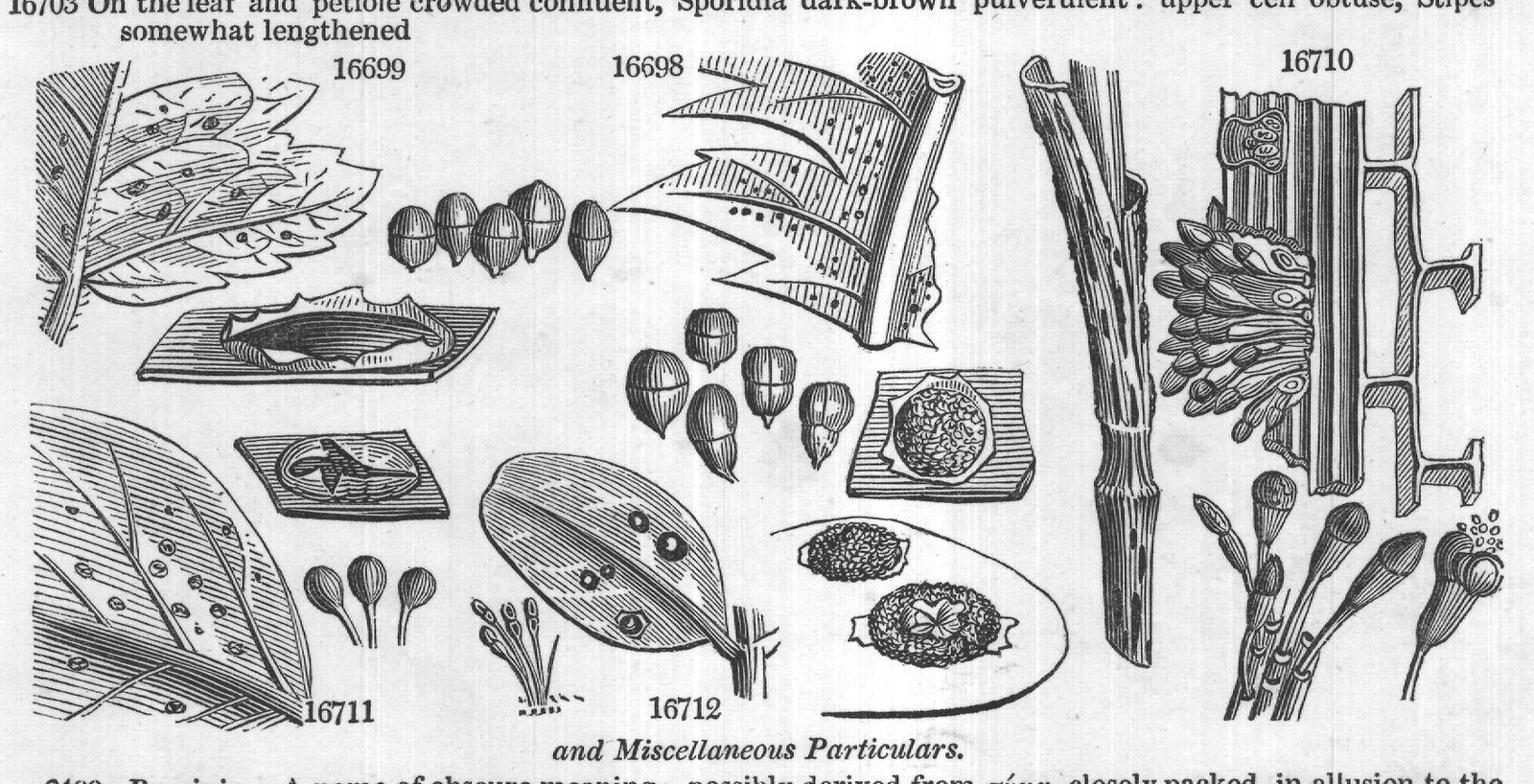
FUNGI CONIOMYCETES. 16669 Hypophyllous at first prominent pustular soon becoming agglomerated very numerous, Peridia splitting 16670 Hypophyllous in widely scattered agglomerated clusters but not very crowded, Peridia subsessile split into short brittle yellowish-white teeth, Sporidia pale-orange into very white exceedingly brittle teeth, Sporidia pale many short recurved teeth, Sporidia ochre-yellow numerous ovate 16671 Hypophyllous and on the petioles and stem, Peridia campanulate agglomerated rarely single split into 16672 Hypophyllous and on the petioles, Peridia in dense agglomerated clusters whitish split into revolute teeth, Sporidia yellowish: the leaf whitish around the clusters 16673 Hypophyllous upon a thickened portion of the leaf, which on the upper surface is of a fine red color with a yellow border, Peridia densely crowded splitting into yellowish-white teeth, Sporidia pale 16674 Hypophyllous, Peridia agglomerated in scattered clusters of various sizes whitish with a brittle dentated margin, Sporidia yellow 16675 Hypophyllous and on the petioles aggregated short somewhat campanulate with numerous very minute marginal teeth, Sporidia bright-orange subglobose or oval 16676 Hypophyllous and on the fruitstalk, seed-vessel, calyx, and even petals, Peridia short or elongated cylindrical densely crowded fine orange, Sporidia yellow under the microscope 16677 Hypophyllous and on the petioles and young fruit, Peridia elongated agglomerated brown splitting to the base in capillary segments, Sporidia numerous light-brown 16678 Hypophyllous, Peridia 2-12 long cylindrical slightly curved yellowish-brown springing from an orangecolored thickened portion of the leaf, Sporidia numerous greyish becoming brown 16679 Hypophyllous marked on the upper surface of the leaf by a yellow or purplish spot, Peridia partly immersed short splitting into white revolute teeth, Sporidia pink-orange 16680 Hypophyllous producing a crimson spot on the upper surface of the leaf, Peridia minute subimmersed splitting regularly into small revolute white teeth, Sporidia yellowish-white 16681 Hypophyllous marked by a pale spot on the upper surface of the leaf and a pale ring round the peridia, which are small not numerous splitting into small brittle yellowish-white teeth, Sporidia pale 16682 Hypophyllous somewhat clustered, Clusters of a roundish form, Peridia oblongo-cylindrical brightorange, Mouth paler and bursting irregularly which is furnished with a yellow gland 16683 Hypophyllous, Sporidia mucronated 5-7-celled with a white filiform stipes incrassated towards the base 16684 Hypophyllous deep-black tufted, Sporidia 4-celled obtuse mucronate, Stipes slender incrassated at the base 16685 Hypophyllous tufted of various sizes black rather lax scattered, Sporidia 7-9-celled somewhat attenuated mucronate with a slender stipes incrassated at the base 16686 Somewhat tufted scattered black, Sporidia cylindrical 3-4-celled obtuse never mucronated, Stipes filiform 16687 Round. or ov. obl. scatter. black somew. convex, Sporidia densely crowded obl. obt. firmly fix. by pedicels 16688 Hypophyl. deep pinkish-brown promin. consist. of a number of distinct aggregat. tufts, Sporidia obl. acute 16689 Hypophyllous small of various sizes few together and confluent pale-brown, Sporidia long somewhat waved much attenuated at each extremity with an elongated stipes 16690 Hypophyllous punctiform minutely tufted subrotund blackish-brown, Sporidia crowded obtusely eggshaped with a long flexuose filiform pedicel 16691 Chiefly hypophyllous minute aggregated rendering the nerves and petioles swollen dark bluish-grey before bursting, Sporidia nearly black oval not contracted in the centre, Stipes short 16692 Hypophyllous and on the petioles conglomerated confluent brownish-grey before bursting, Sporidia nearly 16693 Hypophyllous round scattered nearly black, Sporidia of an obtuse irregular figure with a short filiform 16694 Hypophyllous minute round very crowded reddish-brown: upper cell of the sporidia thick globose; black obtuse scarcely contracted in the centre: the upper cell sometimes divided stipes somewhat incrassated at the base the lower one long and narrow, Stipes short 16695 On both sides of the leaf and on the stem in small nearly black scattered tufts surrounded by the remains of the ruptured epidermis, Sporidia oval the two cells nearly equal, Stipes very short 16696 Hypophyllous minute very dark scattered, Sporidia short with both cells obtuse and a short stipes 16697 Hypophyllous circular very variable in size blackish-brown scattered rarely confluent, Sporidia very obtuse with a subelongated stipes 16698 On both sides of the leaf in minute tufts nearly black circular bordered by the remains of the epidermis, Sporidia variable very obtuse rounded 2-celled both often subdivided, Stipes very short 16699 Hypophyllous blackish-brown irregular in figure girt by ferruginous remains of epidermis, Sporidia crowded obtuse divided but scarcely contracted in the middle, Stipes short 16700 Hppophyllous scattered closely over the whole surface small round brown depressed, Sporidia much contracted in the centre nearly resembling figure 8: the upper cell largest 16701 Hypophyllous very thickly scattered and becoming contiguous but very rarely confluent minute at first and ferruginous after bursting, Sporidia short: upper cell obtuse, Stipes very short 16702 Hypophyllous dark-brown scattered or sub-confluent often concentric, Sporidia crowded pulverulent obtusely oval slightly contracted in the middle: the lower cell terminating in an abrupt and short stipes 16703 On the leaf and petiole crowded confluent, Sporidia dark-brown pulverulent: upper cell obtuse, Stipes somewhat lengthened 16699 16698 16710 and Miscellaneous Particulars. 2499. Puccinia. A name of obscure meaning; possibly derived from πύκa, closely packed, in allusion to the crowded manner in which the little plants are placed. 3 X 4 CRYPTOGAMIA.
CLASS XXIV. 16704 Primulæ Grev.
Primrose two-celled 0 sum.
D.Br under primrose lvs. 16705 Víolæ Dec.
Violet two-celled (0) sum.
D.Br under Viola canina Ivs. 16706 Valántiæ Pers.
Cross-wort two-celled 0 sum.
Dp.Br on Galium verum 16707 glomeráta Grev. heaped two-celled 0 spr. su. Dp.Br under Senecio Jacobææ lvs. 16708 Ulmáriæ Dec.
Ulmaria two-celled 0 aut.
Pu.Bl under Ulmaria lvs 16709 caricína Dec.
Sedge two-celled 0 aut.
Bl on Carex leaves 16710 Gráminis Pers.
Grass two-celled 0 aut.
Bl 16711 globósa Grev. globose one-celled 0 aut.
Bl 16712 Búxi Sow.
Box two-celled 0 sum.
Br on corn & grasses on bean leaves leaves of box Sow. t. 140. U. Frumenti Grev. crypt. fi. t. 29 Grev. crypt. fl. t. 17 ORD. IX. TRIBE IV.
FUNGI CONIOMYCETES. 16704 Hypophyllous deep brown solitary scattered or concentric and subconfluent, Sporidia rather slender with 16706 Hypophyll. very min. scatter. deep-brown, Sporidia thick obt. variable in shape with lower cell fusiform 16707 Hypophyllous tufts circular depressed broad dark fuscous composed of many smaller ones confluent at the lower cell attenuated into a short stipes small with a short stipes 16705 Hypophyllous minute scattered sometimes confluent irregular in form nearly black, Sporidia short obtuse the centre, Sporidia oblong with lower cell somewhat attenuated frequently also divided perpendicularly, Stipes short white filiform stipes firmly fixed at its base 16708 Hypophyllous purplish black scattered in tufts, Sporidia variable generally very obtuse two rarely S-celled 16709 Epiphyllous brown eventually black oval often confluent and forming long lines, Sporidia oblong with a 16710 Tufts dense oblong often confluent and forming long parallel lines changing from yellowish-brown to black, Sporidia elongated: the upper cell the shortest, Stipes filiform 16711 Epiphyllous minute scattered nearly black, Sporidia globose with a filiform slender stipes 16712 Scattered reddish-brown round very convex surrounded by the ruptured epidermis, Sporidia oblong 2-celled yellow with a long filiform stem ENCYCLOPÆDIA OF PLANTS.
PART II.
NATURAL ARRANGEMENT.
First grand Division, VASCULARES (vas, a vessel; plants with woody fibre and cellular tissue).
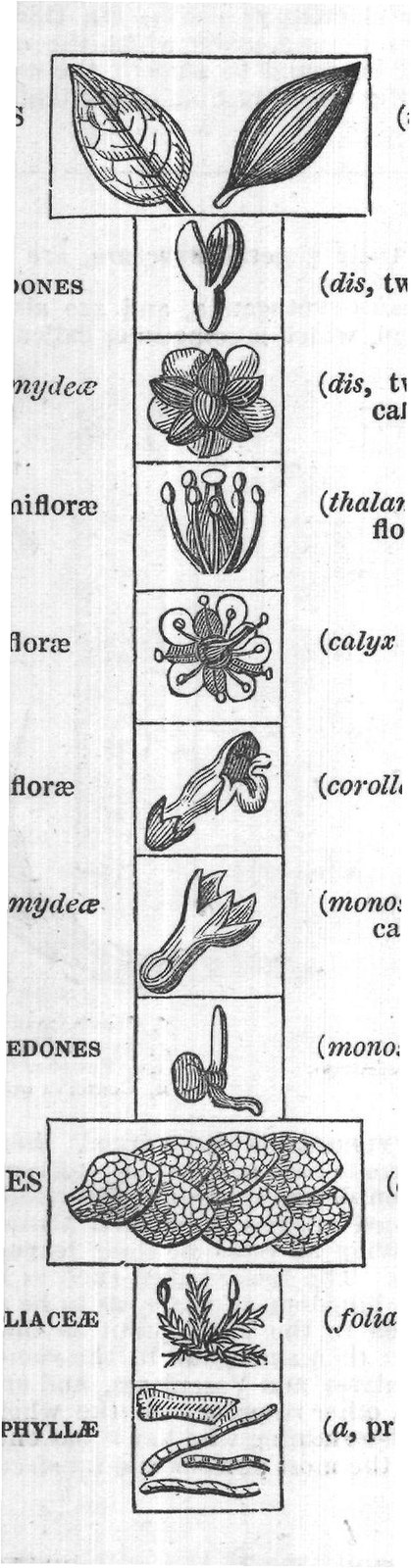
First Class, DICOTYLEDONES Subdivision I. Dichlamydeæ Subclass 1. Thalamifloræ Subclass 2. Calycifloræ (dis, two, and cotyledon; cotyledons two). (dis, two, and chlamys, a coat or covering; calyx and corolla distinct). (thalamus, a bed or receptacle, and flos, a flower; stamens under the pistillum). (calyx and flos; stamens on the calyx).
Subclass 3. Corollifloræ Subdivision II. Monochlamydeæ Second Class, MONOCOTYLEDONES (corolla, and flos; stamens on the corolla). (monos, one, and chlamys, a coat or covering; calyx and corolla not distinct). (monos, one, and cotyledon; cotyledon one).
Second grand Division, CELLULARES First Class, FOLIACEE (cellula, a little cell; plants with cellular tissue only). (foliaceus, leafy; habit).
Second Class, APHYLLÆ (a, priv., and phyllon, a leaf; leafless).
THE difficulties connected with the adoption of the natural system of plants are these, that the characters of many of the orders are at present imperfectly known, and that they depend upon a consideration of many points of structure which are not to be determined without much labor and a considerable degree of practical skill in the use of the microscope and the dissecting knife . But the facilities which the habit of viewing all natural bodies with reference to the relations they bear to other bodies, and not as insulated individuals merely possessing certain peculiarities by which they may be referred to some station in an artificial system, alluded station in an artificial system, ultimately gives to the investigations of the naturalist, are so great, that difficulties of the nature just will , are so great, that difficulties of the nature just alluded to ought not to be suffered to influence the botanist in determining which line of study he follow, botanist in determining which line of study he will follow, whether that pointed out by Linnæus, or that traced by the hand of nature. By the artificial system of Linnæus, indeed, no great difficulty exists in determining the number of stamens or styles possessed by a given their number of stamens or styles possessed by a given plant, or the nature of their combination, and from the knowledge so obtained, in referring them to their class and order in the Linnæan system. But when this step has been gained, what more has been acquired No step has been gained, what more has been acquired than the bare knowledge that the plant in question possesses a certain number of stamens and styles No possible notion can be formed of the relation it bears to other plants of the same nature, of the qualities and, other plants of the same nature, of the qualities it pro probably possesses, or of the structure of those parts not under examination, the fruit for example; and , finally, if it were wished to convey an idea of the plant to a stranger, no means would be in the possession for stranger, no means would be in the possession of the Linnæan botanist of doing so, except by stating that the plant belonged to Pentandria Monogynia affinities that the plant belonged to Pentandria Monogynia for example, which is stating nothing. But what would be the condition of the student of the natural uninfluenwould be the condition of the student of the natural affinities of plants in a similar case It is true he would be obliged to consult more characters than the two uninfluential ones of Linnæus - it would be necessary to ascertain if his subject was Vascular or Cellular; if Vascular, whether it was Monocotyledonous or Dicotyledonous; if Dicotyledonous, whether the leaves were opposite or NATURAL ARRANGEMENT. alternate, stipulate or exstipulate, whether the flowers were monopetalous, polypetalous, or apetalous, the nature and station of the stamens, the condition of the ovarium, m, and so on. But when he has ascertained thus much, only let it be remembered, for a moment, how much he has gained indirectly as well as directly. Perhaps he has discovered that his plant belongs to Rubiaceæ; he will then have learned that all vegetables with opposite entire stipulate leaves, and a monopetalous superior corolla, are also Rubiaceous; if a fragment of the leaves and stem only of such a plant were afterwards submitted to him for examination, he would recognise its affinities , and remember that it was Rubiaceous, and being aware of that fact, he would be able safely to infer that its calyx and corolla would be of a particular nature, that if the roots afforded any color for dying, it would be red ; that the medicinal properties of the bark, if any, would be tonic, astringent, and febrifugal, and that its seeds would be of the same nature as those of coffee, and finally, its geographical position would be tolerably certain to him.
The really important obstacle which exists in the way of acquiring this kind of knowledge, is undoubtedly the want of any introduction to the study of it, accompanied by the distribution and characters of the want of any introduction to the study of it, accompanied by the distribution and characters of the natural orders into which plants are divided. It is to be hoped that English readers at least will not long have to regret this deficiency in their elementary works. In this place, it must suffice to point out the characters upon which the great divisions depend, under which the orders themselves are arranged; and it is to be hoped, that even this small aid will be found to smooth the way, and to remove some of the obstacles that at present are supposed to exist at the very threshold of the temple. Plants considered with reference to their general structure, are separated into two grand divisions called CELLULARES and VASCULARES.
The Cellulares answer to the Linnæan Cryptogamia, and are also called Acotyledonous; the Vasculares answer to the rest of the Linnæan system, which is sometimes called Phanerogamia and Cotyledonous. to the rest of the Linnæan system, which is sometimes called Phanerogamia and Cotyledonous. e g k 1 h 2 C b d a, Longitudinal section of a stem. b, Transverse section of a stem. c, Stem of a moss, with leaves and theca, or seed-case. d, Leaf of a moss, magnified. e, Leafy thallus of a lichen, with shields. f, Crustaceous thallus of a lichen, with shields. g, Fungi of the highest dignity. h, i, Fungi of the lowest rank. k, Conferva magnified.
CELLULARES, CRYPTOGAMOUS, or ACOTYLEDONOUS plants are all, therefore, different terms denoting the same combination of vegetables. The first term is here adopted in preference to the others as expressing the most of vegetables.
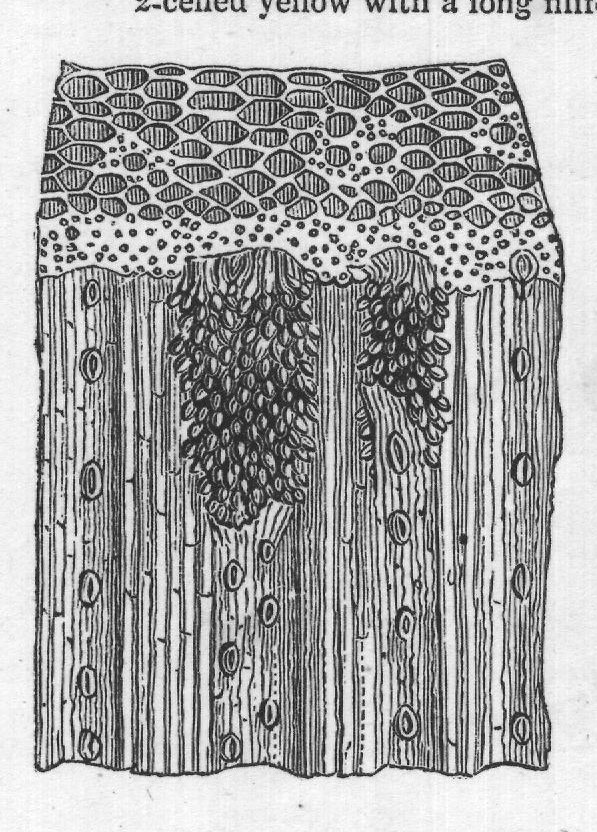
The first term is here adopted in preference to the others as expressing the most obvious character upon which the division depends, namely, the cellular, not vascular, structure of the plants composing it. Cellular plants are formed entirely of cellular tissue (fig. 1.), without woody fibre or spiral vessels; or in more familiar terms by having no veins in their leaves if foliaceous, and not forming wood; they also are destitute of perfect flowers. The lower tribes, such as Fungi and Algæ, are destitute of leaves, and in some points approach the animal kingdom so nearly as to be scarcely distinguishable. In the highest tribe, Ferns, apparent veins are formed in the leaves; but as they are imperfectly supplied with spiral vessels, they cannot be considered more than analogous to the veins of other plants. Ferns, however, hold the intermediate station between Cellulares and Vasculares, and are chiefly retained among the former on account of their perfect accordance in other respects. In the whole of Acotyledones, it is unnecessary to examine the seed for the purpose of determining whether it has one cotyledon, several cotyledons, or none, the structure of the perfect plant giving the most obvious and satisfactory evidence. 0 l 2 n 1, Vertical section of a vascular stem. m, Woody fibre. 0, Leaf of a dicotyledonous plant. p, Leaf of a monocotlyedonous plant. . Spiral vessel P NATURAL ARRANGEMENT.
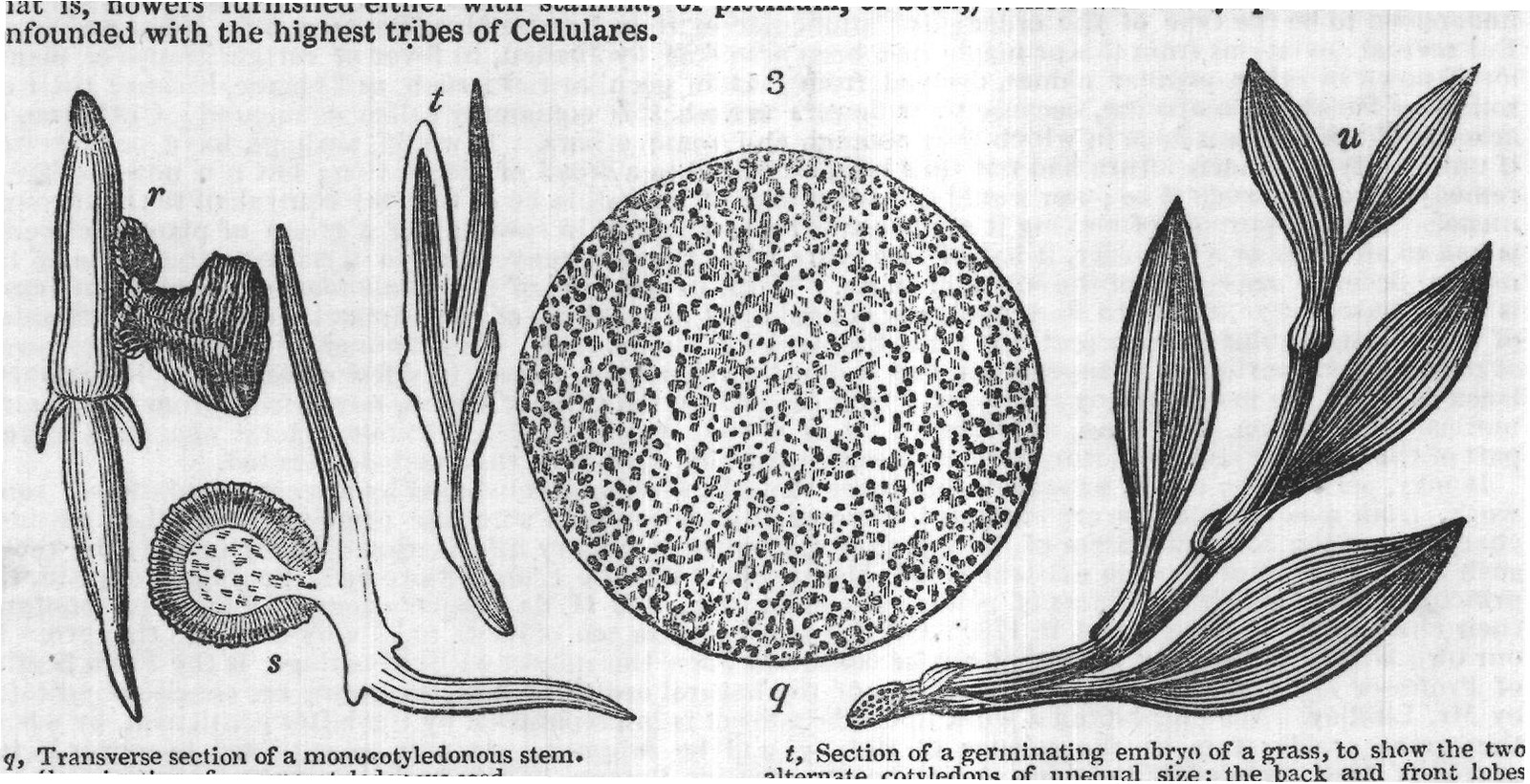
VASCULARES, PHENOGAMOUS, or COTYLEDONOUS plants, are also separated into two great classes called Endogenes or Monocotyledones, and Exogenes or Dicotyledones, both which are distinguished as accurately by their obvious physical structure as they are by the minute and obscure peculiarities of the seed. They are all formed with cellular tissue, woody fibre, and spiral vessels (fig. 2.), and their leaves are traversed by veins; the last character is sufficient for practical purposes, if it is remembered that they also bear perfect flowers, , (that is, flowers furnished either with stamina, or pistillum, or both,) which will always prevent their being confounded with the highest tribes of Cellulares. r S t 3 u q, Transverse section of a monocotyledonous stem. r, Germination of a monocotyledonous seed. s, Section of ditto, to show the cotyledon remaining in the testa. q t, Section of a germinating embryo of a grass, to show the two alternate cotyledons of unequal size; the back and front lobes represent these, the middle lobe is the plumula. u, Stem and leaves of a monocotyledonous plant.
Endogenes, or Monocotyledonous plants, are the first remove from Cellulares, and hold an intermediate rank between them and Exogenes or Dicotyledonous plants, in which vegetation acquires its highest form of developement. They were formerly characterised by having a single cotyledon, but this circumstance is not only not absolute but difficult of determination, except after minute analysis. The real difference in the seed of in the seed of them and Dicotyledones is this, that in Monocotyledones there is only one Cotyledon (fig. 3. s); or, if two, that they are alternate with each other (t), while in Dicotyledones they are always opposite, and more than one, , sometimes several, as in Pínus (fig. 4. y). The physiological structure of the two classes is, however, that by which they are familiarly distinguished, and exhibits a beautiful proof of the harmony that exists between the great features of vegetation and their first principle, the seed from which they originate. In Endogenes, or Monocotyledones, there is no distinction between wood and bark (fig. 3. q); in Exogenes, or Dicotyledones, the wood and bark are distinctly separated (fig. 4. v). In Monocotyledones the wood and cellular tissue are mixed together without any distinct annual layers of the former being evident; in Dicotyledones the wood and cellular tissue have each their particular limits assigned them, a distinct layer of the former being annually deposited. In Monocotyledones there are no radiations from the medulla to the bark in Dicotyledones the radiations are distinctly marked. In Monocotyledones there is generally no articulation between the leaves and the stem, while in Dicotyledones the leaves are always jointed with the stem from which they fall off, leaving a scar behind. In Monocotyledones the veins of the leaf pass in parallel lines from the base to the apex, in Dicotyledones they diverge from the midrib towards the margin at various angles; in the former they are unbranched, the principal veins being connected by nearly simple secondary veins; in the latter they are much branched, ramifying in many directions, and giving the surface of the leaf a netted appearance. 4 y x W v v, Transverse section of a dicotyledonous stem. w, An embryo with two cotyledons. x, An embryo with four cotyledons. y, An embryo with many cotyledons. x, Stem and leaves of a dicotyledonous plant.
Such are the very obvious distinctions of the two great classes of Phænogamous, or flowering, plants; and so far is it from there being any necessity for dissecting a seed in order to ascertain its structure, that this point is one of the most easy determination, and about which there cannot be in one case in five hundred the slightest cause of doubt or difficulty. It is almost impossible to take even a morsel of a plant in the hand without instantly being in possession of the knowledge of the structure of its seed, with respect to the cotyledons.
Thus far have we advanced without a single obstacle to impede us. In all farther investigation no greater degree of knowledge or application is requisite than what ought to be possessed by every one who would be able to ascertain the genus of a plant. Many of the orders do not depend upon the minute characters of the seed so much as is believed the structure of the ovarium and position of the ovula, are aids which frequently make amends for the absence of fruit: and the nature of the foliage and inflorescence are guides which, though sometimes treacherous, are often as faithful as the fructification itself. But as it is not intended to give the characters of the orders in this place, neither is it necessary to advance farther in an explanation of in an explanation of the manner of determining them ; upon that point each order would require a particular note. It may, how- NATURAL ARRANGEMENT. ever, be confidently believed, that there are no greater impediments in the road to an acquaintance with the natural relations of plants than those that have been already removed; and that although neither the science and patient approach. of botany, nor any other science, is to be taken by storm, yet that the fortress is sure to be reduced by silent botany, nor any other science, is to be taken by storm, yet that the fortress is sure to be reduced by silent and patient approach.
It only remains to explain briefly upon what principles the names of the orders, suborders, &c. are formed. It is usual, in the school of Jussieu, to give to a natural order a name derived from that of the genus which is is usual, in the school of Jussieu, to give to a natural order a name derived from that of the genus which is understood to be the type of the order; as Ranunculaceæ from Ranúnculus, Rosaceæ from Rósa, and so on. But several deviations from this principle had been admitted by Jussieu, in favor of certain groups of plants, long known by other popular names, derived from certain peculiarities; such as Labiatæ, because their corollas are labiate; Compositæ, because their flowers are what is commonly called compound; Guttiferæ, on account of the resinous juice in which they abound, and some others. It would, perhaps, have been better, if uniformity in nomenclature had not thus been sacrificed to a dread of innovation; but it is now too late to remedy the evil, if such it be; nor would the advantage of alteration be at this day equivalent to the inconvenience. For the purpose of making it at once apparent, whether, in speaking of a group of plants, reference is had to an order or a suborder, it has of late years been thought convenient to terminate the name of the natural order in aceæ, and of the suborder in eæ. Thus, in speaking of the whole mass of which Ranúnculus is the representative , the word Ranunculaceæ is used; but in speaking of the particular division, or suborder, of which Ranúnculus forms a part, the term Ranunculeæ is employed. This manner of speaking is, however, at present, very partial in its application, and is of little importance, except in a few cases, of which Ranuncupresent, very partial in its application, and is of little importance, except in a few cases, of which Ranunculaceæ is one of the most striking examples. In those orders, the titles of which, necessarily, from their grammatical construction, end in eæ, as Orchideæ, it is obviously inapplicable, without a total change in a great part of the nomenclature of natural orders, a measure which cannot be too much deprecated.
It may, perhaps, be finally expected, that these remarks should be concluded by a recommendation of some work, from which those who are anxious to become fully acquainted with the principles and distinguishing , from which those who are anxious to become fully acquainted with the principles and distinguishing characters of the Natural System of Botany, may derive the necessary information. Unfortunately, however, such a work has at present no existence . M. Decandolle's Théorie E'lémentaire de la Botanique explains the principles upon which the orders of plants are constituted; and M. de Jussieu's Genera Plantarum contains their characters, as determined in 1789: but the latter is now too obsolete to be very useful to the tyro. In our own language , the only work that can be consulted upon the subject with advantage, is the Flora Scotica of Professor Hooker, in which the characters of the natural orders of Scottish plants are concisely indicated by Mr. Lindley. We understand a work upon the subject is in preparation by the latter gentleman, by which this great desideratum in the science of Botany will be supplied. It may be expected to appear in the course of 1829, previously to which , however, the division Botany, in the forthcoming Encyclopædia of Natural History will have been published, in which much inforination may be expected upon this important subject.
I. VASCULARES.
CLASS I. DICOTYLEDONES.
SUBDIVISION I. DICHLAMYDEÆ.
This subdivision comprehends all the Dicotyledonous plants, that have both a calyx and corolla, by which they are distinguished from Monochlamydeæ, in which the calyx only exists. It is in consequence of this high developement of the floral envelopes, that the greater part of flowering trees and shrubs are found in Dichlamydeæ, it rarely happening that those with a single floral covering only have any brilliant coloring. SUBCLASS I. THALAMIFLORE.
Petals inserted into the receptacle.
The insertion of the petals and stamens into the receptacle is the great character of this subclass, which, therefore , contains all the polyandrous plants of Linnæus, as the Calycifloræ contain the icosandrous genera of the same botanist.
Section 1. Carpella numerous, or stamens opposite the petals. ORDER I.
RANUNCULACEÆ.
The greater part of the plants of this order are objects of interest with gardeners, containing, as it does, many of the most elegant or showy of the tribes of hardy plants. It is here that the graceful Clématis, the lowly the most elegant or showy of the tribes of hardy plants. It is here that the graceful Clématis, the lowly Anemone, the glittering Ranúnculus, and the gaudy Pæony are found; differing, indeed, in external appearance, but combined by all the essential characters of the fructification. It is remarkable, however, that the acrid and venomous properties of these plants are nearly as powerful as their beauty is great. They are all caustic, and in many of them the deleterious principle is in dangerous abundance. M. Decandolle remarks, that its nature is extremely singular ; it is so volatile, that, in most cases, simple drying in the air or infusion in water is sufficient to destroy it: it is neither acid nor alkaline; but its activity is increased by acids, honey, sugar, wine, or alcohol; and it is, in reality, destructible only by water. The crowfoots of our European pastures, and the Anemones trilobáta and triternáta, of those of South America, are well known poisons of cattle. Blistering plasters are made in Iceland of the leaves of Ranúnculus ácris. The foliage of some species of Clématis is supposed to afford the means employed by beggars of producing artificial ulcers. Some of the Aconites are diuretic, especially Napellus and Aconites are diuretic, especially Napéllus and Cámmarum. Delphínium Consólida is said to be an ingredient destructive of the surface of the skin. The Helleborus, famous in classical history for its drastic powers, and the Nigella, celebrated in ancient housewifery for its aromatic seeds, which were used for pepper before that article was discovered, are both comprehended in Ranunculaceæ. The range of this order, in a geographical point of view, is very extensive. A great number has been discovered in Europe, but they are so abundant in all parts of the world that an order can scarcely be found more universally and equally dispersed. It is singular, that, with the exception of the climbing species of Clématis and of Xanthorhíza, scarcely an instance occurs in Ranunculaceæ of a shrubby stem.
Clématis L. 1229 Thalictrum W. 1226 Anemóne W. 707 Myosúrus W. 1239 Cáltha W. 1234 Tróllius W. 1286 Eránthis Sal.
Tribe 1. CLEMATIDEE.
Tribe 2. ANEMONEÆ. 1225 Hepática W. en. 1241 Hydrástis W.
Tribe 3. RANUNCULEÆ. 708 Ceratocéphalus P. S. 1228 Naravélia Dec. 1233 Ranúnculus W.
Tribe 4. HELLEBOREE. 1231 Knowltónia Sal. 1230 Adónis L. 1232 Ficária Pers.
Tribe 4. 1053 Garidélla W. 1209 Nigélla W. 1208 Aquilégia W. 1204 Delphínium W 1205 Aconitum W 1235 Isopýrum W. 1237 Helléborus W. 1239 Cóptis Sal.
NATURAL ARRANGEMENT.
Tribe 5. PEONIEE. 1164 Actæ a Ph. 1207 Cimicífuga Ph. 1202 Pæónia W. 709 Xanthorhíza W.