Terebintaceæ
Sp. 1-5.
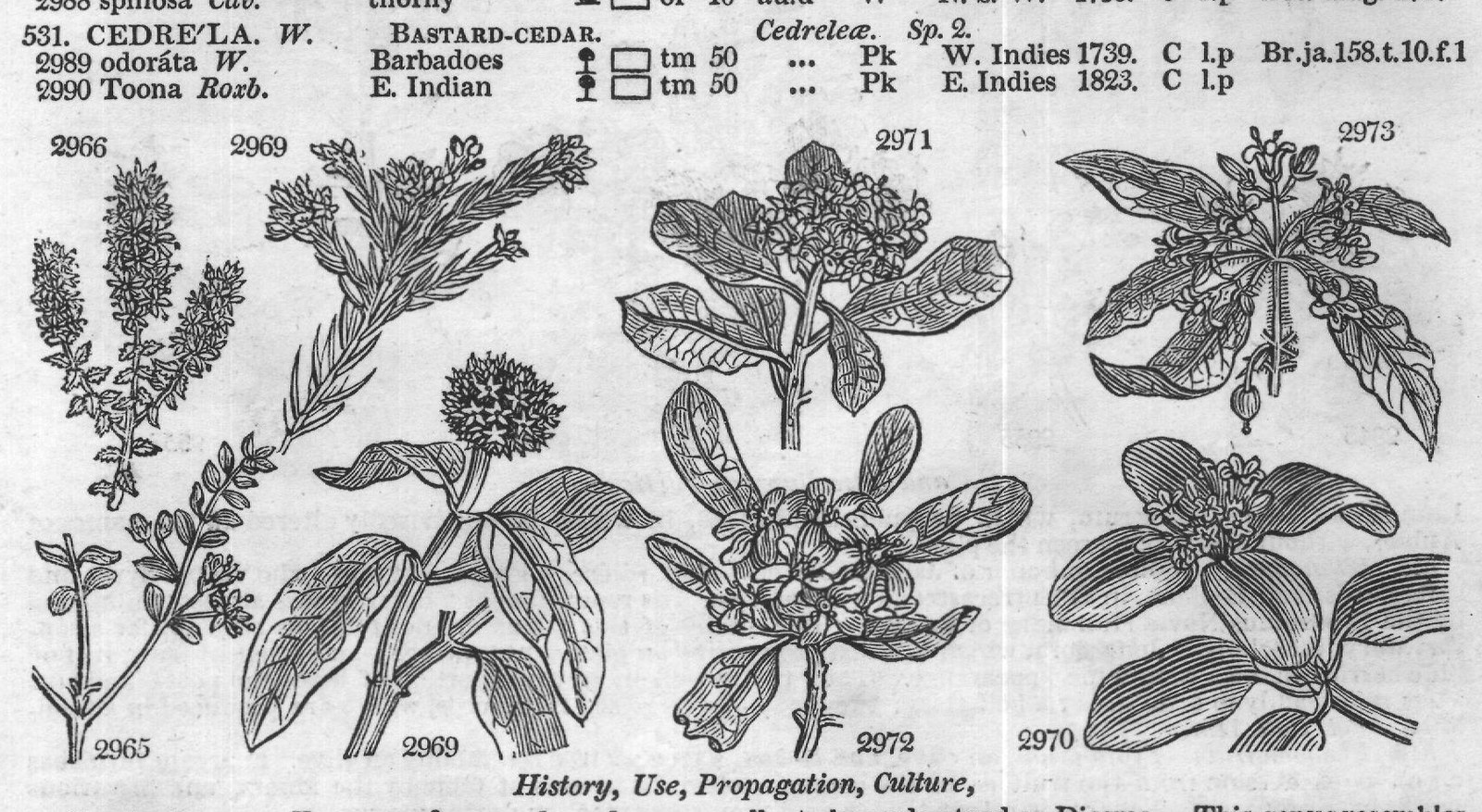
W ... 2965 2969 2972 2970 History, Use, Propagation, Culture, 520. Agathosma. From aγaθoς, good, and oσμη, smell; to be understood as Diosma. This genus resembles that, and requires the same culture. The Hottentots use the leaves of A. pulchella dried and powdered, under the name of Bucku, to mix with the grease with which they anoint themselves. It gives them so rank an odor, that Thunberg says, he sometimes could not bear the smell of the men who drove his waggon. 521. Nauclea. A noble genus of Rubiaceous plants, bearing their flowers in round heads. The meaning of the name is nowhere explained. One species, N. Gambir, is said to yield the gamboge gum of the shops.. 522. Pittosporum. From πiττη, resin, and σπoρoς, a seed. The capsule is resinous. These are handsome shrubs, with good foliage and pretty flowers. P. tobira, a native of Japan, is nearly hardy. Ripened cuttings root freely in sand under a hand-glass, or one species may be grafted on another. 523. Lasiopetalum. From λaσioς, woolly, and πετaλov, a petal; in allusion to the flowers. Ripened cuttings planted in sand under a hand-glass will root freely. 524. Thomasia. Named by M. Gay, after M. Thomas, an industrious collector of Swiss plants. Divided lately from Lasiopetalum. 525. Seringia. Also named by M. Gay, in honor of M. Seringe, an ingenious Swiss botanist, author of Melanges de Botanique, and other useful works. Divided from Lasiopetalum, with which it agrees in habit and appearance. 526. Büttneria. David Sigismond Augustus Büttner, was a professor of botany at Gottingen, who published, ORDER I.
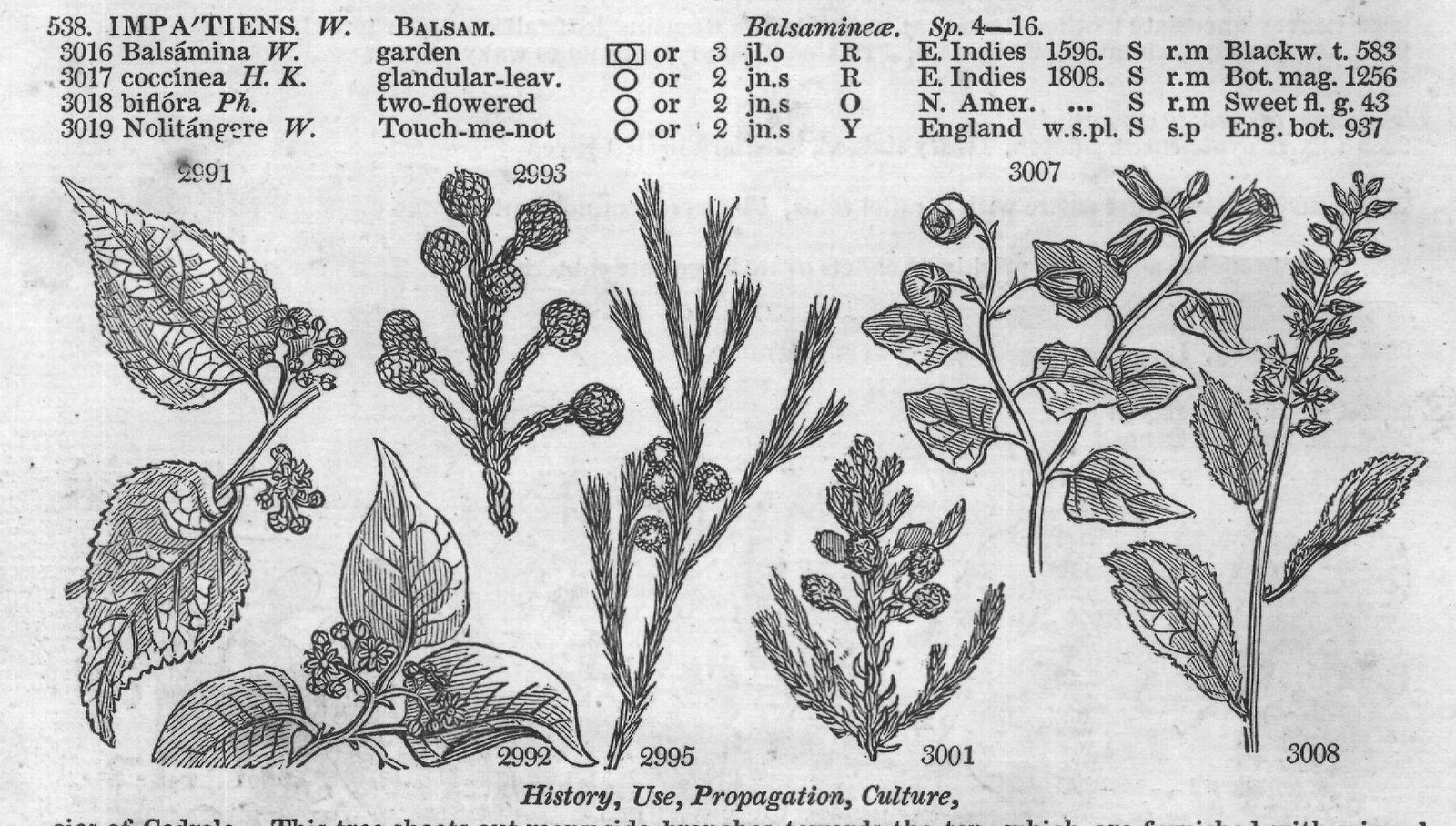
PENTANDRIA MONOGYNIA. 2957 Leaves 3-cornered blunt villous hispid pid spreading, Umbels terminal 2958 Leaves lanceolate carinated ciliated, Umbels terminal 2959 Lvs. aggregate linear lanceolate channelled glandular villous imbricated, Heads of branches terminal 2960 Leaves aggregate ovate acuminate imbricated dotted fringed, Heads of branches terminal umbelled 2961 Leaves alternate aggregate subcordate acuminate pubesc. dotted, Flowers in terminal umbelled branches 2962 Leaves imbricate spreading lanceolate ciliated, Heads terminal, Five stamens sterile. 2963 Leaves aggregate oval obtuse glandular ciliated spreading, Heads of branches terminal 2964 Leaves ovate crenate dotted beneath, Flowers axillary solitary 2965 Leaves opposite smooth ovate entire revolute at edge beneath rusty with dots 2966 Leaves ovate glandular-crenate smooth, Flowers axillary in pairs 2967 Leaves 3-cornered mucronate smooth below dotted in two rows, Segments of calyx smooth 2968 Leaves ovate carinate ciliated imbricated 4 ways, Flowers terminal solitary 2969 Leaves oblong acute, Peduncles equal, Stamens the length of corolla 2970 Leaves obovate obtuse smooth coriaceous, Capsules 2-valved 2971 Leaves obovate blunt shining netted beneath, Panicle globose terminal 2972 Leaves obovate obtuse smooth coriaceous, Capsules 3-valved 2973 Leaves oval lanceolate narrowed at each end and stalks smooth, Peduncles of the branches terminal 2974 Leaves elliptical obtuse pubescent beneath revolute at the edge 2975 Leaves elliptical acuminate smooth, Leafstalks rusty with down 2976 Sepals smooth inside 2977 Sepals hoary on both sides 2978 Leaves linear elliptical entire, Stipules leafy, Petals 5, Stamens 2979 Petals 5, Stamens 10 2980 Leaves 3-lobed beneath hispid downy, Petals O 2981 Leaves ovate lanceolate coarsely toothed 2982 Leaves lanceolate toothed hastate at base, Rachis stem and leafstalks angular prickly 2983 Leaves elliptical entire emarginate, Prickles stipulary, Branches wavy smooth 2984 Leaves cordate smooth 2985 Leaves ovate entire smooth, Ovary stalked, Nectary 10 cleft rayed 2986 Leaves ovate obtuse entire with parallel veins, Flowers terminal panicled 2987 Stem branches and leaves prickly, Leaflets ovate lanceolate subserrated 2988 Stem spiny, Leaves emarginate, Flowers racemose 2989 Cal. and cor. naked 2990 Cal. and cor. fringed 2979 2981 2977 2983 2984 2986 2987 2988 2989 and Miscellaneous Particulars. in 1750, a catalogue of the plants in the garden of an amateur named Cunon. Ripened cuttings planted in sand under a hand-glass will root freely. 527. Ayenia. In honor of the Duke D'Ayen, of the house of Noailles. He was a great patron of botany. Cuttings root freely in sand in a moist heat. 528. Calodendrum. From κaλoς, fine, and δεvδρov, a tree. Fine indeed, with its beautiful foliage and splendid flowers. This is a Cape genus, and is generally supposed to be one of the finest trees known there; its fruit bears great resemblance to a chestnut, but seldom arrives here perfect. It grows freely in an equal mixture of loam and peat; and ripened cuttings root readily in pots of sand under a hand-glass. (Bot. Cult. 159.) 529. Toddalia. Kaka Toddali is the Malabar name of the shrub. Cuttings root readily in sand under a bell-glass. 530. Bursaria. From bursa, a pouch; the capsules resemble those of Thlaspi Bursa Pastoris so much, that Labillardiere fancied he had found a cruciferous tree when he discovered the plant in New Holland. "This is a pretty plant. It is very desirable for a greenhouse or conservatory, being an abundant flowerer, and very showy when covered all over with its elegant little white flowers; an equal mixture of sandy loam and peat is the best soil for it; and young cuttings are not difficult to root in sand under a bell-glass." (Bot. Cult. 155.) 531. Cedrela. From cedrus, the cedar-tree. The wood of plants of this genus is one of the kinds of cedar of commerce. All that comes from New Holland in the form of packing cases, is supposed to be the wood of a spespiked 532. HOVENIA. Th. 2991 dúlcis Th. 2992 acerba Lindl. 533. BRU'NIA. W. 2993 nodiflóra W. 2994 paleácea W. 2995 lanuginósa W. 2996 verticilláta W. 2997 deústa Th. 2998 microphýlla Th. 2999 láxa Th.
PENTANDRIA MONOGYNIA.
HOVENIA. sweet sour BRUNIA. imbricated chaffy woolly whorled black-tipped small-leaved 类型 ココココ Rhamni. Sp. 2.
CLASS V. fr 8 jl.au W Japan 1812. C p.1 Bot. mag. 2360 or 8 jl.au W Nepal Cp.l Bot. reg. 501 Rhamni. Sp. 14-24. ☐ or 6 jl.au W C. G. H. 1786. C p.l Bre. cent.22. t.10 or 2 jn.au W C. G. H. 1791. C p.1 Wendl. coll. t.21 or 3 jn.au W C. G. H. 1774. C p.l Bot. cab. 572 or 3 jn.au W C. G. H. 1794. C p.1 or 1 jn.au W C. G. H. 1804. C p.1 业 or 1 jn.au W C. G. H. 1804. C p.1 or 2 jn.au W C. G. H. 1805. C p.l 3000 alopecuroídes Th. 3001 abrotanoídes W.
Fox-tail or 1 W ...
C. G. H. 1816. C p.l Thyme-leaved or 1 my.jl W C. G. H. 1787. C p.1 Bot. cab. 355 3002 supérba Donn. 3003 fragarioídes W. 3004 ciliata L. superb or 4 my.jl W C. G. H. 1791. C p.1 Strawberry-like or 1 my.jl W C. G. H. 1794. C p.1 ciliated or 1 my.jl W C. G. H. 1812. C p.1 3005 ericoídes Wendl. heathy or 3 jl.au W C. G. H. 1804. C p.1 Wend.coll.2.t.57 3006 phylicoídes Th.
Phylica-like or 2 jn.au W C. G. H. 1805.
C p.l 534. BROSSE/A. L.
BROSSÆA.
Ericeæ. Sp. 1. 3007 coccínea L. 535. I'TEA. L. scarlet or 4 S S. Amer. ... ...
Cl.p Plum. ic. 64. f. 2 ITEA.
Ericeæ. Sp. 1. 3008 virgínica W.
Virginian or 6 jn.au W N. Amer. 1744. L s.p Bot. mag. 2409 536. CYRIL/LA. L.
CYRILLA.
Ericeæ. Sp. 1. 3009 caroliniána Ph.
Carolina or 6 jn.au W Carolina 1765. C 1.p Bot. mag. 2456 537. CLAYTO'NIA. W. CLAYTONIA.
Portulaceæ.
Sp. 6-11. 3010 virgínica Ph.
Virginian pr mr.my St N. Amer. 1748.
D s.p Bot. mag. 941 3011 caroliniána H. K. spatula-leaved pr mr.my Pk N. Amer. 1789.
D s.p Par. lond. 71 3012 lanceoláta Ph. spear-leaved pr mr.my W N. Amer. 1812.
D p.l Pursh. am. 1. t.3 3013 sibírica W.
Siberian pr my.au R Siberia 1768.
S p.1 Bot. mag. 2243 3014 alsinoídes Ph. 3015 perfoliáta Donn. 538. IMPATIENS. W. 3016 Balsámina W. 3017 coccínea H. K. 3018 biflóra Ph. 3019 Nolitángere W. 2991 garden glandular-leav. two-flowered Touch-me-not 2993 Chickweed-like cu mr.jn W Nootk. Sd.1794. S p.1 Bot. mag. 1309 small-flowered cu my.au W N. Amer. 1794.
S s.p Bot mag. 1336 BALSAM.
Balsamineæ.
Sp. 4-16. or 3 jl.o R or 2 jn.s R or 2 jn.s 0 ... or 2 jn.s Y E. Indies 1596. Sr.m Blackw. t. 583 E. Indies 1808. Sr.m Bot. mag. 1256 N. Amer.
Sr.m Sweet fl. g. 43 England w.s.pl. S s.p Eng. bot. 937 3007 2992 2995 3001 3008 History, Use, Propagation, Culture, cies of Cedrela. This tree shoots out many side branches towards the top, which are furnished with winged leaves, composed of 16 or 18 pair of leaflets, so that they are sometimes near three feet long. The flowers are on a branching raceme, and the fruit a woody capsule about the size of a pigeon's egg. The bark, leaves, and fruit have, when fresh, a smell like assafœtida, but the timber has a pleasant smell. In the British West India islands the tree has the common name of cedar. The trunk is so large as to be hollowed out into canoes and periaguas, for which purpose it is extremely well adapted; the wood being soft, it may be cut out with great facility, and being light, it will carry a great weight on the water. There are canoes in the West Indies which have been formed out of these trunks forty feet long and six broad: the wood is of a brown color, and has a fragrant odor, whence the title of cedar has been given to it. It is frequently cut into shingles for covering houses, and is found very durable; but as the worms are apt to eat this wood, it is not proper for building ships, though it is often used for that purpose, as also for sheathing of ships. It is often used for wainscoting of rooms, and to make chests, because vermin do not so frequently breed in it, as in many other sorts of wood, this having a very bitter taste, which is communicated to whatever is put into the chests, especially when the wood is fresh; for which reason it is never made into casks, because spirituous liquors will dissolve part of the resin, and thereby acquire a very bitter taste. Cuttings of Cedrela strike root under a hand-glass in sand. 532. Hovenia. Named after David Hoven, a Dutch commissary in Japan, who gave facilities and encouragement to Thunberg while in that country. A small tree, nearly hardy. Its fruit is eaten in China and Japan, and is said to resemble a Bergamot pear in taste. 533. Brunia. So named after Cornelius Brun, a traveller into the Levant and Russia at the end of the last and beginning of the present century. This, Sweet observes, "is a pretty Cape genus; its species are pretty bushy shrubs, with heath-like leaves, and are handsomest while young. The flowers are not so showy as in many other genera, but some of them are very elegant. A sandy peat soil suits them best, with a moderate supply of water; and young cuttings planted in sand under a bell-glass will strike root freely." (Bot. Cult. 153.) 534. Brossæa. Gui de la Brosse was physician to Louis XIII, and in 1626 procured the establishment at Paris of the Jardin des Plantes, of which he was the first director. A very doubtful plant. It is said to be a shrub like a Cistus, with scarlet fiowers half an inch long. 535. Itea. From ίτεa, the Greek name of the willow. The name Salix having been given to the modern willow, that of Itea has been applied to a plant resembling the willow in leaves and place of growth. This is a handsome plant which thrives well either in peat-soil or sandy loam, and is increased by layers. ORDER I.
PENTANDRIA MONOGYNIA. 2991 Fruit sweet fleshy, Leaves glabrous a little shining- 2992 Fruit austere, Leaves downy quite opaque 2993 Leaves 3-cornered incurved acute, Flowers terminal on the lateral branches 2994 Leaves 3-cornered brown at end, Chaff of the heads exserted colored 2995 Leaves half round erect-spreading withered at end at the base and branches hairy, Heads round latera 2996 Leaves 3-cornered obtuse smooth, Heads terminal, Branches whorled clustered 2997 Leaves 3-cornered black at the end smooth, Heads terminal 2998 Leaves ovate 3-cornered fleshy smooth, Heads terminal, Branches divaricating 2999 Leaves 3-cornered and spiked, Flowers smooth 3000 Leaves 3-cornered acute smooth, Heads lateral globose smooth 3001 Leaves linear-lanceolate reflexed spreading: their edge fringed at base, Heads terminal corymbose 3002 Leaves half rounded spreading incurved hairy at the end with a withered beard 3003 Leaves 3-cornered appressed ciliated at edge 3004 Leaves ovate acuminate ciliated. A very doubtful species 3005 Leaves short acute 3-cornered at the end spreading fuscous and callous, Heads round at end of branches 3006 Leaves ovate convex imbricated, Heads terminal hairy 3007 A little shrub like a Cistus, with ovate stalked alternate pale-green leaves 3008 Leaves ovate acute serrated, Spikes pubescent 3009 Leaves wedge-lanceolate acute membranous nerved, Spikes slender 3010 Leaves very long linear, Petals entire 3011 Leaves short oval abruptly narrowed into the stalk 3012 Leaves lanceolate, Raceme solitary elongated, Root tuberous 3013 Leaves nerved: radical and cauline ovate, Raceme 1-sided, Petals bifid 3014 Radical leaves spatulate ovate: cauline ovate distinct, Root fibrous 3015 Radical leaves spatulate rhomb-shaped: cauline perfoliate 3016 Flower-stalks clustered, Leaves lanceolate: the upper alternate, Spur shorter than flower 3017 Leaves alternate oblong oval serrated, Leafstalks with many glands, Spur incurved as long as flower 3018 Flower-stalks generally 2-flowered, Leaves ovate serrated, Flowers orange-brown spotted inside 3019 Flower-stalks clustered, Leaves ovate, Points of stem tumid 3013 3009 3014 3015 3012 3017 3019 3016 and Miscellaneous Particulars. 536. Cyrilla. In honor of Dominico Cyrilli, professor of medicine at Naples, and a fellow of the Royal Society of London. He published, in 1788, a work upon the rare plants of Naples, which is now one of the scarcest of botanical works. This is a pretty shrub. Young cuttings will root under a bell-glass in sand, but not very freely. 537. Claytonia. In memory of Mr. John Clayton, who collected plants chiefly in Virginia, and sent them to Gronovius, who published them in his Flora Virginica. C. perfoliata is very hardy, and is not easily eradicated where once introduced. It grows on the poorest soil, vegetates early, and the whole of the herbage gathered and boiled makes a very tender spinage. 538. Impatiens. A metaphorical name given to these plants on account of the elastic force with which their capsules burst, and scatter their seeds upon the slightest touch. I. Balsamina is one of the most beautiful of popular annuals, forming a shewy cone of finely variegated carnation-like flowers. The prevailing colors of the petals are red and white, the former extending to every shade of orange, purple, scarlet, lilac, pink, and especially carnation or flesh color. Those are esteemed the most beautiful varieties which have the flowers double, and striped in the manner of a flake or bizarre carnation: but none of the varieties are permanent or can be continued by seeds, and the plant does not root readily by cuttings. The way to procure very large plants is to sow early in the season, as in March, to commence transplanting into 3-inch pots as soon as the plants have two proper leaves, and to shift every week or ten days into pots a size larger every time, till at last they are in pots of the largest or of a very large size, and in the richest light mould. The plants should be kept all the time in a hot-bed or pit, plunged, and with abundance of room and air, and the heat of the melon or pine. Fairweather, by transplanting only three or four times from No. 48. pots to those of eight inches diameter raised, produced balsams "four feet high, and fifteen feet in circumference, with strong thick stems, furnished with side branches from bottom to top, and these covered with large double flowers." (Hort. Trans. iii. 406.) The juice of the balsam, prepared with alum, is used by the Japanese to dye their nails red. (Thunberg.) I. Nolitangere, Ne me touchez pas, Fr., Springsame, Ger., and Erba Impatienta, Ital., is the only species found wild in Europe. When the seeds are ripe, upon touching the capsules, they are thrown out with considerable force: hence the names Impatiens and Nolitangere. In the day-time the leaves are expanded, but at night they hang pendent, contrary to what is observed in plants, which from a deficiency of moisture, or a too great perspiration from heat, commonly droop their leaves during the day. Only the goat is said to eat this plant. I. biflora, the American Noli-me-tangere, resembles this plant, but is handsomer. erect VIOLET. palmated or cut-leaved or winged-leaved or arrow-leaved or spear-leaved or oblique-flower. or hollow-leaved or white-rooted or variegated or doubtful or swamp or small-flowered or white-flowered or Primrose-leav. or hairy Aor hill ft field or marsh ✓ or Austrian or sweet ft ft B álba ft cærúlea سبند ft ò purpúrea pléna ft PENTANDRIA MONOGYNIA. 539. SAUVAGE'SIA. Jacq. SAUVAGESIA. 3020 erécta L. 540. VIOLA. W. 3021 palmáta W. 3022 pedáta W. 3023 pinnáta W. 3024 sagittáta W. 3025 lanceoláta W. 3026 oblíqua W. 3027 cuculláta W. 3028 sorória Ph. 3029 papilionácea Ph. 3030 ambígua W. K. 3031 uliginósa Schr. 3032 clandestína Ph. 3033 blánda Ph. 3034 primulifólia Ph. 3035 hirta W. 3036 collina Bess. 3037 campéstris Bieb. 3038 palústris Sm. 3039 Schmidtiana Sch. 3040 odoráta W. a purpúrea purple-flowered white-flowered blue-flowered double-purple cu Violacea. Sp. 1-6.
CLASS V. 1 my.jn Pk S. Amer. 1820. S co Jacq.am. t.51. f.3 از و Violaceæ. Sp. 50-120. my.jn Pu N. Amer. 1752. D p.l Bot. mag. 535 my.jn B N. Amer. 1759. D p.l Bot. mag. 89 my.jn V S. Europe 17:52. D p.l Gm.sib.4.t.49.f.4 W.B N. Amer. 1775. D p.l jn.jl W N. Amer. 1759. D p.l Gm.sib.4.t.49.f.2 my.jn Y.B N. Amer. 1762. D p.l my.jl B N. Amer. 1772. Dpl Bot. mag. 1795 ap.jn B N. Amer. 1802. D p.1 Will.hort.ber.72 my.jn B N. Amer. 1800. D p.1 ap.my P.V Hungary 1823. D co W.K.hung.t.190 ap.my Pu Carinthia 1823. D co my Br Pensylv. 1800. D p.l my.jl W N. Amer. 1802. D p.1 Will.hort.ber.24 ap.jn P.B N. Amer. 1783. D pl ap.my B England ch. so. D p.l Eng. bot. 894 mr.my B Poland 1822. D co ap.my Pu Tauria 1824. D co my.jn B Britain mos.b. D p.l Eng. bot. 444 my.jn B Austria 1821. D co mr.my Pu Britain sha. pl. D p.l Eng. bot. 619 mr.my Pu Britain gard. D p.l mr.my W Britain gard. D p.l mr.my B Britain gard. D p.l mr.my Pu Britain gard. D p.l & álba pléna double-white ft mr.my W Britain gard. D p.l 3 cærulea pléna n pállida pléna 3041 alpína Jacq. 3042 canína W. double-blue ft mr.my B Britain gard. D p.l Neapolitan ft mr.my Pa.B Britain gard. D p.l Alpine or my.jn D.Pu Austria 1823. D co Jac. aust. t. 242 dog's 3043 sylvéstris Kit. 3044 neglécta Schm wood A W ap.jn B Britain hea. D p.1 Eng. bot. 620 or my.jn B Hungary 1820. D co neglected or my.jn P.B Crimea 1821. D co 3045 glaúca Bieb. 3046 láctea E. B. 3047 mortána W. 3048 Nuttállii Ph. 3049 débilis Mich. glaucous or my.jn P.B Poland 1822. D co cream-colored or my Cr England moi.h. D p.l Eng. bot. 445 mountain or 1 my.jn L.B Al. of Eur. 1683. D p.l Bot. mag. 1595 Nuttall's or my.jn B Missouri 1812. D co weak or ap.my W N. Amer. 1820. D co 3050 valdéria W. en. fringed-leaved or my.jn P Mt. Cenis 1805. D p.1 Al. p. 2. t. 24. f.3 3051 cenísia W.
Alpine or Mt. Cenis 1759.
D p.1 Canadian or streaked 3052 canadénsis W. 3053 striáta W. 3054 pubéscens W. 3055 cóncolor L. T. 3056 mirábilis W. 3057 biflóra W. 3058 uniflóra W. 3059 arboréscens W. 3060 tricolor L. 3061 banática Kit. 3062 arvensis Murr. 3063 altaica Pall. downy green-flowered broad-leaved two-flowered Siberian shrubby Heart's-ease Banatlan corn Tartarian 3064 rothomagénsis P. S. Rouen or or or or or or jn.jl B my.jn L.B jn.jl St jn.jl B 1 jn.jl N. Amer. 1783.
N. Amer. 1772.
N. Amer. 1772.
GN. Amer. 1788. jn.au L.B Germany 1732.
D p.l D p.l D p.l D co D p.l ap.my Y Al. of Eur. 1752. D p.l jn.jl Y Siberia 1774. D co Al. p. 2. t. 22. f. 6 Bot. reg. 390 Linn. tr. 6. t. 28 Flor. dan. 1045 Bot. mag. 2089 Gm. si.4. t. 48.f.5 or 1 ap.my P.B Spain 1779. L r.m Barr. ic. 568 or ap.s Y.Pu Britain co. fi. S co Eng. bot. 1287 Oorap.s Y.Pu Germany 1820. S co or ap.s Y Britain ...
Sco Aor mr.jn P.Y Siberia 1805. D co Bot. reg. 54 or my.au B Bot. mag. 1498 1783. D co France DEINDE 3065 sudética W. en. 3066 lútea E. B. - 3067 grandiflóra L. 3068 Zóysii W. 3020 tooth-flowered yellow-flowered great-flowered crenated Aor Aor or Aor 3021 my.au Y my.au Y Germany 1805. D co Britain m.pas. D p.1 Eng. bot. 721 my.au D.B Switzerl. jl.s Y Carinthia 3041 ... ...
D p.l Ha. hel. 566. t.17 co Jac. co. 4.t.11. f.1 3035 3022 3023 3040 History, Use, Propagation, Culture, 3038 539. Sauvagesia. In honor of Jacques Boissier de Sauvages, a French botanist, who died in 1767. He published a Flora of Montpellier, and other works. A genus of small herbaceous plants, more singular than beautiful. 540. Viola. The ancients feigned that violets were the first food of the cow Io, one of Jupiter's mistresses, This is an extensive genus of low herbs, mostly with violet and white flowers, and well adapted for the flowerborder, rock-work, or for growing in pots. V. odorata is a favorite flower, on account of its fragrance and early appearance. It is a native of every part of Europe, in woods, amongst bushes, in hedges, and on warm banks. 3020 Stem simple, Leaves narrow lanceolate, Stipules very long ORDER I.
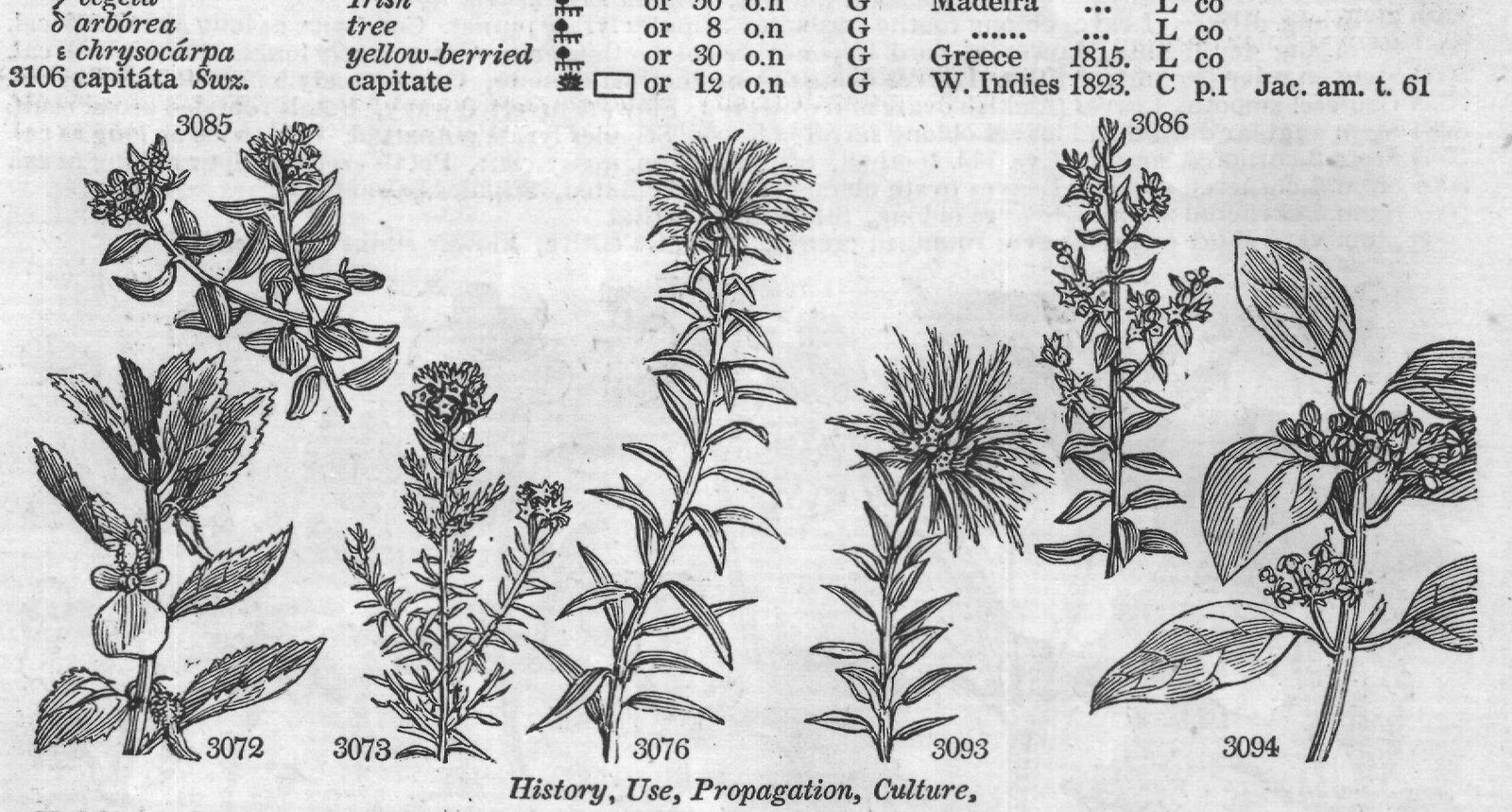
PENTANDRIA MONOGYNIA. 1. Stemless, Stipules membranous. 3022 Leaves pedate 7-parted 3023 Leaves many-cleft, Segments lobed 3021 Pubescent, Leaves palmated 5-lobed toothed and undivided 3024 Leaves obl. acute cord. sagittate serr. cut at base, Flowers inverted, Three lower petals bearded at base 3025 Smooth, Leaves shining lanceolate obsoletely toothed or crenulate, Flowers whitish [middle 3026 Smth. Lvs. cord. ac. cren. serr. flattish, Fls. erect, Pet. obliquely turned: lateral longer bearded below the 3027 Smooth, Leaves cordate serrate smooth hooded at base, Petals obliquely turned: lateral bearded 3028 Leaves cordate crenated pubesc. beneath, Lower petal bearded at base, Flower-stalks shorter than leaves 3029 Lvs. triang. cord. ac. cren. somewhat hood. Pet. obov.: 3 low. beard. below mid. conniv.: 2 upper reflexed 3030 Leaves oblong cordate obtuse crenate naked at the base with unequal inflexed hooded lobes 3031 Stemless, Leaves cordate smooth, Peduncles bracted above the middle 3032 Smoothish, Lvs. roundish obt. at base cord. cren. serrate, Runners flowering, Pet. lin. not longer than cal. 3033 Leaves cordate obtuse acutish flat smooth, Petals not bearded, Flower-stalks as long as leaves 3034 Leaves oblong subcordate, Stalks membranous 3035 Leaves cordate and stalks hispid with hairs, Cal. obtuse 3036 Subhirsute, Runners none, Leaves cordate, Calyxes obtuse, Flowers sweet-scented 3037 Leaves cordate vertilinear at base pubescent, Runners none 3038 Leaves reniform smooth, Root creeping, Calyx obtuse 3039 Leaves cordate acuminate subcrenate smooth, Bractes close under the flower, Lower petal truncate 3040 Creeping runners and stalks smoothish, Cal. obtuse 3041 Nearly stemless, Leaves roundish elliptical crenate stalked, Stipules lin. serrated, Spur as long as calyx 2. Caulescent, Stipules membranous. 3042 Old stem ascending, Leaves oblong cordate obt. dotted, Stipules setaceous toothed, Cal. lanceolate acute 3043 Stem square erect, Radical leaves cordate reniform, Flower-stalks longer than the leaves 3044 Stem erect angular, Lvs. cord. toothed crenat. smooth, Stip. tooth. on one side, Bract. above midd. of stalk 3045 Stem spread. compressed, Lower lvs. cord. ovate: upper ovate-lanceol. crenul. Stip. toothed on each side 3046 Stem ascending rounded, Leaves ovate lanceolate, Stipules cut serrated 3047 Stem erect, Leaves cordate oblong, Stipules toothed on one side, Anthers free 3048 Pubescent, Stem simple erect, Leaves ovate obl. acute, Petals lanc. entire, Flower-stalks length of leaves 3049 Caulescent weak, Stipules membranous lanceolate slightly torn, Leaves shortly cordate toothed 3050 Stems erect and procumbent, Leaves oblong entire sinuated ciliated hispid, Stipules undiv. Calyxes acute 3051 Stems filiform undiv. procumb. Leaves ovate stalked their edge at the base ciliated, Stipules undivided 3052 Smoothish, Leaves subcordate acuminate serrated, Flower-stalks length of leaves, Stipules short entire 3053 Leaves cordate acuminate serrated flattish, Stipules lanceolate serrated ciliated 3054 Villous pubescent, Stem erect leafy at top, Leaves broad cordate, Stipules oblong serrated at end 3055 Erect, Leaves broad lanceolate, Stipules linear lanc. entire, Flower-stalks axillary in pairs very short 3056 Stem erect and leaf-stks. 3-corner. Rad. fl. with cor. but sterile: caul. apet. fertile, Lvs. reniform cord. cren. 3057 Stem weak about 2-flowered, Leaves reniform serrate, Calyxes acute, Stipules entire 3058 Stem 1-flowered, Leaves cordate toothed 3059 Leaves linear lanc. toothed, Stipules linear entire, Spur very obtuse much shorter than calyx §3. Stipules pinnatifid, Stigma cup-shaped. 3060 Stem ang. diffuse, Leaves oblong toothed crenate, Stipules lyrate pinnat. Cor. twice as long as smooth cal. 3061. Stem. ang. dec. diffuse, Lower lvs. cord. upper ovate obl. toothed cren. Cor. scarcely longer than smooth cal. 3062 Stem angular decumb. diffuse, Leaves ovate oblong toothed crenate, Cor. scarcely longer than hairy cal. 3063 Caulesc. smooth, Leaves thickish ovate and oval cren. Flowers inverted wavy, Petals rounded broad renif. 3064 Stern angular diffuse and leaves oblong serrated hairy, Stipules lyrate pinnatifid, Cor. twice as long as cal. 3065 Stem 3-cornered simple, Lvs. obl. toothed, Stipules palm. many-cleft, Petals crenate, Spur as long as cal. 3066 Stem 3-cornered simple, Leaves ovate oblong crenated ciliated, Stipules palmate cut 3067 Stem 3-cornered simple, Leaves oblong, Stipules pinnatifid 3068 Stem very short erect, Leaves roundish crenate, Stipules entire, Flower-stalks 3-cornered 3046 3047 3057 3066 5064 3042 3055 and Miscellaneous Particulars. 3068 Desfontaines says it is frequent about Cassa and Tozzer, in Barbary, in the palm groves; the blue and white growing promiscuously and flowering in winter. Hasselquist found it in Palestine, Thunberg in Japan, and Loureiro in China, near Canton. The double purple and the Neapolitan are the most esteemed varieties: the latter forces well, and where there is a stove or warm pit, may be had from Christmas to April, when others are in flower in the open air.
In medicine, the flowers of violets act as a laxative, and the syrup is used by chemists to detect an acid or an alkali: for this purpose the V. odorata is cultivated to some extent at Stratford upon Avon. (Withering.) 3069 calcaráta W. 3070 cornúta W. spurred horned Aor or PENTANDRIA MONOGYNIA. mr.jn L.B Switzerl. 1752. D p.l CLASS V. my.jn B Pyrenees 1776. D p.1 Bot. mag. 791 541. IONI DIUM. Vent.
IONIDIUM.
Violacea. Sp. 2-30. 3071 polygalæfólium V. whorl-leaved业 or 1 ap.au G.Y S. Amer. 1797. C l.p Vent. malm. 27 3072 Ipecacuanha Vent.
New Ipecac 1½ jl W S. Amer. 1822. C 1.p Bot. mag. 2453 542. PHY'LICA. W.
PHYLICA.
Rhamni. Sp. 21- 3073 ericoídes W.
Heath-leaved or 3 ap.s W C. G. H. 1731. C p.1 Bot. mag. 224 3074 parviflóra W. small-flowered or 2 ap.jl W C. G. H. 1790. C p.1 3075 lanceoláta W. lance-leaved or 3 ap.my W C. G. H. 1790. C p.1 3076 capitáta W. en. headed or 1 my.au W C. G. H. 1800. C p.1 Bot. reg. 711 3077 pubéscens W. downy or 2 f.ap W C. G. H. 1774. C p.1 Bot. cab. 695 3078 erióphora W. pale-flowered or 3 n W C. G. H. 1774. C p.1 Pl. am. t. 445. f. 1 3079 rosmarínifólia P. S. Rosemary-lvd. or 3 ...
W C. G. H. 1815. C p.1 Bot. cab. 849 3080 axilláris P. S. axillary-flower. or 2 my.jn W C. G. H. 1812. C p.l 3081 plumósa W. feathered or 2 mr.my W C. G. H. 1752. C p.1 Bot. cab. 253 3082 villósa W. villous or or 2 my W C. G. H. 1790. C p.1 3083 stipuláris W. horned or 3 my.s W C. G. H. 1786. C p.1 Bur. afr. t.43. f.2 3084 cordáta W. heart-leaved or 2 my.jn P.Y C. G. H. 1789. C p.l Com. rar. 62.t.12 3085 buxifólia W.
Box-leaved or 2 my.s W C. G. H. 1759. C p.l Bot. cab. 848 3086 spicáta W. spiked or 2 n.d W C. G. H. 1774. C p.1 Bot. cab. 323 myrtifol 3087 myrtifólia P. S. 3088 callósa W.
Myrtle-leaved callous-leaved or 3 ...
D.Y C. G. H. 1816.
C p.1 or 1 mr.ap W C. G. H. 1774. C p.1 3089 imbricáta W. imbricated or 1 au.n W C. G. H. 1801. C p.1 3090 cylíndrica W.en. cylindrical or 2 ap.au W C. G. H. ...
Cp.1 Wendl. coll. t. 3091 racemósa W. cluster-flower. or 5 my.s WC. G. H. 1790.
C p.l 3092 pinifólia W.
Pine-leaved or 6 my W C. G. H. 3093 squarrósa W. squarrose or 2 au.n W C. G. H. 1800. 1789. C p.1 C p.l Bot. cab. 36 543. PLECTRO'NIA. W. PLECTRONIA.
Rhamni. Sp. 1-2. 3094 corymbósa P. S. corymbed 오or 20 ...
W.GC. G. H. 1816. C p.1 Burm. afr. t. 94 544. CONOCAR/PUS. W. BUTTON-TREE.
Combretaceæ. Sp. 2-4. 3095 erécta W. upright tm 30 ...
Pa. Y Jamaica 1752. C p.1 Cat. car. 2. t. 33 3096 procúmbens W. procumbent or 6 ...
Pa. Y Cuba 1730. C p.1 Jac. am. t. 52. f. 2 545. CY/PHIA. W.
CYPHIA.
Campanulacea. Sp. 3-8. 3097 volúbilis W. twining or 1 ...
P.B C. G. H. 1795. D 1.p 3098 bulbósa W. bulbous or au.s P.B C. G. H. 1791. D l.p Bur. afr. t. 38. f.1 3099 Phyteuma Bot. reg. 625 546. LIGHTFOOTIA. L'Her. LIGHTFOOTIA. 3100 oxycoccoídes W. lance-leaved or 3101 subuláta W. awl-leaved or Campanulacea. Sp. 2. jl B.w C. G. H. au BC. G. H. 1787. 1787.
Cs.l D s.l Ex. bot. 2. t. 69.
L'He. s. an.4. t. 5 547. JASIONE. W.
SHEEP'S SCABIOUS.
Campanulacea. Sp. 2-5. 3102 montána W. mountain 3103 perénnis W. perennial 1 jn.jl B Opr 1 jn.jl B Britain sa. pa. S co pr France 1787. D co Eng. bot. 882 Bot. mag. 2198 548. LAGE CIA. W.
CUMIN.
Umbelliferæ. 3104 cuminoídes W. wild O cu 1 jn.jl G.Y Sp. 1.
Levant 1640. S co Lam. ill. t. 142 549. HEDERA. W.
Ivy.
Caprifoliacea. Sp. 2-8. 3105 Hélix W. common חה or 40 o.n G Britain woods. L co Eng. bot. 1267 ẞ poética vegéta arbórea & chrysocarpa 3106 capitáta Swz. 3085 poet's or 20 o.n G ...... ...
L co Irish or 50 o.n G Madeira L co זה ... tree • or 8 o.n G דה ... ...
Lco yellow-berried or 30 o.n G Greece 1815. L co capitate or 12 o.n G W. Indies 1823. C p.1 Jac. am. t. 61 3086 3072 3073. 3076 3093 3094 History, Use, Propagation, Culture, V. hirta and canina bear a considerable resemblance to V. odorata; but the first may be distinguished by its hairy petioles, and the last by its flowers being inodorous. V. arborescens is readily propagated by young cuttings planted under a hand-glass. 541. Ionidium. From lov, a violet, and εiδoς, similar, on account of its resemblance to a violet, from which it is by some thought not to be generically distinct. 542. Phylica; in Greek φiλύκη, and should therefore be written Philyca. The plant of the ancients is not known. Some think it was the Holly. P. ericoides occupies large tracts of ground about Lisbon, in the same manner as heath occupies many lands in England. Young cuttings of all the species root readily in sand under a bell-glass. 543. Plectronia. From πλεκτρov, a spur. The tree is furnished with stiff spines like the spurs of a cock. 544. Conocarpus. From κωvoς, a cone, and κaρπoς, a fruit : its fruit resembles the cone of an alder. Tropical trees, with alternate entire leaves and small heads of yellowish flowers. 545. Cyphia. From κuφoς, curved, on account of its curved stigma. Small Cape plants resembling Lobelia. ORDER I.
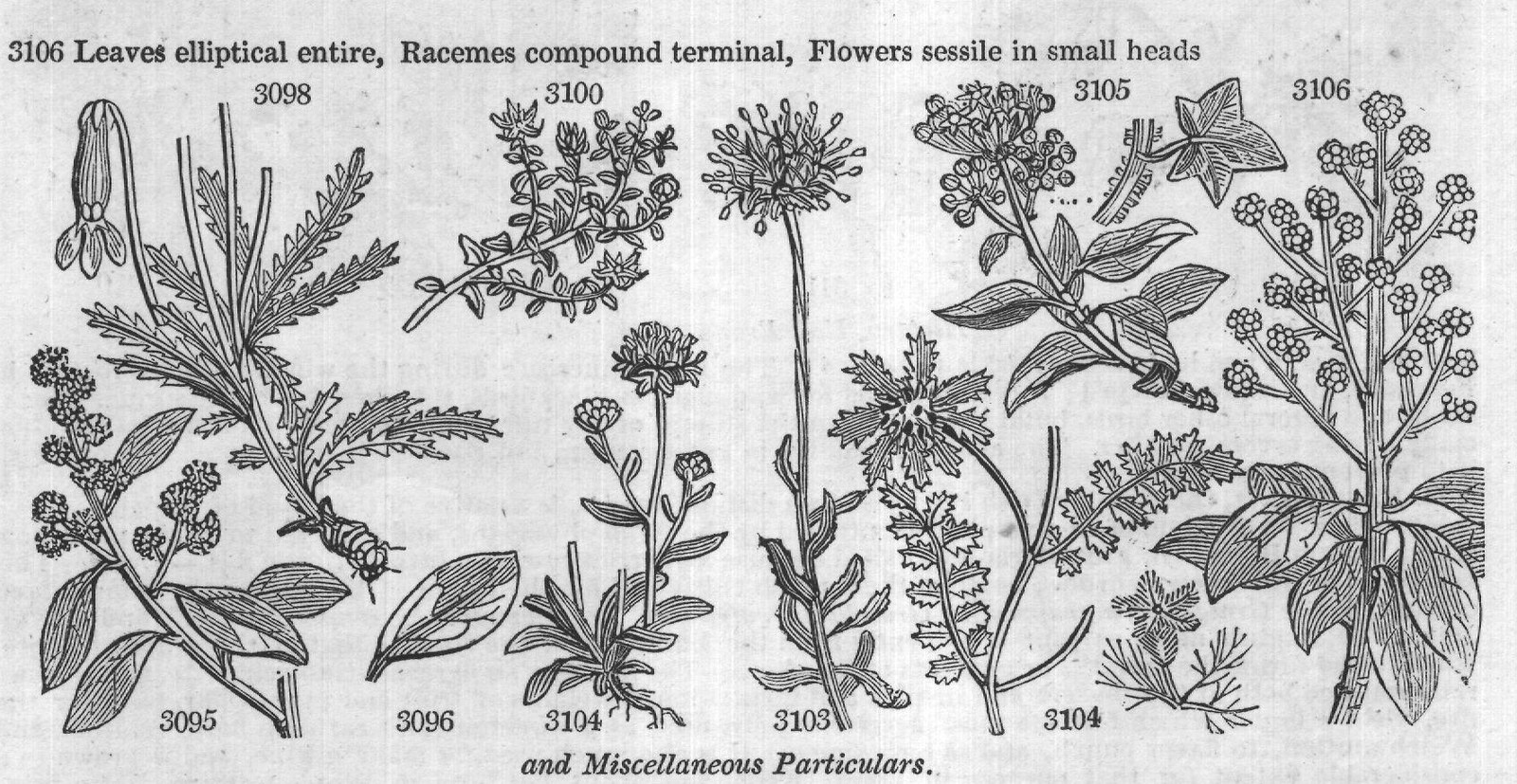
PENTANDRIA MONOGYNIA. 3069 Stem short, Spur subulate longer than petals, Leaves somewhat ovate, Stipules toothed 3070 Stem ascending 3-cornered, Leaves cordate crenate, Spur subulate longer than calyx, Upper petal acum. 3071 Stem ascending, Leaves opposite sessile and stipules lanceolate, Flowers nodding longer than leaves 3072 Leaves ovate obl. Pedunc. axillary solitary drooping, Lower lip very large emarginate 3073 Leaves linear lanceolate obtuse revolute at edge smooth, Branches umbelled, Heads round downy 3074 Leaves subulate acute rough somewhat hairy, Branches panicled many-flowered 3075 Leaves scattered linear lanceolate hoary beneath, Heads terminal hairy 3076 Leaves linear lanceolate villous, Bractes woolly, Heads terminal 3077 Leaves linear lanceolate acute spreading villous hoary beneath, Bractes colored villous very long 3078 Leaves linear hairy tomentose beneath revolute at edge, Heads terminal, Flowers downy 3079 Leaves linear flattish hoary beneath erect, Heads ovate downy 3080 Leaves linear lanceolate revolute at edge hoary beneath, Flowers axillary solitary racemose 3081 Leaves linear subulate very villous, Flowers terminal axillary, Cor. spreading 3082 Leaves linear upper villous, Flowers racemose 3083 Leaves linear revolute at edge rough hoary beneath, Stipules filiform colored, Bractes bifid naked 3084 Leaves cordate ovate spreading, Stem proliferous 3085 Leaves ovate scattered opposite and three together beneath netted veiny tomentose 3086 Leaves oblong cordate acuminate beneath hoary, Spikes cylindrical, Flowers length of bractes 3087 Leaves ovate mucronate smooth above and shining beneath hoary, Racemes leafy panicled 3088 Leaves oblong cordate acuminate hairy beneath white, Flowers in heads 3089 Leaves cordate ovate smooth, Flowers racemose 3090 Leaves linear lanc. revolute at edge villous hairy beneath, Flowers cylind. Bractes as long as flowers 3091 Leaves ovate smooth, Flowers simple panicled racemose 3092 Leaves acerose flat on each side very smooth, Flowers panicled racemose 3093 Leaves linear ciliated arcuate spreading, Head terminal 3094 Branches square, Leaves opposite stalked lanceolate ovate entire smooth 3095 Erect, Leaves lanceolate 3096 Procumbent, Leaves obovate 3097 Leaves entire and toothed linear, Stem twining 3098 Leaves digitate, Leaflets pinnatifid, Stem erect 3099 Leaves oblong crenated ciliated, Scape erect 3100 Leaves and petals lanceolate 3101 Leaves subulate, Petals linear 3102 Leaves linear lanceolate narrow at the base hispid wavy curled 3103 Leaves linear smoothish flat obtuse 3104 The only species 3105 Leaves ovate 3-5-angular and 3-5-lobed floral ovate acuminate veiny, Umbels erect 3106 Leaves elliptical entire, Racemes compound terminal, Flowers sessile in small heads 3105 3098 3100 3095 3096 3104 3103 3104 3106 and Miscellaneous Particulars. 546. Lightfootia. Named after the Rev. John Lightfoot, an English clergyman, and author of the first Flora Scotica. The genus is very nearly related to Campanula, from which it is by some thought not different. 547. Jasione. A name applied by Pliny to an eatable plant. J. montana so resembles Scabiosa, as to be often mistaken for a plant of that genus. Linnæus gives a curious account of the process of fecundation in this plant, from which may be observed its affinity to Syngenesia, where it was first placed. 548. Lagœcia. From λaγως, a hare, and oiκoς, a residence. The little seeds enveloped in the downy involucrum have been likened to young leverets in a hare's form. The seeds should be sown in autumn soon after they are ripe, otherwise, if this is deferred till spring, they commonly remain a year, and sometimes two or three years, before they grow. 549. Hedera. A name for which many etymologies have been offered. The best explanation is, that it has been derived from hedra, cord, in Celtic. Lierre, Fr. H. helix is a valuable ornamental evergreen for covering naked buildings or trees, for training into fanciful shapes, as of human figures, &c. on skeletons of wirework, or trained up a stake so as to form a standard. Flowering so late in the season, it is much resorted to by 550. RIBES. W. 3107 rúbrum W.
ẞ album y sylvestre CURRANT. red white fr 4 ap.my G PENTANDRIA MONOGYNIA.
Grossulaceæ. Sp. 25-49.
CLASS V.
Britain riv. ba. Cr.m Eng. bot. 1289 fr 4 ap.my G Britain Cr.m wild or 4 ap.my G Britain Cr.m 3108 petræ'um W. rock or 4 my R England moun. C co Eng. bot. 705 3109 multiflórum Kit. many-flowered or 5 ap.my Gr Hungary 1822. C co Bot. mag. 2368 3110 spicátum Sm. acid 黍 or 4 ap.my G 3111 trífidum Mich. trifid or 4 ap.my Pu 3112 procúmbens Pall. trailing fr my.jn Pu 3113 rígens Mich. stiff or 6 ap.my G England m. wo. C co Quebec 1823. C co Dahuria 1804. Lm.s N. Amer. 1812. C co Eng. bot. 1290 Pall. ross. 2. t. 65 3114 prostrátum Ph. glandulous Or 1 ap.my Pu 3115 alpínum W. 3116 aúreum Ph. 3117 nigrum W. 3118 flóridum W. 3119 laxiflórum Ph. 3120 resinósum Ph.
Alpine golden black Pensylvanian or 3 ap.my G N. Amer. 1777. L s.1 Britain woods. C co L'Her. st. 1. t. 2 Eng. bot. 704 or 8 ap.my Y fr 5 ap.my G Missouri 1812. Cr.m Britain m.hed. Cr.m Bot. reg. 125 Eng. bot. 1291 or 4 ap.my G N. Amer. 1729. C co Dil. el. t. 244.f.315 loose-flowered or 4 ap.my Y.G N. Amer. 1812. C co clammy or 3 ap.my Y.G N. Amer. 1800. L co Bot. mag. 1583 3121 hirtéllum Ph. 3122 grácile Ph. hairy or 3 ap.my Y.G N. Amer. 1812.
L s.l slender or 4 ap.my Y.G 3123 triflórum Ph. three-flowered or 4 ap.my G.R 3124 orientále Desf. eastern or 4 my.jn G.Y 3125 diacantha W. two-spined or 4 my.jn G.Y N. Amer. 1812. L s.l N. Amer. 1812. Lr.l Syria 1824. C co Siberia 1781. L r.l W. ho. be. 1. t.61 Schm. arb. t. 97 3126 reclinátum W. procumbent or 2 ap.my P.G Germany 1683. L co 3127 Grossulária W. rough-Gooseb. fr 4 mr.ap G England hed. Cr.m Eng. bot. 1292 3128 Uva-críspa W. smth.-Gooseb. fr 4 mr.ap G England hed. Cr.m Eng. bot. 2057 3129 oxyacanthoides W. Hawthorn-lvd. 3130 lacustre Ph. 3131 Cynósbati W. 551. GRONOVIA. W. 3132 scándens W. or 3 ap.my W.Y N. Amer. 1705. L co D. el. t. 139. £.166 swamp or 4 ap.my Y.G N. Amer. 1812. C p.l prickly-fruited or 4 ap G Canada 1759. C s.l Schmidt. arb. 98 GRONOVIA.
Cucurbitaceæ. Sp. 1-2. climbing உ cu 6 jn.jl G. Jamaica 1731. C p.i Jac. ic. 2. t. 338 552. ACHYRAN'THES.
W. ACHYRANTHES.
Amaranthacea. Sp. 6-28. 3133 argentea W. upright cu 1 my.o W Sicily 1713. C L.s Bocc. sic. 16. t. 9 3134 áspera W. rough cu 3 my.o Pk India 1751. Cl.s Mill.ic.1. t.11.f.2 3135 pórrigens H. K. crimson-flower. ☐ cu 2 ap.au Pu ...... 1802. Cr.m Bot. mag. 830 3136 nívea W. white cu 2 my.jl W Canaries 1780. Cr.m 3137 fruticosa Lam. shrubby cu 6 my.jl Pu E. Indies 1820. Cr.m 3138 pubéscens Roth. pubescent cu 14 ap.jl Pk 1821. Cr.m ...... 3108 3110 3117 3109 3115 3116 3120 History, Use, Propagation, Culture, bees and flies, when little other food is to be had. The berries increase during the winter, are full formed in February, and ripen in April; furnishing food for wild pigeons, blackbirds, thrushes, &c. in the spring. Blackbirds, and several other birds, build their nests in the stumps of ivy tufts. Sheep are fond of the leaves, especially during severe weather. The ancients held ivy in great esteem, and Bacchus is represented crowned with it to prevent intoxication.
H. Helix vegeta, the giant or Irish ivy, perhaps a distinct species, is a native of the island of Madeira. 550. Ribes. The name of an acid plant mentioned by the Arab physicians, and supposed to be the plant now called Rheum Ribes. R. grossularia is so called because its berries resemble little half-ripe figs,-grossi. This is a genus of well known shrubs; some of them much cultivated for their fruit. R. rubrum, the common red currant, is the Groseilles en grappes, or Groseilles d'outre mer, Fr., Gemeine Johannisbeere, Ger., and Uvetta, Ital. The English name currant is evidently from the similitude of the fruit to that of the grape of Zante, which dried forms the corinths or currants of the shops. The fruit has an agreeable sub-acid taste, and is gene rally relished both at the dessert and in pies and tarts. Equal weights of fruit and pure sugar, put over the fire, yield a liquor which forms a most agreeable jelly, used as a sweetmeat to eat with hare, venison, and Welch mutton, to flavor punch, and as a medicine. It is also much used for making wine, and is grown to a considerable extent for that purpose in Essex, Kent, and about Pershore in Worcestershire. The principal varieties are the white, and pale or Champagne; but any number of varieties may be procured from sowing the seeds; from which, however, none superior to those in general use have been hitherto originated.
Wel L The culture of the red currant is known to every countryman. It grows freely by cuttings of last year's wood, which should be of sufficient length to form a handsome plant, with a clean stem, ten inches high. It grows in any soil, but prospers best in one loamy and rich. The best flavored fruit is produced from plants in an open free situation, but they will grow under the shade of walls or trees, and either as low bushes or trained against walls or espaliers. They bear chiefly from spurs, and therefore, in pruning, most of the young wood is cut to within two or three buds of that where it originated. R. nigrum, the black currant, is common in moist woods in Russia and Siberia, where a wine is made of the berries alone, or fermented with honey, and with or without spirits. In Siberia they make a drink of the leaves: these tincture common spirits so as to resemble brandy; and a few of them dried and mixed with black tea, answer all the purposes of the green material, Many persons dislike the very peculiar flavor of the berries ORDER I.
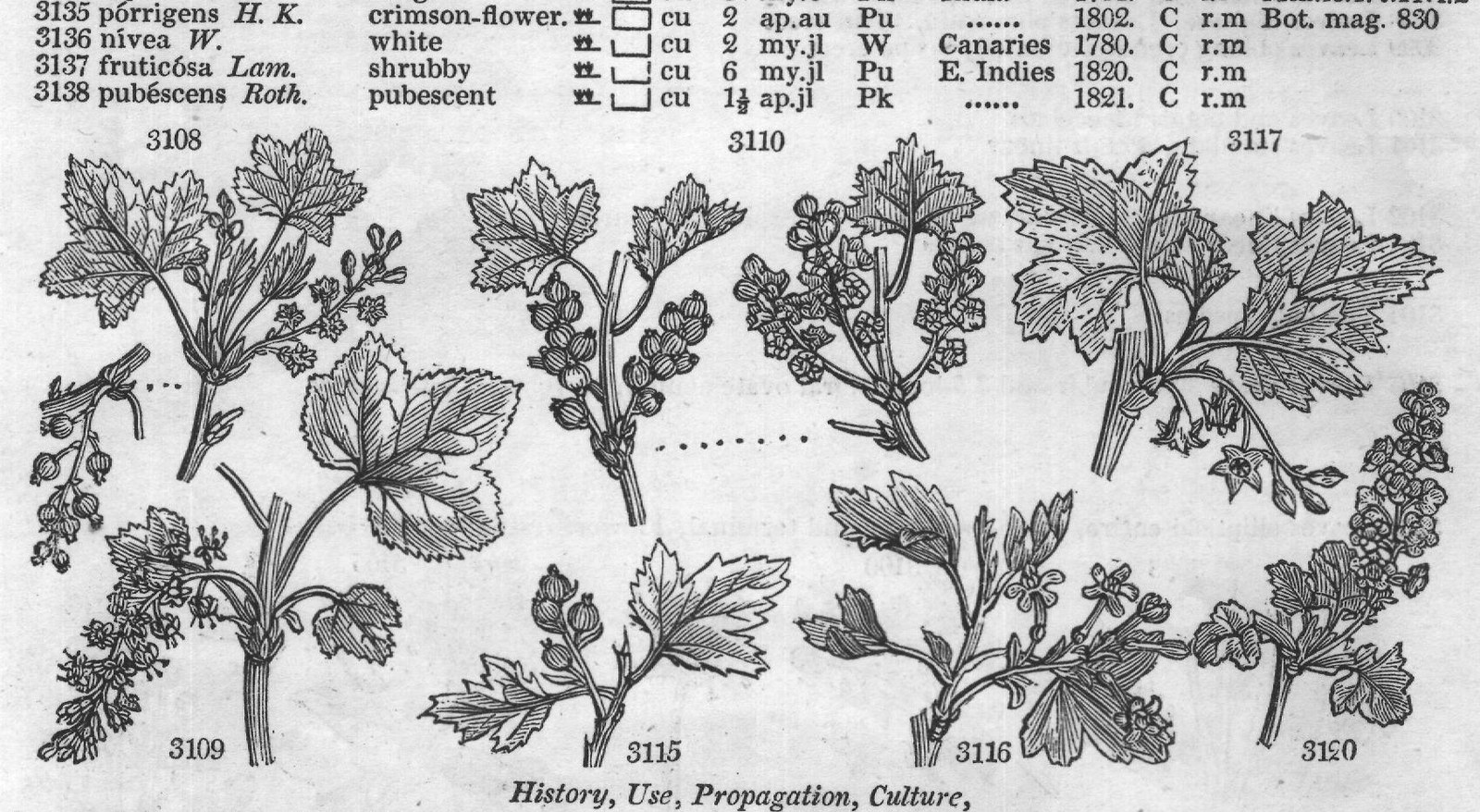
PENTANDRIA MONOGYNIA. 1. Unarmed. CURRANTS. 3107 Leaves smooth pendulous, Flowers flattish, Petals obcordate, Leaves obtuse 5-lobed, Stem erect ẞ Berries yellow Lobes of leaves shortish, Leaf-stalks, Flower-stalks, and Flowers pubescent [Stem erect 3108 Rac. rather hairy when in flow. erect afterw. pendul. Brac. shorter than flow. Lvs. acum. lob. cut toothed, 3109 Racemes spiked pendulous, Petals oblong, Bractes shorter than flowers 3110 Spikes erect, Petals oblong, Bractes shorter than flower 3111 Leaves moderately lobed smoothish above pub. beneath, Flowers small, Sepals trifid, Berries red harry 3112 Racemes erect, Flowers flat, Leaves obtusely lobed, Stem procumb. [fruit stiffly upr. Ber. rough red 3113 Branc. upr. Leaves smooth above beneath pub. nett. Lob. and teeth acute, Rac. loosely many-fl. always in 3114 Stems prost. Lvs. lobed smoothish younger pub. Rac. nearly erect, Petals deltoid, Bract. min. Berr. hispid 3115 Racemes erect, Bractes as long as flowers or longer, Peduncles hairy with glands, Lvs. shining beneath spreading with a few teeth, Bract. lin. as long as fl.-stalks, Berries smooth 3117 Lvs. dotted beneath, Racemes hairy loose, Flow. campan. Brac. shorter than fi.-stalks, Ped, simple at base 3118 Leaves dotted on each side, Racemes pendulous, Flowers cylindrical, Bractes longer than germen slender, Racemes loose erect the length of leaves 3120 Glandular hairy, Rac. erect, Lvs. 5-lobed obtuse cren. roundish, Bractes lingulate longer than fl.-stalk 2. Prickly. GOOSEBERRIES. 3121 Spine one under the axillæ, Branches hispid, Lvs. small-trifid: lobes toothed, Berr. solitary smooth red 3122 Spine under axillary very short, Lvs. on slend. stalks pub. on both sides: lobes acute cut and toothed, Ped. 3123 Prickles solitary, Peduncles 2 or 3-flowered, Berries polished 3124 Somewhat prickly, Leaves round cut-lobed hairy, Racemes short, Berries rough with hairs [capillary 3125 Prickles twin or solitary, Leaves wedge-shaped 3-parted and obsoletely 3-lobed toothed, Fl. racemose erect 3126 Branches somewhat prickly reclinate, Bract. of the peduncle 3-leaved 3127 Leaf-stalks hairy, Peduncles 1-flowered, Bractes 2, Fruit hairy 3128 Peduncles 1-flowered, Bractes connate-tubular, Fruit smooth 3129 Branches prickly all over 3130 Spine sub-axillary compound, Stem hispid all over, Leaves lobed beyond middle, Berries racemose hispid 3131 Prickles sub-axillary, Berries prickly racemose dull brown 3132 Leaves like those of the vine stinging cirrhose 3133 Leaves roundish ovate acuminate, Calyxes reflexed pressed close to the spike 3134 Leaves obovate acute narrowed at base, Calyxes reflexed pressed close to the spike 3135 Leaves ovate lanceolate opposite, Spikes elliptical corymbose on long stalks, Stem shrubby 3136 Leaves whorled ovate downy, Corymbs compact dichotomous, Flowers with corollas 3137 Stem erect , Ovate leaves and calyxes smooth 3138 Stem erect rounded and elliptical oblong leaves pubescent, Spikes axillary and terminal stalked 3123 3125 3129 3131 and Miscellaneous Particulars. 3132 3134 3135 3133 of the black currant, which are therefore not much used in the kitchen or dessert, and seldom in wine making. They make a jelly or jam in estimation as a gargle for inflammatory sore throats.
The culture of the black currant is similar to that of the red; but as it is less apt to bear on spurs than on young wood, the shoots are not so much shortened in this as in the other. It is singular that no varieties have wood, the shoots are not so much shortened in this as in the other. It is singular that no varieties have been raised of this species, nor will it produce hybrids, as far at least as has been tried with the other cultivated sorts of Ribes. raised of this species, nor will it produce hybrids, as far at least as has been tried with the other cultivated sorts of Ribes.
R. Grossularia and R. uva crispa are the rough and smooth gooseberries; Groseille, Fr., Johannisbeere, Ger., and Uvaspina, Ital. in universal culture and estimation in Britain, but not much known or esteemed in any Uvaspina, Ital.; in universal culture and estimation in Britain, but not much known or esteemed in any other country. The climate of France, Italy, and Spain is too warm; and the summers of many parts of the north of Europe too rapid for their attaining a good size. They are, however, more in vogue now in the latter countries than they have ever been before; but as the quality of the fruit soon degenerates when the plants are not kept in high cultivation , it can never become very popular in countries where the pear, vine, fig, and olive grow freely, and which being planted and once established in the soil, grow and bear for ages with very little care.
The varieties of the gooseberry are very numerous, and yearly increasing in Lancashire and other counties where the fruit is grown for prizes, by raising from theseed. These new varieties, however, are valued more acthe fruit is grown for prizes, by raising from the seed. These new varieties, however, are valued more according to the size of the berry, than its flavor, or the prolificacy of the plant; so that few so originated are fit to be added to the list of table or kitchen fruit. Twenty-five pennyweights is considered a great weight for a gooseberry, but some have been raised a few dwts. heavier. (See the Manchester Gooseberry Book, pub. annually.) The gooseberry is generally propagated by cuttings, and trained as a dwarf bush, or sometimes on espalier rails one variety, the green-gage, makes very neat half-standards, and bears better in that state than as a bush. : one variety, the green-gage, makes very neat half-standards, and bears better in that state than as a bush. They require a loamy soil, an open airy situation, and yearly attention to pruning, and refreshing their roots with manure and stirring the surface. 551. Gronovia. In honor of John Frederick Gronovius, a learned botanist at Leyden. This is a trailing plant like the cucumber, with broad hairy leaves, which sting like the nettle. Treated like the melon, it will prothe cucumber, with broad hairy leaves, which sting like the nettle. Treated like the melon, it will produce ripe seeds, but is a plant of neither beauty nor use. 552. Achyranthes. From ἀχuρov, chaff, and avθoς, a flower, in allusion to the chaffy nature of the floral envelopes. This genus is of easy culture, but little beauty. All root freely by cuttings. A. porrigens is the only handsome species. 553. PHILOXE/RUS. R. Br. PHILOXERUS.
Amaranthacea. Sp.2-6. 3139 vermiculátus R. Br. creeping... cu 2 jl.o 3140 brasiliensis R. Br. upright 业 cu 3 jl.o 554. DESMOCHETA. D. C. DESMOCHÆTA. 3141 lappácea J.
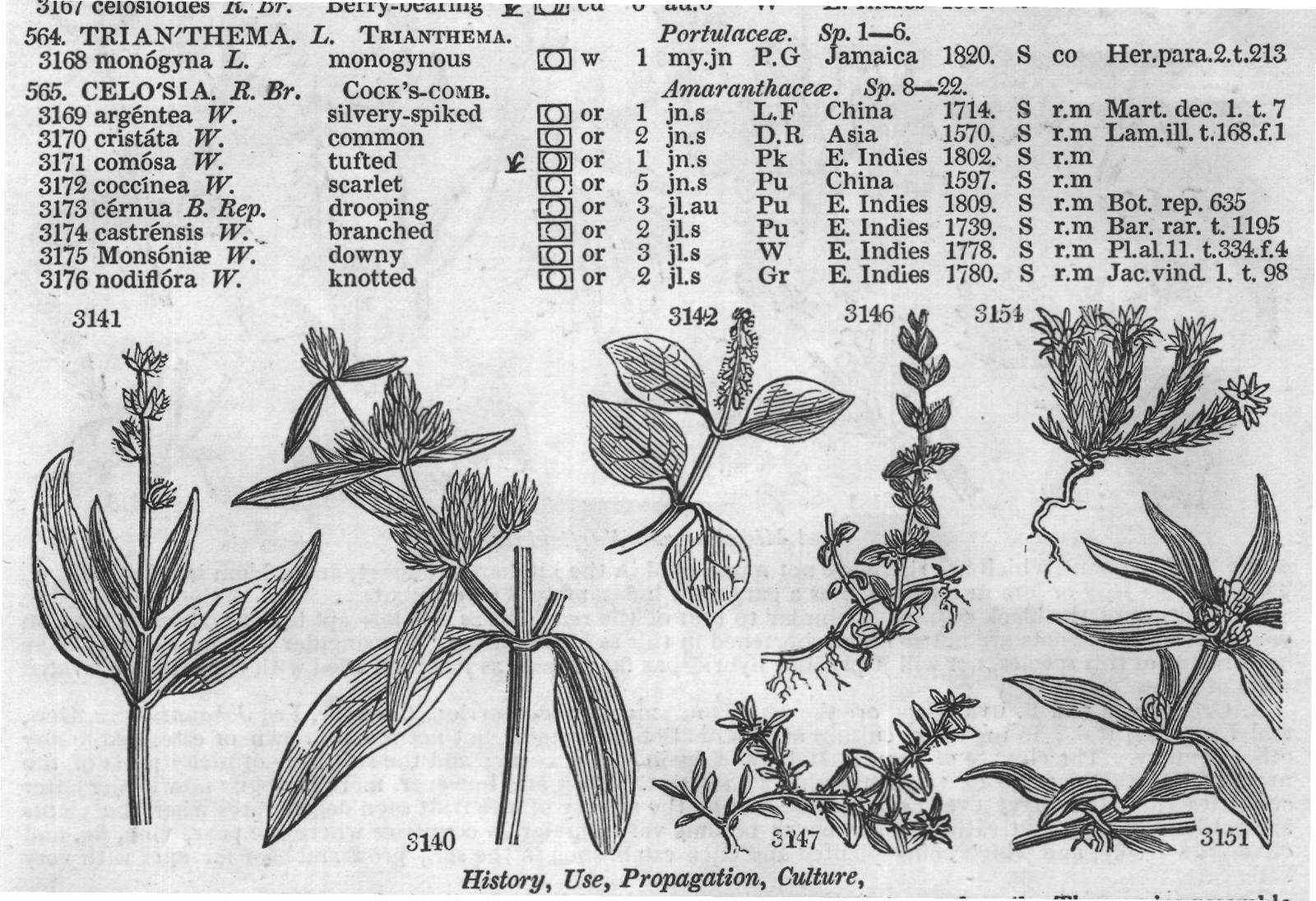
Bur or 1 au.o 3142 prostráta D. C. prostrate or 2 jl.au 3143 muricáta D. C. prickly M or 3 au.n 3144 alternifólia D. C. alternate-leav'd or 2 jl.au P 3145 pátula R. S. spreading or 3 au.o W PENTANDRIA MONOGYNIA.
Brazil Amaranthacea. Sp.5-12.
CLASS V.
Cr.m Her. parad. t. 15 Cr.m Jac. ic. 2. t. 346 Pu E. Indies 1759. C l.p G.Pu E. Indies 1793. D l.p G 1777. C L.p E. Indies 1789. S l.p E. Indies 1823. C l.p India S. Amer. Pk W Rhd. mal.10.t.59 Rumph. 6. t. 11 Rumph. 5. t. 83 Plk.alm.t.260.f.1 555. ILLECE BRUM. Juss. KNOT-GRASS.
Amaranthacea. Sp. 3-15. 3146 verticillátum W. whorled W jl W England bog.pl. S p.1 Eng. bot. 895 3147 cymósum Vill. cymose 3148 echinátum Poir. prickly 100 W jl W W jl G S. Europe 1820. S p.1 Barbary 1821. S p.l Fl. græc. t. 245 Bocc. sic. t.20.f.3 556. ALTERNANTHERA. R. Br. ALTERNANTHERA. Amaranthacea. Sp.5-25. 3149 Achyrantha R. Br. creeping cujn.au W 3150 polygonoides R. Br. Persicaria-leav. Acu 1 jn.au W Buenos A.1732. D 1.p Dill. elt.8. t.7. f.7 America 1731.
Cr.m Herm. par. 17 3151 séssilis R. Br. sessile-flowered cu jl.o Br 3152 ficoídes R. Br. fleshy-leaved cu jn.jl G E. Indies 1778. Sr.m Rhd. mal.10.t.11 S. Amer. 1821. Sr.m Jacq.am. t.60.f.4 3153 spinósa Horn. spiny cu 1 my.jn Y 1823. Sr.m 557. PARONY CHIA.
Juss. PARONYCHIA.
Amaranthacea. Sp. 4-18. 3154 capitáta Juss. capitate W jn.au W Spain 1683. D p.l Lobel. ic. 420.f 1 3155 nívea D. C. villous LAW 1 jn.au W Spain 1812. D s.l 3156 alsinifólia J.
Chickweed-lvd.w 3 jn.au W Spain ...
D Scop.del.ins. t. 13 3157 hispánica D. C.
Spanish W 1 jn.au W Spain 1683. D s.l 558. CHENO LEA. W.
CHENOLEA.
Chenopodeæ. Sp. 1. 3158 diffúsa W. silky W 业₩ 1 au.s G C. G. H. 1758. Cr.m 559. ANY CHIA. Mich.
ANYCHIA.