Home › T › Terebintaceæ (Sp peduncul ta Dec peduncled)
Terebintaceæ (Sp peduncul ta Dec peduncled)
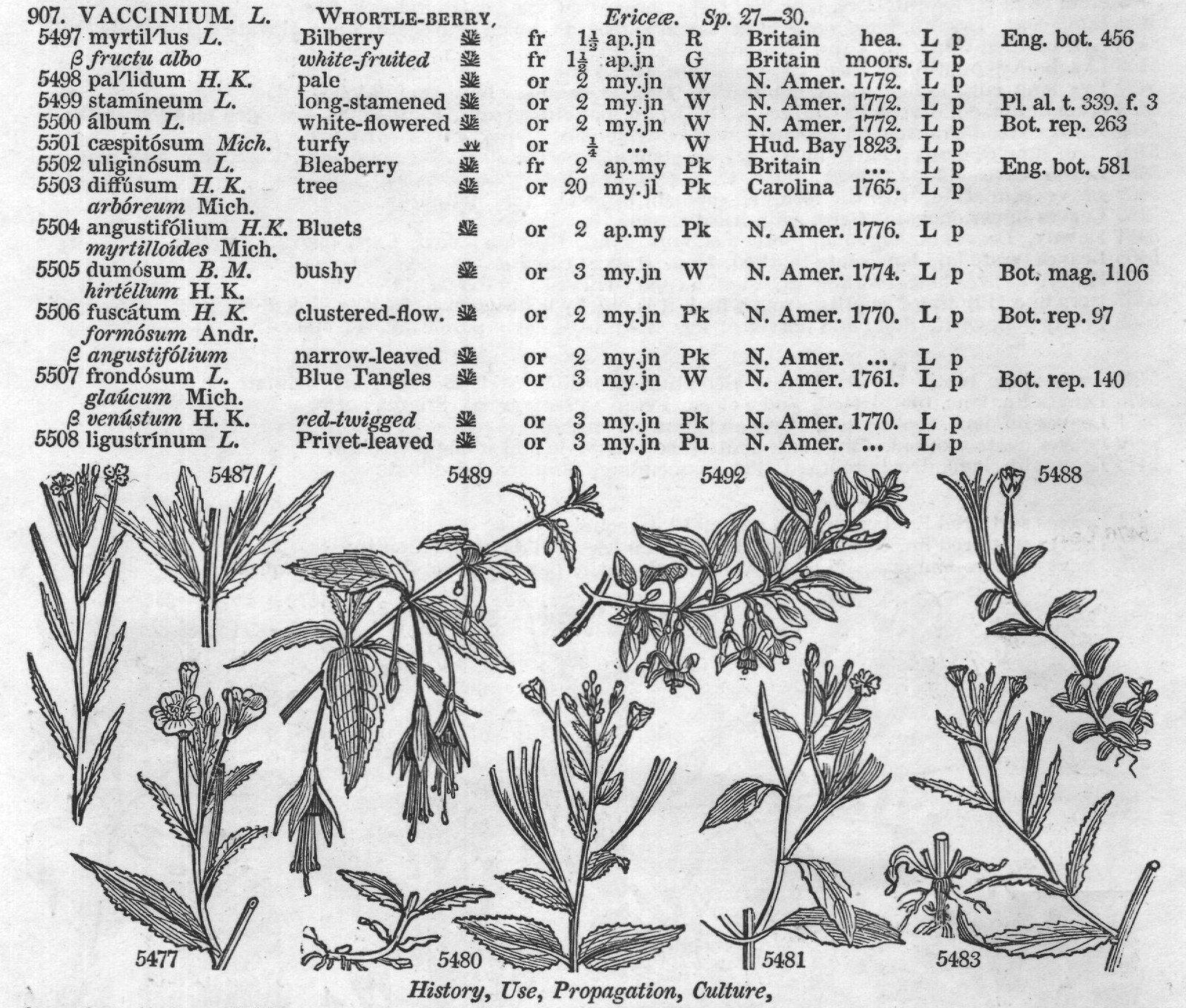
Sp. 1-3. 5493 pedunculáta Dec. peduncled 906. OXYCOC'CUS. P. S. CRANBERRY. 5494 palústris P. S. 5495 macrocarpus Ph. large-fruited 5496 erythrocarpus P. S. upright 0. eréctus Psh. 907. VACCINIUM. L. 5497 myrtillus L.
ẞ fructu albo cu Ericeæ. Sp. 3. common fr my.jn Pk fr my.jn Pk WHORTLE-BERRY, Ericeæ. Sp.
Bilberry fr 1 ap.jn R fr 4 f.d G E. Indies 1800. C lt.l Vah. sym. 3. t.61 Britain tur. bo. L p my.jn Pu N. Amer. 1760. Lp N. Amer. 1806. Lp 27-30.
Eng. bot. 319 Dend. brit. 122 Dend. brit.
Dend, brit. 31 Eng. bot. 456 white-fruited fr 1 ap.jn G Britain hea. Lp Britain moors. L p 5498 pallidum H. K. pale or 2 my.jn W N. Amer. 1772. L p 5499 stamíneum L. 5500 álbum L. long-stamened white-flowered or 2 my.jn W or 2 my.jn W 5501 cæspitósum Mich. turfy or W ... 5502 uliginósum L.
Bleaberry 5503 diffúsum H. K. tree fr 2 ap.my Pk or 20 my.jl Pk N. Amer. 1772.
N. Amer. 1772.
Hud. Bay 1823.
Britain Lp L p Lp Lp Carolina 1765. Lp ...
Pl. al. t. 339. f. 3 Bot. rep. 263 Eng. bot. 581 arbóreum Mich. 5504 angustifolium H.K. Bluets myrtilloides Mich. 5505 dumósum B. M. hirtéllum H. K. 5506 fuscátum H. K. formósum Andr. angustifólium 5507 frondósum L. glaúcum Mich.
B venústum H. K. 508 5508 ligustrínum L. 5487 narrow-leaved Blue Tangles red-twigged Privet-leaved or 2 ap.my Pk N. Amer. 1776.
L p bushy or 3 my.jn W N. Amer. 1774.
Lp Bot. mag. 1106 clustered-flow. or 2 my.jn Pk N. Amer. 1770. L p Bot. rep. 97 or 2 my.jn Pk N. Amer. Lp ... or 3 my.jn W N. Amer. 1761. Lp Bot. rep. 140 or 3 my.jn Pk N. Amer. 1770. Lp or 3 my.jn Pu N. Amer. Lp ... 5489 5492 5488 5477 5480 5481 History, Use, Propagation, Culture, 5483 from that plant; as fodder, goats are said to be extremely fond of it, and cows and sheep to eat it; the down of the seeds mixed with cotton or fur has been manufactured into stockings and other articles of clothing. E. hirsutum is found only in rich moist soil by water. The leaves smell like scalded codlings or gooseberry pye when green, but lose that odor when dry. Cattle are rather fond of the plant both recent and dried. 904. Fuchsia. So named in honor of Leonard Fuchs, a famous German botanist, author of Historia Stirpium, in 1542, with 516 excellent engravings in wood. F. coccinea is one of the most elegant of deciduous greenhouse shrubs; the young wood and nerves of the leaves are tinged with purplish red: the pendent blossoms, like most produced from the axils of the leaves, as the shoots grow, continue during the greater part of the growing season, and are succeeded as they fade by a purple berry. The finest specimen in England of this species is at Salt-Hill.
Many other species have been lately introduced, some of which will probably be very handsome. South America contains some most splendid species, of which we know nothing in this country. 905. Jambolifera. From fero, to bear, and Jambol, the name of a Malabar fruit. Cuttings strike freely in sand under a hand-glass. 906. Oxycoccus. From oξuς, acid, and zozzos, fruit; on account of its acidity. A genus well distinguished from Vaccinium, by the narrow revolute segments of corolla. These are pretty little trailing evergreen plants, to which a peat soil and rather a moist situation are absolutely necessary: they are very little changed by culture.
O. palustris bears edible berries which are gathered wild both in England and Scotland, and made into tarts. Lightfoot says, twenty or thirty pounds worth are sold each market day, for five or six weeks together, ORDER I.
OCTANDRIA MONOGYNIA. 5477 Leaves opp. and altern. subamplexicaul. ovate-lanceolate hairy, Stem much branched hairy 5478 Leaves sessile lanc. pubescent, Stem simple villous, Root fibrous 5479 Leaves altern, lanceolate serrated hairy 5480 Leaves opp. ovate toothed 5481 Leaves stalked ovate acute toothed, Stem erect branched square, Petals bifid 5482 Leaves on short stalks ovate acute toothed shining, Stem ascending simple, Petals half bifid 5483 Leaves lanceolate toothletted: the lower opposite, Stem square 5484 Stem round pubescent, Leaves lanc. serrul. stalked opp. upper alternate smooth veiny 5485 Leaves opp. and alt. ovate toothletted sess. smooth, Fl. axill. sess. Caps. 4-cornered 5486 Stem erect simple, Leaves toothed pubescent, Ovary with scattered hairs 5487 Leaves sessile lanc. toothletted, Stem rounded, Stigm Stigma undivided 5488 Leaves on short stalks opp. lanc. ellipt. obt. entire, Stem ascending few-flowered 5489 Peduncles 1-flowered axillary, Leaves in threes serrated 5490 Branches slightly downy, Leaves opposite stalked smooth, Flowers much longer than leaves 5491 Peduncles axillary 1-flowered, Leaves ovate alternate 5492 Flowers stalked axillary, Sepals reflexed, Leaves ovate-lanceolate about S 5493 Leaves oblong lanceolate smooth, Cymes terminal shorter than the leaves 5494 Leaves oval revolute at edge acute white beneath, Segm. of cor, oval 5495 Leaves oblong flat obtuse, Segm. of cor. lanceolate 5496 Leaves oval acuminate serrulate ciliated, Flower not revolute at first 5497 Peduncles 1-flowered, Leaves serrate ovate deciduous, Stem angular 5498 Leaves ovate acute serrulate smooth, Racemes with bractes, Cor. cylind. camp. [exserted 5499 Leaves oval ac. ent. glauc. beneath, Pedic. sol. axill. filif. Cor. open camp. Anth. exserted 5500 Lvs. oval or obov. acute ent. glauc. ben. Nerves and veins pub. Ped. axill. sol. filif. Cor. open camp. Anth. 5501 Dwarf tufted glabrous, Leaves cuneate rounded deeply sawed membranous, Fl. sol. 5502 Leaves small obov. obt. ent. above smooth, beneath veiny pubescent glaucous, Fl. sol. cor. urceolate 5503 Leaves stalked obovate acute at each end serrate, Racemes nodd. Cor. cylind. camp. Anth. included 5504 Leaves narr. lanceol. membr. ent. Nerves and edge pubescent beneath, Fl. scatt. sol. nearly sessile 5505 Branches and lvs. covered with resin. dots, Lvs. obov. ent. Rac. with bractes, Cor. camp. with round. seg. 5506 Lvs. obl. acute serrul, smooth, Racemes aggreg. term. corym. Cor. cylind. with short erect seg. Style exsert 5507 Leaves obov. blunt ent. glaucous and resinous beneath, Racemes loose, Cor. ovate campanulate 5508 Branches ang. Leaves subsess, erect mucron. lanc. Clusters sessile, Cor. oblong ovate, Fl. stalks none 5495 5493. 5500 5497 5502 5505 5507 5506 and Miscellaneous Particulars. in the town of Langtown, on the borders of Cumberland. The plant might no doubt be cultivated with equal ease as the American species.
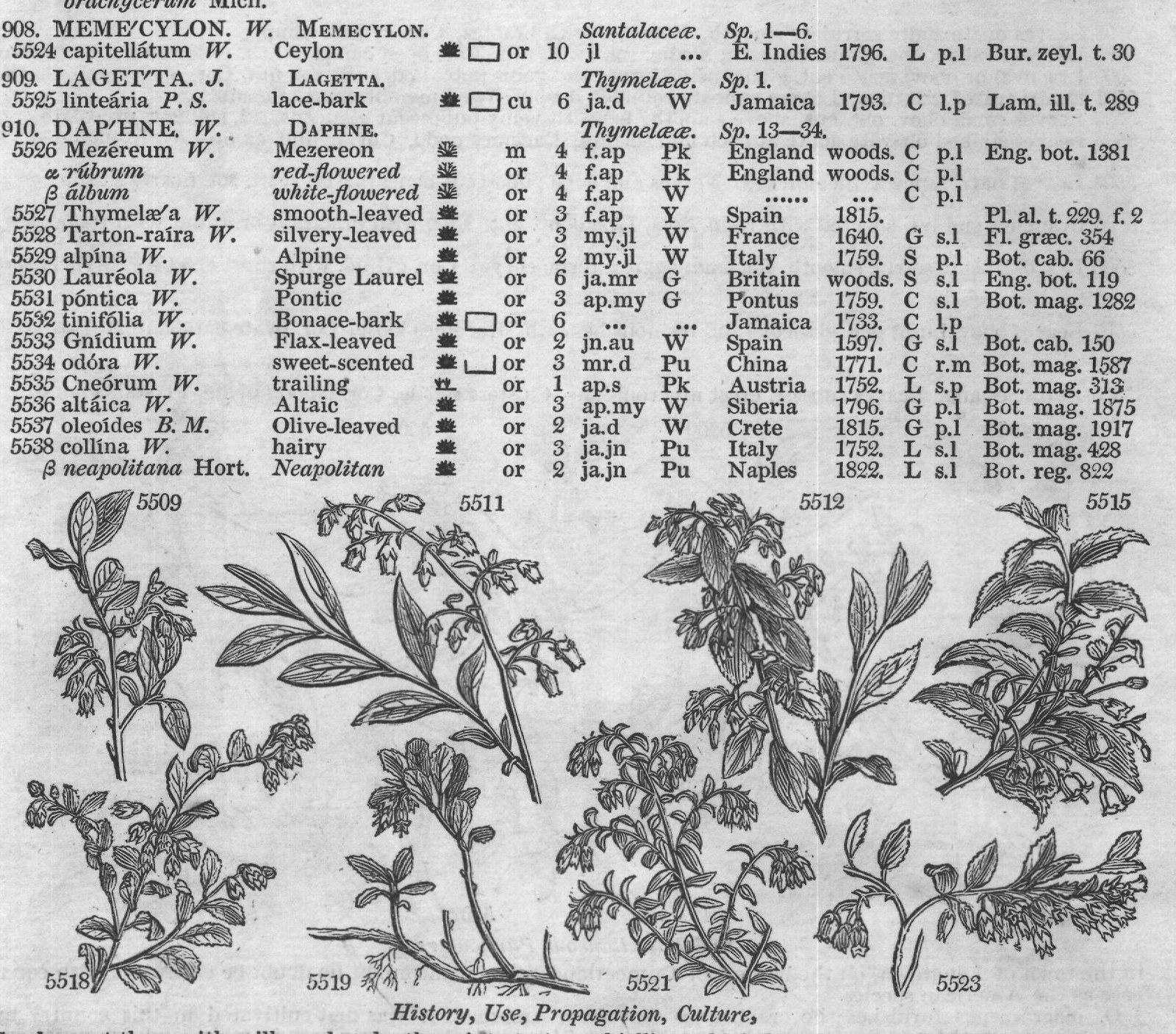
O. macrocarpus furnishes the cranberries sent from America: it was first cultivated in this country by Sir J. Banks, on the margin of a pond (Hort. Trans. i. 71.), and subsequently both in moist and dry situations by different cultivators. Peat earth is essential to every mode of culture; but a much less degree of moisture will do than was at first believed. Salisbury found it do very well in pots of bog earth set in the shade; and Milne found "vigorous shoots and abundant crops produced on dry beds of peat earth, even in the warm summer of 1822." The American cranberry he found easier to cultivate than the common sort; but Hallet found both the cranberry and bilberry succeed perfectly under such treatment. (Hort. Trans. iv. 483, and v. 279. 907. Vaccinium. A name, the derivation of which is not known. Neither are commentators more decided as to what was the Vaccinium of the Latins. The only conclusion to which they have come, is that the Vaccinia nigra of Virgil are the same as the μελav ὑaκivθoς of the Greeks. The species are neat little evergreen under shrubs, and inhabitants of moist alpine or subalpine regions in peat earth. V. Myrtillus is an elegant and also a fruit-bearing plant. The young fresh green leaves, and wax-like red flowers appear in May, and towards autumn the leaves grow darker and more firm, and the ripe berries are gathered in the north for tarts, and in Devonshire and Poland are eaten with clotted cream. (Eng. Bot.) The berries are very acceptable to children, either eaten by themselves or with milk, or in tarts. The moorgame live upon them in the autumn. The juice stains paper or linen purple. Goats browse upon the plant; sheep are not fond of it; horses and cows refuse it. (Withering.) The berries have an astringent quality; and in Arran and the Western Isles are given in diarrhœas and dysenteries with good effect. The High. Y 5509 resinósum H. K. a viridéscens ẞ rubescens parviflórum Andr. small-flowered 5510 corymbósum L. corymbose disomorphum Mich. 5511 amœ'num H. K. 5512 virgátum H. K. 5513 galézans Mich. 5514 tenéllum H. K. pensylvánicum Mich. ramulósum W. húmile W. 5515 padifólium Sm. arctostaphylos B. M.
Madeira 5516 meridionale Swz. Jamaica 5518 crassifólium Andr. thick-leaved 5519 Vitis Idæa L.
ẞ május y máximum 5520 hispídulum W.
Gaultheria serpyllifolia Psh. 5521 nítidum Psh.
ẞ decumbens 5522 myrsinítes Mich.
ẞ lanceolátum yobtúsum 5523 buxifólium Andr. brachýcerum Mich. 908. MEME/CYLON. W. MEMECYLON. 5524 capitellátum W. clammy green-flowered red-flowered or 4 my.jn or 3 my.jn Y.G or 3 my.jn Pk or or 3 my.jn R.Y 7 my W OCTANDRIA MONOGYNIA.
N. Amer. 1772. L p Canada 1772. Lp N. Amer. 1772. Lp N. Amer. 1804. Lp N. Amer. 1806.
CLASS VIII.
W. am. t. 30.f.69 Bot. mag. 1288 Bot. rep. 125 Lp broad-leaved or 6 my.jn Pk N. Amer. 1765.
Lp Bot. rep. 138 twiggy or 3 ap.my Pk N. Amer. 1767. L p Bot. rep. 181 Gale-leaved or 2 my.jn W N. Amer. 1806. Lp Pensylvanian fr 1½ my.jn Pk N. Amer. 1772. L p fr 4 jn.au Pk Madeira 1777. L p Bot. mag. 974 5517 myrtifólium Mich. Myrtle-leaved or 2 mr.jn W.G Jamaica 1778. Lp pr 1 my.jl W Carolina 1812. L p pr 1 jn.jl Pk Carolina 1787. Lp Bot. mag. 1152 Cow-Berry pr ap.jn Pk Britain ...
Sk p Eng. bot. 598 large 业 prap.jn Pk N. Amer. ...
Sk p largest pr ap.jn Pk N. Amer. ...
Sk p Snowberry fr ap.my W Huds. Bay 1815.
L p Pursh am. t. 13 glossy pr 2 my.jn Pk Carolina 1794. Lp decumbent 业 pr my.jn Pk Carolina 1794. Lp Bot. rep. 480 Bot. mag. 1550 Myrsine-leaved pr 1 my.jn Pk Carolina ...
Lp lanceolate pr 1½ my.jn Pk Florida ...
Lp obtuse pr 1 my.jn Pk Carolina Lp Box-leaved cu 1 my.jn Pk N. Amer. 1794. Lp Bot. mag. 928 Santalaceæ. Sp. 1-6.
Ceylon or 10 jl ...
E. Indies 1796. L p.1 Bur. zeyl. t. 30 909. LAGETTA. J.
LAGETTA.