Tribe VI
FUCOIDEÆ.
Frond coriaceous, rarely membranous, continuous, olive-green, flat or filiform. Sporidia black, included in capsules, which are either ovate, and surrounded by a hyaline border, and nestling in a peculiar receptacle, or pyriform, and immersed in the frond. 2318. Lemanea. Frond filiform, torulose, tubular. Chains of sporæ adhering to the inner surface of the filament, pencilled moniliform.
In fresh water.
CRYPTOGAMIA.
CLASS XXIV. 2319. Chordaria. Root scutate. Frond filiform of an olive color and cartilaginous substance. Fructification; clavate, pyriform, concentric filaments constituting the whole frond. Frond fiiform, tubular, subcoriaceous. Fructification; naked pyriform 2320. Scytosiphon. Root scutate. granules covering the whole frond. 2321. Sporochnus. Root mostly scutate. Frond plane, with distichous branches, bearing, in most instances, delicate pencil-like deciduous tufts of confervoid filaments. (" Receptacles composed of concentric, clavate, articulated corpuscules.") 2322. Haliseris. Frond flat, linear, ribbed, membranous. Capsules heaped in sori. 2323. Encælium. Frond tubular or bladdery, dotted. Fruit, the tips of the frond filled with a black sporaceous matter. 2324. Zonaria. Root downy. Frond plane, ribless, flabelliform or wedge-shaped, or linear and dichotomous. Fructification, adnate tubercles collected into parallel lines on the frond. 2259. ACHNAN'THES. Agh. ACHNANTHES. 15021 lóngipes Ag.
DIATOMEÆ. long-stalked fine down Sp. 1-2. july Gsh dit., sea coast E.b.t.2488. Conf.stipitata 2260. DI A'TOMA. Ag.
DIATOMA.
Sp. 5-16. 15022 flocculósum Ag. floccose fine film sum.
Y.Br ditches 15023 marínum Ag. marine little tufts febr. Y.G ocean 15024 Biddulphianum Ag.
Miss Biddulph's short down nov.d. G sea coast 15025 striátulum Ag. striated short down april G ocean 15026 obliquátum Ag. oblique minute branc. sum.
Lt.Br ocean E. bot. t. 1761. Conferva E.b. t.1883 Conf. tæniæf.
E. bot. t. 1762. Conferva E. bot. t. 1928. Conferva E. bot. t. 1869. Conferva 2261. FRAGILLA'RIA. Ag. FRAGILLARIA.
Sp. 2-3. 15027 pectinális Ag. silvery loose tufts 15028 hyemális Ag. winter 2262. MELOSEI RA. Ag. MELOSEIRA. 15029 nummuloídes Ag. necklace down-like 15030 lineáta Ag. striated short down 15031 discígera Ag. cup-bearing short down 2263. DESMI'DIUM. Ag. DESMIDIUM. 15032 Swártzii Ag. pinnatifid loose masses 15033 Smíthii Ag.
Smith's slipp. threads lake slipp. threads Dillwyn's pointed lax tufts erect tufts 2264. SCHIZONE/MA. Ag. SCHIZONEMA. 15034 lacústre Ag. 15035 Dillwýnii Ag. 15036 apiculátum Ag. 15037 dichótomum Grev. dichotomous march Y.G on wat. plan. E. bot. t. 1611. Conferva Sp. 5-9. sum.
Lyngb. phyt. dan. t. 63 Dil.con.24. t. B. Conferva lvs. of aquat. Di.co.25.t.B.C.nummul. still waters E.b.t.2464. Con.dissiliens Brsh sea coast sum. Brsh lakes entangl. tufts 1½ sp. su. Ol.G sea coast spring Y.G sea in basins E. b. t.2101. Conf. fœtida Di.co. t. 104. Conf. fœtida Grev. crypt. t. 30 dense fl. tufts 3 april O.Br rivulets Sp. 3-5. march Ysh march Ysh salt marshes rivulets Eng. bot. t. 2287 sum. Brsh Sp. 1-2. 1½ sum. G 1 sum. 2265. PALMEL/LA. Ag. PALMELLA. 15038 protúberans Ag. 15039 botryoídes Ag. 15040 adnáta Ag. 15021 lobed bunched adnate 15022 00 NOSTOCHINE.
Eng. bot. t. 2583. Ulva rocks damp places Y.Br mount. rocks Lyngb. phyt. dan. t. 69 Sp. 6-12. mass thin skin gregarious ... sp aut. G aut. 15023 15025 15024 History, Use, Propagation, Culture, DEDES 15027 15026 2229. Achnanthes. From aχvη, the froth of the ocean, and avθoς, a flower. Marine productions, separating into fragments, but by degrees. In the middle of each articulation are one or two crystalline points. 2230. Diatoma. From δiaτoμη, incision, in allusion to the curious manner in which the filaments are divided into joints cohering alternately by their angles. 2231. Fragillaria. So named on account of their fragile nature, which is more remarkable than that of other Confervæ. The filaments when complete are flat and composed of little fragments glued together crosswise. These are very narrow, and when once separated do not cohere again. 2232. Meloseira. From μελoς, a membrane, and σεiρa, a chain, with reference to the form of the filaments. This genus differs from the last, as Conferva from Oscillatoria. 2263. Desmidium. From δεσμoς, a bond, in allusion to the singular manner in which the parts cohere when in a state of dissolution. At that period the articulations become half separated one from the other in such a way as to represent a pinnatifid appearance. 2264. Schizonema. From σχiζω, to divide, and vημa, a filament; the filaments are finally divided into compound granules. These plants have entirely the habit and flexible substance of Confervæ. When fresh they are sparkling and brown, when dry olive-green, and very shining. They are composed of many filiform individuals, which include nearly the same corpuscles as are visible in the foreign genera Frustulia and Meridion.
ORDER VII.
ALGE. 2325. Laminaria. Root fibrous. Stipes dilated into a plane frond. Fructification, naked granules immersed and forming irregular groups in the frond. 2326. Lichina. Fronds minute, tufted, greenish-black when growing. Fructification solitary tubercles with a pore, at length scutelliform. 2327. Furcellaria. Frond cylindrical. Fructification concealed in the swollen extremities of the frond, capsules in the centre, and pyriforme granules in the circumference. 2228. Fucus. Root scutate. Frond plane or comp tubercles contained in a common mucose receptacle, and filled with sporules and filaments. compressed, (rarely filiform) liform) dichotomous. Fructification, 2329. Cystoseira. Root scutate. Stipes cylindrical. Lower leaves plane, upper ones filiform, furnished with pinnate vescicles. Fructification, tubercles in common receptacles, the receptacles with several loculaments. 15021 Articulations with one dot, Stem long DIATOME. 15022 Filaments striated, Articulations nearly equal in diameter with parallel striæ 15023 Articulations half as long again as wide granular transversely 15024 Filaments greenish, Articulations square striated 15025 Filaments arcuate transversely striated, Articulations nearly square with pellucid joints 15026 Articulations half as long again as wide oblique marked with a pellucid transverse band and a dot 15027 Filaments tapering very rigid with parallel transverse dense striæ 15028 Filaments tapering orange-colored, Articulations twice as short as their diameter 15029 Filaments unequal containing nearly circular moniliform globules in rows 15030 Joints contract. Articulations transversely striat. with 1 or 2 very fine lines about 3 times as long as wide 15031 Articulations shorter than broad finally changed into somewhat oval close moniliform heaps 15032 Filaments after copulation pinnatifid traversed by a longitudinal green streak, Articulations 2-toothed 15033 Filaments somewhat branched cæspitose acute, Granules parallel clustered 15034 Filam. somew. branched cæspitose acute, Granules clustered appressed, Membrane of filam. inconspicuous 15035 Filaments densely branched virgate , Granules elliptical 15036 Filaments minute continuous erect branched containing cylindrical oblong scattered granules 15037 Filaments slender erect dichotomous, Branches swollen here and there into roundish knobs: interior gelatinous with numerous cylindrical oblong granules NOSTOCHINE. 15038 Frond thick angular-lobed, Granules elliptical 15039 Fronds aggregate minute globose, Granules globose 15040 Frond deformed rugose, Granules globose brown 15029 0000000XXX 15032 15035 15030 15031 15033 and Miscellaneous Particulars. 0 Π 15036 2265. Palmella. Apparently a diminutive of Palma, a little palm; but the application of the name is not obvious in that sense. The plants are found in marshy or inundated places, and consist of globules nestling in a gelatine; in which respect the genus differs from Protococcus, the Red Snow plant. It is supposed that many of the species are only the ova of animalcules. The Red Snow plant, which, as we have just said, is nearly related to this genus, has not hitherto been noticed in this country, but as it has been found in many countries similar to our own regions of snow, it is so in this country, but as it has been found in many countries similar to our own regions of snow, it is so probable that it exists in Great Britain, that we insert some particulars of it here, especially as it may be considered to have been introduced at least in 1819, by Captain Ross's expedition to the North Pole. When viewed under the highest powers of a simple microscope, it appears to consist of globules containing a red fluid. We the highest powers of a simple microscope, it appears to consist of globules containing a red fluid. We select the following observations upon its history, from a communication made to the News of Literature and Science, on the twenty-first of January, 1826. "Our scientific readers will remember the interest which was excited on the subject of this natural production, upon the return of Captain Ross from his Polar expedition, some years since. At that time it was examined by three of the most acute observers in this country, especially of microscopical objects, Wollaston, Brown, and Bauer, who all formed a similar conclusion in one respect, that it was of vegetable origin, but were of different opinions as to its precise nature: Dr. Wollaston supposing it to be the seed of a moss; Mr. Brown, a substance belonging to Algæ, and nearly related to Tremella cruenta, a common British plant; and Mr. 15041 rósea Lyngb. 15042 montána Ag. 15043 cruénta Ag. rosy mountain bloody jointed 2266. ECHINEL/LA. Ag. ECHINELLA. 15044 articuláta Ag.
CRYPTOGAMIA. gregarious leaf-like thin crust 2267. ALCYONI'DIUM. Ag. ALCYONIDIUM. sum.
Pk on lichens CLASS XXIV.
Grev. crypt. t. 51 1½ sum. R.G all sea. R.Br Sp. 1-3. thin film ... jn.jl G lakes Sp. 3-7. 15045 diáphanum Ag. transparent fleshy mass 6 sum.
Y ocean 15046 flavéscens Ag. yellowish fleshy mass 3 sum.
Y ocean 15047 defráctum Ag. broken vermicular 4 sum.
Y.Pk ocean 2268. NOS'TOC. Ag. 15048 commúne Ag. 15049 prunifórme Ag. 15050 sphæricum Ag. 15051 verrucósum Ag.
NOSTOC.
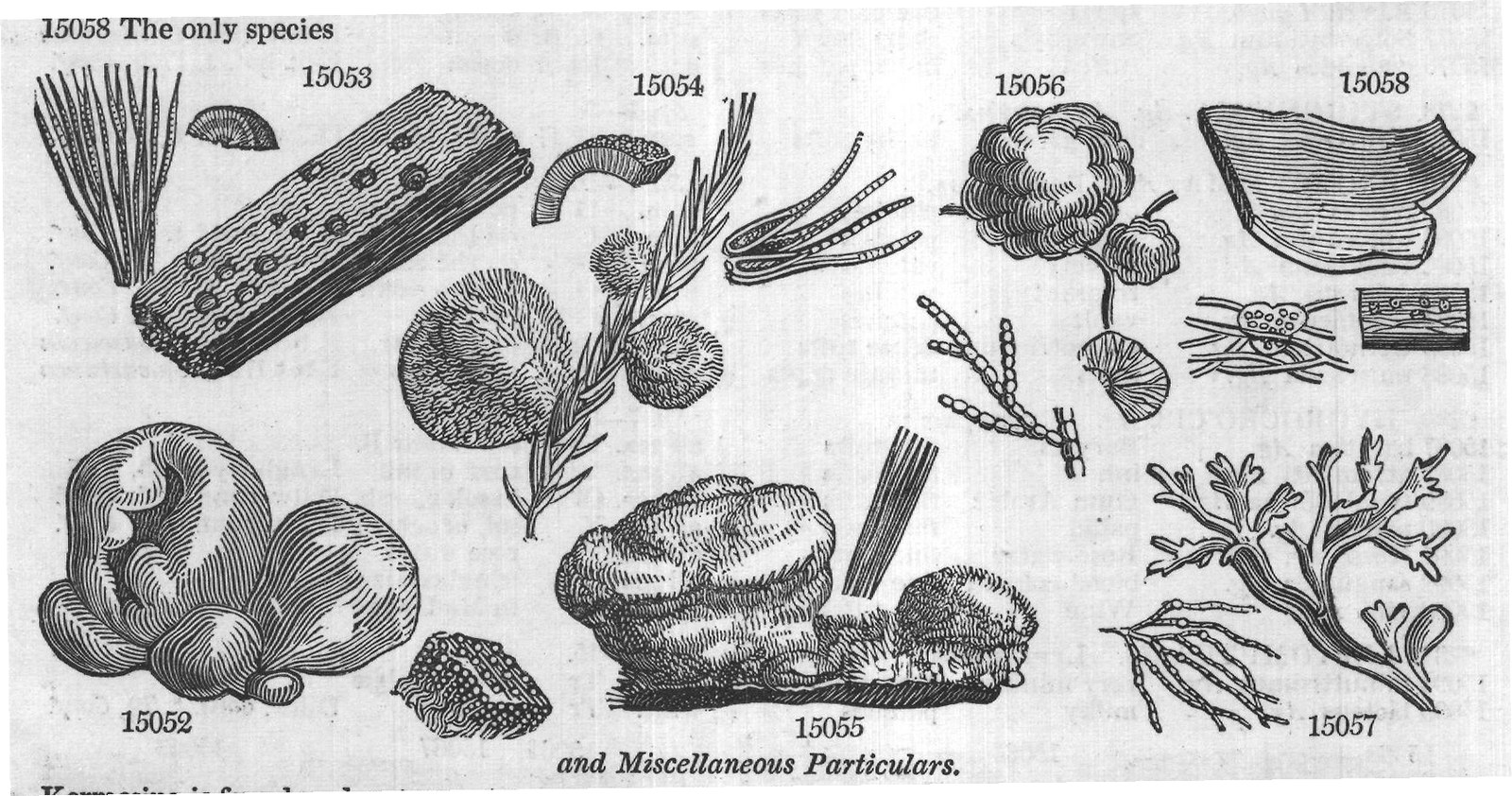
Sp. 4-22. common lobed mass 2 sum. plum-shaped little balls sum. spherical warted little balls sum. alpine rocks Eng. bot. t. 2195. Ulva shady places E. bot. t. 1800. Tremella E.b. t. 1378. C.echinulata Eng. bot. t. 263. Ulva Fl. dan. t. 1245. Ulva Eng. bot. t. 1626. Ulva Ol.G damp places E. bot. t. 461. Tremella Ol.G lakes Ol.G still waters gregarious 1 april Ol.G rocks CORYNEPHORA. 15052 marína Ag. lobed mass minute dots little balls 2269. CORYNEPHORA. Ag. marine Rivularia tuberiformis E. B. 2270. RIVULA'RIA. Ag. RIVULARIA. 15053 átra Ag. 15054 angulósa Ag. 15055 calcárea E. B. conflu. mass. 1 all sea. G lakes & mar. 2271. CHATO PHORA. Ag. CHETOPHORA.
Eng. bot. t. 1798 Eng. bot. t. 968 Eng. bot. t. 1799 Sp. 1. 1½ aug.
Br sea shore Eng. bot. t. 1956 Sp. 3-11. dark angular calcareous Linckia dura Lyngb. 15056 tuberculósa Ag. 15057 endiviæfólia Ag.
ẞ crassa Ag. warty endive-leaved branched thick-leaved branched balls 2 sum.
Sp. 2-12. sept. G 2 sum. G G ditches E. bot. t. 2366. Rivularia still waters lakes Lyngb. phyt. dan. t. 65 E. b. t. 967. U.incrassata 2272. SCYTHYME'NIA. Ag. SCYTHYMENIA.
Sp. 1. 15058 rupéstris Ag. rock broad mass 24 sum.
Br rocks Eng. bot. t. 2194 15043 15044 15046 Ta oct. D.G sea plants sum. Dl.G ditches 15038 30 15041 15045 15047 History, Use, Propagation, Culture, Bauer refering it to a genus of Fungi, called Uredo. We have lately seen a curious paper upon this subject, by Professor Agardh, of Lund, whose opinions upon all matters connected with the lower orders of vegetation demand deep attention. "That snow occasionally assumed a red color, had long been a fact of which there could be no doubt; and that water was also under particular circumstances stained with red, we have the popular traditions of showers of blood, and water changed to blood, to attest. In the year 1608, a shower of blood fell near Aix, in France, which was examined by Peiresc, and found to be caused by insects; and to the same cause was undoubtedly to be ascribed the bloody rain that fell at Schonen, in 1711, which the learned Bishop Swedberg looked upon as a supernatural phenomenon, and a direct sign of the anger of the Divinity. The red pools which are occasionally met with, even in this country, are generally stained by the presence of an immense number of animalcules, called Daphinia Pulex, or Cyclope quadricornis. The red stains sometimes seen upon the seashore are occasioned by a particular sort of Fucus. Professor Agardh proceeds to observe, that the red snow is very common in all the alpine districts of Europe; where it is probably, for the most part, of the same nature as that brought from the North Pole by Captain Ross. Saussure saw it in abundance upon Mount Brevern, in Switzerland, and elsewhere; Ramond found it on the Pyrenees, and Sommerfeldt in Norway. In March, 1808, the whole country about Cadore, Belluno, and Feltri, was in a single night covered to the depth of twenty centimetres with a rose-colored snow; at the same time a similar shower was witnessed on the mountains of Valtelin, Brescia, Carinthia, and Tyrol. But the most remarkable red-snow shower was that which fell on the night between the 14th and 15th of March, 1823, in Calabria Abruzzo, in Tuscany, and at Bologna, and upon the whole chain of the Appennines. We may add, that both snow and ice were seen stained with red, green, and blue, by the late expedition under Baron Wrangel to the Frozen Ocean. "With this information before him, Professor Agardh proceeds to consider the nature of this remarkable substance, which he concludes, with Brown, to be referable to the lowest order of Algæ, and to stand as a distinct genus, which he calls Protococcus, upon the very limits of the animal and vegetable kingdoms. Saussure, indeed, from finding that the red snow of the Alps gave out, when burnt, a smell like that of plants, concluded that it was of vegetable origin; but he supposed it to consist of the farina of some plant, although he could neither account for its having ascended to such elevated regions, nor mention a plant whose farina was of that color. "Besides the plant called Palmella cruenta, which is similar in its structure to the red-snow plant, other low vegetable productions have been noticed by different authors, as possessing a similar color. Such are the Lepraria Kermesina, which, by the way, is considered only a particular state of the red-snow plant itself, and the Byssus cobaltiginea. These are always found in situations in which they are exposed to the intense action of light, such as vast plains of snow, or masses of glittering limestone. Whence it is inferred, that the color of the red snow is attributable to the action of light, modified in some mysterious manner, by the nature of the body on which it strikes. In confirmation of which hypothesis, it is remarked, that when the Lepraria ORD. VII. TRIBE II.
ALGE NOSTOCHINE. 15041 Minute roundish soft rose-colored containing extremely minute sporules 15042 Frond deformed rugose, Granules ovate red 15043 Frond crust-like crimson 15044 Corpuscles radiant lanceolate jointed 15045 Branches elongated 15046 Branches short obtuse 15047 Frond filiform simple 15048 Frond expanded deformed plaited wavy 15049 Frond globose watery inside, Integument coriaceous very smooth 15050 Frond globose solid smooth 15051 Frond bladdery subcoriaceous hollow plaited smooth 15052 The only species 15053 Frond hemispherical hard, Filaments very dense branched by apposition 15054 Frond globose hollow, Filaments simple , globos ow, Filaments simple 15055 Filaments intermingled with calcareous particles hard and crustaceous when dry 15056 Frond tubercular hollow, Filaments distributed in many little orbs 15057 Frond linear flattish dichotomous at base much pinnated at end β Branches very short 15058 The only species 15053 15054 15056 15058 15052 15055 and Miscellaneous Particulars. 15057 Kermesina is found under stems, stones, or in crevices of limestone, where light can scarcely gain admittance, its color gradually passes from red to green. "The only difficulty in the way of this explanation of its nature is in the statements of so many observers, that fell snow falls from the air. But Professor Agardh shrewdly remarks, that all the the red snow falls from the air. But Professor Agardh shrewdly remarks, that all the persons agree that it fell in the night, which is as much as to say, that no one saw it fall. He is of opinion that the Protococcus, or Red Snow, is called into existence by the vivifying power of the sun's light, after its warmth has caused the snow to dissolve, and accompanied by that incomprehensible power in white snow, of producing a color; and, moreover, that it first attracts the eye when there is a considerable quantity, in the same way that we do not see the color of drops of water till they have accumulated in the ocean." 2266. Echinella. From echinus, an hedgehog, in allusion to the bristly appearance presented by its radiant particles. Many naturalists believe the bodies referred to this genus to be animalcula. 2267. Alcyonidium. So called, from aλκuovέiov, the foam of the sea, among which the plants referred to this genus are naturally produced. This also is supposed to genus fixed are it naturally produced. This also is supposed to be the nidus of animalcula. Lamouroux who originwhich last opinion Gaillon agrees with him, declaring that he has actually seen the animalcula nestling in it. D'Orbigny and Ellis consider it the ova of a testaceous animal. 2268. Nostoc. A name first used by Paracelsus, without an explanation of its meaning. Agardh thinks this singular substance changes into the genus Collema among the Lichens. singular substance changes into the genus Collema among the Lichens. 2269. Corynephora. From κoρuvη, a club, and φερω, to bear, in allusion to the clavate filaments which are found on different parts of it. The species are found in the ocean." 2270. Rivularia. So named on account of the places in which the species grow. They have a globose frond, The of a filaments toughish texture. Their color is dark-green, and not as in the next genus, pale-green. a gelatinous but toughish texture. Their color is dark-green, and not as in the next genus, pale-green. The filaments are very singular, seated on a globule, simple, cylindrical, and terminated by a very fine point; they are densely compact, continuous, and filled with a green annular matter. 2271. Chatophora. From χaiτη, a bristle, and φερω, to bear; the filaments are terminated by a bristle-like point. This genus is chiefly distinguished from Confervoideæ by its gelatine. The color is bright green, and the texture softer than in the preceding. The manner of propagation, which has been noticed in so small a number of Algæ, has been observed by Agardh in two species of this genus. In Chætophora pisiformis little hard crystalline corpuscles, like grains of sand, may be seen, which separate from the mother plant and produce young filaments. But in C. clavata, the points of the filaments fall off and sink to the bottom of the water, where they unite by three, four, five, or by a greater number at a time, in a common point, which is first green, afterwards blackish, and apparently inorganic. From this beginning new individuals arise. 2272. Scythymenia. Derivation unknown. A very singular plant, formerly referred to Ulva. It has the habit of a fungus, and grows upon damp walls. It is supposed to be most nearly related to Palmella.
CRYPTOGAMIA.
CONFERVOIDEE.
Sp. 1-3. ?
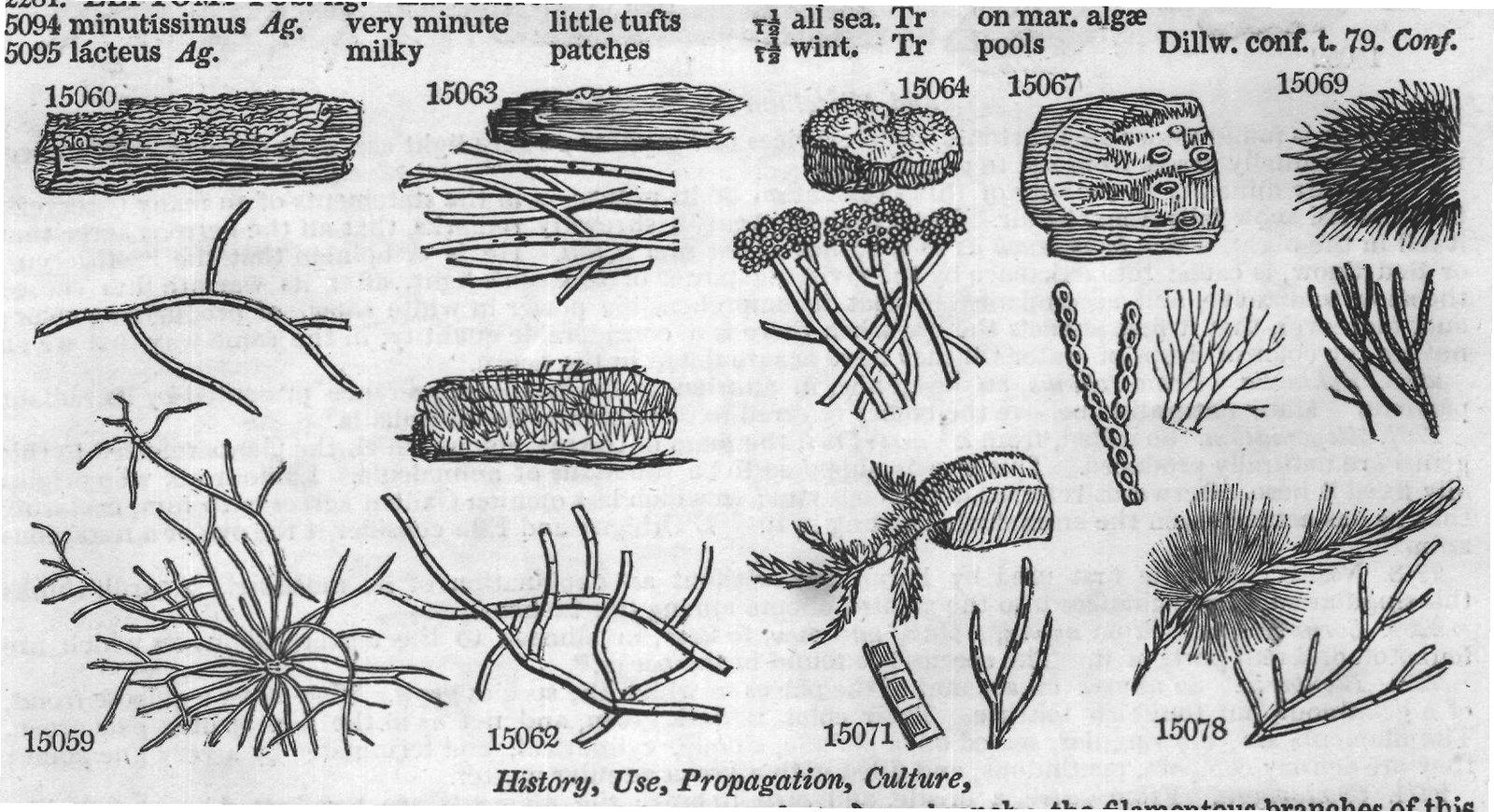
CLASS XXIV. 2273. BYSSOCLA'DIUM. Ag. BYSSOCLADIUM. 15059 fenestrále Ag. window fine tuft all sea. G on windows Dillw.conf. t. 94 2274. MYCINEMA. Ag. MYCINEMA.
Sp. 5-6. 15061 fúlvum Ag. 15060 arachnoídeum Ag. cobweb 15062 rubiginósum Ag. patch all sea Pa.G dead trees Dillw.conf.t.C. Conferva tawny down-like Taut.
Br rotten wood 15063 phosphóreum Ag. rusty phosphoric patch all sea. Rust patches Tall sea. V 15064 pulvéreum Ag. powdery thin crust Tall sea. G 2275. CHROOLE/PUS. Ag. CHROOLEPUS. 15065 Jólithus Ag.
Ag. CHROOLEPUS. purple patches Sp. 5-6. all sea. Pu rocks 15066 odorátus Ag. sweet-scented patches wint. Br trees 15067 lichenícola Ag.
Lichen down Tsum.
R.O on lichens 15068 rubicúndus Ag. pink patches