Home › V › Vent (Cels t bifl ra W two-flowered)
Vent (Cels t bifl ra W two-flowered)
cels. t. 99 5695 biflóra W. two-flowered or 6 f.jn Pu C. G. H. 1789. C p.1 Bot. mag. 753 5696 calyptráta H. K. one-flowered or 6 ap.jl Pu C. G. H. 1792. C p.1 5697 styracifólia B. M.
Storax-leaved or 6 my.jl Pk C. G. H. ...
Cp.l Bot. mag. 1580 5698 buxifólia W.
Box-leaved or 2 my.jl B C. G. H. 1790.
C p.l Bot. reg. 869 5699 oleæfólia P. L.
Olive-leaved or my Pu C. G. H. 1804.
C p.l Par. lond. 114 5700 hirsúta H. K. hairy or 2 jl.au B C. G. H. 1774. C p.1 5701 cordáta H. K. heart-leaved or 2 my.jl B C. G. H 1794.
C p.l 949. CHOROZEMIA. Lab. CHOROZEMIA.
Leguminosæ.
Sp. 3. 5702 ilicifólia H. K.
Holly-leaved or 3 mr.o Y N. Holl. 1803. S s.p Lab. voy. 1. t. 21 5703 nána H. K. dwarf or mr.o Y N. Holl. 1803. S s.p Bot. mag. 1032 5704 rhómbea H. K. few-flowered or 2 ap.jn Y N. Holl. 1803. S s.p 950. PODOLO'BIUM. H. K. PODOLOBIUM.
Leguminosæ.
Sp. 1-2. 5705 trilobátum H. K. common or 2. ap.jl Y N. S. W. 1791. S s.p Bot. mag. 1477 951. OXYLO'BIUM. H. K. OXYLOBIUM.
Leguminosæ. Sp. 3-5. 5706 arborescens H. K. tall or 6 ap.jn Y V. Di. L. 1805. S s.p Bot. reg. 392 5707 ellípticum H. K. oval-leaved or 3 my.s Y V. Di. L. 1805. S s.p Lab.n.ho.1.t.135 5708 cordifólium H. K. heart-leaved or 3 ap.s Y N. S. W. 1807. S s.p Bot. rep. 492 952. CALLISTA CHYS. Vent. CALLISTACHYS.
Leguminosæ.
Sp. 2-3. 5709 lanceoláta V. spear-leaved or 3 jn.au Y N. Holl. 1815. S s.p Bot. reg. 216 5710 ováta B. M. oval-leaved or 3 jn.au Y N. Holl. 1815. S s.p Bot. mag. 1925 953. BRACHYSE/MA. H. K. BRACHYSEMA.
Leguminosæ.
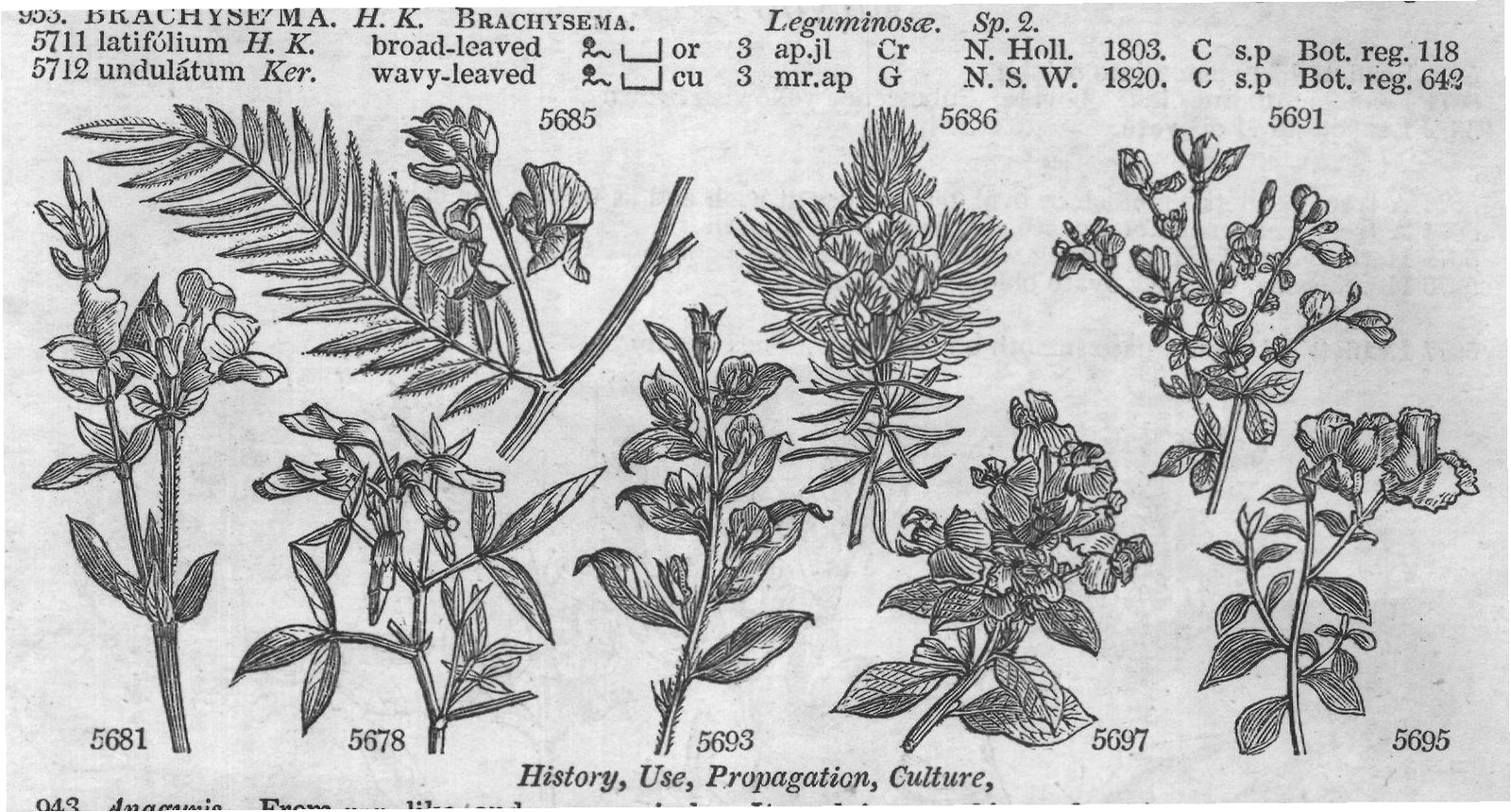
Sp. 2. 5711 latifólium H. K. broad-leaved or 3 ap.jl Cr N. Holl. 1803. C s.p 5712 undulátum Ker. wavy-leaved 2 cu 3 mr.ap G N. S. W. 1820. C s.p Bot. reg. 118 Bot. reg. 642 5685 5686 5691 5681 5678 5693 5697 5695 History, Use, Propagation, Culture, 943. Anagyris. From ava, like, and γuρoς, a circle. Its pod is curved inwards at its extremity. Small trees native of the South of Europe and North of Africa, and one doubtful species of Nepal. Young cuttings root of the South of Europe and North of Africa, and one doubtful species of Nepal. Young cuttings root in sand under a hand -glass. 944. Thermopsis. So named from the resemblance of the flower to that of a Lupine. This genus is cultivated with difficulty: it grows best in a light loamy soil, and may be increased by seed; dividing the root is liable to injure the plant, so that it is increased with difficulty by that means. (Bot. Cult. 427.) 945. Virgilia. A genus dedicated by Lamarck to the poet Virgil, whose Georgics contain many things interesting to botanists. to botanists. 946. Cyclopia. Named by Ventenat, from κuκλoς, a circle, and 785, a foot, in allusion to the replicate circle which is found about the base of the pods. is found about the base of the pods. 947. Baptisia. So named from βaπτω, to dye, in allusion to the economical properties of some species. Herbaceous plants of easy cultivation, and as border flowers ornamental. plants of easy cultivation, and as border flowers ornamental. 948. Podalyria. Podalyrus was a son of Æsculapius. Small Cape shrubs, with simple silky leaves and purple blossoms. The species may be grown in leaf mould and peat, or peat loam, and rooted by cuttings in sand, or raised from seeds. 949. Chorozemia. M. Labillardiére originally discovered this plant upon the south-west coast of New ORDER I. 5678 Leaves lanceolate acute 5679 Leaves elliptical obtuse DECANDRIA MONOGYNIA. 5680 Leaves lanceolate shining silky beneath 5681 Leaflets oblong-lanceolate, Stipules lanceolate twice as long as stalk, Pedicels whorled 5682 Leaves pinnate, Leaflets with a short point smooth, Racemes long pendulous 5683 Stamens persistent, Ovaries downy, Leaflets oval obtuse pointless 5684 Stamens persistent, Ovaries smooth, Base of calyx pushed inwards, Leaflets oval obt. with a little point 5685 Stam. decid. woolly at base, Ovaries downy, Keel acuminate, Leaflets lanceolate 5686 Leaflets subulate and sepals pointless, Bractes oblong ovate shorter than peduncle, Branchlets smooth 5687 Leaves perfoliate entire roundish 5688 Stem and leaves very hairy, Leaflets oval obtuse, Raceme terminal spiked 5689 Leaves ternate stalked, Leaflets cuneate lanceolate, Stipules longer than stalk lanceolate 5690 Leaves ternate stalked, Leafl. ellipt. obl. Stipules deciduous subulate shorter than stalk, Ovaries smooth 5691 Leaves ternate stalked, Leafl. roundish obovate, Stipules setaceous obsolete 5692 Leaves oblong obovate on both sides with the calyxes silky, Pedunc. one-fl. as long as leaves 5693 Leaves oblong obovate on both sides with the calyxes silky, several times longer than the 1-flow. fl-stalk 5694 Leaves cuneiform emarginate silky, Pedunc. shorter than leaf 5695 Leaves oval silky on both sides shorter than 2-fl. peduncle, Cal. downy rough 5696 Lvs. oval and obov. pubes. beneath netted: when full-grown not silky, Cal. vill. with a scarious refl. limb 5697 Leaves ovate reticulate, Branches hairy angular striated, Peduncles as long as leaves 5698 Leaves simple ovate downy, Fl. axillary, Peduncles longer than leaf 5699 Leaves elliptical-lanceolate, Peduncles 1-fl. shorter than leaves, Calyx deeply split 5700 Leaves villous stalked: upper ovate; lower roundish, Cal. villous with segments as long as wings 5701 Leaves cordate roundish subsessile very villous, Segments of villous calyx shorter than wings 5702 Leaves pinnatifid-toothed spiny oblong-lanceolate: with an entire point longer than the teeth 5703 Leaves sinuate-toothed spiny oblong obtuse, Bractes below the end of stalk 5704 Leaves entire flat mucronate: lower rhomboid orbicular; the upper elliptical lanceolate 5705 Lvs. opp. spiny toothed 3-lobed with a transverse base, Lateral lobes much shorter than term. toothed one 5706 Leaves lin. lanc. Bractes adhering to top of the footstalk, Corymb. clust. Pods scarcely longer than cal. 5707 Leaves oval. obl. Bractes deciduous below the end of footstalk, Corymb. clust. Pods twice as long as cal. 5708 Leaves ovate cordate hairy, Umb, terminal sessile 5709 Leaves lanceolate acute 5710 Leaves ternate obovate mucronate silky beneath 5711 Leaves ovate flat, Standard oblong obovate 5712 Leaves elliptical wavy mucronate, Standard oblong cordate 5699 5712 5706 5703 5705 5709 5710 5711 and Miscellaneous Particulars.
Holland, at the foot of the mountains, in a loamy soil, near a spot where, after having been tantalized with finding many salt springs, his party had just met with an ample supply of fresh water. This welcome refreshment, of which he speaks feelingly in his book, seems to have suggested a name for this plant, which he had properly determined to constitute a new genus. He called it Chorozema, evidently from Xogos, a dance or Chorozěma, evidently from xogos, a dance or joyous assembly, and ζεμa, a drink, in allusion to the circumstance just mentioned. (Smith.) This genus ripens abundance of seeds, from which it may be readily increased, and also by young cuttings in sand under a bell-glass. 950. Podolobium. This and the succeeding names ending in lobium, refer in that part of their derivation to their pod; this genus is called from πες πoδoς, a foot, the pod being on a stalk. The species may be treated as Chorozemia. 951. Oxylobium. From oξuς, pointed, the pods being pointed. See Podolobium. 952. Callistachys. From κaλoς, beautiful, and saxus, a spike, in reference to the fine spikes of yellow flowers. These are handsome conservatory shrubs, which grow rapidly and flower freely. They may be raised from seeds or cuttings in sand under a bell-glass. 953. Brachysema. From βρaχuς, short, and σημa, a standard. The standard of the flower of the genus is very short. This is a handsome climber, increased by layers, cuttings in sand, or by seeds. Z4 DECANDRIA MONOGYNIA. 954. GOMPHOLO'BIUM. H. K. GOMPHOLOBIUM.
CLASS X.