Important: Safety Warning
This page gives first-aid or emergency advice that predates modern medicine and can make an emergency worse. Do not follow it. In any medical emergency, call emergency services and follow current first-aid guidance.
This page prescribes plants as medicine according to pre-modern medical theory. Several of the plants named are toxic, correct identification is difficult, and the doses given have no scientific basis. Do not ingest or apply any preparation described here.
This information has been left in for historical purposes but should not be acted upon.
Home › V › Vent (Cels t Jac aust t Plu phy t f)
Vent (Cels t Jac aust t Plu phy t f)
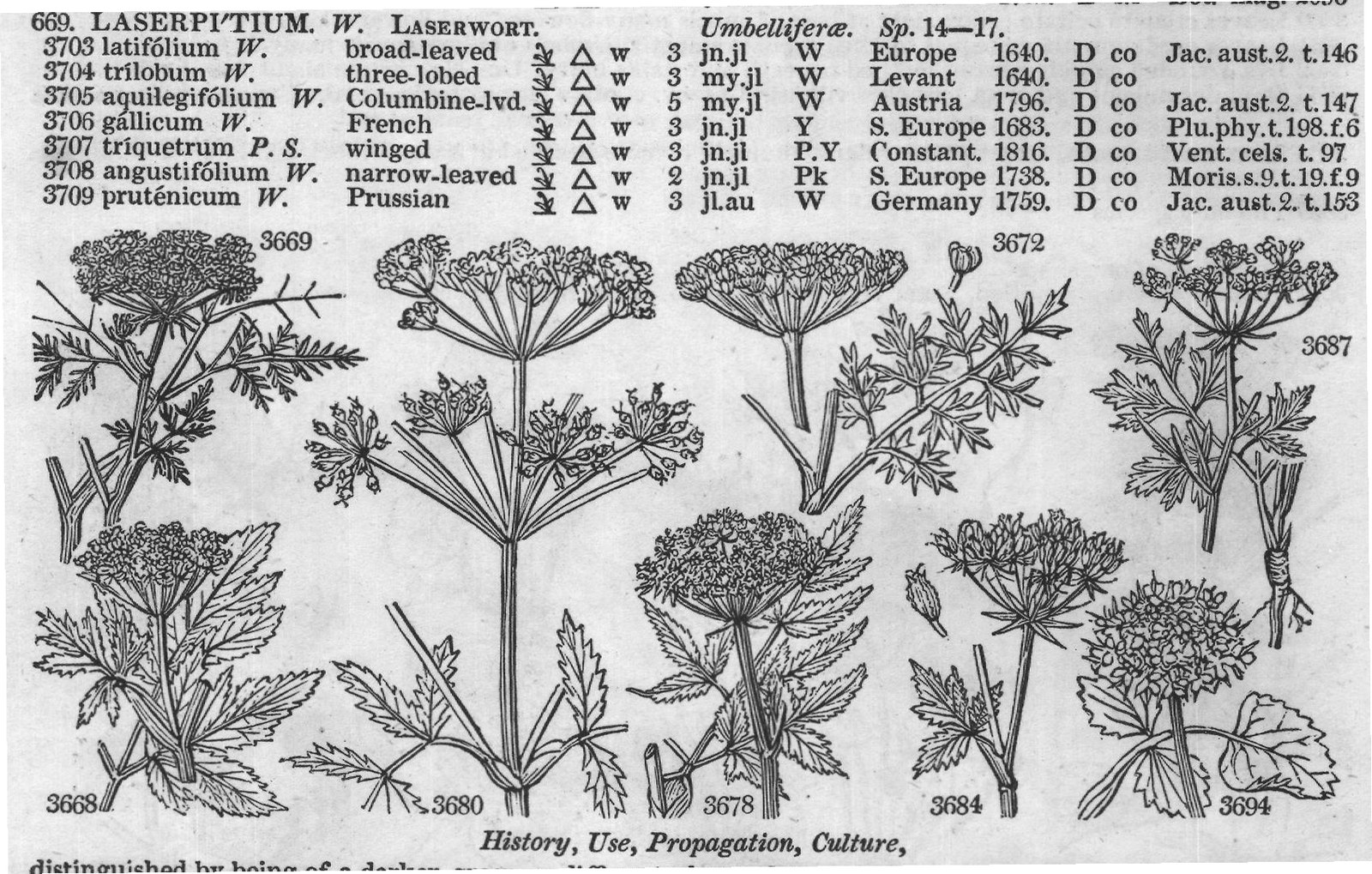
cels. t. 97 Jac. aust.2. t.147 Plu.phy.t.198.f.6 Moris.s.9.t.19.f.9 Jac. aust. 2. t. 153 3669 3672 3668 3680 3678 3684 3694 3687 History, Use, Propagation, Culture, distinguished by being of a darker green, a different shape, flat, and not curled, and of a disagreeable smell. When eaten in mistake for parsley it occasions vomiting, which may be stopped by a very large dose of brandy. It is deleterious to geese. 662. Imperatoria. A metaphorical name given to this plant to express its many virtues. For the same reason the English call it Masterwort. The root, which is very acrid, is sometimes used in toothache, and an the English call it Masterwort. The root, which is very acrid, is sometimes used in toothache, and an infusion of it in wine instead of bark in quartan agues. 663. Selinum. From σεληvη, a name of the moon, in allusion to the crescent-like form of the seeds when cut across. liferous. The Greeks seem to have used the word selinon, with reference to the same plants as we call umbel- . The Greeks seem to have used the word selinon, with reference to the same plants as we call umbelliferous. 664. Angelica. So called, in allusion to its agreeable smell and medicinal qualities. A. archangelica (from agxn, superior, an augmentative prefix), is sometimes cultivated in gardens for its leaf-stalks, to be blanched , superior, an augmentative prefix), is sometimes cultivated in gardens for its leaf-stalks, to be blanched and eaten as celery, or candied with sugar . It is considered stimulant and anti-pestilential. 665. Ligusticum. um. This plant, says Dioscorides, grows in great abundance in Liguria, near Mount Appennine, from which circumstance it derives its name. L. levisticum and scoticum are sometimes used as pot- , from which circumstance it derives its name.
L. levisticum and scoticum are sometimes used as potherbs or ingredients in salads, and are accounted emmenagogue. The root is carminative; and an infusion of the leaves is used as a purgative to calves in the Isle of Sky. 666. Hasselquistia. So named by Linnæus, in memory of his pupil, Frederick Hasselquist, M. D., who. ORDER II. 3668 The only species PENTANDRIA DIGYNIA. 3669 Stem striated, Root fusiform divided, Rays of umbel hispid 3670 Leaves 3-parted thrice sinuated. A doubtful species, scarcely distinct from the next 3671 Stem furrowed, Common involucre many-leaved, Leaflets wedge-shaped cut 3672 Stem furrowed with acute angles, Comm. invol. Ó, Leaflets lanceolate cut at the end with a callous point 3673 Stem rounded striated, Comm. invol. O, Sheaths of leaves loose, Leaflets filiform linear 3674 Stem rounded striated, Comm. invol. O, Leaflets trifid linear mucronate 3675 Stem striated, Lvs. pinnat. subcor. Leaflets ov.-obl. at base cartil. serrate, Upper sheaths enlarged leafless 3676 Stem woody naked beneath, Lower leaves bipinnate, Pinnæ lanceolate entire and cut serrate 3677 Leaves doubly pinnate ovate lanc. serrated with the odd leaflet lobed 3678 Leaflets equal ovate lanceolate serrated 3679 Leaflets lanceolate serrated decurrent 3680 Leaves very much divaricating, Leaflets ovate serrate, Stem with the peduncles whorled 3681 Outer pair of leaflets united together; terminal leaflet stalked 3682 Leaflets equal ovate cut serrate 3683 Leaves multiple, Leaflets cut upwards 3684 Leaves biternate 3685 Leaves many times pinnate, Leaflets pinnately cut 3686 Leaves bipinnate, Leaflets confluent cut entire 3687 Leaves decompound cut: cauline ternate lanceolate entire, Furrows of seed obsolete 3688 Lvs. supra-decompound, Leaflets pinnatifid, Seg. linear mucronate, Comm. invol. scarcely any deciduous 3639 Lvs. supra-decom. Leaflets wedge-shaped cut smooth, Comm. invol. 2-leav. leafy, Ribs of seed mem. smooth 3690 Invol. of the 1st umbel scarcely any : of the lateral umbels membranous at base, Rays branched 3691 Leaves pinnate, Lower leaflets acute with a smaller one 3692 Leaves biternate; radical decompound, Leaflets lin. lanc. entire 3693 Leaves pinnate, Leaflets pinnatifid 3694 Leaves cordate 3695 Seeds scaly 3696 Leaflets linear very long simple 3697 Leaflets linear subulate rounded, Comm. invol. O 3698 Leaves supra-decompound, Leaflets lanc. linear flat 3699 Leaves cut, Segm. 3-toothed unequal shining 3700 Pinnæ of leaves naked at base, Leaflets setaceous 3701 Leaflets with appendages, Umbels nearly sessile 3702 Leaves supra-decompound many cut acute decurrent, First umbel sessile 3703 Leaves obliquely cordate toothed, Teeth mucronate, Wings of seeds crisp 3704 Leaflets 3-lobed cut 3705 Leaves obtuse ovate at base lobed 3706 Leaflets wedge-shaped trifid, Segm. oblong bluntish with a callous point at end 3707 Stem naked 3-cornered, Branches angular, Leaflets obl. toothed crenate, Involucres many-leaved short Leaflets obl. toothed crenate, Involucres many-leaved short 3708 Leaflets lanceolate obtuse mucronate entire sessile 3709 Leaves lanceolate entire: the outer joined together 3686 3695 3702 3701 3703 3709 3705 and Miscellaneous Particulars. travelled into the Holy Land, &c. and died at Smyrna in 1752. Author of Travels in Palestine. A remarkable genus, supposed with some reason to be a monstrous alteration of a species of Tordylium. 667. Artedia. So named by Linnæus, in honor of Peter Artedi, a Swedish naturalist, one of the first who attempted to divide umbelliferous plants into genera. His method was followed by Linnæus, and was, perhaps, not more defective than many of those which have been proposed in modern days. He died in 1735. 668. Ferula. From ferire, to strike. The stalks were used as a rod for children, because they made more noise than harm. F. communis is one of the tallest of herbaceous plants. The flower-stalk soon becomes dry after the seeds ripen, and then the Sicilians take out the pith and use it for tinder. It is very abundant in is very abundant in Apulia, where it is eaten by buffaloes. Gerarde says, it grew to the height of fifteen feet in his garden in Holborn. The drug asafœtida is obtained from one or more species of this genus natives of Persia; and one species, the F. asafœtida, though introduced to our gardens in 1782, is now lost. The drug is the inspissated juice of the root, which being bared of earth and cut across at the top, it oozes out, and when dry, is scraped off as opium is from the capsule of the poppy. The plant grows three feet high, with yellow flowers and hemlocklike leaves and habit. 669. Laserpitium. The Latin name of the Silphion of the Greeks. D'Herbelot says, that the natives of Africa called the plant silphi or serpi, whence the Latins formed lac serpitium and Laserpitium. (Bibl. Or. p. 493. 3710 silaifólium W. 3711 peucedanoídes W. fine-leaved PENTANDRIA DIGYNIA.
CLASS V.
Sulphurw.-lvd. w 2 jn.jl P.Y Italy W 2 jn.jl Pk Italy 1791. D co 3712 Síler W. mountain W 3 my.jl 3713 lúcidum W. 3714 feruláceum W. shining Fennel-leaved Ocu jl w 1 jn W Austria P.Pu Switzerl.
W Levant 1640. D co Jac.aus.app. t.44 Jac. ic. 2. t. 350 Jac. aust.2. t.145 3715 pilósum sulphur-colored W jn.jl P.Y ...... 1775. Sco 1752. D co 1759. S co Tourn.it.2. t. 121 3716 hirsútum W. hairy W 1 jn.jl P.Y Alps 1759. D co 670. PEUCE/DANUM. 3717 officinále W.
W. SULPHURWORT. officinal Umbelliferæ.
Sp. 6-21. m 6 my.jl Y 3718 arenárium P. S. sand W 5 jn.jl Y 3719 itálicum P. S.
Italian W 8 my.jl Y 3720 alpéstre W.
England salt m. D c.l Hungary 1816. D c.l Italy ...
D c.l Eng. bot. 1767 P.rar.hun. 1. t.20 Lob. ic. 781 Alpine W 3721 sibíricum W. 1 jn.jl P.Y Siberian W 3 jn.jl Y 3722 aúreum W. golden cu 3 jn Y 671. PASTINA'CA. W. PARSNEP.
Umbelliferæ.
France 1739. D c.1 Siberia 1804. D c.l Canaries 1779. C co Sp. 4-6.
P.rar.hun.1. t.60 3723 lúcida W. shining-leaved 3724 satíva W. garden 3725 Opópanax W. rough ** 3726 dissécta Vent. cut-leaved 0000 w 1 jn.jl Y cul 4 jl Y cu 6 jn.jl Y w 1½ jn.jl W S. Europe 1771. S s.l England ch.pl. S s.1 S. Europe 1640. D co Levant 1816. S co Jac. vind.2. t.199 Eng. bot. 556 Gou.il. 19. t. 13,14