Important: Safety Warning
This page states that certain wild plants are safe to eat. Its identifications and edibility claims are more than a century old and in some cases simply wrong, and deadly look-alikes exist for many edible species. Never eat a wild plant on the strength of this text.
This information has been left in for historical purposes but should not be acted upon.
Vent
cels. t. 78 672. HERACLEUM. W. COW-PARSNEP.
Umbelliferæ.
Sp. 10-19. 3727 Sphondýlium W. common ec 4 my.jn W Britain hed. D co Eng. bot. 939 3728 flavéscens W. yellowish W 4 jn.jl W 3729 angustifolium W. narrow-leaved w 4 my.jn W Austria 1789. D co Britain Jac. aust. 2. t. 173 D co Jac. aust.2. t.174 3730 élegans W. rough-leaved w 3731 sibíricum W. 3 my.jn W Siberian W 2 my.jn G Austria 1800. D co Siberia 1768. D co 3732 Panáces W.
Fig-leaved W 3 jl.au W 3733 austríacum W.
Austrian W 2 jn.jl W 3734 alpínum W.
Alpine W 1½ jn.jl W 3735 pyrenáicum Cusson. Pyrenean W 3 jn.jl W 3736 púmilum W. dwarf W my.jl W 673. TORDY'LIUM. W. HARTWORT.
Umbelliferæ. 3737 syríacum W.
Syrian W jil 3738 officinále W. officinal 3739 peregrínum W. oriental W jl W W F Sp. 6-8.
Syria 2 2 jl W 3740 ápulum W. small 3741 máximum W. great W 3742 siifólium. W. red-flowered Ow 1 jl Ow 1 jn.jl R 2 jn.jl W W Siberia 1596. D co Austria 1752. D co Switzerl. 1739. D co Pyrenees 1798. D co Dauphiny 1800. D co 1597. S co England corn fi. S co Levant 1596. S co Italy 1739. S co England corn fi. S co Carniola 1816. S co Jac. vind. 1. t. 54 Eng. bot. 2440 Cam.hor.37. t.11 Jac. vind. 1. t. 53 Eng. bot. 1173 Scop. car. 194. t.8 Gmel. sib.1. t. 50 Lobel. ic. 701 Jac. aust. 1. t. 61 Barr. ic. 55 Hort. ber. t. 53 Vill.delph.2. t.14 674. ASTRAN'TIA. W. MASTERWORT.
Umbelliferæ.
Sp. 4. 3743 máxima B. M.
Hellebore-lvd.Apr 2 jn.jl 3744 májor W.
Pk great-black 3745 minor W. small 3746 carniólica W. pr 2 my.s Str A pr my.jn Pk Carniolian pr 1 my.jn Str Caucasus 1804. D s.p Al. of Eur. 1596. D p.l Switzerl. 1686. D p.1 Carniola 1812. D p.l Bot. mag. 1553 Ex. bot. 2. t. 76 Bot. cab. 93 Jac.aus.app. t.10 675. ZOSI MIA. Hoffm.
ZOSIMIA. 3747 absinthifolium P. S. Wormwood-lvd.
W Umbelliferæ. 2 jl.au W Sp. 1.
Persia 1816. S co Vent.choix. t. 22 676. RUMIA. Hoffm. 3748 taúrica Hoffm. 3749 capénsis Lk.
RUMIA.
Taurian Cape Umbelliferæ. Sp. 2. cu 1 jl W Crimea 1819. D co cu 1 s W C. G. H. 1822. S co 3711 3718 3723 3724 3712 3721 3717 History, Use, Propagation, Culture, 3737 670. Peucedanum. From πεuκη, a pine-tree, and davos, dwarf; a diminutive fir. The plant was so called on account of its strong smell, which resembles resin. 671. Pastinaca. One of the names given by the Latins to the Daucus of the Greeks. It is derived from pastus, nourishment. P. sativa is a well known culinary root, and grown also in agriculture for feeding cattle. It was much in use during Catholic times to eat with salted fish. In the north of Ireland a sort of beer is brewed from the roots mixed with hops; a very good wine is also made from them; and by distillation they yield an ardent spirit, similar to that afforded by the potatoe. The parsnep is much cultivated in Jersey and Guernsey, chiefly for feeding milch cows. The variety preferred is called the Coquaine, the roots of which, Dr.
Macculloch informs us (Caled. Hort. Mem. i. 408.), sometimes run four feet deep, and are rarely so small in circumference as six inches. The time of sowing is February and March, in drills to admit of stirring the soil between the rows. They should be thinned so as that each plant may have a surface of twelve or fourteen square inches, and, with the usual routine culture, the crop will be mature in October. They may be taken up and housed like the carrot, or as wanted for use: as they are not easily injured by frost, the latter mode is the best, where they are grown only for the table.
P. opopaпax (oπoς, juice, πav, all, and azos, cure: a cure for all complaints) produces from its stem, when it cut, a gum resin which is a famous cure in the East for all sorts of maladies. is cut, a gum resin which is a famous cure in the East for all sorts of maladies. 672. Heracleum. Named after the hero Hercules, who, according to a modern French author, was not only a a great doctor and botanist. H. Sphondylium (from oporduros, a vertebra, in allusion to the warrior but a great doctor and botanist. H. Sphondylium (from σφovδuλoς, a vertebra, in allusion to the jointed stem), the Heilkraut of the Germans, is common in most parts of Europe. The seeds smell somewhat ORDER II.
PENTANDRIA DIGYNIA. 3710 Leaves pinnatifid, Segm. lanceolate, Common involucre scarcely any, Stem smooth 3711 Leaflets linear-lanceolate veiny striated distinct 3712 Leaflets oval-lanceolate entire stalked 3713 Leaves supra-decompound linear-subulate smooth, Comm. invol. pinnated 3714 Leaflets linear 3715 Hairy, Stem rounded simple, Lvs. tern. bipinnate, Leaflets alternate ovate pinnatifid cut wedge-shaped 3716 Leaves supra-decompound hairy, Leaflets many cut, Leaves of many-leaved invol. membranous at edge 3717 Leaves 5 times 3-parted filiform linear 3718 Leaves ternate decompound, Leaflets linear obtuse stiffish, Comm. invol. scarcely any 3719 Leaves 3-parted filiform longer, Umbels deformed 3720 Leaflets linear branched 3721 Leafiets linear acute, First umbels sessile 3722 Leaves thrice pinnate, Cauline leaflets linear lanceolate: radical oblong many-cut 3723 Leaves simple cordate lobed shining acutely crenate 3724 Leaves simply pinnate 3725 Leaves pinnate, Leaflets with their front base cut out 3726 Stem rounded rough branched, Leaves bipinnatifid, Peduncles rigid villous 3727 Leaves pinnate, Leaflets 5 oblong pinnatifid acute toothed, Cor. of one shape 3728 Leaves pinnate, Leaflets 5 oblong pinnatifid acuminate toothed rough at edge, Flowers radiant 3729 Leaves cruciate pinnate, Leaflets linear, Corollas flosculous 3730 Leaflets pinnatifid crosswise toothed 3731 Leaves pinnated, Leaflets 5: the intermediate sessile, Cor. of one form 3732 Leaves pinnated, Leaflets 5: the intermediate sessile, Flowers radiant 3733 Leaves pinnated rugose on each side scabrous, Flowers somewhat radiant , Flowers somewhat radiant 3734 Leaves simple cordate obsoletely lobed serrated 3735 Leaves simple 3-leaved cordate toothed beneath pubescent 3736 Leaves simple and ternate many cut torn, Segments linear 3737 Involucres longer than the umbels 3738 Partial involucres the length of flowers, Leaflets ovate laciniate 3739 Seeds furrowed wrinkled plaited, Universal involucre 1-leaved trifid 3740 Umbellules remote, Leaves pinnated with roundish cut pinnæ 3741 Umbels clustered radiant, Leaflets lanceolate cut serrated 3742 Umbels clustered radiant, Leaflets angular toothed pubescent 3743 Radical lvs. palmate 3-lobed unequally twice serrated; cauline sessile lobed, Involucre longer than umbel 3744 Radical leaves 5-lobed, Lobes trifid acute toothed, Involucres lin. lanceolate entire 3745 Radical leaves digitate, Leaflets about 7 lanceolate acute deeply toothed 3746 Radical leaves 5-lobed, Lobes oblong acutish trifid mucronate-toothed, Involucres entire 3747 Hoary, Leaves decompound, Leaflets wedge-shaped trifid, Flowers angular, Fruit villous 3748 Stem dichotomous knotty, Leaves decompound, Involucre short, Female flowers with a long ray 3749 Stems decumbent, Sheaths loose, Seeds smooth 3728 3733 3741 3738 3745 3743 3748 3747 and Miscellaneous Particulars. like a bug. Gmelin, informs us, that the inhabitants of Kamtchatka, about the beginning of July, collect the footstalks of the radical leaves, and after peeling off the rind, which is very acrid, dry them separately in the sun, and then tying them in bundles, lay them up carefully in the shade in bags ; in this state they are covered with a yellow saccharine efflorescence, tasting like liquorice; this being shaken off, is eaten as a great delicacy. From the stalks thus prepared and fermented with bilberries the Russians distil an ardent spirit, which, Gmelin says, is more agreeable to the taste than spirits made from corn. A kind of ale is brewed from the leaves and seeds in Poland and Lithuania, and attempts have been made to extract sugar from this plant, but forty pounds of the dried stalks only yielded a quarter of a pound of powdery sugar. The young shoots may be eaten as asparagus. Rabbits and swine are fond of the leaves, but not horses. H. sibiricum is used in the same manner in the north of Siberia and Kamtchatka. 673. Tordylium. Bodæus à Stapel thinks that the derivation of the name is to be found in τoρvoς, a lathe, and iλλω, to turn, because the seeds seem as if turned in a lathe. But this seems to be a commentator's guess only. 674. Astrantia. From asgov, a star, and avτi, similar; so called with reference to the beautiful starlike dispositon of the involucrum of all the species, and of A. minor in particular. 675. Zosima. Named by Hoffmann, in honor of the three famous brothers Zosimades, the celebrated patrons of so many fine editions of the Greek classics. A remarkable plant, formerly referred to Heracleum, native of most of the eastern parts of the world. 676. Rumia. Named by Hoffman after Rumia or Rumina, the goddess who presided over suckling, on 677. CA'CHRYS. W. 3750 Libanótis W. 3751 Morisóni W.
CACHRYS.
PENTANDRIA TRIGYNIA.
Umbelliferæ. Sp. 3-10.
CLASS V. smooth-seeded Morison's 3752 panacifólia W.
Parsnep-leaved w cu w 3 jl.au Y jlau Y 4 jlau Y Sicily 1570. D co S. Europe 1710. D co Sicily 1752. D co Schk, han.1. t.65 Mor.umb. t.3.f.1 Boc. sic. 1. t. 1 hairy 678. HIPPOMA'RATHRUM. Lk. HIPPOMARATHRUM. Umbellifera. Sp. 1. 3753 sículum Lk.
A cu 3 jl.au Y Sicily 1640. D co Bocc. sic. t. 18 TRIGYNIA. 679. VIBURNUM. W.
VIBURNUM.
Caprifoliacea. Sp. 23-36. 3754 Tinus P. S. co. Laurestine or 4 mr.d W S. Europe 1596.
L co Bot. mag. 38 a hírtum hairy or 4 mr.d W S. Europe Lco ...
ẞ virgátum slender or 4 mr.d W S. Europe ...
L co y strictum upright or 4 mr.d W S. Europe L co ... 3755 lúcidum P. S. sh.-lvd.-Laures. or 6 mr.d W Spain 1596.
Lco Clus. hist. 49 3756 rugósum P. S. large-lvd.-Laur. or 4 W ...
Canaries 1796.
L p.l Bot. mag. 2082 3757 prunifólium W.
Plum-leaved or 8 my.jn W N. Amer. 1731.
L p.l Dend. brit. 23 3758 odoratíssimum Ker. sweet-scented or f W China 1818. L Bot. reg. 456 3759 squamátum Muhl. scaly or 6 jl WN. Amer. 1822.
L p.1 Dend. brit. 24 3760 pýrifólium Ph.
Pear-leaved or 6 my.jn WN. Amer. ...
Lp.l Dend. brit. 22 3761 Lentágo W. tree or 8 jl W N. Amer. 1761.
L p.l Dend. brit. 21 3762 núdum W. oval-leaved or 8 my.jn Pa.Y N. Amer. 1752.
L p.l Bot. mag. 2281 3763 daúricum Pall.
Siberian or 2 jn.jl W Dahuria 1785.
L p.1 Pall. ross. i. t. 38 3769 pubéscens Ph. 3770 lantanoídes Mich. 3771 Lantána W. 3772 mólle Mich. 3773 acerifólium W. 3764 obovátum Walt.
ẞ punicifólium 3765 cassinoídes W. 3766 lævigátum W. w. 3766 læ 3767 nítidum W. 3768 dentátum Ph. thick-leaved Cassiober.-bush shining-l aved tooth-leaved downy tooth-lv.
Lantana-like Wayfaring-tree Maple-leaved obovate-leaved or 2 my.jn W N. Amer. 1812.
L p.1 narrow-leaved or 2 my.jn WN. Amer. 1812.
L. p.1 or 3 jn.jl W N. Amer. 1761.
L p.l or 10 jl.au Pa.B N. Amer. 1724.
L p.1 Mil. ic. 1. t.83.f.1 or 2 my.jn W N. Amer. 1758.
L p.l or 5 jn.jl WN. Amer. 1736.
Lp.l Dend. brit. 25 or 3 jn.jl W N. Amer. 1736.
L p.l or 5 my.jn W N. Amer. ...
L p.l or 10 my.jn W soft or 6 jn.jl W or 4 jn.jl W Britain hed.
N. Amer. 1812.
N. Amer. 1736.
L p.1 Eng. bot. 331 L p.l L co 3774 O'pulus W.
Guelder Rose or 10 my.jn W Britain moi.w. L p.1 Dend. brit. 118 Eng. bot. 332 B róseum Snowball-tree or 14 my.jn W ...
L p.l 3775 Oxycóccos Ph.
Cranberry-like or 12 jl W N. Amer. ... 3776 édule Ph. eatable-fruited or 12 jl W N. Amer. 1812.
L p.l L p.l 680. SAMBUCUS. W.
ELDER.
Caprifoliacea. Sp. 7-9. 3777 Ebulus W. dwarf cu 3 jn.jl P.Pk Britain 3778 chinensis Lindl.
Chinese 3779 nígra W.
B viridis 3780 laciniáta Lk. 3781 canadénsis W. 3782 púbens Mich. 3783 racemósa W. 681. RHUS. W. 3784 Coriária W. 3785 typhína W.
ẞ frutescens 3750 common green-fruited Parsley-leaved Canadian ec 15 my.jl or 8 my.jl or 8 my.jl or 6 jn.au W cu 4 s.o W China Britain W W W wa.gr. D co 1823. D co hed. C co Eng. bot. 475 Eng. bot. 476 ......
C co C co N. Amer. 1761. C s.l ...
Schm. arb. t. 144 Schmid. arb. 142 pubescent or 6 W ...
N. Amer. 1812. C s.l red-berried or 12 my.jn Gr.
S. Europe 1596.
C co Jac. ic. 1. t. 59 SUMACH.
Terebintaceæ.
Sp. 33-75.
Elm-leaved Virginian dwarf ec 10 jl G ec 20 jl.au G S. Europe 1596.
N. Amer. 1629.
L co S co Dend. brit. 136 Dend. brit. 17,18 cu 6 jł G ...... ...
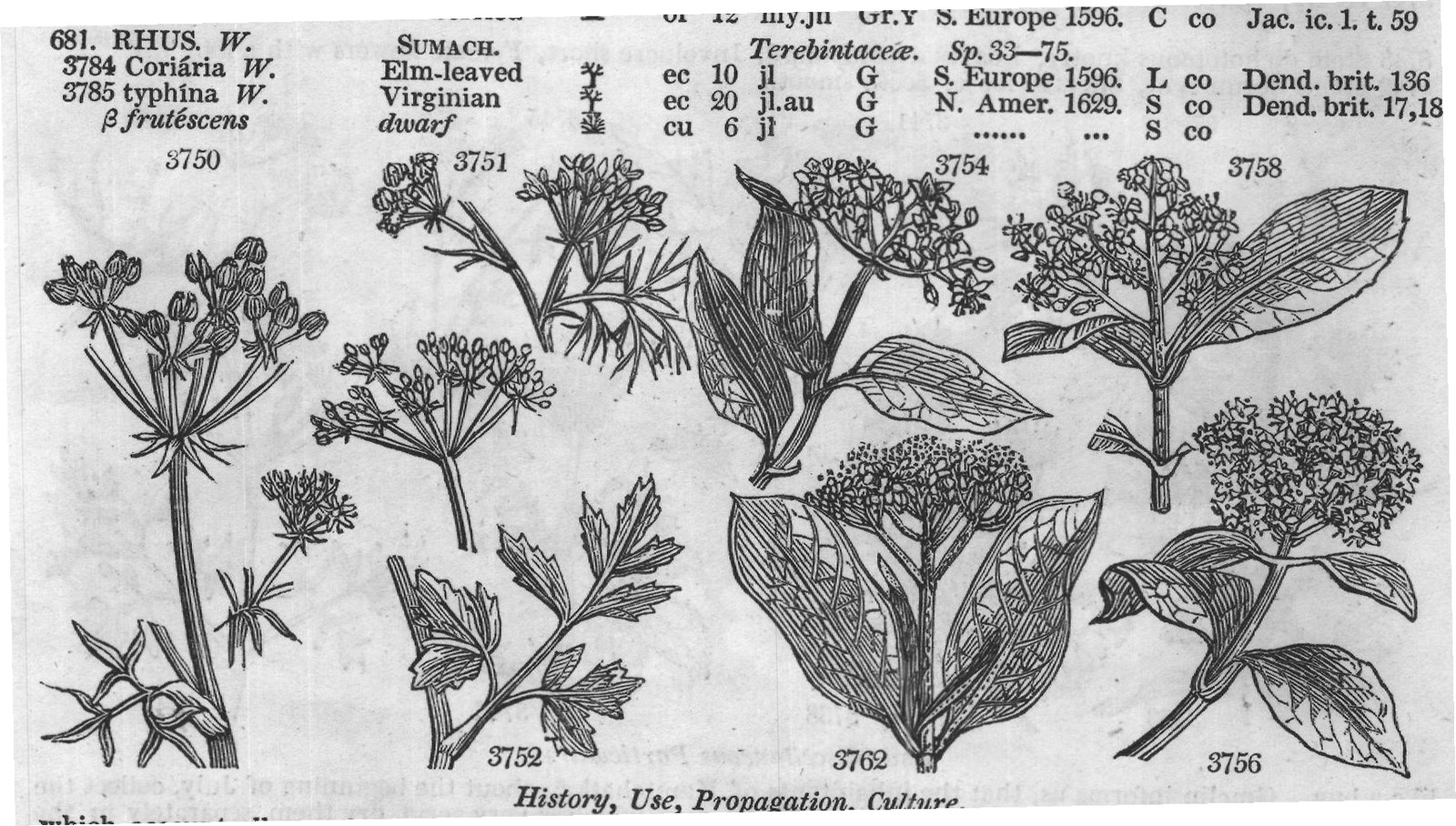
Sco 3751 3754 3758 3752 3762 3756 History, Use, Propagation, Culture, which account all vascular substances, with firm outside but very cellular structure inside, were said to be Ruminosa. The seeds of this genus are of that nature. There was also a in some Polish university. Ruminosa. The seeds of this genus are of that nature. There was also a Dr. Rumy, professor of agriculture in some Polish university. 677. Cachrys. One of the names given by the Romans to the Rosemary. According to Morison, the name was derived from xxiw, to grow hot, on account of the carminative qualities of the plant. The Cossacks of derived from κaiω, to grow hot, on account of the carminative qualities of the plant. The Cossacks of the Jäik chew the seeds of C. odontalgica for pain in the teeth, and obtain relief by the copious salivation which follows their use. This genus is well known by its corky large smooth seeds. 678. Hippomarathrum. From ἱππoς μaρaθρov, horse-fennel, on account of its size compared with that of common fennel. 679. Viburnum. This name is derived, according to the account of Sebastian Vaillant, from the Latin word viere, to tie, on account of the pliability of the branches of some species. V. tinus (τivov, small, dwarf, tiny) is one of the most ornamental of evergreen shrubs, with shining leaves and shewy white flowers, which appear during the winter months. V. lucidum and strictum are taller and more tender than the common species, of which they are by many considered as only varieties. V. lantana (from lento, to tie) grows chiefly on calcareous soils: it has pliant mealy twigs, and the bark affords a bird lime.
V. opulus, (alteration of populus) var roseum, is a most ornamental shrub, producing large white bunches of ORDER III.
PENTANDRIA TRIGYNIA. 3750 Leaves bipinnate, Pinnæ opposite linear rather pungent, Seeds furrowed smooth 3751 Leaves supra-decompound setaceous many-cut, Seeds even smooth 3752 Leaves pinnate and ternate, Leaflets oblong crenate 3753 Leaves bipinnate, Leaflets linear, Stem furrowed TRIGYNIA. 3754 Leaves ovate oblong entire, Divisions of the veins and the young branches glandular hairy a Leaves oval oblong beneath and at edge hairy Leaves lanceolate oblong at the edge and veins beneath hairy Leaves ovate hairy on both sides stiff 3755 Leaves coriaceous ovate lanceolate shining entire 3756 Leaves broad ovate rugose hairy beneath, Common involucre 7-leaved 3757 Leaves obovate roundish and oval smooth finely serrated with edged stalks 3758 Evergreen smooth, Leaves coriaceous elliptical oblong distantly toothed 3759 Leaves oblong obtusely serrated, Stalks and peduncles with scaly pubescence 3760 Smooth, Leaves ovate nearly acute subserrate, Leaf-stalks smooth, Fruit ovate oblong, Cymes stalked 3761 Leaves broad ovate acuminate finely serrated, Stalks edged crisp 3762 Leaves obl. narr. at base rather blunt entire revolute at edge smooth above shining with netted veins 3763 Leaves ovate serrate dotted with hairs, Cymes dichotomous few-flowered 3764 Smooth, Leaves obovate crenate toothed or entire obtuse, Umbels sessile, Fruit roundish ovate 3765 Smooth, Leaves ovate lanceolate acute at each end crenate revolute at edge, Stalks keeled glandular 3766 Leaves obl. lanc. unequally and finely serrated at base wedge-shaped and entire, Branches compr. square 3767 Leaves linear lanceolate shining above obsoletely serrated or entire, Branches square 3768 Leaves ovate tooth-serrated plaited 3769 Leaves oval acuminate tooth-serrated plaited pubescent 3770 Somewhat decumbent, Lvs. rounded cord. abruptly acumin. toothed with the stalks and nerves powdery 3771 Leaves ovate oblong cordate serrate beneath rugose with veins downy 3772 Leaves roundish cord. furrowed with plaits beneath downy with a very soft pubescence, Cymes radiant 3773 Leaves cord. ovate generally 3-lobed loosely serrat. stalks without glands at base with stipules and downy toothed, Stalks glandular smooth 3775 Leaves 3-lobed acute behind 3-nerved divaricating rarely toothed, Stalks glandular, Cymes radiant 3776 Leaves 3-lobed behind obtuse 3-nerved, Lobes very short tooth-serrated, Serrat. acumin. Cymes radiant 3777 Cymes 3-parted, Stipules leafy, Stem herbaceous, Leaves pubescent beneath 3778 Cymes with many abortive fleshy flowers, Stem herbaceous warted, Leaves quite smooth 3779 Cymes 5-parted, Stem arborescent 3780 Flowers umbelled, Leaves pinnatifid, Stem shrubby 3781 Cymes 5-parted, Leaves about twice pinnated, Stem shrubby 3782 Panicle ovate, Leaflets lanceolate acuminate unequal at base, Leaf-stalk hairy, Stem shrubby 3783 Panicle ovate, Leaflets oblong acuminate nearly equal at base, Stalks smooth, Stem arborescent 3784 Leaflets ovate oblong obtuse mucronate scabr. above villous beneath, The last joints of stalk membranous 3785 Leaflets lanceolate acuminate finely serrated hairy beneath 3773 3768 3771 3777 3781 3774 3783 3784 and Miscellaneous Particulars white flowers, resembling those of Hydrangea, and like them abortive. With lilac, laburnum, and scarlet thorn it forms an elegant group. 680. Sambucus. A musical instrument called by the Latins sambuca, is supposed to have been made of the wood of this tree, on account of its hardness. The tree was always famous for this quality; so that Pliny says it of this tree, on account of its hardness. The tree was always famous for this quality; so that Pliny says it consists of nothing but skin and bones. (b. xvi. c. 39.) S. ebulus is supposed to prevent diseases in swine if used as litter: the root is violently cathartic, the leaves drive away mice, and the berries dye blue. S. nigra with its varieties, and S. racemosa, are very shewy trees in shrubberies when in flower and fruit. S. nigra is narcotic, purgative, and acrid; the flowers in decoction are diaphoretic and expectorant; used to nigra is narcotic, purgative, and acrid; the flowers in decoction are diaphoretic and expectorant; used to flavor vinegar, and deleterious to turkeys. The French put layers of them in heaps or casks of apples, to which they communicate a most agreeable odor. The berries are poisonous to poultry; but make a powerful wine much in esteem among country people. As the common elder will grow either exposed to the sea breeze or on high mountains, it is recommended as a nurse-plant in forming plantations. To thrive and be productive as a fruit tree however, it requires a deep, rather moist, and rich soil. 681. Rhus. Derived from the same root as Rosa, rhudd, in Celtic, signifying red, on account of the color of the fruit. Pas, in Greek. Sumach, its English name, is an alteration of simáq, its name in Arabic. (Forsk.) In some of the species of this genus the flowers are hermaphrodite; in others, as R. elegans, are on separate plants. In R. toxicodendron, they Q 3786 javánica W. 3787 glábra W. 3788 élegans W. 3789 viridiflóra Ph. 3790 púmila Ph. 3791 Vérnix W. 3792 succedánea W. 3793 Bucku-Améla Wall. long-leaved 3794 juglandifólia Wall. Walnut-leaved 3795 glaúca Desf. glaucous 3796 oxyacantha Schousb. hawthorn 3797 oxyacanthoides Dum.prickly PENTANDRIA TRIGYNIA.
CLASS V.
Java cu 10 jl.s W Java smooth or 8 jl.s G scarlet or 10 jl G green-flowered or 15 jl G dwarf poisonous P 1 jl G Varnish or 15 jl G 1799. S p.1 N. Amer. 1726. Lp.l N. Amer. 1726. S p.1 N. Amer.
S p.l N. Amer. 1806. S p.l N. Amer. 1713. L co Dend. brit. 15 Di. el. t.243.f.314 Dend. brit. 16 Dend. brit. 19 red Lac כככך ec 10 jn G China 1768. S p.1 Kæm. am. t. 795 or 10 G ...
Nepal 1823. S co or 10 ...
G Nepal 1823. S co cu 2 jl G C. G. H. 1821. C p.1 or 6 ...
G Barbary 1823. C p.1 or 6 G Barbary 1824. C p.l 3798 Zizyphína Ten.
Parsley-leaved cu 3 ...
G Sicily 1824. C p.1 3799 semialáta W.
Service-leaved cu 6 Macao 1780. L p.1 Mur. co. g. 6. t.3 ... 3800 copallína W.
Lentiscus-leav. ec 6 au.s G N. Amer. 1688. S p.1 Jac. sch. 3. t. 341 3801 Toxicodendron Ph. Poison-Oak p 3 jn.jl G N. Amer. 1640. S co a radicans L. common P 3 jn.jl G N. Amer.
Sco ...
Bot. mag. 1806.
ẞ véra true P 2 jn.jl G N. Amer.
Sco Duh.nov. n. t.48 ... y microcarpa small-fruited p 2 jn.jl G N. Amer.
Sco Dill. elth. f. 375. ... 3802 aromática Ph.
ẞ suaveolens W. female sweet or 8 my G N. Amer. 1759. Lp.l T. in an.m.5.t.30 male sweet or 6 my G N. Amer.
L p.1 ... 3803 pendulína Jacq. 3804 dentáta W. pendulous cu 3 ...
G C. G. H.
L p.1 ... rough-stalked cu 2 G C. G. H. 1798.
C p.l 3805 cuneifólia W. wedge-leaved cu 2 G C. G. H. 1816.
C p.l 3806 incísa W. cut-leaved cu 2 G C. G. H. 1789 C p.l ... 3807 tomentósa W. woolly-leaved cu 10 G C. G. H. 1691.
C p.1 Com. ho. 1. t. 92 ... 3808 villósa W. hairy cu 6 jl G C. G. H. 1714.
C p.l Pl. al. t. 219. f. 8 3809 pubéscens W. pubescent cu 10 G C. G. H. 1800. C p.1 ... 3810 viminális W.
Willow-leaved cu 2 ...
G C. G. H. 1774. C p.1 Jac. sch. 3. t. 344 3811 angustifólia W. narrow-leaved cu 6 W C. G. H. 1714. C p.1 Pl. al. t. 219. f. 6 ... 3812 rosmarinifólia W.
Rosemary-leav. cu 4 G C. G. H. 1800. C p.1 Bur. afr. t.91. f.2 ... 3813 pentaphýlla Desf. various-leaved cu 4 ...
G Barbary 1816. C p.1 Desf. atl. 1. t. 77 3814 lævigáta W. polished-leaved cu 6 G C. G. H. 1758. C p.l ... 3815 lúcida W. shining-leaved cu 6 jl.au G C. G. H. 1697. C p.l Bur. afr. t. 91. f. 1 ẞ minor small-shin.-lvd. cu 6 jl.au G C. G. H. 1697. C p.l Com. ho. 1. t. 93 3816 Cótinus W.
Venetian or 6 jn.jl G S. Europe 1656. L co Jac. au. 3. t. 210 682. CASSI'NE. W.
CASSINE.
Rhamni. Sp. 4-8. 3817 capénsis W.
Cape Phillyrea or 1 jl.au 3818 Colpoon W.
Colpoon-tree 3819 Maurocénia W.
Hottentot Cher. 3820 xylocárpa Vent. bony-seeded コココロ W C. G. H. 1629.
C s.l.p Bur. afr. t. 85 or 6 W or 5 ...
C. G. H. 1791.
C s.l.p Bur. afr. t. 86 W C. G. H. 1690.
C s.l.p Di. el. t. 121.f.147 or 3 Pa.Y Antilles 1816. C s.l.p Vent. Ch. t. 23 683. SPATHELIA. W. SPATHELIA.
Terebintaceæ. Sp. 1. 3821 símplex W.
Sumach-leaved tm 40 ...
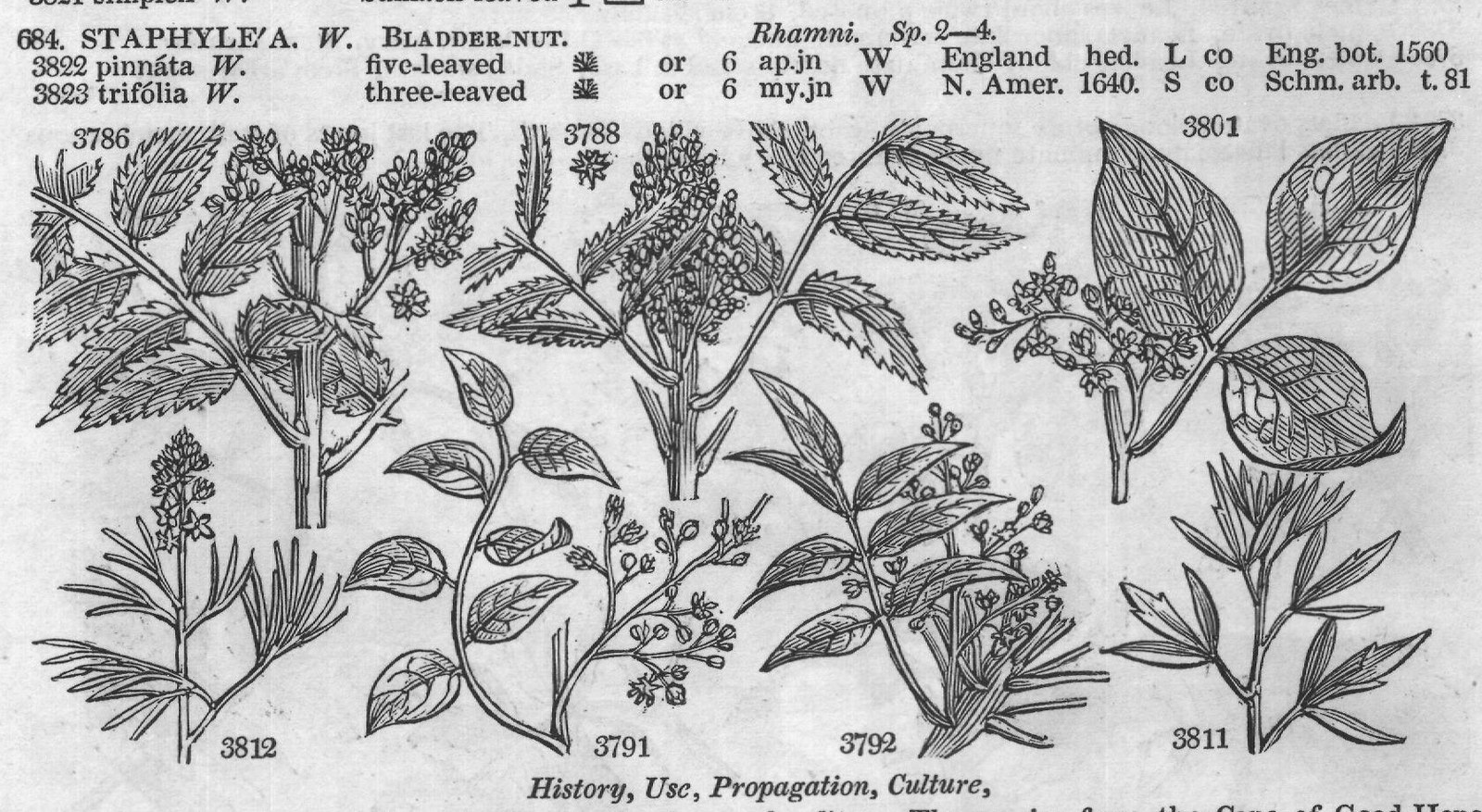
R Jamaica 1778. S s.p Bot. reg. 670 684. STAPHYLE/A. W. BLADDER-NUT.
Rhamni. Sp. 2-4. 3822 pinnáta W. 3823 trifólia W. five-leaved three-leaved or 6 ap.jn W England hed. L co Eng. bot. 1560 or 6 my.jn W N. Amer. 1640. S co Schm. arb. t. 81 3786 3788 3801 3812 3791 3792 3811 History, Usc, Propagation, Culture, are polygamous males, being mixed with the hermaphrodites. The species from the Cape of Good Hope rarely flower in this country, and are chiefly cultivated for the sake of their foliage, which is neat and not susceptible of injury from bad management.
R. Coriaria is used instead of oak bark for tanning leather, and it is said that that of Turkey is chiefly tanned with this plant. The seeds are in common use at Aleppo at meals to provoke an appetite. Both leaves and seeds are used in medicine as astringent and styptic. R. javanica in China affords an oil by bruising the berries and boiling them in water: they use it as a varnish, but it does not keep its polish so well as the oil of R. vernix. R. glabra has berries which dye red, and the branches boiled with the berries afford a black ink-like tincture. This plant is like a weed in some parts of North America, where it overruns land left for a few years in pasture. transparent that when R. vernix affords the true Japan varnish, which oozes out of the tree on its being wounded, and grows thick and black when exposed to the air. It is so transparent, that when_laid pure and unmixed upon boxes or furniture, every vein of the wood may be clearly seen. With it the Japanese varnish over the posts of their doors and windows, their drawers, chests, boxes, scymitars, fans, tea-cups, soup-dishes, and most articles of household furniture made of wood. The milky juice of the plant stains linen a dark brown. The whole shrub is in a high degree poisonous; and the poison is communicated by touching or smelling any part of it. In forty-eight hours inflammation appears on the skin, in large blotches, principally on the extremities, and on the glandular parts of the body: soon after small pustules rise in the inflamed parts, and fill with watery matter, attended with burning and itching. In two or three days the eruptions suppurate; after which the inflammation subsides, and the ulcers heal in a short time. It operates, however, somewhat differently upon 4 ORDER III.
PENTANDRIA TRIGYNIA. 3786 Leaflets ovate acuminate serrate beneath downy 3787 Leaflets lanceolate acuminate with close serratures smooth on both sides whitish beneath, 3788 Leaflets lanceolate acuminate in the middle distantly serrated smooth on both sides, Flowers diœcious 3789 Smoothish, Leaflets lanceolate oblong serrated downy beneath, Racemes erect green 3790 Dwarf, Branches and leaf-stalks pubescent, Leaflets oval, Fruit very downy 3791 Leaflets entire annual opaque, Leaf-stalk entire equal 3792 Leaflets entire perennial shining, Leaf-stalk entire equal 3793 Leaves very large coarse rugose and downy 3794 Leaves pinnated in 9 pair rugose smooth above 3795 Leaflets obcordate, some of them very glaucous 3796 Stem shrubby unarmed, Leaves ternate hoary cuneate ovate, the middle one longest 3797 Prickly, Leaves ternate smooth, Leaflets narrow wedge-shaped at the end 3-lobed and entire 3798 Spiny, Leaflets wedge-shaped toothed beyond the middle, above shining with prominent nerves 3799 Leaflets unequally serrated, Outer petioles with membranous joints 3800 Leaflets entire, Leaf-stalk membranous jointed 3801 Stem rooting a Leaves large entire or rarely toothed, Creeping Dwarf, Leaves variously sinuated downy about flowering time, Erect Leaflets oblong oval with a long point, Fruit very small 3802 Leaflets sessile ovate rhomb-shaped cut serrate hairy 3803 Leaflets lanceolate entire sessile smooth on each side ciliated, Common stalk pubescent, Branches pend. 3804 Leaflets obovate mucronate toothed smooth, Stem scabrous 3805 Leaflets sessile wedge-shaped very smooth 7-toothed, Teeth mucronate 3806 Leaflets sessile wedge-shaped cut pinnatifid beneath downy and veiny 3807 Leaflets stalked rhomb-shaped angular downy beneath 3808 Leaflets obovate entire sessile hairy on both sides 3809 Leaflets obovate mucronate smooth, Branches villous 3810 Leaflets linear lanceolate entire smooth narrowed at base: the intermediate one stalked 3811 Leaflets stalked linear lanceolate entire downy beneath 3812 Leaflets sessile linear revolute rusty beneath 3813 Prickly, Leaves fingered, Leaflets linear lanceolate at the end toothed or entire 3814 Leaflets oblong entire sessile acute on each side smooth, Panicle terminal long 3815 Leaflets obovate sessile very narrow at the base smooth on both sides, Corymbs axillary 3816 Leaves obovate 3817 Leaves stalked ovate retuse crenated, Panicle twice as short as leaf 3818 Leaves stalked ovate subserrate entire at base 3819 Leaves sessile entire obovate coriaceous 3820 Leaves stalked ovate subserrate, Peduncles dichotomous shorter than the leaves, Fruit ovate 3821 Leaves like the mountain ash, Flowers in long erect panicles from among the leaves 3822 Leaves pinnate 3823 Leaves ternate 3815. 3816 3820 3817 3818 3822 3823 3821 and Miscellaneous Particulars. different constitutions; and some are incapable of being poisoned with it at all. Persons of irritable habits are most liable to receive it.
Rhus aromatica and suaveolens, the male and female of one species, have been made into a distinct genus Rhus by Desvaux and Turpinia, and afterwards Lobadium, by the ingenious the consistence and afterwards Lobadium, by the ingenious M. Rafinesque Schmaltz. The expressed oil of the seed of this species, and also of R. succedanea, acquires the consistence of and for making candles.
R. Toxicodendron is poisonous to some persons, like R. vernix, but in a less degree. Kalm relates, that of two sisters, one could manage the tree without being affected by its venom, whilst the other felt its exhalations as soon as she came within a yard of it, or even, when she stood to windward of it, at a greater distance; that it had not the least effect upon him, though he had made many experiments upon himself, and once the juice squirted into his eye; but that on another person's hand, which he had covered very thick with it, the skin, a few hours after, became as a piece of tanned leather, and peeled off afterwards in scales. R. pumila is another dangerous species. Lyons, the collector, suffered severely for several weeks, after only collecting the seeds.
R. cotinus is cultivated for tanning leather near Valcimara in the Apennines, where it is called Scotino. 682. Cassine. An American name. These are shrubs with handsome foliage, but generally inconspicuous white or green flowers. C. Maurocenia has its specific name in honor of the Venetian senator F. Mauroceni, who had a fine garden at Padua. 683. Spathelia. The upright habit and want of bra ches make this tree resemble a palm-tree, anciently called Σπaθη. A very handsome stove shrub, rarely flowering. 684. Staphylea. From στaφuλη, a bunch, in which form its fructification is disposed. Handsome hardy Q2 or or or 3 or cu Betony-leaved cu clustered 140 or PENTANDRIA PENTAGYNIA. 685. TA'MARIX. W. 3824 gállica W. 3825 articuláta W. 3826 germánica W. 686. TURNERA. W. 3827 ulmifólia W.
ẞ angustifólia B. M. 3828 élegans Otto. 3829 trióniflóra Sims. 3830 Pumiléa W. 3831 cistoídes W. 3832 racemósa W.
French TAMARISK. 오 Indian German TURNERA.
Elm-leaved narrow-leaved elegant Ketmia Nettle-leaved Portulaceæ. Sp. 3-18. or 12 my.o F or 30 Pk or 8 jn.s Pk Portulaceæ.
England so. co. Cs.l E. Indies Cl.p Germany 1582. Cm.s Sp. 6-23.
Y Eng. bot. 1318 Vah. sym. 2. t.32 Mil. ic. t. 262. f. 2 Hort. cliff. t. 10 Bot. mag. 281 1821. C s.p 1812. C s.p Jamaica 1796. S s.1 America 1774. S s.l Bot. mag. 2106 Sl. ja. 1. t.127. f.6 Pl. ic. t. 150. f. 1 Jac. vind. 3. t. 94 Jamaica 1733. C p.l Pa.Y Jamaica 1733. C s.p Pa.Y Brazil Pa.Y Brazil CLASS V. 8 jn.s 8 ap.s ... 2 ja.d از Y jn.o Y jl.au 687. DRY PIS. W.
DRYPIS. 3833 spinósa W. prickly cu 688. AL/SINE. W.
CHICKWEED. 3834 média W.
Y Siberia 1789. S s.1 Caryophylleæ. Sp. 1. jn.jl P.Pu Italy 1775. S s.l Bot. mag. 2216 Caryophylleæ. Sp. 3-6. common W 1 jl.s W 3835 segetális L.
Britain fields. S co Eng. bot. 537 corn W 1 jl.s W France 1805. S co 3836 mucronáta L. bristly W 1 jn.jl W 689. TELE PHIUM. W. ORPINE..
Portulaceæ.
S. Europe 1777. S co Sp. 1-2.
Fl. græc. 293 3837 Imperáti W. true W 1 jn.au W 690. CORRIGI'OLA. W. STRAPWORT. 3838 littoralis W. sand cu 3839 telephiifólia Pourr. Orpine-leaved cu Portulaceæ. jl.au W jlau W S. Europe 1658. D s.l Sp. 2-3.
England so. Co. S s Spain 1822. S s Lam. ill. t. 213 Eng. bot. 668 691. PHARNA CEUM.
W. PHARNACEUM. 3840 Cerviána W. umbelled 3841 lineáre W. linear-leaved cu 3842 Mollúgo W.
Ladies' Bedstr. ☐ cu 3843 incánum W. 3844 dichótomum W. 692. PORTULACA RIA. W. PURSLANE-TREE. 3845 áfra W. hoary cu Caryophylleæ. Sp. 5-22.
O cu 1 jn W Russia 1771. S co my.jn W jl.au W 1 my.o W C. G. H.
E. Indies C. G. H. 1795. C s.l 1752. C s.l forked cu W C. G. H. 1782. C s.l 1783. C s.l Gm. si. 3. t.20.f.2 Bot. rep. 326 Bur. ind. t. 5. f.4 Bot. mag. 1883 Portulaceæ.
African cu 3 ...
Pu Sp. 1.
Africa 693. BASELLA. W.
MALABAR-NIGHTSHADE.
Chenopodeæ.
Sp. 5. 3846 rúbra W. red cul 8 jl.s Pk 3847 nígra Lour. black cul 3 jl.s W 3848 álba W. whitc cul 8 jl.n W 3849 lúcida W. shining cul 6 jl.n W 3850 cordifólia P. S. heart-leaved ☑ ☑ cul 6 jl.n 1732. Cr.m Jac. col. 1. t. 22 E. Indies 1731. S r.m China 1822. Sr.m E. Indies 1688. S r.m Plu. al. t. 63. f. 1 E. Indies 1802. S r.m P.Pu E. Indies 1802. Sr.m TETRAGYNIA. 694. PARNASSIA. W. GRASS OF PARNASSUS. 3851 palustris W. 3852 caroliniána Ph. 3853 asarifólia Ph. marsh Apr jl.au W Carolina Apr my.jn W Asarum-leaved pr jl.au W Hypericineæ. Sp. 3-5.
Britain bogs. Dm.s Eng. bot. 82 N. Amer. 1802. D m.s Bot. mag. 1459 N. Amer. 1812. D m.s Vent. mal. t. 39 PENTAGYNIA.
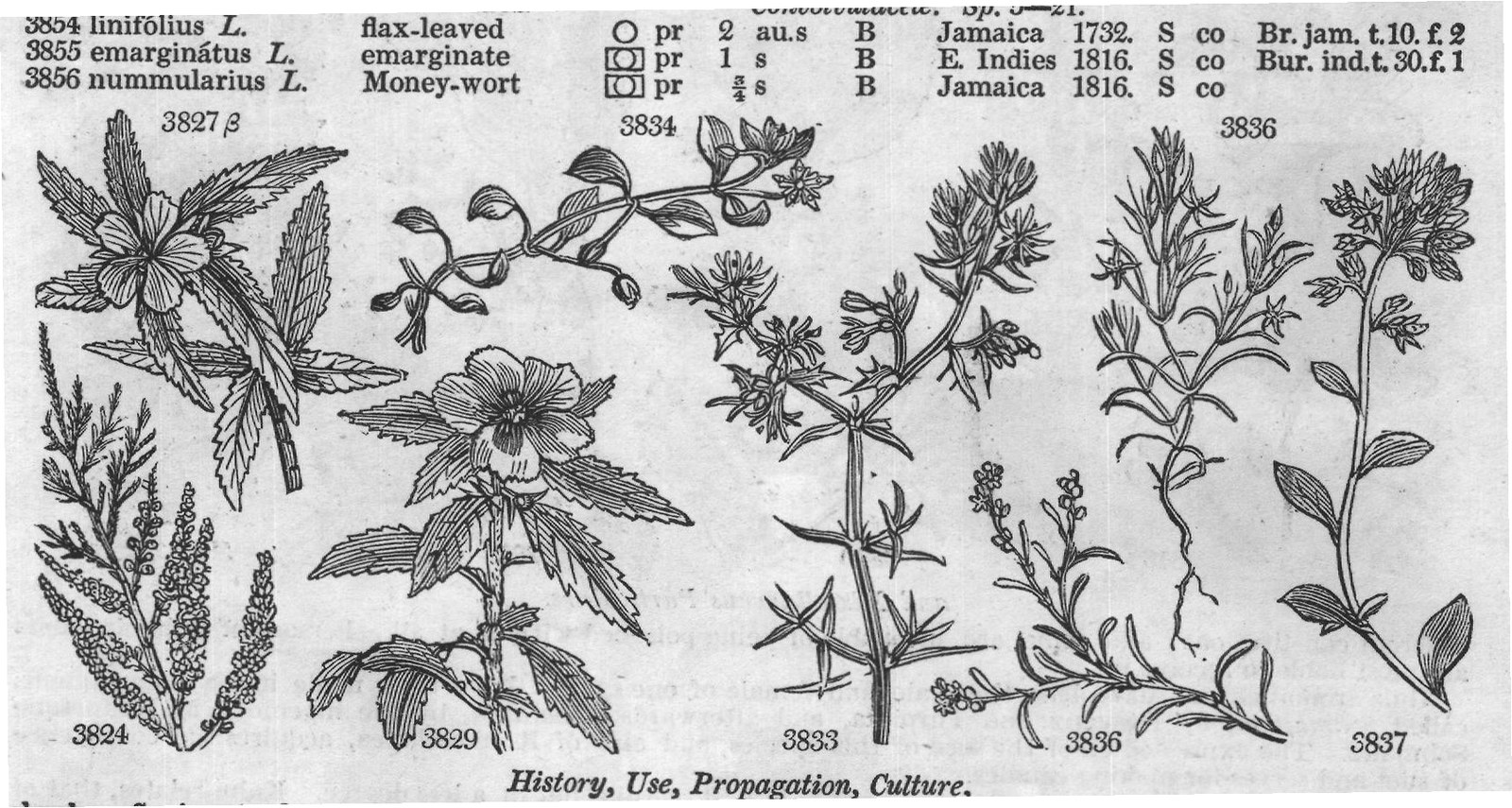
Convolvulaceæ. Sp. 5-21. pr 1 s B B S B Jamaica 1732. S co E. Indies 1816. S co Jamaica 1816. S co 695. EVOL/VULUS. L.
EVOLVULUS. 3854 linifólius L. flax-leaved pr 2 au.s 3855 emarginátus L. emarginate 3856 nummularius L.
Money-wort pr 3827 β 3834 3824 3829 3833 3836 Br. jam. t. 10. f.
Br. jam. t.10. f. 2 Bur. ind.t. 30.f. 1 3836 3837 History, Use, Propagation, Culture, shrubs. S. pinnata has hard smooth nuts, which are strung for beads by the Catholics in some countries, while in others the kernels, though bitter, are eaten by the inhabitants. 685. Tamarix. Tamarisci were people who inhabited the Spanish side of the Pyrenees, where one species grows abundantly on the banks of the Tanaris, now called the Tambra. T. gallica, as it stands the sea breeze, is sometimes used as a hedge plant in such situations. 686. Turnera. So named by Plumier, in memory of William Turner, M. D. Prebendary of York, &c. author of A new Herball," London, 1551 died in 1568. All the species are of the easiest culture, but few of them " A new Herball," London, 1551: died in 1568. All the species are of the easiest culture, but few of them of any beauty. They are chiefly weeds with yellow Cistus-like flowers. 687. Drypis. From δρύπτω, to tear. Its leaves are armed with stiff spines. 688. Alsine. From άλσoς, shady place, where alsine loves to grow. Little weeds of no beauty. Morgeline, Fr. 689. Telephium. Pliny says, Telephus was a king of Mysia, and had his wounds cured by Achilles with this plant. A little inconspicuous weed, with the appearance of a minute Euphorbia. 690. Corrigiola. A diminutive of corrigia, a thong; and applied to the plant we call Polygonum avioulare, ORDER V.
PENTANDRIA PENTAGYNIA. 3824 Bractes shorter than flower-stalks, Spikes lateral panicled, Leaves lanceolate subulate stem-clasping 3825 Flowers sessile, Spikes lateral, Leaves very short sheathing, Branches with turbinate mucronate joints 3826 Spikes terminal solitary, Bractes longer than flower-stalks, Leaves linear lanceolate sessile 3827 Flowers sessile, Leaves oblong acute serrate pubescent with two glands at base 3828 Flowers sessile, Leaves ellipt. cuneate obtusely serrated scabrous with two glands at base 3829 Bractes subulate, Leaves ovate acute at each end with two glands at the base 3830 Flowers sessile, Leaves without glands 3831 Peduncles axillary leafless, Leaves serrated at end 3832 Raceme terminal long, Leaves ovate unequally obtusely serrated 3833 A small glaucous plant with rigid prickly leaves 3834 Petals bipartible, Leaves ovate cordate 3835 Petals entire, Leaves subulate 3836 Petals entire short, Leaves bristly, Calyxes awned 3837 Leaves alternate 3838 Flowers stalked, Calyxes membranous at edge 3839 Stem diffuse procumbent, Leaves oblong ovate, Branches leafless 3840 Peduncles umbelled lateral as long as linear leaves 3841 Umbels unequal, Leaves linear distant 3842 Peduncles 1-flowered lateral, Flowers as long as leaves, Stem depressed 3843 Common peduncles very long, Leaves linear, Stipules hairy 3844 Peduncles axillary elongate dichotomous, Leaves whorled linear 3845 A fleshy shrub with many small opposite fleshy roundish leaves 3846 Leaves flat, Peduncles simple 3847 Leaves round ovate, Spikes lateral 3848 Leaves ovate wavy, Peduncles simple longer than the leaf 3849 Leaves cordate, Peduncles clustered branched 3850 Leaves cordate roundish, Peduncles simple shorter than the leaf TETRAGYNIA. 3851 Radical leaves cordate acuminate, Nectaries many-parted 3852 Radical leaves nearly orbicular, Nectaries with 3 bristles 3853 Radical leaves reniform, Petals unguiculated, Nectaries 3-parted PENTAGYNIA. 3854 Leaves linear lanceolate sessile, Peduncles 1-3-fil, a little longer than the leaves 3855 Leaves reniform repand 3856 Leaves roundish, Stem creeping, Flowers nearly sessile 3813 3841 3845 3848 B 3851 3852 3855 and Miscellaneous Particulars. in allusion to the long and slender shoots of that plant. The Corrigiola of modern times is related to the Polygonum. 691. Pharnaceum. Named after Pharnaces, king of Pontus, who is said by Pliny to have been the first to use the plant. Pretty little herbaceous plants, with fine leaves, and elegant umbels of usually white flowers. 692. Portulacaria; that is to say, a Portulaca-like plant. The leaves of this plant resemble purslane, whence also the English name, as well as the Latin name. 693. Basella. A Malabar name. The species of this genus are used in China as spinage plants: they are also raised on a hotbed at Paris in spring, and transplanted into a warm border for the same purpose, and are said to furnish a summer spinage equal to that of the orache. 694. Parnassia. From Mount Parnassus, the abode of grace and beauty, where, on account of the elegance of its form, this plant is feigned to have first sprang up. P. palustris is one of the most elegant of marsh plants, well deserving a place in aquatic collections. 695. Evolvulus Derived from evolvo, to turn; in the same sense as Convolvulus, which this genus entirely resembles in habit.
Q3 3857 alsinoídes L. 3858 latifólius Ker.
PENTANDRIA PENTAGYNIA.
CLASS V.
Chickweed prjn.jl B E. Indies 1733. S co Bur. zeyl. t. 6.f.1 broad-leaved & pr 2 jn.jl W Brazil 1819. D co Bot. reg. 401 696. ARA'LIA. W.
ARALIA.
Araliaceæ. Sp. 4-32. 3859 spinósa W.
Angelica-tree or W Virginia 1688.
R p.1 Dend. brit. 46 3860 híspida Ph. hispid or 2 jn.jl W N. Amer. 1799.
R p.l Bot. mag. 1085 3861 racemósa Ph. berry-bearing or 4 jn.s W N. Amer. 1658.
D s.p Mor. s. 1. t. 2. f.9 3862 nudicaúlis Ph. naked-stalked or 4 jn.jl W N. Amer. 1731.
D s.p Pl. al. t. 238. f. 5 697. ACTINOPHYLLUM. R. & P. AcTINOPHYLLUM. Araliaceæ. Sp. 1-6. 3863 digitatum Wall. finger-leaved or 10 ...
G E. Indies 1820. C s.l 698. RO CHEA. Dec.
ROCHEA.
Crassulaceæ.
Sp. 7. 3864 falcáta P.S. sickle-leaved or 业 2 jn.s R C. G. H. 1785. C s.l Bot. mag. 2035 3865 coccinea P. S. scarlet or 1 jn.au S C. G. H. 1710. C s.l Bot. mag. 495 3866 cymósa Haw. cymose or au R C. G. H. 1800. C s.l 3867 fláva Haw. yellow or 1 au.s Y C. G. H. 1802. C s.1 Pl. al. t. 314. f. 2 3868 odoratíssima Haw. sweet-scented or 1 jn.jl Pk C. G. H. 1793. C s.l Bot. rep. 26 3869 jasmínea Sims. jasmine-like or ap.my W C. G. H. 1815. C s.l Bot. mag. 2178 3870 versícolor Burch. changeable or 2 mr.s R C. G. H. 1817. C s.l Bot. reg. 320 699. CRAS'SULA. W.
CRASSULA.
Semperviva.
Sp. 44-83. 3871 perfoliáta L. perfoliate or 3 jl.au W C. G. H. 1725. C s.1 Plant. grass. 13 3872 ramósa W. branching or 2 jl.au Pk C. G. H. 1774. C s.l 3873 tetragóna W. square-leaved or 2 au W C. G. H. 1711. C s.l Plant. grass. 19 3874 móllis W. soft 业 or 1 au W C. G. H. 1774. C s.l 3875 acutifólia P. S. acute-leaved or s.n W Greece? 1795. C s.l Plant. grass. t. 2 3876 nudicaúlis W. naked-stemmed or my.s G C. G. H. 1732. C s.l Plant. grass. 133 3877 arboréscens W. tree or 3 my.jn Pk C. G. H. 1739. C s.l Bot. mag. 384 3878 oblíqua W. 3879 láctea W. oblique-leaved white or 4 ap.my R C. G. H. 1759. C s.l Plant. grass. 79 or S.O W C. G. H. 1774. C s.l Bot. mag. 1771 3880 cultráta IW. sharp-leaved or 1 jl.au W C. G. H. 1732.
C s.l Bot. mag. 1940 3881 ciliáta W. 3882 unduláta Haw. 3883 scábra W. 3884 biconvéxa Haw. 3885 obvalláta W. 3886 ramuliflóra Lk. ciliated or jl.au Y C. G. H. 1732. Cs.l Plant. grass. 7 wave-leaved or au.n W C. G. H. 1797. C s.l Bot. cab. 584 rough-leaved or jn.jl P.Y C. G. H. 1730. Cs.l Di. el. t. 99. f.117 double-convex or au W C. G. H. 1800. C s.l Houseleek-lvd.or jlau W C. G. H. 1795.
C sl Plant. grass. 61 branch-flower.or 1 jn.jl W C. G. H. 1822. C s.l 3887 corymbulósa Lk. corymbulose or 1 jl au W C. G. H. 1822.
C s.1 3888 columnáris W. columnar or ...
W C. G. H. 1789.
C s.l Burm. afr. t. 9- 3889 imbricáta W. imbricated or 1 jn.jl W C. G. H. 1760. C s.l 3890 canéscens grey or jl.au W C. G. H. 1800.
C s.l Globuléa canéscens Haw, 3891 perfiláta P. S. threaded or 1 s Pk C. G. H. 1785.
C s.l Sc. del. ins. 3. t.6 3892 punctáta W. dotted or 1 ap.au W C. G. H. 1759.
C s.l 3893 marginális W. margined or 2 jl.au P.Y C. G. H. 1774.
C s.l 3894 pellúcida W. pellucid or 1 jn.s Pk C. G. H. 1732.
C s.1 Di. el. t. 100.f.119 3895 spathuláta W. 3896 cordáta W. notched-leaved or jl.s W C. G. H. 1774.
C s.l Plant. grass. 49 heart-leaved or my.au Pk C. G. H. 1774. C s.I Bot. cab. 359 3897 tomentósa W. 3898 linguæfólia Haw. 3899 Cotylédonis W. 3900 orbiculáris W. downy tongue-leaved Cotyledon-leav.or starry সসসস or 1 ap.my W C. G. H. 1790. C s.l or 1 au W C. G. H. 1803. C s.l 1 W ...
C. G, H. 1800. C s.l or jl.s Pk C. G. H. 1731.
C s.l 3901 retrofléxa W.
Orange-flower. pr jn Y C. G. H. 1788.
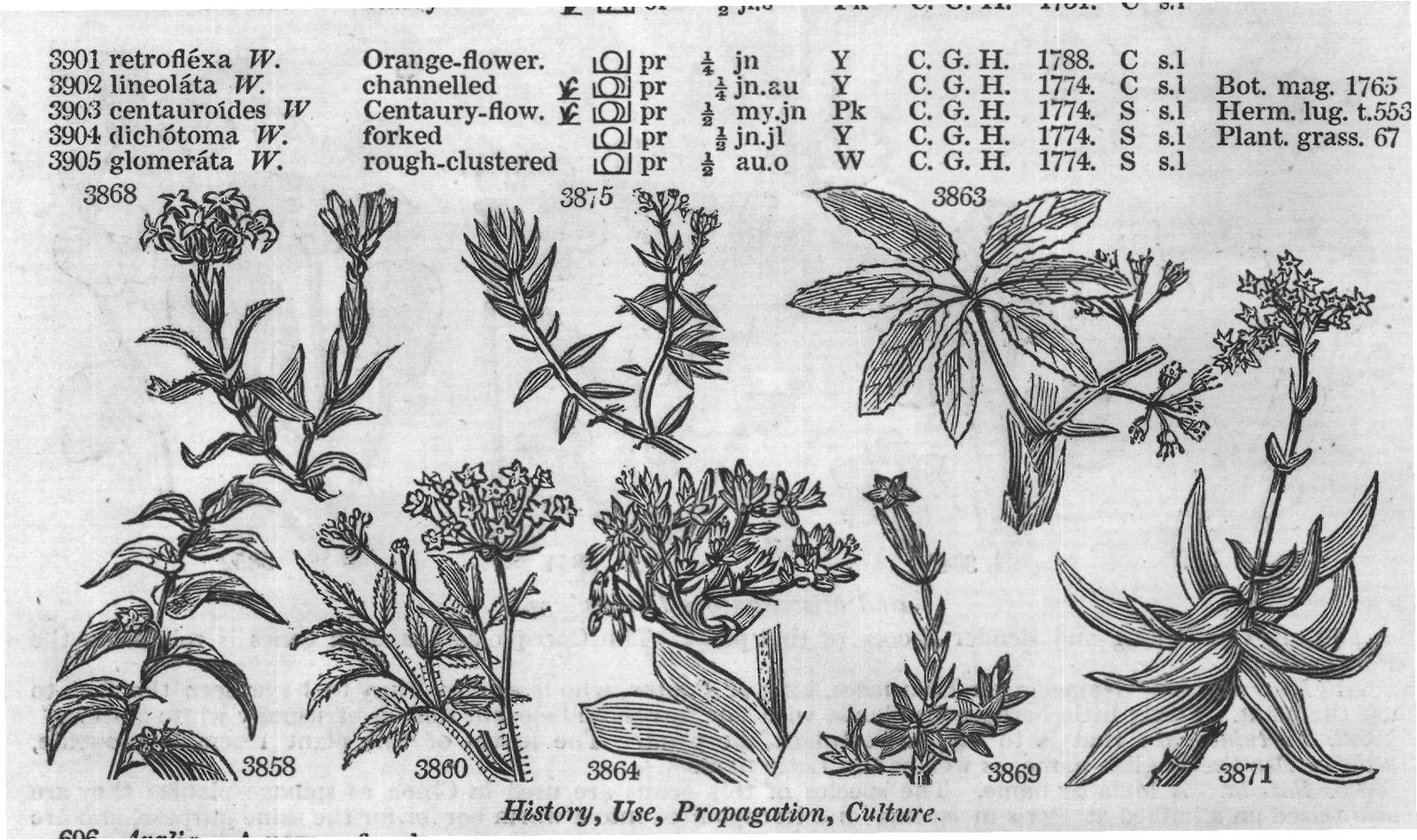
C s.l 3902 lineoláta W. 3903 centauroídes W 3904 dichotoma W. 3905 glomeráta W. 3868 channelled pr jn.au Y C. G. H. 1774. C s.l Bot. mag. 1765 Centaury-flow. pr my.jn Pk C. G. H. 1774. Ss.l Herm. lug. t.553 forked pr jn.jl Y C. G. H. 1774. S s.1 Plant. grass. 67 rough-clustered prau.o W C. G. H. 1774. S s.l 3875 3863 3858 3860 3864 3869 History, Use, Propagation, Culture. 696. Aralia. A name of unknown meaning, under which one species was sent to Fagon from Quebec, m 1764, by one Sarrazin, a French physician. A. spinosa is an ornamental low tree for lawns, on account of its Angelica-like leaves. , by one Sarrazin, a French physician.
A. spinosa is an ornamental low tree for lawns, on account of its Angelica-like leaves. 697. Actinophyllum. From azτiv, a ray, and φuλλov, a leaf; because the leaflets are disposed as it were in rays round a centre. Fine Aralia-like plants, with beautiful foliage, but not with any attraction in the appearance of the flowers. ORDER V.
PENTANDRIA PENTAGYNIA. 3857 Procumbent villous, Leaves oval subsessile, Capsules deflexed 3858 Very hairy, Leaves subsessile oblong cordate acuminate, Flowers sessile 3 together subsessile oblong cordate acuminate, Flowers sessile 3 together 3859 Arborescent, Stem and leaves prickly 3860 Stem suffruticose and leaf-stalks hispid, Leaves decompound 3861 Stem herbaceous smooth, Leaves decompound, Peduncles axillary branched umbelled 3862 Stemless, Leaves decompound, Scapes leafless 3863 Leaflets 5 very smooth shining elliptical entire 3864 Leaves opposite nearly connate oblong with an auricle on one side, falcate 3865 Leaves ovate oblong flat, edge with a cartilagin. fringe, at the base, connate sheathing, Flowers term, sessile 3866 Leaves linear with a cartilaginous fringed edge, Stem shrubby, Cyme terminal 3867 Leaves flat connate perfoliate smooth, Flowers in corymbose panicles 3868 Leaves linear flat fringed with cartilage connate sheathing at base, Flowers terminal sessile 3869 Stem decumbent, Leaves ovate cruciate, Head 2-flowered, Petals connate 3870 Erect, Leaves oblong lanceolate with cartilaginous teeth at base sheathing, Umbels double many-flow. §1. Shrubby, Leaves subulate. 3871 Leaves lanceolate subulate sessile connate channelled convex beneath 3872 Leaves subulate above flat connate perfoliate smooth much spreading, Pedunc. long, Flowers cymose 3873 Leaves subulate incurved obscurely 4-cornered spreading, Stem erect shrubby rooting 3874 Leaves cylindrical acute gibbous beneath smooth nearly erect, Cymes terminal compound 3875 Leaves connate rounded subulate spreading, Cymes few-flowered on long stalks, Stem shrubby decumbent 3876 Leaves subulate radical, Stem naked §2. Shrubby, Leaves broad, smooth. 3877 Leaves roundish acute glaucous fleshy dotted, Cyme trichotomous 3878 Leaves opposite ovate oblique entire acute distinct somewhat cartilaginous at edge 3879 Leaves ovate attenuate at base connate entire dotted inside the edge, Cymes panicle-shaped 3880 Leaves opposite obovate cultrate oblique connate entire §3. Shrubby, Leaves broad, distant, ciliated. 3881 Leaves opposite oval flattish distinct fringed, Corymbs terminal 3882 Leaves connate ovate expanded cartilaginous crenated; upper ovate elliptical wavy, Stem dichotomous 3883 Leaves opposite spreading connate rough fringed, Stem rough backwards 3884 Leaves linear obtuse sheathing convex on both sides, Flowers cymose, Stem decumbent 3885 Leaves obl. con. obtuse falcate with a cartilaginous fringed edge, Pan. long, Pedunc. opposite clustered 3886 Leaves obovate subconnate, Branches axillary few-flowered, Petals lanceolate reflexed 3887 Leaves lanceolate convex beneath, Corymbs small axillary, Petals lanceolate §4. Shrubby, Leaves broad, very closely imbricated. 3888 Leaves round imbricated, Fascicle round terminal 3889 Leaves ovate acute smooth imbricated in rows, Flowers axillary sessile 3890 Leaves radical decussately imbricated fringed lanceolate cultrate hoary 5. Shrubby, Leaves broad, very much perfoliate. 3891 Leaves connate perfoliate cordate dotted 3892 Leaves opposite ovate dotted fringed, Lower oblong 3893 Leaves cordate perfoliate acuminate flat spreading dotted within the edge 3894 Stem flaccid creeping, Leaves opposite §6. Shrubby, Leaves stalked. 3895 Leaves stalked cordate roundish acute crenate, Corymbs panicle-shaped 3896 Leaves stalked cordate obtuse entire, Cymes panicle-shaped §7. Herbaceous. 3897 Villous, Leaves connate lanceolate fringed, Stem nearly naked terminal, Spike whorled 3898 Lower leaves distinct opposite tongue-shaped ciliated pubescent, Flowers whorled sessile close, Stem leafy 3899 Leaves connate oblong downy fringed, Stem rather naked, Flowers corymbose close 3900 Leaves oblong obtuse cartilaginous-fringed tufted, Scape panicled, Branches opposite cymose §8. Annual or biennial. 3901 Leaves connate oblong remote flat, Stem simple, Cyme compound, Flower stalks bent backwards 3902 Leaves cordate sessile, Peduncles terminal axillary approximate umbellate 3903 Stem dichotomous, Leaves sessile oblong ovate cordate flat, Peduncles axillary 1-flowered 3904 Stem dichotomous, Leaves sessile ovate oblong channelled recurved, Peduncles axillary 1-flowered 3905 Stem dichotomous rough, Leaves lanceolate, End flowers in bundles 3879 8877 3880 3882 3891 3888 3904 3896 3885 and Miscellaneous Particulars. 698. Rochea. Named after M. de la Roche, author of "Historia Eryngiorum," a work of reputation. This succulent genus thrives well in sandy loam, and requires but little water. " Young cuttings taken off and laid to dry a few days, and then potted, or stuck in the tan, will root directly." (Sweet.) days, and then potted, or stuck in the tan, will root directly." (Sweet.) 699. Crassula. From crassus, thick, in allusion to the fleshy nature of the leaves and stems of all the species. These plants grow best in sandy loam and brick rubbish, with the pots well drained. " Cuttings root grow best in sandy loam and brick rubbish, with the pots well drained. Q4 PENTANDRIA PENTAGYNIA.
CLASS V. 3906 glábra Haw. smooth-cluster. pr jn.o W C. G. H. 1774. S s.1 3907 Aloídes W.
Aloe-like prjn.au W C. G. H. 1774. S s.l 3908 capitélla W. square-spiked pr jl.au W C. G. H. 1774. S s.1 Plant. grass. 55 3909 rúbens W. annual red pr my.jn Pk Italy 1759. S s.l 3910 verticilláris W. whorl-flowered pr Pk S. Europe 1788. S s.l 3911 expánsa W. awl-leaved pr jn.jl W C. G. H. 1774. S s.l 3912 spársa W. alternate-lvd. pr jn.jl W C. G. H. 1774. S s.l 3913 diffusa W. diffuse prjn.jl Pk C. G. H. 1774. S s.l 3914 moscháta W. musky pr my.n W N. S. W. 1794. S s.l 700. GISE KIA. W.
GISEKIA, Portulaceæ. Sp. 1-5. 391 pharnaceoídes W. trailing cu 1 jn P.Gr E. Indies 1783.
Rox. cor. 2. t. 183 701. LI'NUM. W.
FLAX.
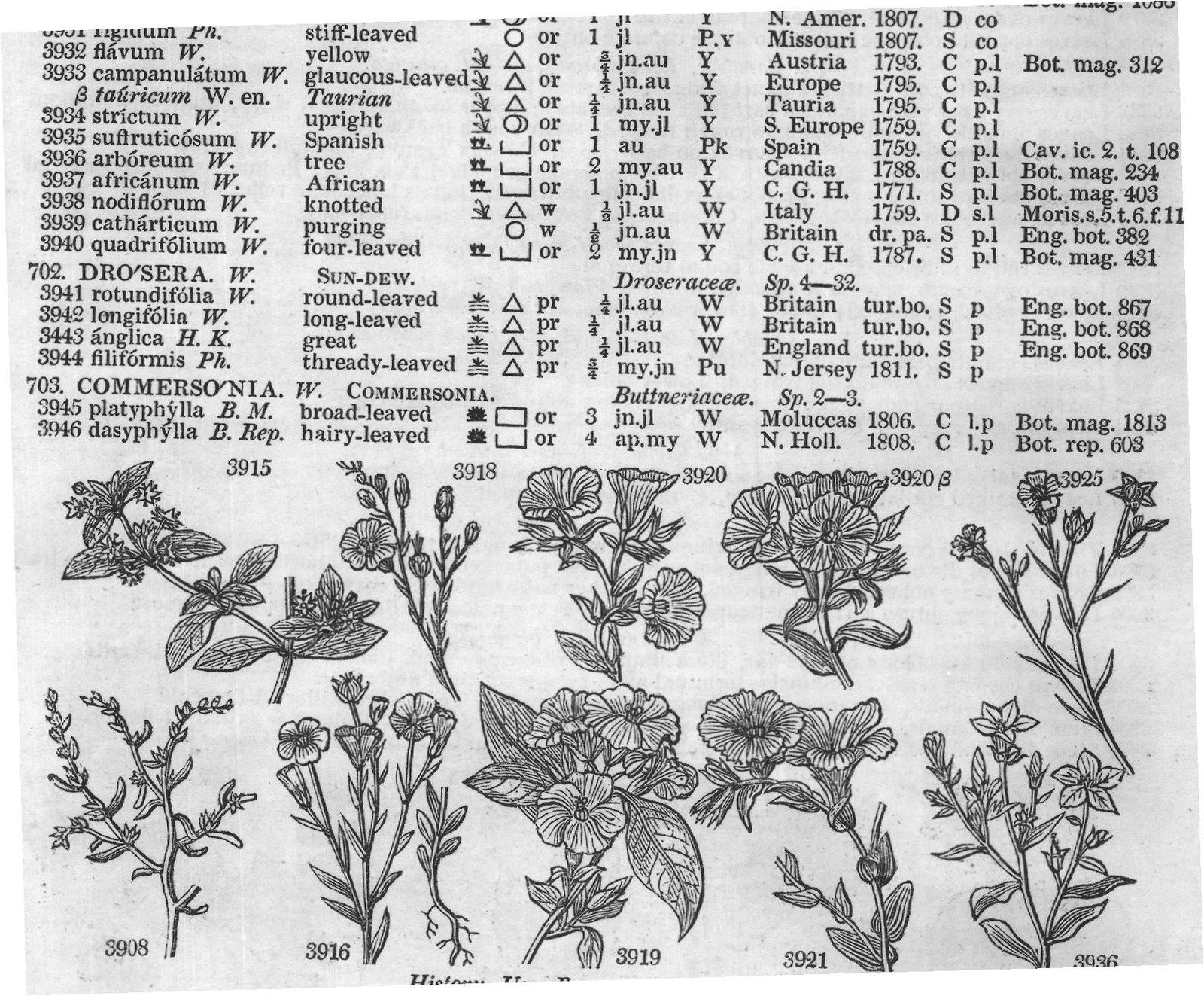
Caryophylleæ. Sp. 25-54. 3916 usitatissimum W. common ag 1 jn.jl B Britain co. fi. S co Eng. bot. 1357 3918 perénne W. 3919 trígynum Sm. 3920 hirsútum W. 3917 nervósum W. & K. nerved ẞ hypéricifólium Sims. Mallow-flower. perennial three-styled hairy 3921 áscyrifólium H. K. blue and white পপপপপ or jn.jl B or 3 jn.au B or 2 ja.o Y Aor 1½ jl.au B or 1 jn.jl Pu or 1 jl.au W 3922 narbonénse W.
Narbonne or 2 my.jl B 3923 refléxum W. reflex-leaved or 1 jl B 3924 tenuifólium W. slender-leavedor 1½ jn.jl Pk 3925 angustifólium H. K. narrow-leaved or 1 jl Pu 3926 gállicum W. annual-yellow or 1 jl.au Y 3927 marítimum W. sea لا or 2 jl.au Y 3928 alpínum W.
Alpine or jl.au B 3929 austríacum W.
Austrian Aor 1 jn.jl B 3930 virginiánum W.
Virginian or 1 jl Y 3931 rigidum Ph. stiff-leaved or 1 jl P.Y 3932 flávum W. yellow or jn.au Y 3933 campanulátum W. glaucous-leaved or jn.au Y ẞ taúricum W. en.
Taurian or jn.au Y 3934 stríctum W. upright or 3935 suffruticosum W.
Spanish 1 my.jl Y or 1 au Pk 1759. C p.l 3936 arbóreum W. tree or 2 my.au Y 3937 africánum W.
African or 1 jn.jl Y C. G. H. 3938 nodiflórum W. knotted W jl.au W 3939 cathárticum W. 3940 quadrifólium W. purging four-leaved W jn.au W Italy Britain or 2 my.jn Y C. G. H. 1788. C p.1 1771. S p.l 1759. D s.l dr. pa. S p.1 1787. S p.l Hungary 1822. D co England ch.so. D co E. Indies 1799. C p.l Austria 1759. D co Caucasus 1807. D co Portugal 1800. D co S. France 1759. D co S. Europe 1777. D co Europe 1759. D co England sa. pa. D co France 1777. S co S. Europe 1596. D co Austria 1739. D co Austria 1775. D co N. Amer. 1807. D co Missouri 1807. Sco Bot. mag. 1100 Bot. mag. 1048 Jac. aust. 1. t. 31 Bot. mag. 1087 Jac. aus. 3. t. 215 Eng. bot. 381 Ger. pr. t. 15. f.1 Jac. vin. 2. t. 154 Sweet fl. g. 17 Bot. mag. 1086 Austria 1793. C p.1 Bot. mag. 312 Europe 1795. C p.l Tauria 1795. C p.1 S. Europe 1759. C p.l Spain Candia