THE gardens of Japan possess a significance which is, so far as my knowledge goes, lacking in all other gardens in the world. They exercise a spell upon the beholder, the cause of which is undiscoverable. We may analyze it in vain. After all is said there remains a quality unaccounted for in the physiognomy of all Japanese gardens—a nameless something which in a human being we would call intelligence—but which in a garden we may, for want of a better word, term significance. We feel that something is meant, that it was not by chance a garden has come to express what it does, but that long ago it grew out of the mind and shaping intelligence of some human consciousness to express or fulfil some human need, the meaning of which may be hidden from us but which is very clear to all Japanese.
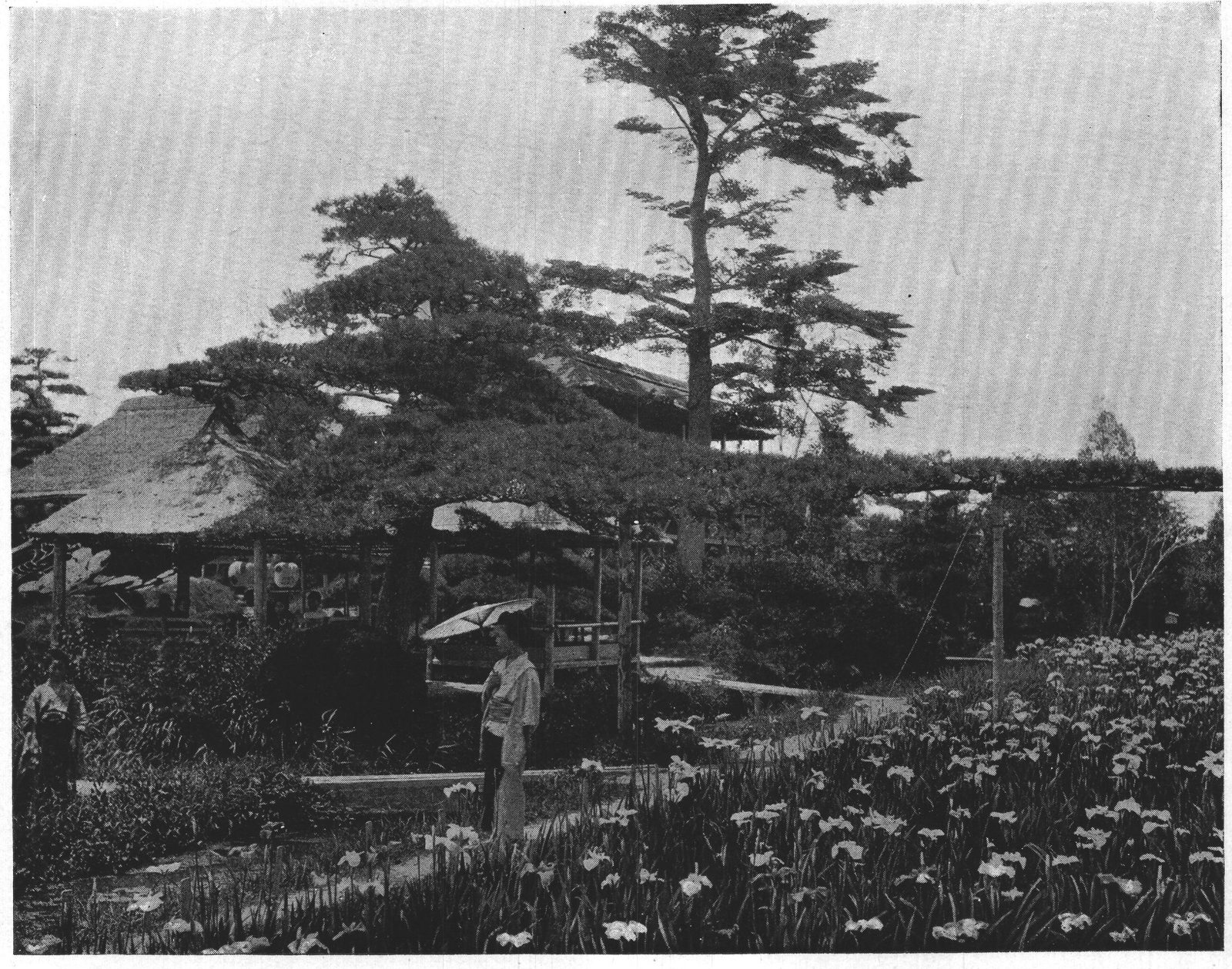
We do come to perceive, however, after a little study, that a Japanese garden is as closely related to the laws of composition as a poem or a picture, and that in a very true sense it is no less an inspired work of art. The ancient landscape gardens of Japan, indeed, live on like old pictures whose lines and tints do not fade but gather an added depth and richness from age.
Most of us are accustomed to thinking of gardens as places in which to grow things, or at any rate as places in which they are or may be grown, and we generally proceed to fill such places, much as a child might, with regard chiefly to the number and variety of our selections. Such ideas would seem lamentably crude and even laughable to a Japanese gardener, in whose eyes every stone possesses character and every plant and species of plant life a distinct individuality. But plants are, with him, ever a minor consideration. The garden space itself is first, and that is selected with as much care as a canvas for a picture or the space for a wall decoration. Upon this is sketched the lines of a composition in rock, tree, hill, and stream. Color comes last and sometimes is wanting altogether. Such gardens, without flowering plant or shrub to soften their bold outlines, are like a vigorous Chinese landscape drawing in pen and ink, and many of the most famous of the old landscape gardens are of this class. But the elements of a garden are, after all, very simple, and such as may be found almost everywhere except in the most arid sections of the earth. Rock, tree, hill, and stream—I think I have never seen a Japanese garden without these four primary elements. Endurance, aspiration, contemplation, and activity, they might be said to represent. But whatever their fancied qualities they are present in reality or semblance in even the most miniature of all gardens, such as may be kept in a shallow bowl on one's desk.
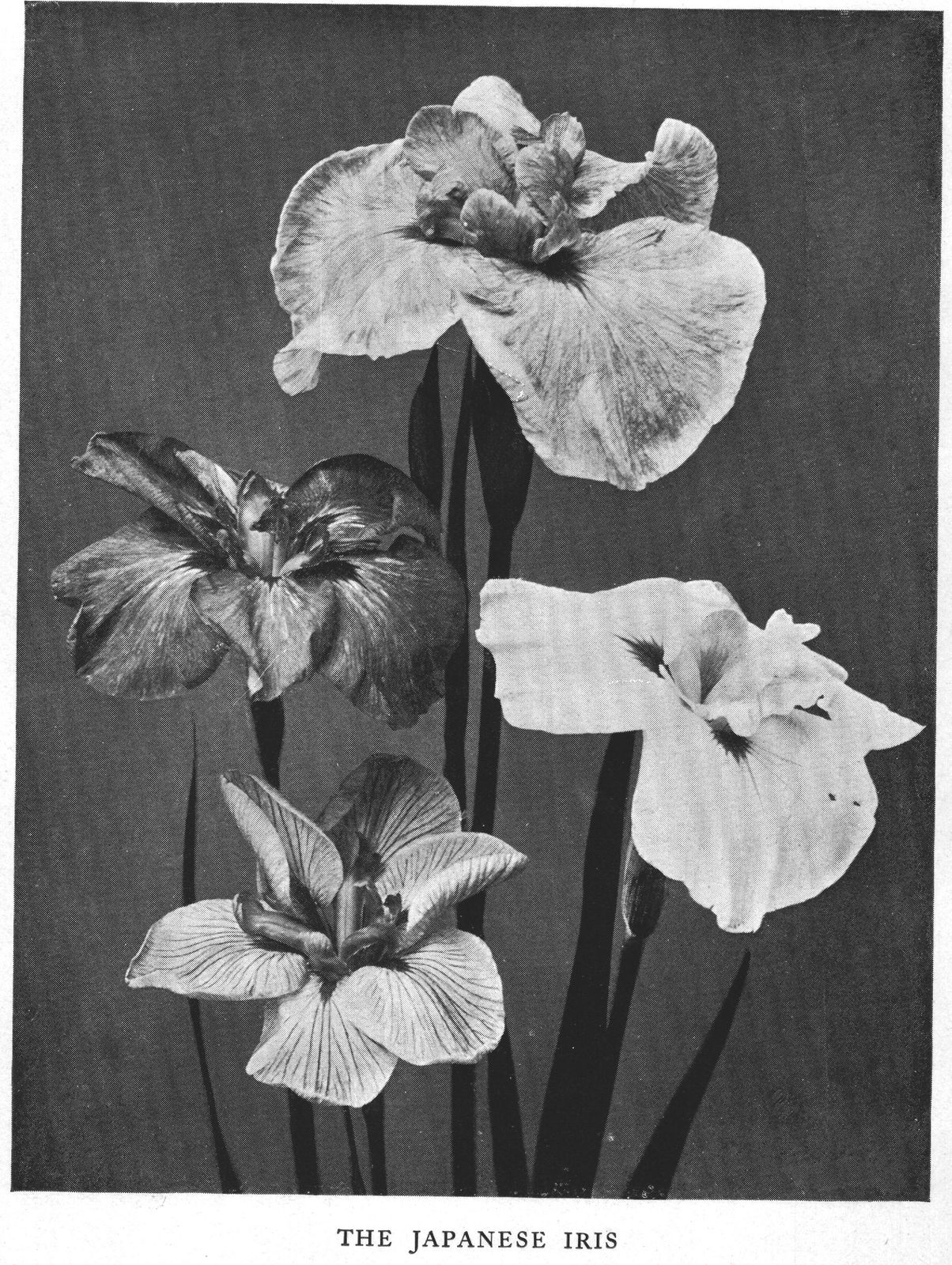
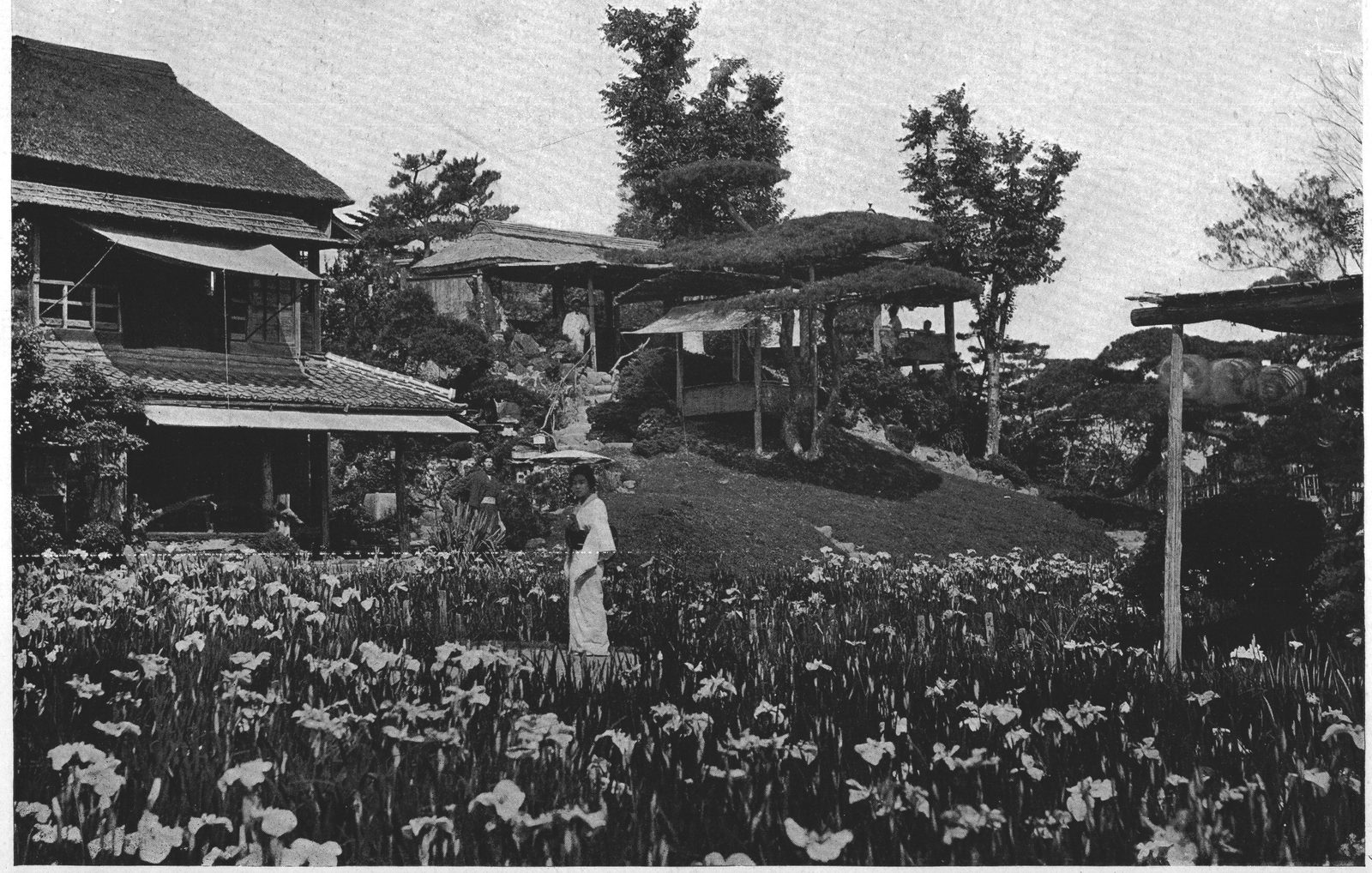
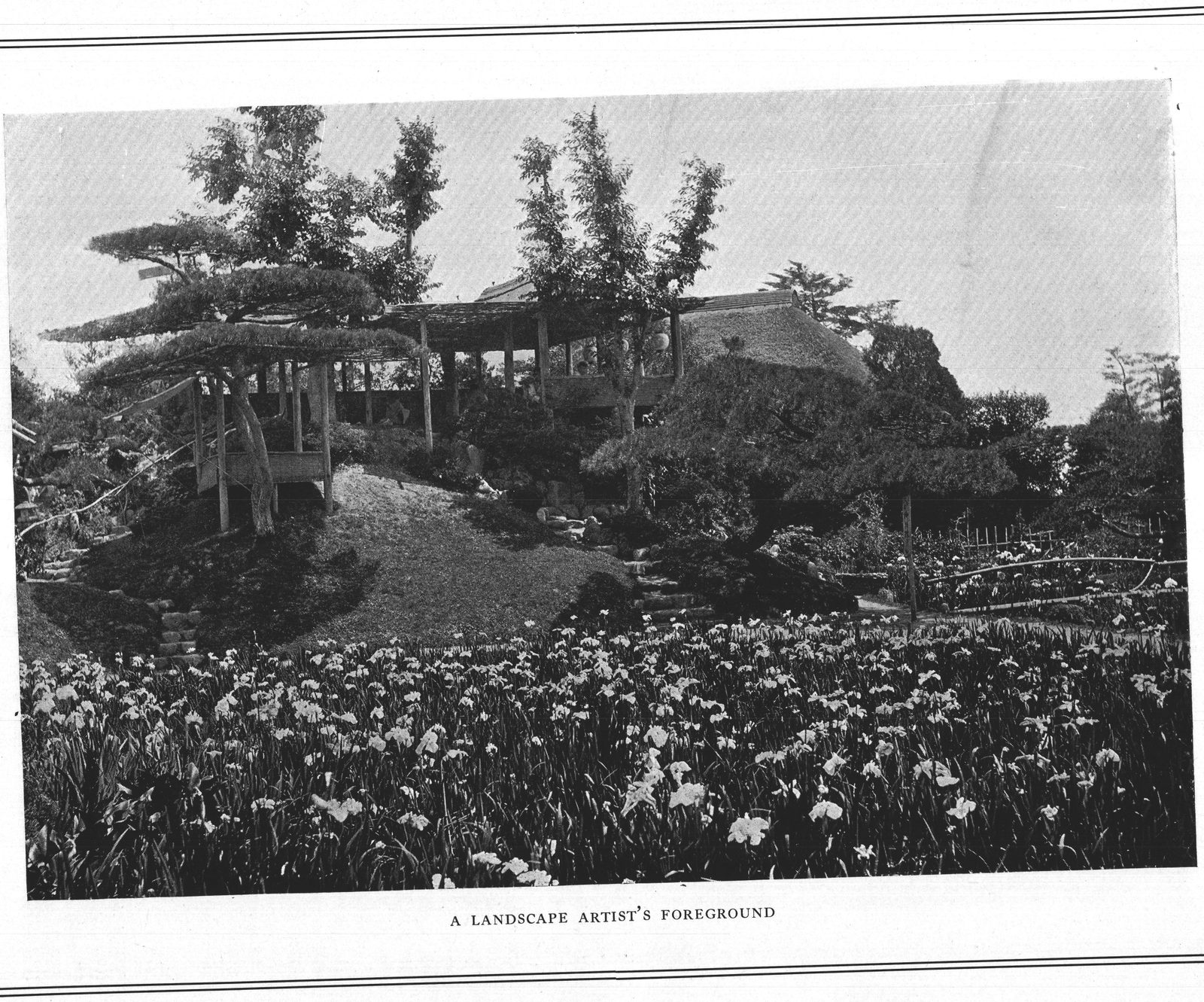
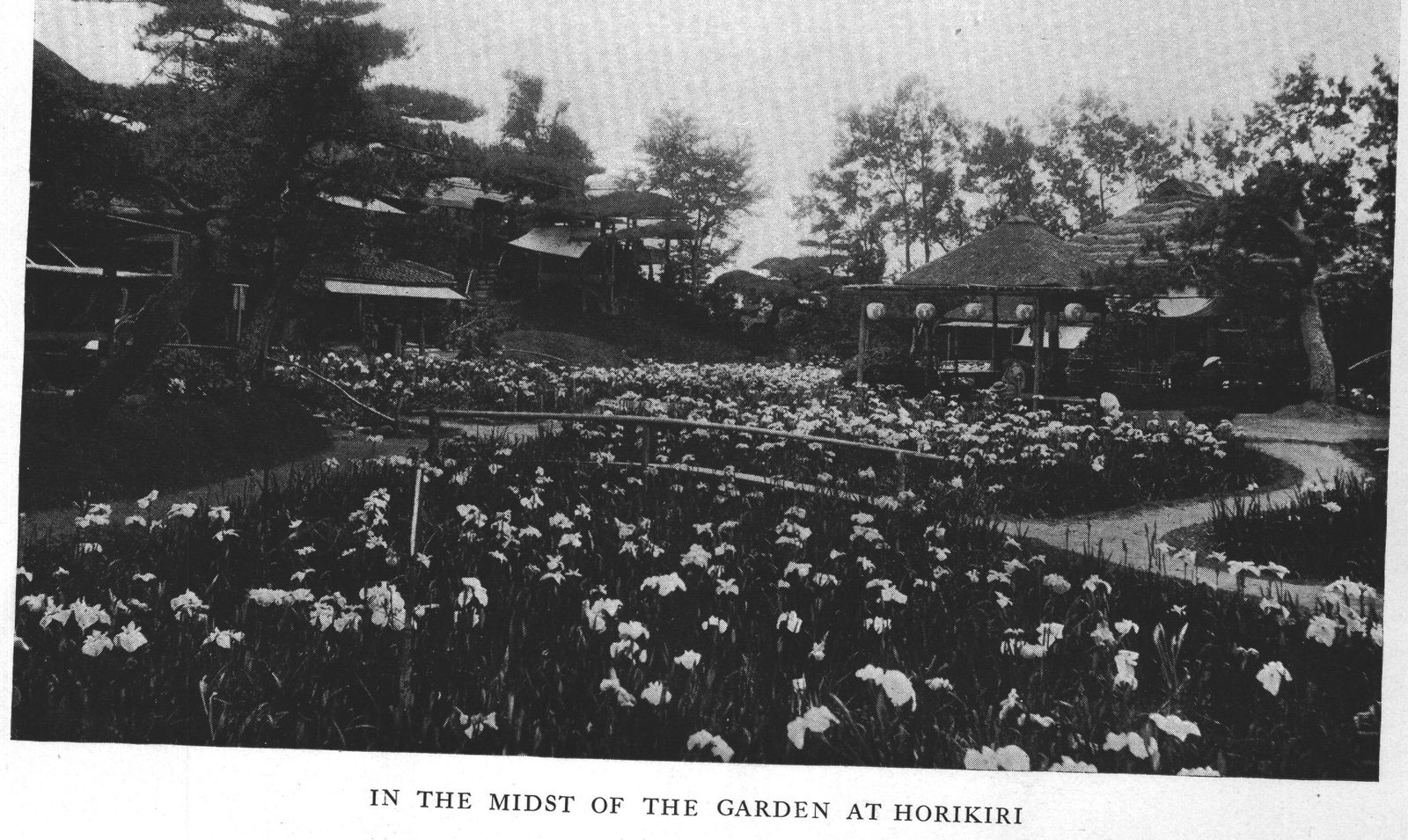
In the little village of Horikiri, situated a few miles out of Tokyo and within easy jinrikisha distance, is to be found what is perhaps the oldest and most famous iris garden in the world; although it is only one hundred and twenty years old, which is very young for a Japanese garden. To this garden, however, and to the founder of it, Kodaka Izayemon, we owe the iris as we see it to-day. It is not generally known, perhaps, that this flower in its present remarkable state of development is so modern a product. Up to the time of Kodaka's discovery, it was nothing more than the little wild mountain iris which has been charmingly portrayed by some of the old flower painters, and which may be found now on almost any hillside in certain localities, growing scarcely more than one foot, or at most two, in height, the blossoms of two colors only, blue and white, and with three petals as in the fleur-de-lis or in our own flag lily. But one hundred and twenty years ago a certain well-to-do Japanese farmer who surely had the soul of a discoverer, even if he was only a sort of head gardener in the little flower-raising village of Horikiri, in making a journey to the foot of Fuji, brought back a specimen of the iris growing there. With this and two other specimens procured from different places, he formed the nucleus of the garden which was to grow into what is at present one of the most celebrated gardens in Japan. It was not until late in the Tokugawa period, however, in the time of the second Kodaka, the son of the original founder, that Koda-ka-en, as it was for a long time called, came into prominence. Two samurai chanced to visit it, and their reports attracted others, until finally the fame of it reached the ear of the reigning shogun himself, who came in person to see it. Since then the tide of visitors has annually increased until it is not only known to all Japanese, but has also become a favorite resort of the foreign tourist.
The fact that there are comparatively few flower gardens in Japan may account in part for the popularity of this one with the tourist, who does not find demands made upon his appreciation to which he is obviously unequal. The untutored visitor can say with Thoreau: "All fables, indeed, have their morals; but the innocent enjoy the story." If there is a moral, a lesson, or a creed contained in this garden, it is to be found, apparently, only in the duty of joyousness and in the communication of that quality from nature to man. Of the subtleties and symbolisms of some of the more ancient gardens there appears to be no trace. It would seem to have been created in a mood of pure delight in beauty for its own sake and as an end in itself.
One's first impression, coming upon it suddenly after the long ride through flat, green intersections of intermediate rice fields, is like passing from the silence of twilight into a burst of sunlight and music. The brilliancy of the scene is almost operatic in effect. As the Japanese themselves are fond of saying, "It is more beautiful than nature, it is as beautiful as art." From the wide irregular ponds situated in the central and flat portions of the garden the flowers rise in magnificent battalions that assault and take the eye by storm. With no suggestion of confusion or massing, each giant spear and stalk stands out clearly, tipped with its great, furled, quivering butterfly blossoms flashing in the sunlight in prismatic hues of gem-like splendor and bearing on its wings all the concentrated radiance of midsummer in Japan.
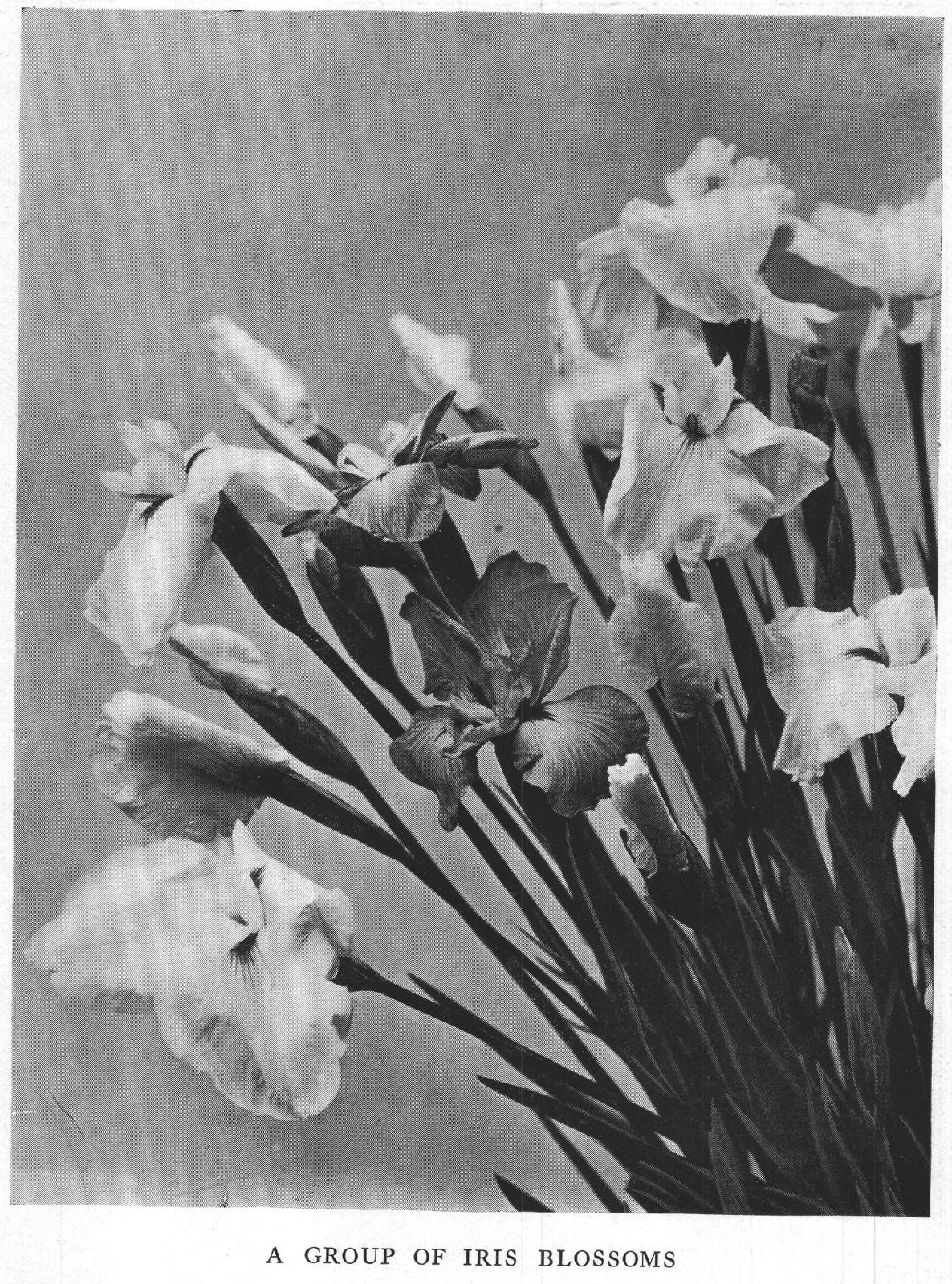
The garden is not very large, but it is jewel-like in its completeness of form and intensity of color. No Western artist has given even approximately such range of color with such infinite blending and shading of tone; only those of the later Ukioye artists who sacrificed everything else to dramatic effect have partially done so. In a sense such a garden is a departure from the normal, as all genius is, and surely nothing less than genius could have evolved from three simple specimens more than three hundred different varieties of such complex and bewildering beauty as are here displayed. The little simple classic iris of so many centuries has blossomed into a Court Beauty. The hills, her ancient playgrounds, know her no more, and she lives henceforth in an atmosphere of adulation and applause. Strangely enough a sort of moral transformation has accompanied this phenomenal growth. In its later brilliant development the iris is a flower more admired than beloved by the Japanese, who find in it none of the ethical qualities dear to them in the plum and other flowers. Ayame is a name frequently adopted by that most brilliant class of modern Japanese women, the Geisha, as signifying a superlative degree of beauty and accomplishment, but it is almost never used in private families, being held to typify qualities too striking to fulfil the Japanese ideal of womanly excellence, of which the most essential attribute is a retiring modesty. Nevertheless, the modern iris is to my mind, pre-eminently the flower of temperament. If she has lost her simplicity she has not lost her inherent grace and charm, and she has remained through all her phases a fruitful source of inspiration to poet and artist.
There is a pretty story told of a beautiful lady named Ayame, who lived six hundred years ago in the reign of Go Shirakawa, and who was beloved by the famous warrior, Minamoto Yorimasa. This warrior had the good fortune to deliver his Emperor from a bakemono, the ghost of a woman who appeared nightly to her august victim in the guise of a demon whose head was composed of three gigantic emeralds. Upon being asked to name his reward Yorimasa without hesitation named the Lady Ayame. The Emperor, perhaps to test his love, perhaps in the hope of retaining the young favorite at court, caused to be brought before him twelve maidens who, by means of the art of dress, had been made so exactly to resemble one another that it was impossible to detect the smallest shade of difference between them.
Being told to make his choice, Yorimasa, concealing the great perplexity which he felt, replied in words which have since become proverbial:—
Samidare ni, ike no makomo ni,
Midzu no oite, idzure Ayame to
Hikizo wadzuro.
Which being roughly translated to prose means, "When the June rains flood the pond, how impossible it is to distinguish the beautiful Ayame from common reeds!"
This answer so displeased the Lady Ayame that she blushed crimson with mortification, and thus unconsciously gave her lover the signal that he hoped for.
It would require too much space to attempt to give any adequate idea of the place the iris holds in the art and literature of her country. Her praises have been sung in verse and painted on screen, kakemono, and even the single sheet print. In a recent exhibition by modern artists almost all their work was done on gauze or roe silk of a very transparent quality. This material proved excellently well qualified to suggest the translucent greens of the spears and the sun-soaked quality of the flowers, whose marvelously luminous and glowing petals are so diaphanous as to transmit the very quality of light itself. As a rule, in these pictures, as in all Japanese painting, the fewer the brush strokes the more admirable the suggestion.
In a collection of verse which I have on the iris, this is one of the simplest:—
Kono tsuyu ga Hotaru ni naru ka, Hana Shobu!
These drops of dew upon the iris, I wonder if at nightfall they become fireflies.
Like the picture of a few brush strokes, or the poem of a few syllables, the garden at Horikiri, in its large suggestiveness and its essential poetic feeling, remains with us in memory as the pictorial idea of a garden, and long after we have ceased to see it, is still a vision of that "inward eye which is the bliss of solitude."