THE famous Taj Mahal at Agra was commenced by Shah Jahan in 1632, as a memorial to his beloved wife, the Empress Mumtaza Mahal. The earliest existing plan of the Taj gardens was made in 1828 by Colonel Hodgson, Surveyor-General of India, and probably shows the original lay-out of the beds, though not the original planting of the trees. The gardens have since been considerably Europeanized; and, as attempts are now being made to restore them on Indian lines, it will be very opportune to take them as an example in discussing the question: How were the Mogul gardens planned and planted? They are so essentially a part of the whole great architectural conception of the Moguls, that their restoration is a matter of much artistic importance.
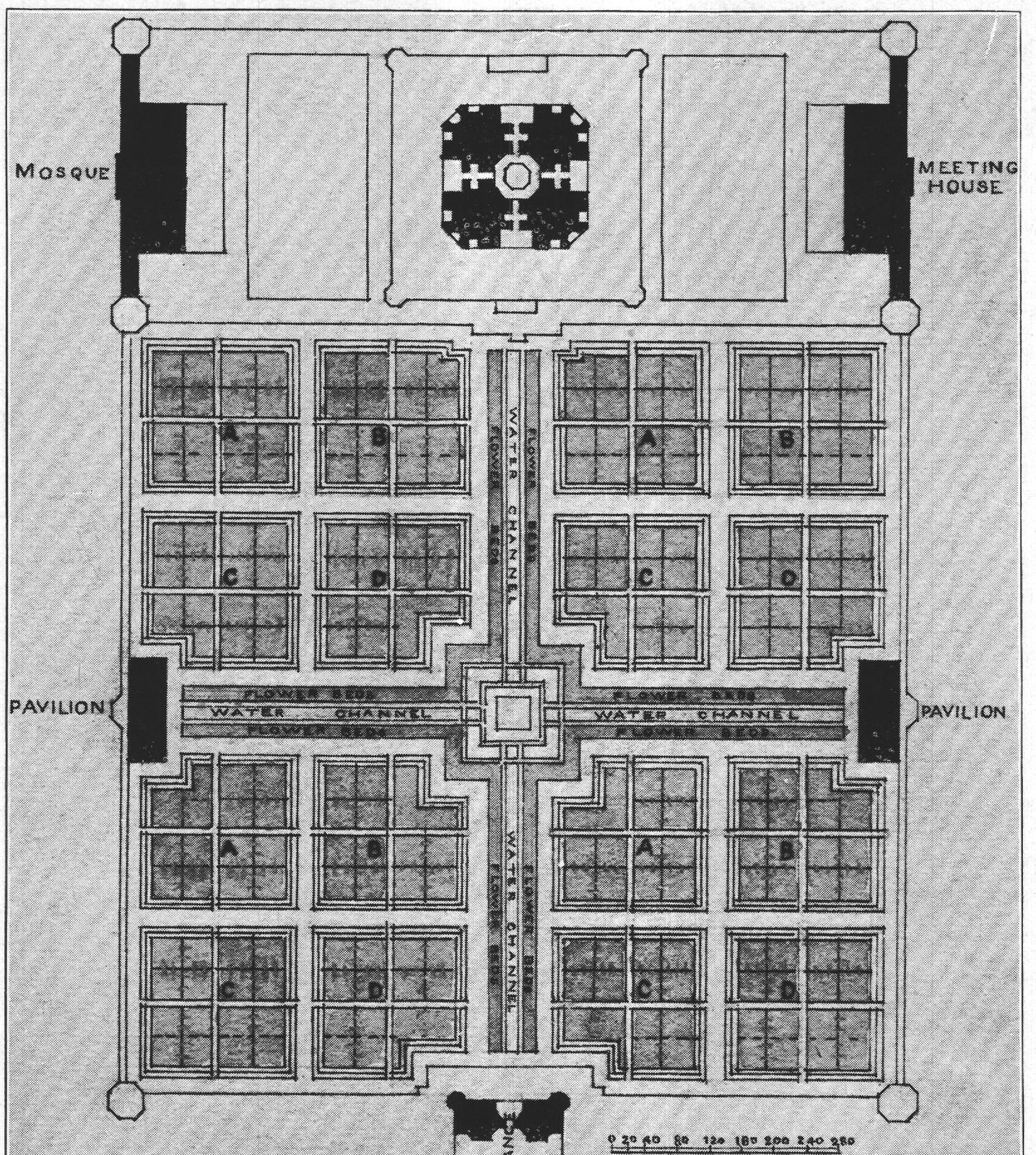
The plan shown by Colonel Hodgson is very simple. It is a square, subdivided into four smaller squares (the "four-fold field-plot" as Babar called it), by two main avenues crossing each other in the center. One avenue forms the main approach to the Mausoleum; the other leads up to two large pavilions on the east and west sides of the garden. Each of the squares formed by these avenues is similarly subdivided by branch avenues into four compartments, and smaller pathways again divide each of the latter into yet other four. The monotony of the squares is varied by the entrance gateway, the central platform and the corners of the pavilions breaking into the angles of those adjacent to them. A water channel containing a row of fountains runs through the middle of the two main avenues, which with the platform in the center of the garden form a Greek cross; only the arm nearest to the Mausoleum is slightly longer than the others. On either side of the water channels are long parallel strips of earth panelled into geometric shapes with stone borders. These shapes have always been treated as flower beds, until recently they were filled in with grass and planted with a continuous row of cypress-trees down the center, as shown in the illustration. I believe this arrangement to be wrong, on artistic and archæological grounds which I will presently discuss.
Let us first investigate the earliest historical accounts of the Taj gardens. Bernier, the French physician, who saw them about 1660, gives the following description, viewing the gardens from the raised platform of the Mausoleum:
"To the right and left of that dome (the Mausoleum) on a lower surface, you observe several garden walks covered with trees and many parterres full of flowers . . . . Between the end of the principal walk and this dome is an open and pretty large space, which I call a water parterre, because the stones on which you walk, cut and figured in various forms, represent the borders of box in our parterres."
This is only intelligible on the supposition that the two lines of geometric figures already described were not flower beds but were filled with water, like the channel which divides them. I cannot help thinking, however, that the honest Bernier, writing at Delhi, had in these details mixed up the Taj gardens with the other great gardens which Shah Jahan constructed there. An earlier historian, a native author of Shah Jahan's time, Muhammad Salat Kumbo, in the Shah Jahan Namah seems to contradict Bernier on this point. He says: "In the four beds situated in the center of the orchard (i. e., the beds in the four arms of the Greek cross), each of which is 40 dirra broad, there is a water-course 6 guz broad in which jets d'eau besprinkling light are by the waters of Jumna playing and sprinkling pearls." The distinction here made between the beds and the water-course does not agree with Bernier's suggestion that the whole arrangement was filled with water.
Jahangir in his memoirs has given several indications as to the planting of Mogul gardens before the Taj was built. He tells us that one of Babar's gardens at Agra had a long avenue of areca-nut palms about ninety feet high. The gardens of Akbar's tomb at Sikandra were planted with cypress, wild-pine, plane and supânry trees (areca-nut palm). Another garden constructed under Jahangir's directions at Sehrind, is described thus: "On entering the garden I found myself immediately in a covered avenue planted on each side with scarlet roses, and beyond them arose groves of cypress, fir, plane and evergreens variously disposed. . . . Passing through these we entered what was in reality the garden, which now exhibited a variegated parterre ornamented with flowers of the utmost brilliancy of colors and of the choicest kinds." This is very suggestive of the geometric flower beds of the Taj gardens. In yet another garden at Ahmedabad he particularizes "orange, lemon, peach, pomegranate and apple trees, and among flowering shrubs every kind of rose."

It is necessary to bear in mind that very little, if any, of the present plantation of the Taj gardens is more than a century old. During the latter half of the eighteenth century, when the Mogul Empire was falling to pieces, Agra was occupied for years by the Jâts and Mahrattas, both Hindus in religion, who had no respect for the Mogul masterpieces and looted whatever they could lay hands on. It is more than probable that in these troublous times the gardens were often used as a convenient camping ground for Jât and Mahratta troops. Even if they did not wantonly destroy the gardens, it is unlikely that they took any trouble to preserve them. We may safely assume that when the British captured Agra, in 1803, a great deal, if not all, of the original plantation had perished.
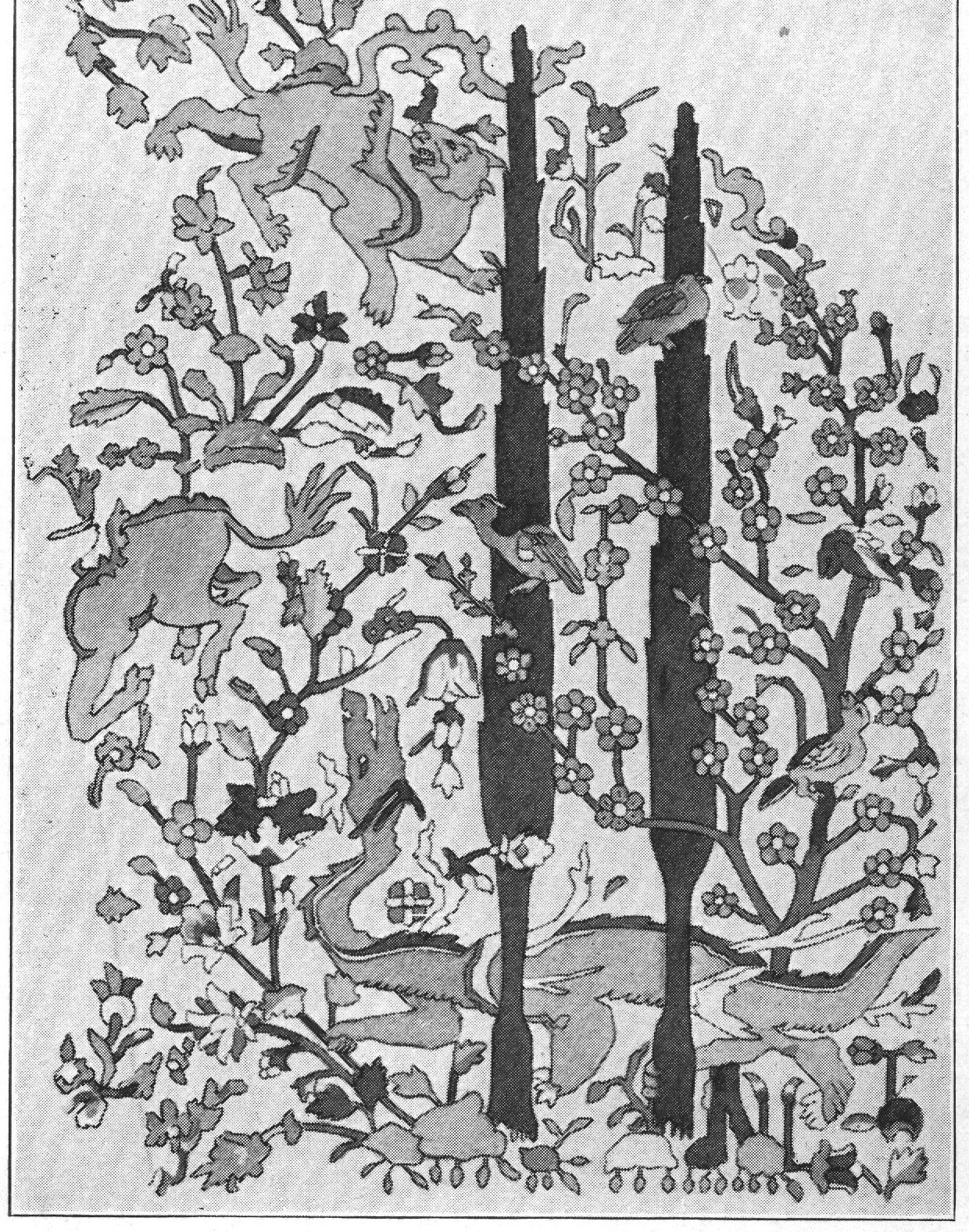
In attempting to reconstruct the gardens, according to the original idea, it is first necessary to consider the strictly religious purpose of the Taj and the symbolism and mysticism of Oriental art. Next, we must remember that the great artists who designed the whole magnificent architectural scheme would never have neglected the proper relation of the garden to the building. The whole art of the Taj being so largely derived from Persia, we may be sure that in the planting of the trees the Mogul gardeners symbolized the mystery of life, death and eternity in the manner in which it is always represented in Persian art, i. e., the fruit-tree or flowering shrub contrasted with the evergreen, flowerless cypress. The illustration on page 72, from an old Indian painting, shows the cypress alternated with a flowering shrub. This is the usual arrangement. The cypress was often planted at the corners of flower beds. Sometimes a pair of cypresses is alternated with the emblem of life, as in the illustration taken from an old Oriental carpet.
In an old, sixteenth-century, Indian painting the intervals between the cypresses are occupied alternately with a flowering shrub and an areca-nut palm. We may take it that the cypress trees in the Taj gardens were planted in one of these ways.
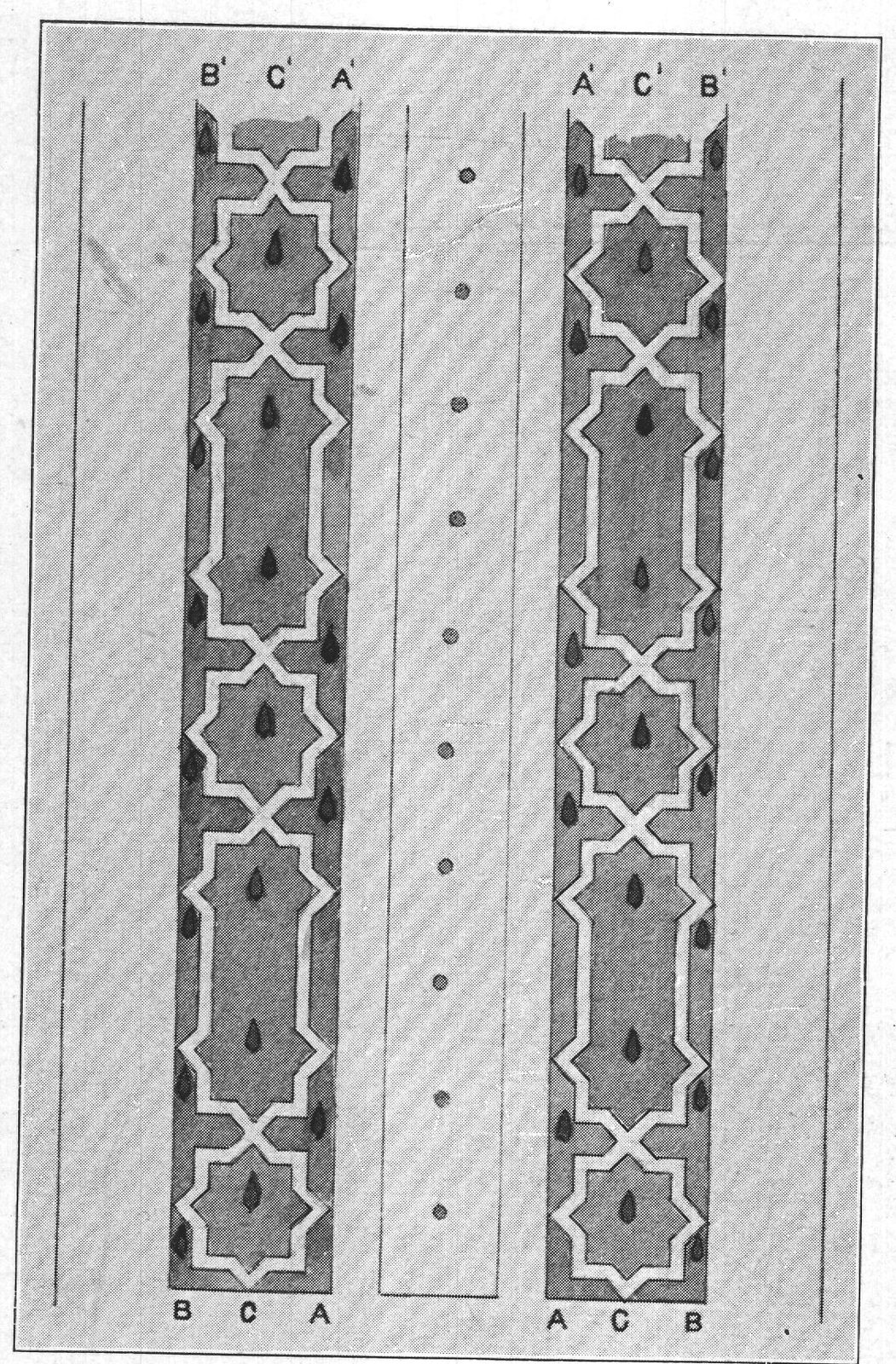
While the Taj has been in British possession an avenue of cypresses has always been planted down the main approach to the Mausoleum. Since 1803 it has been replanted at least twice, for in times of great drought the trees perish for want of irrigation. Each time a different line has been taken. I think it will be interesting and instructive from a gardening point of view to endeavor to determine which of these lines are the right ones. The plan on page 77 shows a portion of the main avenue with details of the water channel, the geometric beds and the three lines of cypresses as they have been successively planted. The lines AA′ represent the trees as they were in 1828, according to Colonel Hodgson's plan in which the cypresses were very carefully indicated. The correctness of the plan in this particular is attested by an old native painting of about the same date in a book now preserved in the Victoria Memorial Collection, Calcutta. The cypresses were then planted in pairs along the inner edges of the borders, BB′ of the flower beds. About 1850 these had perished and new ones were replanted in the lines BB′ on the outer edges of the flower beds. Our illustration, from a photograph taken about thirty years ago, shows the effect of this change. Another great drought killed the trees, and two or three years ago they were replanted in a continuous row in the centers of the flower beds.
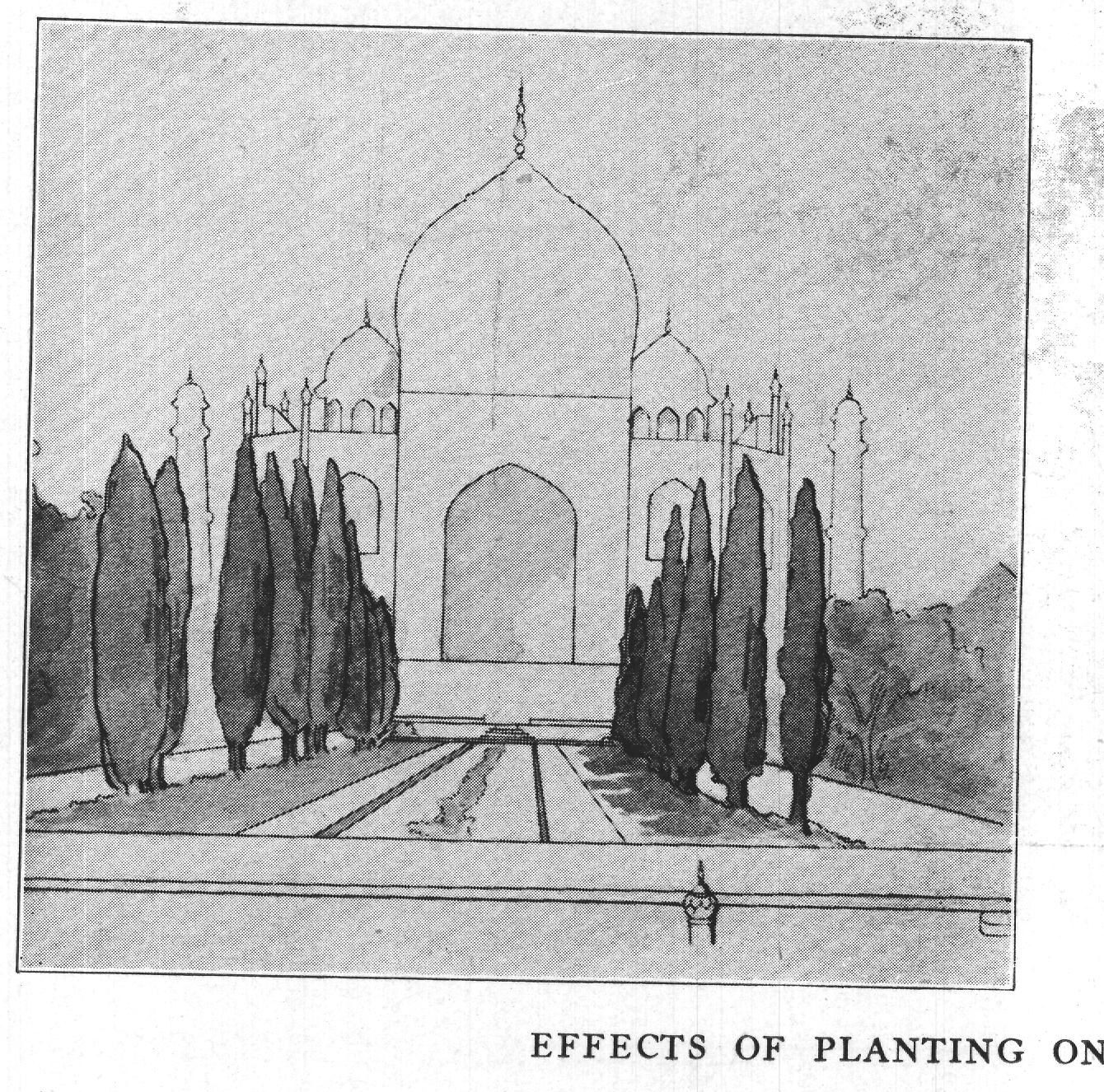
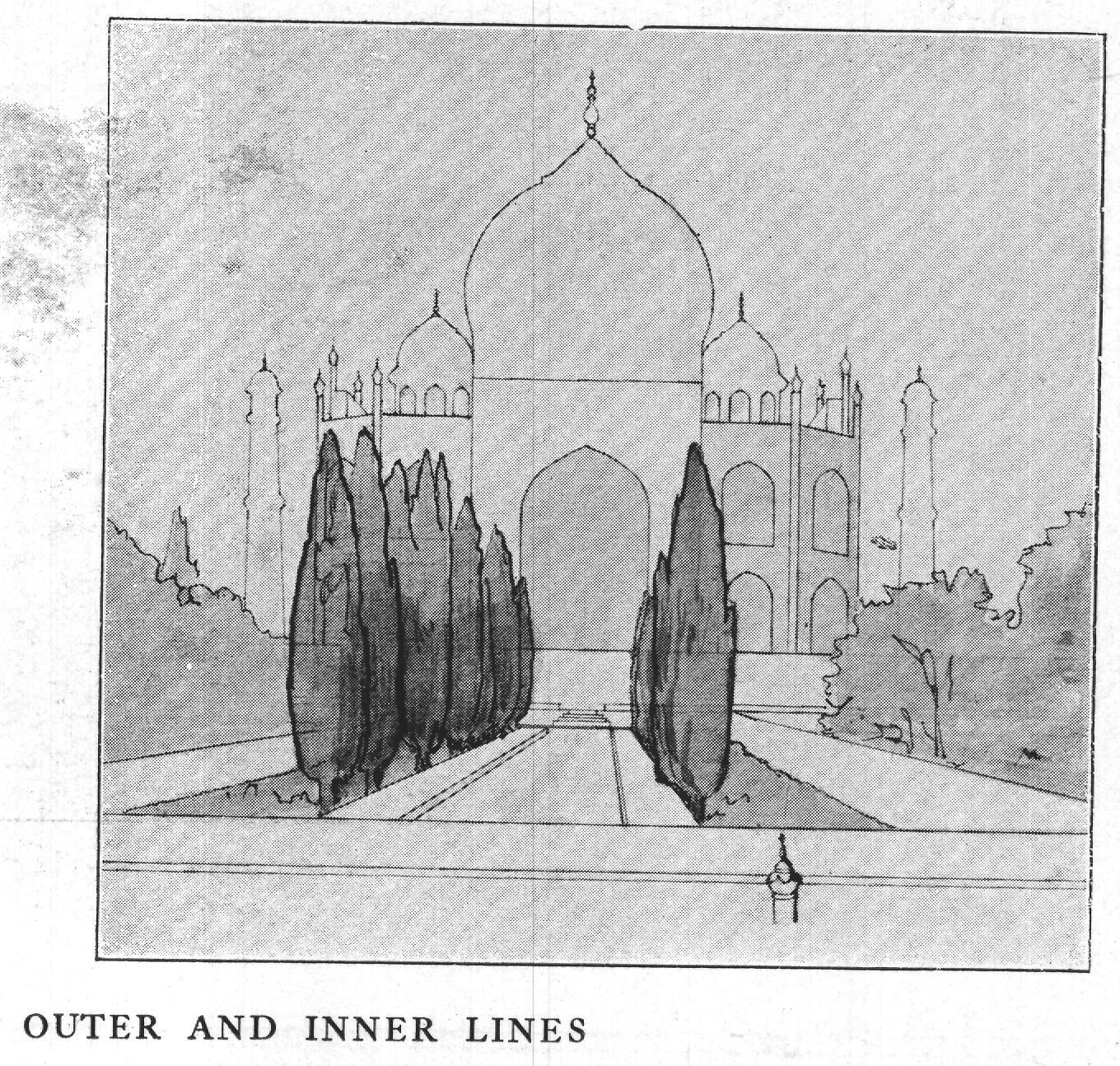
Now it is obvious that in the avenue which is the main approach to the Taj, the Taj itself is the chief point to consider, not the trees. Let us then compare the different effect of the three lines of cypresses, AA′, BB′ and CC′ in their relation to the Taj, the point of view being the central platform. The two diagrams on this page in which the architectural composition is reduced to its simplest elements, are sufficient to show these differences, for the effect of the lines AA′ and CC′ are nearly the same, so far as the architecture is concerned. In the first diagram it will be noticed that the cypresses as a mass frame in the chief division of the front of the Taj. Each row of trees, at the end nearest the building, terminates just under the springing of the great dome, and carries the eye up to its incomparable contour. No artist or architect could believe that the Moguls, if they planted cypresses in these parterres at all, would have done otherwise; for any lines which go inside of these, as AA′ and CC′, are disastrous to the composition, because the cypresses, instead of supporting the dome, seem as it were to undermine it, and to elongate very unpleasantly the proportions of the great alcove in which the entrance door is placed. It is quite conceivable that there were no cypresses at all along these flower beds. They might very possibly have been planted only along the edges of the square plots, thus making a still wider avenue than either of the three lines we have discussed; but the artistic objections to both the lines AA′ and CC′ are to my mind unanswerable.
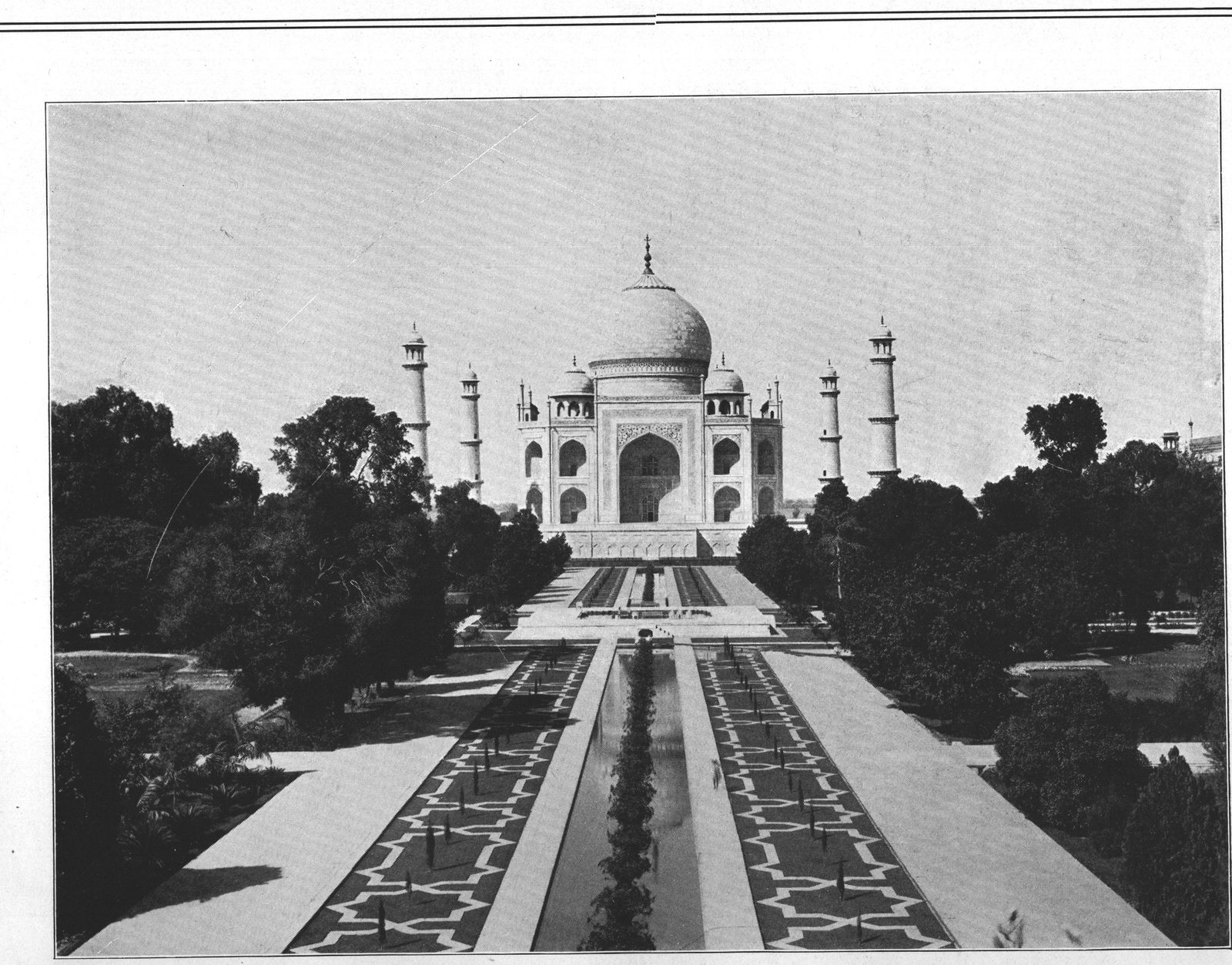
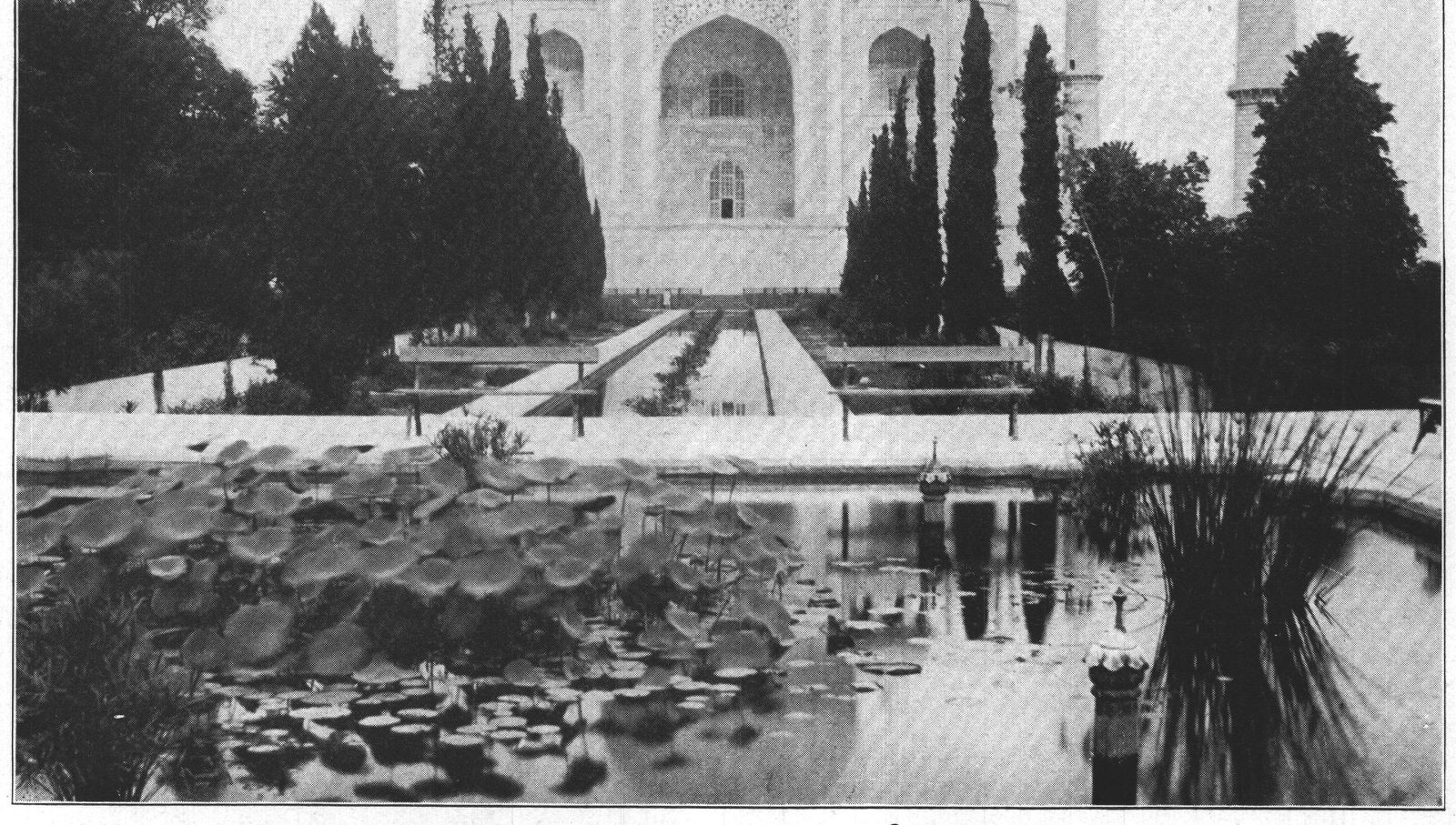
If the cypress avenues on the latter lines fail to satisfy artistic considerations, they are equally unsatisfactory from an archæological point of view, for the plan of the whole garden shows clearly that the water channel and the flower beds on either side of it must be treated in the design as one space (as they are by the native historian quoted above) and not as three separate spaces. This being the case, the outer lines BB′ are the only possible ones for cypresses, as the Moguls always planted cypresses at the corners or on the edges of their flower beds, never in the middle.
Having thus cleared the ground, let us try to plant out the central avenue as the Moguls might have done it. We will assume that there were flower beds and cypresses planted along them. The form of the geometric pattern seems to suggest that the latter would be planted in pairs, as they were in 1828. So we will accept Colonel Hodgson's plan as correct in this respect, only we will remove them from the inner to the outer borders of the beds and thus restore them to the line shown in the above illustration, which is surely the most beautiful of all modern representations of the gardens. Taking a hint from the Oriental carpet design, let us plant a plum-tree between each pair of cypresses. In the flowering time the sprays of snow-white bloom, emblems of life and purity, will echo the silver whiteness of the Taj itself and contrast beautifully with the deep green tones of the solemn cypresses, emblems of death and eternity. Through the branches of the plum-trees anyone walking down the avenue will get beautiful vistas of the Taj, which would be entirely blocked out by continuous lines of cypresses. If we followed Babar's plan and filled up the flower beds with roses and narcissus "alternately and in beds corresponding to each other" the Great Mogul himself might say, "indeed, the garden is charmingly laid out."
The most fatal objection to the latest laying out of the Taj gardens is that all the poetry and religious feeling of Oriental art are lost in the pretty formality of its grass-plots and unbroken lines of cypresses. We shall see how Shah Jahan, even in his pleasure ground at Lahore, suggested the symbolic idea of the cypresses and flowering-tree by alternating plane-trees with the tall and slender aspen. Certainly then, in the Taj gardens, which all Indian historians compared to the Gardens of Paradise, the art of the Moguls would not have lost its religious significance.
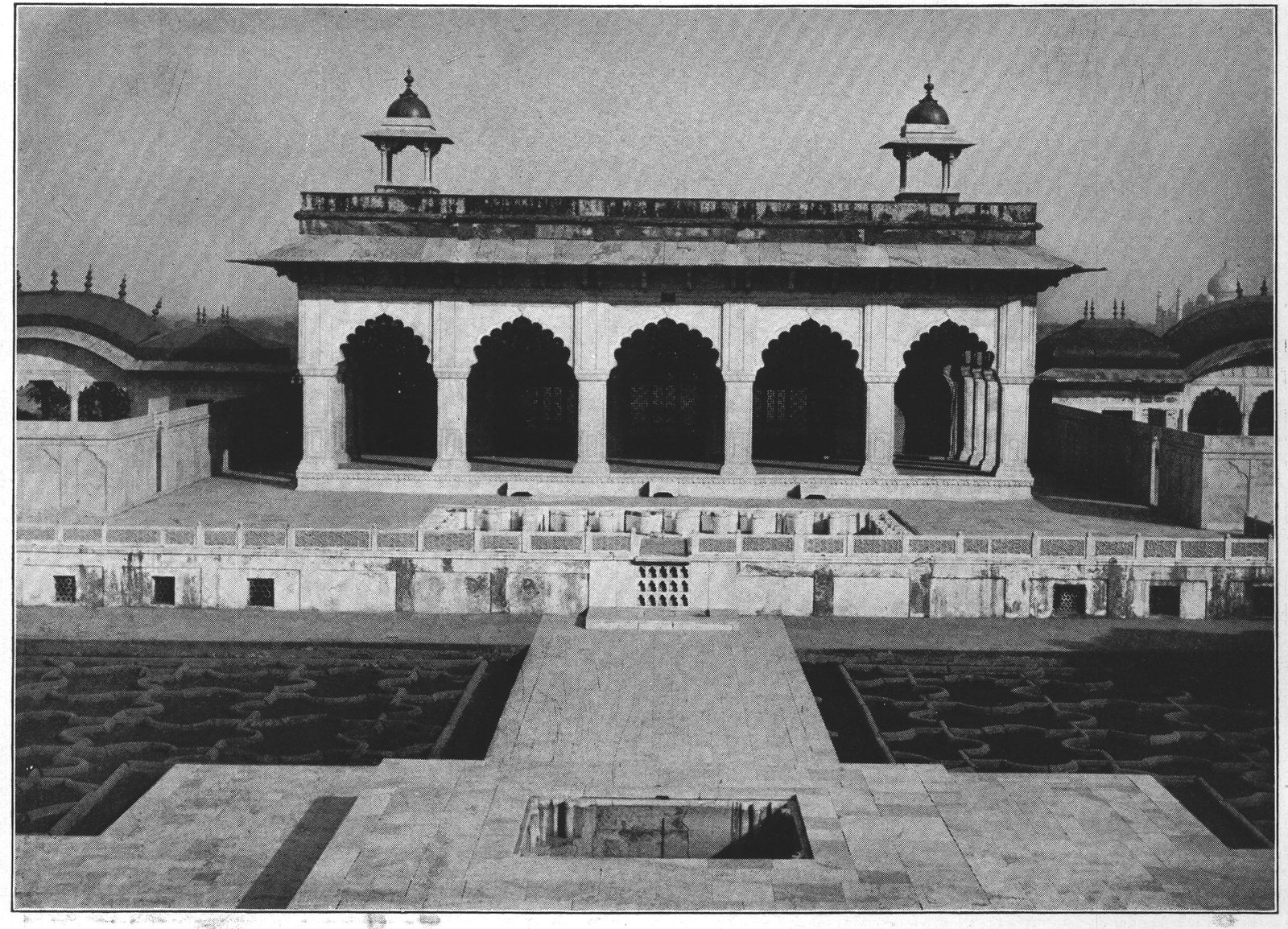
*It is supposed that the Anguri Bagh, or "Grape Garden," originally had a pierced stone trellis, or railing, on the outer edges of the four main plots into which it is divided. This trellis may have supported the vines which gave the garden its name. It will be noticed that the water-shoot, which conveys the overflow from the fountain in front of the main pavilion, has below it three rows of small arches. These were doubtless arranged for lamps to light up the cascade from behind, in the same way as will be seen in the Indian garden of Shahlimar Bagh at Srinagar.
Indian art never was and never is detached from the inner spiritual and religious life in the same way as our cold, modern eclectic art. If we recognized this we should never teach Indian art-workmen to place Hindu symbols upon our sugar-basins and teapots, and to carve the sacred incarnations of Vishnu upon sideboards and dining-room screens. We should be terribly shocked at the idea of putting such representations in our churches. We should be equally shocked if Hindus were to use effigies of our Lord and our Christian symbols as meaningless decorative features in their houses. But we fail to understand that the real Indian artist, uncontaminated with European ideas, does not recognize one art for the church and another for the home. To him all art is one, and in all art there is a meaning beyond and above, but yet a part of, the decorative idea.
Now let us continue the reconstruction of our garden. The clue to the planting of the square beds on either side of the main avenues is given in the native history of Shah Jahan's reign already mentioned. The author alludes to the garden of the Taj as a "paradise-like orchard." There is every probability that these square plots were really planted with fruit trees. The Gardens of Paradise, to which the Taj gardens were continually compared, were always represented as full of trees bearing all kinds of delicious fruits. The Moguls were keenly alive to the beauty of fruit-bearing trees. Babar writes with delight of the "pomegranates hanging red on the trees," and is in raptures at the sight of an apple-tree in the autumn, when its branches showed a few scattered leaves of a beauty which "the painter with all his skill might attempt in vain to portray."
There is another reason which makes it exceedingly probable that this part of the gardens was planted with fruit-trees. The Taj was a great charitable institution. It had an endowment of over two lakhs of rupees, of which a great deal was spent in pensions to deserving persons and in gifts to the poor. It would be quite in accordance with Mogul custom to establish a public orchard as part of a religious and charitable foundation. Jahangir in his memoirs, after telling us that large and lofty shade-trees had been planted by his orders all along the road from Agra to Lahore, a distance of four hundred miles, adds that in his reign many benevolent persons had laid out spacious gardens and plantations containing every description of fruit-tree, so that travelers in all parts of his dominions could find at convenient distances rest-houses and a refreshing supply of fruit and vegetables.
Let us take the fruit-trees which Jahangir mentions in the description of the garden at Ahmedabad, i. e., orange, lemon, peach, pomegranate and apple-trees. Colonel Hodgson's plan indicates that in 1828 the trees were planted in the middle and in the center of each of the sides, of the smallest square beds. Cypresses were placed on the outer corners of the squares, alternating with the other trees. This would be quite in harmony with Mogul traditions.
But there is another point to consider before we proceed further. If the whole of the square plots are filled up with fruit-trees, the effect will certainly be very monotonous. It will be remembered that Bernier, in his description quoted above, says that the garden to the right and left of the dome was covered with trees "and many parterres of flowers." I think, therefore, it is highly probable that in the center of each of the four main subdivisions of the gardens a space was kept for flower beds. According to Mogul ideas of gardening this could only be the squares ACDB, which I have marked on the plan, containing sixteen of the smallest square beds. The Anguri Bagh in the Agra Fort, another of Shah Jahan's gardens, gives a very good idea of how such a flower garden would be laid out; it was panelled into geometric parterres of flowers such as Bernier described. Colonel Hodgson's plan also shows that the four angle beds which adjoin the central platform, were planted in a different way to the others. I would suggest that here, on the edges which face the platform, we should plant the areca-nut palm which, as we have seen, was often found in Mogul gardens. Towering with their graceful heads above the cypress-trees, they would mark the center of the gardens and make a pleasant break in the long lines of the main avenues, without obstructing the view of the monument. With their slender stems they would repeat the idea of the graceful detached minarets at the four corners of the Taj platform and contrast finely with them.
Some of the good people at Agra have been very much distressed at the cutting down of the large trees which have been allowed to grow up in the gardens, especially of a great pipal (sacred fig-tree), which, it is asserted, is probably as old as the Taj. This, I venture to say, is an impossibility. The sacred tree of the Hindus rarely found a place in the Mogul gardens. I myself could view with complacency the removal of a great many of the trees in the present Taj gardens, for they have been planted, or allowed to plant themselves, without any consideration for the artistic ideas of the creators of one of the world's masterpieces.