THE glories of Stowe have been sung by many poets, a stately mansion that needs no panegyric. In its quiet old age it is, perhaps, more pleasing to the senses than ever it was in the palmy days of its grandeur and magnificence. It whispers a sweet message of peace to the heart, war-wearied with the strife of faction and ambition, and attracts us with its plaintive utterances far more than when kings and poets and wits crowded its corridors or sought refreshment in those wonderful gardens of which the world has heard. In the days of its zenith, Stowe must have been one of the grandest mansions in England, and enough remains of its former greatness to enable us to picture to our eyes the princely seat of the Dukes of Buckingham as it appeared to Pope, Horace Walpole, Lord Chesterfield, the Prince of Wales and a host of other illustrious guests of the dukes of former times. Now the dukedom is extinct.
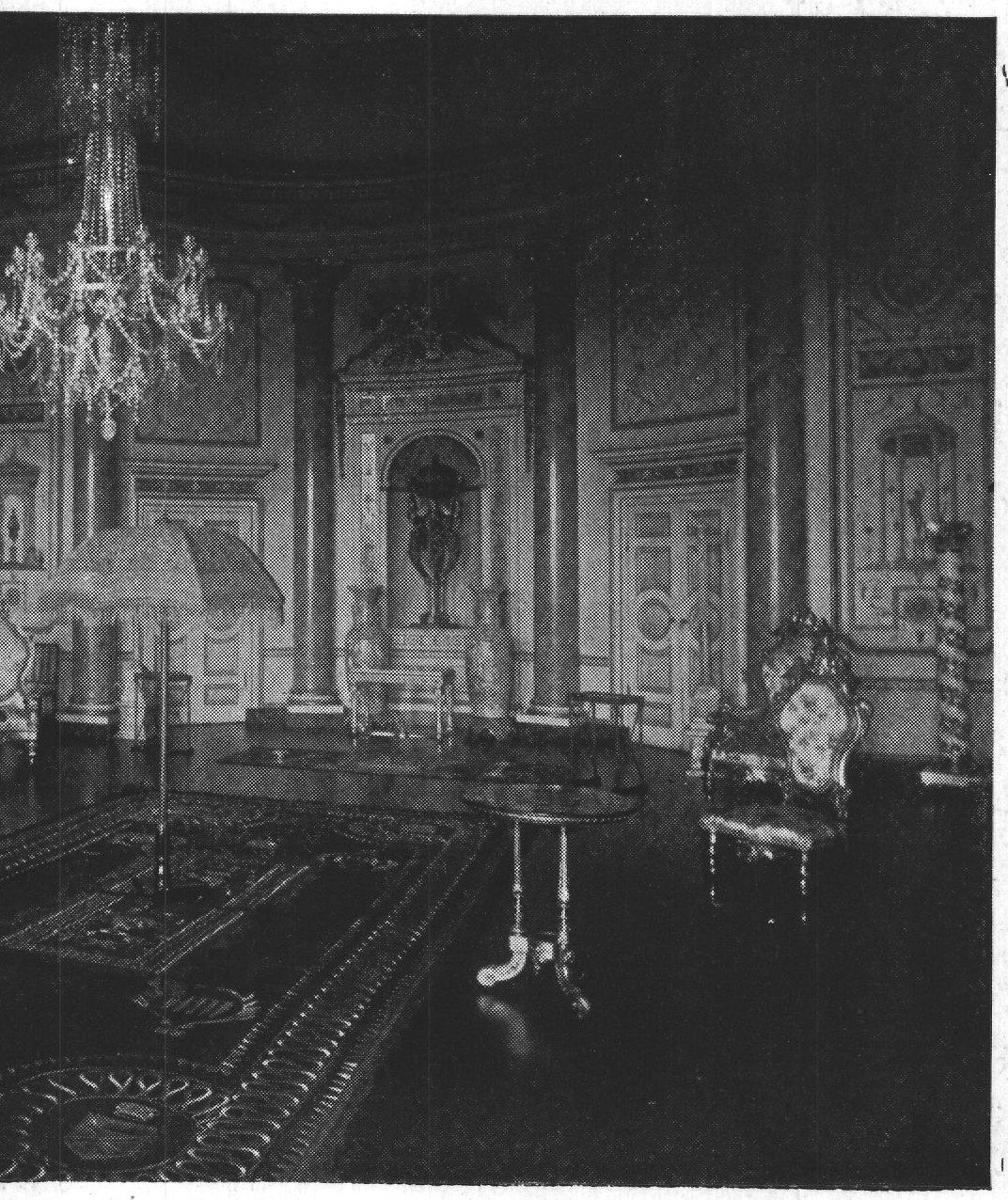
Stowe has been robbed of most of its choicest treasures by the relentless hammer of the auctioneer, owing to the ruin of the second duke in 1848. It is sad to reflect that all that the prodigal expenditure of immense wealth had collected, all that had descended from numerous lines of ancestry renowned for taste and opportunities of acquiring beautiful and priceless objects of art and vertu, all the priceless heirlooms of an illustrious family were scattered over the world to be sold in shops, to glitter in the public rooms of hotels, or to decorate the mansions of the nouveaux riches. It is very sad, but happily, although this is not known to the world, many of the treasures were saved, others have been repurchased and restored to their old places, and the house, now the residence of Lady Kinloss, the widowed daughter of the last duke, is by no means destitute of beautiful works of art, the salvage from the wreck of Stowe's former magnificence.
The early history of Stowe need not detain us long. From the Domesday Survey we gather that the manor was held by a Saxon gentleman named Turgis, and that William the Conqueror gave it to his half-brother Odo, the warlike bishop of Bayeux in Normandy. The bishop had so many manors bestowed upon him by the Conqueror, that he could not live in them all. So he let the estate to Robert D'oiley and Roger Ivory for 605 years. But bad times fell upon the battle-loving bishop. William the Conqueror found that he was conspiring against him; hence, the bishop was dispossessed of his rich manors, and D'oiley, a faithful follower of the king, a prudent man, too, who married the heiress of the Saxon lord of the old town and castle of Wallingford, and gained vast possessions, added Stowe to his extensive property. Whether he was overcome with remorse on account of some lawless oppression of the English, history sayeth not; at any rate he bestowed his estates at Stowe on the monks of St. Friedswide at Oxford, whose minster is now the Cathedral Church of the Oxford Diocese.
The property remained in the peaceful possession of the monks until Henry VIII, that rapacious monarch, wishing to atone somewhat for his spoliation of their monasteries, created five new Sees, and amongst these the Diocese of Oxford. His son, Edward VI., bestowed upon it for the endowment of the bishopric the estate of Stowe, of which the good canons of St. Friedswide had been deprived. Queen Elizabeth, during the vacancy of the See, alienated the best of the estates from the bishopric to which they had been assigned by the letters patent of King Edward VI., amongst them the manor of Stowe. The estate was purchased from the Queen by Peter Temple, Esq., who came of a distinguished family and could trace his descent to Saxon times and claim Leofric, Earl of Leicester, as an ancestor. He erected a manor house in the Elizabethan style, and enclosed 200 acres for a deer park. His son, Thomas, was knighted by King James I., and created a baronet, whose widow lived to a great age and saw four generations and seven hundred of her descendants. Sir Peter followed his father and fought in the civil war for the royal cause. His son, Sir Richard, earned fame by rebuilding Stowe House, and died in 1697. The front of the house was rebuilt by his son, also named Sir Richard, who added the two wings. This Sir Richard was a great soldier and fought with the Duke of Marlborough in the Low Countries and was present at the sieges of Venloo and Rutemonde. Military honors clustered thick upon him. Moreover, he was a favorite at the Court of Queen Anne and was raised to the dignity of baron and then Viscount Cobham. He kept a gallant court himself at Stowe, and gathered together the wits, poets and great folks of the day, who roamed the extensive gardens which he had created, and revelled in his lavish hospitality.
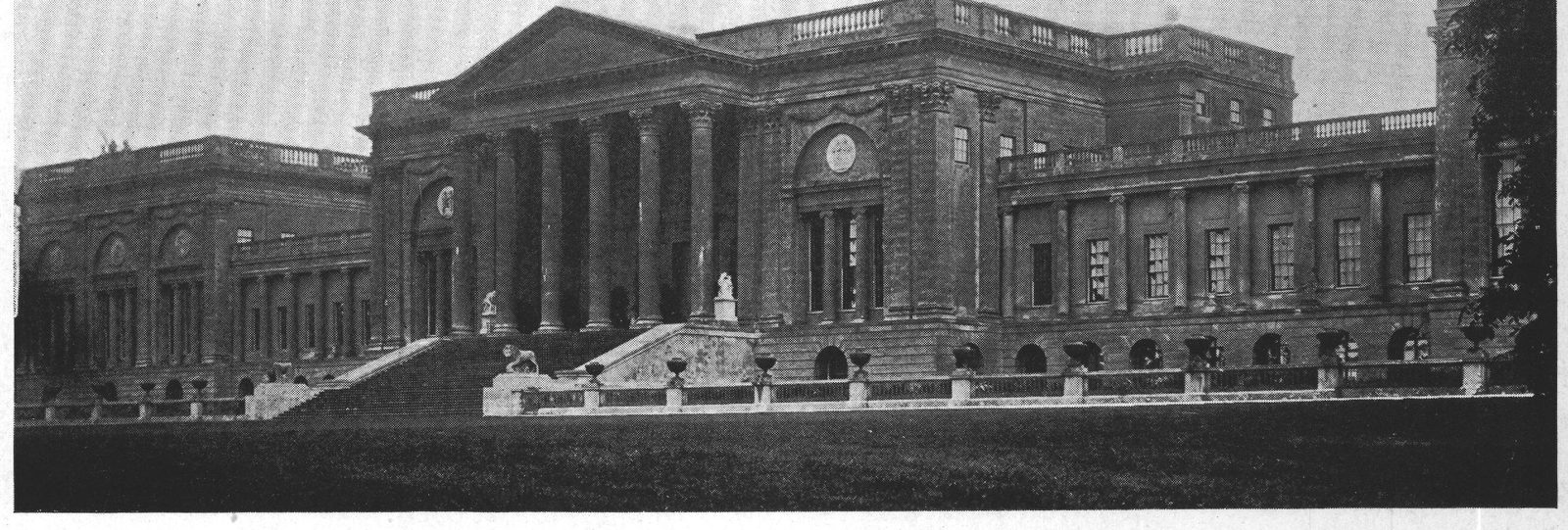
We shall presently stroll through these same gardens, "a melancholy relic of eighteenth century taste and magnificence," filled with its pseudo-classical erections. Of course, Horace Walpole visited this shrine of fashion, and, of course, he wrote amusingly about it. Writing to Conway in 1770, he says: "Twice a day we made a pilgrimage to every heathen temple in that province that they call a garden." In the same year he visited Stowe in the company of the Princess Amelia, the daughter of George II., and gives a very amusing description of his sojourn there when writing to his friend, George Montagu. It is, I regret, too long to be quoted here. Thus does Pope describe the Stowe gardens as they were in his day:
"To build, to plant, whatever you intend,
To rear the column, or the arch to bend;
To swell the terrace, or to sink the grot,
In all, let Nature never be forgot;
But treat the goddess like a modest fair,
Nor overdress, nor leave her wholly bare;
* * * * * * * * * * * * * *
Still follow sense, of every art the soul;
Parts answering parts, shall slide into a whole.
Spontaneous beauties all around advance
Start e'en from difficulty, strike from chance;
Nature shall join you; Time will make it grow
A work to wonder at—perhaps a STOWE!
Without it, proud Versailles! thy glory falls,
And Nero's terraces desert their walls:
The vast parterres a thousand hands shall make,
Lo! Cobham comes, and floats them with a lake."
Nor was Pope the only songster who sang the praises of the gardens of Stowe. Thomson, meditating his "Seasons," often came thither to visit the kindly Mæcenas of the eighteenth century, and doubtless after his delightful custom, wandered round the garden in his dressing-gown, and bit off the sunny side of his host's peaches. To make amends for such heinous crimes he, doubtless, wrote the lines:
"O lead me to the wide extended walks,
The fair majestic paradise of Stowe!
Not Persian Cyrus on Ionia's shore
E'er saw such sylvan scene; such various art
By genius fired, such ardent genius tamed
By cool, judicious art: that, in the strife,
All beauteous Nature fears to be outdone."
The property and titles of Lord Cobham, who had no male heir, passed to his sister, Hester Temple, who was the wife of Richard Grenville, of Wootton. Her son Richard, created the first Earl Temple, was a distinguished statesman, being Lord of the Admiralty in 1756, and Lord Privy Seal in the following year. He did much to improve the house. He died at Stowe in 1779, and was succeeded by his nephew, George Grenville Nugent Temple, Earl, another statesman, created Marquis of Buckingham in 1784. Under his direction, many of the chambers of Stowe were designed and completed. He was the brother of Lord Grenville, of Dropmore, who played a considerable part in the political history of the period. The owner of Stowe was restless and ambitious, and when writing to his brother would often break off in the middle of a political letter telling him that he was forwarding to him many thousands of young trees for his Dropmore estate. His son Richard, who married the daughter of the last Duke of Chandos, a lady of royal descent, was created Duke of Buckingham and Chandos. The second Duke succeeded in 1839, to a magnificent property, entertaining in a most lavish style. Queen Victoria paid a memorable visit to Stowe in 1845, and was entertained most sumptuously. The Duke was a great collector and amassed a magnificent store of treasures of art and vertu. Stowe became a vast treasure-house of priceless objects of artistic merit. But the Duke was ruined by his reckless extravagance. Soon followed the famous sale of all these treasures. Christie & Manson were the auctioneers. Much happily was saved and repurchased by the family; many treasures never left the house, and when the improvident Duke died in 1861, his son, the last Duke of Buckingham and Chandos, bravely faced all difficulties, bought back many of the family heirlooms, and endeavored to revive the glories of Stowe. Having no son, the dukedom died with him, and his widowed daughter, the Baroness Kinloss, now owns and resides at the famous mansion.
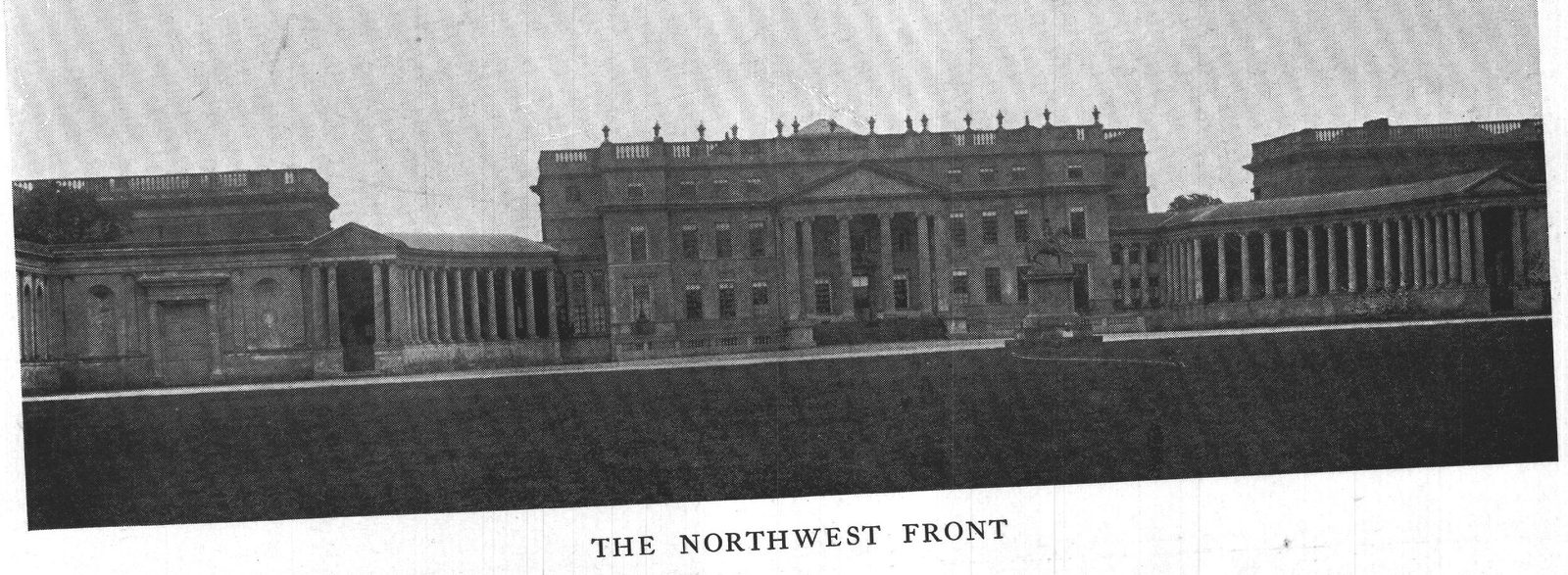
Nigh the ancient county town of Buckingham stands Stowe, redolent with the memories of its former greatness. You walk or drive along a long straight avenue of somewhat meagre trees, which leads you to a Corinthian arch, sixty feet high, designed by Thomas Pitt, Lord Camelford. The southeast front of the house now appears in sight, a grand façade, nearly a thousand feet in length, consisting of a central portion faced with a portico and flanked by two wings. Forty stone steps lead up to the portico, and on each side stand two lions guarding the entrance, which are a reproduction of those to be seen at the Villa Medici in Rome. As I have said, this front was the work of Viscount Cobham. Its style is Italian throughout, founded on models of Palladio's work, a style that dethroned the old English traditions of domestic architecture, and substituted for its pleasing features, a foreign grandiose design, unsuited to our English ideas of comfort and convenience, and harmonizing little with our English landscape. Porticoes, colonnades and other majestic features characterize the palaces of Anglo-Palladianism, and these are abundantly exemplified in the mansion of Stowe. The portico or loggia is formed of six Corinthian columns and two pilasters. There are some colossal female figures in the loggia from the Braschi collection. Two groups remain out of several designed by Scheemakers, Delorme and others, which once adorned the spaces between the columns.
As we view this noble front, we cannot discover any traces of an upper story. The large windows of the ground floor gaze at us. Above them there is a lofty parapet, and behind this are concealed rows of chambers arranged in blocks perpendicular to the side of the house. If you have the good fortune to stay at Stowe, you will not, therefore, be able to gaze at the beauties of the historic gardens from your bedroom window. This rather bears out the truth of Lord Chesterfield's witticism on an Anglo-Palladian house; he advised the owner, who found it so inconvenient within, in spite of its exterior beauty, to hire a lodging over the way and spend his days in looking at his house.
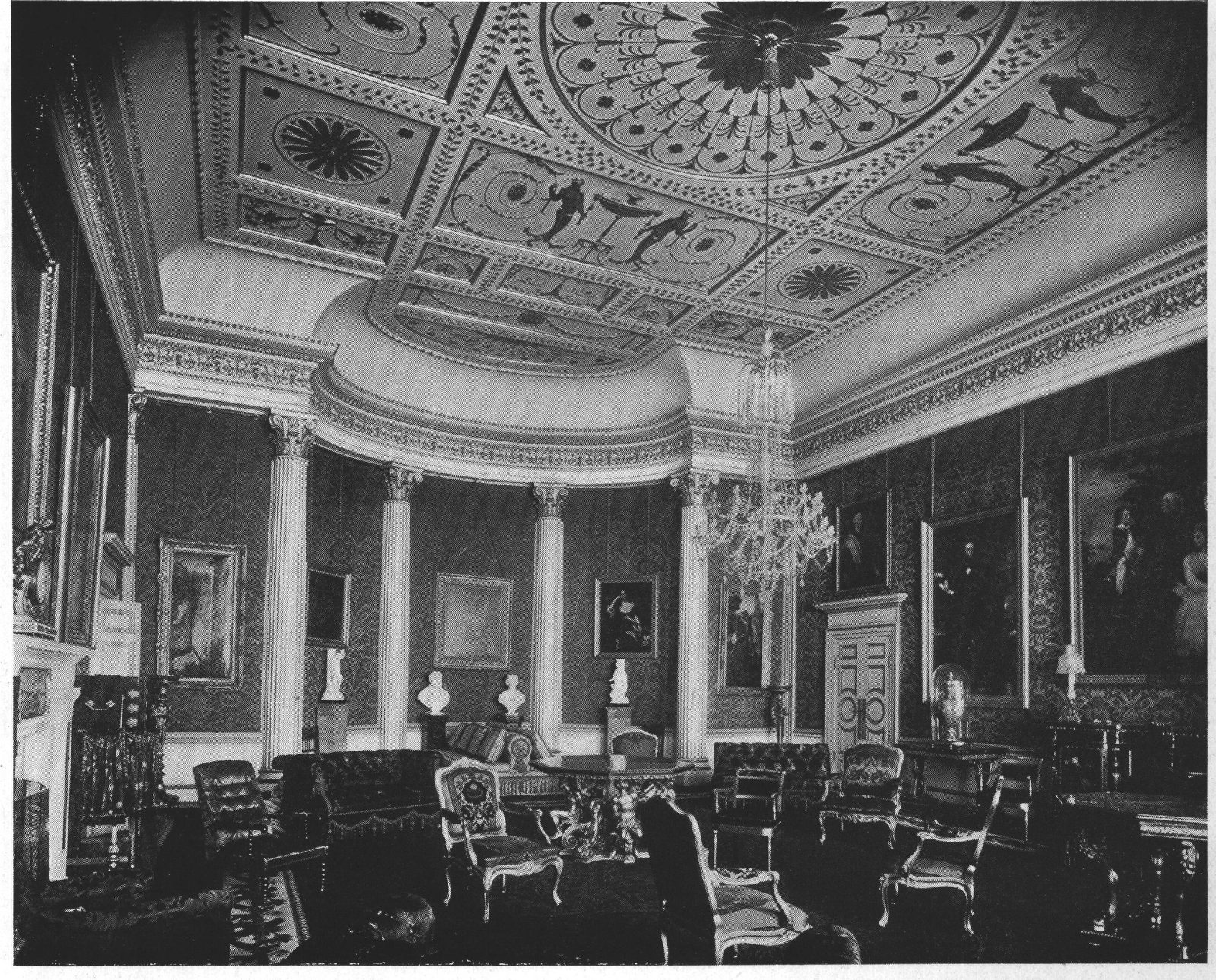
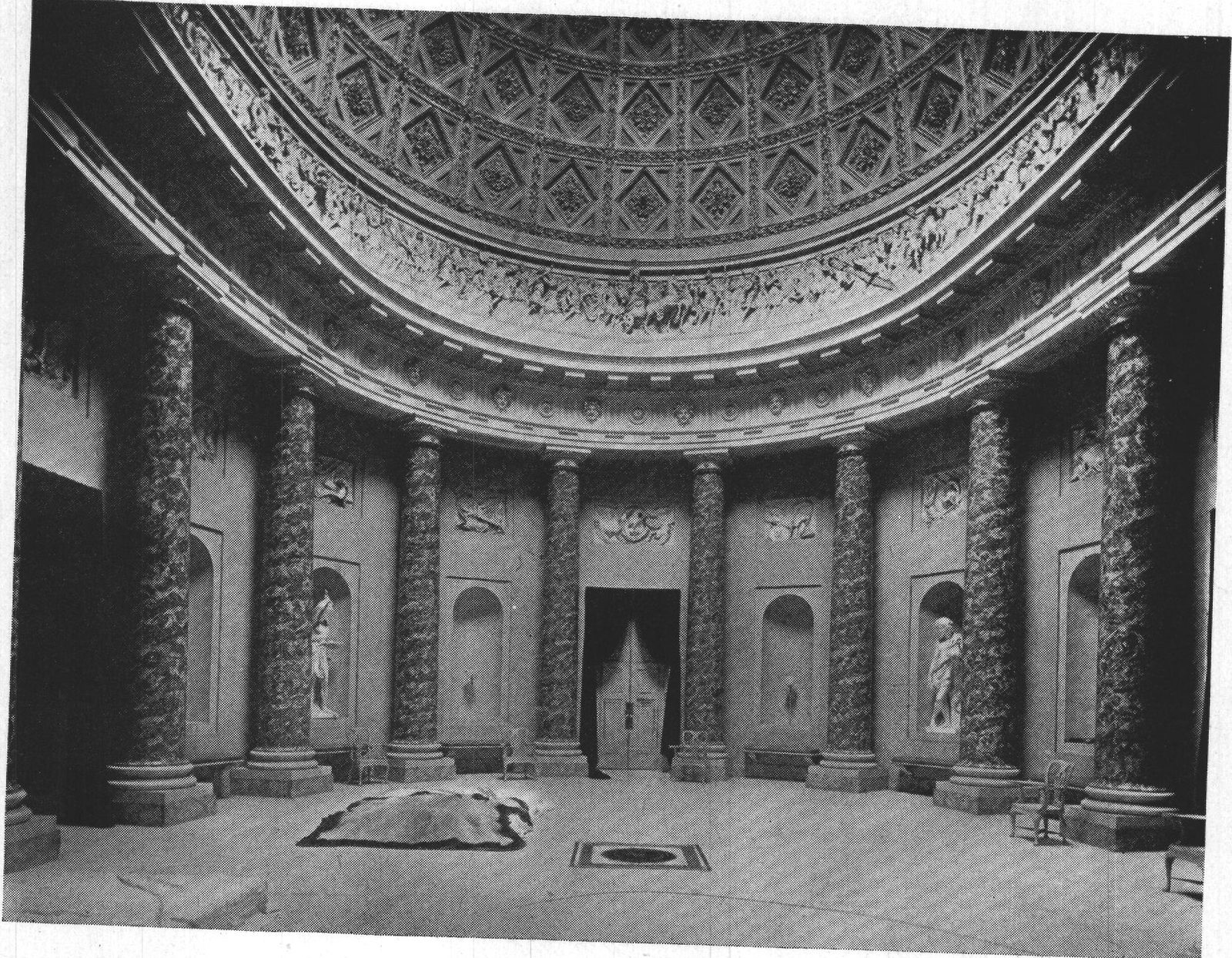
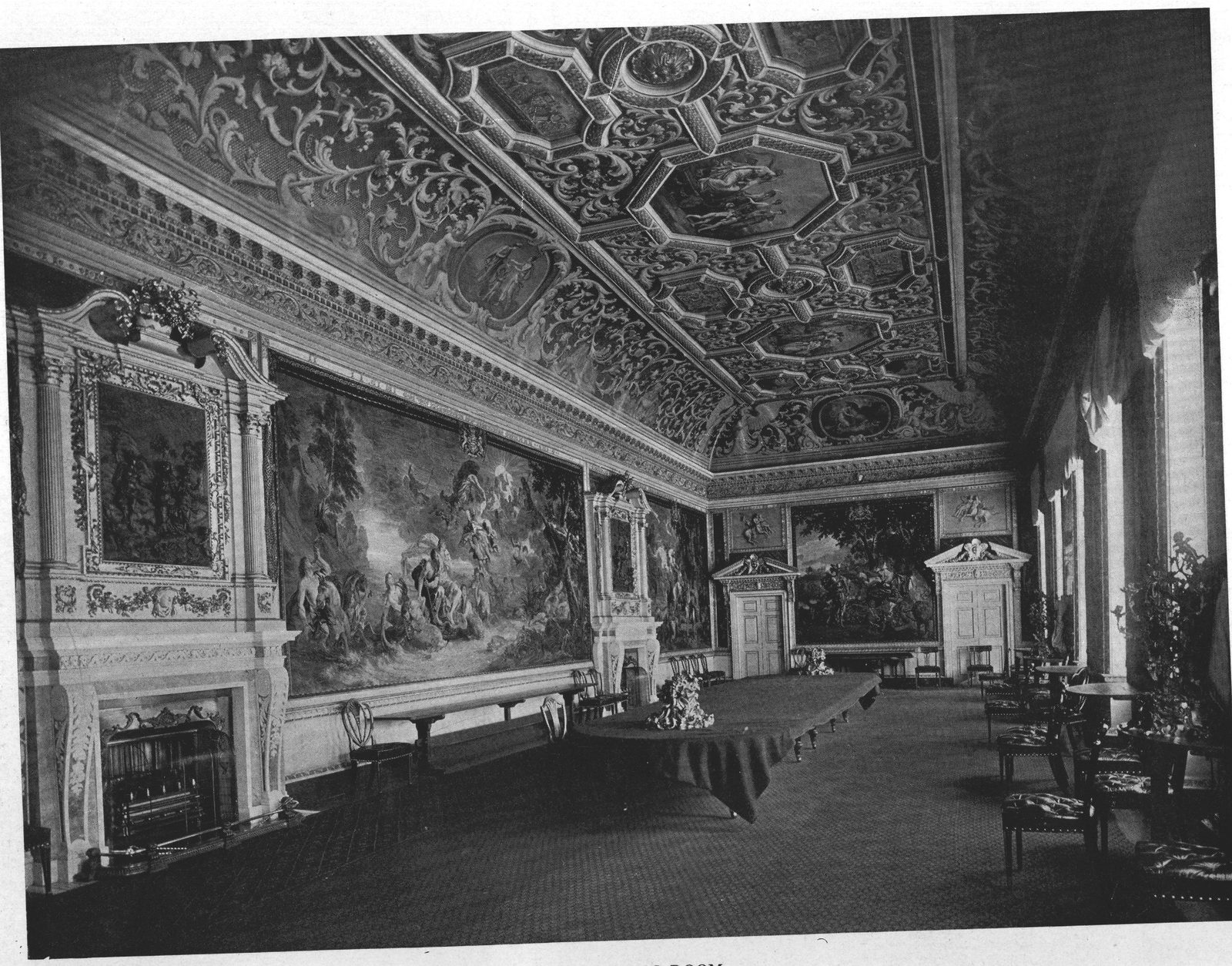
The usual entrance to the house is at the northwest front, which somewhat resembles the other and has a portico with wings. On entering, you find yourself in a vestibule with a ceiling painted by Kent, architect and artist, the friend of Lord Burlington, the designer of Holkham. This ceiling is an allegorical design representing Victory or Mars presenting a sword to Lord Cobham, the companion of Marlborough in his victorious campaign. Some people see in the face of Mars the likeness of "Dutch William." A copy of the Venus de Medici, two panels of ancient sculpture, and a large Herculanean vase adorn this hall. We pass thence into the large saloon (60 feet by 43 feet), a great feature of a Palladian house. It has a vast dome and a frieze with some remarkable figures engaged in celebrating a Roman triumph, by Valdre. The student of Roman antiquities will see in these figures a strong similarity to those with which he is familiar in "The Eternal City." The staterooms all open from this central saloon. On the right is the state drawing-room, which contains several pictures saved from the wreck. There is a Correggio, showing the figures of Mars, Venus and Cupid, and over the mantelpiece is a bas-relief representing a sacrifice to Bacchus. We next find ourselves in the noble dining-room hung with tapestry, and over the mantelpiece are some carvings of Grinling Gibbons. Another small dining-room is the next room which we enter, also adorned with tapestry representing battle scenes of the Queen Anne period. A portrait of one of the Temples painted by Van Dyck is over the mantelpiece. From this room opens the Duchess's drawing-room: with which our tour of the western wing of the house terminates. There are two china closets at the entrance.
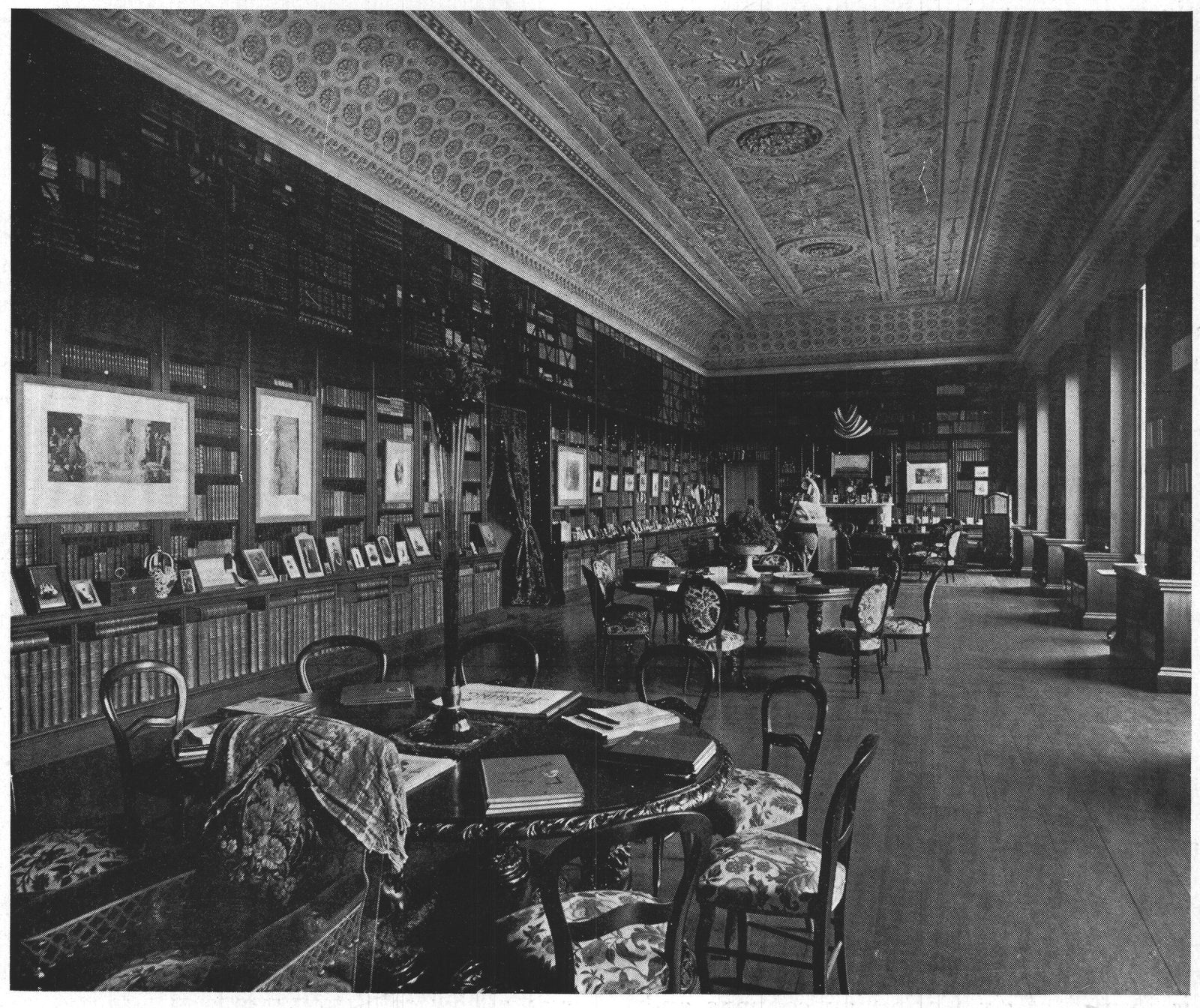
On the eastern side are the music-room, grand library, which once contained a vast store of 20,000 books, and three other rooms, one of which is known as the Queen's bedroom, where Queen Victoria slept during her memorable visit in 1844. In the basement are extensive corridors which are used as armories. The old muskets used in the Peninsular War by the regiment commanded by the Marquis of Buckingham are stored here. The MS. room was modelled from Henry VII.'s Chapel in Westminster Abbey, by Sir John Sloane, and in the center of the vaulted ceiling are the 719 quarterings of the noble families who have owned Stowe. There is still a vast store of valuable papers, but the famous Stowe MSS. are now in the British Museum.
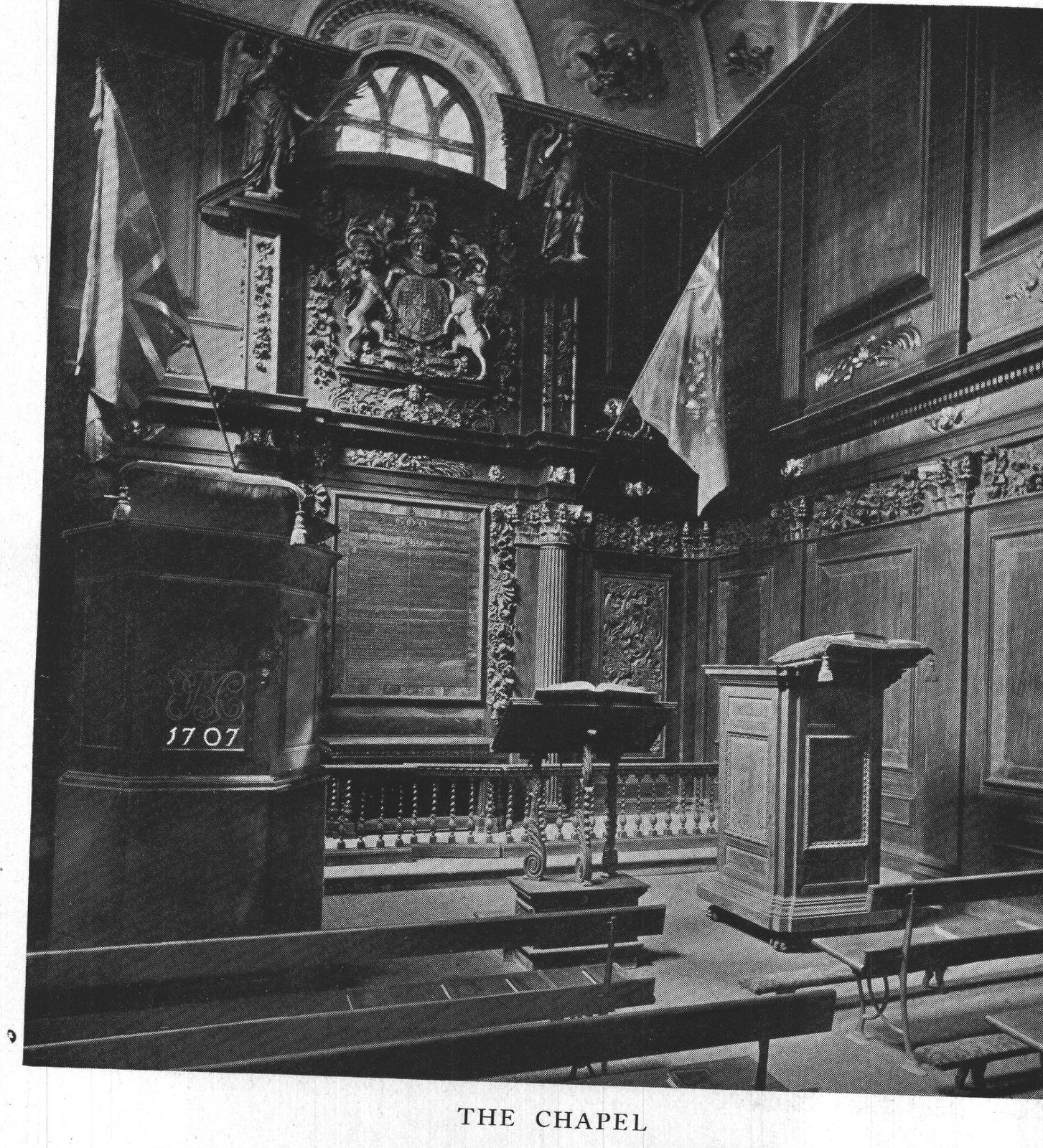
The chapel is worthy of a visit. The cedar wainscot was taken from a Spanish prize vessel, and was formerly at Pilkhampton, Cornwall, the seat of Sir Richard Grenville, the hero of Queen Elizabeth's time, the commander of the gallant little "Revenge," sung of by Tennyson. Grinling Gibbons did the carving. Some old regimental colors hang from the walls. The vast kitchen resembles one of the larger kitchens at Oxford or Cambridge, and it is said that a ton of coal is required to set the huge fire going in the morning.
A memorable scene took place at Stowe. King Louis XVIII., of France, driven from his country by the revolution of 1793, came to reside in the neighborhood at Hartwell House, Buckinghamshire. The illustrious exile often used to visit Stowe and here he met Louis Philippe, who went on his knees and begged pardon of his royal uncle for having ever worn the tricolored cockade. Another illustrious name, connected with the history of France is associated with Stowe. The Comte de Paris came to reside here in 1889, and died in the house six years later.
The gardens occupy four hundred acres. Historic they are, and associated with the names of many worthies in English history, neglected but glorious, appearing like a grove adorned with obelisks, columns, statues, temples, and towers apparently emerging from a luxuriant mass of foliage. They were originally laid out by Viscount Cobham, who employed Bridgman and Kent to carry out his designs. A lake spreads its placid waters on the south side, and on the side remote from the house are two Ionic pavilions designed by Kent. A little lake is hidden within a shady dell, wherein trees and thickets, grass and flowers flourish, and here and there quaint monuments and temples arise amid the verdure, sometimes recalling (as Horace Walpole wrote) "Albano's landscapes to our mind: and oftener to our fancy the idolatrous and luxurious vales of Daphne and Tempe." We can imagine the aged beau "with certain other giddy young creatures of near three-score supping in a grotto in these Elysian fields, refreshed with rivers of dew and gentle showers that dripped from all the trees, and being reminded of the heroic ages when kings and queens were shepherds and shepherdesses, and lived in caves, and were wet to the skin two or three times a day."
We find a monument of Lord Cobham's nephew, Captain Thomas Grenville, who was killed fighting the French under Admiral Lord Anson, in 1747. Yet another temple is that of Concord and Victory, girt with Ionic columns, erected for the commemoration of the Treaty of Paris in 1763 and the close of the Seven Years' War. Lord Cobham's pillar still survives and an urn keeps in memory the achievements of William Pitt, Earl of Chatham. Here is the Temple of Friendship. Walpole has enumerated many of the friendships it commemorated.
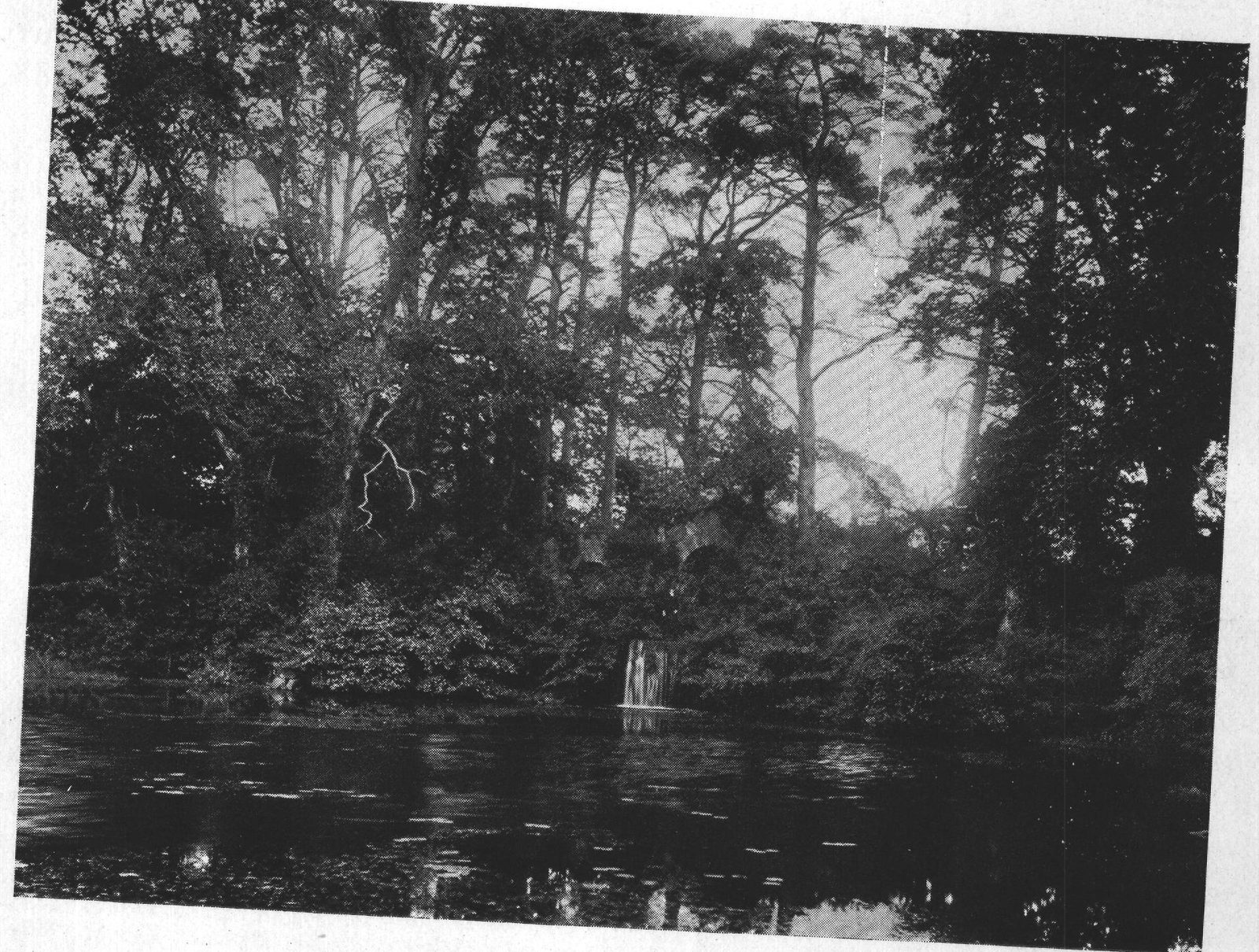
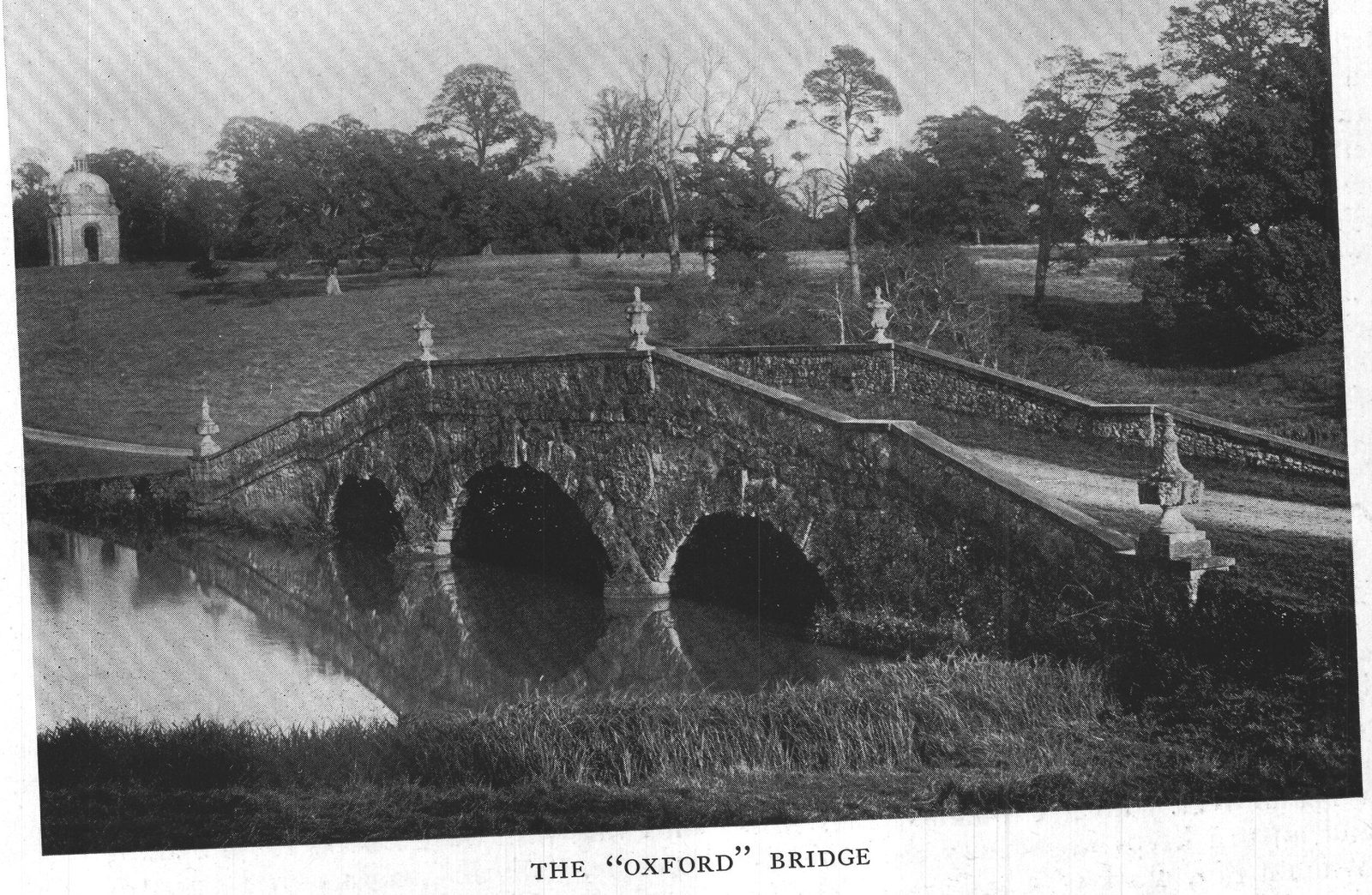
It is impossible to exhaust the treasures of Stowe's wondrous gardens. The Bourbon tower records the restoration of the French monarchy in 1814; Kent's monkey tells of the comedies of Congreve; a Moorish Gothic temple which reminded Walpole of the Place of St. Mark's, Venice, and I know not what else lies buried within the shades of the trees. Rysbrach's seven statues of Saxon deities who gave their names to the days of the week used to be there, but perhaps they have vanished. Then there is the Palladian Bridge, after the design of the great Italian, a fine structure similar to that at Wilton.
It was in the gardens at Stowe that "Capability" Brown first worked, whose hand fell heavily on many a fair English garden, which he uprooted and destroyed in his quest for landscape-gardening triumphs. Here his energies were happily confined to the kitchen-garden, and it would have been well if he had never strayed from the cultivation of useful herbs.
We love to linger among the trees of Stowe and picture to ourselves its past glories and to see the ghosts of the great men who trod the Elysian fields and read again Walpole's delightful descriptions of his visit with the Princess Amelia and other exalted people, "whose images crowd upon one's memory and add visionary personages to the scenes that are so enriched with fanes and temples, that the real prospects are little less than visions themselves."