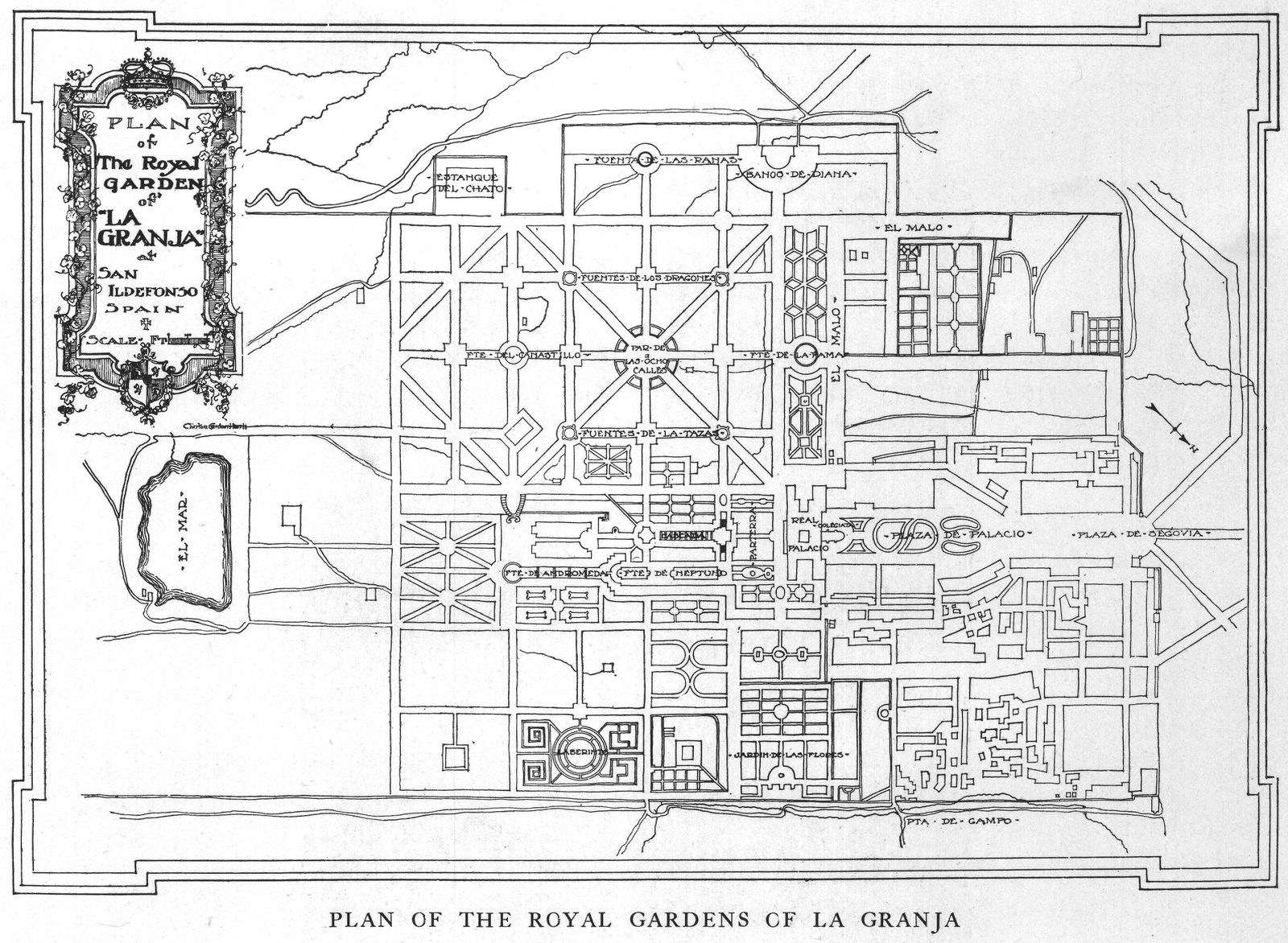
LA GRANJA, the favorite summer palace of the Spanish monarchy, is best approached by way of the picturesque city of Segovia which lies on the northern slope of the Sierra de Guadarrama, the central mountain range of the kingdom. As the highroad leads away across the low plains, and leaves behind the ancient towered walls, the great yellow Middle Age cathedral, and the Roman aqueduct, we part with regret from scenes which make so real the strongly contrasted life of Roman, Moorish and mediæval ages.
The city quickly disappears from view, shut out by the noble plane trees which line the roadsides almost all the way to the village of San Ildefonso, which is but an hour's drive from our starting point. We found the village given over to joy. The day was a fiesta, and all the Castilian faces we saw were sunny and bright, with the total surrender to pleasure that one sees rarely in Northern Europe, and not too frequently even in Spain. It is one of the few days of the year—before the Court comes here from Madrid—when the fountains are permitted to play in the gardens, and this rare event seemed to the villagers to prefigure all the pleasures that would accompany the expected royal party.
The whole scene, however, though filled with spontaneous gayety, seemed to us somewhat remote from every-day busy life, and it did not at all violate the proprieties when, in answer to our inquiry for a fitting guide to the beauties of the place, there stepped forth, as out of Shakespeare, in black costume and bearing a wand, a stately Malvolio, courteous and condescending to his unenlightened guests, but with an ever-present consciousness that his station was below his deservings.
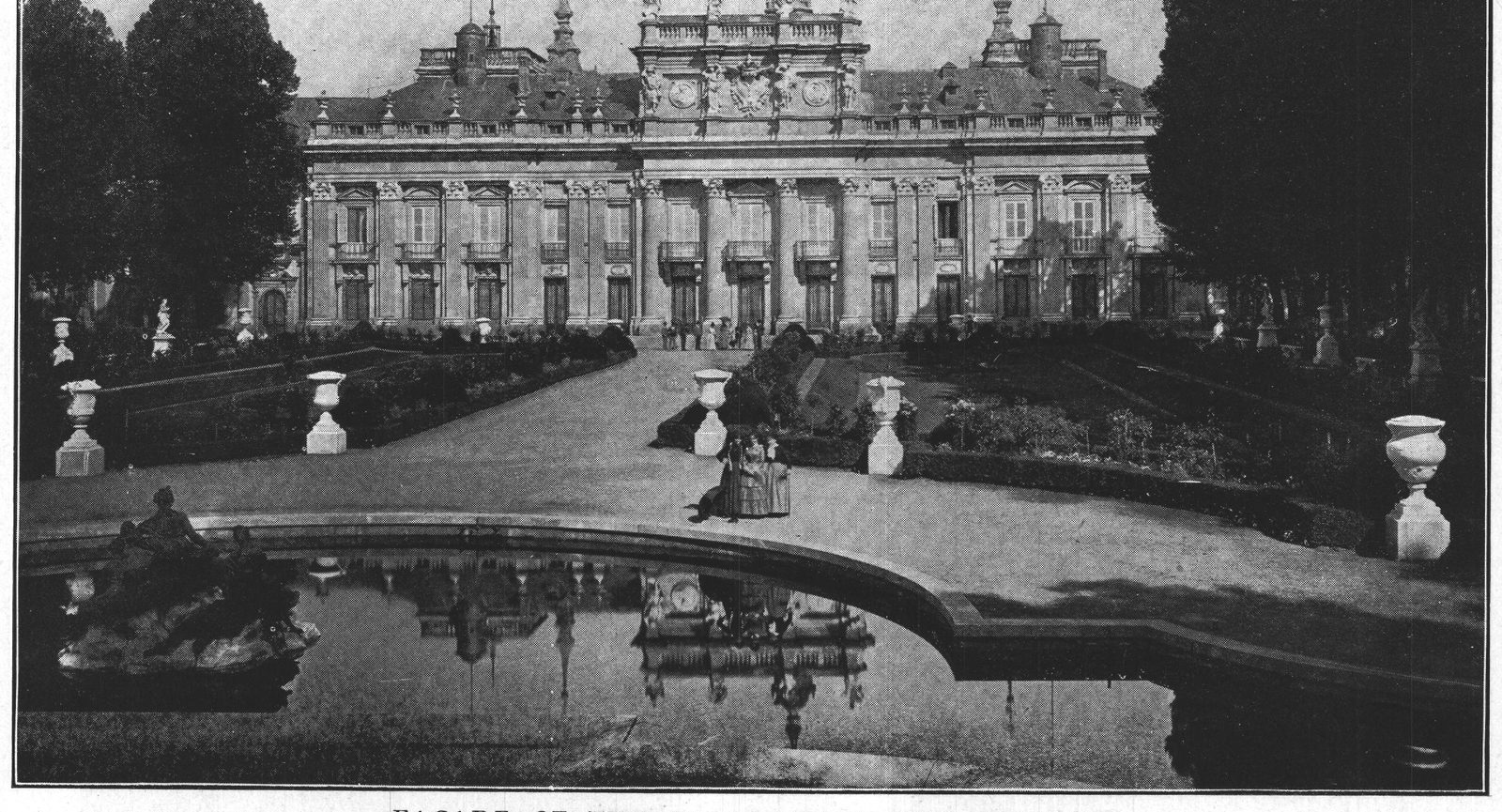
We followed him into the palace, and our "Castle in Spain" lay before us. Through its windows we gazed for a moment across and beyond the trim garden, where there burst upon our sight that which hurried us forth into the sunlight, leaving our astonished cicerone descanting on the interior glories of the palace, and chiefly on the marvelous mirrors of the room in which we had been standing, one of whose crowning merits in his eyes was that they were products of the village in which they hung.
It was Nature's first mirror which had enchanted us. Tumbling from the mountainsides, falling from basin to basin, and into successive pools till the torrent reached our feet, spouting here from lofty jets, and there from finely modelled leaden heads, came the purest of crystal waters, now dazzling in the brightness of the meridian sun, now flowing swiftly by our side from pool to pool, enclosed by cool, deep woods, which now shadowed vases and statues, and again revealed enticing paths, leading away to unknown new delights, while in the distance, forming a background to the lovely picture, stood silent and serious sentinels over the enchanted ground, the wooded peaks of Guadarrama.
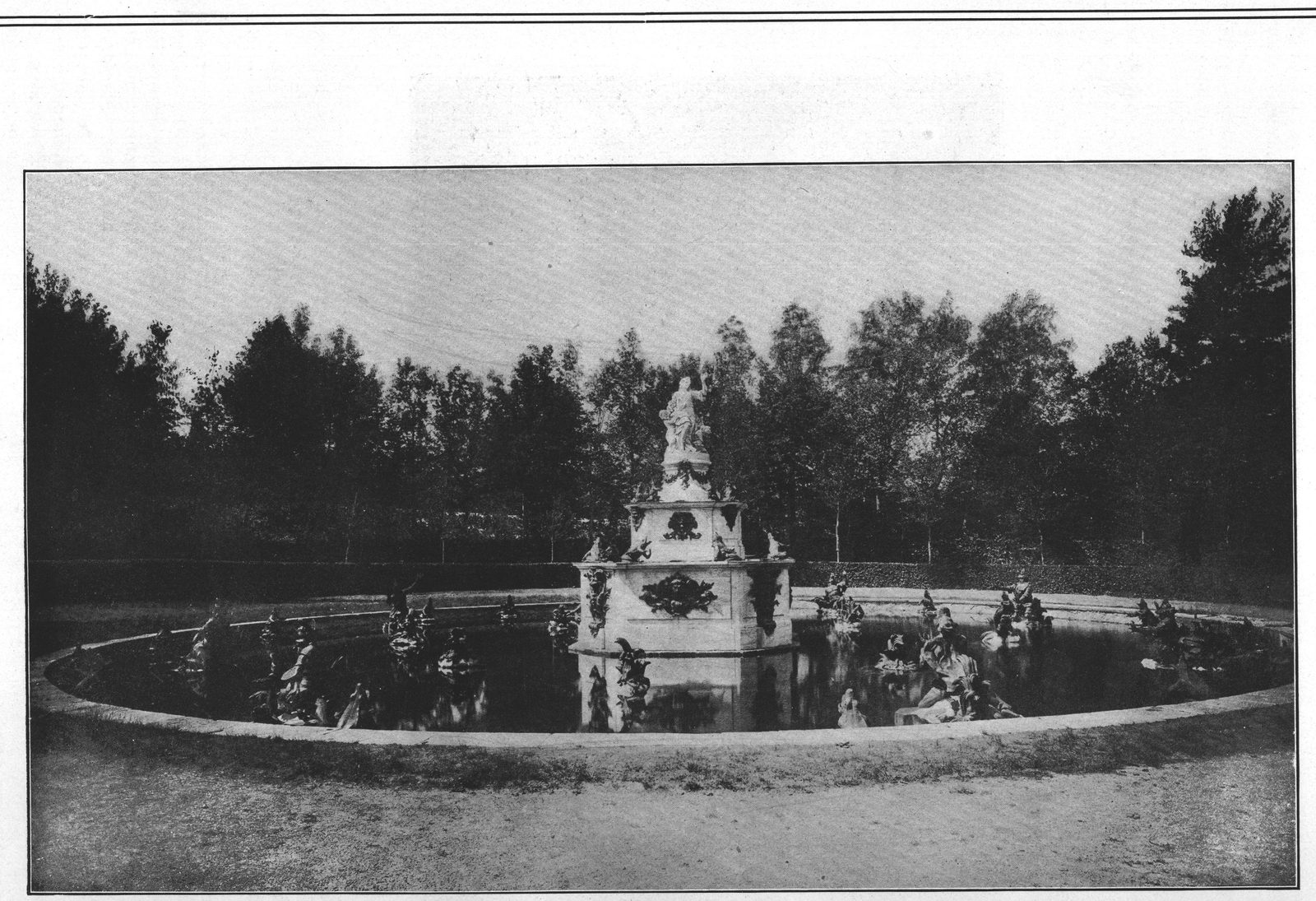
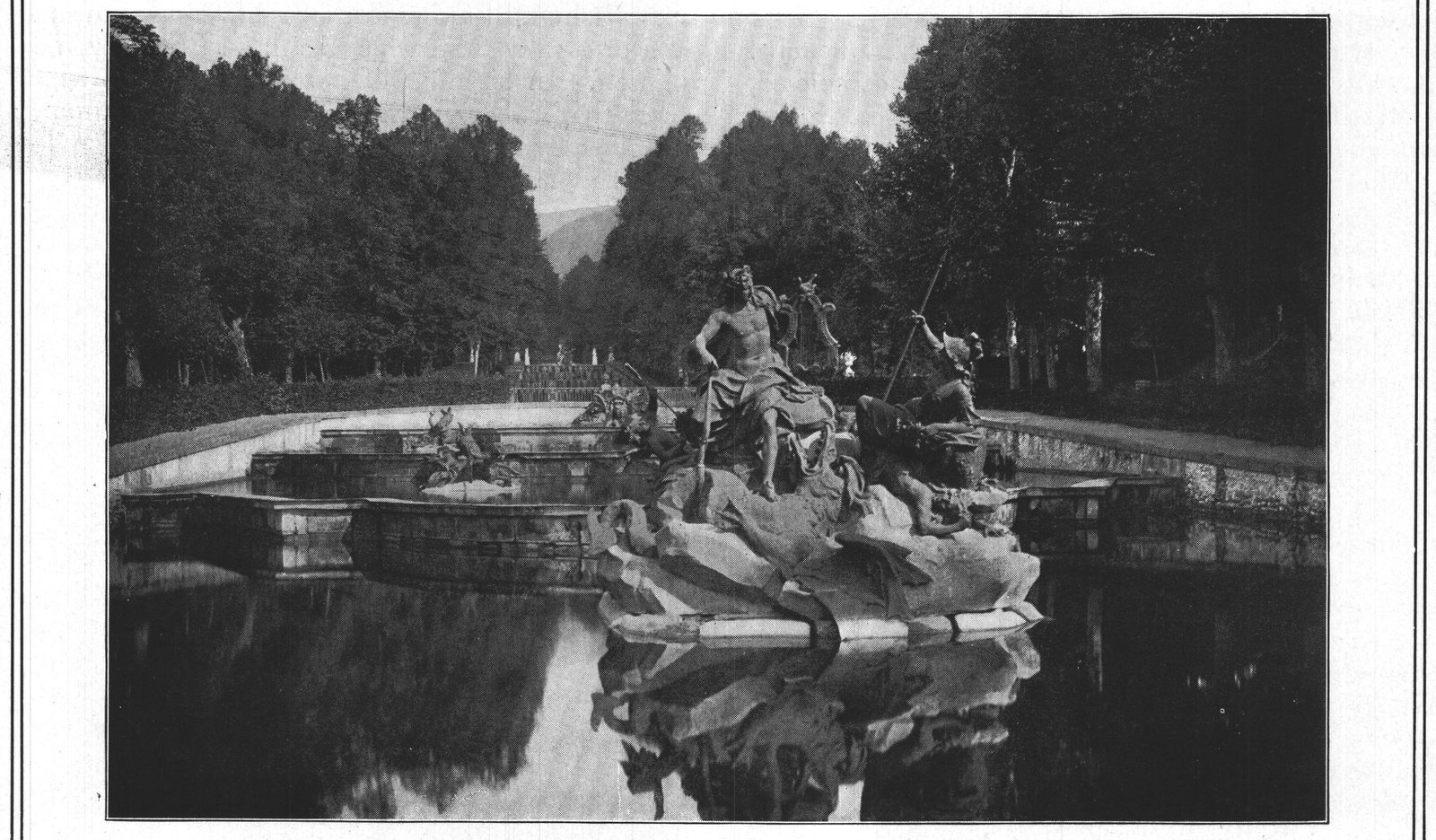
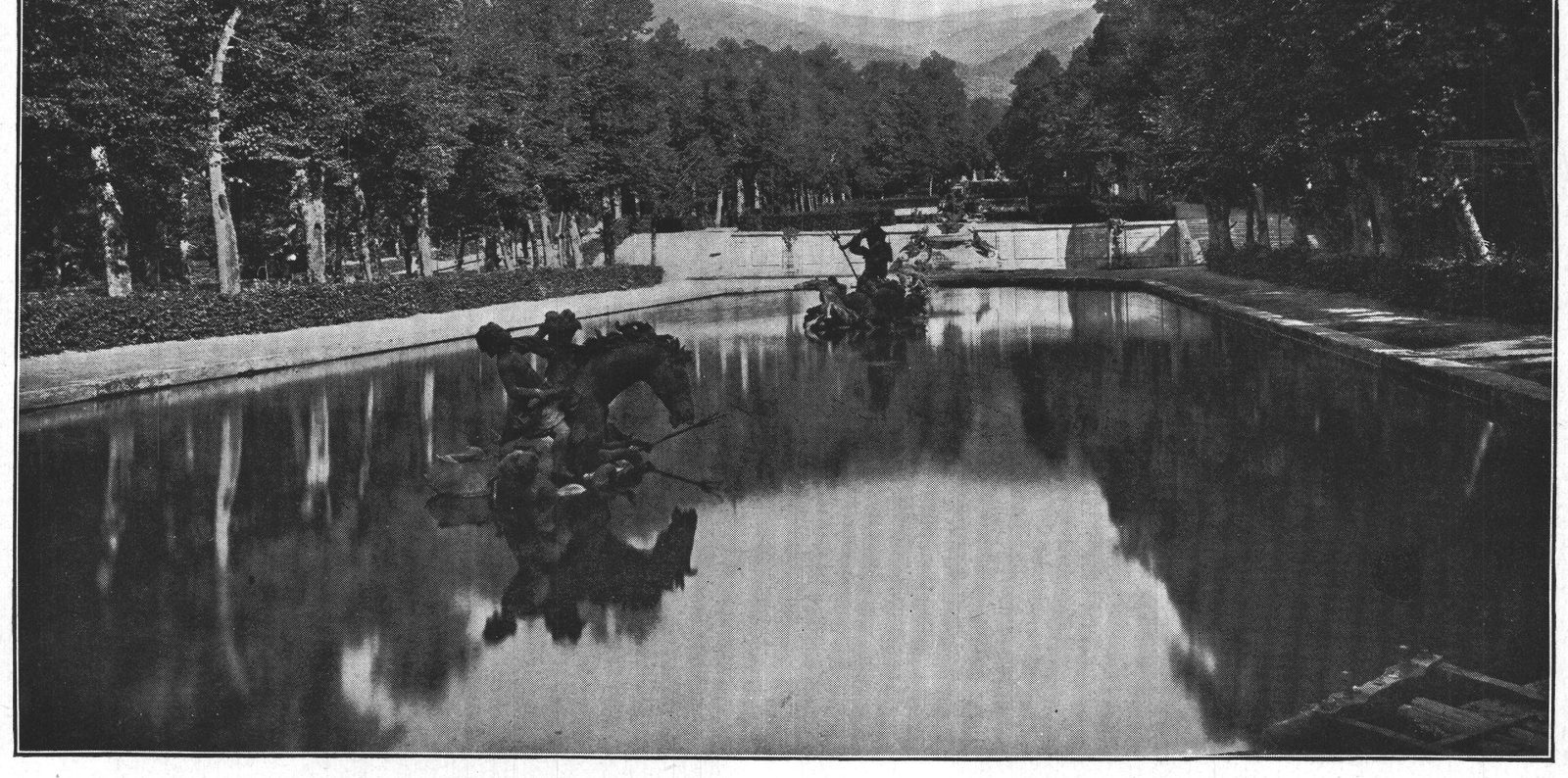
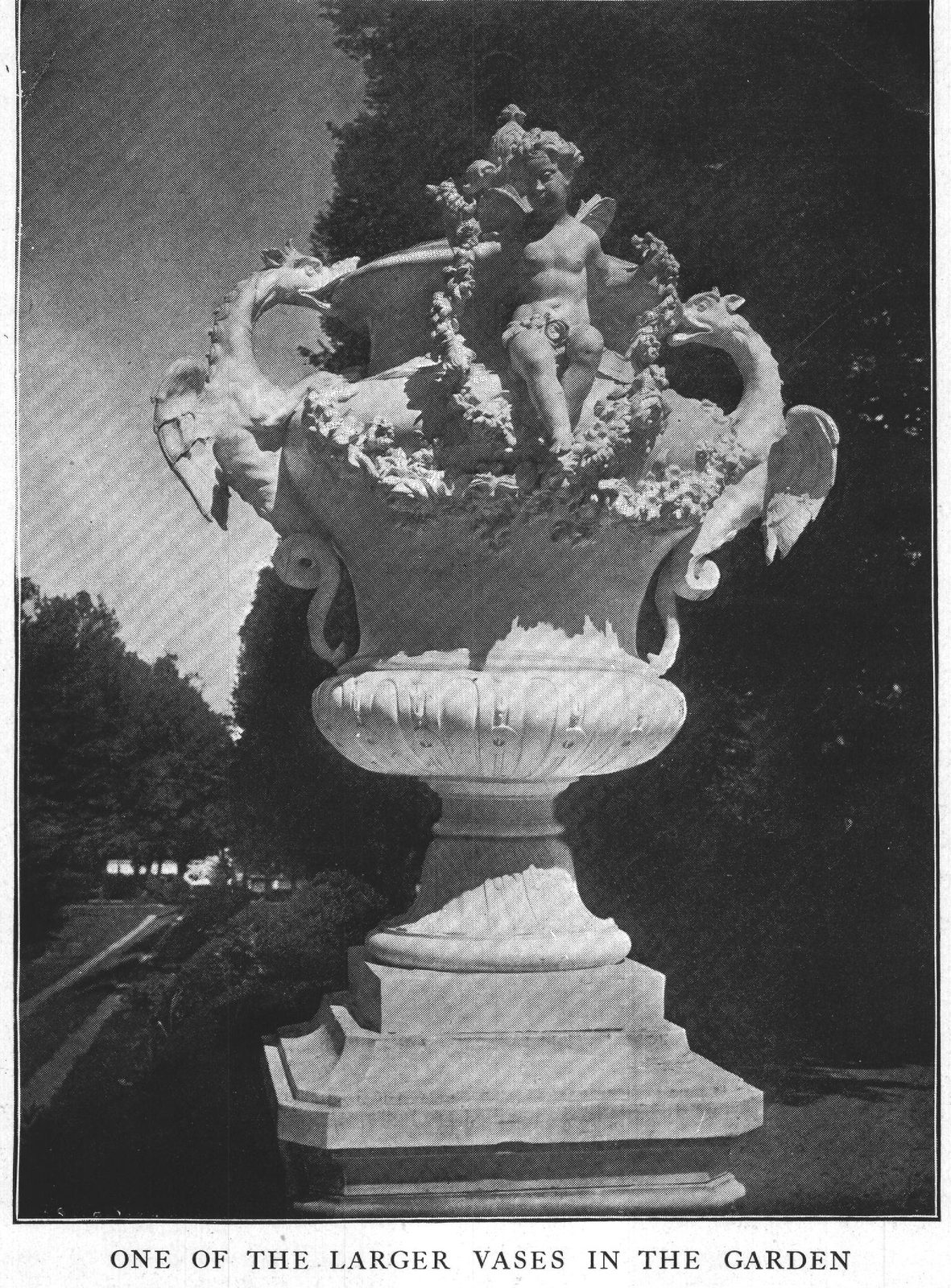
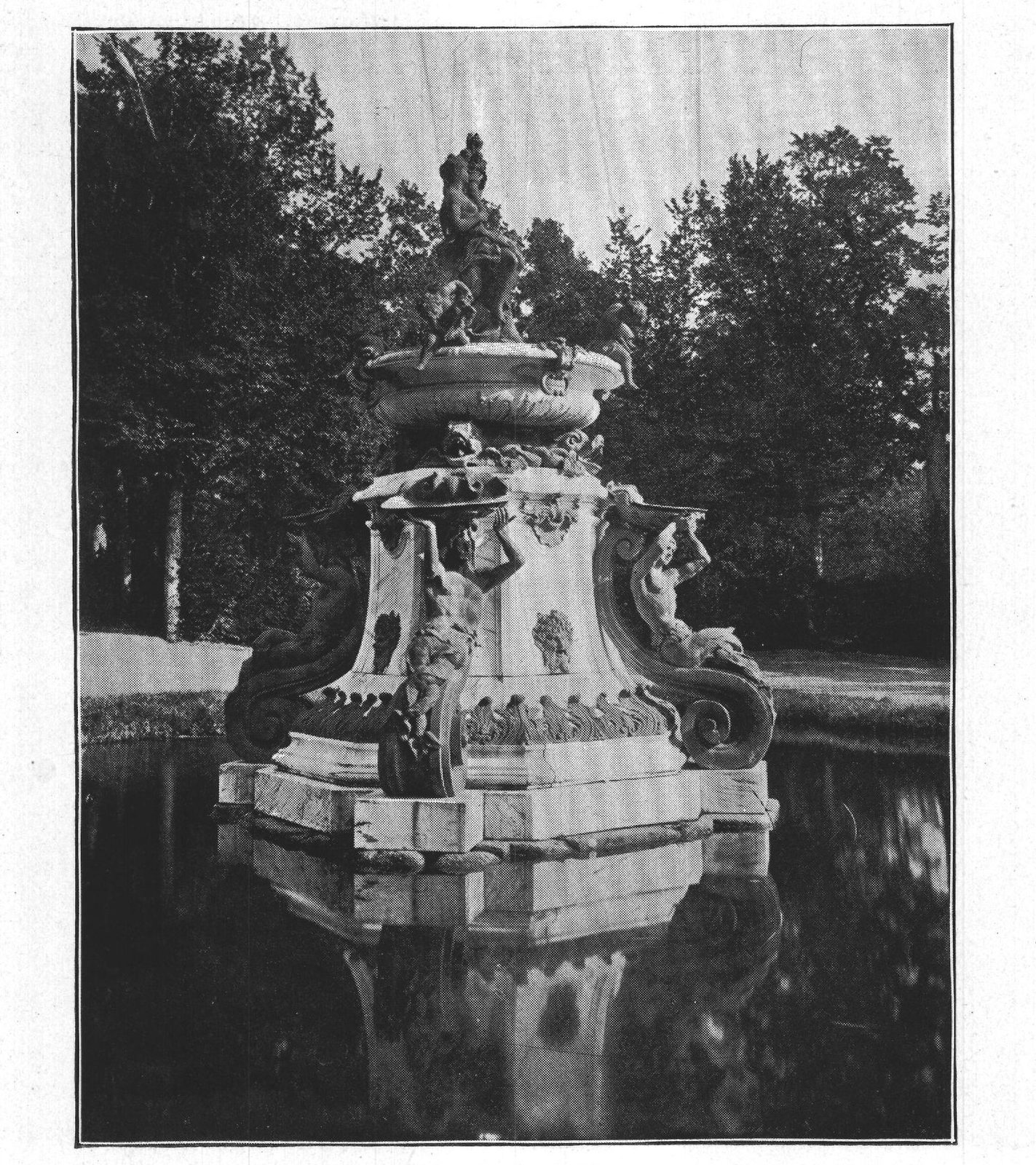
This was the gem of the garden, the far-famed Cascada, fed from the great reservoir high up on the mountainside, which, collecting the waters from many springs and streams, pours from its lip a vast volume which is led, in all ways that can be imagined to produce the finest scenic effects, down to the garden level. Thence the water is led away with delightful irregularity of plan, forming in striking contrast with the roaring, tumbling current which had first attracted our attention, the quiet, dignified pools of the fountains of Neptune, with its lower and upper basins, in which are displayed striking groups in bronze of sea-horses, children, and mythological figures.
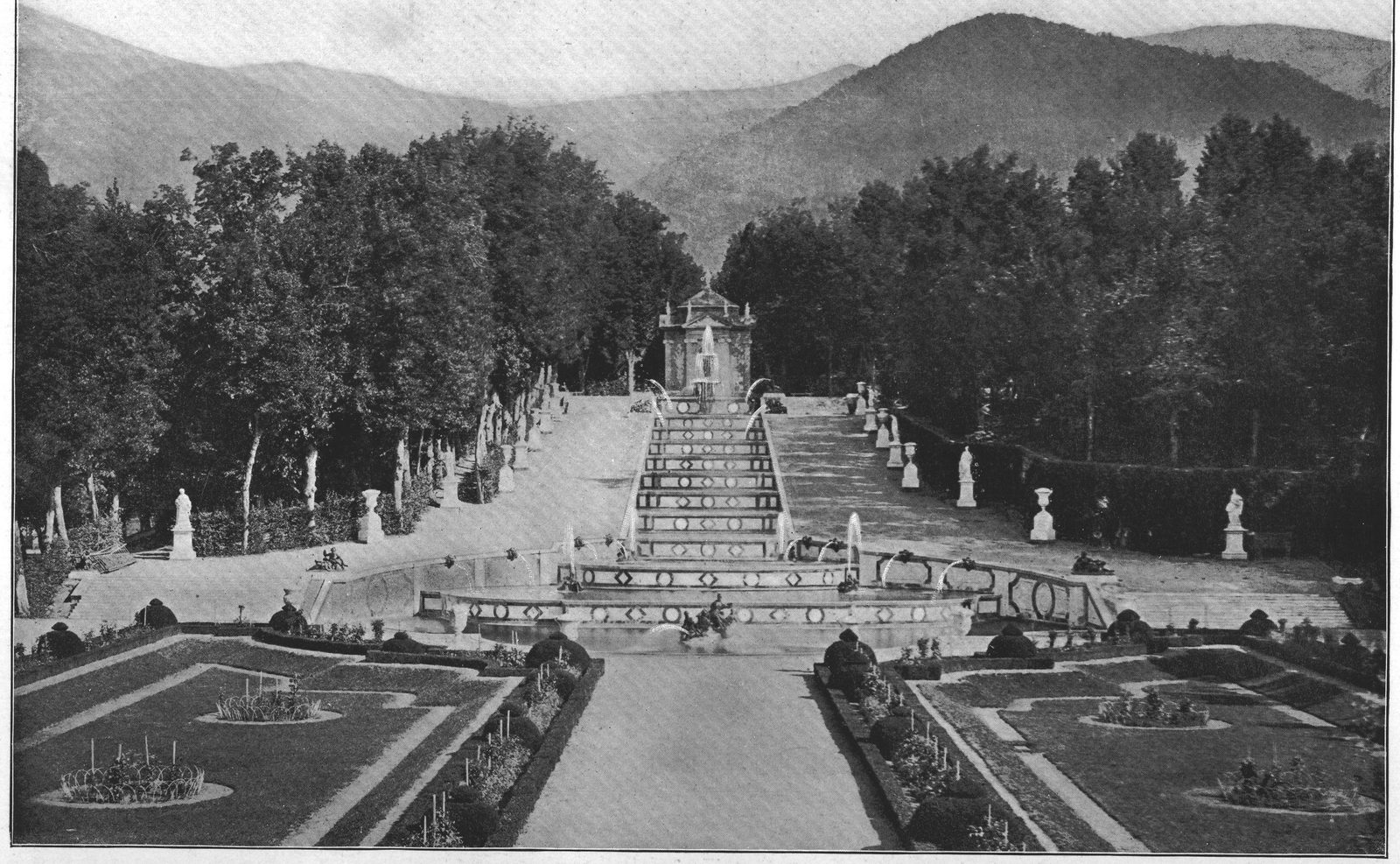
Our genuine enthusiasm here quite reinstated us in the favor of our attendant, and soothed his spirit, ruffled by our heedlessness of his eloquence; for with a ceremonious wave of his enchanter's wand, he touched some unseen and unsuspected source, and again, as by magic, new fountains flung their waters high in the air.
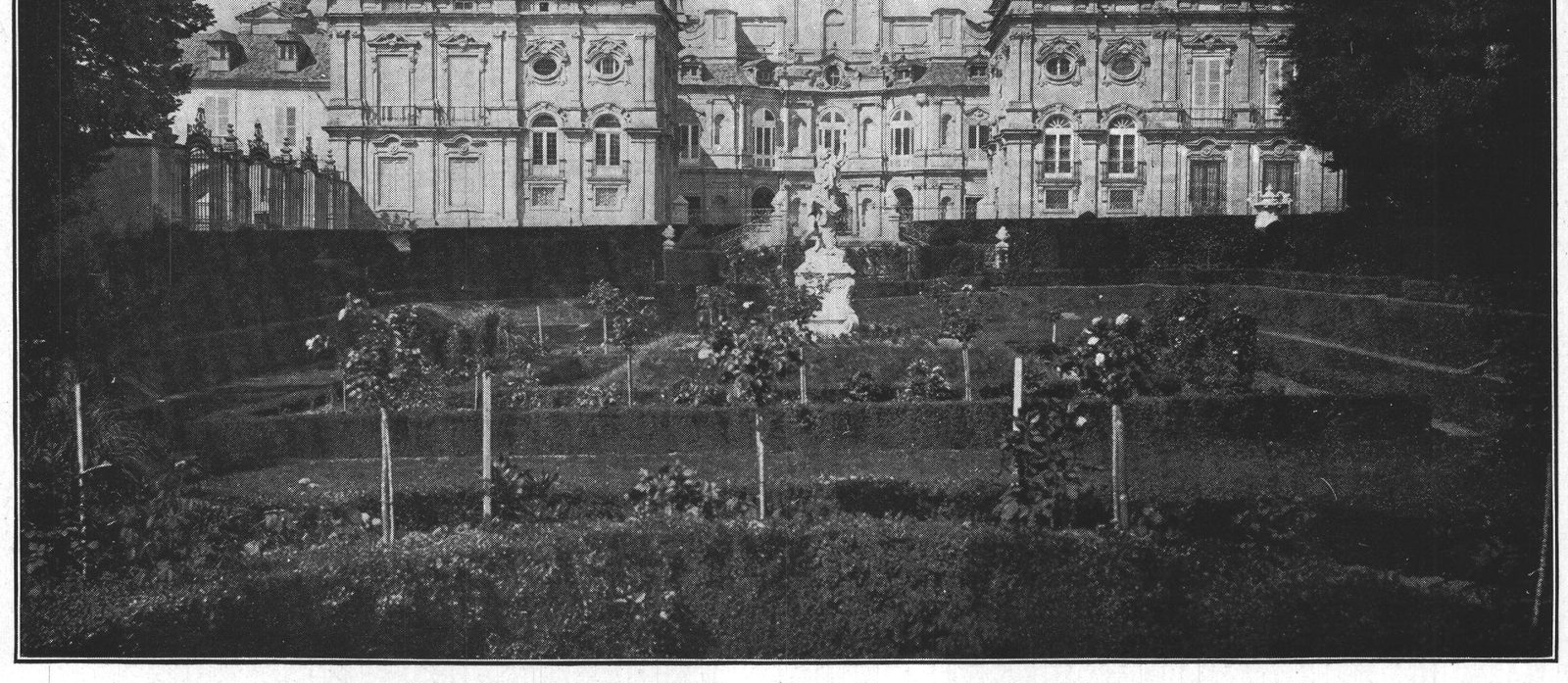
He then conducted us past the parterre, and through a box-bordered garden, where we first caught sight of the exterior of the palace, gay in general effect, but showing the disregard of rules which is so common a feature of the Spanish architecture, created when imperial wealth and power commanded the services of the world's best architects. These men, though they brought with them great technical knowledge and skill, seemed inspired by their unwonted surroundings to ever branch out into new forms, often charming, but governed by no accepted rules.
Here, once more, an aqueous surprise awaited us; the great fountain whose peer is not to be found in Europe, a single huge jet rising to the height of 130 feet, fed, and sustained by the great reservoir, in the hills above. One must have traveled for some days through the dusty, sterile, treeless plains and mountains of Central Spain to appreciate the full joy of the lavish profusion with which water is cast abroad here, as if what might elsewhere be the restriction of prudent use, would be in the presence of an exhaustless supply, but a causeless parsimony.
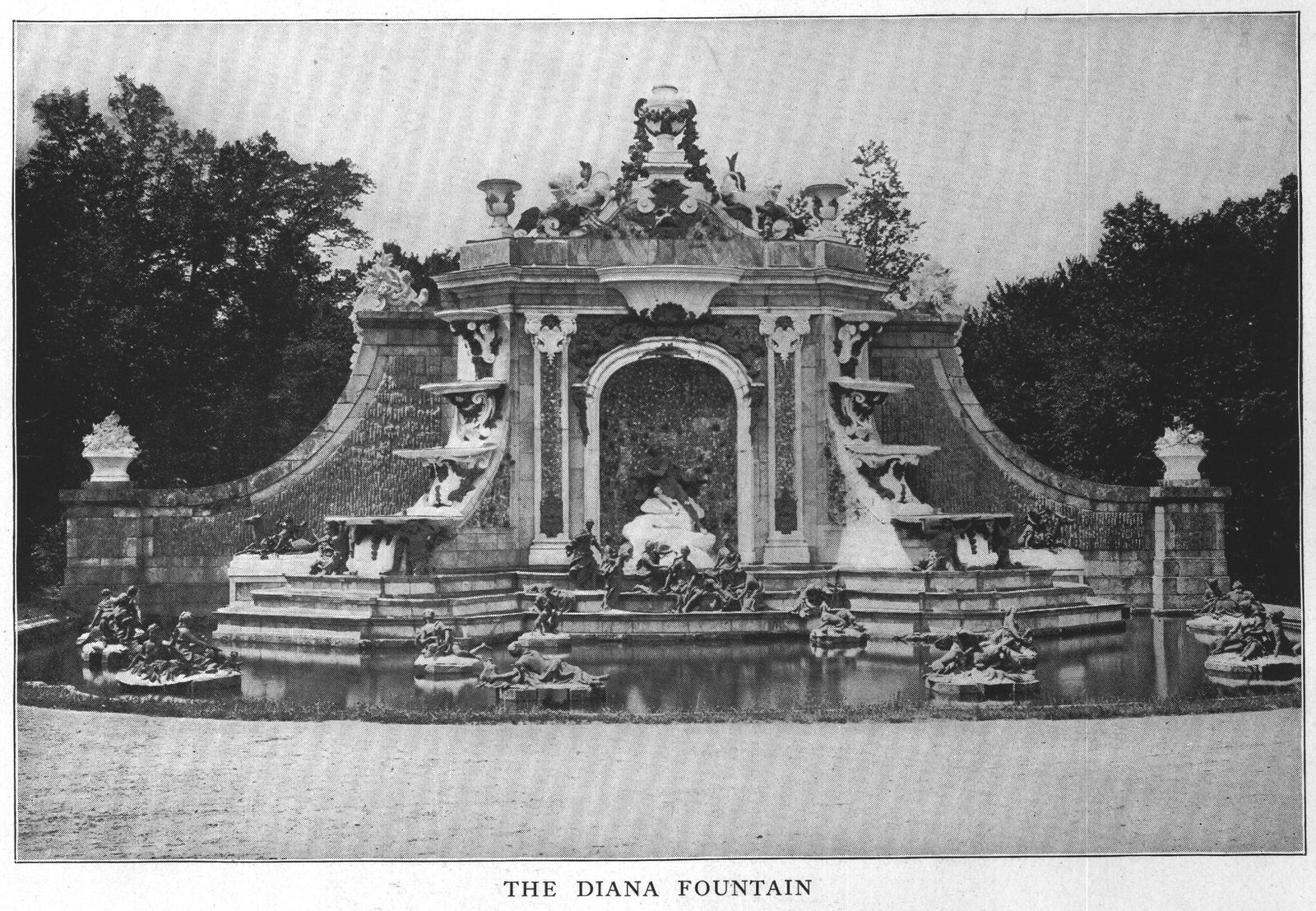
Having sated our wonder and admiration, we sauntered on through shadowed roads. How gay all seemed,—a fountain here, a fountain there, the formality of architecture of the well-cut stone of the pool margins and cascades changed to rural simplicity; shaded paths crossing small brooks by rustic bridges, with just here and there a formal bit to remind us that we were traversing the pleasure grounds of earthly royalty, and not a pure dream of Nature. Fantastic features were not wanting, the baths of Diana seemed to have been conceived in sport. One trick fountain attracted spectators to its brimming basin, only to scatter them occasionally by its unexpected and irregular overflows.
As we next began to climb through the gardens we came soon to realize the altitude at which the waters are gathered, which furnish so many and so various delights to the royal pleasure grounds, and the course of the cataract brought us to El Mar, "the sea," as the dwellers in these arid lands were pleased to name it.
Our afternoon reverie was concerned not so much with the interesting bits of history which have been enacted here as with the character and the tastes of the designers and builders to whose skill and labor we owed the present enjoyment. The minds that saw such wondrous possibilities in the then wilderness of mountains, forests and springs, and brought out so much of sweet and healthful beauty, seemed worthy of admiration and emulation, as well as of study, if perchance one might catch the trick of such development.
Lying high on the northern slope of the Sierra de Guadarrama, which mountains divide the ancient kingdoms of Old and New Castile, with trees of luxuriant foliage, pure, cool and stimulating air, and an abundant and perennial water supply, the monarchs of Spain early realized and proceeded to develop its natural advantages that they might make it a summer retreat from the hot and dusty rolling plain, on which their lives were of necessity largely spent. The huge peak of Pañalara, rising to the altitude of 8000 feet above the sea level, looks down upon this site, guarding it and shielding it from the almost intolerable heat of the summer on the vast, treeless, wind-swept plateau, on which Madrid blisters in summer and shivers in winter.
As early as 1450, Henry IV., of Castile, decided to build here a shooting lodge; and as he was a devout churchman, he founded near the selected spot a hermitage, which he dedicated to San Ildefonso. The shooting lodge grew into a hunting château at Valsain, a granja, or grange; the village of San Ildefonso sprang up near the hermitage, and the whole became the much desired summer retreat for the court, it being distant from Madrid about sixty miles.
La Granja was originally a grange at the foot of the Guadarrama mountains, belonging to the monks of St. Jerome. They presented this estate to Ferdinand the Catholic in recognition of a donation which he made them after the conquest of Granada. Its fortunes were comparatively humble for several generations, its use as a summer palace not being conceived till 1700, in the reign of Charles IV., after the château at Valsain had been entirely destroyed by fire.
When Philip V. came to the throne in 1701, a Bourbon, the grandson of Louis XIV. of France, brought up at the French court, and familiar with the beauties of Versailles, he seems to have determined to emulate them in order to glorify the capital of his new realm. He saw in La Granja natural advantages which would enable him at greatly less outlay of money, and without the heavy cost of lives which his grandfather had wasted in the making of his highly artificial creation of Versailles, to create a summer retreat worthy of the greatness of the state to whose government he had fallen heir; and which, favored by the singular natural endowment of the site should be unique and individual, and not a mere copy of what the French king had produced.
He began, by a large extension of his domain, acquiring the reserved rights of the monks of Parral, by promising to construct for their use another monastery on the banks of the Rio Frio, where they would be less disturbed by the gayety of the court, and the court less restrained by their proximity.
San Ildefonso lies in the latitude of Naples, at about the altitude of the summit of Mount Vesuvius, but the surrounding mountains which far overtop it, its wealth of forest, and its abundance of water, rare at so considerable a height, were gifts that were all its own, and suggested possibilities of development unique among royal pleasure grounds. Its great altitude fitted it in his imagination for the resort of Spanish royalty, which seemed to him, and still more to his people, who thought their sovereigns the most exalted of human kings, to be properly placed so near the clouds; and its other great gifts he proceeded vigorously to develop.
He was not so fortunate as to secure the services of an architect and a landscape gardener so great as to write for themselves and for him enduring names in the temple of fame, but he and they wrought wisely and patiently through a number of years to evolve the best result that was attainable—given the site, the money, and the labor required.
The pecuniary means at hand were moderate; for Spain, naturally a poor country, made poorer by the idleness and improvidence of its people, and by the enormous expenditure of the war of the Spanish Succession, and with much less developed methods than France had under Louis XIV., of wringing a large revenue from its citizens, could not in any way produce the great sums that had been lavished upon Versailles.
But Philip had still goodly revenues at command, and as soon as he became the sole master of La Granja, he set to work with his engineers and his architect to demonstrate what could be made of his new plaything.
The arid, open mountainsides were to be changed into the cooling, wooded seclusions of a garden, trout brooks to be made into broader and more gently flowing streams, pools and ponds should become miniature lakes, and fountains should burst forth from rocks in cooling play. Tiny waterfalls should flash from mossy heights, the level and sometimes marshy ground at the foot of the descent should be developed into parterres and such well-kept bosquets as were associated with recollections of his youth.
Philip charged his architect-in-chief to restore or re-arrange the old monastery as might seem best, that it might serve as a dwelling-place for the royal family, but he strictly enjoined him to destroy nothing. The plans were soon perfected and approved by the king, and the vigorous prosecution of the work was ordered.
At the same time his engineer, Marchand, commenced the task of grading the lesser hills, and planting the gardens, the cultivation of which was confided to Boutelet.
The best sculptors of the day, Forman and Thierry were empowered to produce in bronze the fountains and also the ornamental work that was to border the basins and cascades, but this proved too great a task and required too long a time, and the king was forced to content himself with the execution of much of the minor work in lead, colored to match the genuine bronze.
The whole enterprise went forward so quickly that even in Spain, where the time to do anything is always to-morrow, the work which was not started till 1719 had, in 1723, so far progressed that the former habitation of the monks had assumed the air of a small palace, and the fields and woods of the grange had been transformed into a labyrinth of paths, bosquets and cool, shaded glades.
On the ground floor of the monastery a dozen rooms had been prepared as museums and galleries wherein to display a collection of remarkable antique statues and bric-a-brac which had once formed part of a collection which the able but eccentric Queen Christina of Sweden had gathered in Rome, and which, after her death, had been purchased for Philip by his ambassador at that court.
Six rooms were set apart as the king's suite of apartments, and four were reserved for the use of his queen, Isabella Farnese, of Parma. The rest of the building was appropriated to the use of the royal household, and ample provision was made for the service of religion, and for the accommodation of the attendants of the court and the work people.
The work on the gardens and landscape architecture kept pace with the construction of the buildings, though the changes undertaken were of much greater proportions.
The abundance of water, and the height at which it first came to the surface, permitted the establishment of reservoirs at a considerable elevation. The chief one, an artificial lake to which was given the pretentious name of El Mar, was placed so high—two hundred feet above the level of the palace—as to give enough pressure to throw jets of water high into the air from many piped fountains in its descent to the lower altitudes.
The streams which had once wandered at will through La Granja as open brooks, were now largely conducted underground, coming to the surface occasionally as bubbling cascades, losing themselves again to reappear unexpectedly and supply some fountain or to form a stepped cascade, leading toward the palace over ever lower basins. The glorious plane trees were so placed and tended as to produce shaded groves, in the midst of which fountains played, glittering as the rays of the sun fell upon them through the trees.
Only near the terrace did there appear reminiscent of royal Versailles the parterre, and the grand walk looking away across beds of flowers and sheets of water, the vista terminating in the everywhere dominant mountains.
Here and there on these lower levels, statues and vases lined the avenues where the bordering trees were planted formally, and walks led from fountain to fountain, whose artificiality contrasted strongly with the entourage of hills, rocks and pines whose only gardener had been Dame Nature.
But the unique and crowning glory of La Granja was the fountains, for which Versailles gave the suggestion, but which far outshone their original. No turbid puddle forced up by noisy pumping engines supplied the liquid element, but a crystal mountain stream fresh from the wild heights of Guadarrama here flashed and laughed and glistened as if, after bondage underground, it rejoiced to greet once more the fresh, pure air in the Cascada Cenador, which, under the glistening sun and the azure Castilian sky, glitters like molten silver, reflecting later in its quieter pools, the deep, cool shade of over-arching boughs.
Philip's landscape gardening, when completed, covered an area of three hundred and sixty acres. He gave to the task a constant, loving supervision, and the work itself and the after contemplation of it formed one of the purest and most tranquil joys of his whole life. It marks some fine strain in his character that, brought up as he had been among influences which promised to develop only his lower qualities, he should still be able to love deeply and permanently the quiet and restful intercourse with Nature which he found here.
His work at La Granja completed, he seemed to find the intrigues of the court and the cares which must beset the wearer of a crown growingly distasteful. He longed to lay down the government of his restless and turbulent dominion, and to pass his remaining days, not in monastic retreat as his more serious predecessor, Charles V., had done more than a century and a half before; but, in the quiet of this mountain fastness to escape from the unceasing battle with the forces which were arrayed around his ambitious, unscrupulous and intriguing queen.
He yielded to this wish for peace in 1724, surrendered the throne to his son, Louis I. of Spain, and retired to San Ildefonso to live a life of peculiar simplicity. But his freedom was destined to be of short duration. Louis died after a reign of eight months, and the father was forced to resume the burden of royalty from which he had so recently freed himself. In his after life, which was extended for more than twenty years, he passed all his summers in the enjoyment of the peace of La Granja; and he and his queen lie buried together there.
Our concern here is not with the questions of Philip's worth as a man, or his success as a ruler. Doubtless the union of the crowns of France and Spain under the rule of the Bourbons, with which the welfare of Europe seemed for half a century so bound up, turned out to be a matter of no great moment, and not worth the intrigue and the treachery which brought it about. We are only interested in the skill with which he and his advisers conceived, and the success with which they carried out this bit of landscape gardening, and the architecture of this royal summer retreat, which, slight as they must have seemed at the time of their creation, have long outlived the political schemes which wasted for twelve years the blood and treasure of Europe. Philip's successors found La Granja to their liking. His son, Charles III., amused himself by putting the finishing touches on his father's work, and during his reign the summer always found the court there.
He conferred a benefit on the village of San Ildefonso by favoring the establishment there of the manufacture of glass and of mirrors. These factories, once very celebrated, have left little to testify to their greatness, though they have not ceased to exist. The charm of the situation of San Ildefonso promises to be permanent. On the northern slope of the great chain of mountains, which form the backbone of Spain, which arrests and discharges the clouds borne inland from the Atlantic, there would seem to be an assured supply of the moisture so rarely found elsewhere in the kingdom, and which gives such wonderful freshness to this oasis in a dry and burning land.
These musings over the past history of San Ildefonso, tracing on the spot its development from monastery and grange to royal palace and summer garden, repeating what so often occurred in Spanish history, that the spots which were selected by the good taste and practical wisdom of the monks later found favor in the eyes of the monarchs and were appropriated by them for royal abodes, brought us to the close of a glorious May day, and we began to cast about for a resting place. At the very door of the palace we found an excellent hotel where we secured quarters. In an evening's conversation with the landlord, we discovered that a beautiful wild mountain road, practicable only in the summer, led from La Granja over the top of the mountain range into the valley of the Escorial, but it took some persuasion to convince him that we were earnest in our purpose to make an early morning start that we might view its wild scenery in the freshness of the young day.
La Granja is still the favorite summer palace of Spanish royalty. The apartments of the palace are light, airy and agreeable, without being oppressively magnificent. During the stay of the royal family the village assumes its gayest air, the fountains play, and the whole tone of the surrounding region is one of life and merriment.
Shortly after sunrise next morning we bade farewell to the place which had given us such keen delight for a day, and with a four-mule team, guided by a driver on the front seat of our mountain carriage, and controlled by a rider on each of the two near mules, we crossed the Sierra by a road of marvelous excellence, constructed by the Bourbon kings of Spain with reckless disregard of expense, to facilitate the transfer of the court between the Escorial and the gardens of La Granja.