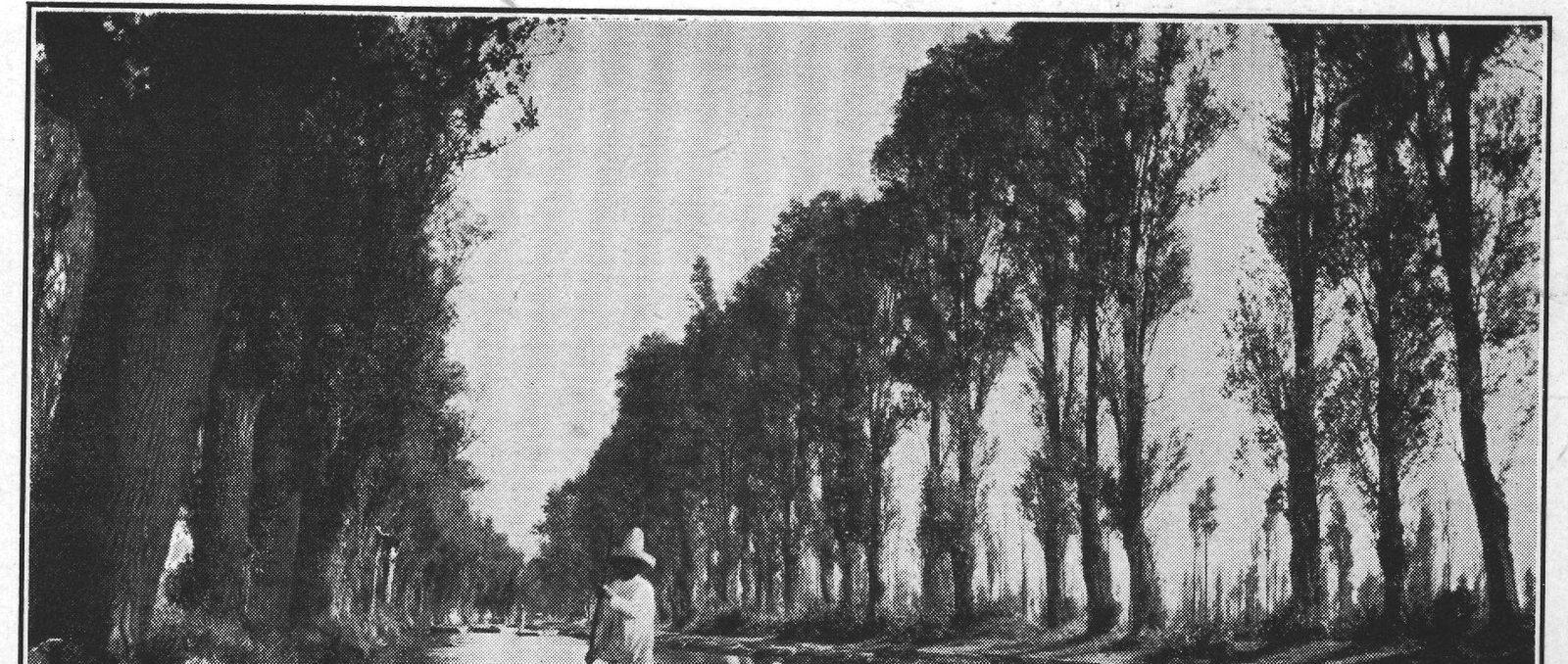
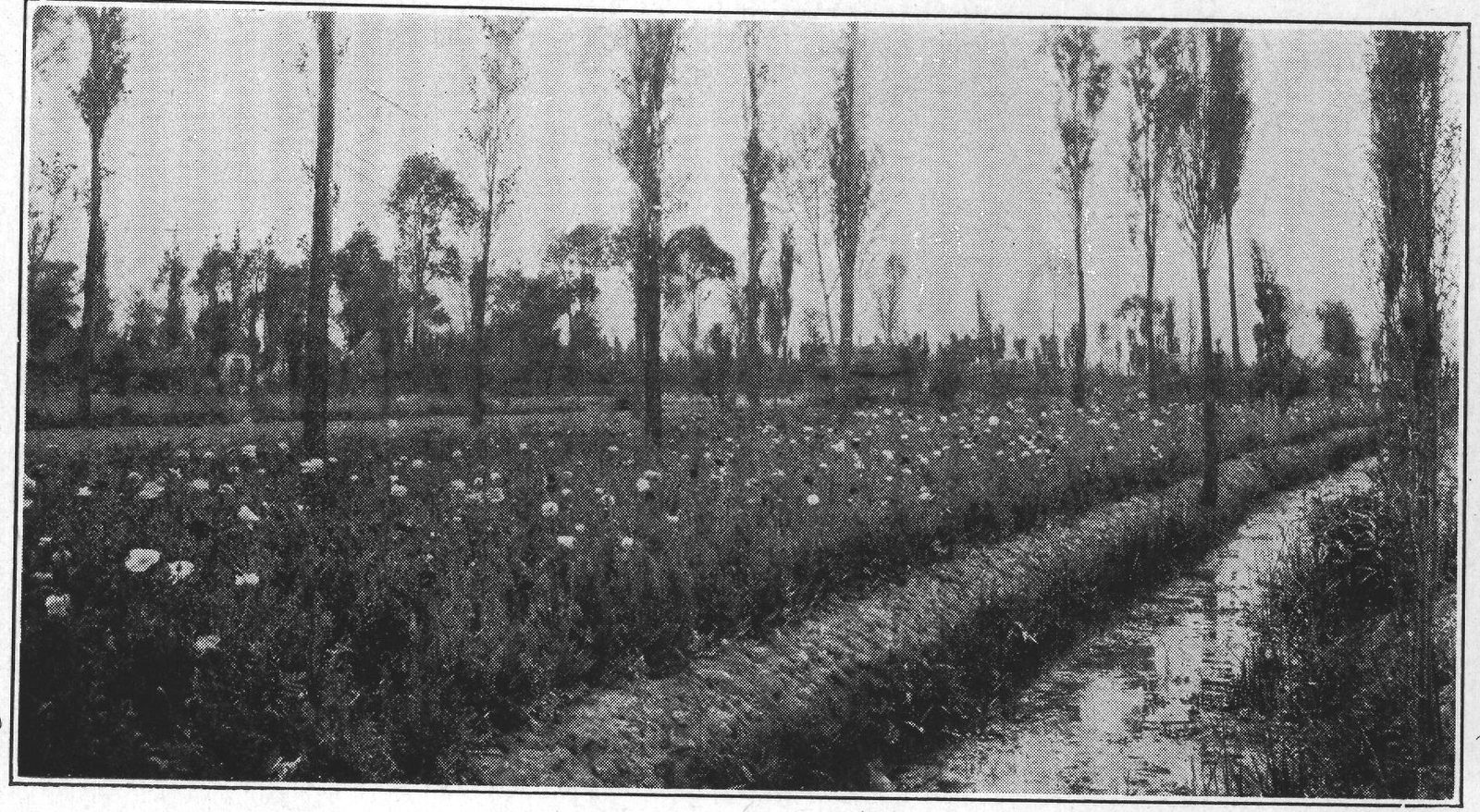
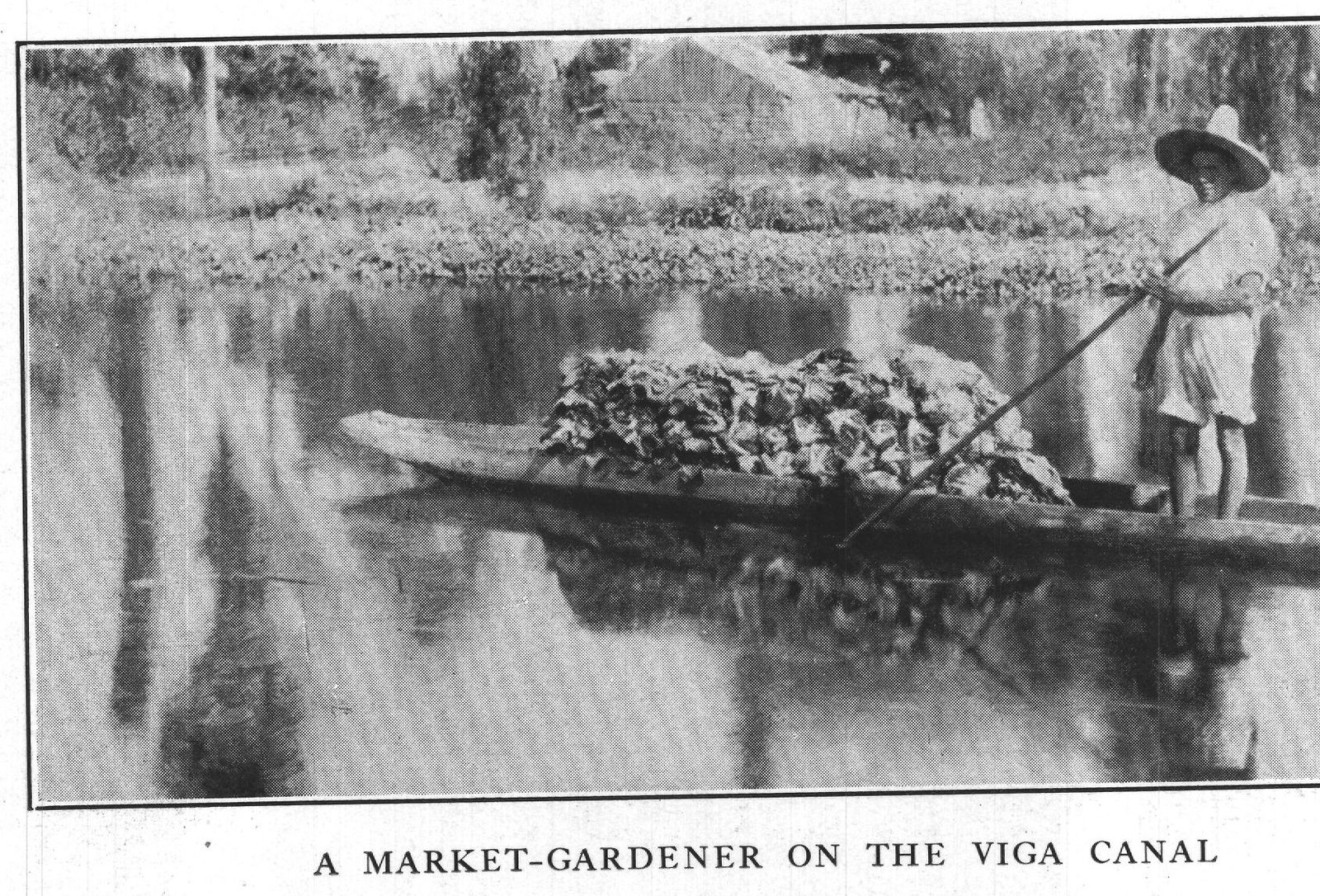
The glory of the floating gardens of Mexico has in a great measure departed, but there remains much that is unusual, quaint and beautiful. They consist of measured squares of ground composed of layers of turf and soil bound together and secured to the bottom by means of long willow stakes which frequently take root in the mud. These squares of cultivated land are intersected by narrow dykes which cut through them at right angles, and they still float on the surface of the water, although they are not navigable as they were in the old days. In those days when dusky princesses, in their gondolas, visited their chinampas or floating gardens, they must have been, according to all accounts, brilliant with color and sweet with the scent of many flowers. In these days, although flowers are still grown there and, in the season of poppies, the banks of the Viga Canal present a vision of pink and scarlet, the chief products are vegetables, a fact which is apt to disappoint the traveler. Cabbages are very good things in their way, no doubt, and so is Indian corn; but to any one who has pictured something romantic, the reality lags behind. All the same, the reality is both picturesque and interesting, as the accompanying illustrations will show, and the aquatic gardeners in their queer little dug-out canoes which rather resemble coffins in size and shape, dart in and out of their waterways with an address and an agility which is delightful to watch.
The history of these gardens dates back to the thirteenth century. When the Spaniards conquered Mexico in 1519, they found the city of Tenochtitlan, the ancient city of Mexico, in an advanced state of civilization. However much modern authorities may differ as to the exact truth or likelihood of these accounts, they are all agreed that there were stone buildings, aqueducts, causeways and other constructions which showed engineering skill, as well as manufactures which proved artistic ability. The genius of the natives was shown to great advantage in the swamps and marshy lands which surrounded the capital city, for here they overcame many difficulties. It appears that great clumps of soil and turf would often break away from the shore, and the thrifty native learned to bind several of these together and to plant the ground with whatever had most chance of being productive. Here he would often erect a hut and live on his floating domain, which he could steer at will with his long pole among the reeds of the salt lagoons and the lakes. The beautiful floating gardens which developed from this primitive idea, are a matter of history, and there is some mention of them in the old picture writings of the Aztecs, where Coxcoxtli, a king of the marshy regions, is represented in his dug-out canoe. This image used to be regarded as a deluge-myth and the king became known as "Coxcox, the Mexican Noah."
The canal of La Viga—the old Aztec canal—is navigable from Mexico City to the towns and villages on Lakes Chalco and Xochimilco. The floating gardens of Xochimilco and Ixtacalco are perhaps more beautiful, both in situation and vegetation, than those at Santa Anita, but as these latter are more easily reached by water from the city, it may be worth while to consider them a little more in detail. The pilgrim to the watery region takes a train from the Plaza Mayor to the Embarcadero, where he finds three or four punts awaiting his convenience. Choosing the most attractive boat, or the most persistent boatman—probably the latter—he seats himself on a little wooden bench under a gaily striped awning and watches his gondolier, if one may call him so, as he deftly gets clear of the various craft which block up the way. He is a picturesque object himself, quite as picturesque as his Venetian prototype, even if his punting is without the graceful rhythmic motion of the gondolier. The Mexican is dressed in white linen, the shirt knotted in front over a scarlet sash, while trousers and sleeves are rolled up displaying bronzed limbs, the lithe, slim limbs of the Indian. On his head is the inevitable sombrero, casting a deep shade on his dark face.
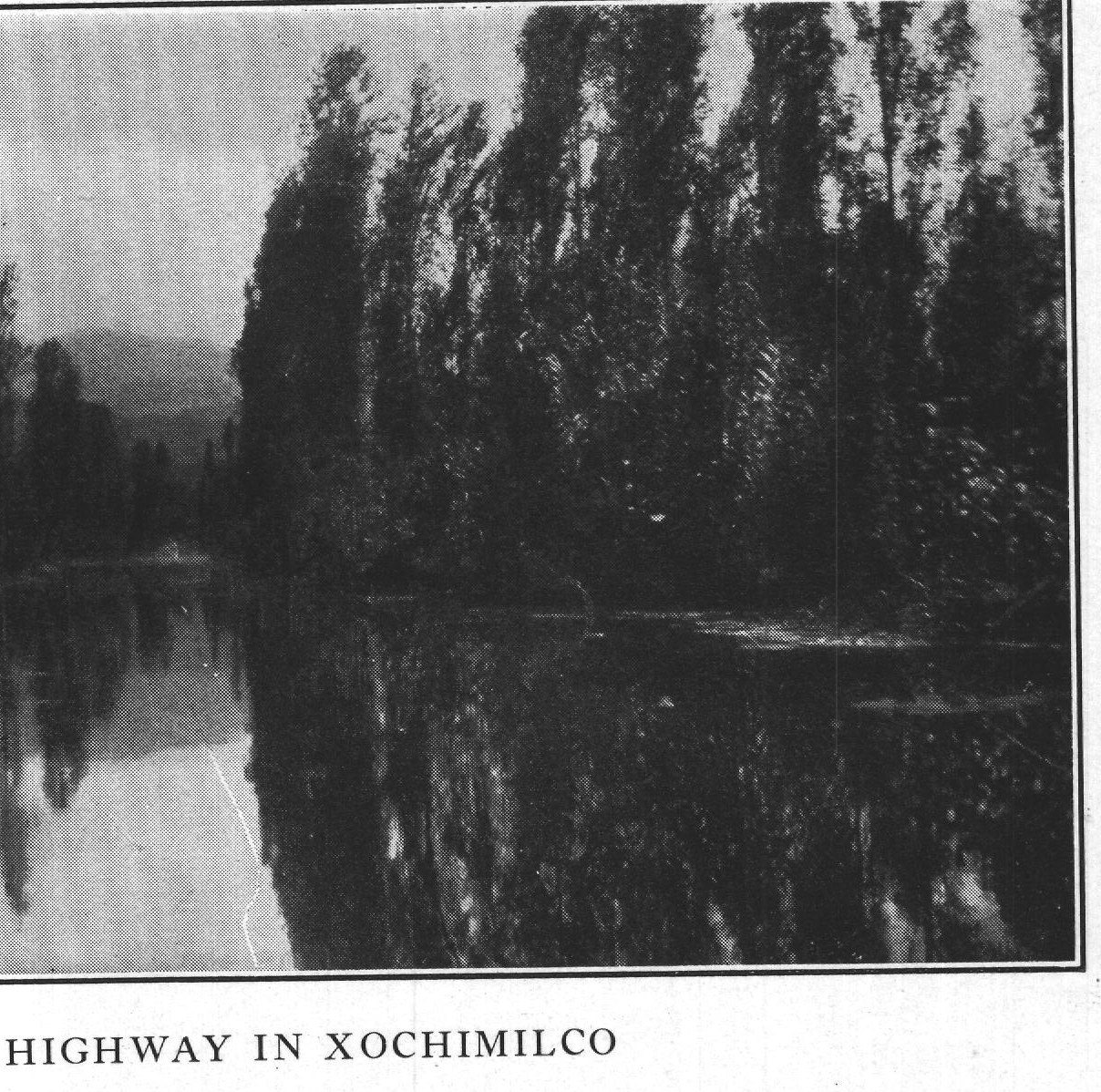
That part of the canal of La Viga which is nearest to the city is not famous for its cleanliness. The water is dirty and full of decaying vegetable matter which falls from the boats or from the piled up masses on the shore. To the left are the long buildings of a distillery; on the right an avenue of trees half hides the Paseo of the Viga and the low line of mean houses and brightly painted pulque shops beyond. Under the trees the men are unloading their market-garden boats, or squatting on their heels, cigarette in mouth, or stretched in the shade enjoying a siesta. The women are busy washing their clothes—and sometimes their hair—in the murky water, or in making tortillas, plentifully mixed with chili and pepper; a popular form of food which has given rise to the saying that no wolf or vulture will touch a dead Mexican, so seasoned is he with these somewhat hot ingredients! The women are generally dressed in colored cotton and wear a shawl draped over their heads which is often of a peculiarly soothing shade of indigo blue. To see one of these women walking barefoot with a great red jar on her shoulders or with a little brown baby tied on to her back is a joy to anyone whose eye is jaded by the incongruities of the modern world. The really beautiful scenery of Mexico owes part of its charm to the invariable harmony of the people who compose the foreground. Here, along the banks of the Viga, it is a perpetually shifting scene of movement, while afloat on the water, the flat-bottomed boats laden with grass and vegetables give great variety to the whole. After a little while the crowd ceases, the houses are left behind, and if we lose in animation we gain infinitely in the cleanliness of the water and the tranquil beauty of the surroundings. A row of willows and poplars to the right makes a thin screen which hardly obscures the view of the purple hills; to the left a high bank rises, shutting out the view. There are quantities of water-lily leaves on the water, clusters of pale lilac blossoms like crocus, and bunches of a green fruit which resembles a fig. The banks are covered with verdure, the sky is blue and the green trees are reflected peacefully in the clear water. By and by the tiny thatched village of Santa Anita appears on the left bank. Passing up the little street and leaving the old church to the left, the traveler finds himself in a sort of little plaza, which has a landing stage, for Santa Anita lies between the canal and the floating gardens. A vivid hedge of double scarlet geranium flanked by the blue green of the cactus, gives a note of color to the scene, as he embarks in the narrow punt which awaits him and seats himself on a tiny wooden bench. The gardener in charge of the boat punts slowly down a narrow dyke which is hardly wider than a ditch, and square gardens succeed each other, planted chiefly with vegetables. Sometimes the boat glides up a narrow waterway almost choked with water-lilies; sometimes it comes suddenly on a patch of maize, and the violet mountains—for once almost lost sight of—reappear framed with the tall stalks of the Indian corn.
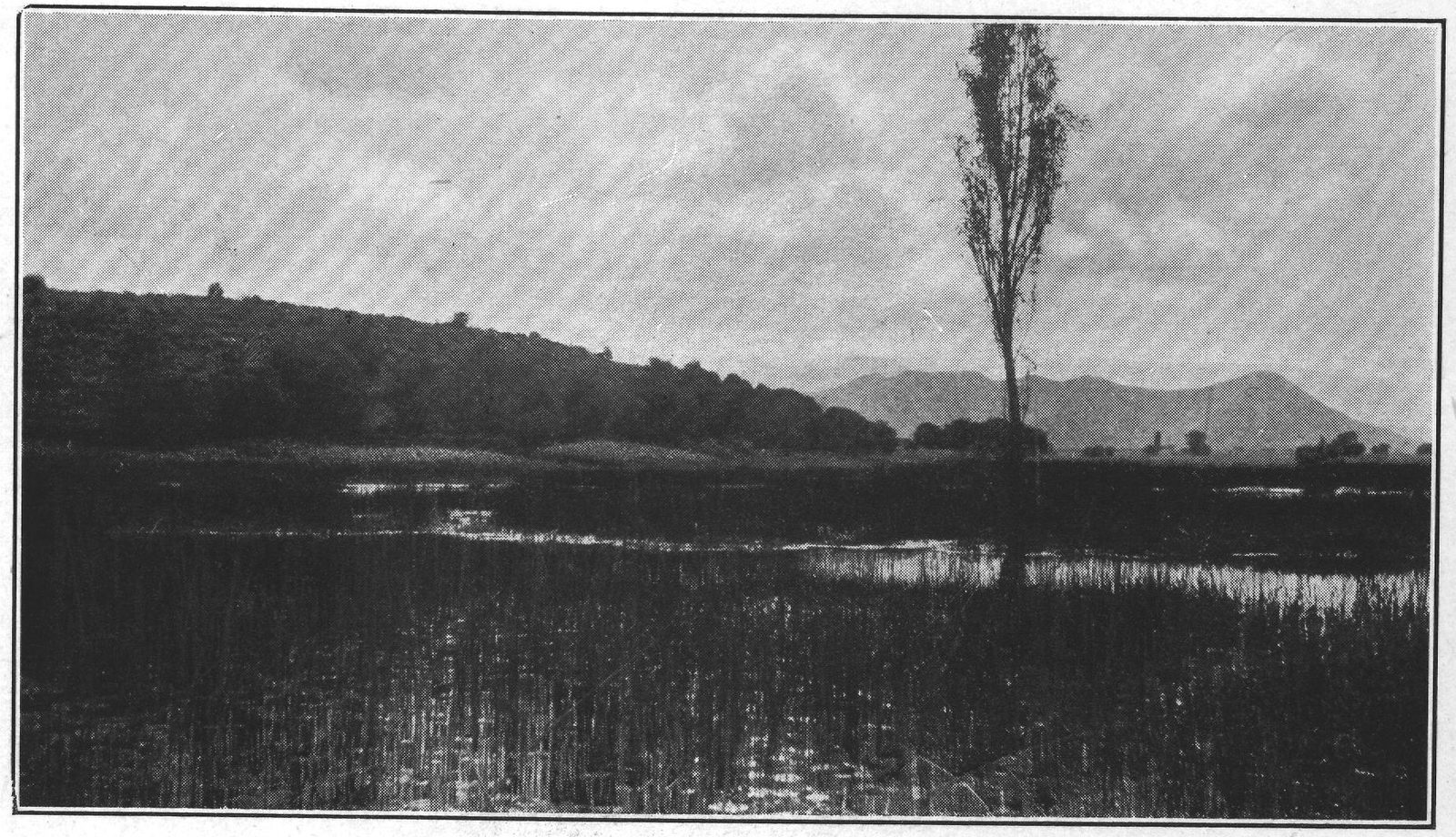
This floating garden has the appearance of being solid ground and very likely, in process of time, the space between the soil and the bottom of the water has been choked up and filled with mud. But the character remains and the effect is unique.
What strikes a stranger most in Mexico is the extraordinary opportunities given by the climate to the cultivator and the sparing use made of them. Much is said of the fine fruit in this country, but the fact is, that the fruit is extremely poor. And this in a country where there are two crops of corn and maize every year, and where, with a little ordinary perseverance and care, so much might be done. It is true that strawberries can be obtained all the year round, but this is thanks to the climate and not to the cultivator. They are tasteless and watery, resembling mountain strawberries without their peculiar delicacy of flavor.
Much of the land is given up to the cultivation of the maguey or American aloe, from which the pulque is made; an intoxicating liquor which is the curse of the modern Mexican, as it was of his ancestors. A great deal of the land is given up to corn and maize also, and not a little of it is either sandy desert or mountain peak. But still there is a vast field for the cultivation of fruit, and as the Mexicans do not make use of the natural advantages of their magnificent country and climate, it seems a pity that some enterprising American should not do it for them. The game is, apparently, quite worth the candle.