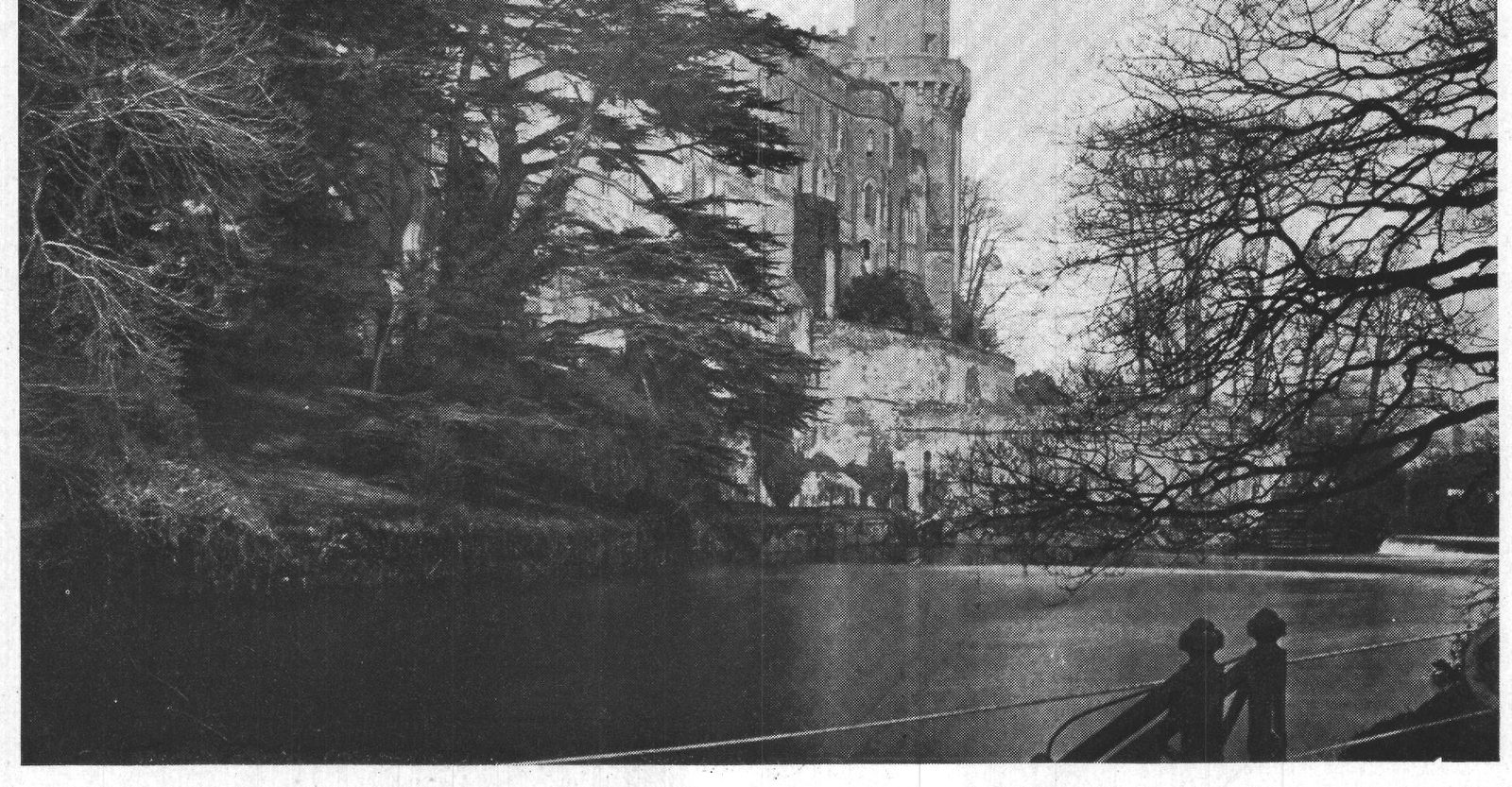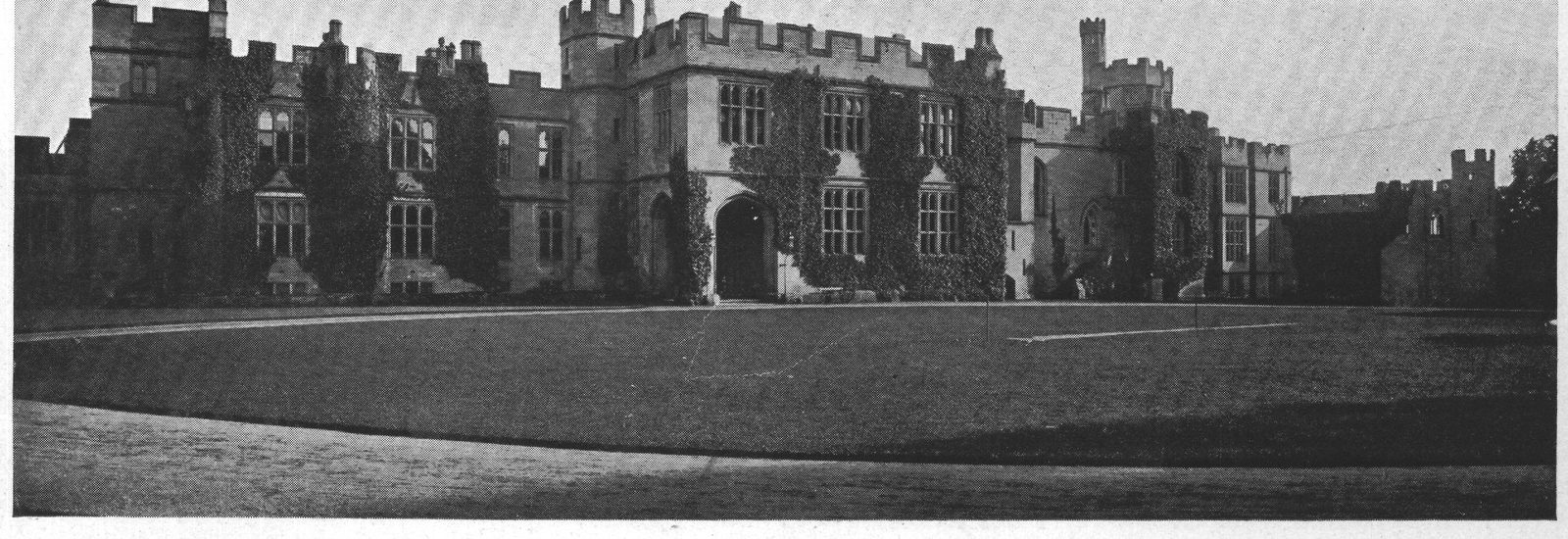
Few of the historic houses of England can compete with Warwick Castle in regard to either its natural beauty, or its wealth of historical associations. It possesses all the characteristics of a mediæval fortress of great strength and grandeur, and may be selected as one of the best examples in England of the castle of ancient days which played no inconsiderable a part in the times of civil strife, and in the political revolutions of our country's annals. Most of our castles are in ruins. They were held by Royalists in the great civil war, and were "slighted" by Cromwell in order to prevent them from proving themselves thorns in the sides of the Parliamentary party. Warwick, having been held by Lord Brooke, who fought on Cromwell's side, was spared and therefore retains to-day all the features of its former greatness, a delightful study for the student of the military architecture of the Middle Ages. It has an ancient lineage. Ethelfleda, daughter of King Alfred, (according to Dugdale) in the year 915 A. D., made a strong fortification here, called "the Doungeon" for the resistance of the enemy, upon a hill of earth artificially raised near the riverside. "The enemy" were the Danes, who attacked Warwick in 1016, and well-nigh destroyed the fortress of Alfred's martial daughter. The Conqueror, who had a keen eye for positions of natural strength or military importance, ordered Turchel to fortify the town and castle of Warwick. Various sums were spent upon the repair of the walls and the maintenance of the garrison in the reign of Henry II., Richard I. and John; but Simon de Montfort paid a surprise visit to the castle held for the king by William Mauduit, Earl of Warwick, and wrought such effectual destruction that nothing of value was left save the herbage in the castle ditches. This earl, like several of his successors had no children, and the castle and title passed to the powerful Beauchamp family. Guy de Beauchamp, with other barons, seized the much hated Piers Gaveston, favorite of Edward II., and brought him as a prisoner to the castle. This wretched person had dared to style the great baron "The Black Hound of Arden." The Black Hound caught his fox and lodged him in the dungeon of the Cæsar's Tower. "Now you shall feel the hound's teeth," said the Earl to his prisoner who, after a mock trial, was beheaded at Blacklow Hill, where a monument marks his memory. To Thomas Beauchamp, Earl of Warwick and to his son, also named Thomas who flourished in the 14th century, the castle owes much of its strength. The former erected Cæsar's Tower. He fought on the bloody field of Crecy where the Black Prince won his spurs, and also at Poitiers, and became rich with the spoils of war and the heavy ransoms of French knights and princes which fell to his lot. He built the church of St. Mary, and sleeps his last sleep in its choir. His son Thomas built Guy's Tower. Another tower tells of his prowess, the Beauchamp Tower in the Tower of London, which marks the site of his incarceration during the wane of royal favor. Richard, the son of the second Thomas, was a mighty warrior, a powerful and successful baron, foremost in valor in the field, a prince among knights. Many tales could be told of his might. The cognizance of the family "the Bear and the Ragged Staff" was borne in many a fray, and dreaded by every foeman. His son Henry actually attained to regal rank, and was crowned King of the Isle of Wight by his grateful sovereign Henry VI. Like the leaves of the forest, great families have their day, then wither and die. The Beauchamps pass, and the Nevils enter the lordly castle, and make it famous in English history. Richard Nevil, Earl of Salisbury, married Anne, the heiress of the Beauchamps, and is better known as "the King-maker," the powerful baron who had six hundred armed retainers, made and unmade kings, and brought to his castle Edward IV. a prisoner in 1469. Again the pageant passes. Barnet Field seals the fate of the King-maker. Troublous times are in store for the Earls of Warwick. A butt of Malmsey wine finishes the career of the Duke of Clarence, created Earl of Warwick by Edward IV., and his wife died suddenly, it is said, by poison. Here comes the hunchback Richard, and is joined by his gentle queen, Anne Nevil, and in the hall of the castle he receives the ambassador of Elizabeth of Castile, as well as the envoys of the King of France and the Duke of Burgundy, who come to congratulate him on his accession. The Dudleys enter into possession of the castle. Some were beheaded, and Ambrose, known as "the good Earl of Warwick," the last of the race, who entertained Queen Elizabeth, died in his bed in 1589, and having no children, the title died with him. The castle was granted by James I. to Sir Fulke Greville, Lord Brooke, a costly present, as the buildings were so dilapidated that the new owner had to expend £30,000 upon their restoration. Sir Fulke was a favorite of both Queen Elizabeth and James I., the friend and biographer of Sir Philip Sidney, whose shade still haunts Penshurst.
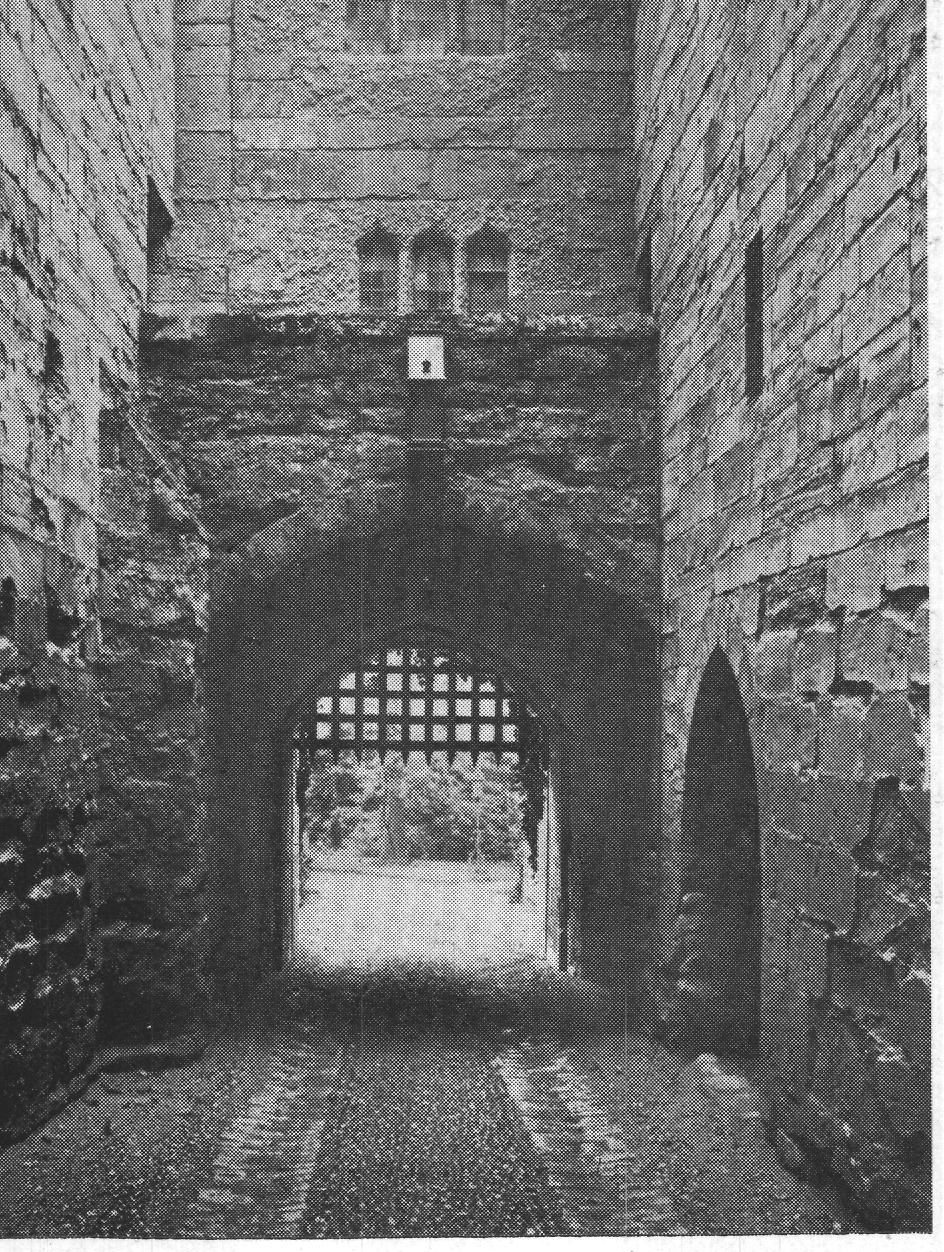
The earldom, however, was no longer conjoined with the ownership of the castle and property, but was granted by King James I., to Lord Rich, in whose family it continued until its extinction in 1759. The Lords Brooke in the meantime, continued to hold the castle. Sir Fulke was assassinated by his servant in 1628 after he had restored and beautified the castle. Robert, Lord Brooke, his successor, was a strong Puritan, who fell in the close at Lichfield, when the Parliamentarian forces were besieging the cathedral garrisoned for the king. On the site of the present orangery in the gardens of the castle stood an old timber framed house which was used as a Presbyterian chapel, where Lord Brooke listened to the discourses of Samuel Clarke the younger. Lord Northampton made a dash to seize the castle, the garrison of which was commanded by Sir Edward Peto of Chesterton. The king's forces were driven back. Sir Edward had hung woolpacks outside the gate house on great hooks, which still remain, to protect the walls from Lord Northampton's cannon-balls. No royal standard waved on Guy's Tower, but a winding-sheet and a Bible in order to show to the enemy that the Puritan leader was ready to die for his faith. The Roundheads trembled for the fate of the Castle of Warwick; but it held its own, and Lord Northampton withdrew his troops discomfited.
After the extinction of the Rich family in 1759, the earldom was conferred on Francis Greville, Lord Brooke, and has remained in the family ever since, together with the noble castle which it is now our privilege to visit.
In the year 1634, three pilgrims set out from the city of Norwich on a tour through England. They are described as "the Captain, Lieutenant, and Ancient of the Military Company at Norwich," and they were wise enough to record their experiences. Happily their descriptions of the places visited have been preserved, and are now in the British Museum. Here is their impression of Warwick, "which for a fayre and stately castle may compare with most in England. It is most sweetly and very pleasantly seated on a rocke very high, upon that pleasant river, the Avon, that divides the shire in twaine; whether ye sumptuousnesse of the building with the richnesse of the ffurniture, the pleasantnesse of the seat, or the strengthe of the brave ancient high towers with her own defencive situation, exceeds, it is hard to be determined. At our first ascending entrance wee passed over a large bridge and then through a strong double gate into a fayre courte leaning on either hand, a strong and lofty defensible tower, namely Julius Cæsar's on the left and Guy of Warwicke's on the right.
"The castle is seated on the sayd river Avon. By it a second Eden, wherein is a most stately mount, which overtops and commands a great part of her owne and some part of four adjacent shires; and the whole hill and declining brow is so planted and furnished with beech, birch, and severall sorts of plum-trees, as it is more delightful and pleasant to ascend.
"By this large and pleasant peece of ground, which is adorned with all kind of delightful and shady walks and arbors, pleasant groves and wildernesses, fruitful trees, delicious bowers, oderiferous herbes and fragrant flowers, betweene the river and the high rocky ffoundations of the Castle, on the south side thereof, there are many rare and curious ffish ponds, all made and hewn out of the solid rock of ffreestone, like cisterns of lead, which are levell with the river, and supply'd with great store of good ffish.
"This sumptuous stately building, this most pleasant garden, and these most delightful ffish ponds were made thus rare and excellent at the cost and charges of that worthy and famous knight, her late owner and inhabitant, Sir Fulke Greville. And as at the last Castle (Kenilworth), we met with the high armor of that warrior Guy of Warwicke for his body, so here we saw that for his horn, his fearfull sword and dagger, the larger rib and tooth of the wild bore, which they call a dangerous beast that frequented the woods, the hills, and the rocks thereabout, which he encountered withall, and slew, if report passe for credit."*
*The legends connected with Guy, Earl of Warwick, who lived in the 9th century, are full of romantic interest. The minstrels in the Middle Ages used to tell of how he fought the Danish chieftain Colbrand, went as a pilgrim to the Holy Land, slew the dun cow, a ferocious beast, and a huge wild boar, and retired from the world, ending his life in a hermit's cave, which still bears his name, Guy's Cliff.
I make no apology for extracting this long quotation from the excellent observations of "the Captain, Lieutenant, and Ancient" of the worshipful Norwich Company. Their descriptive powers were so good, that the picture they drew for us forms a very accurate sketch of what we see to-day.
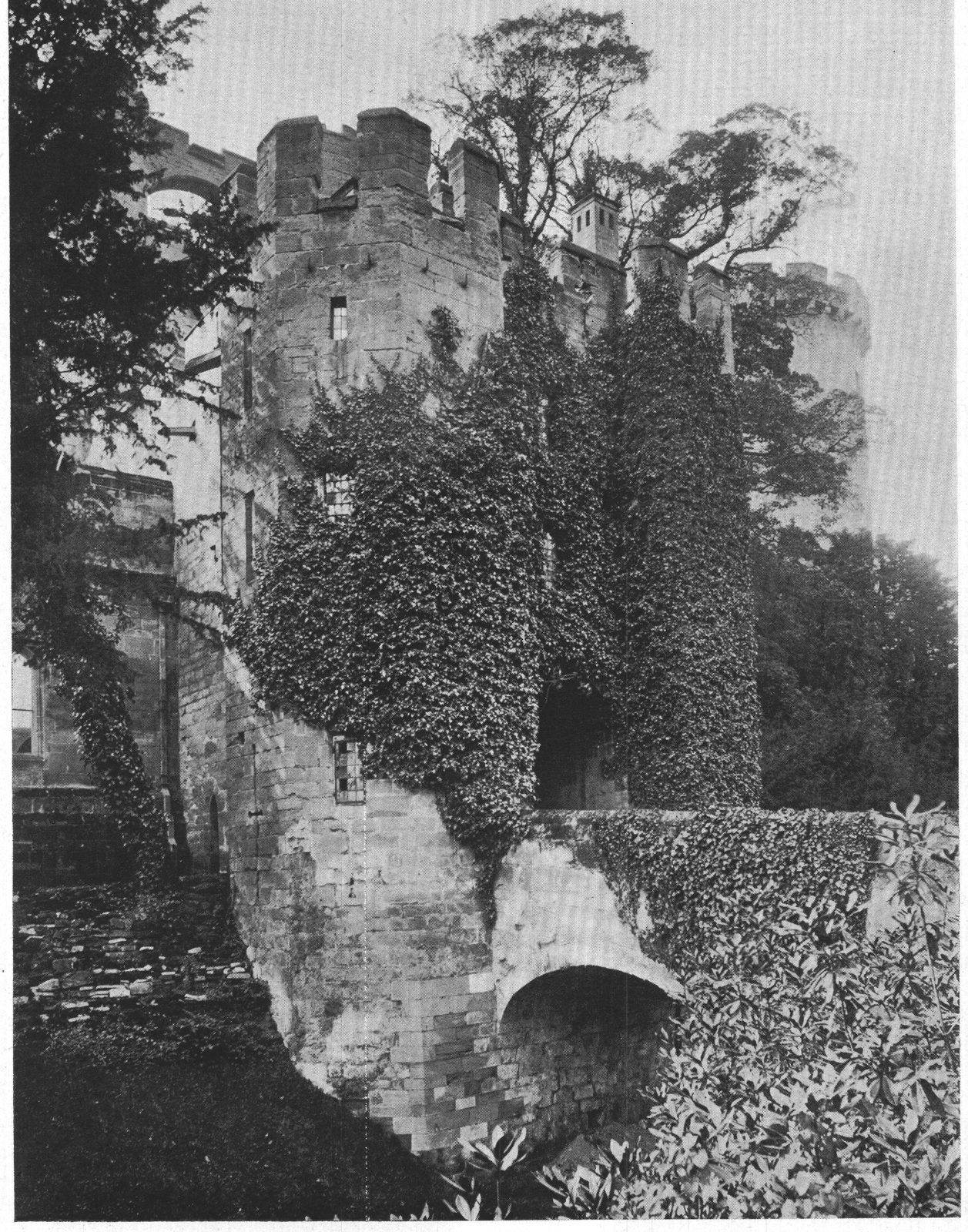
Admirably adapted for defensive purposes is the site of this castle, which crowns a lofty hill. Passing the porter's lodge we ascend the steep slope of the carriage drive which has been cut through the solid rock and is overhung with trees. Suddenly, as we gain the outer court of the castle, we see before us a grand view of the stupendous walls of the fortress, with its lofty towers. A deep moat adds to the strength of the fortifications, crossed formerly by a drawbridge. There is a noble double gateway clad with ivy, flanked by towers. The portcullis still remains, and the four holes through which heated sand or burning pitch could be poured upon inconvenient visitors to discourage their attentions.
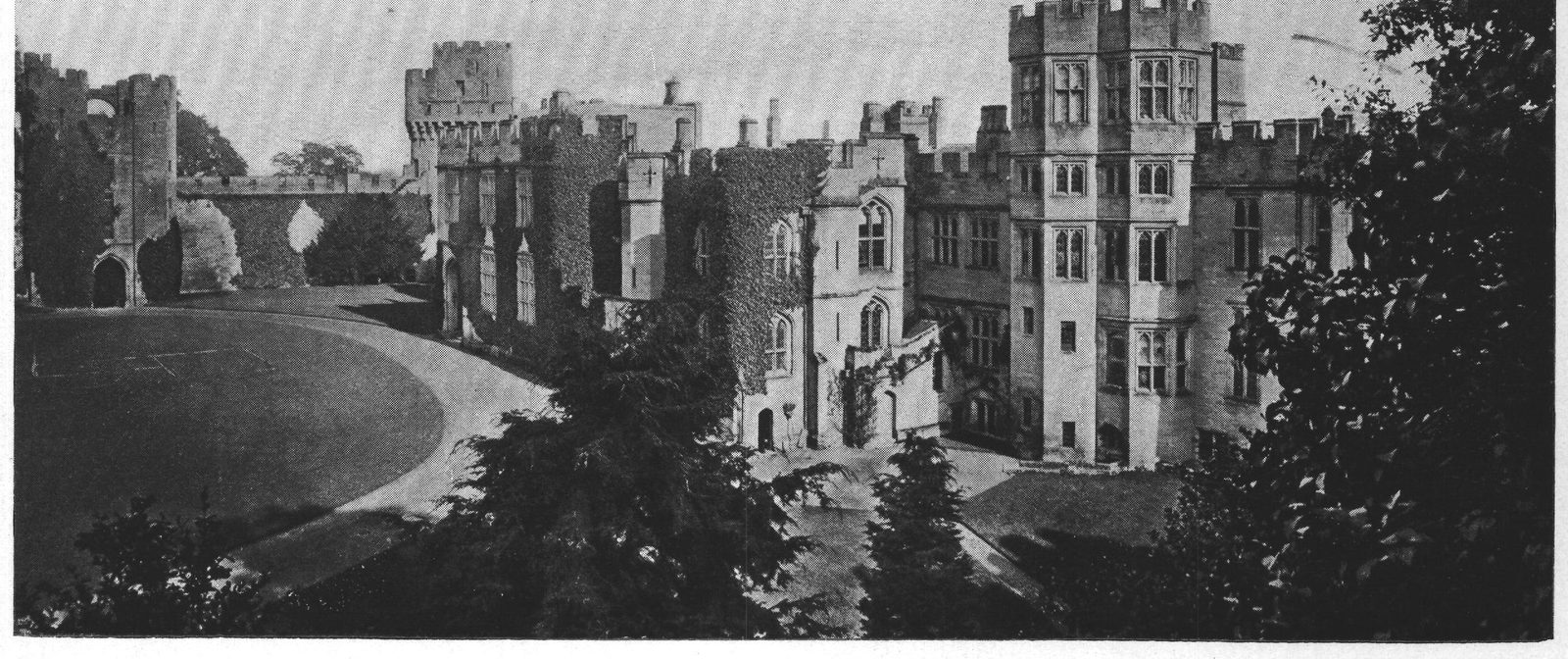
Entering the courtyard, we see on the left Cæsar's Tower and the front of the habitable portion of the castle, somewhat modernized, an extensive restoration of the Great Hall having been necessitated by the disastrous fire which broke out in 1871. Cæsar's Tower has nothing Roman about it except its name. Nor can it claim Norman origin. It was built, as I have said, by Thomas de Beauchamp in the 14th century. Its plan is polygonal with curved faces and machicolated with overhanging battlements. Its height is 147 feet. The base projects widely. There are four stories. Its most interesting feature is the strong vaulted dungeon, the walls of which have several curious inscriptions and rude carvings scratched by the poor prisoners who have been confined therein. There are several votive crosses and crucifixes, and amongst others the following verses:
MASTER JOHN SMITH, GUNER TO HIS
MAIESTYE HIGHNES WAS A PRISNER IN THIS
PLACE AND, LAY HERE FROM 1642 TELL TH
WILLIAM SIDIATE ROT THIS SAME
AND IF MY PIN HAD BIN BETER FOR
HIS SAKE I WOULD HAVE MENDED
EVERRI LETTER
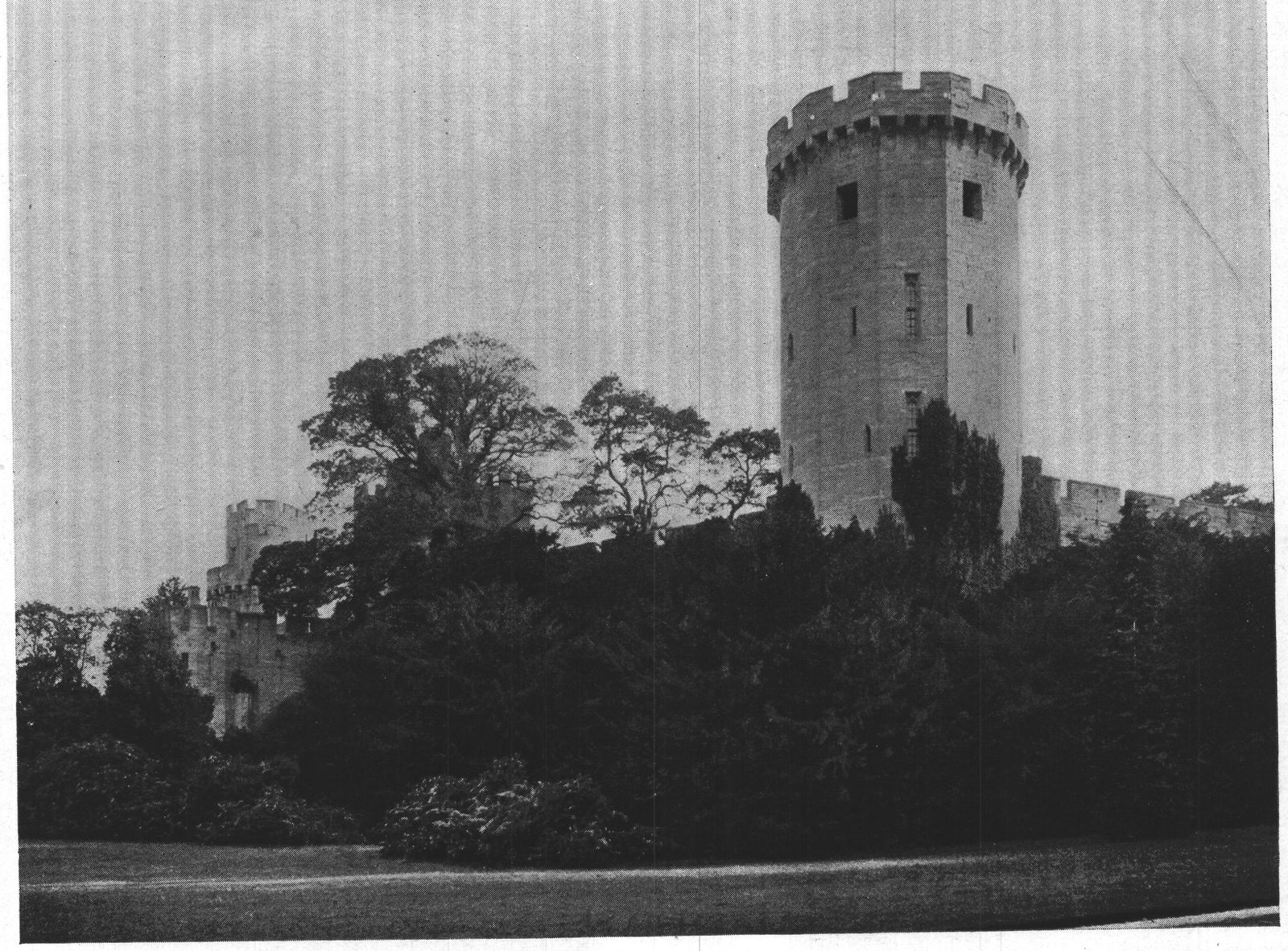
These towers are worthy of close inspection. On the right stands Guy's Tower, the Bear and Clarence Towers and the strong walls, guarding the inner bailey court. A beautiful stretch of greensward covers the courtyard, and in front is the mound or keep where once stood the Norman fortress, and where Ethelfleda, the daughter of Alfred, raised her Saxon stronghold.
Guy's Tower was built by Thomas de Beauchamp, the son of the builder of the former tower, in 1394. The Bear and Clarence Towers guard the entrance to the gardens; the former if not the latter, was erected by the notorious Richard, Duke of Gloucester, afterwards Richard III., and beneath it is a subterranean passage.
We must now "sound the warder's horn," or in modern style ring the bell in order to gain entrance to the residential part of the castle. The whole of the eastern portion has been restored after the great fire of 1871. The main walls, however, were too thick and strong to suffer greatly from the fire, which brought to light some of the old features of the chamber, disclosed some clerestory windows, and enabled the architect to reproduce with fair accuracy the design of the mediæval hall. The furniture, carpets, screens and flowers give it the appearance of a modern drawing-room rather than of the ancient hall which once witnessed the condemnation of Piers Gaveston, echoed with the sound of the feastings of the retainers of the Last of the Barons, and heard the snuffling, whining voices of the extreme sectaries of Cromwell's day. The whole castle is indeed a well-stored museum, replete with objects of antiquarian and historical interest, and abounding with paintings of important personages and family pictures by the great masters of the art. The hall contains many objects of supreme interest. There is some good Flemish tapestry of the 17th century, many suits of armor, the antlers of an Irish elk, measuring 10 feet 9 inches, Queen Elizabeth's saddle, on which she rode on her journey to Kenilworth, Cromwell's helmet, some crusader's armor, a Knight Templar's helmet, a doublet blood-spotted, in which Lord Brooke was slain at Lichfield in 1643, the mace of Richard III., Scottish claymores, a swivel gun taken from a French pirate off the Irish coast, armor worn by Montrose, some suits of armor of the 15th and 16th centuries, some horse armor of the 15th century and that used by the "noble imp." Popular attention is always attracted to a huge cauldron made of bell-metal known as Guy's Porridge Pot. The large vessel holds 120 gallons, and is sometimes described as a punch-bowl. It is, however, conjectured that the pot was made for cooking the soldier's dinners by order of Sir John Talbot, who died in 1365. Guy's sword, a large weapon which really belongs to the time of Henry VIII., is also preserved, for the keeping of which William Hoggeson, Yeoman of the Buttery, received two pence a day in the time of the last named monarch.
Before leaving the hall, we must glance through the deeply recessed windows, and see the magnificent view, the Avon flowing 100 feet below with its wooded banks, the remains of the old bridge over which Queen Elizabeth rode when she visited the castle, and the "new" bridge erected more than a century ago. It is a delightful prospect.
Then we traverse the fine suite of state apartments, first examining the red drawing-room, which contains Van Dyck's painting of Snyder's wife, the Marquis of Spinola by Rubens, Velasquez's Gotama, and the portrait of the present Countess of Warwick, a prominent lady in English society, socialistic politician, founder of the Ladies' Agricultural College at Studley Castle, and an authoress whose history of her ancestral home is the standard work on the subject.
The cedar drawing-room, panelled with cedarwood, beautifully carved by local workmen, and magnificently furnished, contains a series of portraits by Van Dyck, which includes the second Earl of Warwick of the Rich family (1642), Charles I., and his Queen Henrietta (the dress is said to have been finished by Sir Joshua Reynolds), James Graham, Marquis of Montrose, the Countess of Brignola and her son (brought here from the palace of the family at Genoa), the first Duke of Newcastle and Lely's Nell Gwynn. The mantelpiece of this exquisite room was designed by Adams and is said to be unique. There are valuable bronzes, Etruscan vases, and some beautiful cabinets.
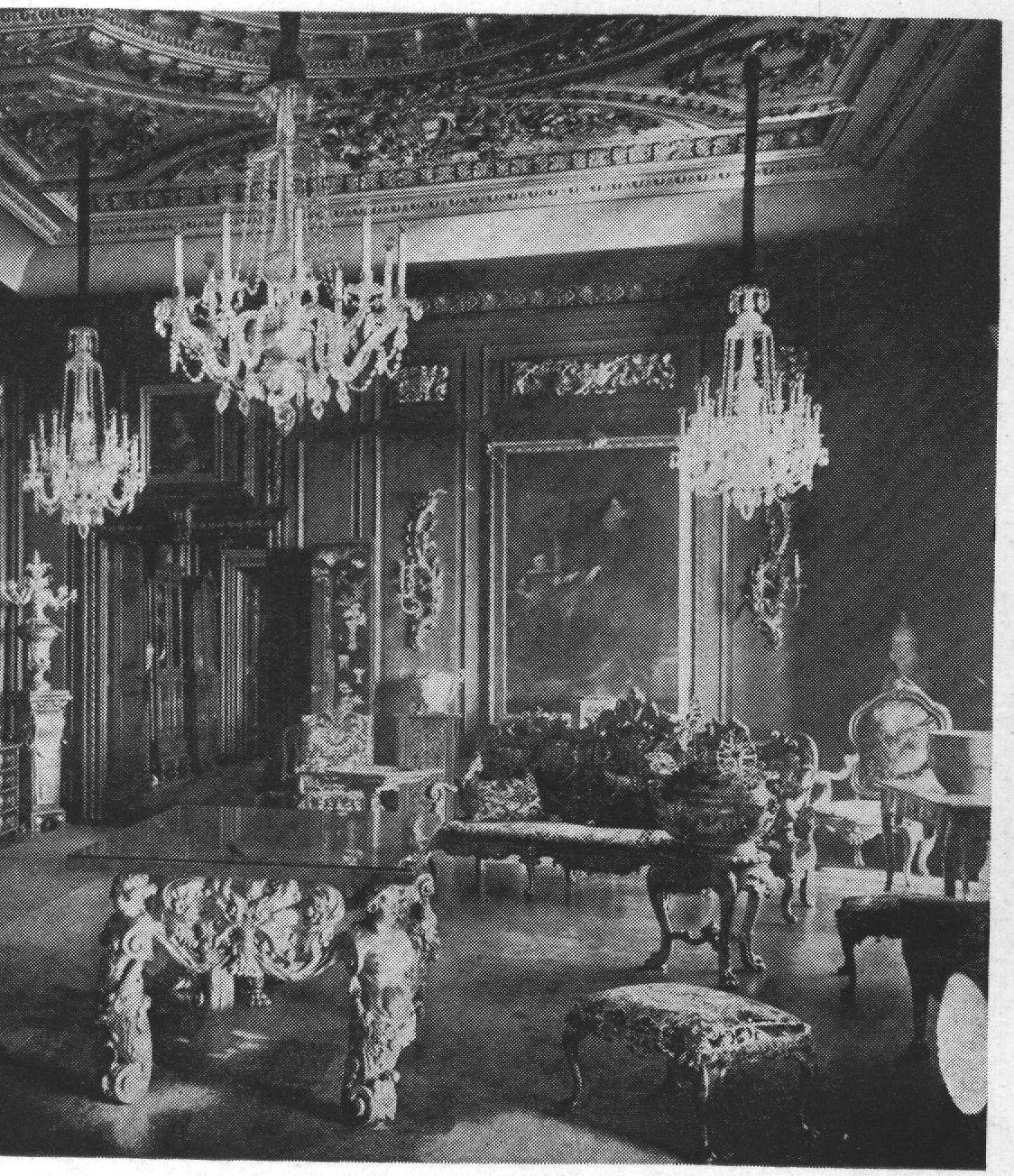
The green drawing-room has a fine ceiling richly gilded. Here is the wonderful Grimani table which came from the palace of that family at Venice, portraits of Ignatius Loyala by Rubens, a Spanish warrior by Moroni, Robert Bertie, Earl of Lindsay, Thomas Wentworth, Earl of Strafford, and Prince Rupert, both by Van Dyck, and Lord and Lady Brooke.
Queen Anne's bedroom is hung with Gobelin tapestry, manufactured in 1604. The bed, hung with crimson velvet, and the furniture belonged to Queen Anne, and were presented to the Earl of Warwick by George III. Kneller's portrait of the Queen appropriately adorns the room. Queen Anne's traveling trunk is curious and interesting. There is a fine example of seventeenth century buhl work, consisting of silver and tortoise-shell inlaid.
We next pass into the Countess's boudoir, a charming little room which abounds with treasures of art and vertu. The walls are covered with silk tapestry and the ceiling was constructed in 1750. The pictures include Holbein's portraits of Henry VIII., Martin Luther, and Anne and Mary Boleyn, Lely's Barbara Villiers, Duchess of Cleveland, a boar-hunt by Rubens, and many others by well-known masters.
Lovers of ancient armor will find in the armory passage many examples of supreme interest, including cross-bows, crusaders' armor, weapons from various countries, Moorish, Spanish, Indian, cedar brought from Palestine by the crusaders, Cromwell's mask, his armor and boots, a bugle taken from the battle-field of Edgehill, guns from the field of Waterloo, etc. Here is also a table which belonged to poor Queen Marie Antoinette.
The dining-room is a noble chamber, built by Francis, Earl of Warwick, about 1770. The furniture is French work, upholstered with appliqué embroidery, and there is a fine carving by Grinling Gibbons of the Battle of the Amazons. The pictures include the well-known equestrian portrait of Charles I. by Van Dyck, some Lions by Rubens, Augusta, Princess of Wales and George III. when an infant by Phillips, Frederick, Prince of Wales by Richardson, Jansen's Duns Scotus and a portrait by Sir Philip Sidney. A rib of the fabulous dun cow slain by Guy of Warwick is preserved here.
The chapel has a very modern appearance. The Shakespeare room contains a collection of prints and works relating to the poet and the wonderfully carved Kenilworth Buffet representing in its panels scenes from Sir Walter Scott's romance on the visit of Queen Elizabeth to Kenilworth castle.
The visitor to the castle will retain a rare but perhaps confused vision of all kinds of rare treasures of art, "superb garde-robes, encoignures, cabinets, and tables of buhl and marqueterie of the most costly finish; splendid cups, flasks, and vases of ormolu, crystal, china and lava; Etruscan vases, marble and pietra dura tables; bronzes and busts displaying the utmost efforts of art; Limousin enamels, costly bijouteries and rare antiques," in addition to the priceless canvasses that adorn the walls.
Leaving the inner court, we pass through a portcullised doorway across the moat to the gardens. The undulating ground of the moat has been laid out with much taste as a garden, and beyond are lawns girt with magnificent trees, oaks and elms, chestnuts, beeches and cedars of Lebanon. Then we come to the formal garden with its yews clipped into shape of divers birds, and flower beds lined with box borders.
But the great treasure of the gardens is the famous Warwick Vase, made of white marble and preserved in the huge greenhouse. It was fashioned by Lysippus, a great artist in the fourth century, B. C. The following appears on the modern base:
HOC PRISTINAE ARTIS
ROMANAEQ. MAGNIFICENTIAE MONUMENTUM
RUDERIBUS VILLAE TIBURTINAE
HADRIANO AUG. IN DELICIIS HABITAE EFFOSUM
RESTITUTI CURAVIT
EQUES GULIELMUS HAMILTON
A GEORGIO III, MAG.BRIT. REX
AD SICIL REGEM FERDINANDUM IV LEGATUS
ET IN PATRIAM TRANSMISSUM
PATRIO BONARUM ARTIUM GENIO DICAVIT
AN. AC. N. CIC. DCCLXXIV.
From this lengthy inscription we gather that the vase was dug out of the ruins of the Tiburtine villa, the favorite abode of the Emperor Hadrian; that Sir William Hamilton, the ambassador of King George III. to Ferdinand IV., King of Sicily, took care that it should be restored and sent to England in 1774. It is a beautiful specimen of early Greek art, the carvings representing Bacchanalian symbols and vine leaves and grapes.
We might follow the dead earls to their last resting-place in the Beauchamp Chapel in the church of St. Mary's, but time presses. We can only note that there lie buried Robert Beauchamp, Earl of Warwick, the builder of the chapel; Robert Dudley, Earl of Leicester, of Elizabethan fame, and other dwellers in the fortress, for Warwick Castle will live in our memories as a perfect example of a mediæval fortress, adapted to the needs of a modern mansion, and we are grateful that Time has dealt gently with its frowning battlements, and left us so much that recalls the historical associations that cluster around this fair mid-England stronghold.