About two miles distant from the old town of Banbury, famous for its cakes, for the mythical fine lady who "rode a white horse" accompanied with the tinkling of many bells, and for much else that need not now be chronicled, stands the noble Broughton Castle. It has passed through many a scene of storm and stress during its life of six centuries; but Time has dealt gently with its strong walls or been defied by them; and guarded by its faithful moat, it still keeps watch over the lands of its lord, and has many memories to recall of the exciting scenes which it has witnessed. Indeed, Broughton Castle has adapted itself to the needs of modern luxury and comfort, and though its walls and guarded gate seem to frown darkly on an intruder, within it is the perfection of a twentieth century nobleman's residence. Its fortunes are bound up with those of its noble owners, the Lords Saye and Sele, whose family name is Fiennes. They have owned the castle since the middle of the fifteenth century. The history of Saye and Sele is the history of England. Hardly a great event happens, but they have a hand in it. We meet them at every turn, and return to them at every crisis. They are descended from the union of two great houses, the de Sayes and the de Fiennes, representatives of whom came over with the Conqueror and fought in the battle of Hastings. The Fiennes came from a French village of that name near Calais, and ancient records tell of the marriage in 1020 of Eustace, Baron of Fiennes, with Adila, lady of Ardres, daughter of Everard de Furnés, whose son founded Beaulieu Abbey. One of the most famous scions of the family was Ingelram de Fiennes who married Sybil de Tyngrie, a daughter of the illustrious house of the Counts of Boulogne, whose descent is traceable through the Dukes of Ponthieu to Bertha, the daughter of Charlemagne. Count Eustace's hand struck down the ill-fated Harold at the battle of Senlac. You may see his portrait in the Bayeux tapestry, taken in the act of slaying the English king. High honors were bestowed upon him by the Conqueror, besides some rich manors.
We cannot now follow the fortunes of this noble family, which produced many warrior-knights, who wrought many a deed of high emprise and fame on the battle-fields of England and in the wars of the Crusades. Moreover, they increased the family estates by marrying heiresses; one John de Fiennes wedded Maud, the daughter of Sir John de Monceaux, of Hurstmonceaux, where the ruins of a mighty castle testify to its ancient greatness and magnificence. Another, William, married Joane, the sister of William de Saye, whose son James served bravely under Henry V. in the French wars, and fought at Agincourt. He it was who came to such a cruel death at the hands of Jack Cade's rebels in 1450. A picture at the castle tells the sad story of his savage murder, a story which Shakespeare has told before in his drama of Henry VI., Act IV, Scene 7.
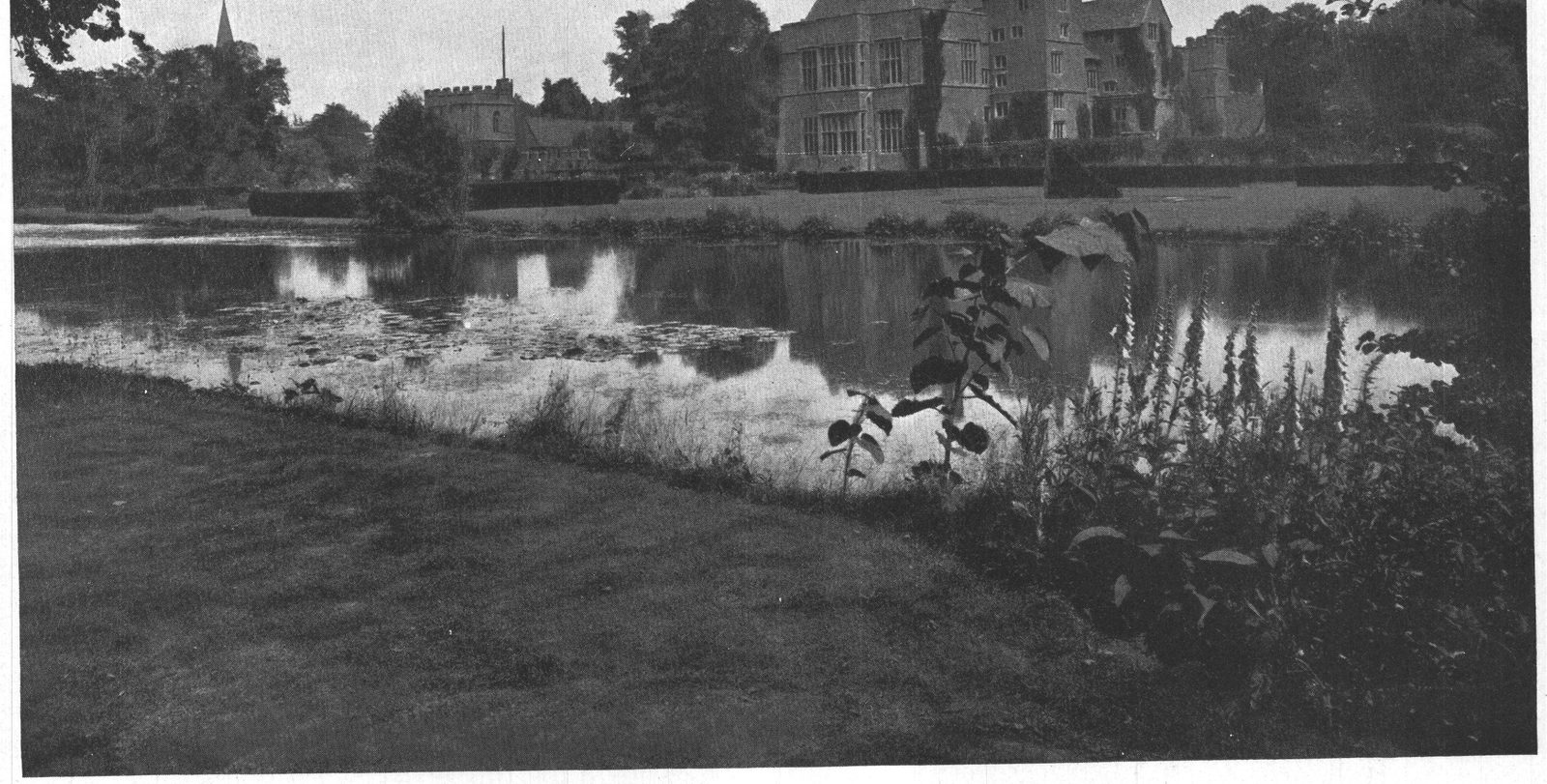
But Broughton Castle in its early days knew other owners. Parts of the present building were erected by the Broughton family, which derived its name from this place. They occupied a position of rank and consequence, and divers members of the family were engaged in the king's service in the thirteenth century. Early in the fourteenth century they began to build their castle, and near it, some fifty yards away from the lily-bespread moat, they reared the beautiful church. A fine canopied tomb and monument of the time of Edward II., a rich and beautiful specimen of Decorated work, is traditionally said to represent the De Broughton who founded the church and castle. Then the castle and lands passed into the hands of the Wykeham family, of which the famous architect-bishop, William of Wykeham, was the most celebrated. He purchased the castle and estates from Sir Thomas de Broughton in 1377, and then settled the property on Sir Thomas Perrot, who assumed the name of Wykeham, and Margaret his wife, daughter of Agnes, the Bishop's sister. In 1450 Margaret, the heiress of the Wykeham family, was married to William, Lord Saye and Sele, the son of the victim of Jack Cade's rebellion, and thus this famous house passed into the possession of the distinguished family who have held it so long.
The Lords of Saye and Sele have had varied fortunes. This William who acquired Broughton by marriage did not long enjoy its possession. He was an ardent supporter of Edward IV., had twice been captured by the Lancastrians, and had to sacrifice his estate of Knowle in order to obtain a ransom. He had fled with Edward to Flanders and sold thirty manors in order to raise troops for his sovereign, and then—irony of fate—fell in the hour of victory at Barnet when the cause was won on which he had staked his all. He has a fine tomb in the church at Broughton; his helmet and gauntlets hang there and still tell of the fame of the fallen warrior.
Royal gratitude did little to restore the fortunes of the family. Two peers in succession refused to take up the title from want of sufficient means. But with the advent of the Stuarts their position improved. James I. paid them a visit at Broughton, and liked his reception so well that in 1618 he brought his queen with him. In 1624, William Fiennes, eighth Baron, was created Lord Viscount Saye and Sele.
Then came the troublous period of the civil war, in which Broughton and its owners played a conspicuous part. The castle was the cradle of the conspiracy, and William, first Viscount, one of the chief actors in that fatal drama. "Old Subtlety" he was styled by his opponents. He was one of the first to oppose the arbitrary acts of Charles I., and was the friend and ally of John Hampden. Retired country houses of the English malcontents were considered to be the safest places for the grave and dangerous consultations which were carried on at that time; and two places were selected as meeting places of the leaders. These were Fawsley in Northamptonshire, and Broughton Castle. In these secluded houses did Hampden, Pym, St. John, Lord Saye and Sele and Lord Brooke, and later on the Earls of Bedford, Warwick and Essex, Lord Holland and Nathaniel Fiennes, hold their sittings, which were sometimes attended by other persons of rank and property, who were as deeply involved in the general plan of resistance. Anthony à Wood thus describes the secret meetings at Broughton: "For so it was that several years before the civil war began, he (Lord Saye and Sele) being looked upon as the godfather of the party, had meetings of them in his house at Broughton, where was a room, and passage thereunto, which his servants were prohibited to come near; and when they were of a compleant number, there would be great noises and talkings heard among them, to the admiration of those that lived in the house, yet could they never discern their lord's companions."
We may presently visit the little consultation chamber, redolent of the memories of these conferences, a small isolated room, with three outer walls and a tower staircase leading up to it.
Soon the royal standard was unfurled. After Edgehill, the king marches on Banbury, where was a castle also held by the Lord of Broughton. The garrison was disaffected and the fortress surrendered. Then the royal troops march on Broughton, and lay siege to it. You can still see in the park the remains of the earthworks thrown up by the Royal forces, and where the defenders hung bales of wool over the walls to deaden the impact of the cannon-balls. But all is of no avail. The place is too completely surrounded by hills. It surrenders, and is ruthlessly pillaged. The inhabitants of Banbury learn the stern lessons of war and suffer at the hands of Prince Rupert's troopers.
They complain bitterly, and conclude "But that which touched us most is a warrant, under His Majesty's hand, for the plundering of Lord Saye and Sele his house, demolishing of it, and invites the people to do it, with a grant unto them of all the material of the house." "Old Subtlety" had, however, found his way so far into the hearts of the men of Oxfordshire that no man would touch a stone of the old castle, which remains until the present day to tell the story of those troublous times. Saye and Sele's "Blue Coats" distinguished themselves in the long struggle, and their leader was not loved by the Cavaliers, who used to sing:
Farewell Saye and Sele and hey,
Farewell Saye and Sele and ho,
And those sons of Ayman
Shall hang as high as Haman,
With the old Anabaptists they came on,
With a hey trolly lolly ho!
We need not follow the fortunes of war further, save to note that the Lord of Broughton never agreed to the king's murder, and when the Commonwealth had run its course, was one of the first to bring back Charles II. The castle bears some traces of the change in the political opinions of its owner when "the king enjoyed his own again." The long barrack-room where Cromwell's troopers and the "Blue Coats" of Lord Saye and Sele used to sleep, was christened "Mount Rascal," and on the beautiful angle lobby of the great dining-room the penitential words were placed:
"Quod olim fuit meminisse minime juvat."
Lord Saye and Sele became Lord Privy Seal. You can see his bag of office, with its C. R. upon it, hanging at Broughton to this day. It is interesting to note that it was this Lord and his friend Lord Brooke, when the fortunes of the "root and branch" men were low, meditated a settlement in New England, and built a little town called Saybrook, in 1635, which is now, I believe, a flourishing place in Connecticut.
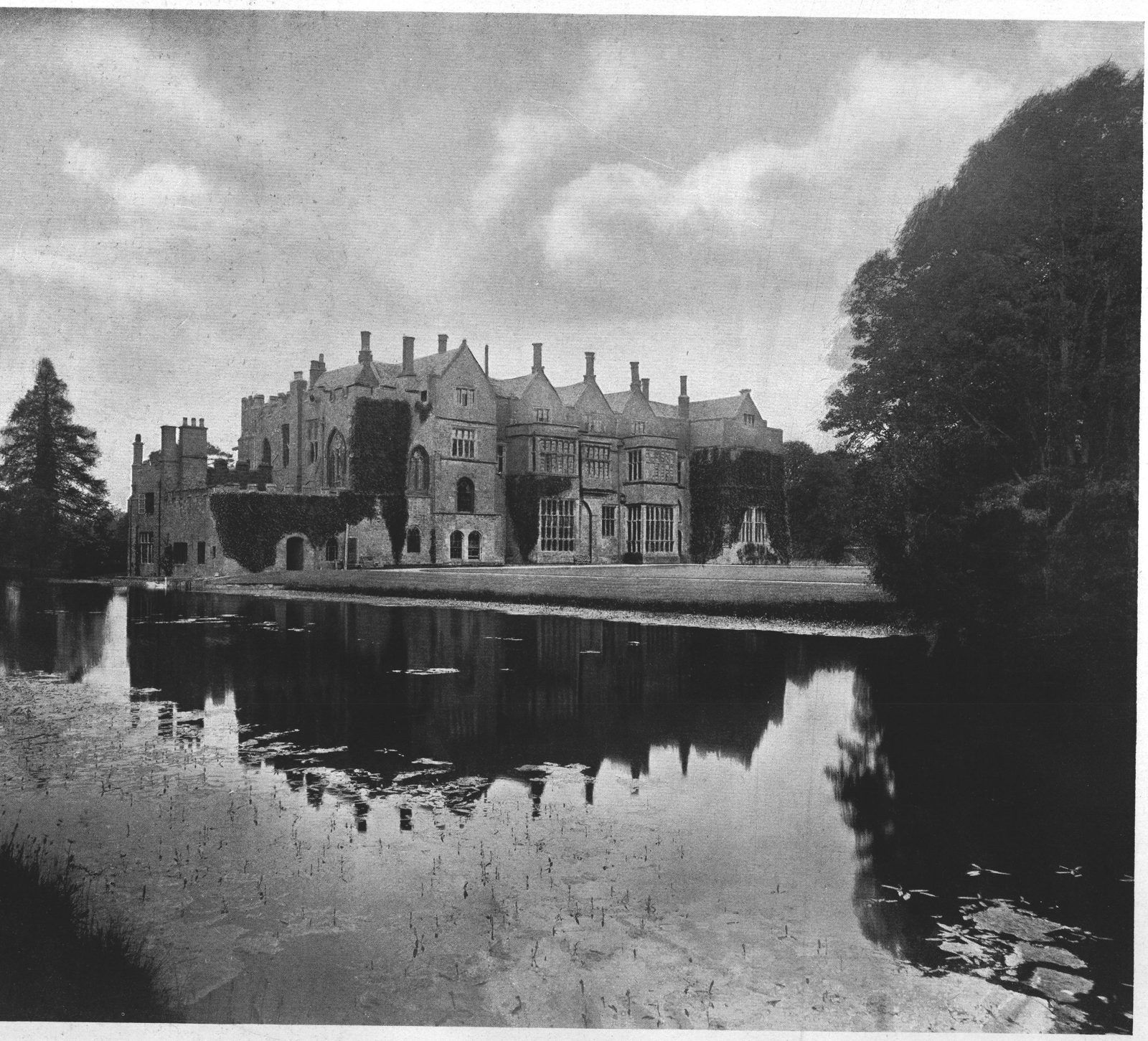
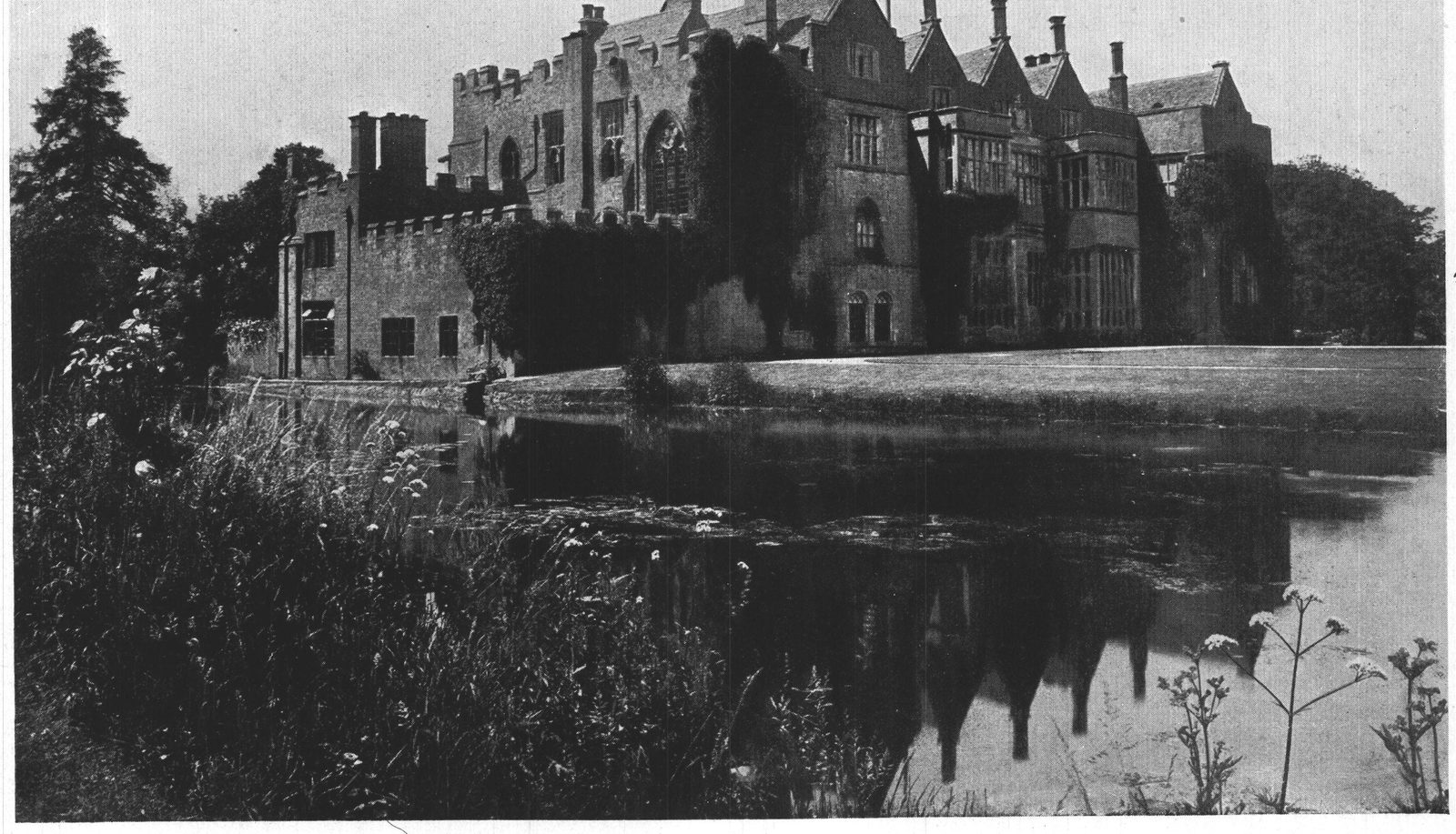
Since that troublous time peace has settled on the noble house and its noble owners. When we approach the castle we see that it stands in a small park, and lies in a hollow, surrounded by low wooded hills. Entrance to the castle is gained through a large gatehouse and over a bridge spanning the moat. These were constructed at the beginning of the fifteenth century, when, in 1407, a royal license was granted to the owner to crenelate the castle. To the same period belong the embattled walls to the moat, the embattled rooms of the house containing the kitchen, guard room in the roof and other chambers and the stables.
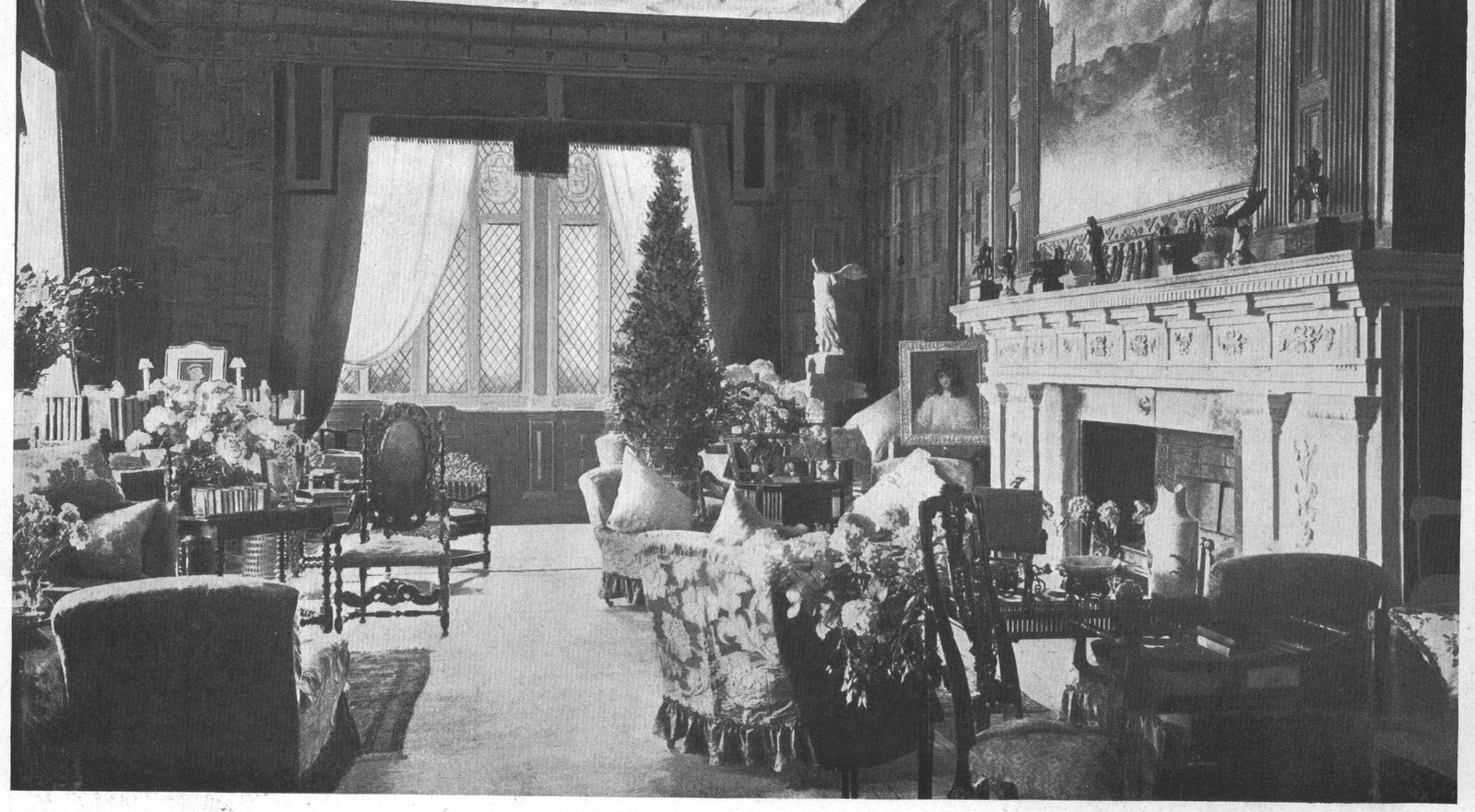
Recent restoration work conducted with loving and reverent care by the tenants, Lord and Lady Algernon Gordon Lennox, has thrown much light upon the construction of the castle. Lady Algernon Lennox has kindly sent me some notes of the discoveries which have been made, and my friend, the present Lord Saye and Sele, has furnished me with some family papers relating to the history of the castle. A considerable portion of the De Broughton's fourteenth century work (1301-1307) remains. The chapel belongs to this period, situated at the northeast angle. The east window is Decorated, with the geometrical tracery which was in use in the beginning of the fourteenth century. Immediately under this window is the original stone altar, supported on three plain corbels, and retaining the five small crosses. This chapel has several windows or peep places looking into it. A witty Bishop of Oxford, when he saw two windows looking down into it from side bedrooms, remarked, "Now I understand why the Psalmist says, 'Let the saints rejoice in their beds!'" Adjoining is a groined priest's room, and leading away to the west is a beautiful groined corridor branching off to a circular staircase. This leads to the "barracks," a long attic where Saye and Sele's "Blue Coats" used to sleep when they were not fighting, and also to the mysterious "Council Chamber" where the chiefs of the Rebellion hatched their plans. A great part of the walls in the north and east sides and the groined chambers belong to the same period, early fourteenth century; and the recent restorations show that the main walls of the great hall are of the same date. When the plaster was removed from the walls, a series of doorways of undoubted fourteenth century work was discovered, which seem to have led to the minstrel's gallery. Also the remains of three magnificent windows of the Decorated style, which reach the whole height of the hall, were laid bare. A portion of the beautiful tracery which filled them has been discovered on the south side of the castle. The hall appears to have been "Elizabethanized" in 1554, when the bay windows were thrown out and Tudor windows inserted in place of the earlier ones. This noble hall measures 54 feet by 26 feet. Along the north side of the castle on the first floor runs a fine gallery 90 feet long by 12 feet 3 inches wide, with rooms opening out of it. The latest portion of the house is the dining-room, which has a fine ceiling and splendid chimney-piece. The room is panelled throughout, and in the corner is an angle lobby or screen, forming the entrance. The original of this quaint and singular adornment is the interior doorway of the ante-chamber of the Hall of the Council of Ten in Venice. It is an elaborate work of beautiful detail, thoroughly Elizabethan in style. A few other houses in England have similar screens, notably at Bradfield and in a few Devonshire seats. The white paint has recently been removed from the oak panelling, and the large window at the north end re-opened, after being blocked for many years. This white paint had a signification, and was used in the houses of enthusiastic loyalists to testify to their zeal for the House of Stuart. The drawing-room has a fine ceiling dated 1559, which has rich pendants. King James's bedroom, the entrance to which is from the gallery, has a large and very handsomely carved Jacobean chimney-piece of stone of unusual design, owing to the peculiar treatment of the figure sculpture. The two grand staircases were also erected in the restoration of 1554. The groined passage leading from the hall to the present dining-room is a fine specimen of English architecture, as the removal of the plaster which defaced it now shows. The corbels, all different in design, are remarkable for their originality and spirit, notably the carvings representing a man blowing a horn, and a rabbit chewing a pea-pod.
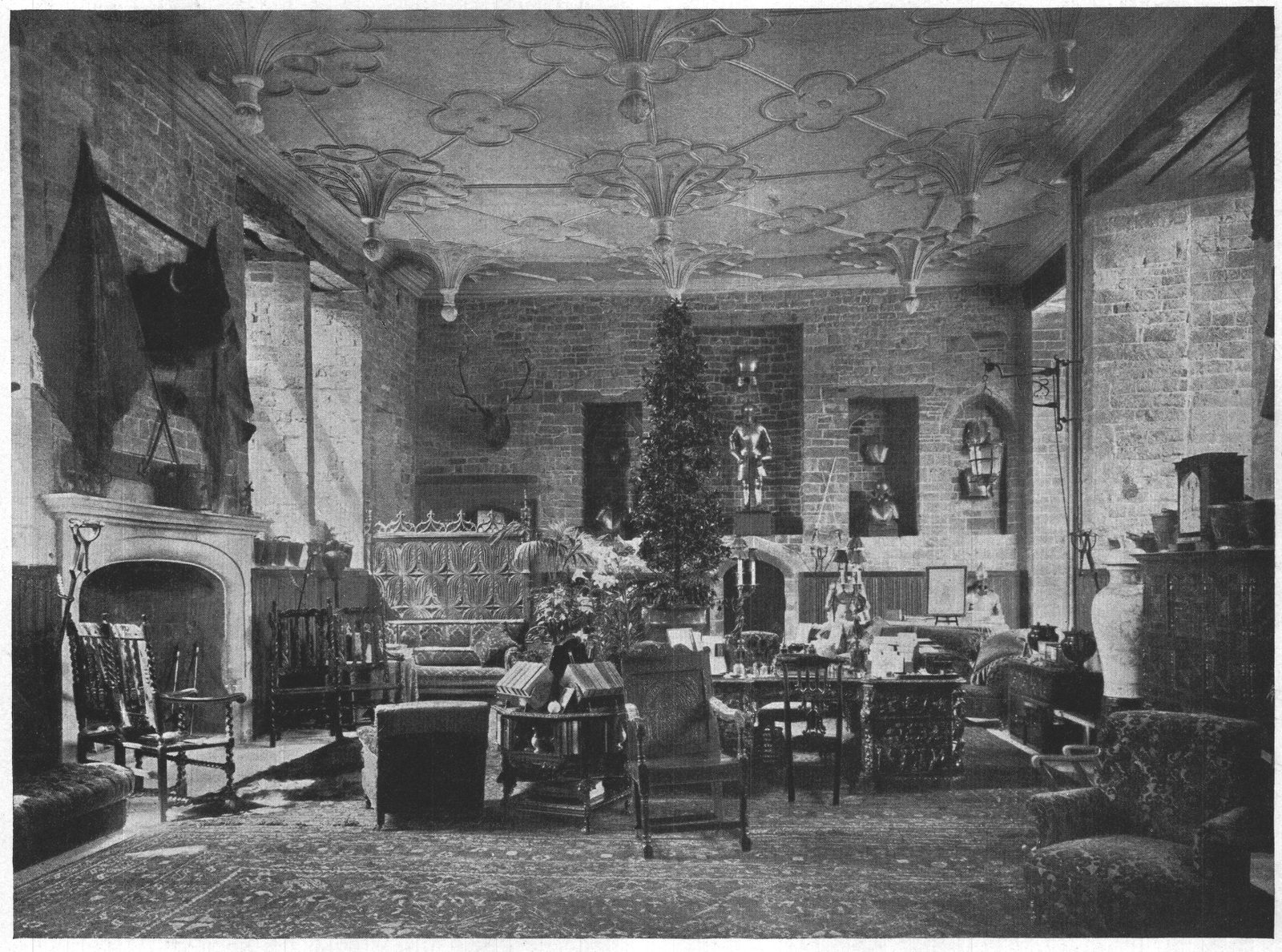
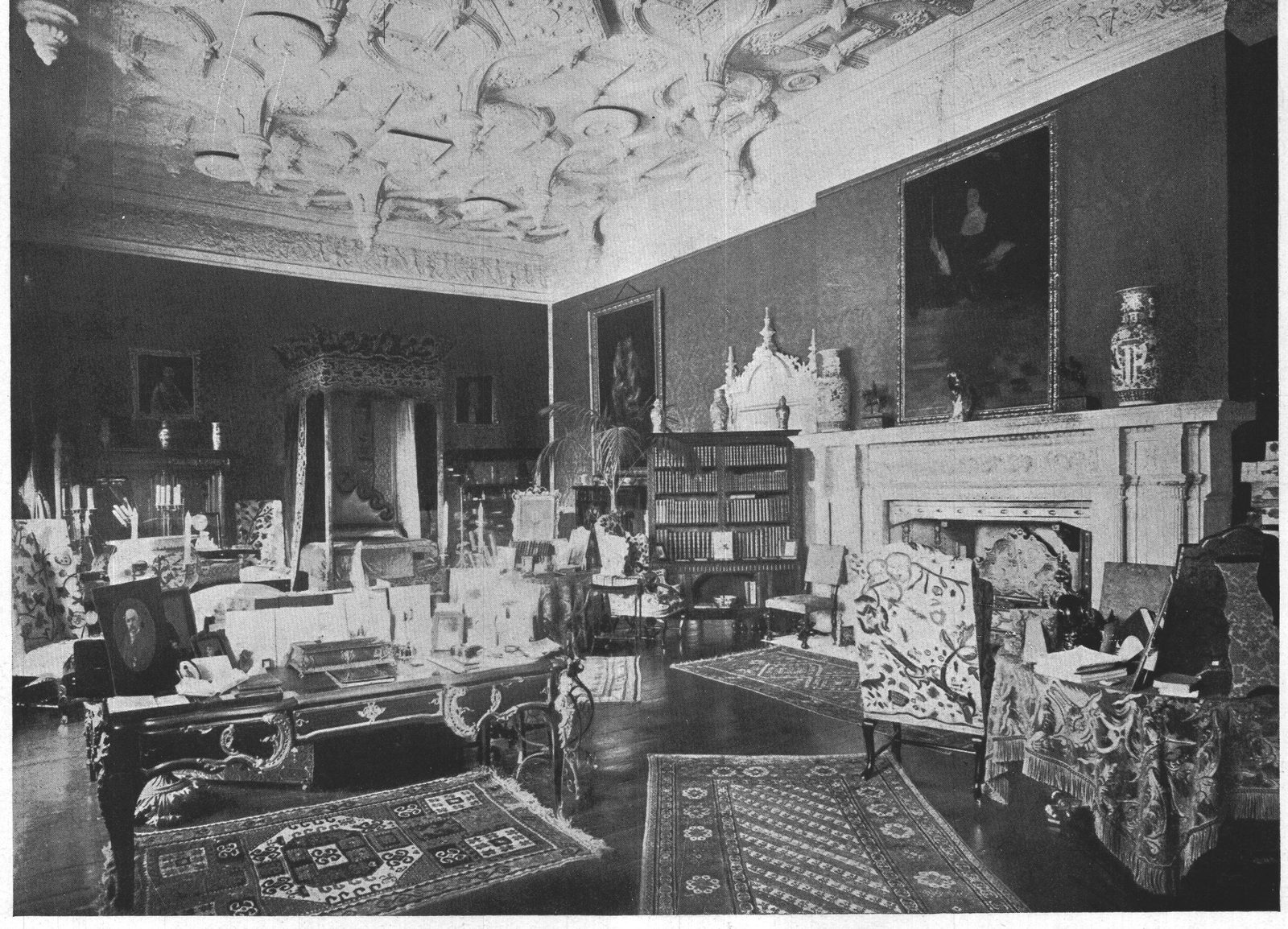
The house is full of memorials of the civil wars, old armor, swords, cannon-balls, and dented cuirasses. The walls are adorned with family and historical portraits. The heroes of the civil war gaze at us from the canvas, Royalists and Parliamentarians alike, now in godly union and concord, Charles I., Prince Rupert, Prince Maurice, William, Viscount Saye and Sele or "Old Subtlety," Oliver Cromwell, John Hampden, Nathaniel Fiennes, Lord Falkland, Pym, John Fiennes, are all there, and perhaps leave their frames on some ghostly evenings, and discuss their fights over again.
In the little church hard by the lords of the castle lie at rest. It is a very beautiful resting place, principally of the Decorated period. Sir Gilbert Scott used to say that the west window of the aisle was the best fourteenth century window he had ever seen anywhere for beauty and fair proportions. The nave is Early English, and the chancel screen is of stone of Decorated style. The roof and clerestory are of fifteenth century date. The tower and spire are very good examples of Decorated work, beautifully, but simply proportioned. Within there is almost a wilderness of monuments. A splendid canopied monument records the memory of Sir T. Wykeham and Margaret his wife. The De Broughtons all lie there, and many of the Saye and Seles, the lord who fell at Barnet, and "Old Subtlety" and many of his successors.
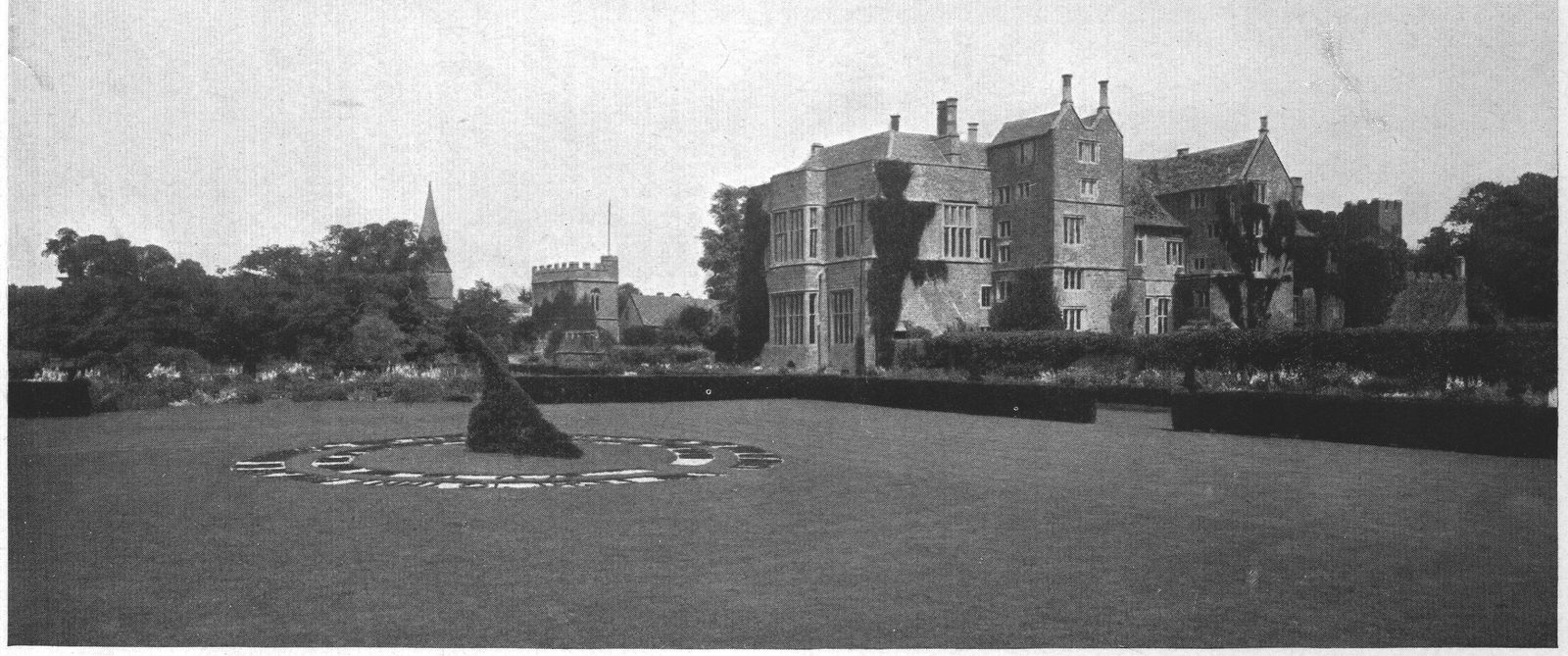
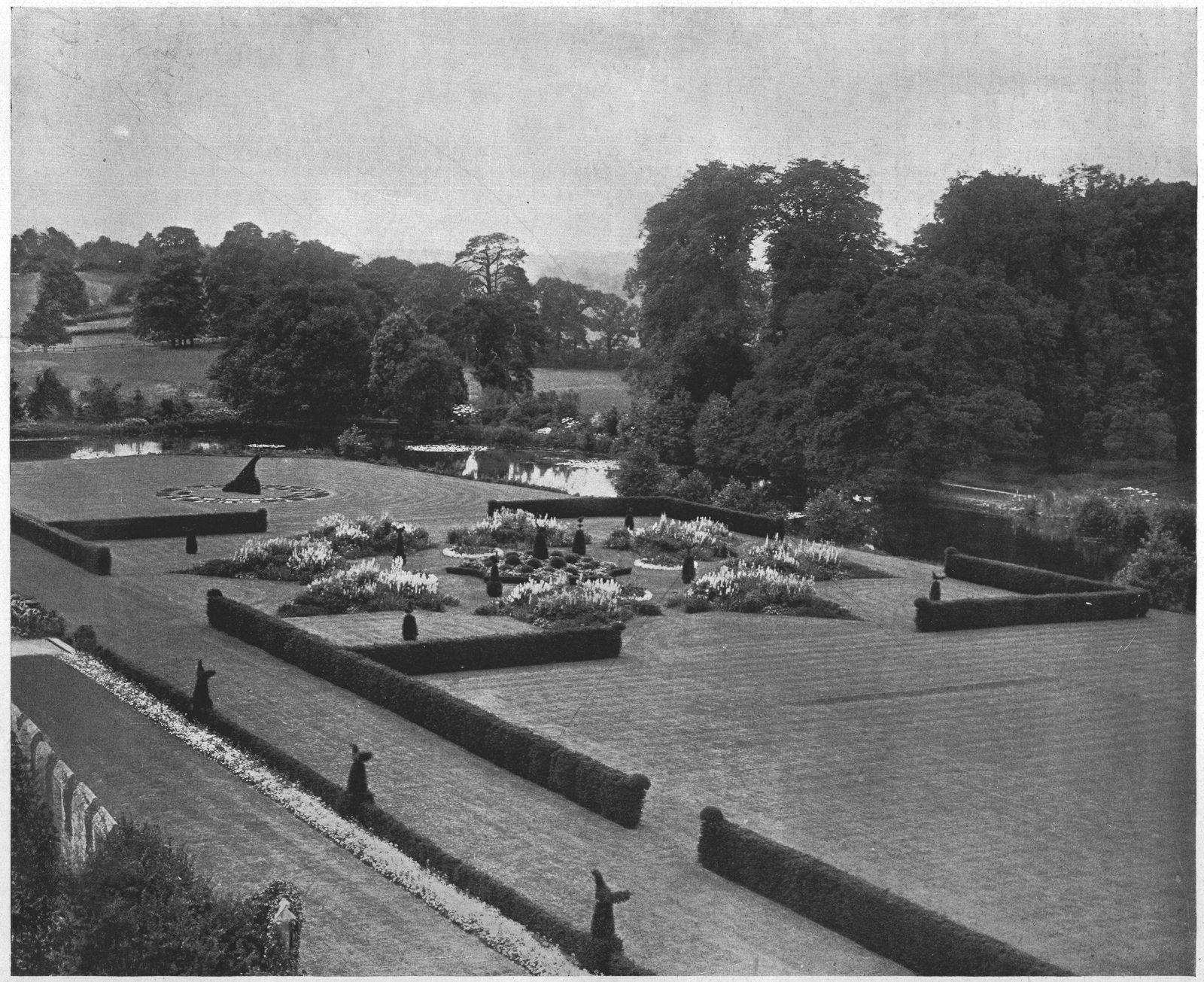
The gardens of Broughton are an attractive and charming feature of the old castle. They were created by Lady Algernon Lennox, who now resides in the ancestral home of the Lords Saye and Sele, and are a witness to her taste and sense of beauty. Situated between the castle and the moat, the carefully trimmed hedge of box with the quaintly-cut figures of birds, the wealth of old-fashioned flowers, and the sweet formal character of the garden harmonize well with the old gray walls of the castle. An attractive feature of the garden is the large sun-dial with the hours marked in a circle in the midst of the wide spread lawn. May the dial only mark happy hours for the Lord and Lady of Broughton. Broughton Castle, with its little church, presents many features of special historical interest, and remains to this day a well-nigh perfect specimen of English domestic architecture of the fourteenth century.