Illustrated with Photographs by Arthur Murray Cobb
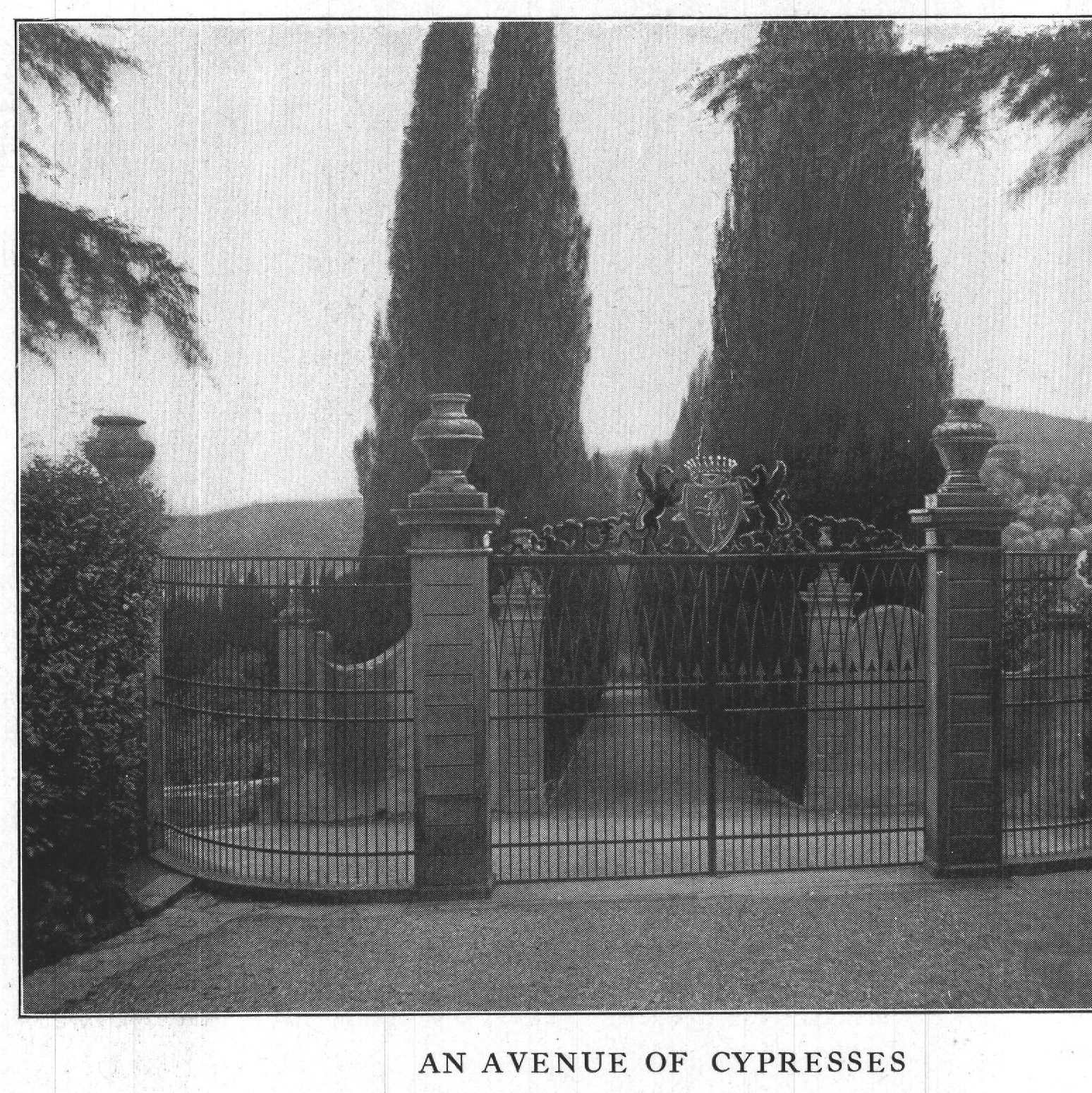
Just before reaching the small station at Compiobbi, as the train from Rome nears Florence, it passes across a magnificent avenue of cypresses. This avenue runs from the banks of the Arno, one hundred and fifty yards below the railroad track, to a distance of about two hundred yards up the hill. Ruthlessly the railway has made a breach through those fine trees, and as ruthlessly the smoke and noise of passing trains disturb the solitude and peace of the avenue's dark shade.
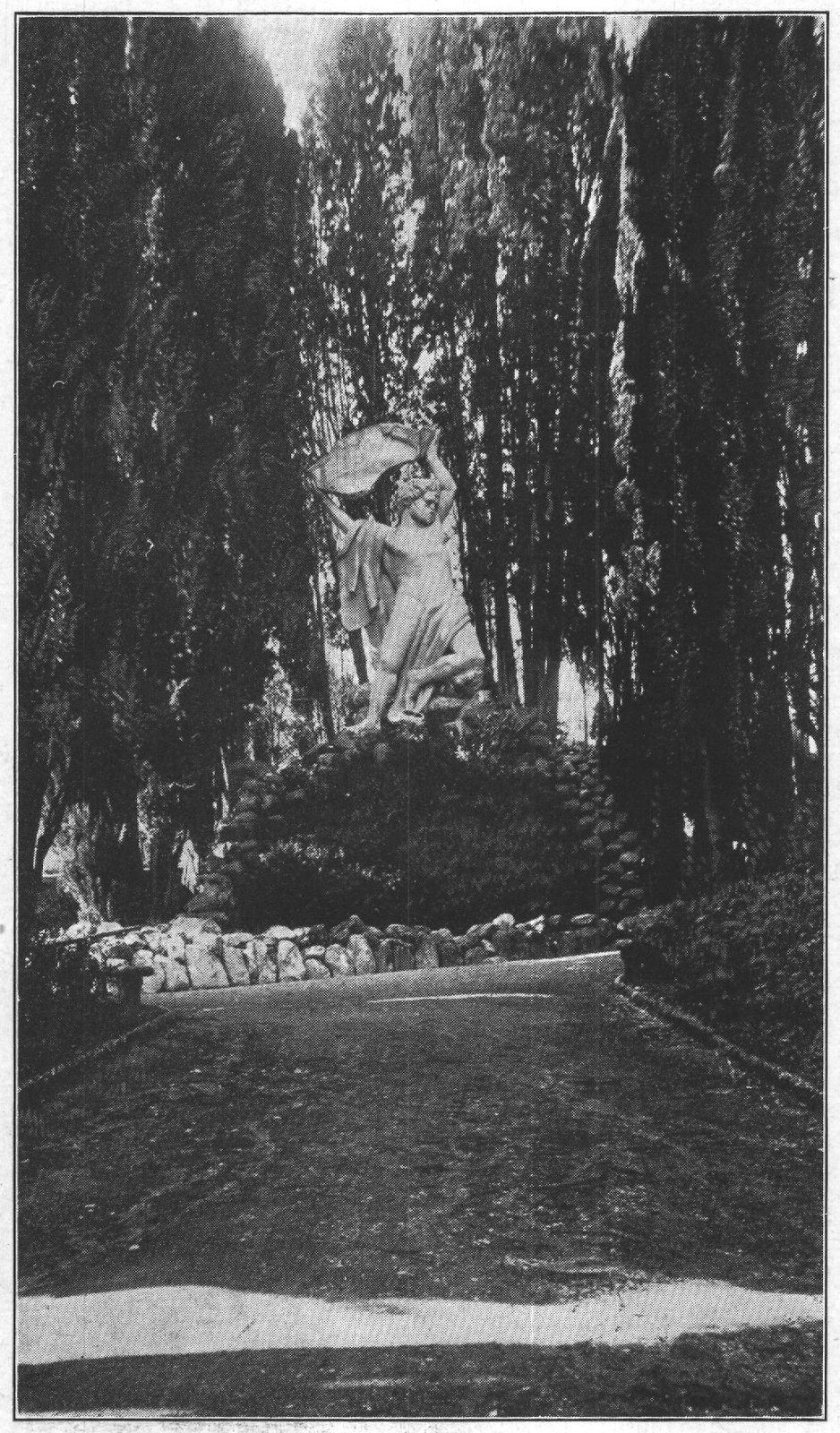
Looking up to the north, as the train passes, you would have a glimpse of a huge bit of statuary at the extreme end of the avenue, effective enough at that distance, bad though it be at close quarters. Another avenue crosses at that point, coming down from the cancello of the garden, near the house, and, from the point where the statue marks the meeting of the roads rising again in a straight line up a very steep hill on the summit of which the trees encircle an obelisk. Beyond and above, a dense wood stretches east and west along the hillside, a wood of ilexes, oaks and bays, and, most beautiful of all, the wavy lines of a mass of stonepine pierced here and there by the needles of taller cypresses.
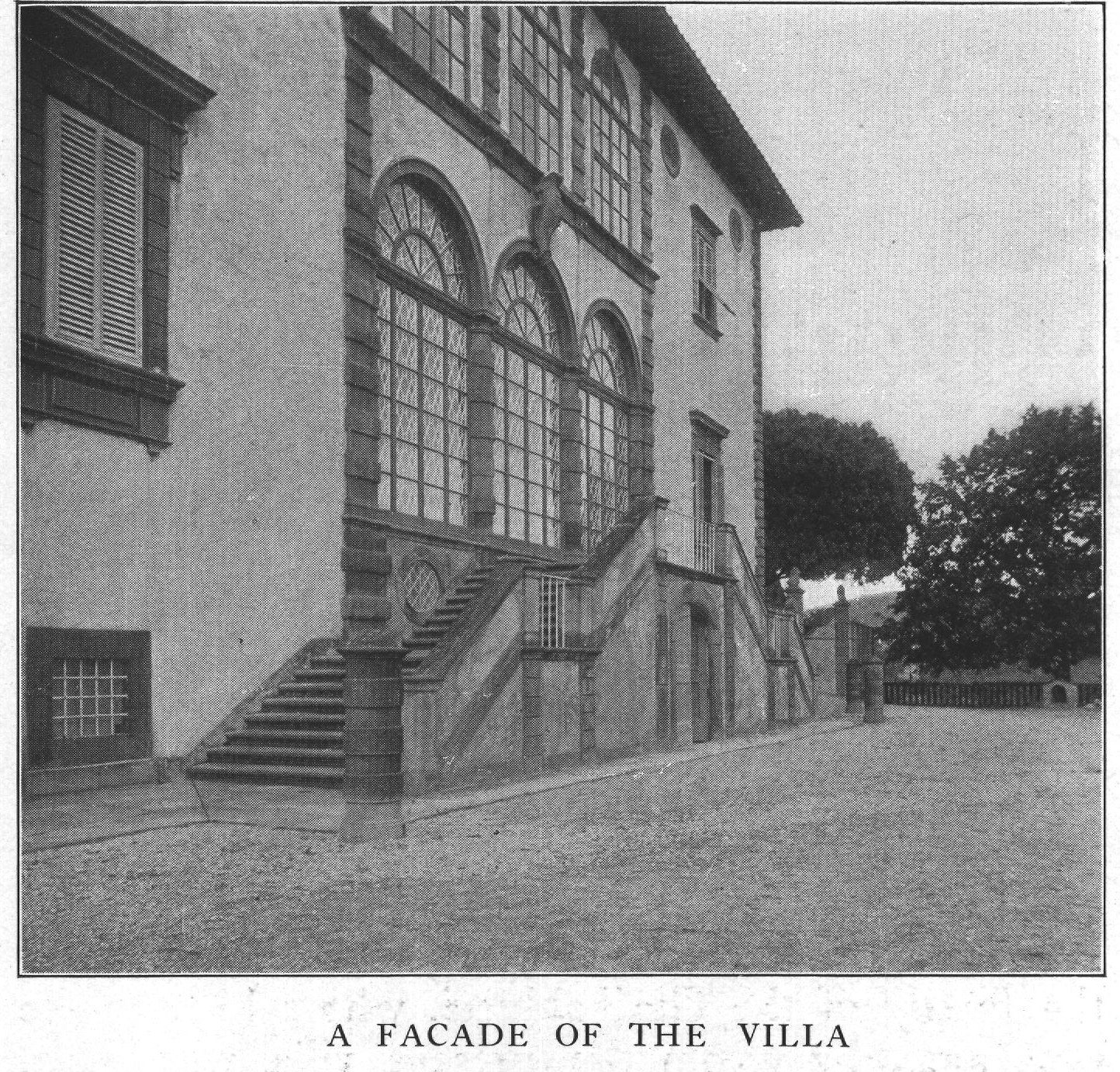
These avenues and woods belong to the Villa Danti, a square block of a building standing on the lower slopes of the hill, on a terrace facing the long valley of the Arno. Built as it is on the side of the hill, the loggia on the ground floor (which, to the north, is on a level with the garden, opens to the south upon a long and wide balcony, from which double steps lead to a terrace below). This level again overlooks a small semicircular garden, all roses, lemon trees and fountains. Beyond, the podere, cut in two by the railway embankment, runs down to the Arno.
An inscription which runs the whole length of the southern façade tells us that "Alexander Guadanius Senator di Phillipi filii erexit 1625."
It is known that the property once belonged to the family of the Garibalducci, who sold it to the Guadagni, by whom the present villa was built. In 1692 some additions must have been made, as that date appears on some of the outbuildings. The Guadagni sold it to the Danti, a daughter of whose house has lately brought it by marriage to the Friulian family of Counts Colloredo.
Far off enough down the valley to be at peace, whatever might happen in Florence, the villa has no associations with the history of the town. It is merely one of the many fine, massive country houses which was built in Tuscany in the seventeenth century. The center of the façade has two loggias, one above the other. A low, square clock tower rises slightly above the roof of the house to the left of the building. On each side of the loggias there is space for two windows, the lower ones, heavily barred, as in almost all villas. The front door opens under the loggia.
The interior is planned in large and lofty rooms, several of which are still rich in furniture, china and carvings of a good period. A large hall, lighted by glass doors opening in the loggias north and south, takes up the center of the house. On this most of the rooms on the ground floor open. One of these is of special interest, for every newly married pair of the Danti family, perhaps of the Guadagni family before them, has occupied that room. A magnificent cassone, one of those chests in which the gifts of the bridegroom were taken to the bride, and in which she kept her correds or trousseau, stands in one corner. It is a genuine bit of thirteenth century work, but the mistaken zeal of an ancestor of the lady who owns the house has, alas, restored it to a painful pitch of brand-newness, all bright gold and brilliant color! The hangings of the bed, a huge four-poster, look as fresh as the day the red brocade was woven. There is a fine crucifix, some beautiful china, and one or two interesting pictures in the room. Such things can be seen elsewhere, but the contents of a little cupboard in the wall near the bed are so singular as to deserve special mention. In this little cupboard, for many a generation, it has been a custom in the family that every bride who sleeps in that room should, next morning, leave her slippers and there they are, these strange little marriage witnesses: slippers of velvet and slippers of leather, some embroidered, some plain, these poised on heels two inches high, those with toes turned up to a sharp point; others less extravagant in design but all dainty and pretty. One tiny little pair, of blue velvet embroidered with silver, had belonged to the lady of the house, who, faithful to the traditions of her family, had left them in the cupboard the day after her wedding.
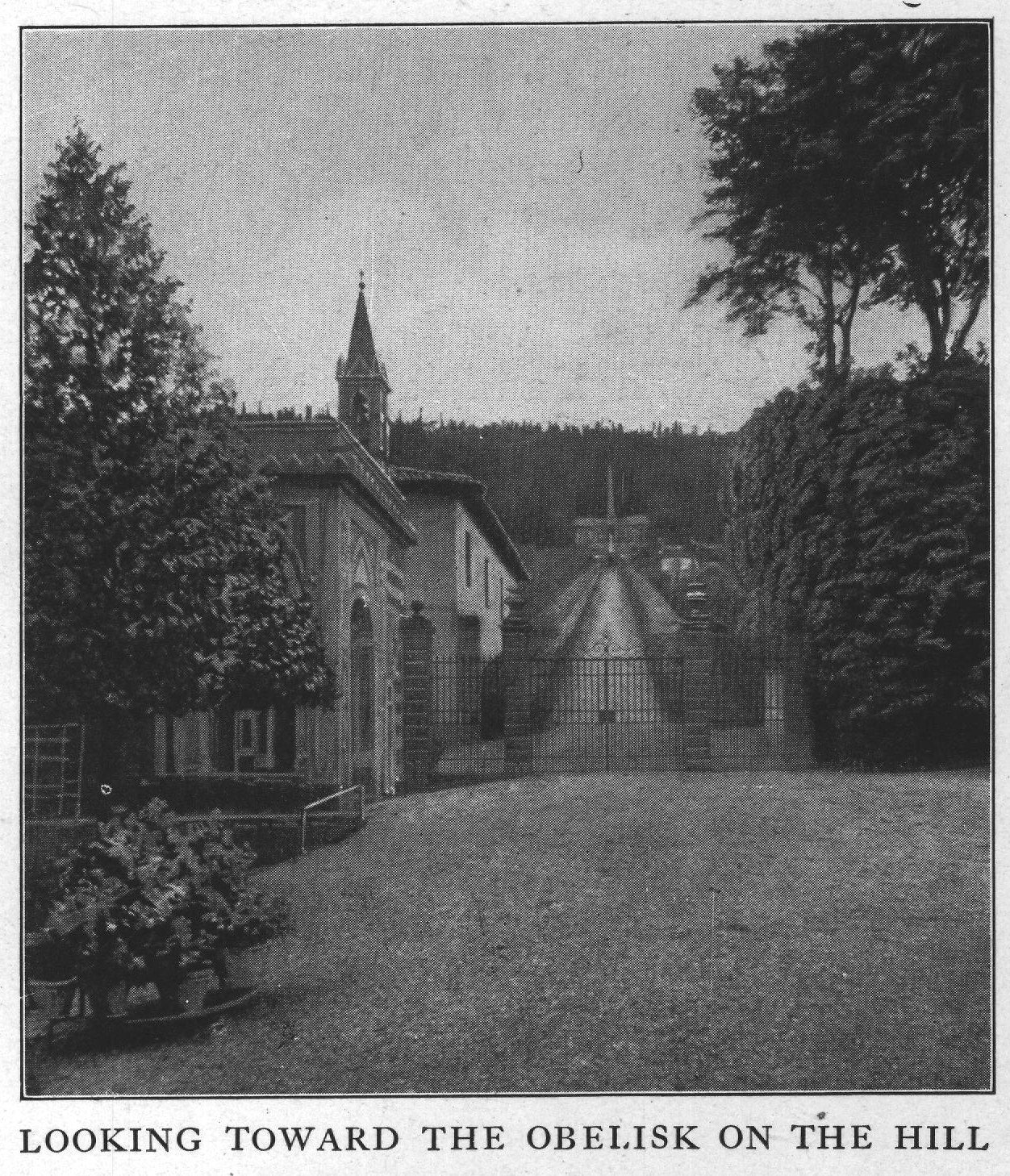
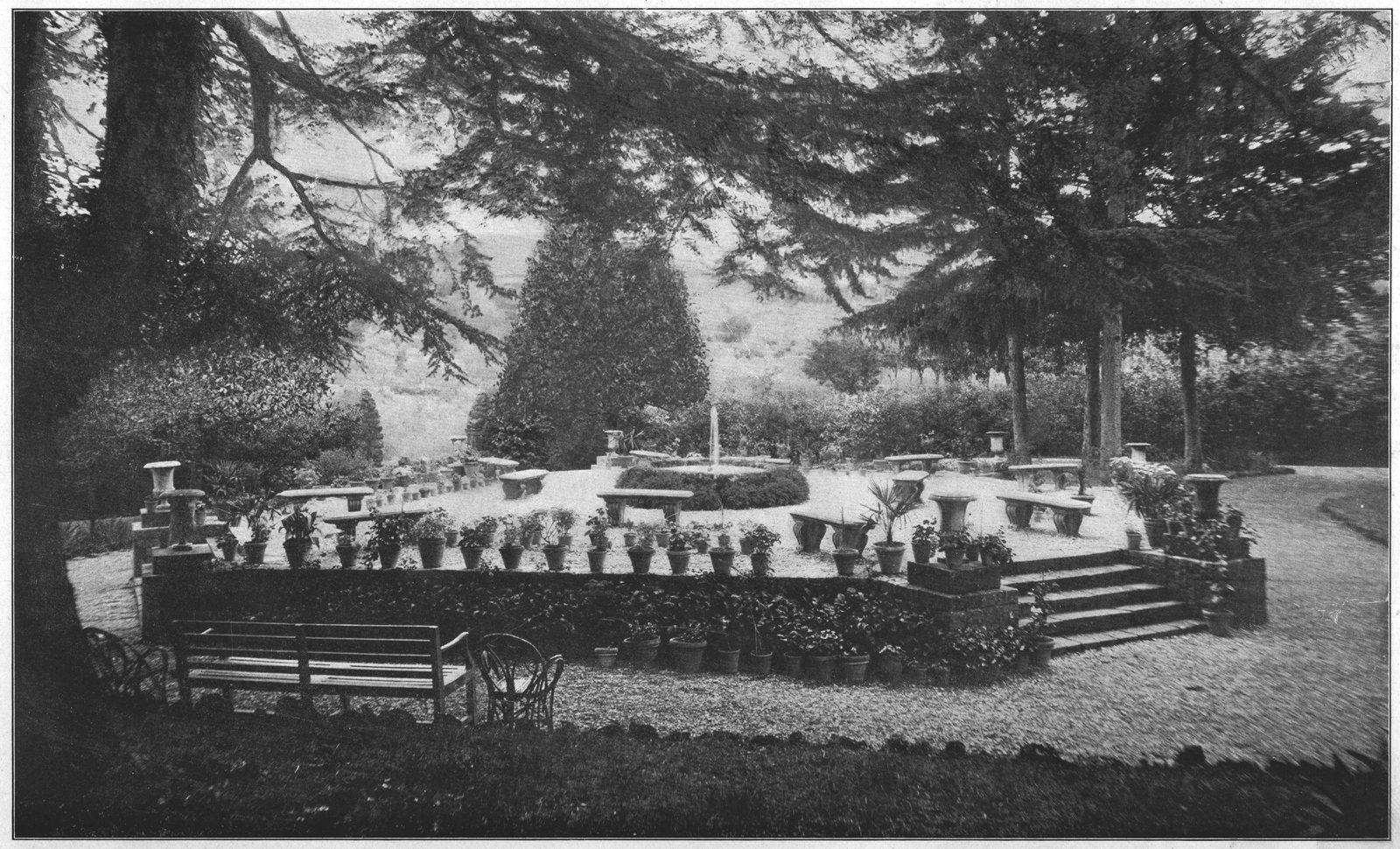
The garden around the house is not very large, but picturesque, from being on different levels of ground and shaded by many fine trees. To the right you look through iron gates down the cross avenue of cypresses. From here the obelisk on the top of the opposite hill is visible, ending the perfectly straight line between the double row of trees. Besides the shade of trees the garden has the charm of water. It is heard rippling in the fountains on both sides of the house. An avenue of horse-chestnuts and limes leads from the front door under the loggia to a cancello, upon the left of which is a small family chapel. An immense deodar, planted in 1848, as a tablet tells us, is remarkable for the height it has reached in so comparatively short a time. Besides this there are some fine standard magnolia, copper beech, and tulip trees. Of flowers, the beds are bright with roses, geraniums and marguerites.
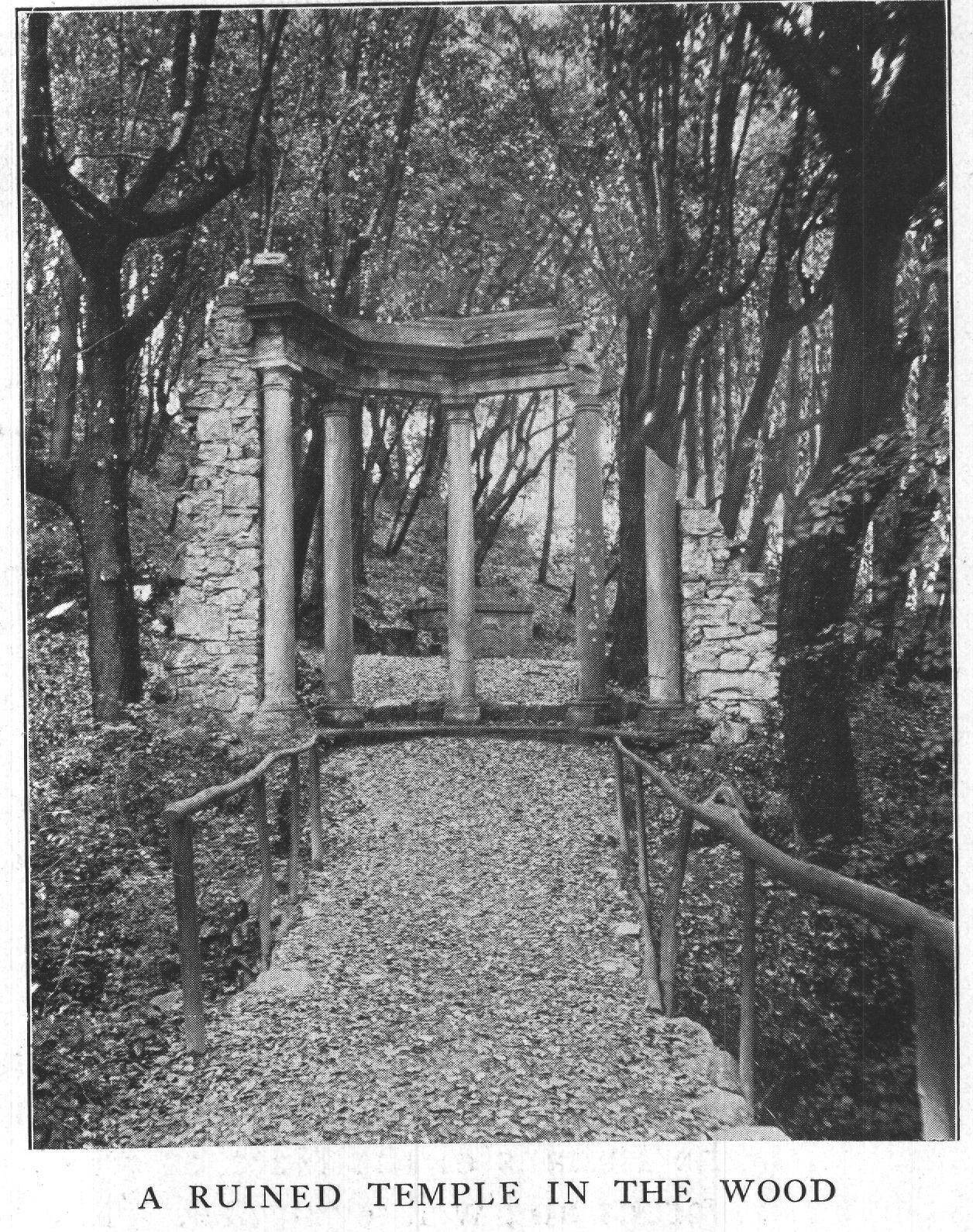
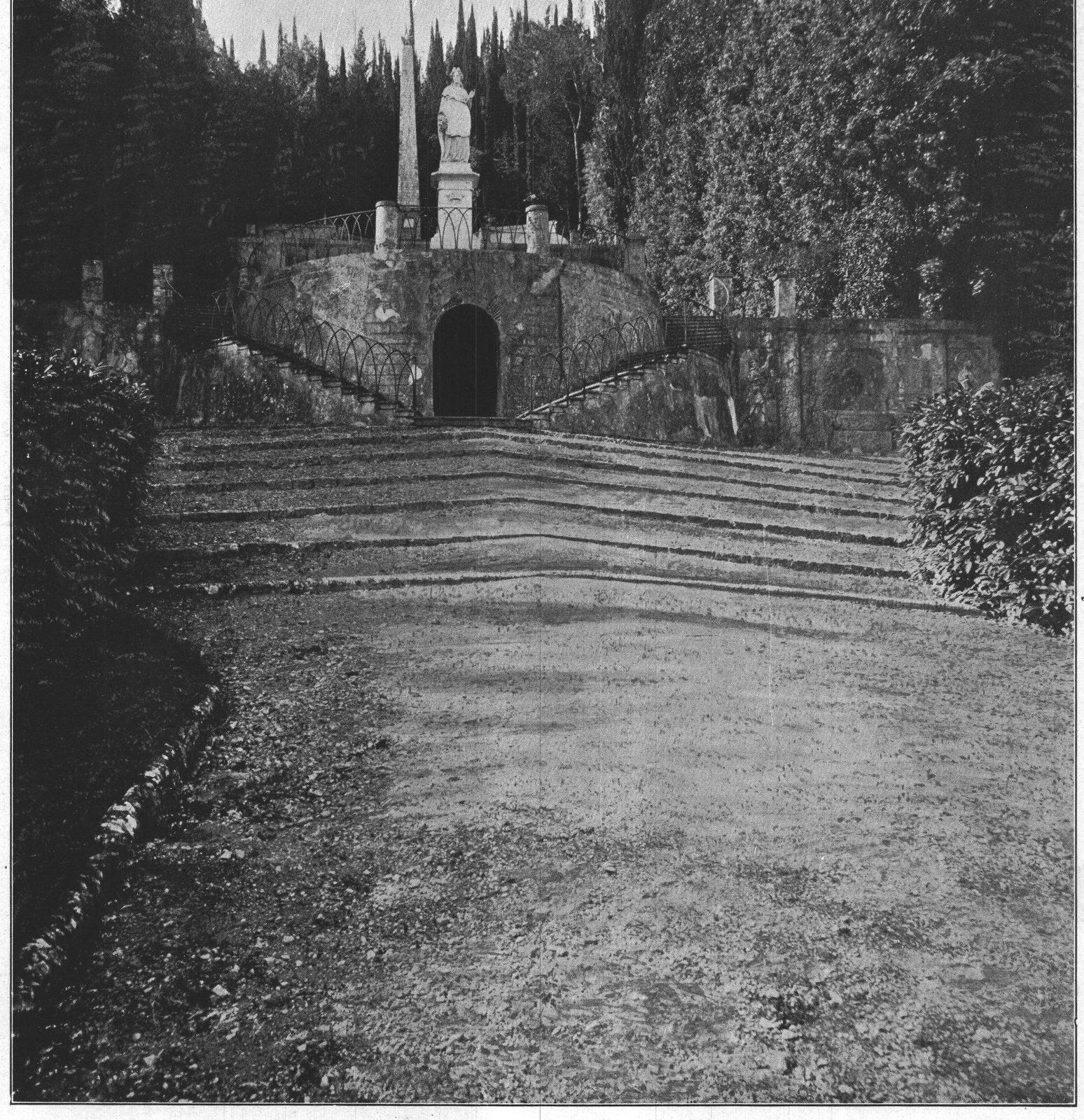
Looking up from the garden to the hill, immediately opposite the house, you have before you a strange piece of ornamental architectural work. High up the hill, the summit of this monument (for I do not know what else to call it) is crowned by an obelisk thirty feet high, surmounted by a golden eagle. The base of the obelisk, a square block of granite, bears a tablet which informs us that "Cavaliere Priore Enrico Danti inaugurava il di 28 Nov. 1865" this wonderful construction. A semicircular concave wall fifteen feet high, covered with now obliterated frescoes, supports the higher ground on which stands the obelisk. A stone seat runs around this wall, and the ground in front of it has been leveled to form an iron-railed terrace, in its turn held up by a stone wall, down the center of which some narrow steep steps lead to the next level. Here the hill has been graveled and held in by some mule steps. Two aloes on each side are the only plants that ornament this steep incline, which about fifty feet lower reaches a paved circular terrace, in the middle of which stands a statue of Spring, of no merit whatever as a statue, but effective enough when seen from a long distance. Narrow stairs with iron rails creep down the sides of the circular wall and meet at the bottom, where a grotto has been excavated under the terrace. From this point to the cancello there is no more masonry. A straight gravel path runs down between clipped laurel hedges, beyond which the poderi stretch right and left. This may be described as the Cavaliere Priore's capolavoro, but it is by no means the only embellishment he has "inaugurated" in his grounds. He was evidently as fond of dramatic effect in landscape as Horace Walpole himself. The wood abounds in temples, ruins, towers, obelisks and hermitages. A fortified castle on one hill frowns down upon the valley. It is castle, however, only on one side; on the other the defenseless walls of a contadino's house appear. In one most lovely glade we come across a monk; he has apparently just left his chapel, half hidden in the ilexes; his hands are joined, his eyes turned devotionally upwards to a tall wooden cross. At some distance he would be almost realistic but for a cruel blow that has deprived him of his nose and some chips in the stucco of his venerable knees.
We have outgrown the taste for incidents in our gardens and grounds. The return to Nature which Rousseau preached came with too sudden a rush upon an artificial world. Coute qui coute everything had to be natural; then Nature left to herself was found unsatisfying. She had to be assisted, but always in the most natural way. Formal garden paths were discarded as artificial, and winding grottoes, ruins and rustic bridges over meandering streams, all equally artificial, became the fashion. The Cavaliere Priore was a late disciple of this school, but an ardent one, as anyone who has strolled through the woods of Villa Danti will bear witness. Luckily for those who have outgrown his taste, Nature has done so much to make those woods beautiful that she seems to laugh at these efforts to interfere with her. For instance, from a little plaster temple, in itself quite graceful in design, a glorious view of the hills of Vallombrosa, purple as with the bloom of a purple grape, is before you. The little temple becomes so insignificant a detail in such grandeur that whether it be there or not matters little; your eyes instinctively turn elsewhere. The long ilex wood down which trickles the stream which carries water to the garden fountains, is a place to rest and dream in. There is no undergrowth, but the trees are planted close enough to prevent the eye from penetrating far along the winding path. Only the sunlight pierces through the dark leaves and throws a dappled pattern of light and shade on the moss and fern that grow along the stream. The Cavaliere Priore has, wisely, done but little to improve this spot. A quite inoffensive little bit of gray ruin just serves the purpose of making his presence felt, and spoils nothing. It is perhaps ungrateful to speak thus of one who certainly loved, and in his way felt, the beauty of these glorious woods; but the villa is so fine in its simplicity, the cypress avenues so grand and severe, that one wonders he should not have caught more of their spirit, and left what was so well, alone.