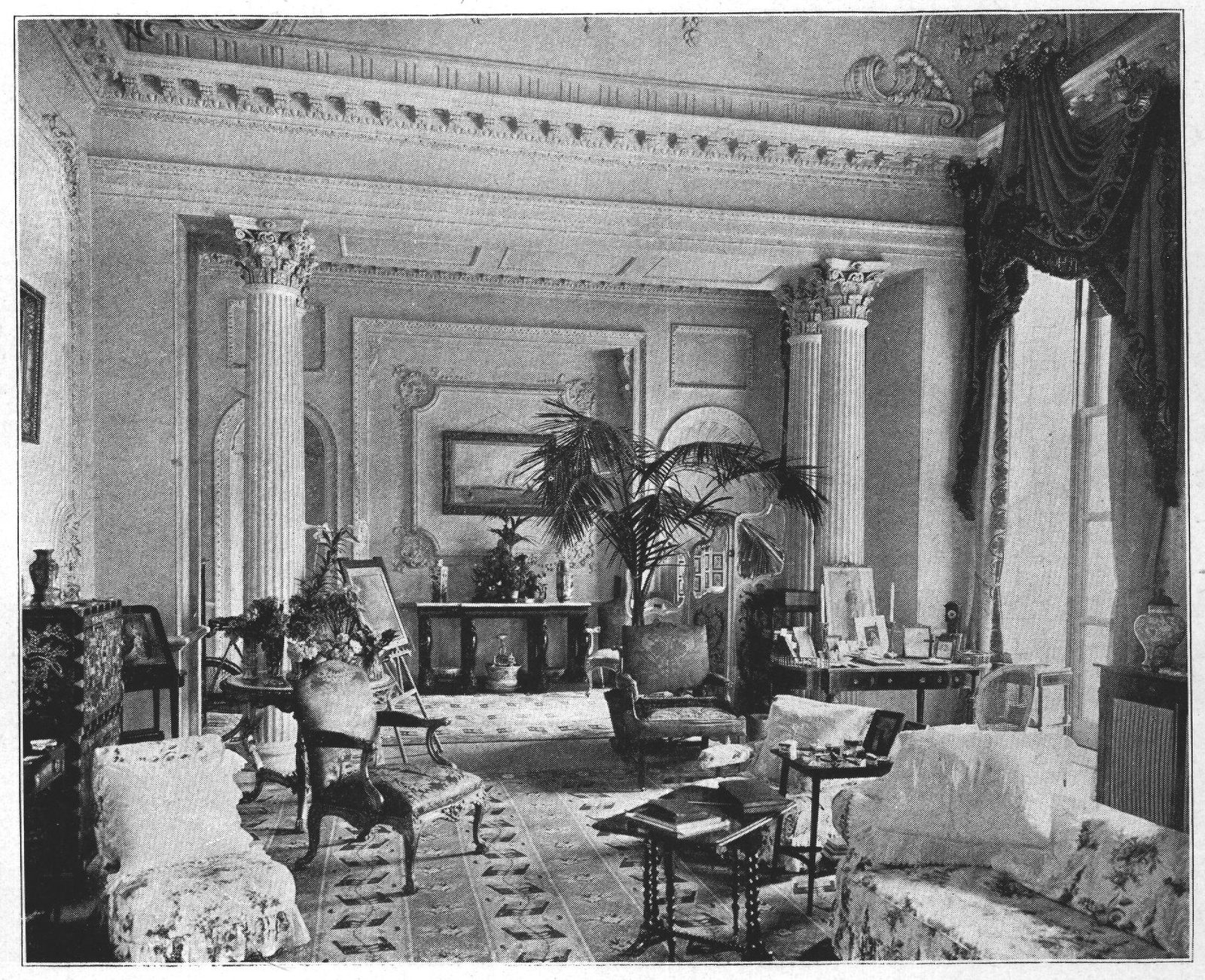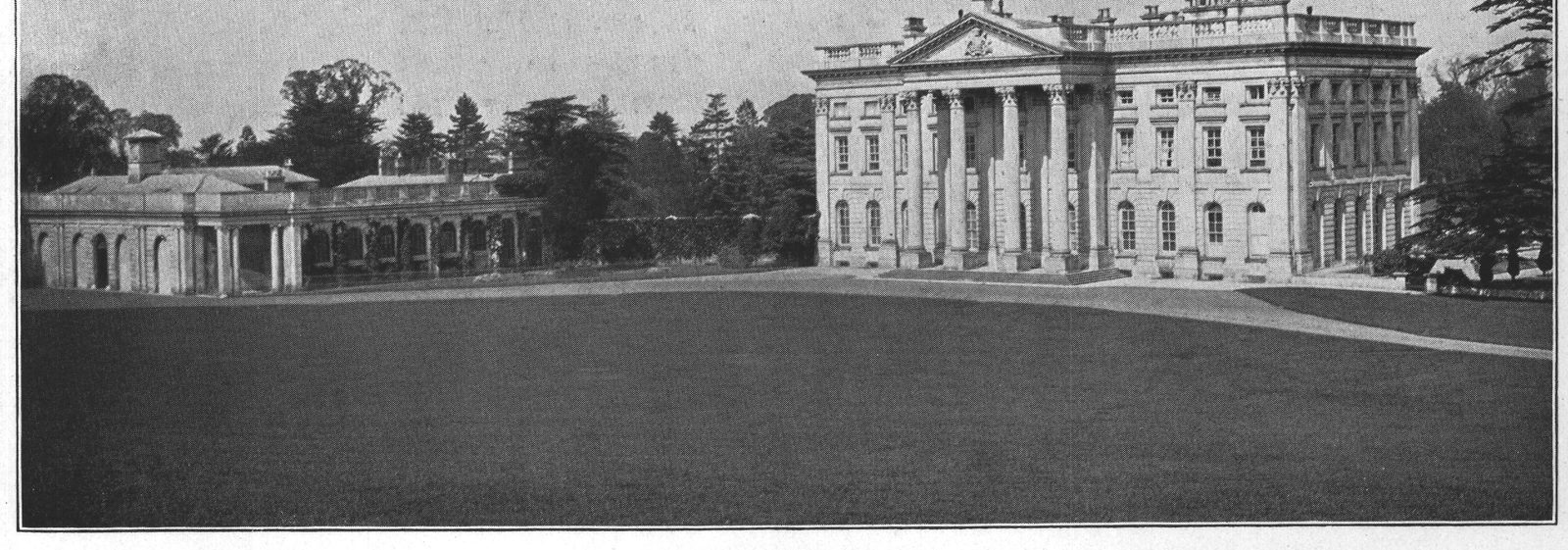
Few houses can rival Moor Park in its historical associations, the home of Lord and Lady Ebury, the lineal descendant of the great house famous in English annals, with which everybody who was anybody and every event worth recording seem somehow to have been connected. Lord Bulwer Lytton loved to people it with the shades of the mighty warriors in his Last of the Barons. In an autograph letter written to Lord Ebury in 1871, which lies before me, he says: "I suppose there is no historical romance existing which adheres so rigidly to accuracy in detail as The Last of the Barons. And I may say that now without vanity, for instead of deeming it a merit, I deem it a fault." Sir Walter Scott, Shakespeare, and other writers have made it a background of their romances, and many a scene recorded in true history, more remarkable than fiction, has taken place here on this site.
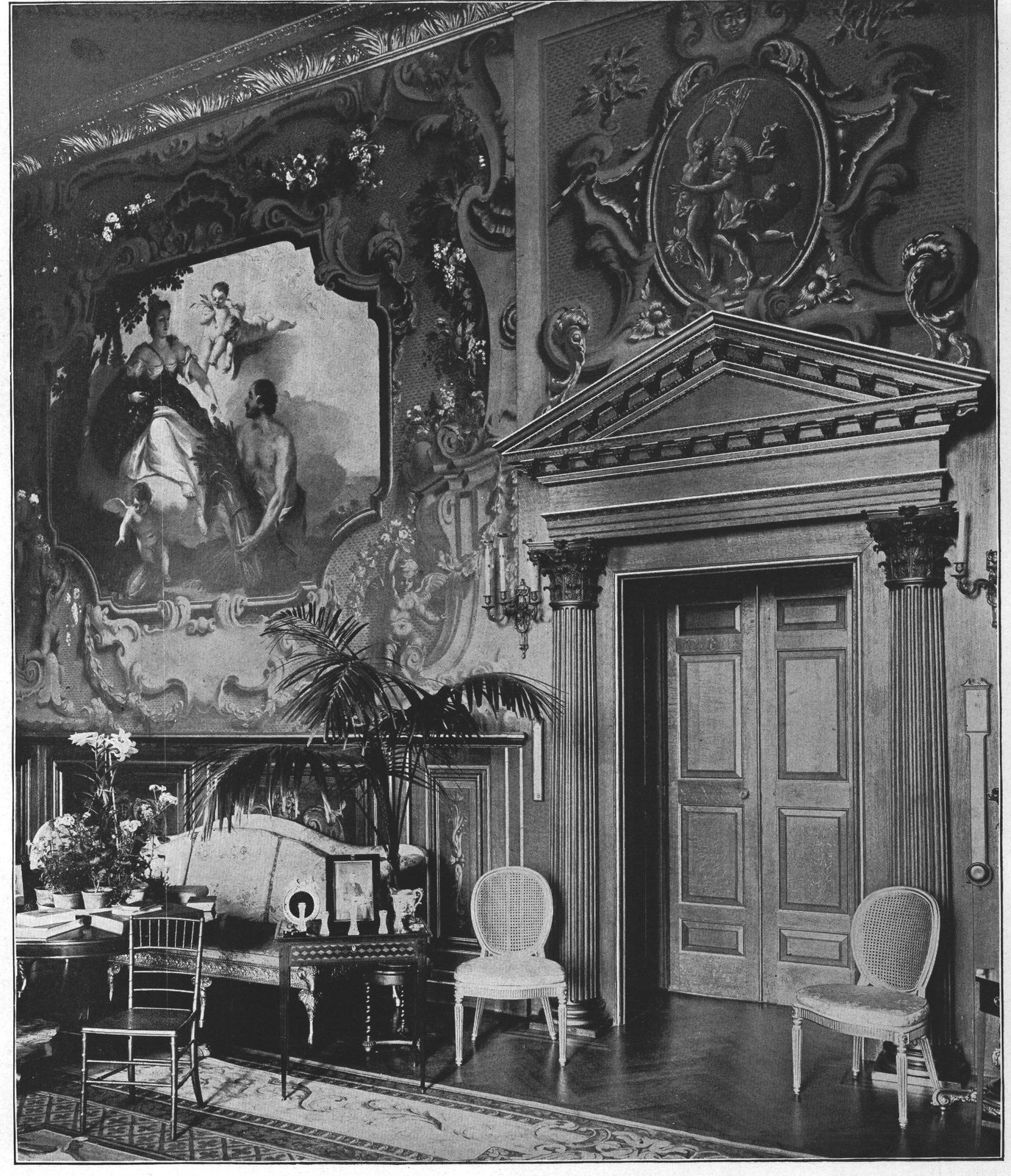
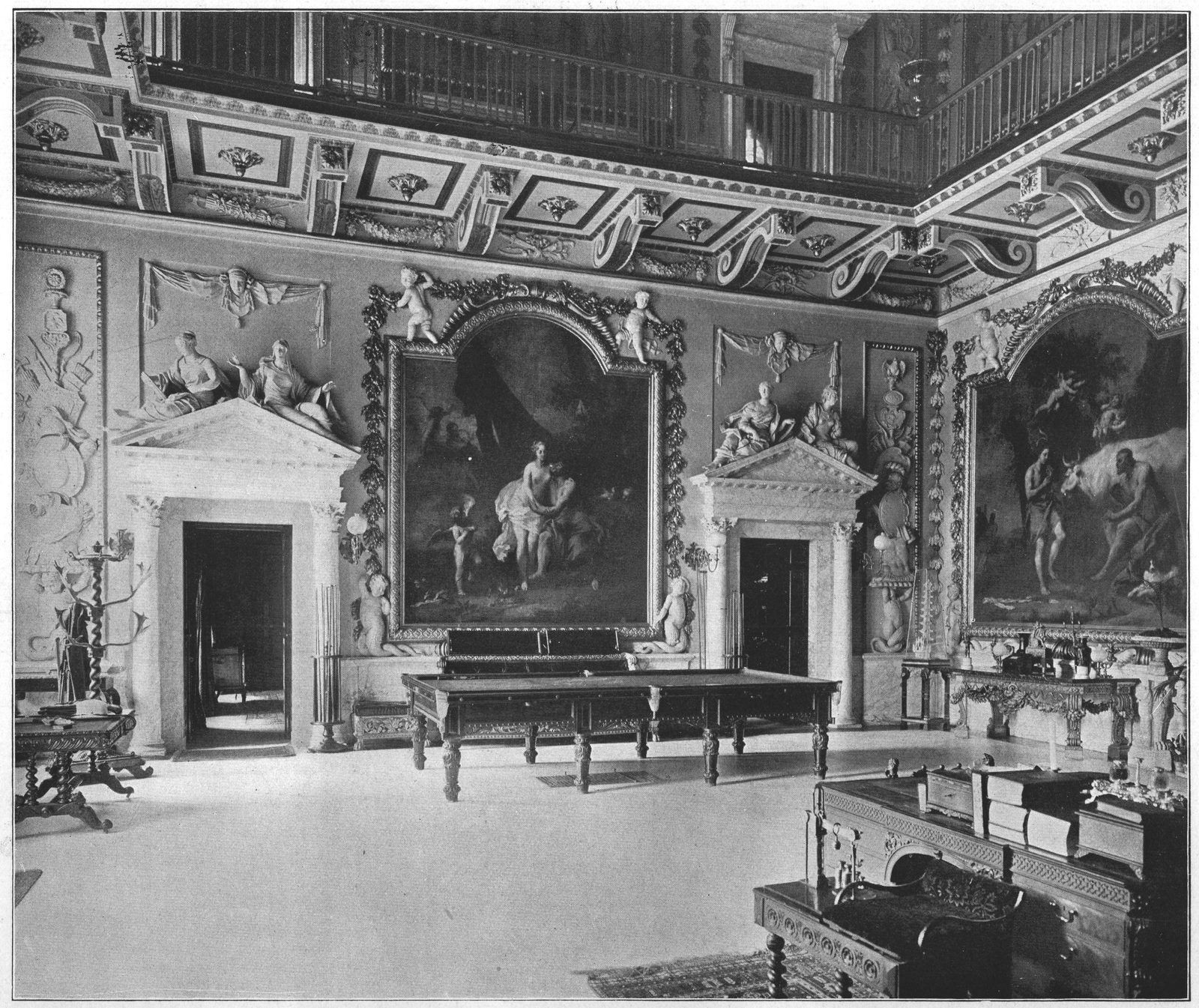
The present house owes its birth to the unfortunate Duke of Monmouth, a natural son of foolish Charles II., a man who added to his crime of rebellion against the King, for which he lost his head in an uncomfortable fashion on Tower Hill, the terrible fault of pulling down the old mansion, the home of romance and chivalry, for more than two centuries the magnificent abode of monarchs and princes. The estate of Moor Park became the property of the Crown on the attainder of the Duke, but was granted to the widowed Duchess by James II. as some compensation for the harsh treatment she had received from her sovereign. In 1720, after having married and buried another husband, she sold Moor Park to Benjamin Hoskins Styles, who had amassed a large fortune in the South Sea Bubble, and, unlike most of the speculators in that hazardous enterprise, managed to sell his shares when they were at their highest value, and thus became enormously wealthy. He mightily transformed Moor Park, encasing it in Portland stone, erecting a magnificent portico, adding two wings connected with the house by colonnades in the Tuscan style. Sir James Thornhill was the director of the work, and an Italian, Leoni by name, was the chief designer of the alterations. Solid marble doorways, ceilings painted and gilded, magnificent pictures, galleries and staircases adorned with paintings remain as noble monuments of Mr. Styles's work at Moor Park. Admiral Lord Anson bought the place from the representatives of the Styles family and added lustre to the mansion, expending vast sums on the house and grounds, employing in the latter that archpriest of destroyers of old gardens, "Capability Brown." Here in his beautiful home the gallant sailor used to recount his victories in the war with Spain, his adventurous voyage around the world, his captures of Spanish galleons, and his wonderful exploits which made him a prince of sailors. Here came Dr. Johnson to stay with the Admiral, and was not impressed by the gallant sailor's stories. He hated Whigs, to which party Lord Anson belonged. He loved to hear his own voice, and perhaps could not get a word in when Lord Anson was describing his fights and his victories. Hence his sarcastic epigram:—
Gratum animum laudo. Qui debuit omnia ventis,
Quam bene ventorum surger templa jubet
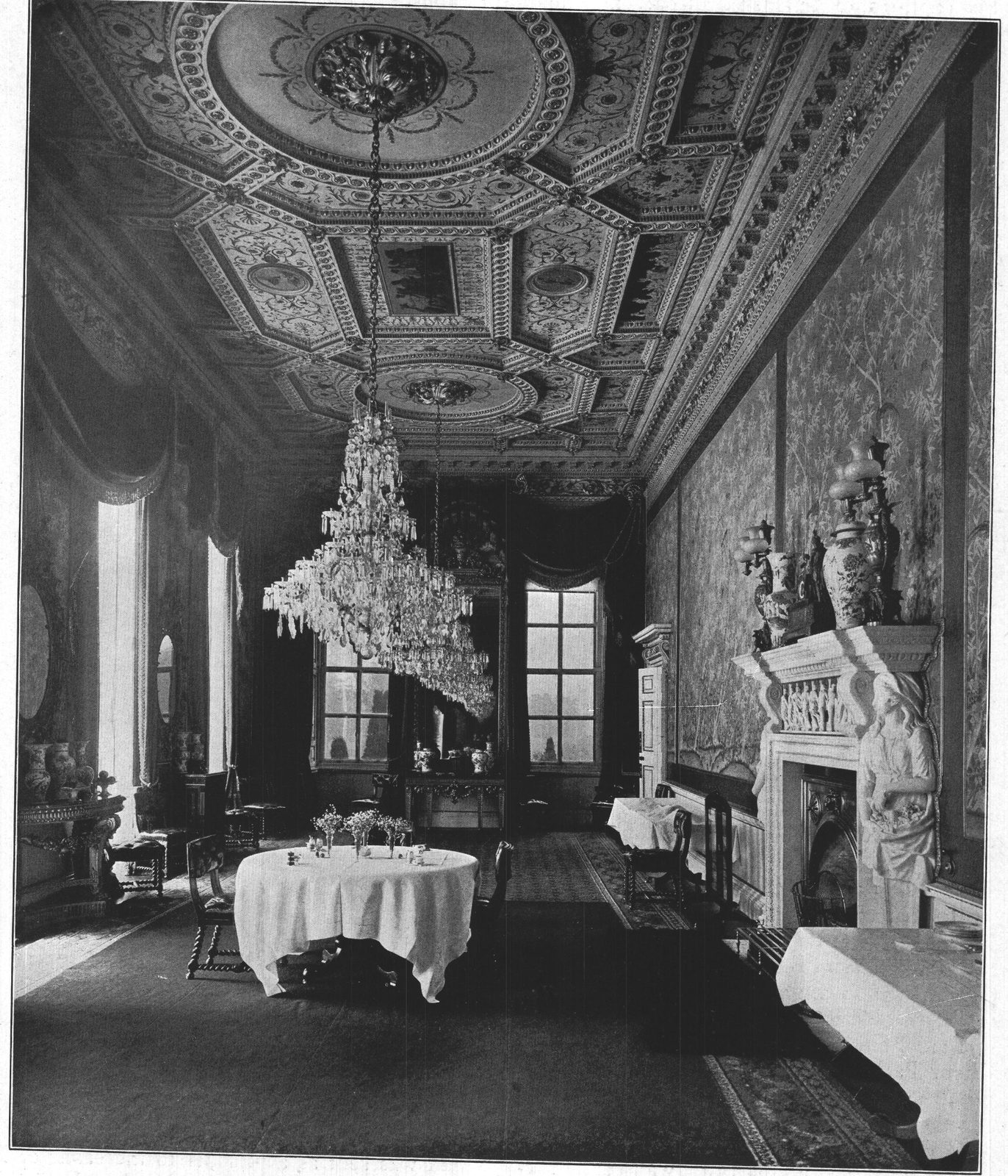
Sir Laurence Dundas, Bart., next acquired the property in 1763. He was commissary-general and contractor to the army in several wars, and amassed a large fortune. He added much to the decoration of the mansion, and entertained here the Prince of Wales, afterwards George IV. A Mr. Rous wrought much evil, pulling down the wings and colonnades, with the chapel and offices. He was a sorry vandal, and his memory at Moor Park is not revered. The next owner was Mr. Robert Williams, a man who raised himself by his own exertions from an upholsterer's apprentice to a distinguished position in the East India Company and became the head of the banking house which is now known as that of Williams, Deacon & Co. His son sold the house to Robert, Earl of Grosvenor, afterwards Marquis of Westminster. This is not the place to record the annals of this distinguished house, which has left its mark on many a page of England's history. Here the Marquis entertained right royally King William IV. and his Queen. On the death of the Marchioness of Westminster the property passed to her third son, Lord Robert Grosvenor, who was created Baron Ebury in 1857, a great benefactor, the friend and colleague in many charitable enterprises of the good Lord Shaftesbury. Here Queen Victoria and the Prince Consort came to pay a memorable visit in 1854. On the death of the first Lord Ebury, at the great age of ninety-two years, Moor Park passed into the possession of his eldest son, the present Lord Ebury.
We have recorded briefly the history of the present mansion. We will now visit the site of the old palace, of which the moat and an old brick wall partly surrounding an orchard are the only visible remains. Here we must construct again in imagination the great house which once stood there, and people it with the host of kings, princes, cardinals, prelates, and warriors who once thronged its magnificent hall. This mansion was of brick, the chief buildings forming a square court, which was entered by a gate-house flanked with towers.
Originally the property belonged to the Abbey of St. Albans, having been granted by Offa, King of Mercia, in atonement for the murder of Ethelbert, King of East Anglia. Here a cell of the abbey was established, and the tenant was obliged to provide a horse for the abbot whenever he wished to visit Tynemouth, near Newcastle.
The real history of the Park begins with its acquisition by that powerful ecclesiastic, George Nevil, brother of the great Earl of Warwick, styled "the King-maker," Archbishop of York in 1464, and Lord Chancellor of England. He obtained a license from Henry VI. to enclose six hundred acres in the parishes of Rickmansworth and Watford, and built the mansion which was destined to witness some of the great events in English history. It was a magnificent palace of stately architecture, embellished with a façade of double arches, painted and blazoned somewhat in the fashion of certain old Italian houses. Lord Lytton thus describes it:—
"Through corridor and hall, lined with pages and squires, passed Montagu and Marmaduke till they gained a quaint garden, the wonder and envy of the time, planned by an Italian of Mantua, and perhaps the stateliest one of the kind existent in England. Straight walks, terraces, and fountains, clipped trees, green alleys, and smooth bowling-greens abounded; but the flowers were few and common, and if here and there a statue might be found, it possessed none of the art so admirable in our earliest ecclesiastical architecture, but its clumsy proportions were made more uncouth by a profusion of barbaric painting and gilding. The fountains, however, were especially curious, diversified and elaborate; some shot up as pyramids, others coiled in undulating streams, each jet chasing the other as serpents, some again branched off in the form of trees, while mimic birds, perched upon leaden boughs, poured water from their bills."
The Archbishop was a mighty prelate. His mansion was a court of great magnificence, and thither, as to a Medici, fled the men of letters and art. His palace was more Oriental than European in its gorgeousness. By the influence of "the King-maker" and the Chancellor, Edward IV. was at length seated upon the throne, and the monarch was often entertained at "the More." All power in the kingdom seemed to have been absorbed by the Nevils. The King was actually in their power, and was sent as a prisoner to the castle of Middleham, in Yorkshire, but in a few days he was allowed to escape, accompanied by the Archbishop and the Earl of Oxford. They tarried at "the More," where Edward forbad them to go with him further, and rode to London. In 1470 the Archbishop attempted to entrap the King at his house. Edward was received with loyal protestations, but as he was washing his hands Sir John Ratcliffe contrived to whisper to him that a hundred armed men were ready to seize him and take him prisoner. He determined to attempt flight. With noiseless steps he gained the door, sprang upon his steed, and dashing right through a crowd assembled at the gate, galloped alone and fast, untracked by any human enemy, but goaded by that foe that mounts the rider's steed, over field, over fell, over dyke, through hedge, and in the dead of night reined in at last before the royal towers of Windsor.
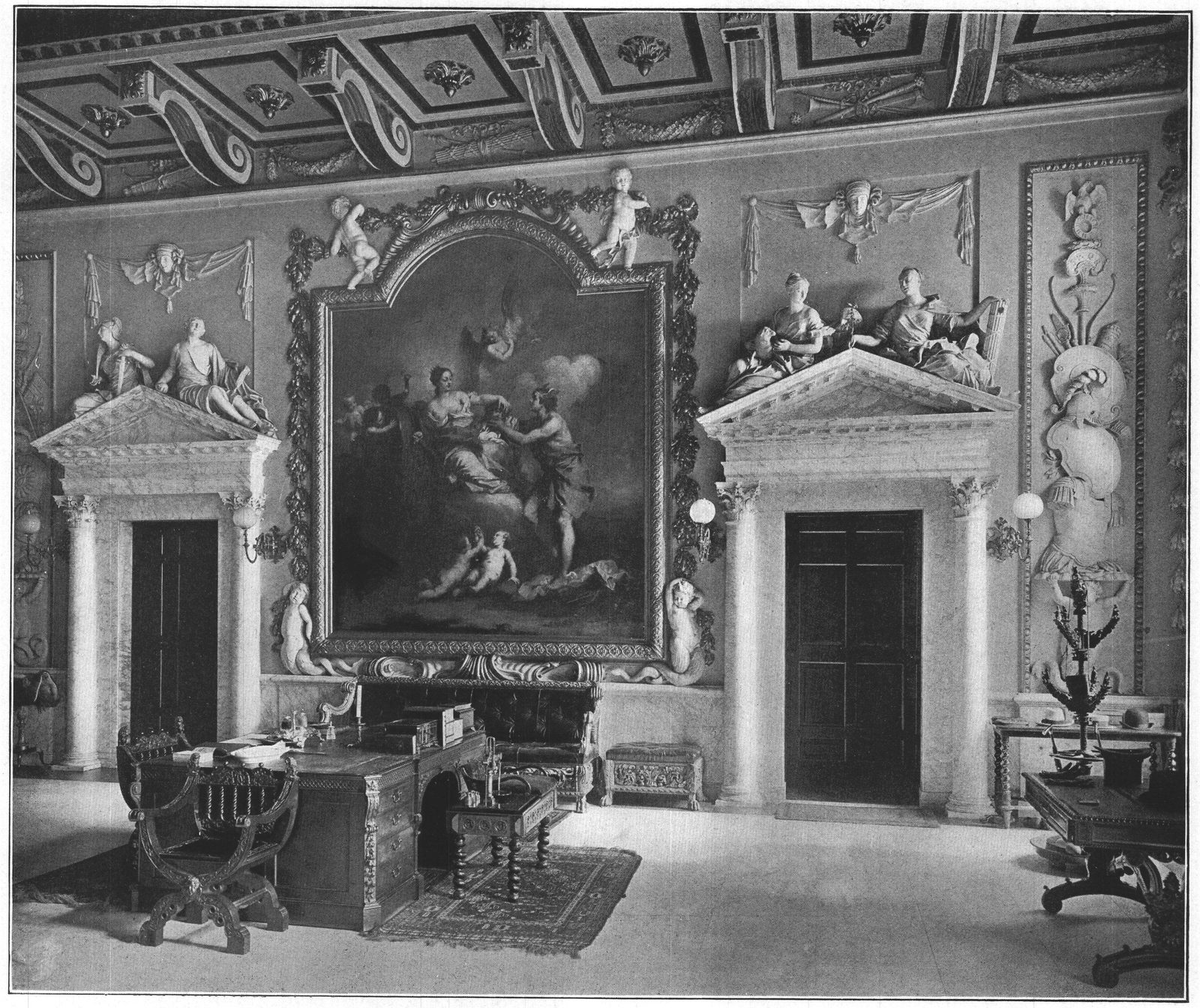
We need not follow the startling events of the Wars of the Roses, the rapid change of fortune, the death of "the King-maker," "the greatest and last of the barons," on the blood-stained field of Barnet. The owner of "the More," by a time-serving policy, contrived to retain the apparent friendship of the King, who was secretly plotting his ruin. It was accomplished in this wise. Edward invited the prelate to Windsor, and when they were hunting in the forest the guest told his royal host of some extraordinary game which he had at Moor Park. The King expressed his pleasure to see it, and promised to come for a day's sport. The Archbishop returned to his house in high spirits, and prepared a mighty feast, bringing together all the plate which he had hidden during the wars, and borrowing some from his friends. When everything was ready, a royal summons was delivered into his hands, ordering him to repair to Windsor. He was arrested, and sent a prisoner to Calais. The King seized his estate, his plate and property, and the temporalities of his see. His mitre, which glittered with precious stones, was converted "into a crown, and the jewels that shone at Moor Park were applied to adorn the royal diadem, and perhaps still sparkle there." Their former owner did not long survive his disgrace, and soon was brought home to die. He lies buried in the Minster at Leicester, but no tablet marks the memory of the powerful prelate, who with his brother, once ruled England, but was at heart a craven and unscrupulous time-server. Warkworth, in his chronicles, speaking of his great wealth and short-lived prosperity, concludes: "Such goods as were gathered in sin were lost in sorrow."
The estate remained to the Crown until the reign of Henry VII., who granted it to John de Vere, the thirteenth Earl of Oxford, to whom he was principally indebted for his throne. De Vere was the hero of Bosworth Field, and led the gallant archers in that memorable fight which sealed the fate of the despicable Richard III. He received abundant reward for his prowess and faithfulness, and amongst the confiscated lands bestowed upon him was Moor Park. He died without issue in 1513, and his property reverted to the Crown. Henry VIII. used it as a royal residence, and gave it to Cardinal Wolsey, who enlarged or rebuilt the mansion, and often lived here in magnificent state. Hither came cardinals, ambassadors, nobles, and princes, and on several occasions King Henry came, and was entertained with royal splendor. In 1529 King Harry and his first Queen stayed a whole month at "the More," and though Anne Boleyn was in her train, Cardinal Campeggio failed to detect any wanderings in the affections of his majesty or any jealousy on the part of Queen Catherine.
An event of historical interest occurred at the house, where, in 1523, a Treaty of Alliance between England and the French King, Francis I., was signed, called "The Treaty of the More." The provisions of the treaty we need not concern ourselves with, save to notice that the astute Cardinal secured for himself a good round sum for the arrears of pension due to him for resigning the bishopric of Tournay, and a hundred thousand crowns of gold "for great and reasonable services."
Never before had Moor Park seen such magnificence. The Cardinal's chambers were garnished with the finest tapestry. His couch and table-cloth were covered with gold, and he dined amidst the subtle perfumes of musk and sweet amber. His dishes were silver, full of the daintiest viands, and he drank his wine always from silver and gold vessels. But his days were numbered, his disgrace nigh. The charms of Anne Boleyn had made an impression on the capricious king. The divorce was sought and much delayed. Campeggio comes to "the More," and long and deep are the confabulations of the two Cardinals over the matter. They hasten together to the court at Grafton. Wolsey is denied lodging in the court. The Cardinals return to Moor Park, sad and sorrowful. Campeggio hastens away to London. No sooner has he gone than hurried messengers arrive at the Moor in search of some of Henry's love letters to Anne Boleyn which that lady had missed from her boudoir. They ride after him and do not overtake the Nuncio until he arrives at Calais, where they search his baggage; but the letters are not found. They are on their way to Rome, and there they remain until this day amongst the archives of the Vatican.
Alarmed, anxious, and depressed, Wolsey passed his days at the Moor, dreading the outbreak of the hostility of the King. You can see the chair at the mansion wherein he sat and dreamed of his approaching fate, the saddle on which he rode, and the old cardinal's oak under which he sat brooding over his troubles. He left his lovely home for London, never to return, and ere long his ambitious heart found rest within the cloister shade of Leicester Abbey. You can see in the British Museum a long inventory of the Cardinal's goods—his carpets and hangings, his beds and hats and vestments—which, together with the property, fell into the King's hands. The poor abandoned Queen Catherine stayed a night at Moor Park on her way to exile from the Court, and to the grave that soon awaited her at Peterborough. Then came the rule of the Bedfords, John Russell, the first Earl, being appointed ranger. The State Papers contain some letters from the Earl to his friend, Thomas Cromwell. One of them, dated May 1st, 1535, mentions that the park palings at "the More" are in decay, that the deer are escaping, and immediate repair much needed. He reports that he has felled two hundred oaks, but he requires money and special directions what to do. He continues:—
"Sir,—The garden goeth to great ruin. By my Lord Cardinal's days it cost him forty or fifty Pounds or a hundred marks for the keeping thereof and since it hath been in the King's hands, it hath cost his Highness forty or fifty marks a year, as Mr. Hennage can show you, and now it is utterly destroyed and all the knots marred. Wherefore if it be not looked on betimes it will be past recovery. Sir, if the King will give 8 Pence a day, I will see that it shall be well kept, that his Highness shall be well contented, though it cost 6 Pence a day on my own purse. And also for the keeping of the fish there, it hath been chargeable unto me hitherto; whereupon if there be not a trusty fellow to have the keeping of the garden that shall have the oversight thereof there will be much displeasure done, and but little fish left, for I had never so much ado to keep it as I have now. Sir, I put you always to pain, but you may command me as your own. Whereupon I heartily desire you as you will do me pleasure that you would solicit the King's Highness as well for the paling of the Park as for the garden and the keeping of the fish,—for an his Highness should come thither and see it so far in ruin as it is, his Highness would lay it to my charge and think the fault were in me, which were greatly to my rebuke and shame as knoweth our Lord who keep you.
"At Charley Wood, the first day of May
"Your assuredly to my power
"J. Russell."
It is hoped that the good ranger obtained his money and a good "trusty fellow" for the garden; otherwise, when Henry and his fifth Queen, Catherine Howard, came five years later, he would certainly not have escaped the anger of the passionate King. The royal pair stayed three weeks, and seem to have courted seclusion rather than the usual courtly pleasures. The second Earl had to fly for his life from the burning questions of Queen Mary's reign, but after her death returned to enjoy his own again, both as owner of his ancestral home at Chenies and as ranger of Moor Park, which was subsequently granted to him by the Queen, at the request of Sir William Cecil, on the payment of an annual rent of £120.
The third Earl who ruled at Moor Park was the grandson of the second Earl of Bedford. His sprightly Countess was a favorite of the Court, where she bloomed as "the crowning rose in a garland of beauty." James I. granted to him the estate absolutely. The Countess constructed the famous gardens celebrated by Sir William Temple, of which no trace remains. She was immensely extravagant, and was forced to sell the place to William, Earl of Pembroke, in 1626. He was succeeded by his brother, Sir Philip, in 1630, who deserted King Charles, and joined the rebels. A year later he sold the property to Robert Cary, Earl of Monmouth. The Duke of Ormond, a faithful supporter of the royal cause, purchased it in 1663, whose eldest son took his title from the estate, and was styled "Lord Butler of Moor Park." In 1670 it was sold to the unhappy Duke of Monmouth, who, as I have already stated, pulled down the old house, which had so many noble and illustrious owners, and had witnessed so many scenes of splendor and magnificence. The old house is gone, but its glories remain imprinted on many a page of English history. Its lineal descendant lives on, a palace worthy of its distinguished ancestry, owned by a family as illustrious as any of those which have preceded it. The Grosvenors have deserved well of their country, fought its battles, and contributed to its prosperity. May the tenure of the scions of that noble family whose lot it is to dwell in one of the fairest of Hertfordshire manors continue far longer than that of many of their predecessors, whose varied fortunes and vicissitudes I have attempted to trace.
I am indebted to Lady Ebury for the loan of many valuable papers which have been most useful in the preparation of this sketch of the history of Moor Park. Amongst them are some interesting letters by Mr. J. A. Froude and Lord Bulwer Lytton, Mr. Henry Mitchell's paper on "The History of the More," and Mr. R. Baynes' "Moor Park." I beg to acknowledge my indebtedness to these writers for much important information.