Adjunct Professor of Architecture at Columbia University
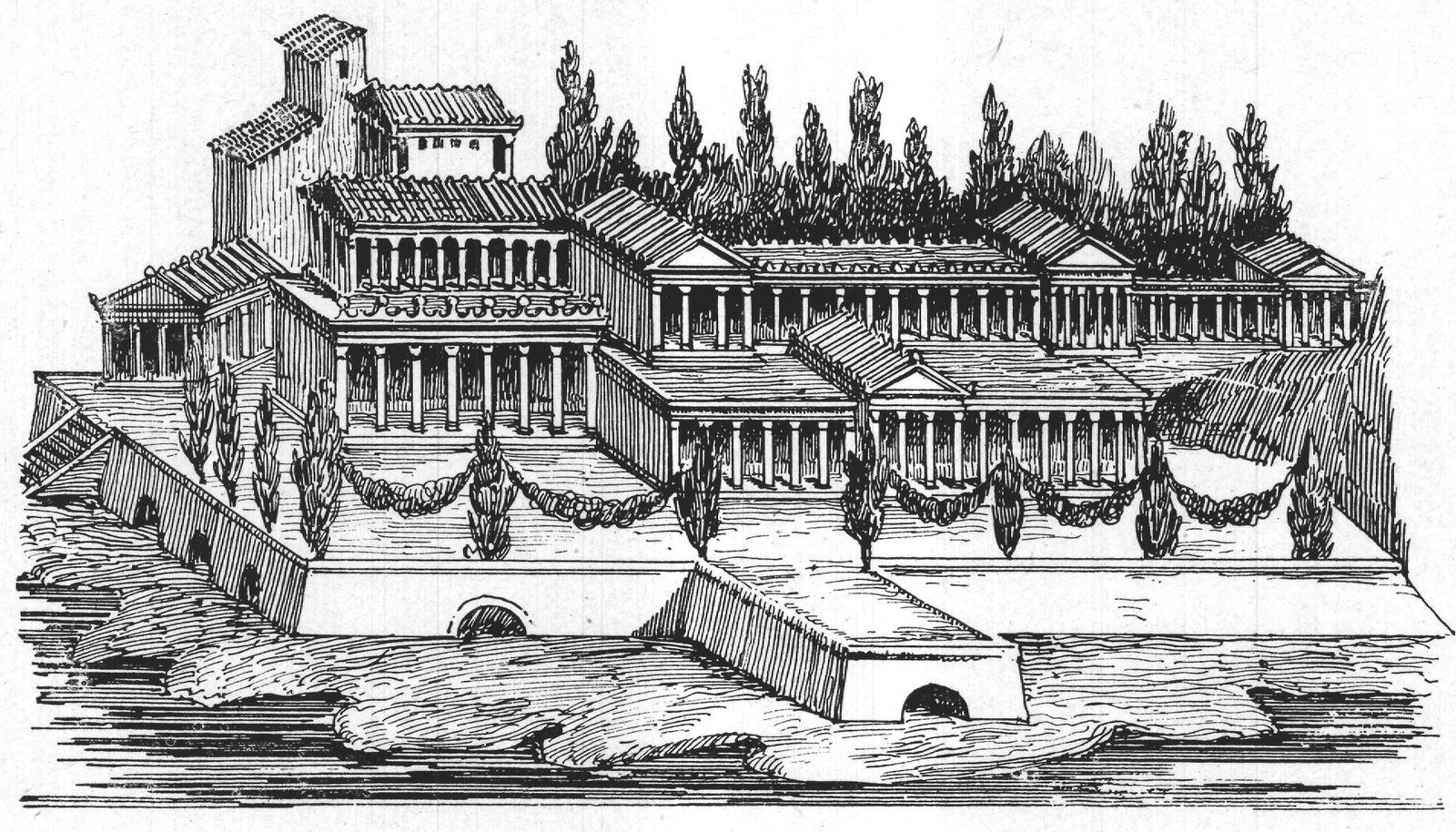
The growth of cities is one of the necessary concomitants of maturing civilizations. As cities multiply and become more and more densely populated, there is developed a reaction towards rural life. Unless, however, the means of transit between the busy centers of urban life and the open country are both abundant and speedy, the privilege of living in the country and transacting business in the city is confined to the wealthy few and it is, of course, only the wealthy who can afford to spend any considerable part of their lives in rural ease upon the income of their investments, or with only infrequent returns to the city to transact business.
In ancient Roman days transit between the Forum and the open country about the Eternal City depended upon the legs of men and beasts. Travel in a springless cart or chariot over the huge lava blocks of the Roman paved roads, or the deep ruts of rural highways, was not an agreeable experience. The wealthy patrician traveled in a litter borne by slaves, whenever this was possible; those of more active tastes rode on horseback. Though "all roads lead to Rome" the city was much less of a distributing point for the outlying country than are our larger cities to-day, thanks to the economic revolution wrought by our railways. To understand Roman country life it is necessary to picture to ourselves conditions of transportation and intercourse more primitive than we can easily imagine, and it requires no light exercise of the imagination to represent to ourselves other features of the environment of Roman city and suburban life,—the innumerable slaves, the thronging and turbulent crowds in the streets and public places, the obsessions of parasites, suitors, dependents and politicians; the noise and smells and other "disagreeables" of the city streets. Yet all these we must take into consideration before we can grasp the full significance of country life to the Roman, or read with intelligent appreciation the letters of Cicero to Atticus, or of Pliny to Gallus and Apollinaris, describing their villas at Tusculum, Laurentinum, Puteoli, and others in the hills of Tuscany.
Rome was a city unlike those of our day. A large part of its area was given up to public buildings—temples, theatres, basilicas, baths; and another large part to places of public resort—fora, gardens and colonnades. The mass of the population was housed in a comparatively restricted area, crowded into tenement blocks or insulæ, piled up in many stories, dark and insalubrious. The saving element in the lives of the teeming thousands in these insulæ was the Roman habit of life in the open; the house was a mere aggregation of sleeping cells, to which the workingman or slave retired like a mole to his burrow. Around this city of vast open spaces, superb monuments and squalid insulæ, spread a fringe of suburban residences, more and more spacious as one proceeded out towards the green Campagna; and finally beyond these, a vast ring of villas or groups of villas, extending far out towards the Alban Mountains in the southeast, towards Tivoli and Subiaco to the east, and northwards along the innumerable affluents of the Tiber. Daily the man of affairs was borne in his litter to and fro between Rome and his villa or suburbanum, in the nearer circuits of country houses; while in those more remote, the jaded politician, the wealthy patrician, and the official whom business no longer called to the Forum or basilica, sought rest and pleasure far from the city's turmoil. Fanned by mountain breezes and lulled by the murmur of mountain streamlets turned to service in the fountains and cascades of his terraced gardens, he rested from the cares of business or of state. The wealthy Roman was not content with a villa or two; he must have a half dozen or more, so variously situated and appointed as to furnish him with a resort for every change of mood or of the weather. Pliny the Younger mentions five in his letters; Cicero had as many. The lot of a literary politician in those days seems not to have been a hard one, in the matter of houses at least. A winter house and a summer house; a seaside house and a mountain house; a house in the south, at Naples or Baiae or near Pompeii, and a house in the north among the hills of Etruria; a little house and a big house and a house near Rome; these were some of the modest requirements of the Roman of wealth and leisure of the imperial or late republican period, in addition to the city house in the very outskirts of Rome or within its walls.
The Roman love for the country amounted to a passion; it survives to-day in the villegiatura of the modern Roman gentleman, to whom the annual summer's rustication is an absolutely essential feature of his life. "No gentleman can do without it," however modest his fortune. This love of the country was, in the ancient Roman, not the modern sentiment of nature-love, the poetic delight in the contemplation of the wonder and beauty of the natural world for its own sake, but rather the more selfish but not unworthy pleasure in the physical and esthetic satisfactions which rural life could bring. In the country were rest and freedom from care; the coolness of fresh breezes in summer, the mildness of a southern sun in winter; the gleam and plash of springs and fountains, the shade of rocks, the restful verdure of trees and grass, the perfume of violets and roses. Above all there was space and air; and the Roman could not live without these. He hated the cramped quarters even of his relatively spacious city houses. Even a modest farmsteading was better than the city with its crowds. "Odi profanum vulgus et arceo," cries Horace; and in the sixth of the second book of his Satires he voices his longing for rural quiet and peace:
"This was my dream—a modest piece of land,
A garden, and a cottage by a spring,
And eke a bit of woods—and lo, the gods
Surpassed my prayers. 'Tis well! naught more I crave,
O Maia's son, but to enjoy these ever."
The Roman of the age from Cicero to Pliny—the golden age of Roman villa-life—never deluded himself with the idea of a reversion to primitive ways of living. His villegiatura was no Adirondack camping-expedition. In the country he required "all the modern improvements" and all the luxuries of the city, as well as the pleasures of rural seclusion. The walls were painted by Greek or Campanian artists. In cold weather a portion of the vast establishment was heated by hypocausts, at great expense. The furniture was often more elaborate than that of the city house. An army of slaves waited upon the owner and his guests; and they could, within the limits of their own property, enjoy the luxury of hot and vapor baths as perfectly as in the magnificent thermæ of Augustus or Titus in Rome. Pliny writes to a friend to give him notice of his coming, so that he might heat his baths in readiness for his entertainment.
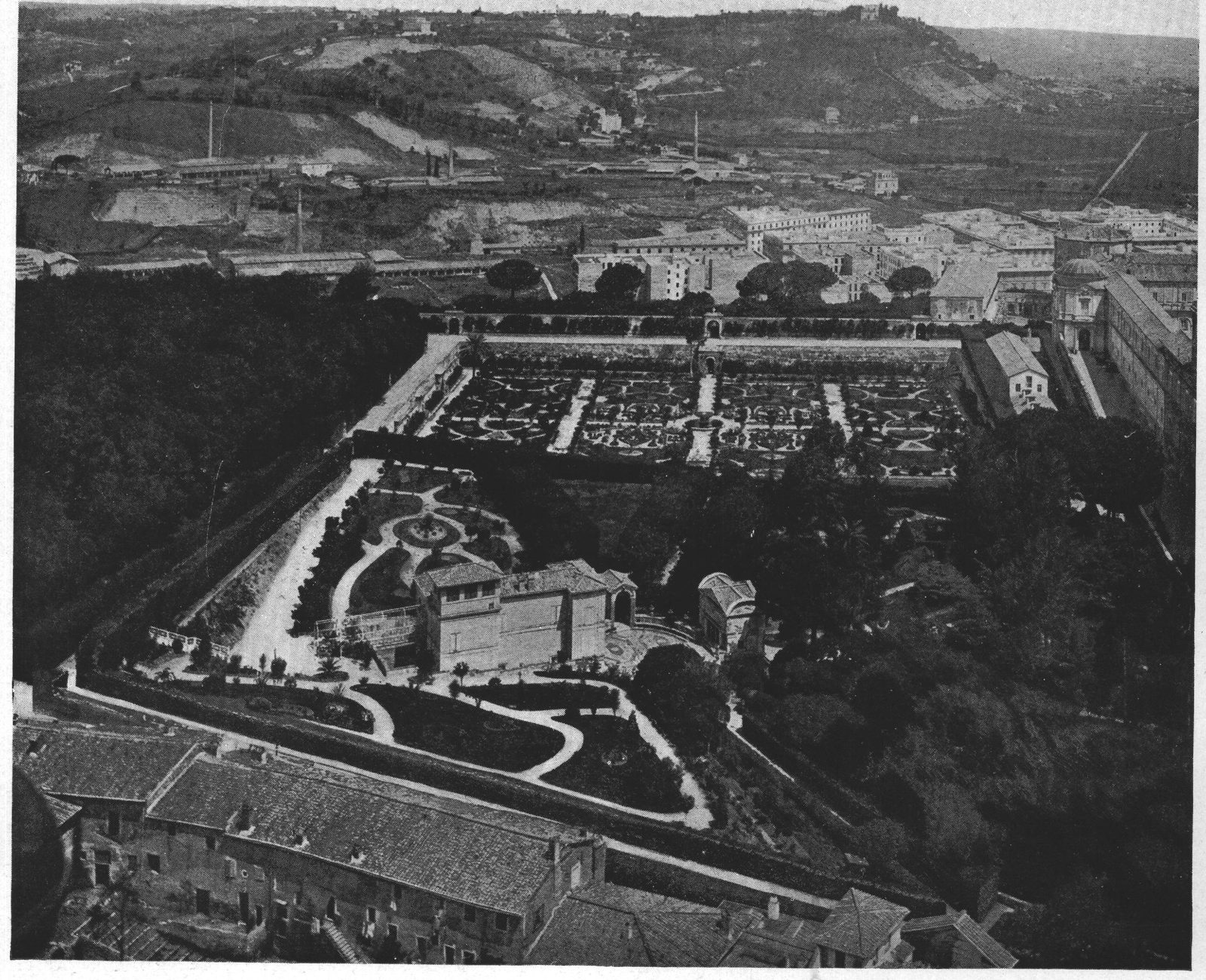
The Roman country estates sometimes, but not always, included the farm. In any case, the villa proper, with its garden, was complete in itself whether connected with a farm or not. In its planning and arrangement the gardens were of at least equal importance with the buildings, and the arts of landscape architecture and formal gardening, as they were practiced by the Italians of the sixteenth and seventeenth centuries and by them transmitted to the French, were direct inheritances from the ancient Romans. The terracing, the handling of water in cascades and fountains, and the architectural and sculptural embellishments were all suggested by the ruins of Roman villas. Lanciani tells us that the Villa Barberini at Castel Gandolfo follows practically in every detail "the plan and outline of the glorious villa of Domitian," and that the Villa Pia in the Vatican Gardens is a fair counterpart of a small Roman villa of the olden time. In all these villas, the first essential seems to have been the selection of a sloping site, capable of being terraced, so that from each successive platform there might be an uninterrupted prospect of distant hills, green plains or blue water. The second essential was a stream of water, for everywhere the Roman demanded the soothing splash and ripple, the cooling presence of fountains and cascades. The third essential was an abundance of shaded and sheltered promenades, screened from the sharper winds or exposed to the more refreshing breezes; and for this purpose colonnades, pergolas, arbors and porticoes were provided with lavish hand. The famous letter of Pliny the Younger to Gallus, describing the Laurentine villa, is full of references to the varied provisions made for every sort of exposure and shelter, to secure or to avoid at will the effects of sun, sea-breeze, land-breeze, shadow, heat and cold, according to the season and the momentary inclination of the occupant.
A well equipped Roman villa was therefore an extensive affair. The buildings, for the most part of a single story, covered a wide area, sometimes including several terraces. In general they comprised three fairly distinct portions—the public, the private and the domestic or servile. Each of these had its courts, rooms and passages. Whether they were all connected into a single block of buildings or divided into separate and distinct wings depended upon the size of the establishment and the taste of the owner. Except in the imperial palaces and such exceptional groups as the Villa Hadriana at Tivoli, comfort and personal ease were sought after rather than grandeur of architectural effect. Yet there was plenty of room for display, and the ostentation of wealth asserted itself in costly decorations and extravagant furnishings, especially in the later Imperial age.
Horace, always praising (whether sincerely or through poetic affectation is immaterial) what is simple and rational, sings the freedom of his own house from such vanities:
"Non ebur neque aureum
Mea renidet in domo lacunar," etc.
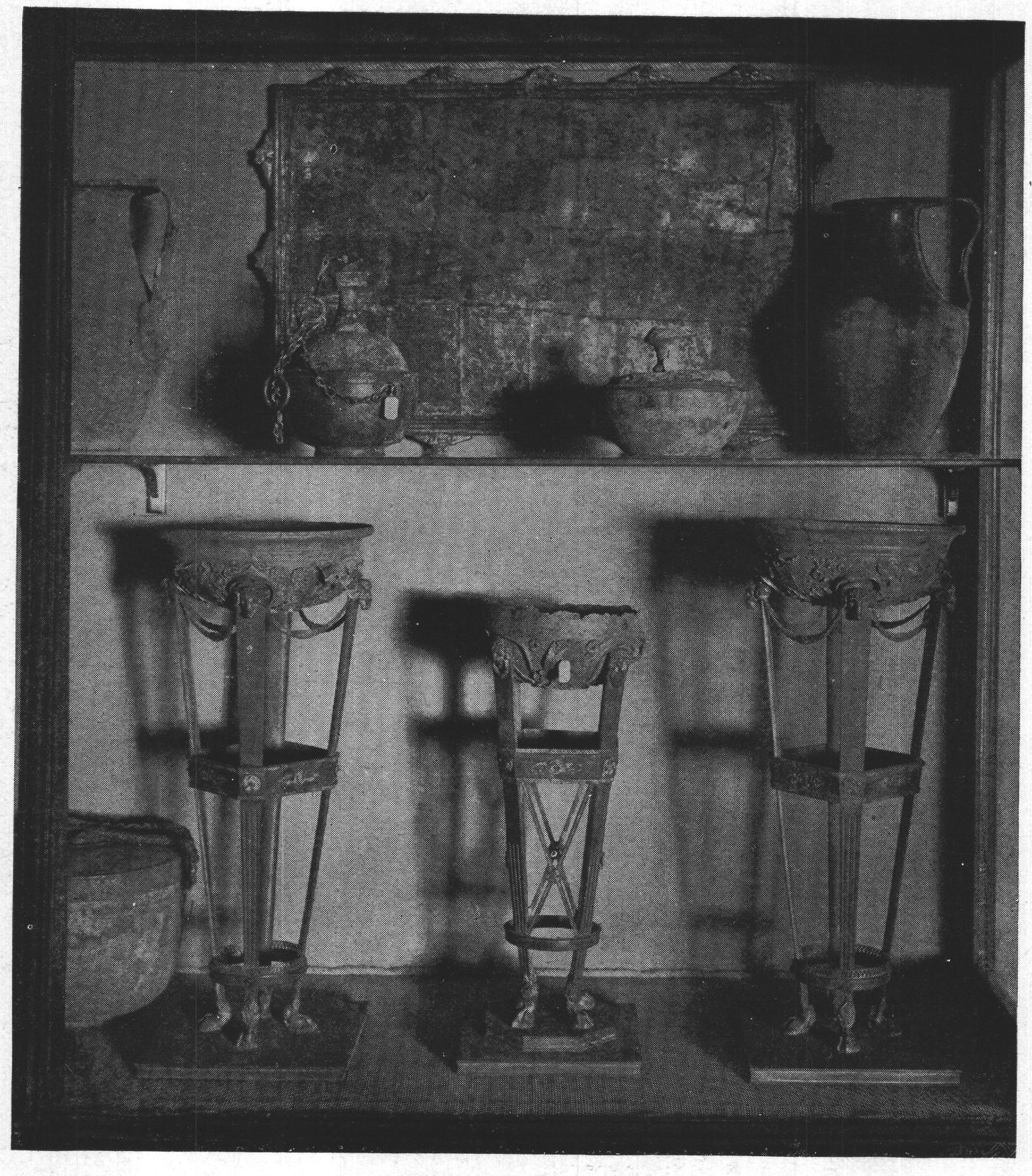
"My house boasts no ivory, nor ceilings panelled in gold; nor beams hewn on Hymettus' mount, upborne by columns quarried on Africa's farthest shore." (Odes: II, 15). The beauty of a fine villa consisted rather in its spaciousness, in the variety of exposure of its courts, triclinia, sitting-rooms and libraries, in the number and variety of its apartments, the extent of its colonnades and terraces, the elegance of its appointments and embellishments, such as vases, statues and tripods, of bronze, silver, and marble, and the extent and beauty of its gardens and prospects,—in these, rather than in the splendor or scale of its architectural masses or the costliness of its carving and gilding. Long vistas, distant views and ever-changing perspectives of trees and shrubs, fountains and statues, balustrades and terraces, marble summer-houses, shady arbors, cascades and rocks, these the Roman delighted in; in these his restless nature found relief from ennui, while he mingled the conveniences of the city with the freedom of the open country.
The appearance and the architectural details of the Roman villas we cannot reproduce with certainty, but may to a certain extent infer from known analogies. Pliny's and Cicero's letters throw light on their general character, and Pliny's to Gallus (II, 17) and to Apollinaris (V, 6) describing his villas at Laurentinum and in Tuscany, give a fairly detailed account of their planning, so that it has become a favorite recreation of students of Roman archæology to attempt their restoration from these descriptions. But the wide variety of these restorations proves how vain is the expectation of precise and accurate results from descriptions written in the familiar style of personal correspondence, without any effort at technical precision of detail. Dimensions, numbers, decorative detail, architectural features are alike wanting from these letters, to illustrate whose style a brief quotation will suffice.
"Behind is a quadrangle, a portico and a lesser court; then again a portico, and then a vestibule, beyond which woods are seen, and at a greater distance, mountains. On the left hand of the dining-room, a little farther from the shore, is a very large parlor, within that a smaller withdrawing-room, which again has one window looking to the east, another to the west. Joining to this angle is a room in an elliptic form; a shape that allows us from the several windows to enjoy the benefit of the sun during the whole course of the day; and the walls of it are so contrived as to hold books," etc.¹ Obviously here is no architectural specification upon which to base a drawing.
¹The letters of Pliny the Younger, trans. by John, Earl of Orrery; I., 149-150, London, 1752.
The analogies upon which we must depend for our restorations of Roman country houses are of three kinds. These are, first, the existing ruins of Roman buildings, both domestic and public. These acquaint us fully with the methods of construction and the common architectural features of ancient Roman times. We have, secondly, certain types of Italian country houses and farm buildings which, it seems not unlikely, have preserved to this late day traditions handed down from a great antiquity. And in the third place, there are many representations of villas and country houses in paintings upon the walls of extant ruins in Rome and Pompeii, and occasionally also in the details of reliefs preserved in the various museums of Europe. It is the similarity between many of those representations and familiar types of rustic buildings encountered by the tourists on the roads about Rome and sometimes in Tuscany, that warrants the belief that the rural architecture of Italy has changed little from that of antique times.
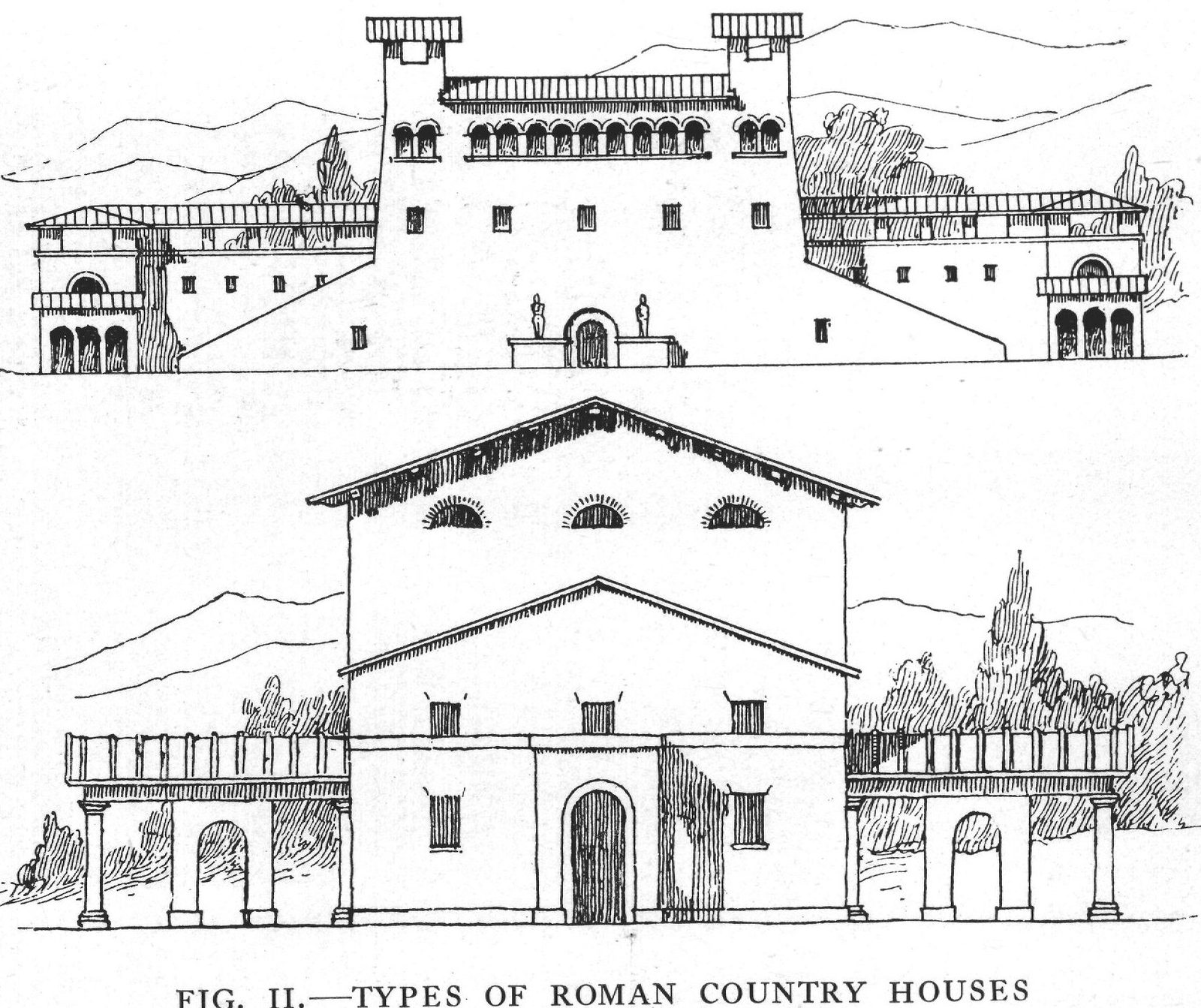
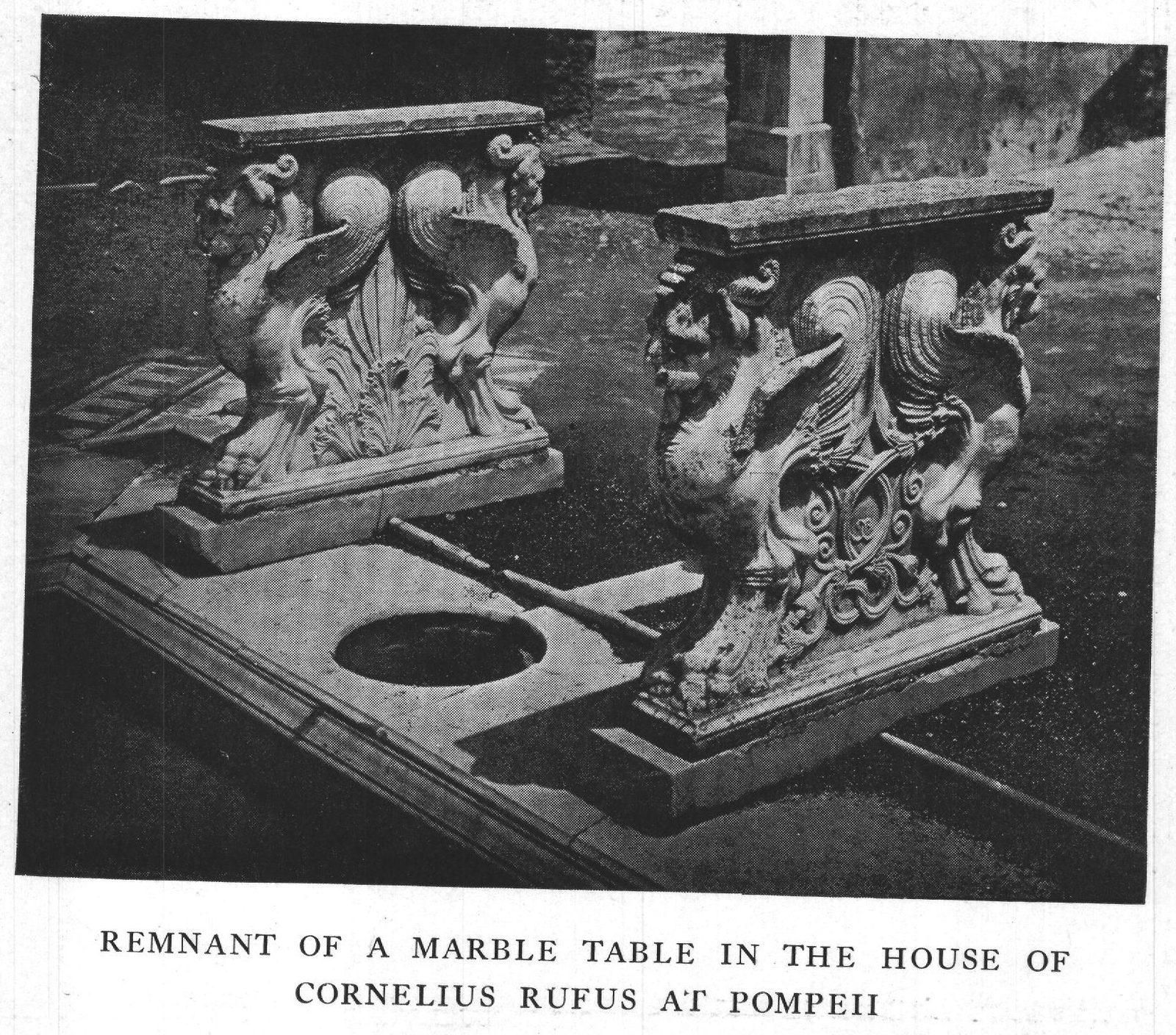
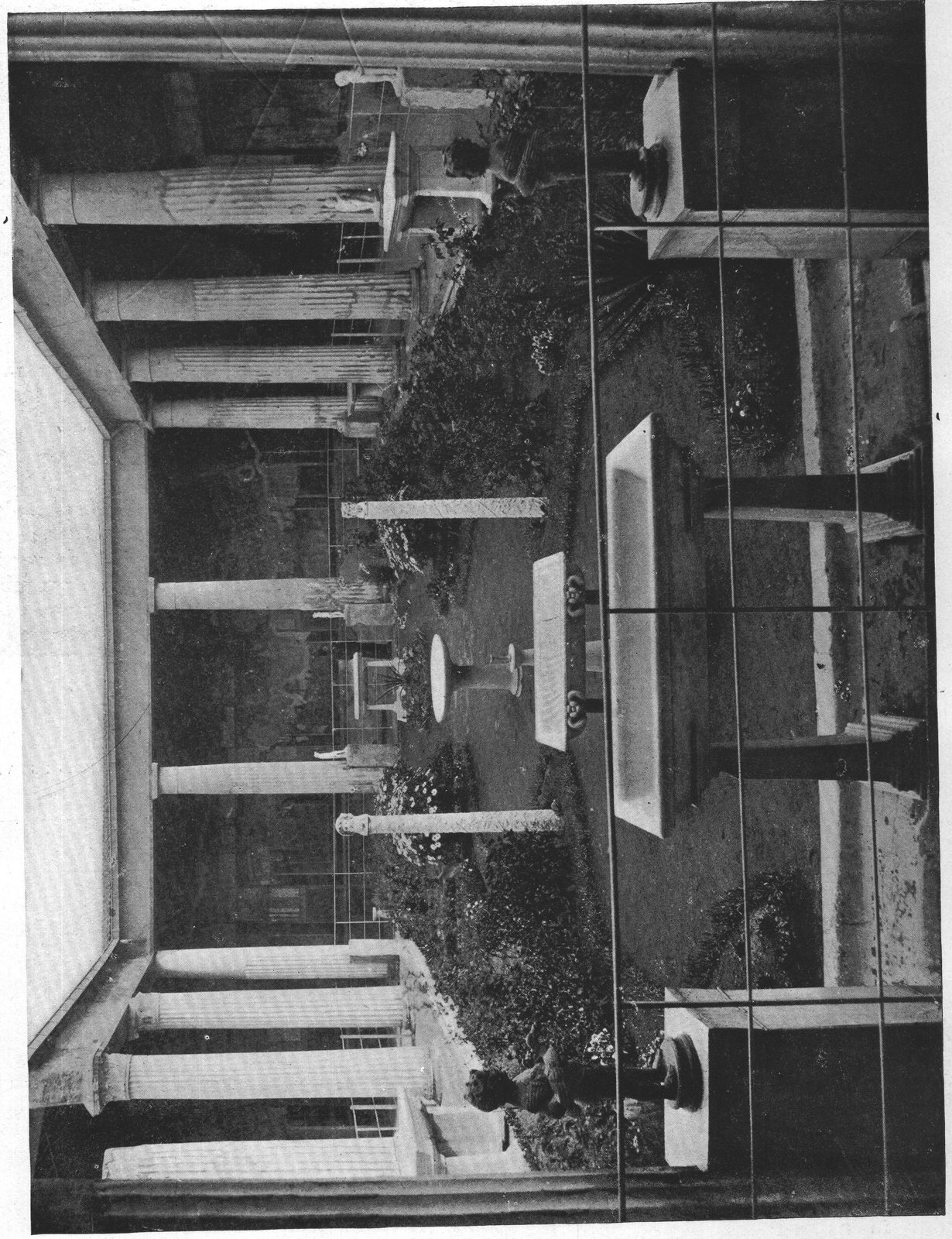
There was probably a wide range of architectural character in the villas of even the same period, corresponding to the variety in the purse and taste of their builders, as well as in the situation and purpose of the various villas of the same owner. While some were no doubt splendid with marble columns, carving and sculpture, others, and perhaps the majority, were probably quite plain in external design. Rubble and brick, heavily stuccoed, were probably the commonest materials for walls, and the roofs were low-pitched, framed of timber and covered with tiles like those one sees all through Southern Europe to-day. The chief elegance of these houses was in their various courtyards—atria or peristyles, as they were called—such as one sees in ruined Pompeii, but much larger. These, planted with trees, flowers and grass, refreshed by fountains and marble basins of crystal water, shaded by trees or by rich awnings, surrounded by sumptuously decorated colonnades, paved with marble and adorned with statues, marble tables and exedras, and an altar, were the chief centers of the family life. In a large villa there were several of these, of different sizes and exposures, with open-fronted triclinia or dining-rooms and small cubicula or sleeping-rooms opening upon some, and libraries, lounging-rooms, and withdrawing-rooms opening upon others. The villas spread over a vast extent of ground, with open porticoes and enclosed passages (cryptoporticus) connecting the several parts, and were for the most part but one story high, though here and there were square towers, turrets or pavilions rising with two or three stories above the rest, providing seclusion and a wide prospect. These square towers with broad eaves and low roofs are a familiar element in modern Italian architecture.
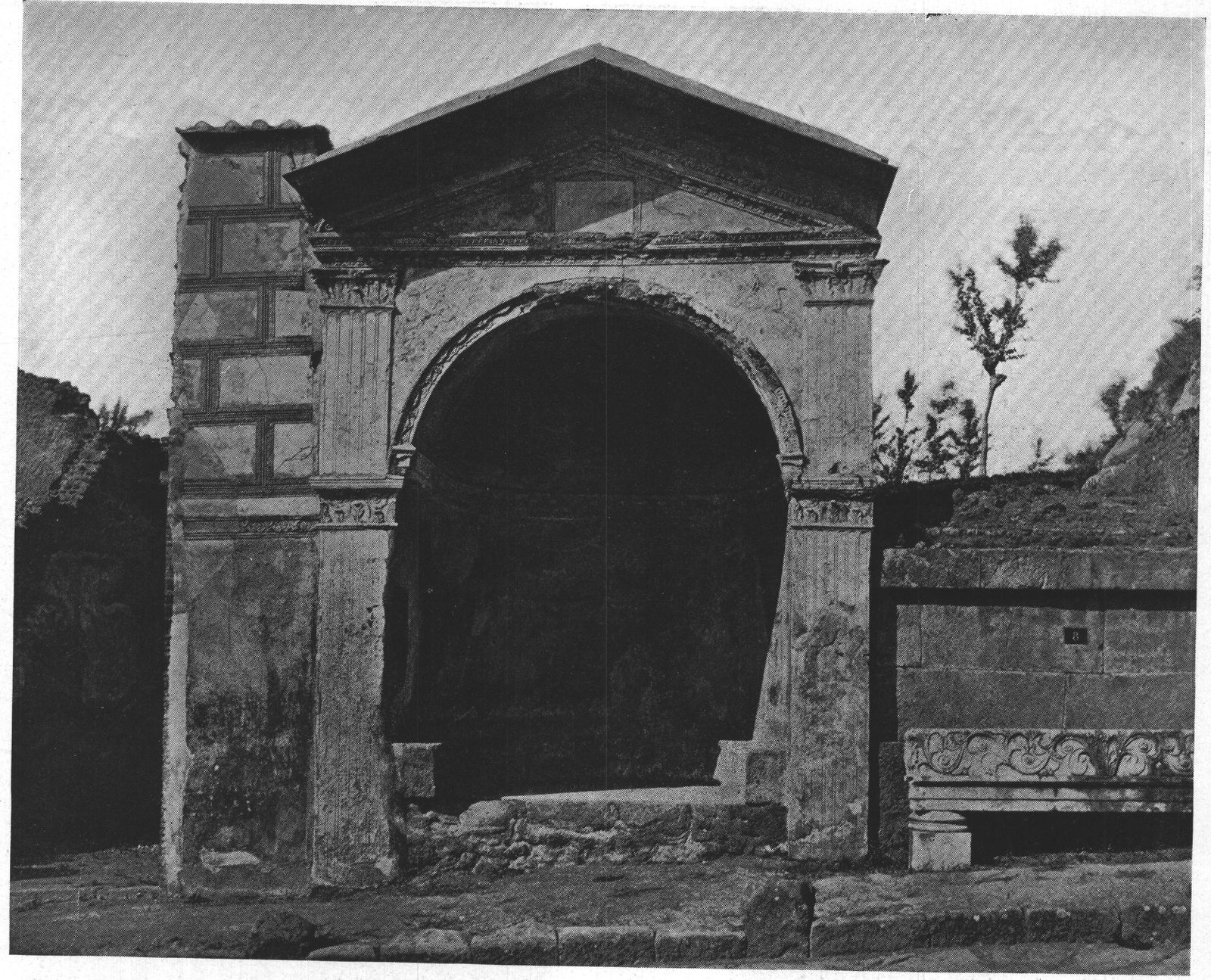
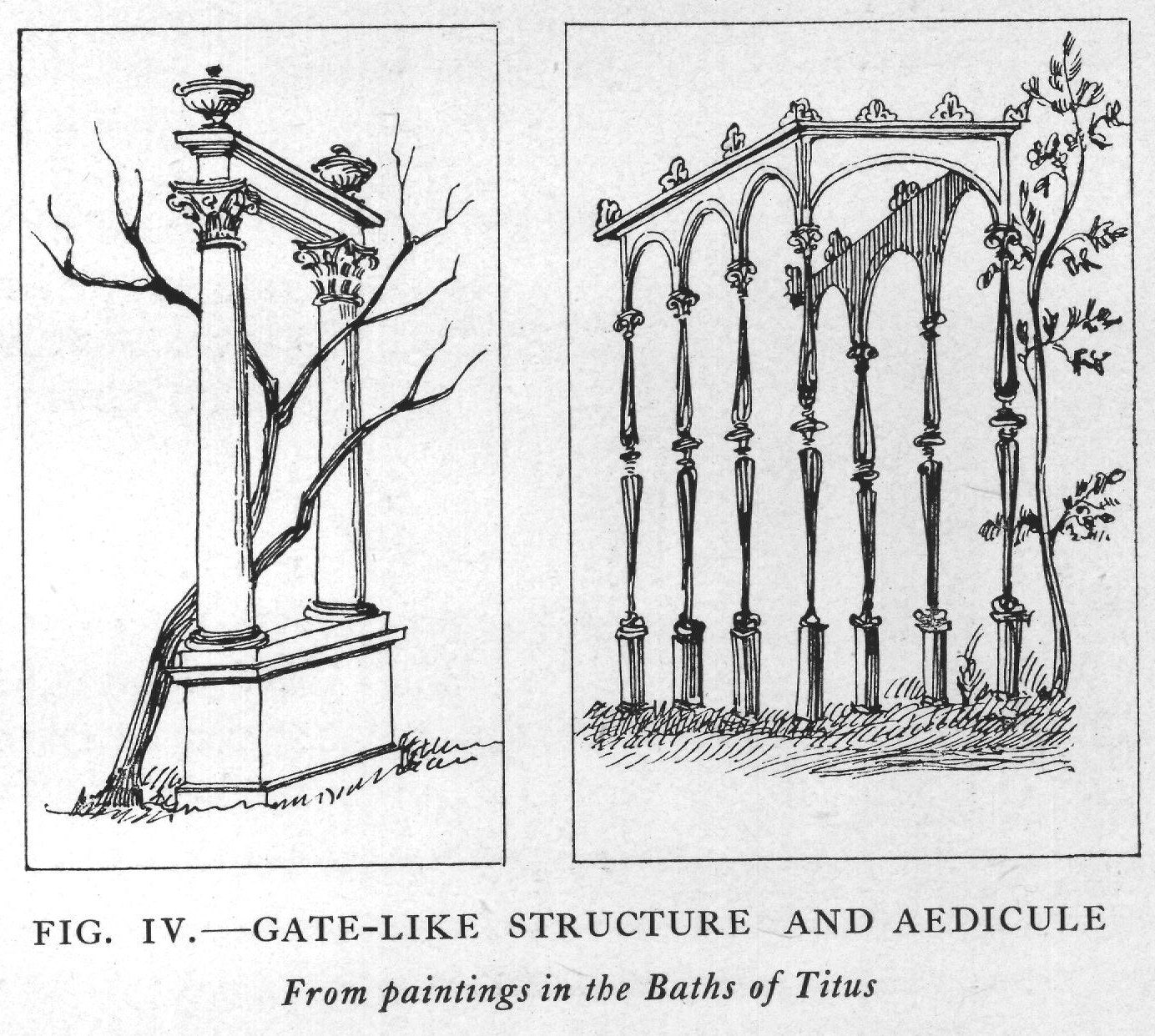
Undoubtedly the finest feature of the antique villas was their formal gardening, to which reference has already been made. In these terraced gardens, with their marble walks and balustrades, their niches, exedras and fountains, their clipped boxwood hedges, their clumps of myrtle and laurel and rose, their beds of violets and other fragrant flowers, the Roman bestowed a large part of the works of art which we gather into museums; in these gardens he lived much of his social life. He bought Greek statues as American millionaires buy French paintings. Cicero was constantly ordering them of his agents. "Your Hermathena pleases me greatly," he writes. "It stands so prettily that the whole lecture-room looks like a chapel of the deity." And again: "As for the statues you sent me before, I have not seen them. They are at Formiae. It is a public hall I have here, not a country house" he wrote from Formiae,—"whither I am about to go. But I shall remove them all to my place at Tusculum." (Cicero, Letters; Ad Atticum, I, 4, 2). In the gardens also were shrines and ædicules. One form of gate-like structure constantly reappearing in the paintings and reliefs (see Fig. IV) appears to be a tree-shrine, erected in connection with a sacred tree or tree dedicated to some deity.
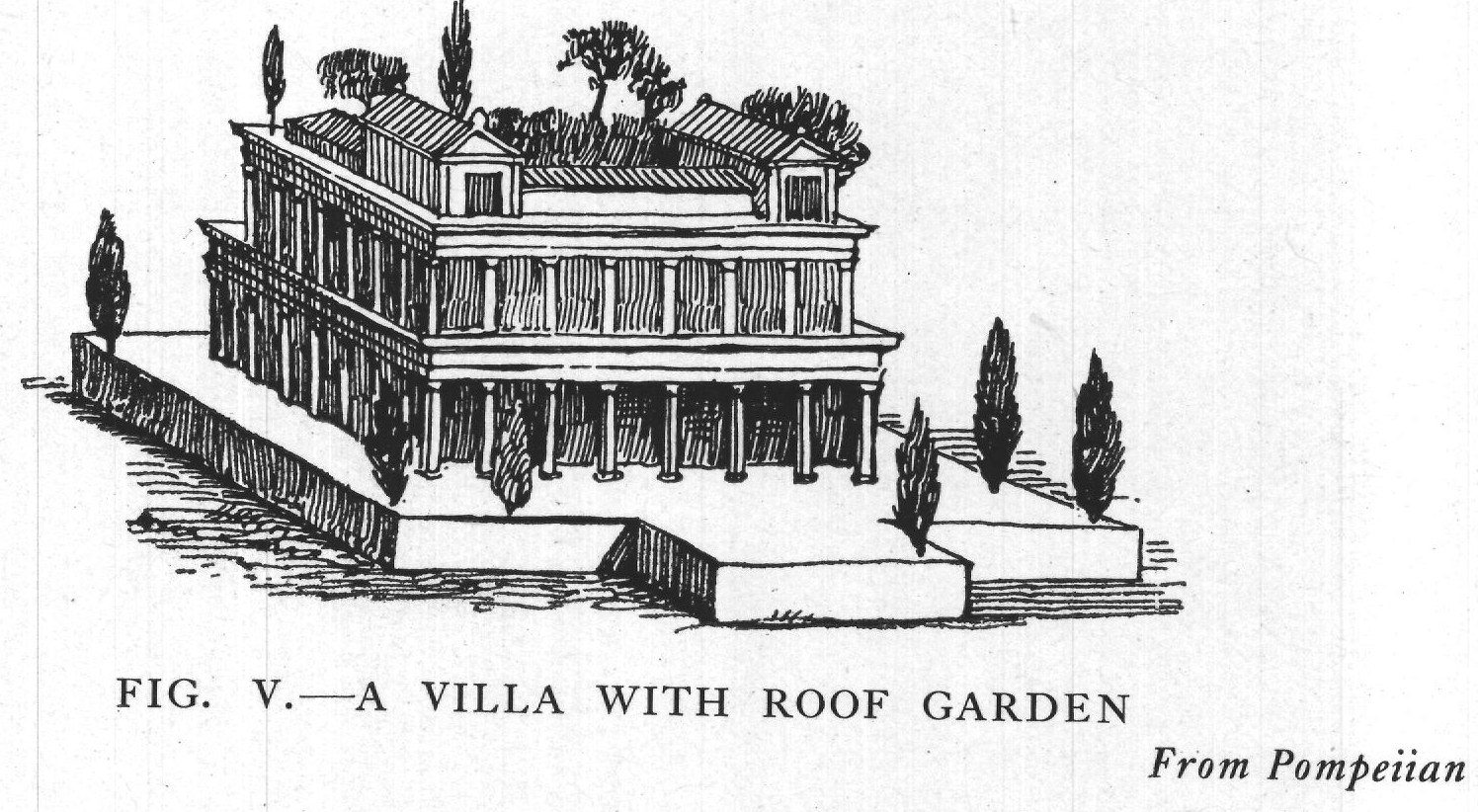
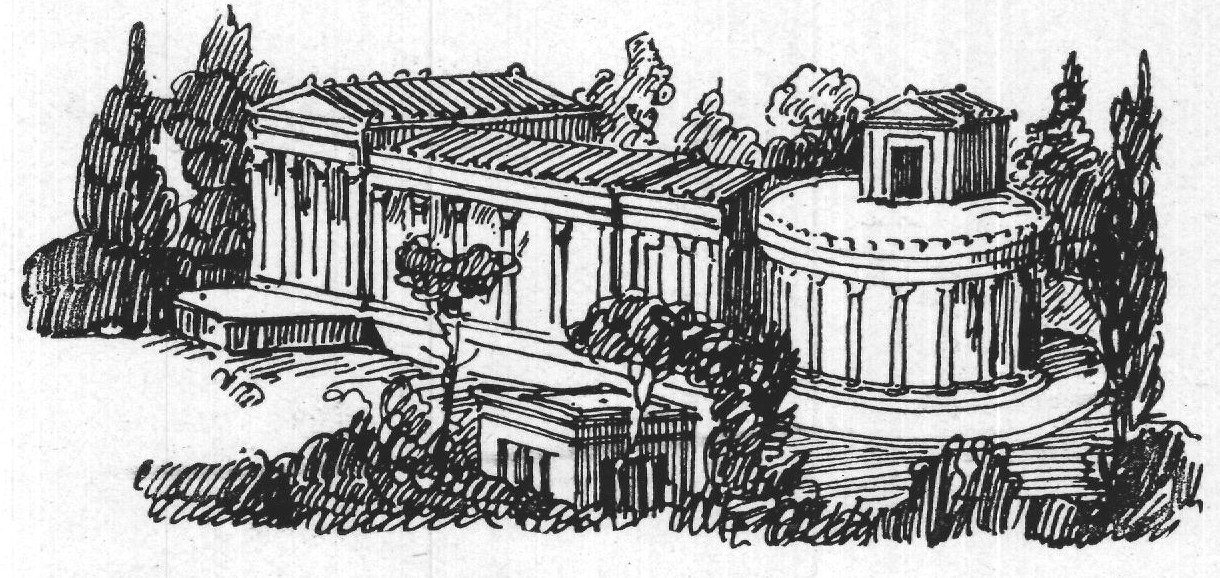
In considering the various representations from paintings, it must be remembered that in most cases the drawing is of the most summary character, and no dependence can be placed upon the correctness of the proportions or details. Most of them may be compared to modern pictures on plates and dishes, occasionally representing an actual building with some fidelity, but more often fantastic and unreal. Especially is this true when the representation is part of a mere decoration, rather than of a picture making pretensions to realism. The frequent recurrence, however, of like structures in widely diverse paintings argues an actual and common prototype and pictures of structures resembling those one sees to-day in Italy are supposedly based on actualities. We may have grave doubts whether the palace in Fig. V ever existed outside of the painter's imagination, for it will hardly bear structural analysis. But when we find that Seneca moralizes upon the unnatural custom of planting gardens upon the housetops, the upper part of the structure takes on an air of reasonableness. Whether Fig. VI is a temple or a villa is not quite clear; perhaps the painter did not himself know and was simply painting "architecture."
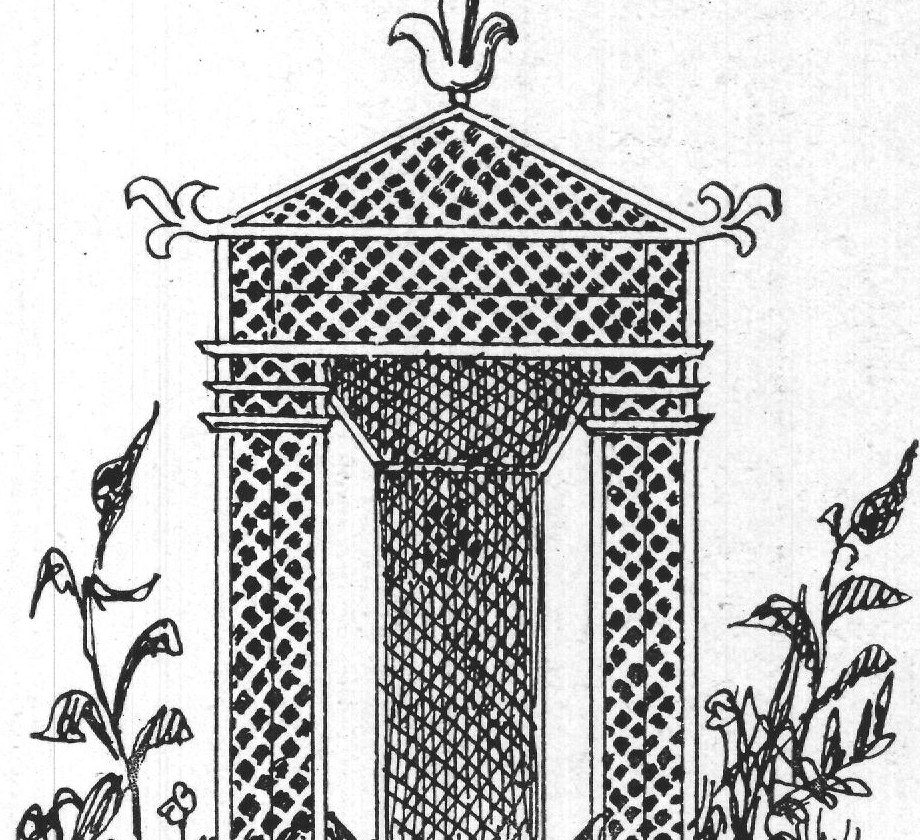
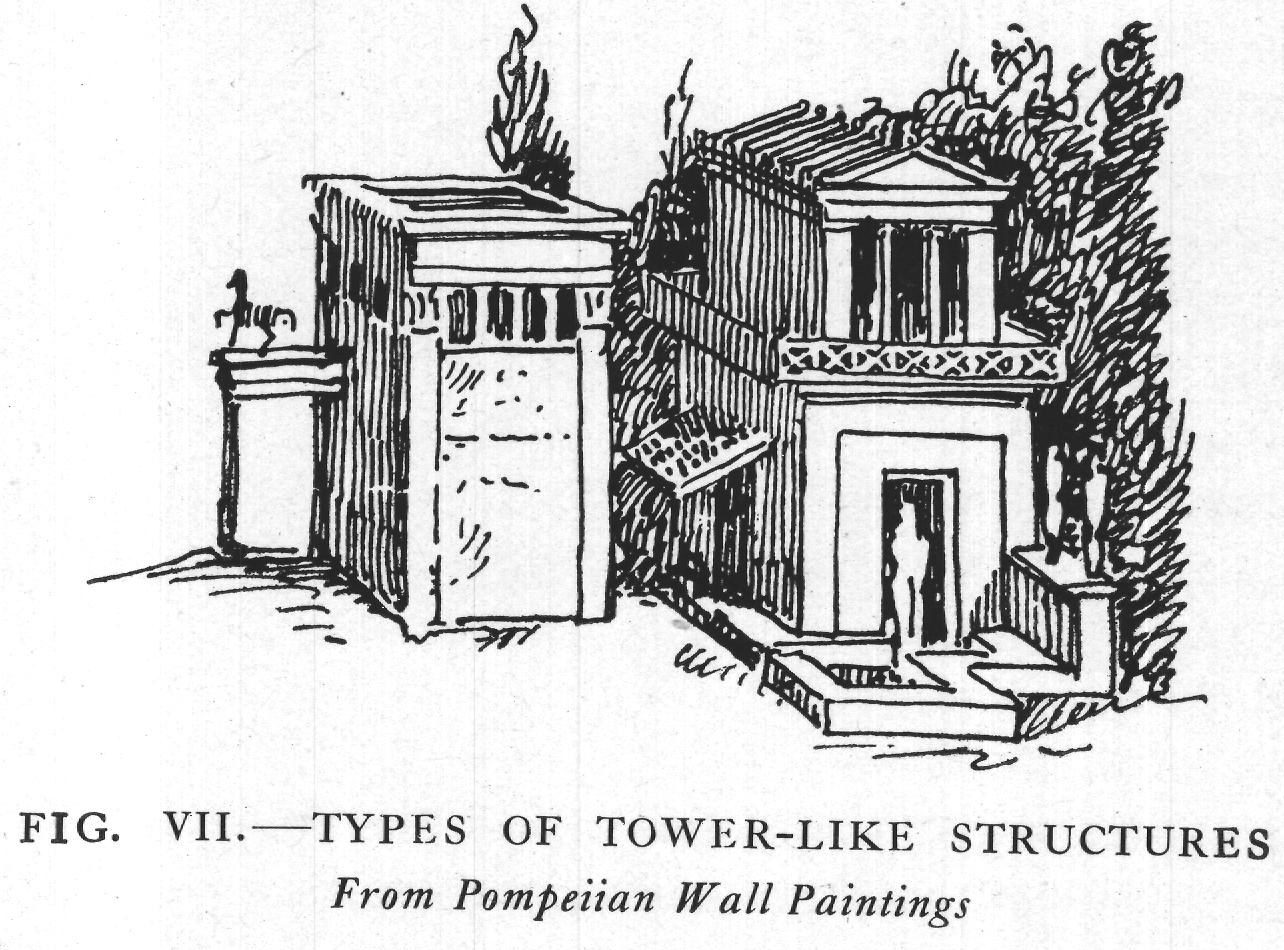
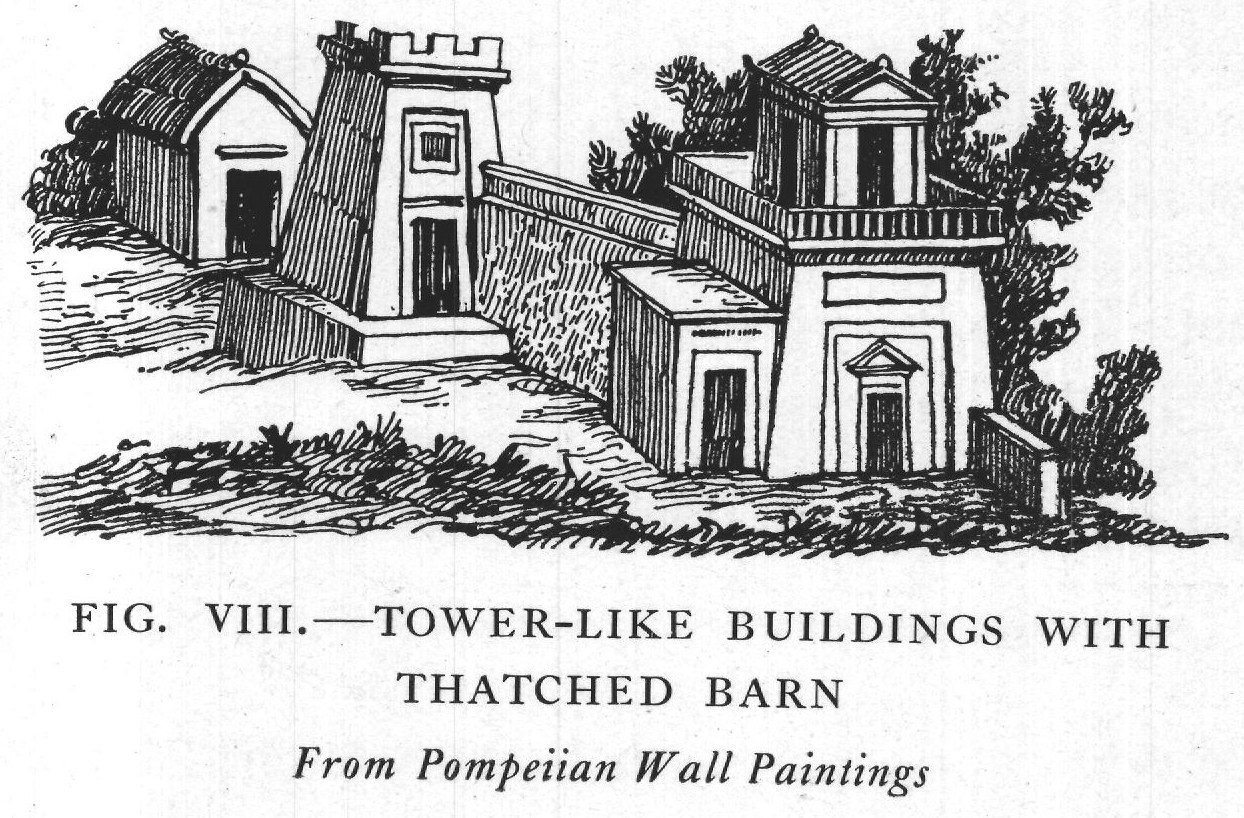
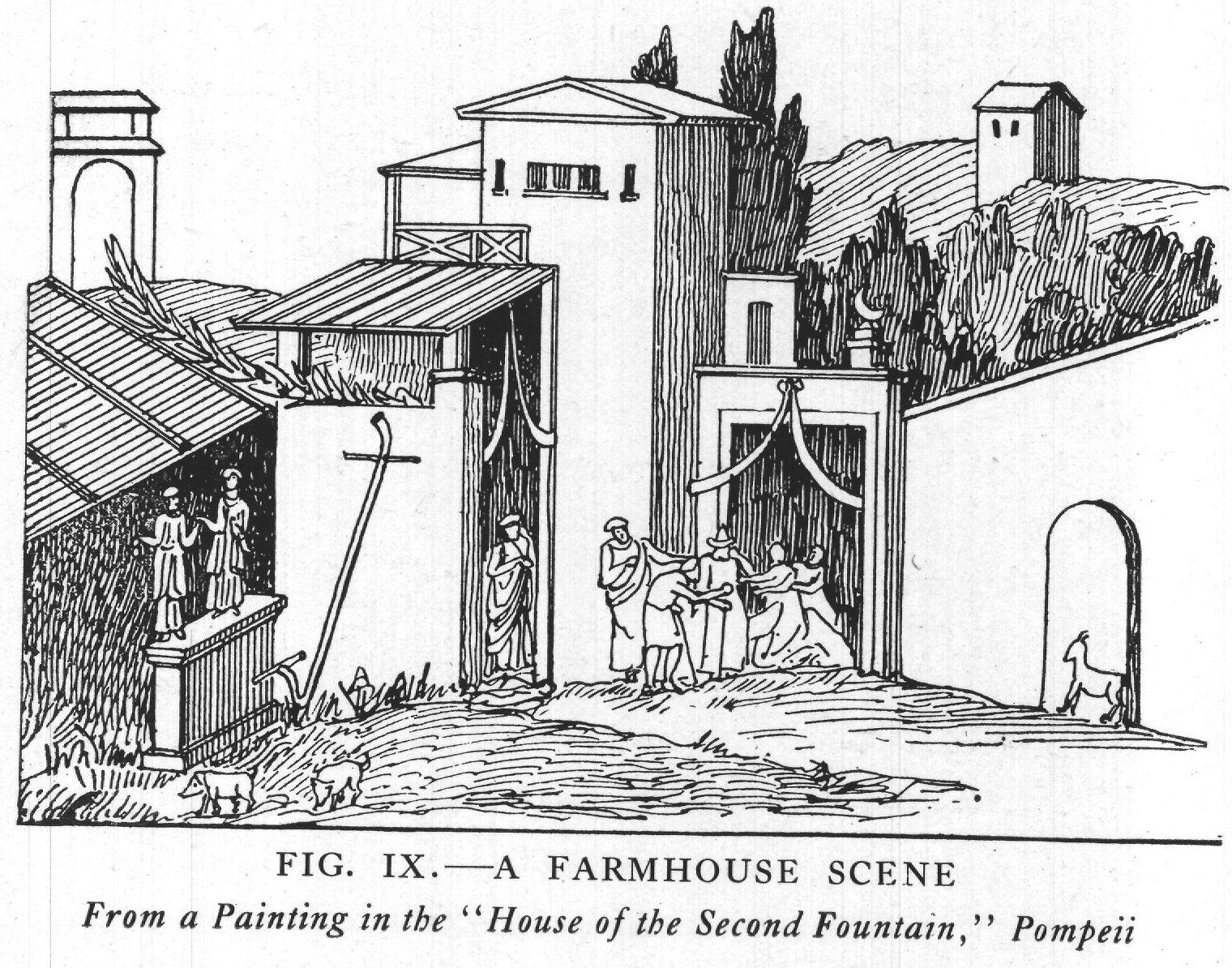
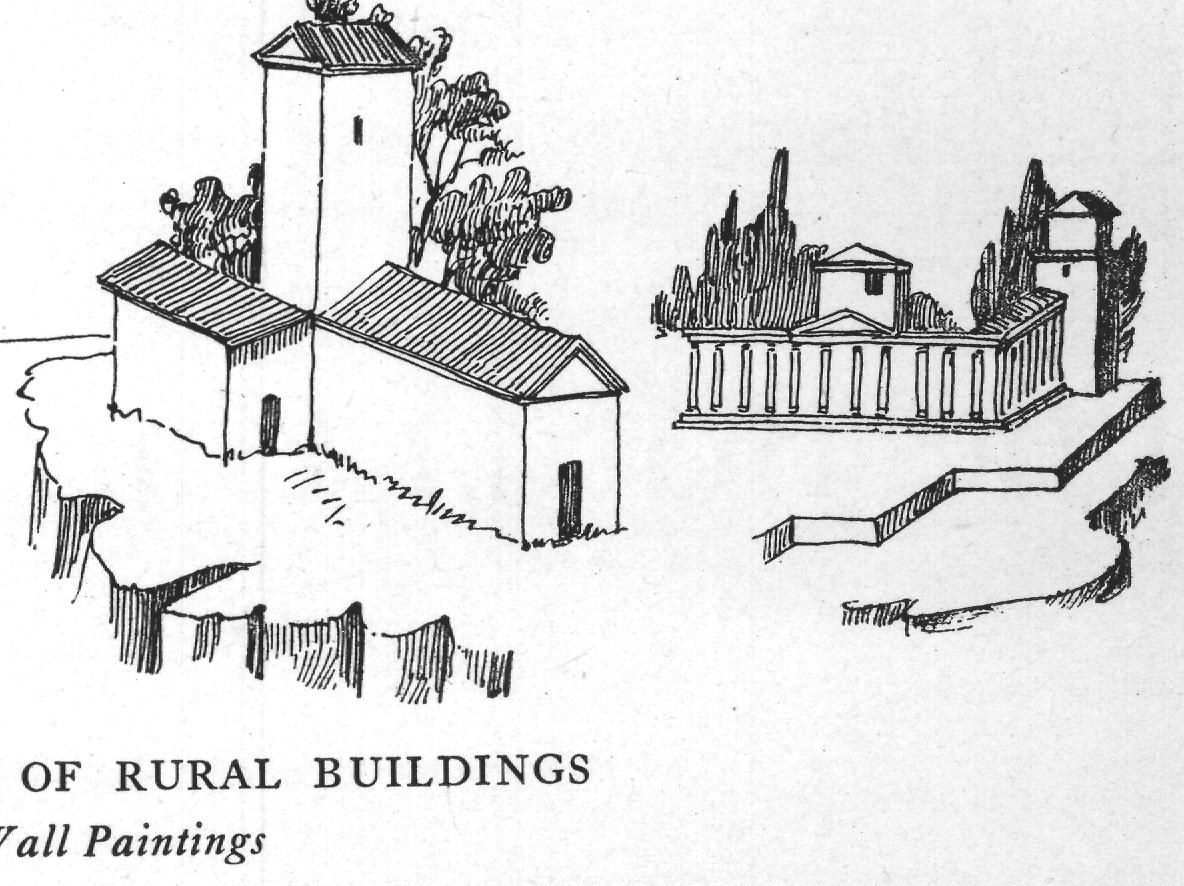
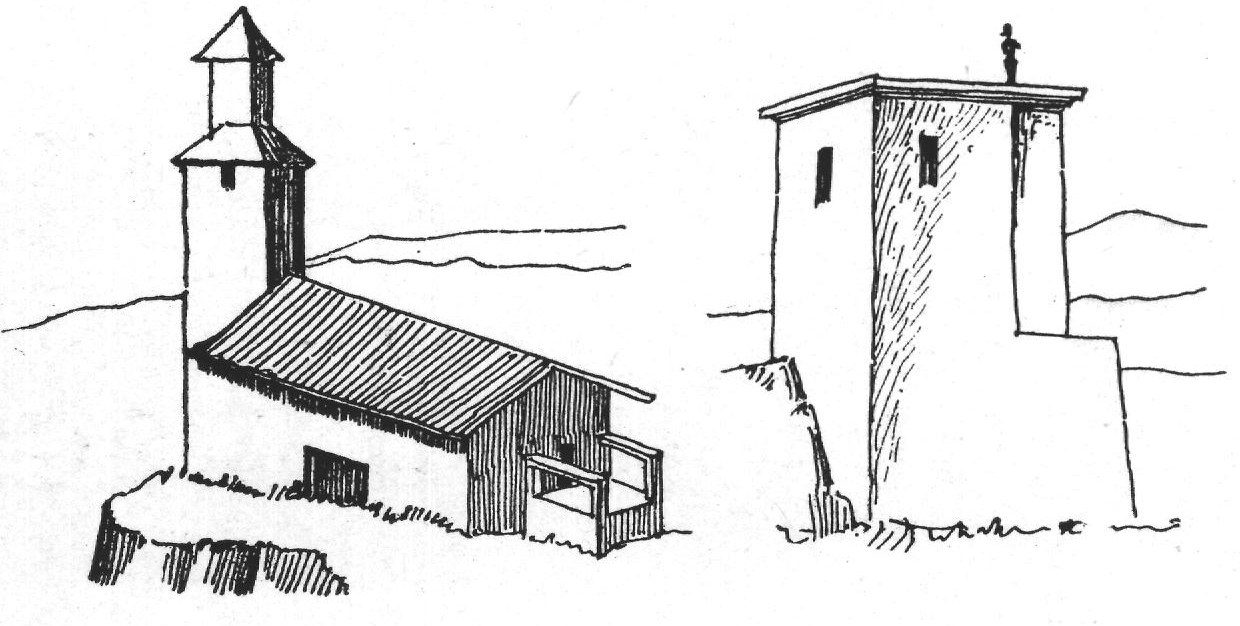
The tower-like buildings in Fig. VII are equally hard to explain with precision. But in Fig. VIII is another very similar edifice with a thatched barn behind it; and Fig. IX from a painting in the House of the Second Fountain at Pompeii, obviously a farm scene, shows a somewhat similar tower, lean-to shed, and pedestal with statues; so that we have probably here a somewhat fantastic series of pictures of actual types of towers or belvederes connected with the farm buildings and villas of the time. Fig. I is an unmistakably realistic representation of a wooden trellised arbor in a garden, and in other pictures in Rome and Pompeii we have many details of garden decoration like trellises, fountains, seats, and the like, which help to a reconstruction, in imagination, of the villa gardens of antiquity.
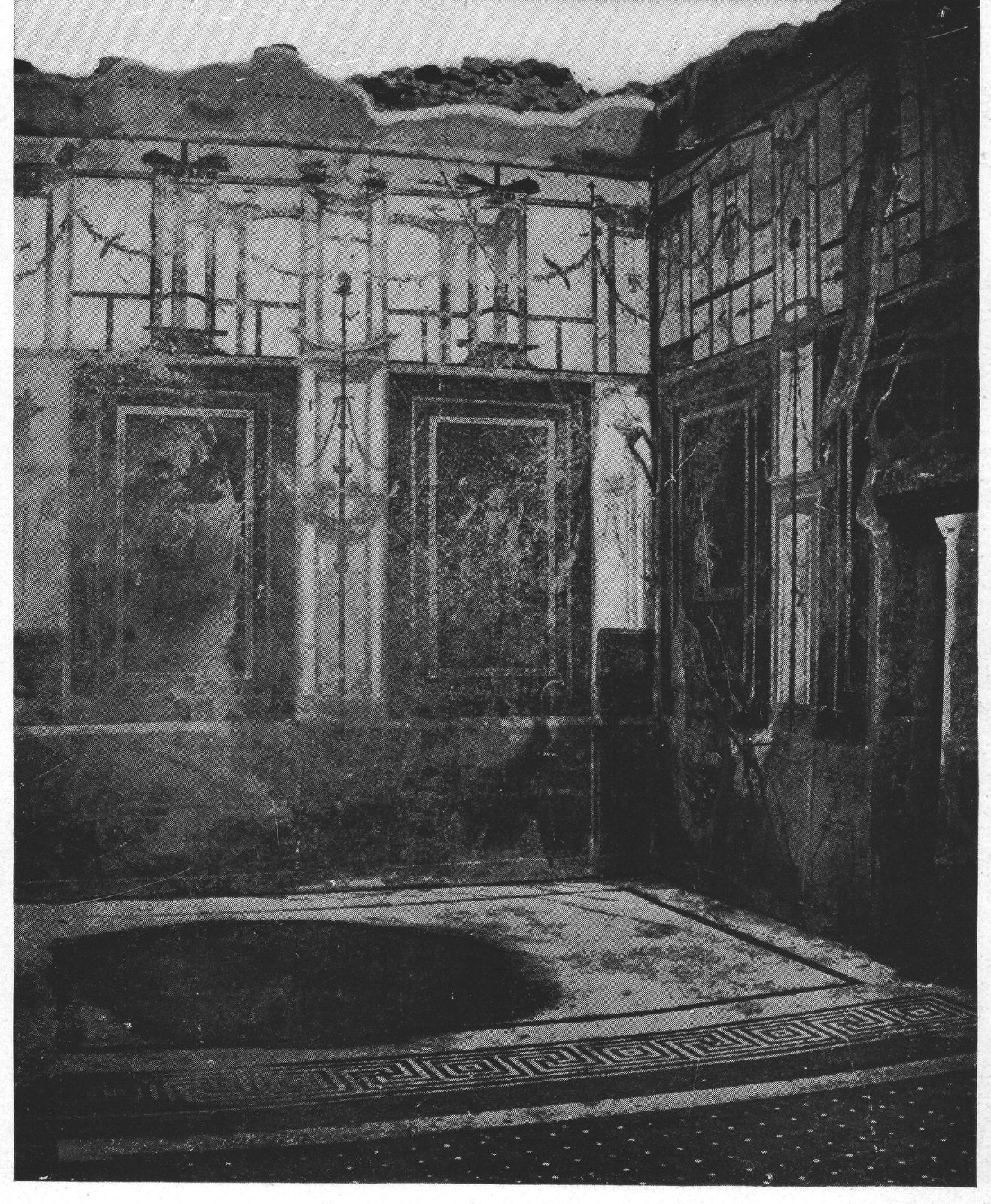
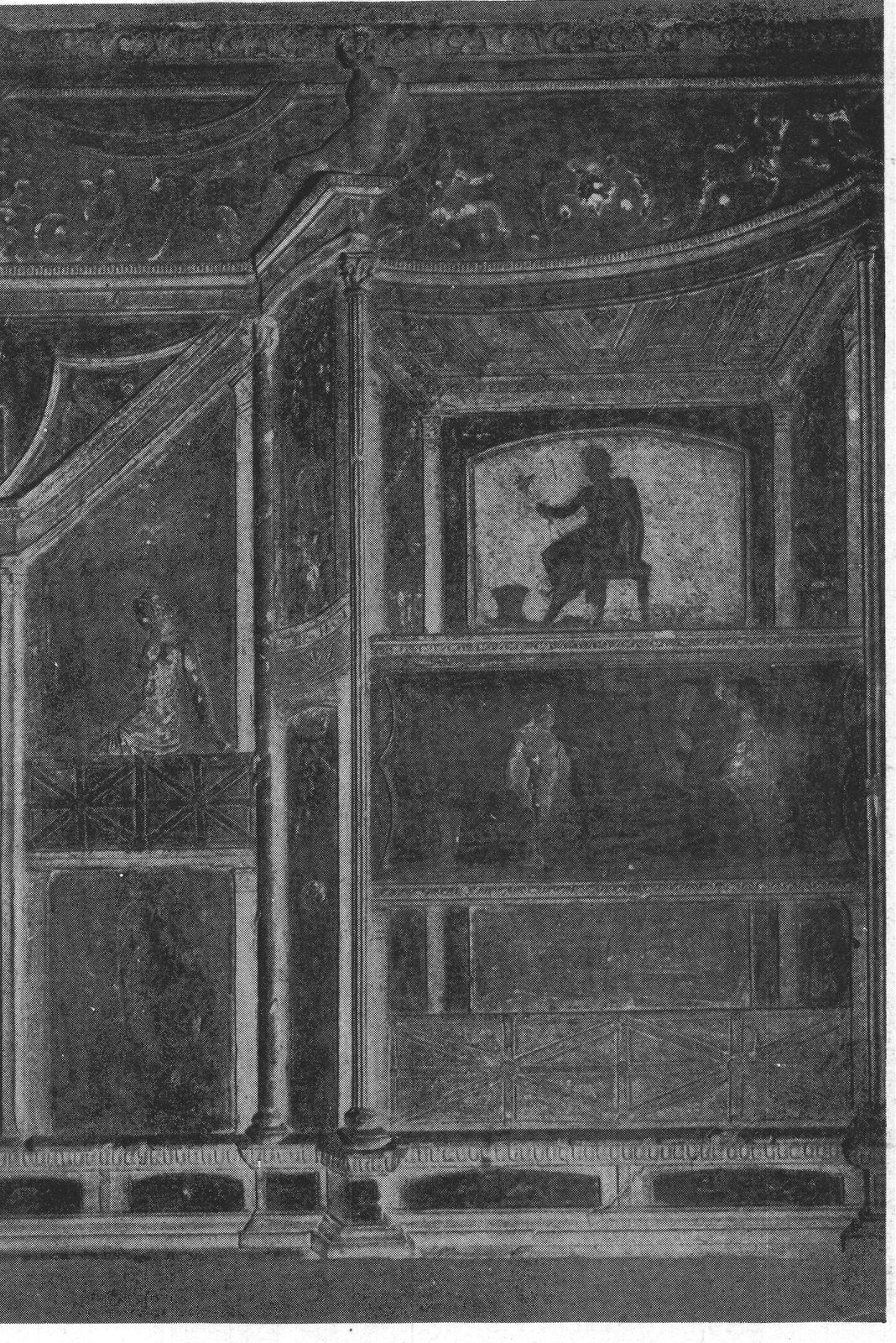
The interior decoration of ancient villas was no doubt much like that of the Pompeiian houses, of the Baths of Titus, the Golden House of Nero, and the house excavated in Rome in 1879, a part of whose walls were removed to the Museo delle Terme, where they may be seen to-day in marvelous preservation. The painting was on hard plaster, done either in tempera or—in finer work—by the encaustic process, using melted wax as the medium. Strong backgrounds of yellow, red and black were used, and a fantastic architecture, in a wild sort of conventional perspective, divided the walls into panels, some of which were adorned with landscapes, mythological scenes or genre pictures. The ceilings were probably panelled in wood, perhaps sometimes of plaster painted; the floors of mosaic or tile, or of marble flaggings. The furniture was scanty compared with modern equipments, but it was costly and heavy, of wood, ivory, bronze or marble. Rugs, cushions, folding stools and couches provided what comfort was to be had. To this day the Italian has little use for the lounging chairs, rockers, hammocks and other devices for comfort which the American deems essential.
The Roman type of villa belonged to the social organization of its time. No other age, people or system could have produced it. We have in modern times the vast wealth necessary for the building of splendid residences, but serfdom and slavery, essential elements in developing the Roman villa, have been forever abolished, and the privacy of family life, which we cherish to-day forbids the creation of the vast caravansaries which the Roman villas really were.
Four or five hundred slaves were not infrequently accommodated in a single one of the larger villas; and we read that when Cæsar visited Cicero at Puteoli,² two thousand of his soldiers were quartered in and about the house of Philippus near by. Hadrian's imperial villa at Tivoli covered a square mile. Such enormous and extravagant establishments are out of the question in an age like ours, even as the folly of an emperor.
²G. E. Jeans, Selected Letters of Cicero: Letter 104, to Atticus. (London, 1880.)
The smaller country houses of the Romans were, by contrast with the villas, quite modest affairs. One of these—a suburban rather than a rural house—was recently excavated in Boscoreale. There is no planning to it, in the modern sense of careful arrangement and systematic adaptation. Rooms of all sorts, sizes and shapes are strung around three sides of a court, and the domestic accommodations occupy but a small part of the whole area. This was, indeed, a farmhouse rather than a rural residence, and the wine-press, oil-press and fermentation court take up the greater part of the ground floor. There was a second story, which probably contained most of the sleeping and living rooms. It is noticeable that there was a complete bathing establishment, with furnace, tepid room and hot room, indicating a well-to-do owner.
The more genuinely rural houses of the small landed proprietors of antiquity have wholly perished. We may infer from the pictures preserved to this day that they were small and modest; that a tower or a turret was an essential feature; that barns and granaries were detached structures, often with thatched roofs; that the tools were left in lean-to sheds, and that barn-yard and dooryard were much the same thing. It would also seem to have been the custom to place the house and farm under the protection of deities whose statues were set up beside the entrance door. The group of sketches shown in Fig. XI³ possibly suggest the types of architecture which prevailed in these smaller houses. They are from carelessly painted details in Pompeiian pictures, and are not to be taken too literally. These rural houses may have been picturesque, but the poorest farm laborer on a New England hillside probably has more real comforts in his wooden house than the most prosperous plebeian farmer in ancient Italy.
³For these sketches I am indebted to the courtesy of Mr. Lucian E. Smith, of New York.