Illustrated with photographs by Henry G. Peabody, Reproduced by Courtesy of the Art Library Publishing Company, Boston
The climate of Mexico, with the everlasting summer that blesses the greater part of the country, particularly invites a formal treatment of the gardens. Indeed, the formal manner is what most conspicuously distinguishes the gardens of Mexico, as might be looked for in a country whose traditions in art are those of Mediterranean lands. It is the style that seems, almost naturally, and quite as a matter of course, to go with the environment that the culture and the topography confer: the stately architecture, the majestic landscape, the intensity of the sunlight and the corresponding depth of shadows, the luxuriant vegetation of the tropics. Nevertheless the impression of formal design is not so strong upon the visitor as might be looked for under the circumstances. This is chiefly to be explained by the fact that in the long period of internal disorder that prevailed from the time of the separation from Spain down to the administration of President Diaz, all the esthetic considerations that had been held in regard throughout the three centuries of Spanish rule were inevitably almost utterly neglected. With a half-century of practically incessant revolution there was little opportunity or inclination to look after these things.
The gardens of Mexico may be classed in three main divisions: Those of public places, those of ecclesiastical institutions, and those of a domestic character. These again fall into various subdivisions, in each of which much of interest is to be observed. In the ecclesiastical field the gardens of monasteries and convents, once of the highest importance in their elaboration and extent, now have little to show. With the sequestration of church property throughout Mexico these gardens are nearly all in a state of ruin or of utter abandonment. The civic gardening is the most conspicuous. Being, of course, always in the public eye, it still has much that is admirable, although in various respects the old-time standards have been lowered.
The domestic gardening, on the other hand, would be hardly suspected of existence by a stranger, were it not for the countless enchanting glimpses through open doors and gateways, or for the rich tresses of roses and other flowering climbers that trail along the tops of high enclosing walls. The domestic gardening is either charmingly concentrated in the patios, or open courts, that are a delightful feature of city houses, or is devoted to the embellishment of the enclosed areas attached to country houses or suburban dwellings.
In the suburbs of the City of Mexico there are some fine examples of the latter. But the most celebrated garden in the country is that which José de la Borda created for himself at a prodigious expense in the little city of Cuernavaca. Joseph of Bordeaux, as his name would be in English, came to Mexico early in the eighteenth century, a penniless French boy in search of a fortune. Had he come to the English colonies he would doubtless have been known as "Bordeaux Joe." Good luck allied itself with native energy; he engaged in mining, made some lucky ventures, and at last found himself a multimillionaire, in possession of one of the greatest individual fortunes that ever was accumulated in Mexico.
It was probably his long and fortunate career that kept him from following the inclinations common to men of his kind—those that prompt a return to the native land to enjoy the riches gained. Borda had great mining properties in various parts of the country, and at each of these centers he built superb great churches. Like most other rich men in New Spain, he built a palatial house in the City of Mexico. Men of wealth in Mexico customarily have country homes where they spend a considerable portion of the year. Many such men have large landed interests; great estates that number their acres by the thousand, and not infrequently by the hundred thousand. When such estates are in the tierra caliente or the tierra templada, the hot country or the temperate country, they choose the winter months for their country sojourn. The capital city is in the tierra fria, the cold country. The term is but relative; to the Northern sense the climate is wonderfully temperate. But the winter nights are now and then frosty where the tropical table-land is a mile and a half above sea-level. Then it is pleasant to leave the thin, crisp atmosphere for a while and luxuriate in the softer and warmer airs of lesser altitudes.
The interests of Don José were exclusively mining. Hence he had no great estate in the warm lands to retire to. It was doubtless the convenience of location that induced him to choose Cuernavaca as the site for his villa—using the word in its Roman sense. Cuernavaca lay directly on the route between the capital and Tasco, to the southward, the scene of his most extensive mining interests. It therefore formed a most delightful stopping place in a fatiguing journey. Cuernavaca lies nearer the capital than any other town in the warm lands. Hence, from the very earliest days of Spanish dominion it has been in favor as a warm-weather resort. The great Conqueror himself, Hernán Cortés, built a palace there, and the rich sugar-estate that he established close by the town is still owned by his heirs. When Maximilian was Emperor of Mexico he made Cuernavaca his warm-country home. Probably the happiest days of his distressful reign were those that he and Charlotte spent amid these tranquil scenes.
A native town called Guanahuac occupied the site when Cortés came thither across the lofty Cordilleras from the Valley of Mexico. Cuernavaca, meaning "cow's horn," is a Spanish corruption of the original name. The place is now the capital of the small and wealthy State of Morelos. It stands in a superb location well down on the southern slope of the extinct volcano of Ajusco, across whose flank runs an important division of the Mexican Central system on its way to the Pacific. The town stands on a sort of promontory between two barrancas, or deep ravines. It is a picturesque aggregation of red-tiled roofs; out of which rise several domes and towers. The landscape is one of the world's lordliest: the vast and fertile valley, rich with tropical cultivations, is surrounded by magnificent mountain ranges, among them the snowy peaks of some of the loftiest heights in North America. Cuernavaca is on the verge of the hot country, but really lies within the limits of the tierra templada, the temperate belt. The climate makes near approach to perfection. Some idea of it may be had by imagining a succession of ideal days in a Northern June, prolonged indefinitely through the year. In the clear, dry air the heat is seldom oppressive; the nights bring cooling breezes that flow gently down the mountain sides, but there is never a chill in their breath. Clear water from great springs that gush from the slopes above sparkles in brooks and irrigating channels on every hand. Its friendly babble is heard everywhere as it hurries valeward, pausing to make gardens and orchards perennially verdant on the way to its greater task of watering the vast fields below.
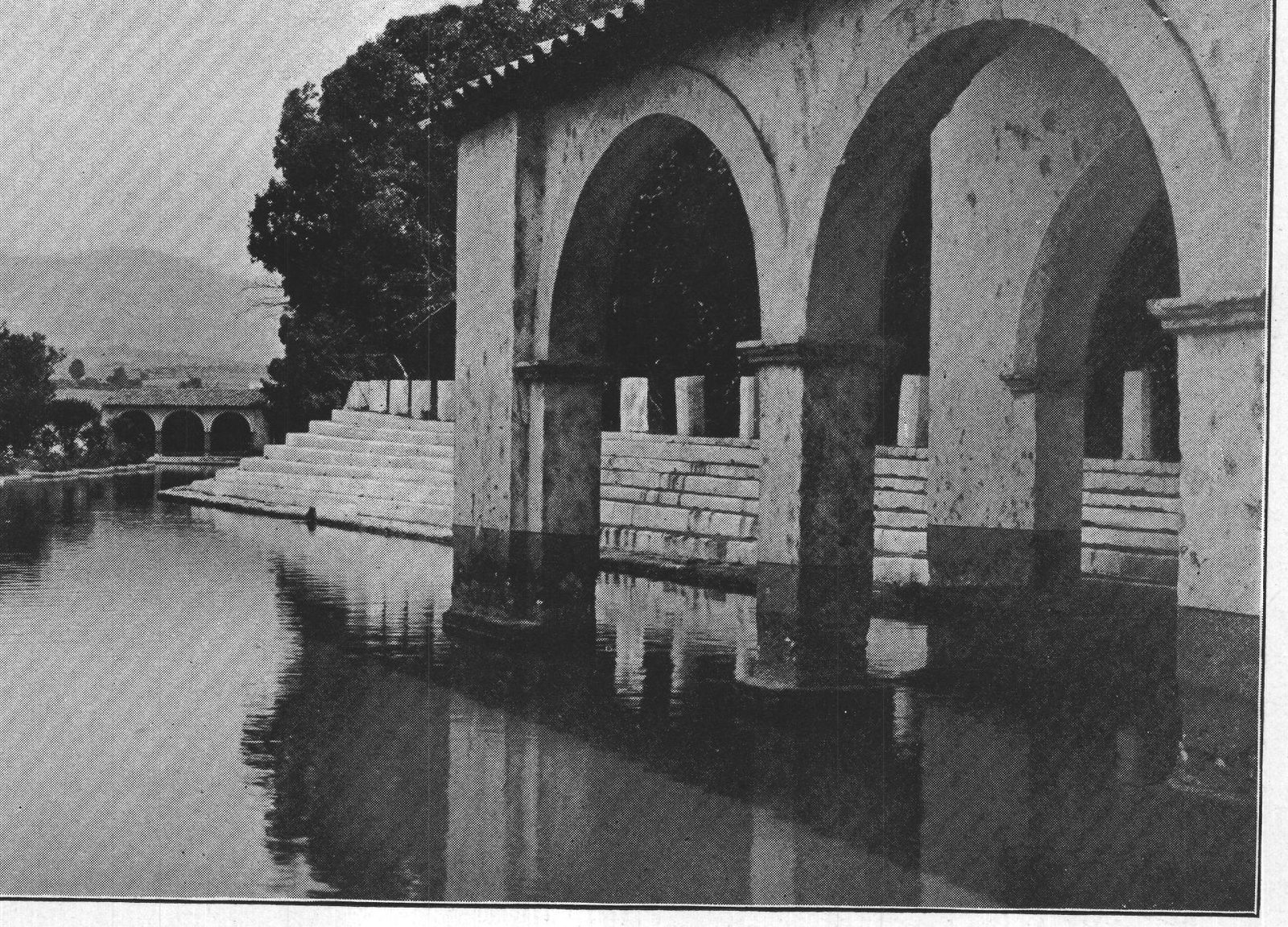
Such surroundings make the location an ideal one for a garden as beautiful as the hands of man can make it. When we think of Italy and its villas we appreciate that their standards are far from reached in the finest that Mexico has to show us. But the beauty of the Borda garden, even in its present state of neglect, is such that no comparisons that might be made could diminish its charm.
In view of its urban vicinage the Borda villa could hardly be called a country home. But, like many of the villas of Rome, its qualities have the restfulness that rural scenery imparts. In the presence of the glorious landscape that encloses it upon three sides it seems like a vestibule built by man for Nature's temple. The villa is well within the city, but seems not of it. The entrance is not directly into the garden. One passes through a plain sort of hall, or ante-room, whose cheerless walls heighten the effect of the coming transition. A door opens and one enters upon a spacious cloistered corridor on the south side of an L of the house. This corridor appears to be the only architectural feature of the dwelling, which otherwise is very plain. Hanging in the arcade, in the pleasant Mexican fashion, are many flowering plants and cages of song-birds. The flooring of red tile is continued in a wide walk that descends by a gentle and uniform grade to the lower side of the garden. It should be said that the Borda place lies on the western side of the city, the garden located along the upper slope of the deep ravine that separates the main town from the outskirt population of San Antón, an Indian suburb where the curious Cuernavaca pottery, inlaid with bits of broken crockery, is made. Just outside the long wall on the lower side of the garden the verge of the barranca becomes very steep. The garden has a length of about 270 metres and a width of about 145 metres, or about 1000 by 400 feet, which gives it an area of something over nine acres.
The place has long been neglected. Its main function is now one of utility. Its present owners devote it to the cultivation of coffee, but they derive some little revenue from admission fees and photographing privileges—the latter regulated according to the size of the camera. The walks and the structural features are kept in good condition, but the jungle of tree-growth that occupies nearly all the area outside the water-surface makes the effect entirely different from what it must have been when the place was in its glory. To shade the coffee, various sorts of fruit trees have been planted all over the garden. These trees are full grown and are handsome in themselves. For the most part they are mangos, aguacates, mameys, and the Mexican persimmon, or zapote prieto. The effect of tree-growth occupying the entire garden is, of course, all too monotonous. But there is a great fascination in the melancholy charm produced by a blending of age, neglect, and decay. The vistas along the paths, with their bosky reaches of luminous shade, friendly with a softened gloom and frequently spangled with sunshine, retain many traces of the past impressiveness.
In such a climate abundant shadow is a grateful element and it was probably taken into account in the original work with plantations of trees at effective points as well as in the various structural shelters disposed here and there. But the mantle of foliage that now covers almost every part leaves no room for the desirable effects of parterres, turf, and other open features that go with a garden of the kind and which were doubtless existent when the place was in its prime. The arborescent growth, however, has by no means obliterated the effectiveness of the terraces, arcades, pergolas, arbors, basins and fountains, that still show very beautifully.
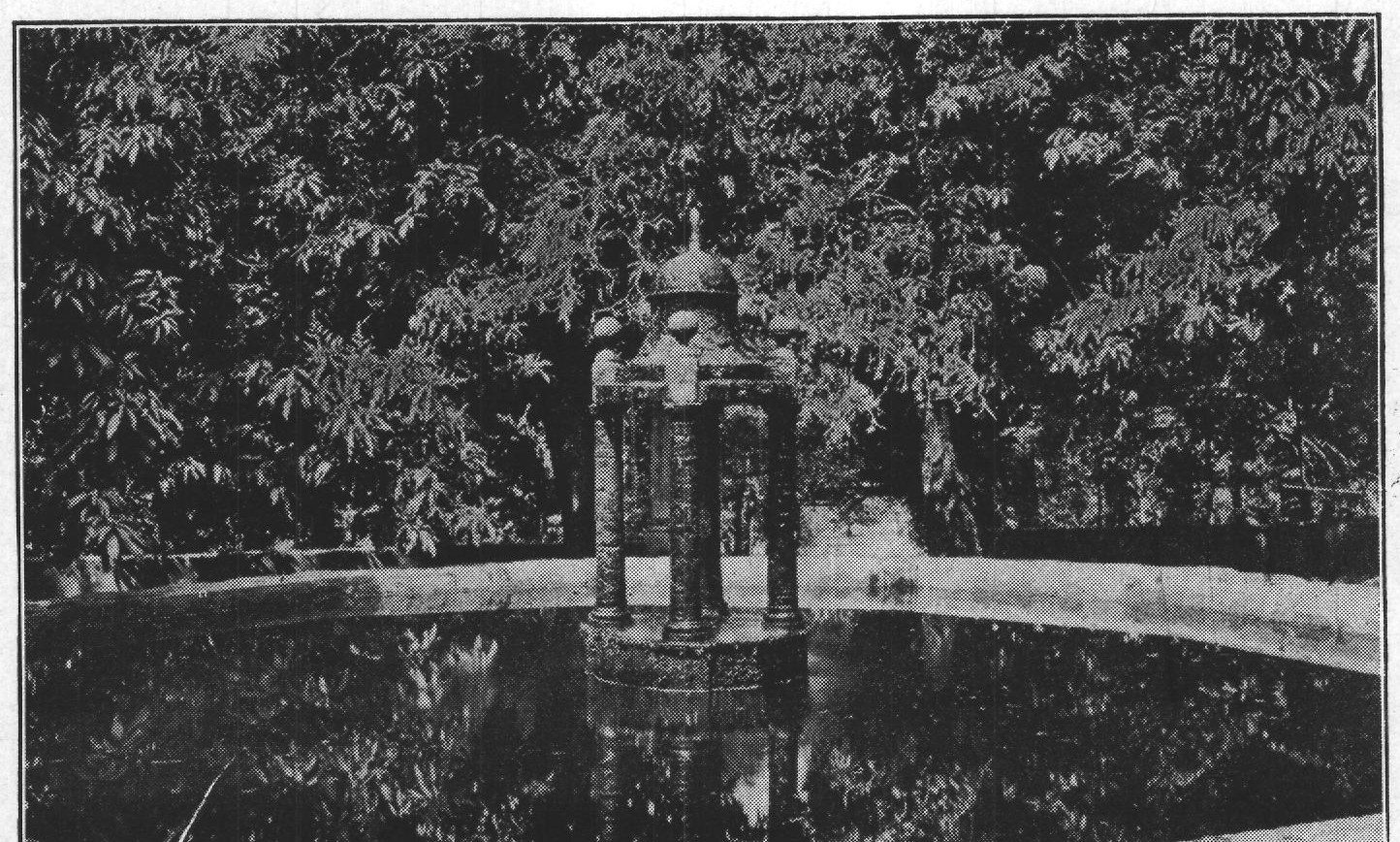
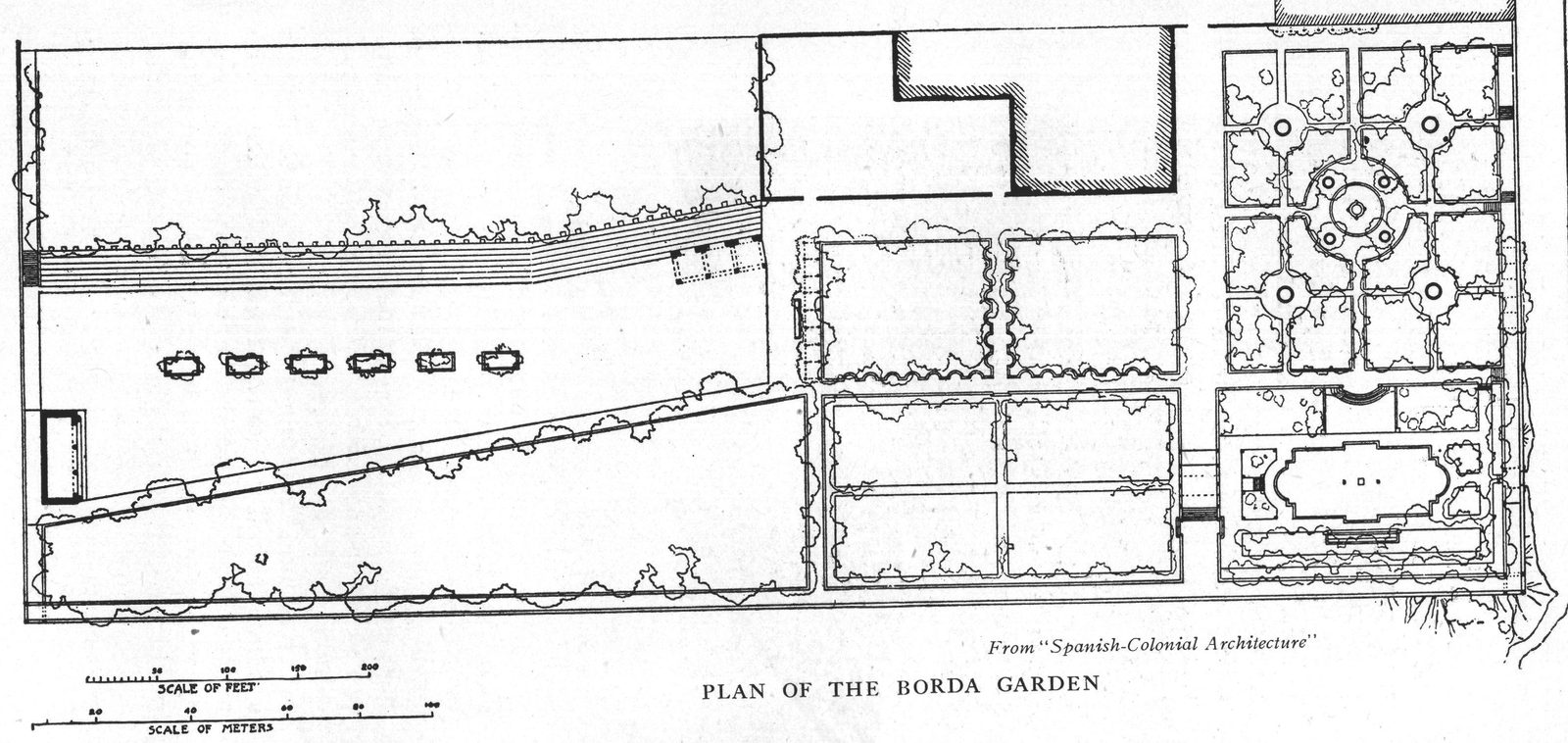
The accompanying plan of the garden was made for "Spanish-Colonial Architecture in Mexico" by Mr. Bertram G. Goodhue, the architect, on the basis of a sketch kindly furnished by Mrs. Richard Frost of Redlands, California. Mr. Goodhue had visited the garden and had carefully noted its character; hence the plan gives a fairly accurate presentment of the place. To the southward of the broad transverse walk the upper section is devoted to what appears to have originally been the flower-garden. A portion of it is still occupied by various flowering plants. There are five circular basins for fountains. Fountains and statuary were probably an important feature of the garden's embellishment. If so, however, all such work has long since disappeared, with the exception of an exquisite temple-like structure that occupies the northeast circle, near the house.
The remainder of the part to the south of the wide walk is devoted to a sunken section with a large basin for its central feature. This basin is overlooked from a terrace bordering the flower-garden, a short flight of curved steps descending in its center. On the main axis of the basin is the arch of a bridge in the broad walk, spanning a path that traverses the section on the north. Curiously the incline is carried across the bridge to the steps beyond.
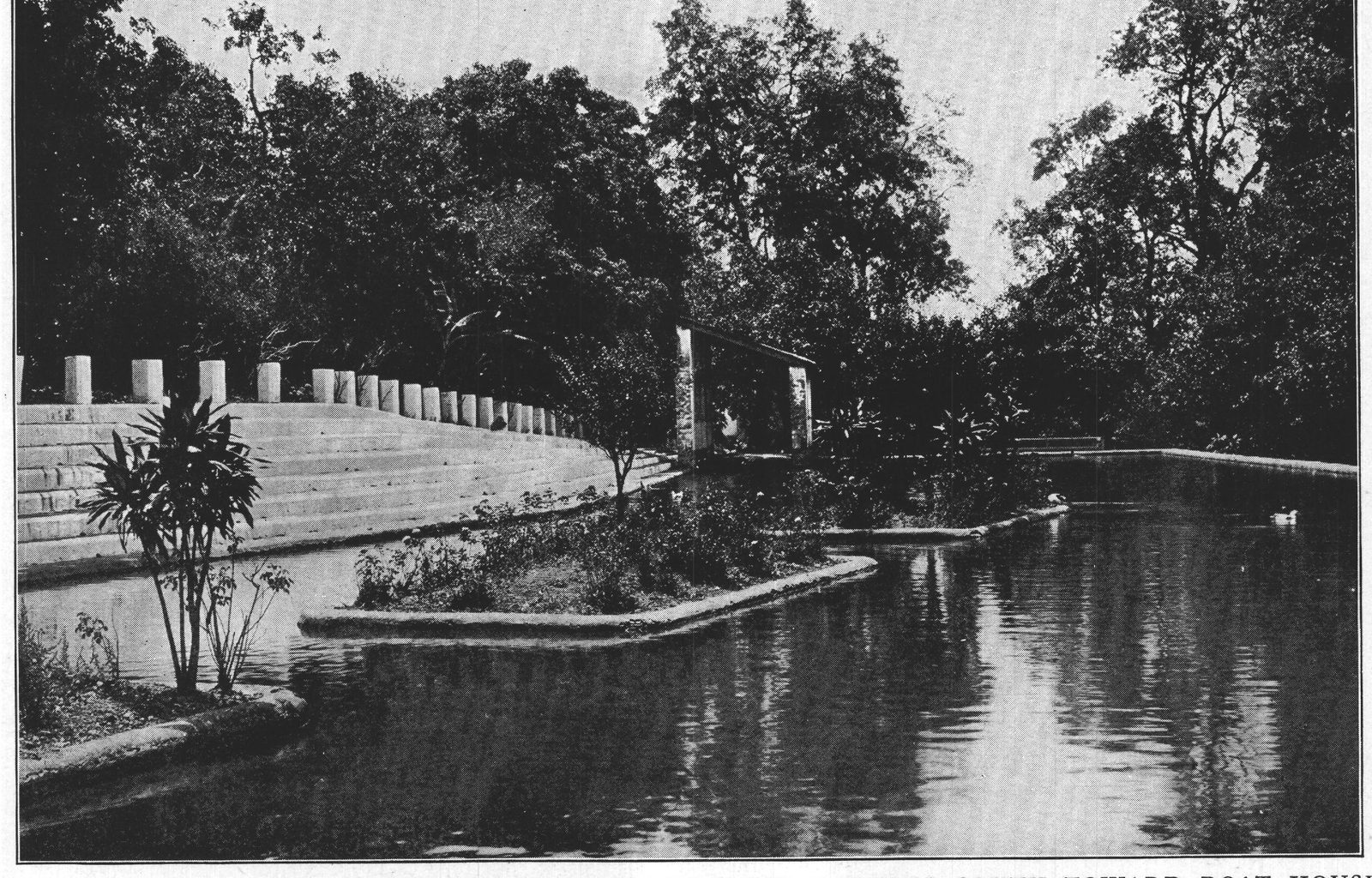
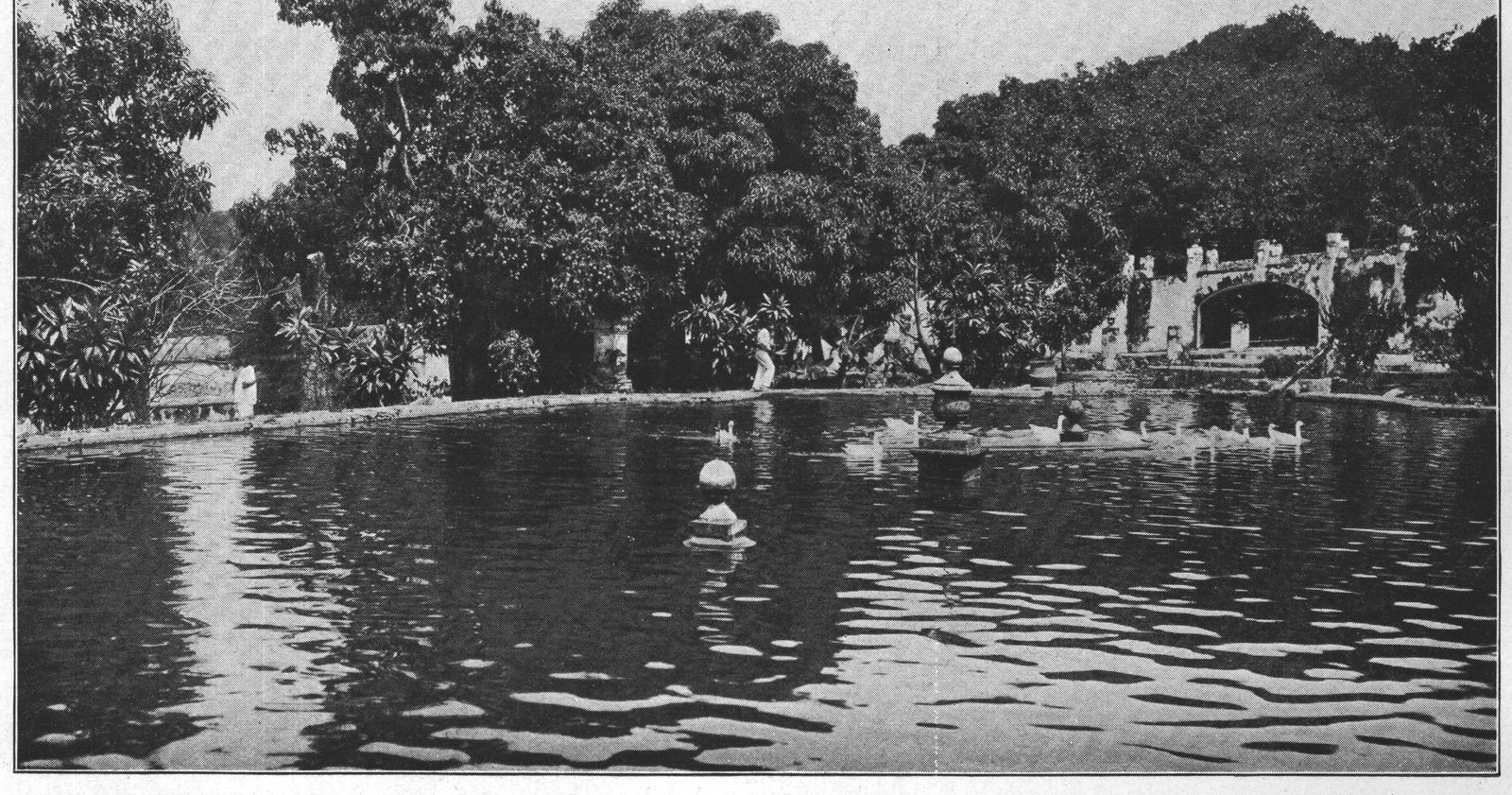
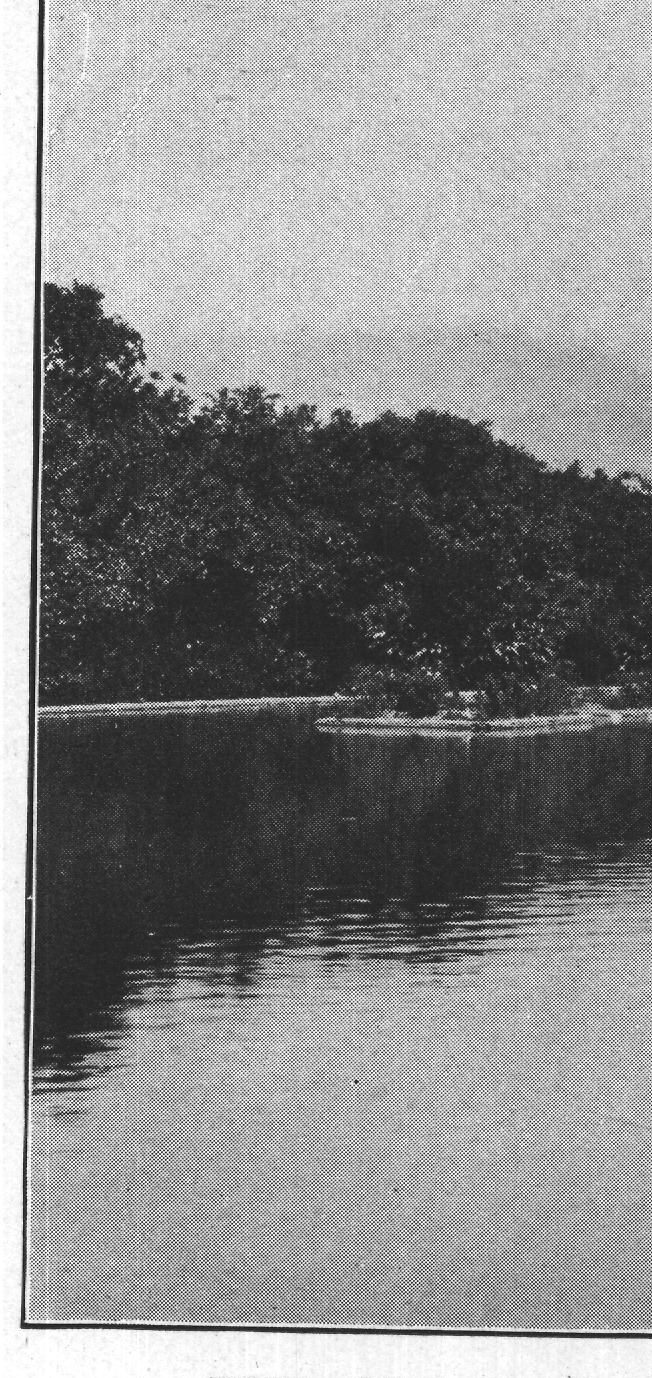
A great basin, of an irregular geometrical shape, runs the length of the northern half of the garden. This irregularity, which is not so awkward in effect as it appears in the design, was probably determined by the contours of the ground. It seems to give the impression of a greater extent of the water-surface than a basin of regular lines would make. Even the turn in the line of the long steps of the terrace on the upper side of the basin is not without an effectiveness of its own. These steps may suggest seats for spectators at an aquatic fiesta—say of boating, swimming-contests, or illuminations and fireworks. An odd feature is the line of six little rectangular islets with plants and shrubbery. At the south end of the basin, adjoining the terrace, is a handsome arcaded boathouse. The views up and down the length of the basin are strikingly fine—particularly that from the pergola at the south end towards the arcaded shelter at the opposite extreme, beyond which rises the noble mountain landscape dominated by the peaks of Ajusco. Straight walks border the garden on three sides and at the two lower corners are pavilions, or miradores (lookouts) rising above the high enclosing walls and commanding extensive prospects over the spacious landscape to the northward, westward and southward.
It has often been stated that Don José de la Borda expended a million dollars upon this garden. This may be an exaggeration. Labor was cheap in New Spain a century and a half ago. A million dollars would have done a tremendous amount of grading and built piles of masonry. Great sums, however, may have been laid out for works of embellishment that are no longer in evidence.