Of the Government School of Art at Calcutta
Gardening, in an artistic sense, will soon become one of the lost arts of India: perhaps it may be placed in that category already. Gardening, in a horticultural sense, still flourishes in India, and doubtless will continue to do so; but the art, so well understood by the Moguls, of planning and planting gardens in direct harmonious relation to the house, palace, or mausoleum to which they belong, is now rarely, if ever, practiced. Even the old gardens which the Moguls designed have either been allowed to fall into ruin or have been so transformed on modern European lines that the original idea has been entirely lost.
There are two causes which have led to the neglect of old Indian garden-craft: first, the degradation of taste, which, among so many Indians of the higher classes, has converted an active artistic faculty into a passive imitation of European fashions: secondly, the change of habits, which has deprived the garden of a great deal of the practical use it formerly served. Before the days of railways the garden in India took the place of hill-stations and summer resorts. With its fountains, cascades, water-courses and airy pavilions, it was a refuge in the hot weather from the stifling heat of the house. Every rich man, besides his ancestral palace or mansion (which always possessed inner courtyards, planted as gardens for the especial use of the ladies of the zanana), kept up one or more summer retreats, or garden-houses.
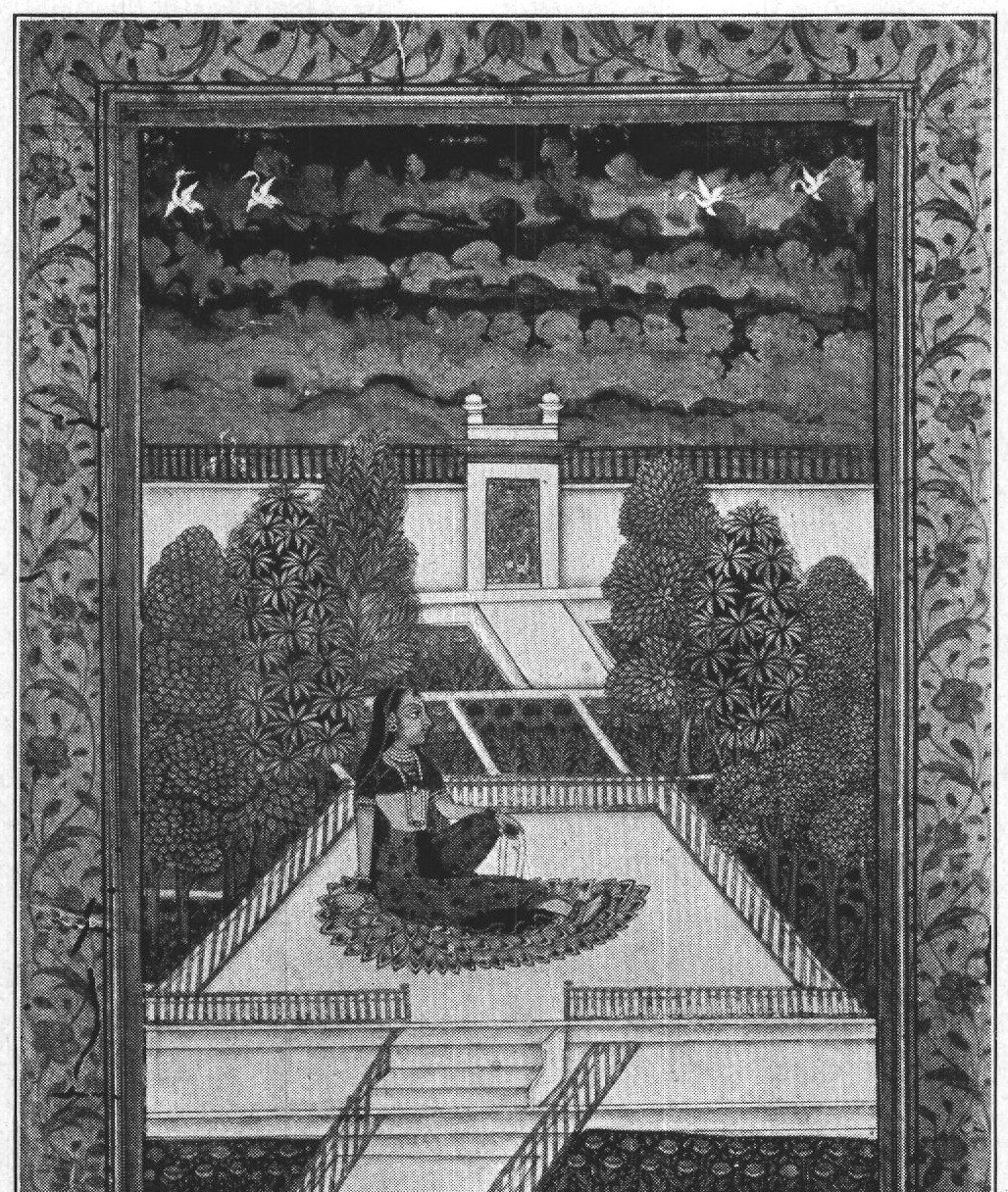
Previous to the Mogul epoch there is very little information to be obtained concerning Hindu notions of gardening, except what may be gathered from very vague descriptions in dramatic or poetical writings. The illustration given on the following page shows the ordinary type represented in Hindu paintings; but I know of no Hindu pictures of gardens older than the Mogul time, and probably this painting represents a style borrowed largely, if not entirely, from the Moguls. In the Mogul gardens there is always a raised platform, generally placed in the center. This was a very essential feature, for the raison d'être of an Indian garden was much more as a place for reclining at ease, for quiet enjoyment of music, of conversation and the hukkah, in the cool of the evening, rather than for exercise or amusements of an athletic description. In Indian gardens, therefore, the meandering paths, cunning mazes, labyrinths, and wide lawns, which Western people enjoy, are never found. Round the platform, which often had a fountain in the center, the garden was mapped out into square or oblong flower beds, nearly always planted with poppies, if we may believe old native pictures of Hindu gardens. Trees were planted round the platform and along the four sides of the garden, and also scattered somewhat promiscuously among the flower beds. The planting of the garden as well as the disposal of trees and flowers, had to conform to various considerations besides esthetic rules. According to an old Indian treatise on gardening, the north and east sides of the house were auspicious for making a garden; the south, southwest and southeast were aspects to be avoided. "These five trees should be planted first: phulsah (Grewia Asiatica), neal bhela, or marking nut tree, poonag (Rottleria tinctoria), Sirish (Mimosa sirissa), and nim (Melia azardirachta), as they are lucky: after this plantations of any kind may be made." The following trees should be planted on the four sides of the gardens, within the ditches (irrigation channels): on the east side, caronda (Carissa carondas); on the south, bamboo; on the north, conor, or jujube (Zizyphus jujuba) and caith (Feronia elephantum); on the west, amlah (Emblica officinalis) and bel (Ægle marmelos). No kind of thorny plant should be planted near or in the entrance of a house—a very sensible limitation. Trees and flowers were also chosen as bearing some symbolic meaning, or from being sacred to the gods. The Asoka tree, with its splendid scarlet blossoms, is sacred to Shiva; the jasmine flower, to Shiva and Vishnu; the champak blossom, to Kama Deva, the Indian Cupid.
The famous gardens in the North of India, of which a more definite account will be given, are all of the Mogul epoch. Babar, the first of the Great Moguls (1494-1530) and prince of gardeners, has given in his memoirs the following description of one of the numerous gardens he laid out in his kingdom of Kabul, before the conquest of Hindustan: "In this district (the Istalif district, to the northwest of Kabul) is a garden, called 'Bagh-e-Kilân' (the Splendid Garden) which Ulugh Bey Mirza seized upon. I paid the price of the garden to the proprietors and received from them a grant of it. On the outside of the garden are large and beautiful spreading palm-trees, under the shade of which there are agreeable spots, finely sheltered. A perennial stream, large enough to turn a mill, runs through the garden and on its banks are planted plane and other trees. Formerly this stream flowed in a winding and crooked course, but I ordered the course to be altered according to a regular plan which added greatly to the beauty of the place." In a valley close by he confined a rivulet within artificial banks "and caused a channel to be dug for it over one of the heights on the southwest of Sêyârên." On the top of this height he formed a circular platform on which to sit and take his ease.
In another district of Kabul he planted a garden, named by him Bagh-e-Vafâ, or Garden of Fidelity, which he describes thus: "It overlooks the river, which flows between the fort and the palace. In the year in which I defeated Behâr Khan, and conquered Lahore and Dibâlpûr, I brought plantains and started them here. The year before I had also planted the sugar-cane in it, which grew and thrived. It is on an elevated site, enjoys running water, and the climate in the winter season is temperate. In the garden there is a small hillock from which a stream of water, sufficient to drive a mill, incessantly flows into the garden below. The four-fold field plot (i. e., a part of the garden divided into four compartments in the old Mogul fashion) of the garden is situated on this eminence. On the southwest part of this garden is a reservoir of water, ten gez square, which is wholly planted round with orange trees; there are likewise pomegranates. All around the piece of water the ground is quite covered with clover. This spot is the very eye of the beauty of the garden. At the time when the orange becomes yellow the prospect is delightful. Indeed the garden is charmingly laid out."
Some years afterwards, returning from one of his Indian campaigns, he hastened to visit his beloved Garden of Fidelity and found it in all its glory. "Its grass-plots were all covered with clover; its pomegranate trees were entirely of a beautiful yellow color. It was the pomegranate season and the fruit was hanging red on the trees. The orange trees were green and beautiful, loaded with innumerable oranges; but the best of them were not yet ripe."
In these descriptions we have an exposition of some of the ancient principles of gardening as practised in Central Asia and Persia and Afghanistan in the beginning of the sixteenth century. First, the choice of a place beautiful from the hands of Nature; next, the arrangement of the irrigation, artificial waterfalls, fountains, reservoirs, flower beds and fruit trees, and a platform for sitting upon—all according to a definite artistic tradition. Symbolism and mysticism were the foundation of all Eastern art and garden-craft. Every tree and every flower had some symbolic or mystical meaning, traces of which can still be found in old European folk-lore. The garden itself, according to the Tartar traditions which Babar brought with him into India, was a symbol of life and death. Some of the Mogul gardens were used only as pleasure-grounds, but there was always one especial favorite which was set apart for the owner's last resting place when the pleasures of life were over. It must have been acquired by fair means, and not by force or fraud, otherwise the possession of it would only bring misfortune. Hence Babar's allusion to the fact that he had paid the price of the Bagh-e-Kilân to the proprietors and received a grant of it.
When Babar conquered Hindustan and established himself at Agra, the barrenness and flatness of the country put great difficulties in the way of his projects for laying out gardens. He expresses his disgust in the following words: "It always appears to me that one of the chief defects of Hindustan is the want of artificial water-courses. I had intended, wherever I might fix my residence, to construct water-wheels, to produce an artificial stream, and to lay out an elegant and regularly planned pleasure-ground. Shortly after coming to Agra I passed the Jumna with this object in view and examined the country to pitch upon a fit spot. The whole was so ugly and detestable that I repassed the river quite repulsed and disgusted. In consequence of the want of beauty and of the disagreeable aspect of the country I gave up my intention of making a charbagh (garden); but as no better presented itself near Agra I was finally compelled to make the best of this same spot. . . . In every corner I planted suitable gardens, in every garden I sowed roses and narcissus regularly, and in beds corresponding to each other." He also avowed his unmitigated contempt for all things Indian: "The country and towns of Hindustan are extremely ugly. All its towns and lands have a uniform look; its gardens have no walls; the greater part of it is a level plain. . . . They have no good horses, no good flesh; no grapes or musk-melons, no good fruit, no ice or cold water, no good food or bread in their bazars, no candles or torches—never a candlestick!"
Undoubtedly India owes a great deal to the Mogul love of gardening. Though, as I have observed above, the artistic traditions of their garden-craft are practically dead, the old gardens were frequently laid out so solidly in marble and stone that it is possible to get a very accurate idea of the Mogul or "regularly planned pleasure-grounds" from the framework of them which still exists. At Agra the gardens were generally planted along the banks of the river Jumna, which not only formed a noble background but made it easy to provide the irrigation and "artificial water-courses." The flatness and monotony of the country around Agra which so disgusted Babar, and also the climatic conditions of India, probably forced him to adopt a more formal design than he would have preferred among the beautiful hills and streams of his dearly loved and never-forgotten home in Central Asia. Unfortunately none of Babar's Indian gardens now remain except that at Agra, which is now known as the Ram Bagh; this has been so Europeanized that it is unsuitable for illustration.
Jahangir, the great-grandson of Babar (1605-1627), gives in his memoirs a description of one of Babar's Agra gardens, with a four-storied marble pavilion decorated with gold and lapis-lazuli and approached by a magnificent avenue of areca-nut palms ninety feet high. It was planted with vines, apricots, apple and plum trees brought from Kabul, with pineapples and other foreign fruits introduced by the Portuguese, besides innumerable Indian fruits. Of flowers he mentions a great variety of roses, especially the musk and damask rose, the jasmine and gult-chemeily, which is either Jasminum grandiflora, or the gardenia. Babar's grandson, Akbar, laid out many gardens at Fatehpur Sikri and near Agra. He brought horticulturists from Persia to look after them. None of these gardens now exist. Jahangir mentions one of them as being remarkable for a great many ancient cypress trees of extraordinary size. These were probably planted by Babar, as he apparently was the first to introduce the cypress into India.
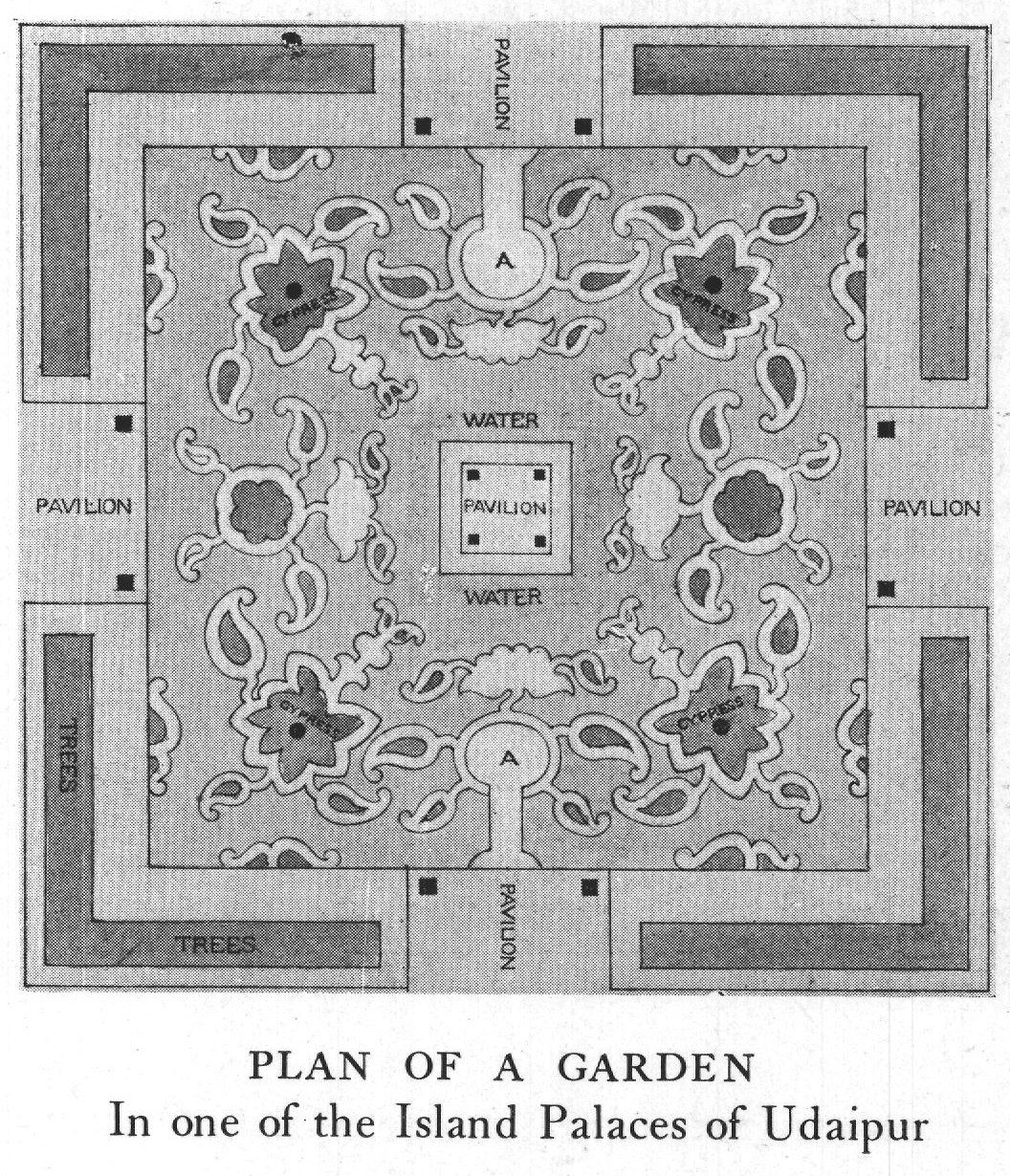
The earliest Mogul gardens which exist now in anything like their original condition are those which the Emperor Jahangir himself constructed. Some time before he came to the throne he was at Udaipur in Rajputana, and there, in one of the island palaces on the lake, is a very interesting garden, which, though probably not of his time, is of the Persian style which he introduced into Rajputana. It is not now cultivated in the old style, but the plan of it below gives a good idea of its very original construction. The flower beds are worked out with brick, covered with a fine polished plaster, into conventional floral patterns, imitating, with the living flowers planted in them, the design of a Persian carpet. The waters of the lake flow into the interstices to form the ground of the pattern. The plain spaces AA are platforms on which to sit. In the center of the garden is a small marble pavilion, probably for musicians; to reach it one must wade through the water, or pass over a plank. A marble platform with beds for trees surrounds the garden. The larger pavilions on each of its four sides look out over the lake.
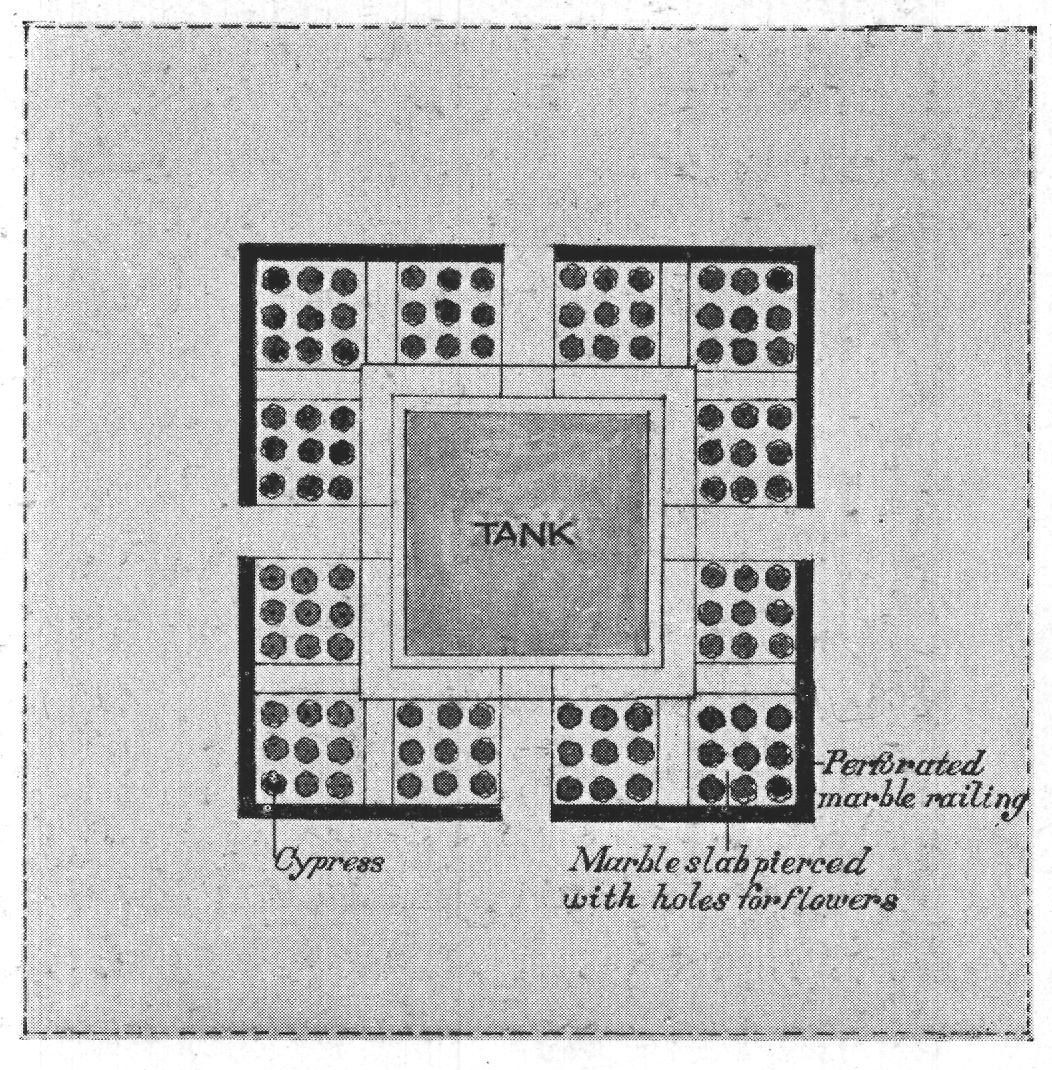
At Udaipur also, within the Maharajah's palace, there is a small courtyard (see page 187) laid out in typical Mogul style. A marble tank in the center is surrounded by square plots, panelled by slabs of marble into geometric flower beds. A rail of perforated marble encloses the flower plots, four cypresses marking the outer corners. In the Mogul times every palace contained within its walls, gardens such as this, large or small, for the use of the ladies of the zanana.
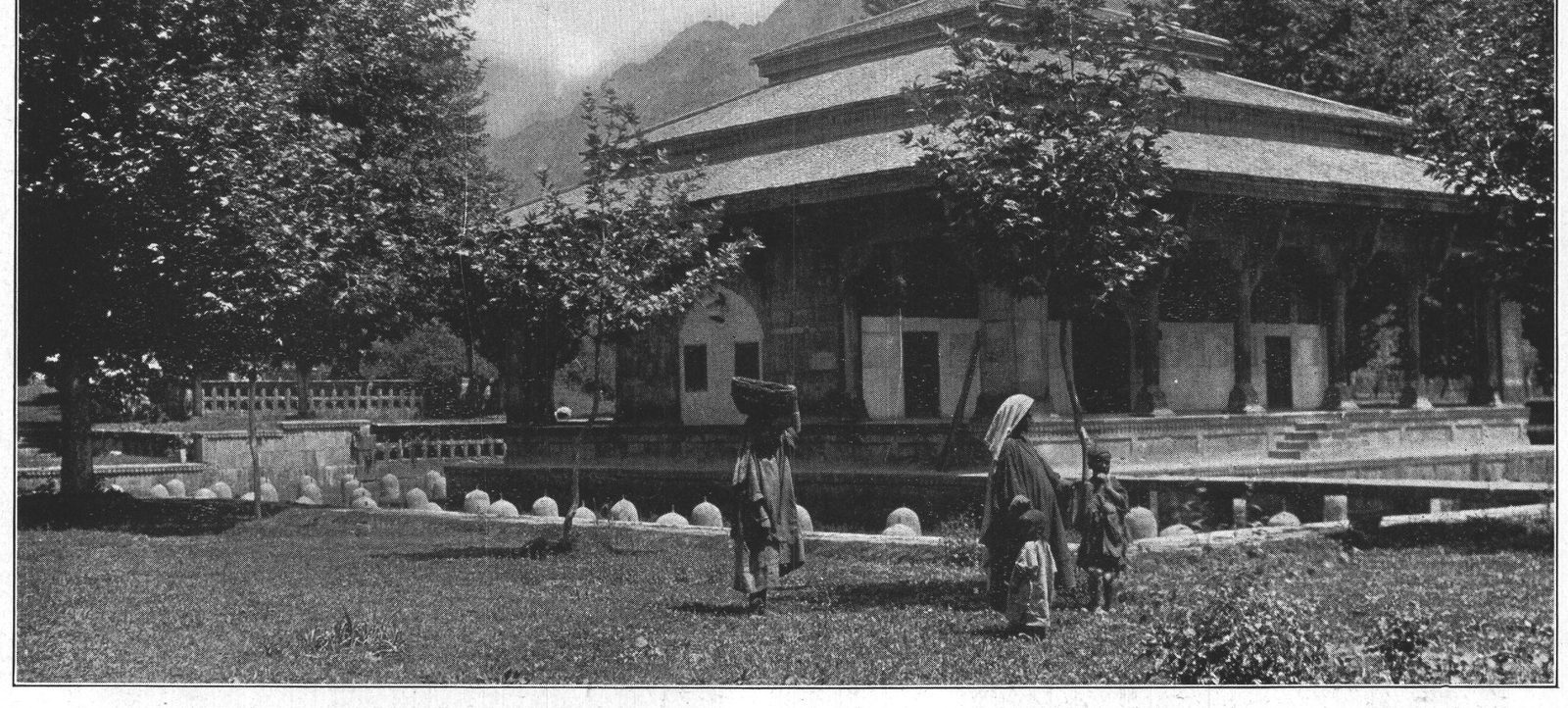
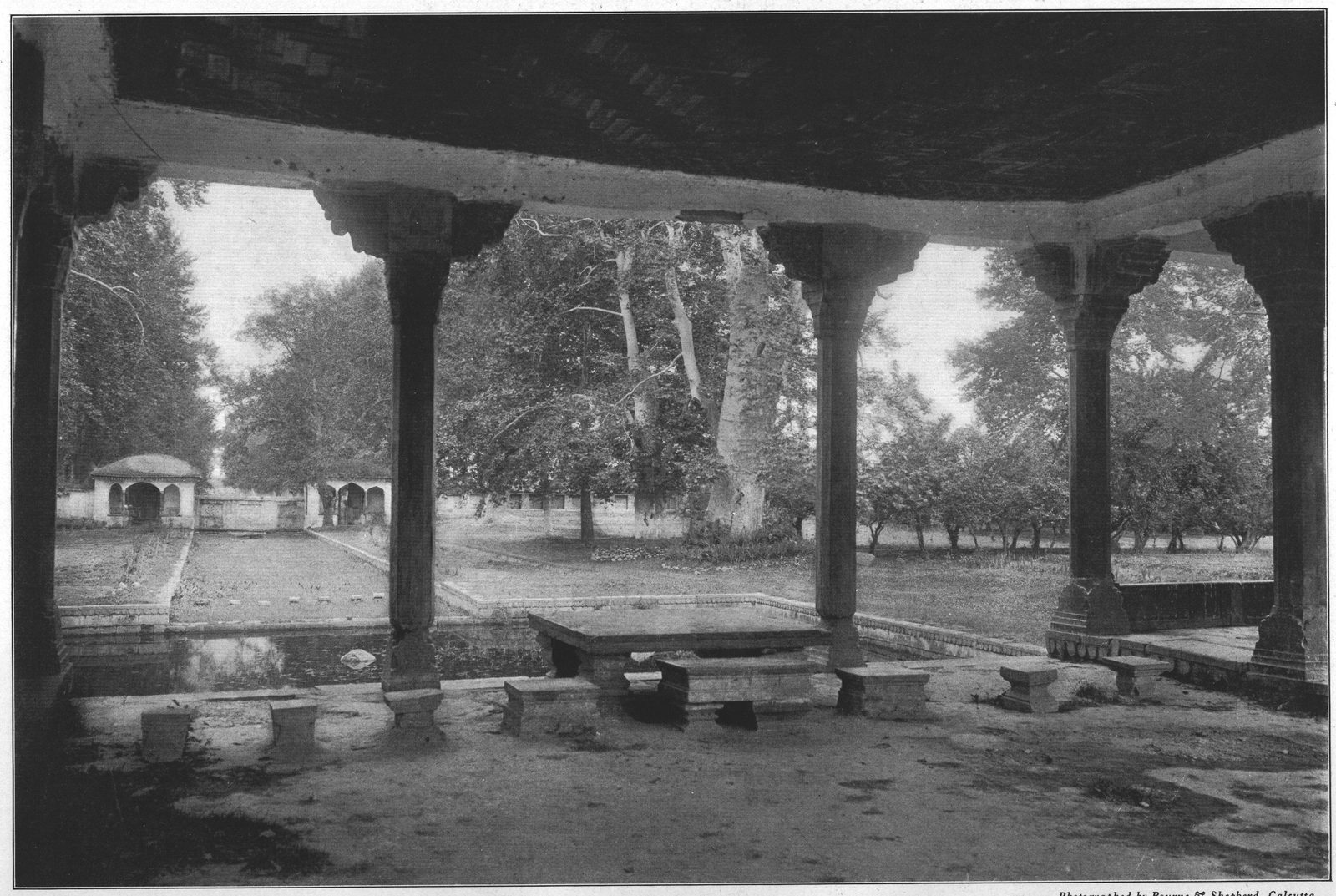
Jahangir's most famous gardens are those which he and his accomplished Queen, the beautiful Nur Mahal, "the Light of the Palace," laid out on a magnificent scale in Kashmir, after his accession to the throne. The principal one, called the Shahlimar Bagh, measures 500 yards by 207, and is arranged in four terraces; a masonry wall, 10 feet high, encloses the whole garden. A mountain stream, as in the Bagh-e-Kilân described by Babar, is trained to pass through the center of the garden, filling its artificial reservoirs and irrigation channels, and falling from terrace to terrace over cascades built of masonry.
Bernier, the French physician, who passed many years at Aurangzîb's court, visited Kashmir about forty years after the Shahlimar Bagh was made and thus describes it: "The most beautiful of all these gardens is one belonging to the King called Chahlimar. The entrance from the lake is through a spacious canal bordered with green turf and running between two rows of poplars. Its length is about five hundred paces and it leads to a large summer house placed in the middle of the garden. A second canal, still finer than the first, then conducts you to another summer house at the end of the garden. The canal is paved with large blocks of freestone and its sloping sides are covered with the same material. In the middle is a long row of fountains fifteen paces asunder; besides which there are here and there large circular basins or reservoirs, formed into a variety of shapes and figures. The summer houses are placed in the midst of the canal, consequently surrounded by water, and between the two rows of poplars planted on either side."
He describes the Kashmir gardens generally as being covered with fruit-trees, and laid out with regular trellised walks. They were usually surrounded by the large-leafed aspen, planted at intervals of two feet. The largest of these trees were as high as the mast of a ship, with a tuft of branches at the top like palm-trees. The reservoirs were stocked with fish, so tame that they approached when called; some of the largest fish had gold rings with inscriptions "placed there, it is said, by the celebrated Nur Mahal."
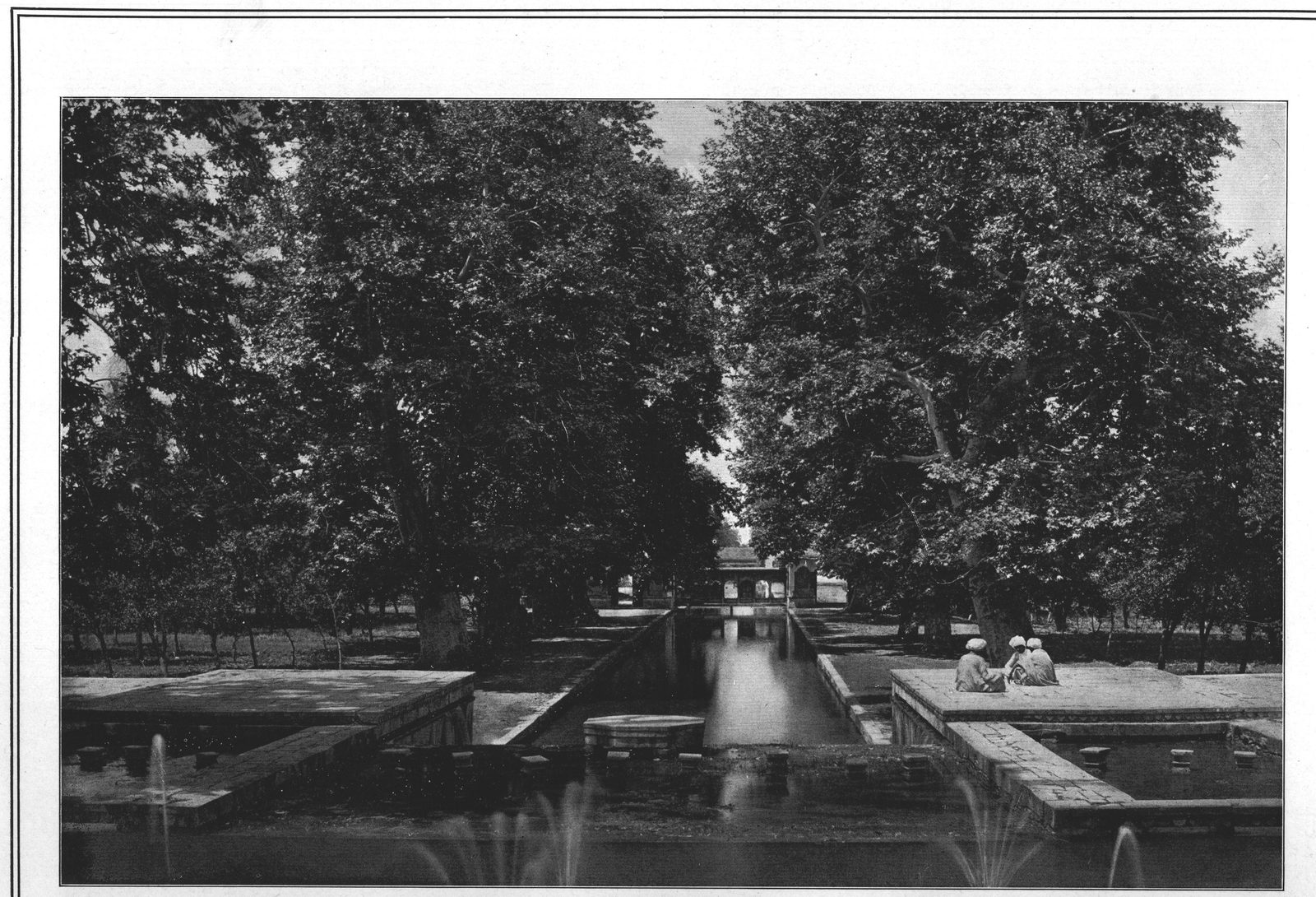
Our illustration on page 186 is a view from the upper pavilion of the Shahlimar Bagh, from a photograph taken some years ago. It shows the avenue of plane-trees which line the principal water-course. It will be observed that Bernier describes rows of poplars, not plane-trees, on either side of the channel. In his account of the gardens at Achibal, also laid out by Jahangir, he gives details regarding the arrangement of the fountains, cascades and trees which apply equally well to the Shahlimar Bagh:—
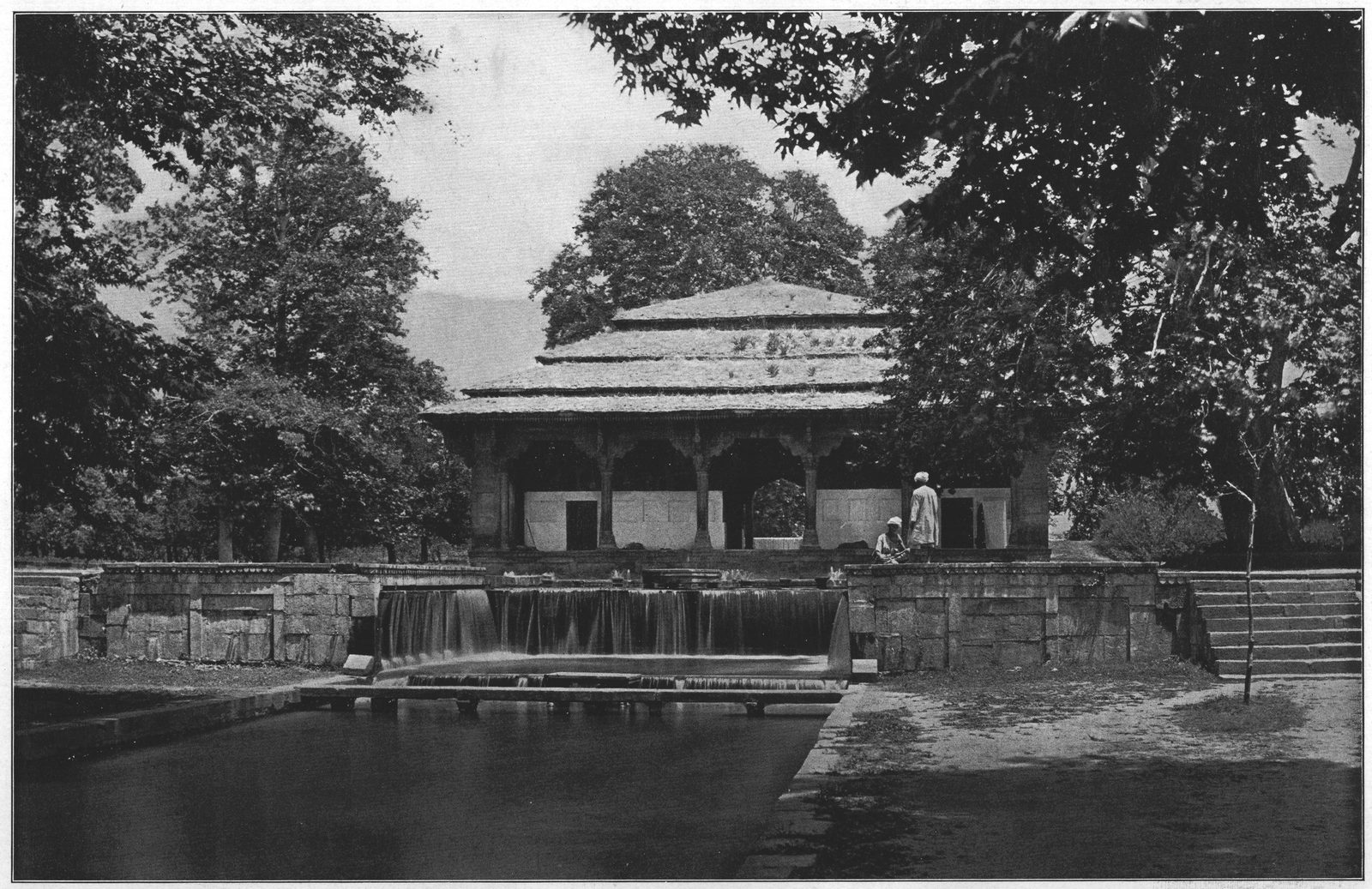
"What principally constitutes the beauty of the place is a fountain whose waters disperse themselves into a hundred canals round the house, which is by no means unseemly, and throughout the gardens. . . The garden is very handsome, laid out in regular walks, and full of fruit-trees, apple, pear, plum, apricot and cherry. Jets d'eau in various forms and fish ponds are in great number, and there is a lofty cascade which in its fall takes the form and color of a large sheet, thirty or forty paces in length, producing the finest effects imaginable: especially at night, when innumerable lamps, fixed in parts of the wall adapted for that purpose, are lighted under this sheet of water."
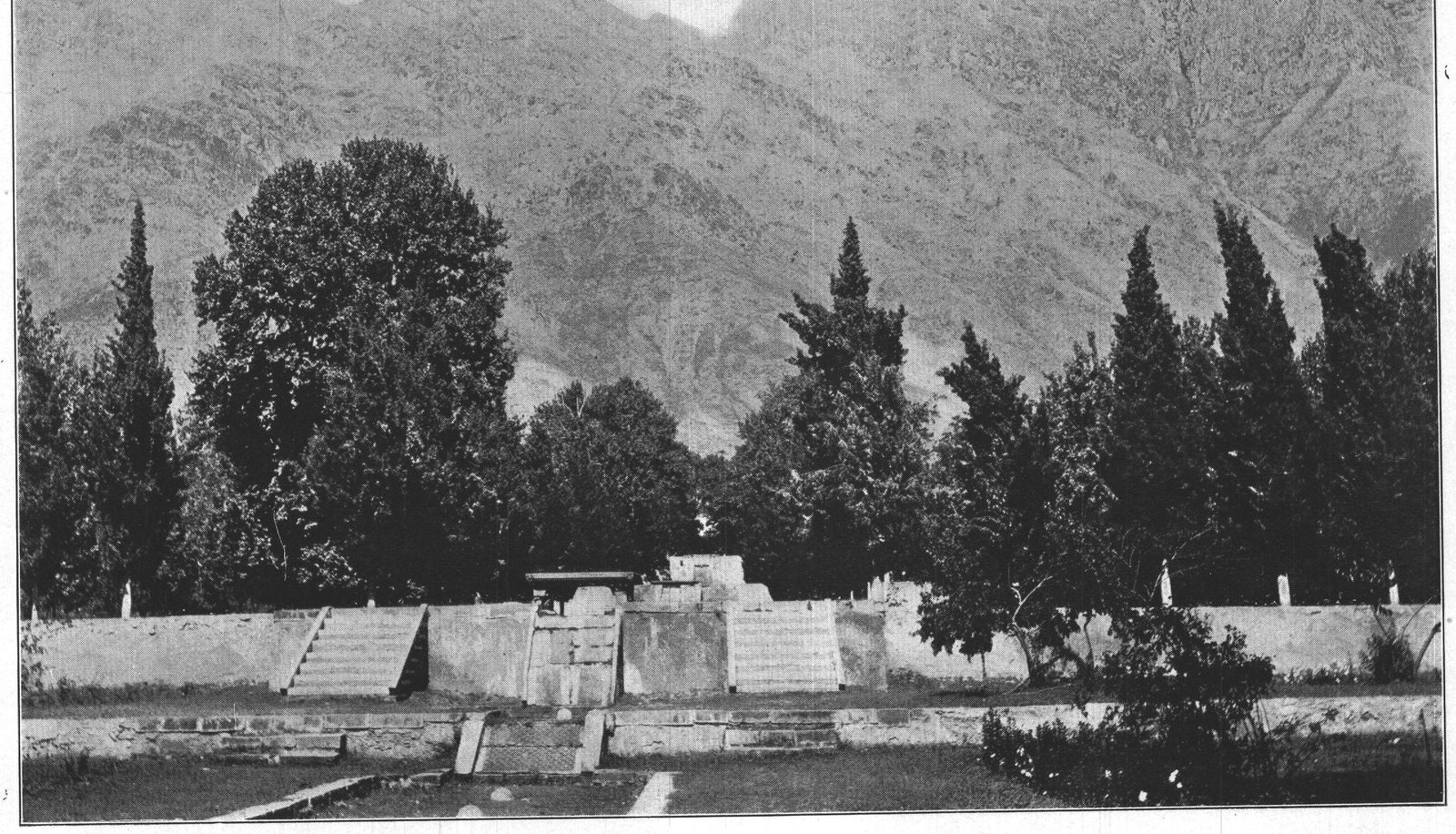
One illustration here given (page 188), a view of the Shahlimar pavilion, when the water is not flowing, shows two stone terrace walls behind the pavilion with numbers of small niches for lamps by which the cascades were illuminated in the manner thus described by Bernier. In the neighborhood of Srinigar, Jahangir laid out many other fine gardens assisted by the taste of Nur Mahal, who is said to have chosen the site for some of them. Like most Eastern potentates, Jahangir was a much-married man, but he confessed that he never knew what marriage was until he married Nur Mahal. Her name was joined with his on the imperial coinage; an inscription declared that gold acquired a new value since "Nur Mahal" appeared upon it. They spent many hot seasons together in their Kashmir gardens, enjoying the shade of the splendid avenues and orchards and the refreshing coolness of the cascades and fountains. No wonder that Jahangir prized Kashmir above all the other provinces of his empire. Many of his nobles imitated the imperial fancy for gardening. The Nishat Bagh, with a delightful prospect over Lake Dal, was constructed by Yemin-ud-danla, one of Jahangir's ministers. It had nine terraces. The lowest contained a fine double-storied pavilion through which the principal water-channel extended and supplied the fountains on the ground floor. On page 193 is a view of the terraces, looking up the garden. It shows the dried-up water-channel and cascades and some of the old cypress trees.
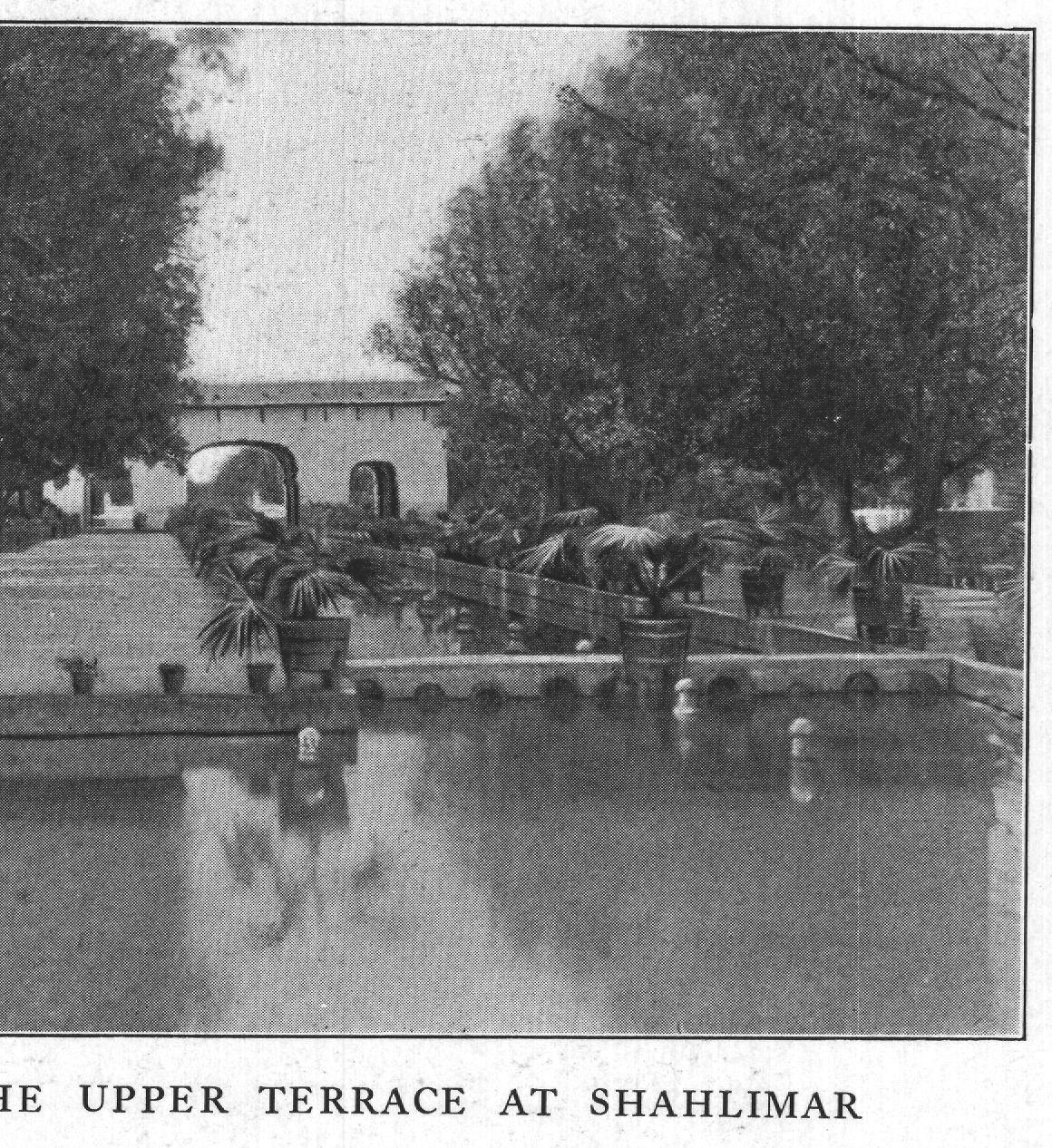
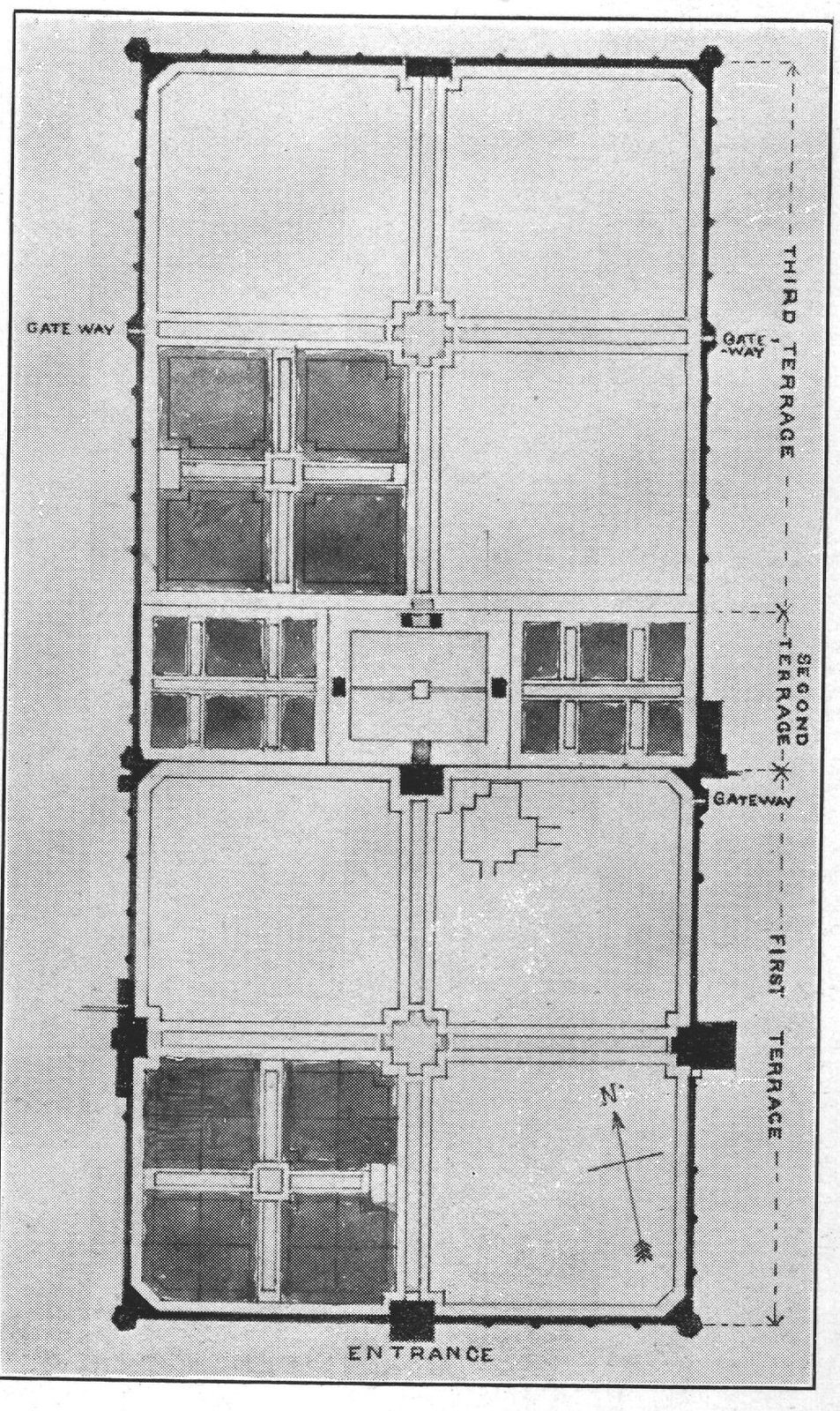
Shah Jahan, Jahangir's son and successor, commenced in 1634 the Shahlimar gardens at Lahore on the model of his father's Kashmir gardens. Though they have suffered terribly, like all the other Mogul gardens, from neglect, spoliation and Europeanization, something of the original intention may be gathered from what remains. The figure on page 196 gives the plan of the gardens. They are divided into three terraces, the dimensions of the whole being five hundred and twenty yards in length and two hundred and thirty yards in breadth. A masonry wall twenty feet high surrounds the entire garden, and secured the privacy which Shah Jahan desired for his zanana.
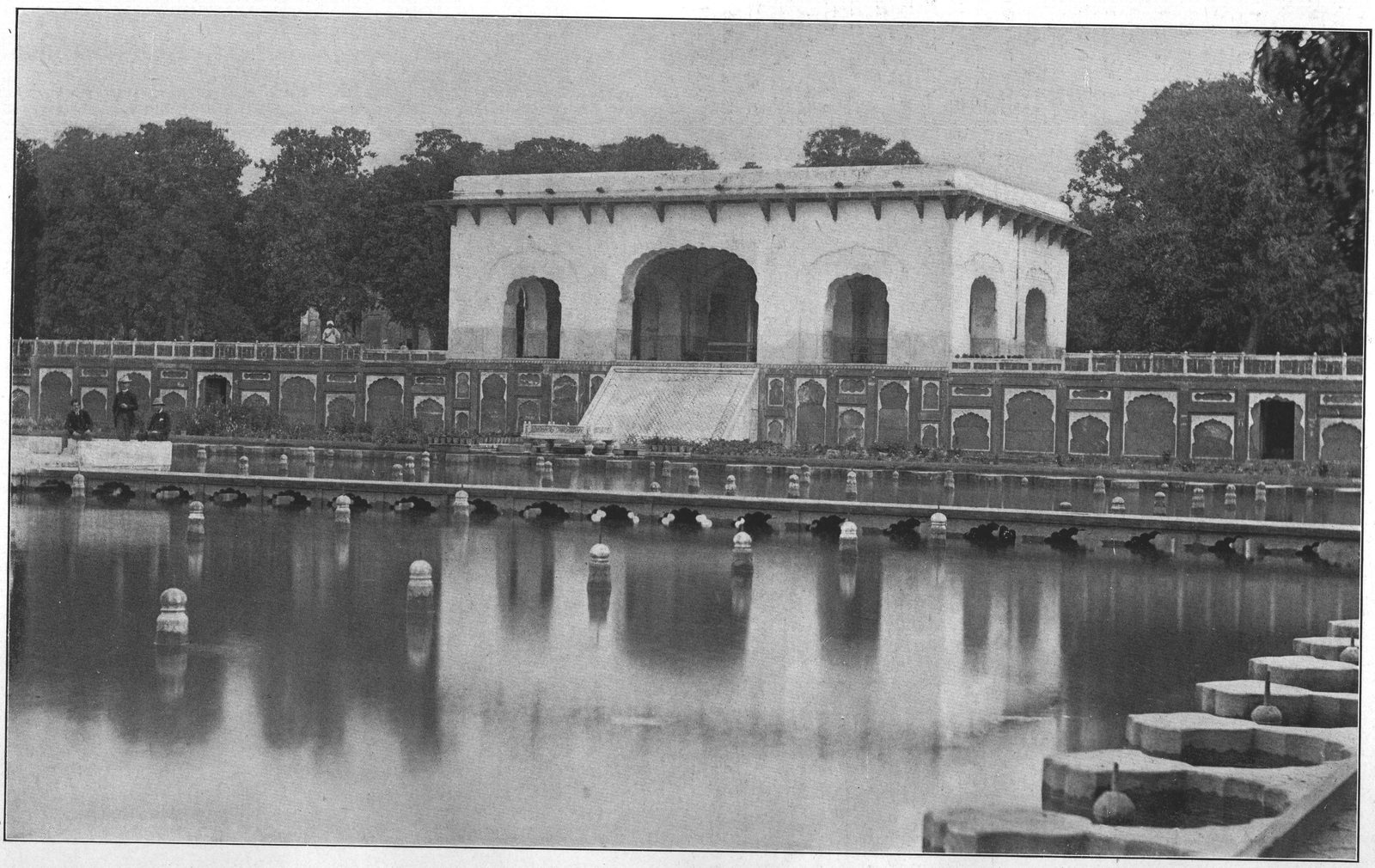
The first terrace is a square of two hundred and thirty yards, divided into four smaller squares by the principal water-channels. The water was brought from the distant hills by a canal constructed by Shah Jahan's engineers at a cost of two lakhs of rupees (about one hundred thousand dollars). Each of the smaller squares is again subdivided into four squares, as shown in the lower left-hand corner of the plan, but the gardens have been so often the camping ground of marauding armies that it is difficult to say how much the present lay-out corresponds with the original design of the Moguls. In the center of the east and west boundary walls two large pavilions were placed for the convenience of the emperor and his zanana. The water from the central channel passes through another pavilion, overlooking the second terrace and, falling over a carved marble slope in front of this pavilion descends about ten feet into the main reservoir which is the principal feature of the gardens. These marble stone water-shoots were ingeniously carved in various patterns cut at an angle so that the water running over them was thrown up into ripples and splashes, suggesting the pleasant gurgling of a mountain stream.
Our diagram shows one of these in Babar's garden, the Ram Bagh, at Agra. The enlarged section of the slope at A explains the method of carving. The Mogul gardeners employed every device to mitigate the intense dry summer heat of Northern India and to recall the memories of their mountain homes in Central Asia.

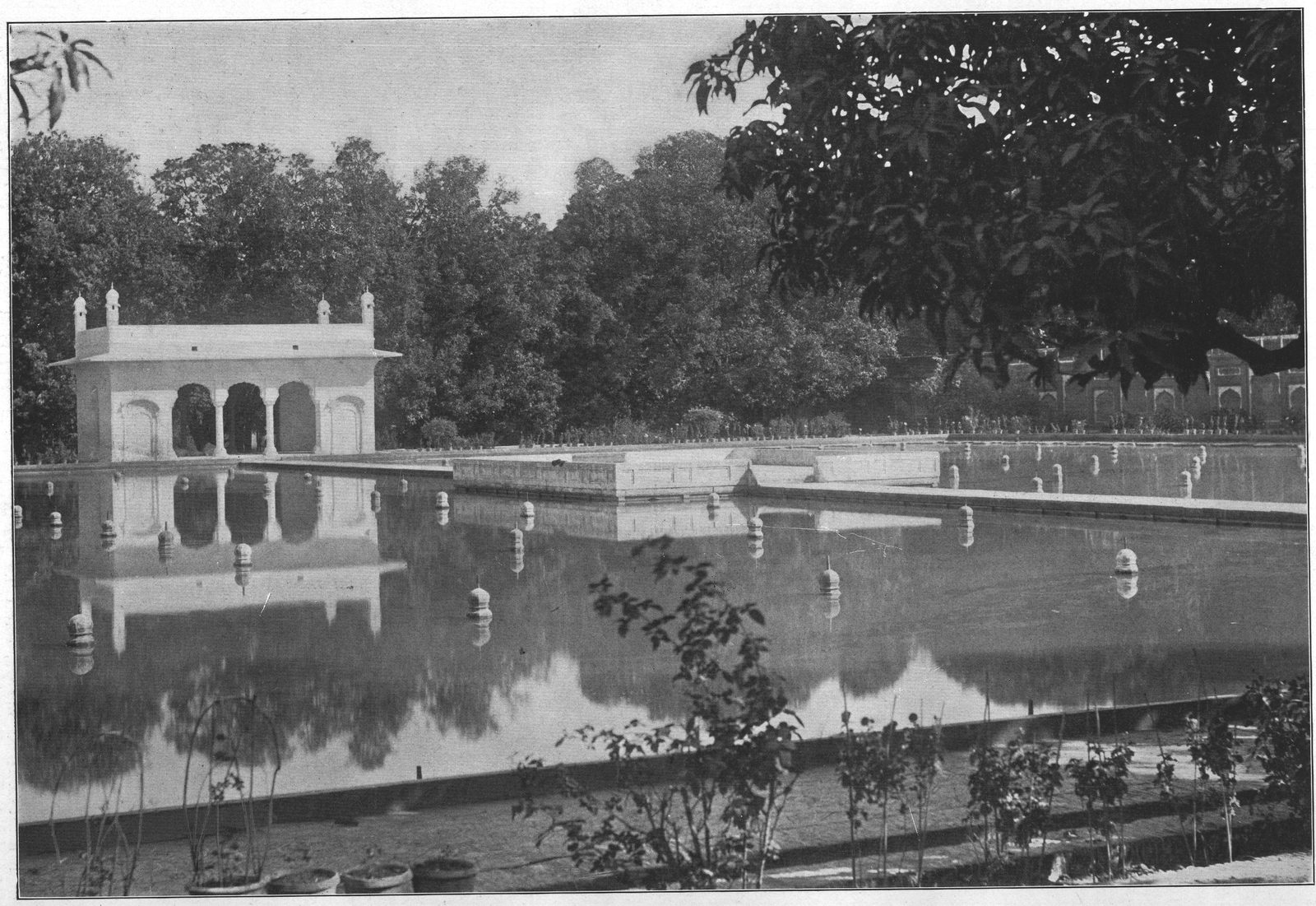
The illustrations on pages 192 and 194 show the central reservoir with its one hundred and forty-four water jets and the marble platform in the center. The marble work of the reservoirs and water-channels is part of the original Mogul design. The pavilions are nearly all inferior modern restorations in brick and plaster, the Sikhs in the eighteenth century having despoiled the gardens of most of the splendid marble and agate work to ornament the Ram Bagh at Amritsar.
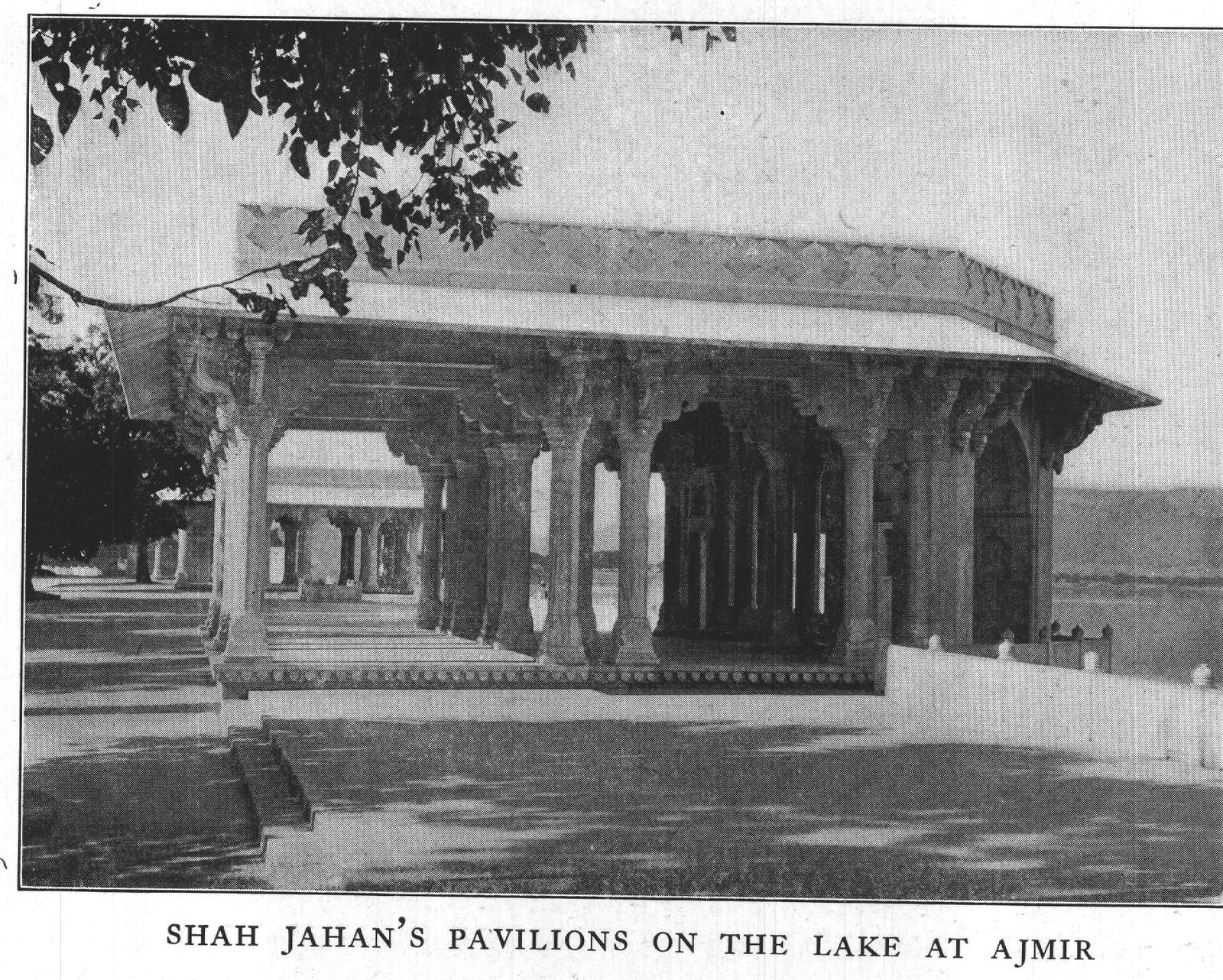
Some idea of the elegance of Shah Jahan's garden pavilions can be gained from the illustration of those he built on the embankment of the lake at Ajmir; but no photograph can do justice to the whole poetic charm of these buildings and their surroundings. They are quite unique of their kind, and Indian art owes much to Lord Argon for their rescue and admirable restoration. To watch the sunset over the lake with these marble pavilions in the foreground, reflecting the glow of color in sky and water, gives an impression of beauty which not even the Taj can diminish. Since the days of ancient Greece there has been little architecture of such exquisite feeling and classic grace as this.
The gardens on either side of the great reservoir in this second terrace are four and a half feet below the first terrace. The plan shows the arrangement of the water-channels. On the east boundary wall of this terrace are the royal bath-rooms. The gardens were in fact completely equipped for royal residence, so that whenever the emperor visited Lahore the inconveniences of tents and camp life were avoided.
On the north side of the reservoir there is another large pavilion through which the water passes to reach the third main terrace. Moorcroft, who visited Lahore in 1820, gives this description of the pavilion: "There are some open apartments of white marble of one story on a level with the basin, which present in front a square marble chamber, with recesses on its sides for lamps, before which water may be made to fall in sheets from a ledge surrounding the room at the top, whilst streams of water spout up through holes in the floor. This is called 'Sawan Bhadon' as imitative of light and darkness with clouds and heavy showers in the season of the rains."
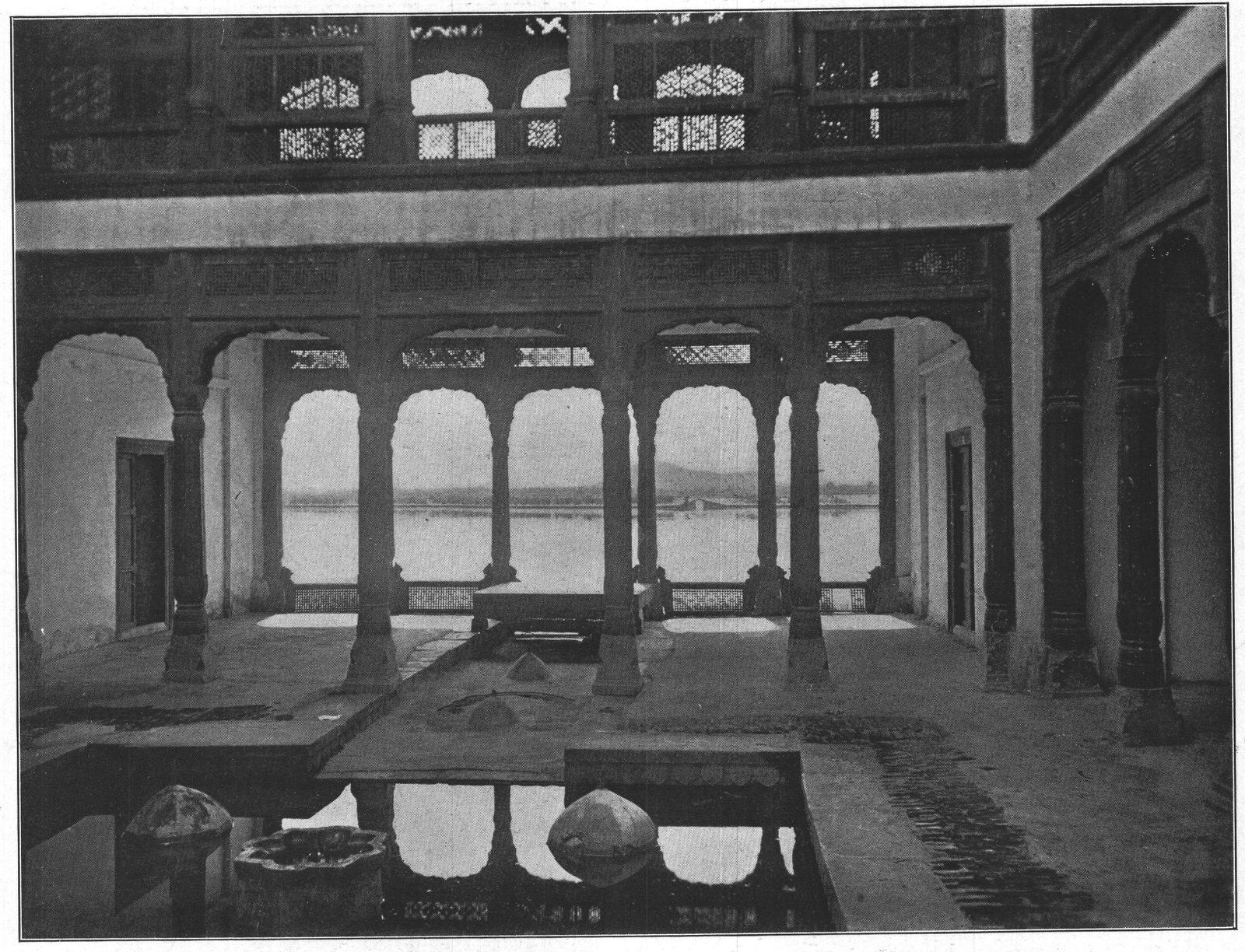
A similar device for cooling the rooms exists in an old garden pavilion at Alwar, belonging to the Maharajah. Of this an illustration is here given. A row of small jets is placed just under the cornice, outside of the pavilion, so that the whole structure can be enclosed in a fine spray of water.
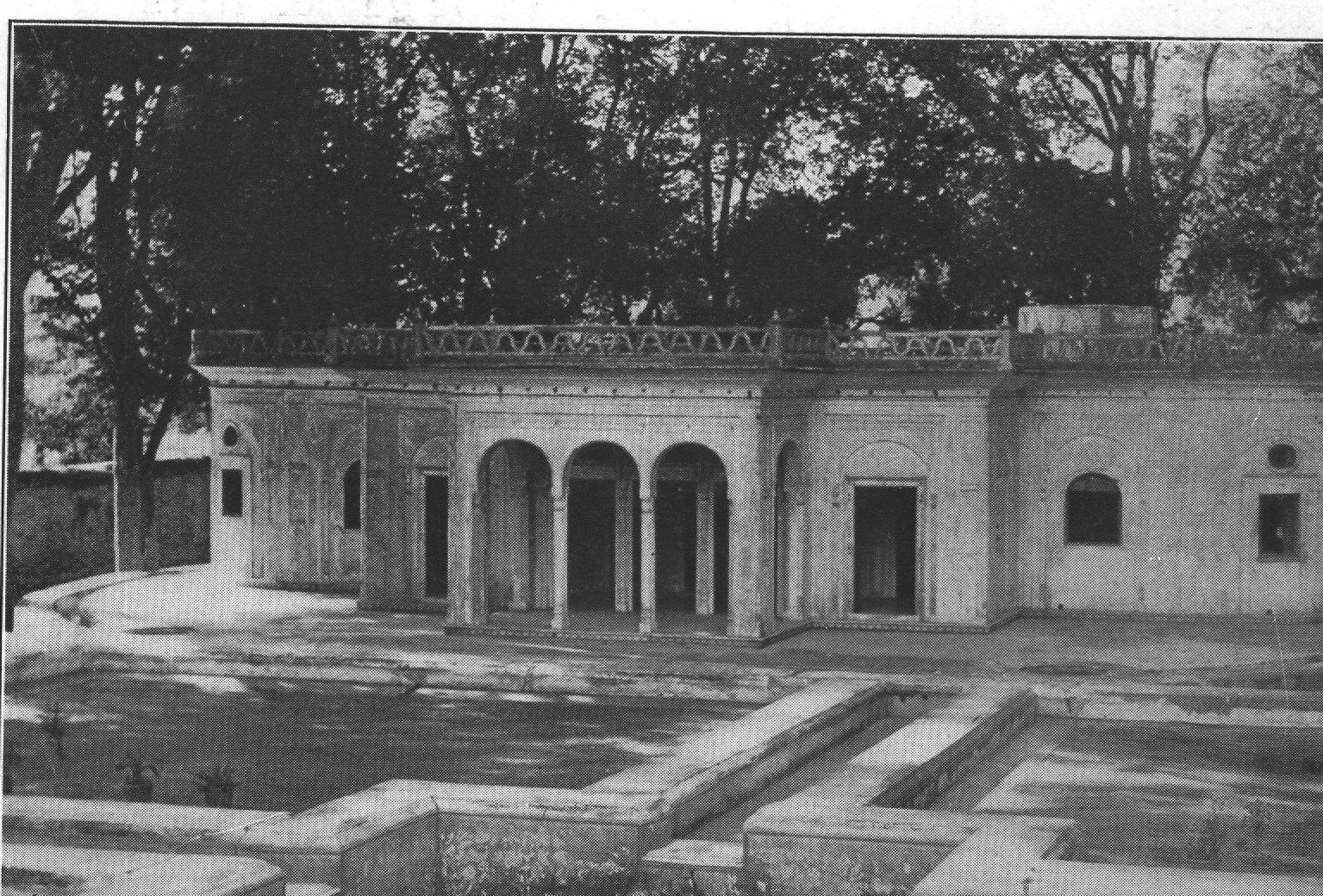
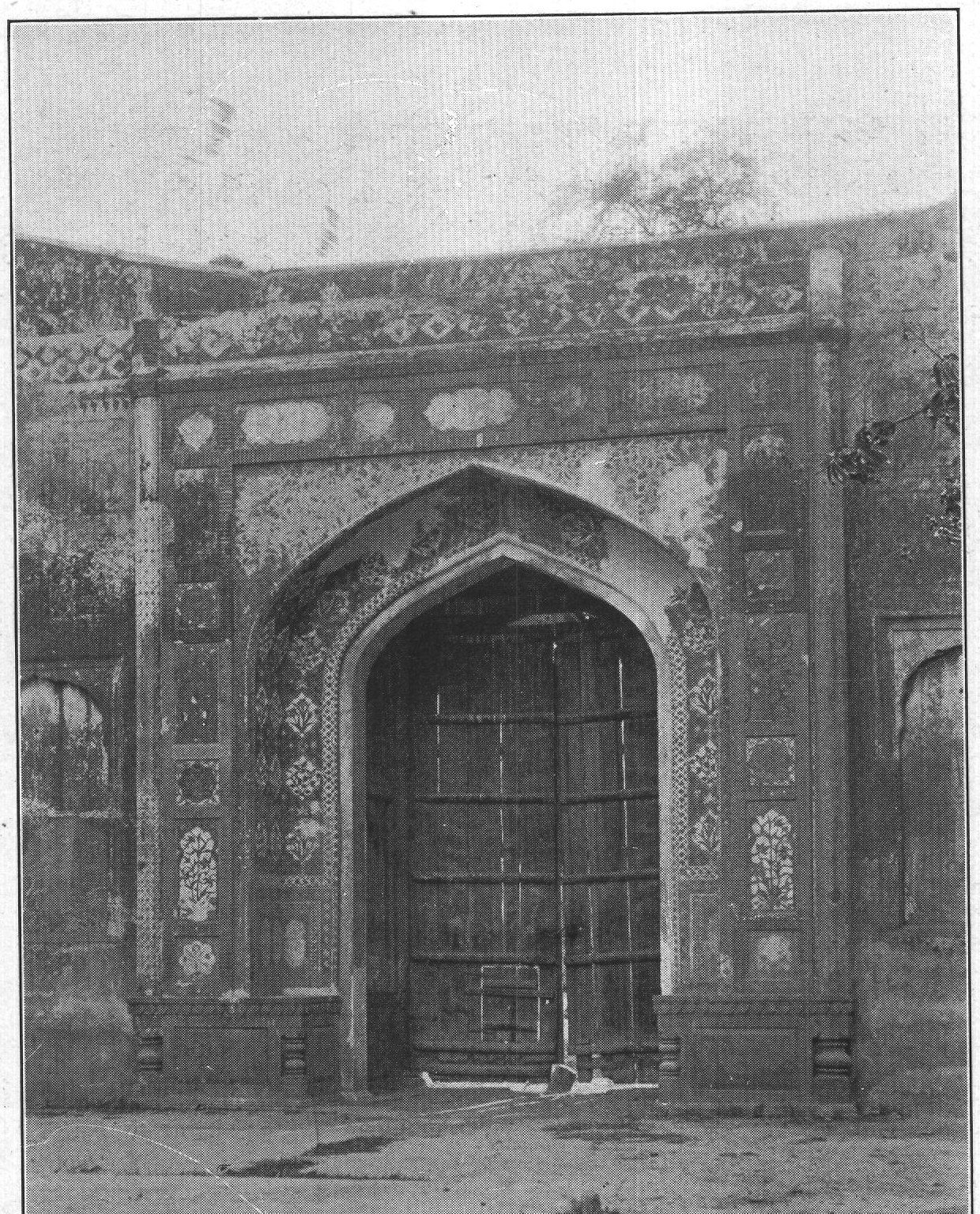
The third, and lowest, terrace of the gardens is a square of two hundred and thirty yards, or the same size as the first. It is at the present time laid out in nearly the same manner; but the gardens, though government property, have been leased out for many years for the cultivation of fruit, and the plantation has accordingly been made entirely without regard to artistic effect. The most noticeable features of this terrace are two gateways (one of which is illustrated on page 193), decorated with the beautiful enameled tiles in the Persian style, of which there are many fine examples in Lahore.
The "Badshahnamah," a history of the Mogul emperors, written by a native historian of Shah Jahan's time, gives a long but not very lucid account of the original construction and plantation of the Shahlimar Gardens at Lahore. He describes the upper terrace as a continuous flower bed, with plane trees and aspens planted at regular intervals at the sides. A pleasant suggestion is conveyed in the description he gives of an aspen, with a plane tree on either side of it, planted on the banks of the Shah Nahr, or principal water-channel, by the emperor himself when a young man. A platform was built under each tree, on which the emperor and the ladies of his zanana could recline at ease. The ground in front was covered, not with gorgeous textiles of silk and gold from the famous looms of Lahore, but with a soft carpet of clover. Evidently Shah Jahan's appreciation of the charms of nature, inherited from his great ancestor, Babar, had not been entirely lost in the luxurious pomp of the Mogul Court and his garden, even to-day, shows his unerring judgment in such artistic matters.