Illustrated with Photographs by Arthur Murray Cobb
In Italy a garden is essentially a luxury of the rich. The very expression, "Italian garden," brings before the imagination long lines of stately walks, wide terraces and statues and fountains and marble seats and stone balustrades, to which flowers add the beauty of their color, without having been in the first thought of those who planned it.
The homely cottage garden of England is not known here, nor does the petit bourgeois of an Italian town invest his savings in a patch of grass, ornament it with glass balls and rustic armchairs and proudly call it "mon jardin," as does every right-minded French shopkeeper. Neither does the Italian care for that which makes a German heart happy: a strip of ground on the high road, not too far out of town, where he can build an arbor and there, heedless of dust and noise, seen and seeing, he may enjoy his kaffe and kuchen.
The Italian is more practical. If he buys land, he wants a podere, not a garden. He wants vineyards and olive trees, maize and corn of his own. He leaves it to Nature to make things beautiful around him, and she does it well! In spring his every field becomes a flower garden, brilliant with various colored anemones and tulips, and beautiful with the softer shades of irises and monthly roses. In summer he looks out upon the tender green of the young vine leaves, the misty gray of the olives and upon, here and there perhaps, a huge oleander bush all aglow with blossom. In autumn the deep purple of the hanging grapes, the darker green of the leaves make the podere beautiful. Why, therefore, should the man of limited means trouble to have a garden when he can enjoy so much beauty in the things growing for his use? Some such reason may, I think, account for the absence of not only the poor man's but of the small business man's garden in Italy. On the other hand, nearly all the great villas have pleasure grounds that form part of their architectural design and without which it would not be complete. When looking over Zocchi's formal drawings, this becomes very apparent. He seems to show us the skeleton of the architect's design, the dry bones of every walk and of every flower bed and of every shrubbery. Time, however, has softened all that was stiff and rigid. The trees, have spread their branches, the flowers have encroached beyond the lines fixed for them, and now, as you turn from the old engraving to the real thing, it is as if the dead had come to life.
This would certainly be the feeling of anyone who, after looking at Zocchi's stately drawing of the grand Villa Palmieri, were suddenly to find himself in its beautiful gardens. Since Zocchi drew them the hot sun has burnt many a rich tone into the old walls and now it lies on terrace and statue, casting deep shadows from tree and shrub, sparkling on the water of the fountains and glowing on a wealth of flowers such as can only be seen in an Italian garden. First and foremost, roses. Roses everywhere, in the flower beds and on the walks, roses pink and white and deep red, of all kinds and of all colors blooming with a positively reckless profusion. And there are other flowers as well, and many. A clematis turns its milk white petals to the light on this wall; lilies-of-the-valley are clustering in that shady spot; the faint perfume of wistaria, nearly over, still floats on the air; above a white acacia is showering its scented blossoms on the grass below; and there are azaleas, and pinks and peonies, and yet the mass of roses is such that the impression remains of roses, and roses alone, everywhere.
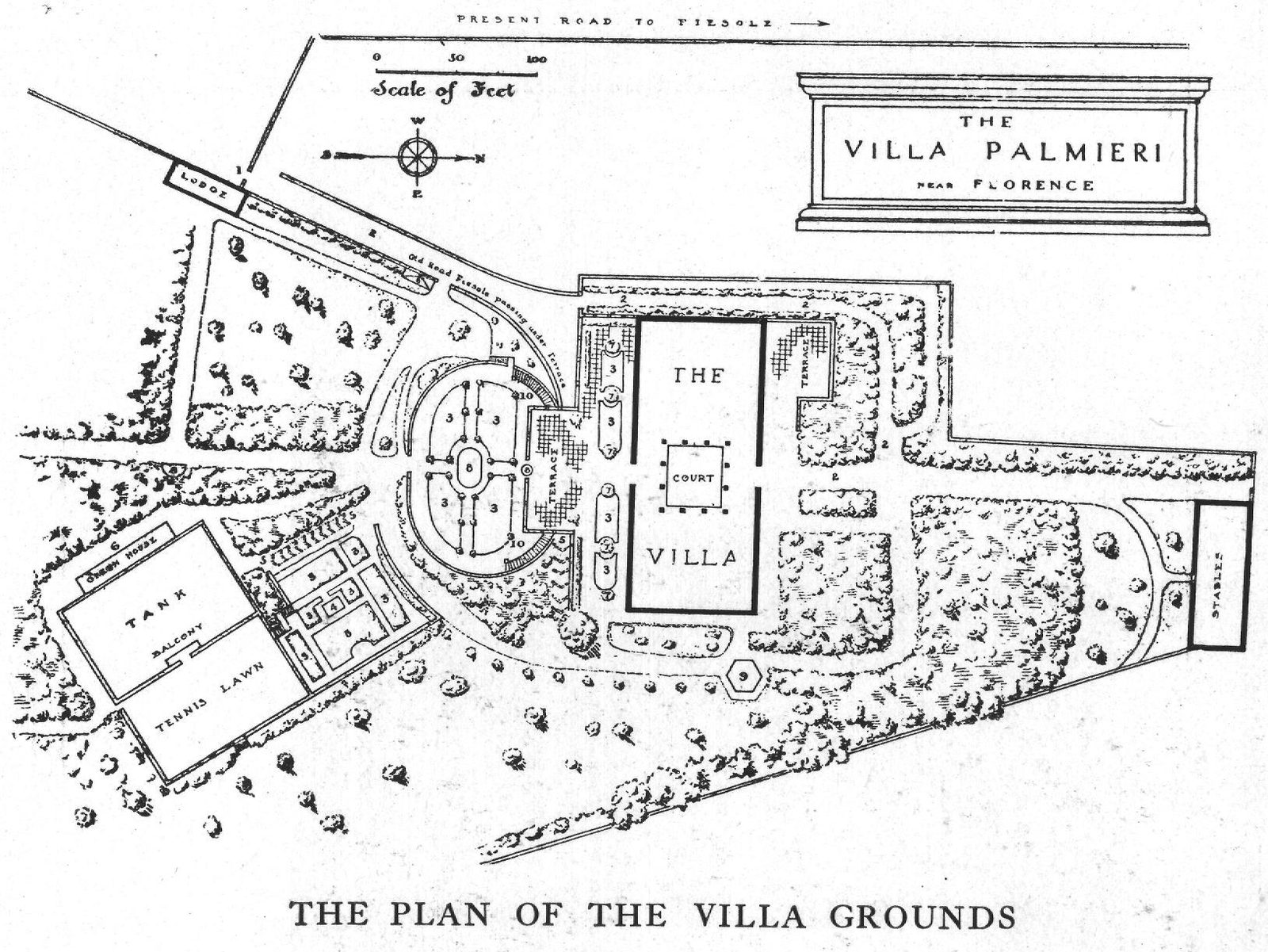
To describe the Villa Palmieri, however, we must approach it not from the gardens, but by its carriage drive which, branching off the high road about a mile from the gates of Florence, runs up a hill, with the podere to the left, the gardens to the right, the latter being screened from view by a thick hedge of clipped cypresses. You reach the cancello, or iron gates, that close in the grounds. Above, to your right, is the terrace, under which, through the old Arco dei Palmieri, once ran the old road to Fiesole. Now this is closed, the late Earl of Crawford and Balcarres having benefited the public at large and added to the privacy and quiet of his own grounds by making a new road, which, skirting his property, rises gradually until it emerges in the village of San Domenico.
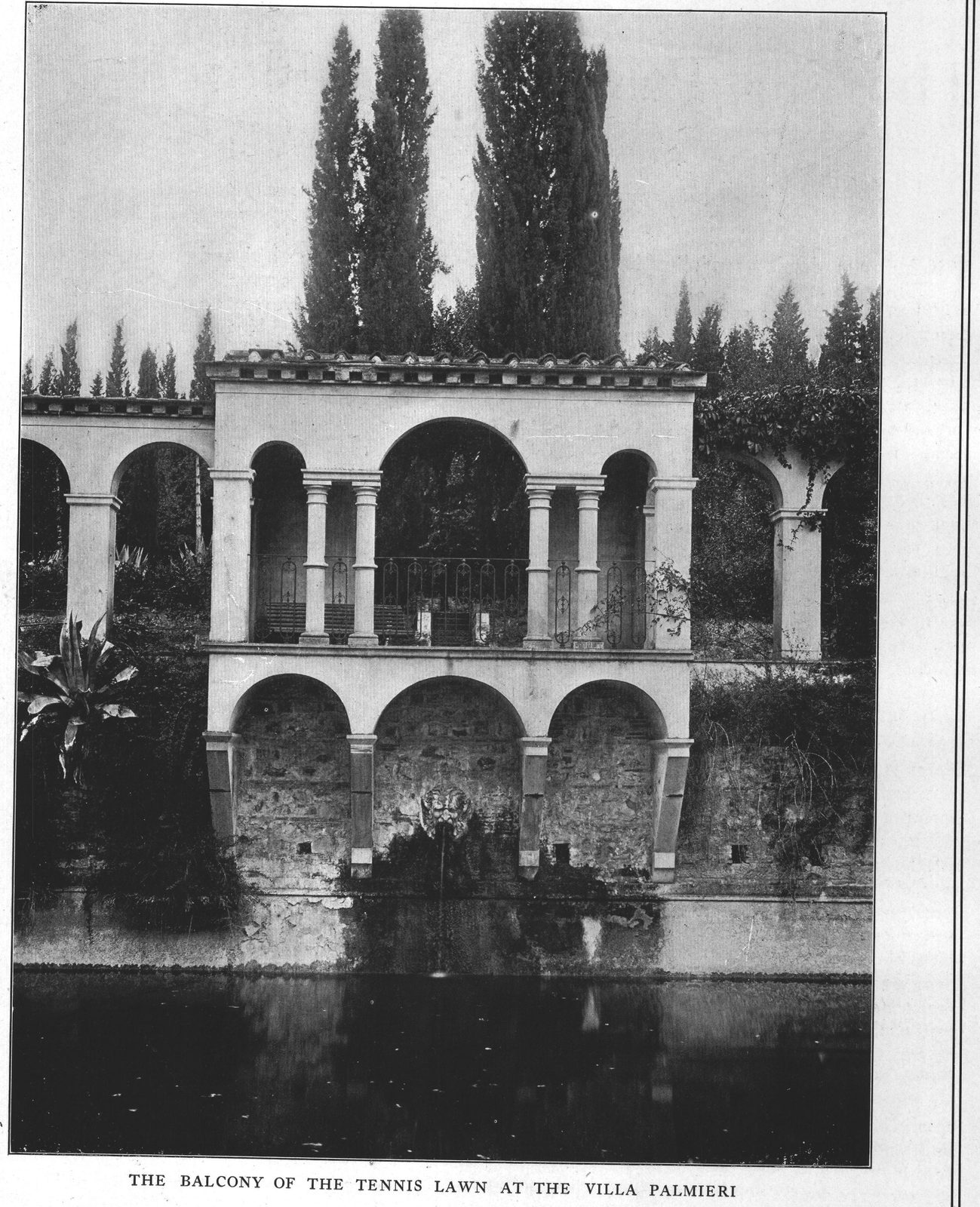
The cancello passed, the road runs upward and then curves round through a small wood, whose trees serve the double purpose of shading the drive and protecting the house from the cold winds that blow down from the higher hills beyond. The villa is entered from the north. All is in shade on this side, but the doors stand wide open, and the effect of sunlight beyond, playing on the water of the fountain in the cortile, is very charming. Your eye passes through successive light and shade to the terrace on the further side of the house, which is reached through wide doors, open too, under the loggia on the south wall of the house. This loggia runs along only one side of the cortile and is supported by four columns which, standing two and two on either side of the gates leading to the terrace, form a portico to it, the span of the arch framing a characteristic bit of seventeenth century ornament in stucco of chubby cupids struggling with heavy draperies placed on the walls beyond.
Two fine rooms running its whole length open on the east and west sides of the cortile; one the library, the other still known as the theatre room, although nothing remains to indicate its former use but the orchestra's richly decorated balcony.
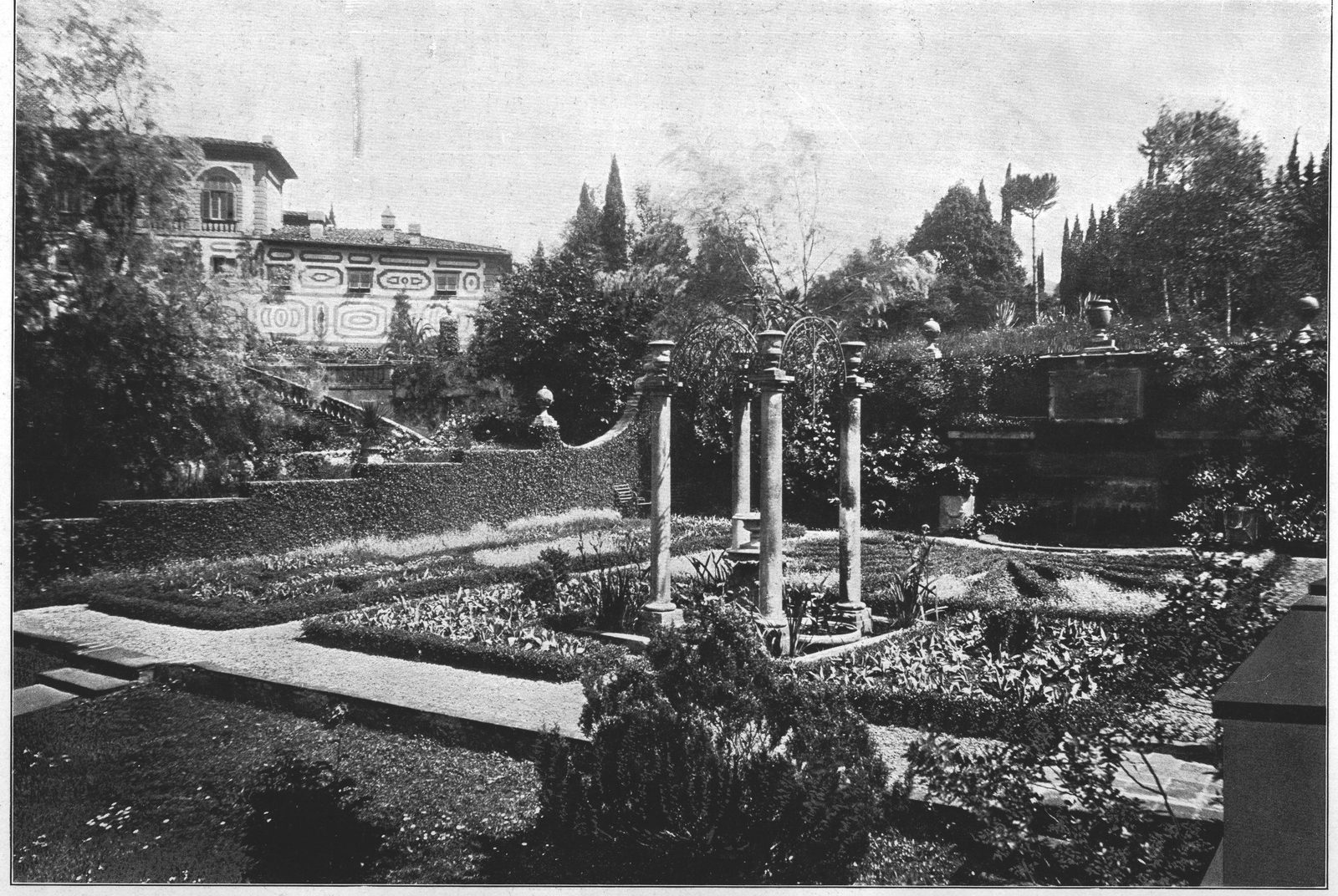
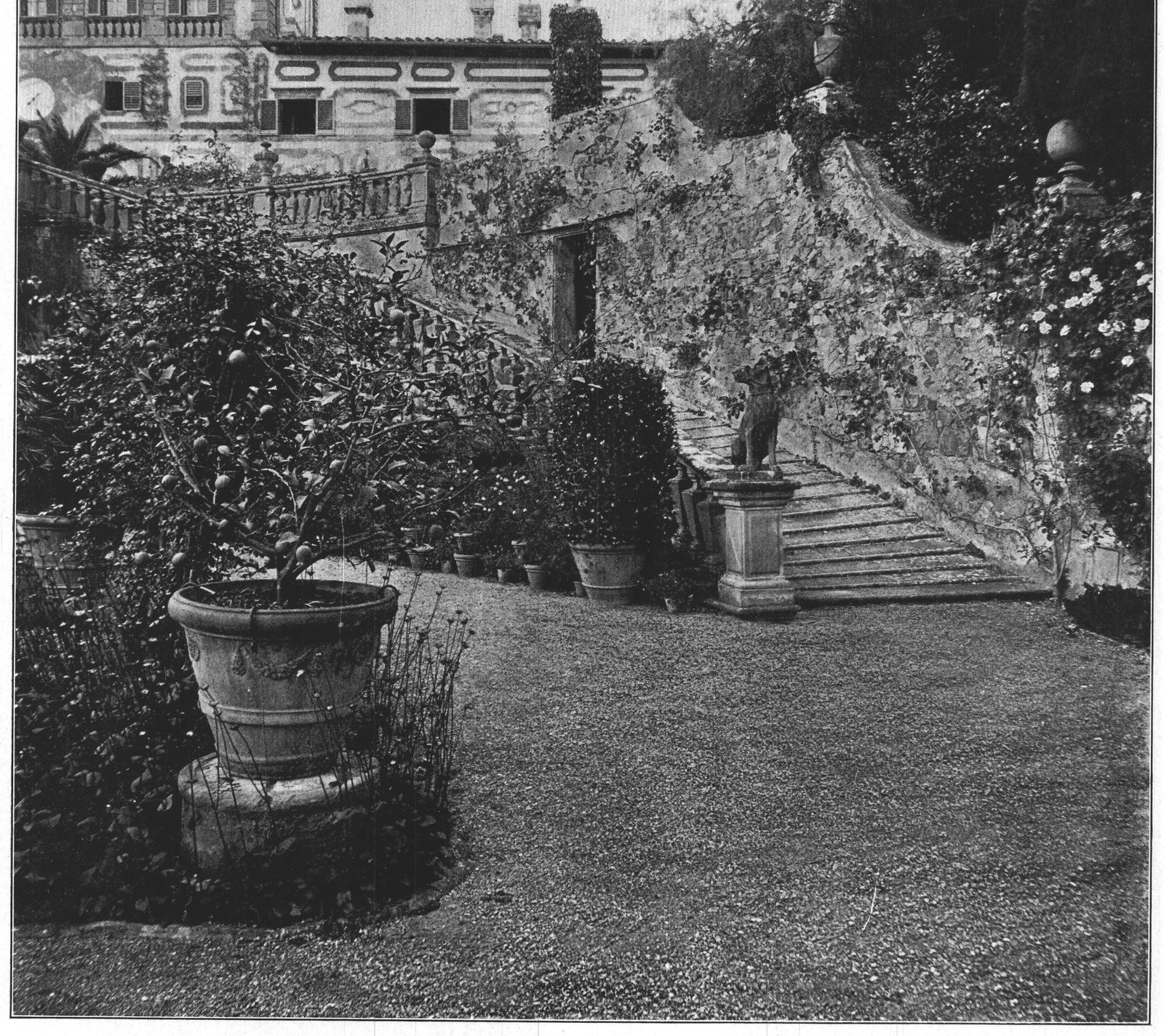
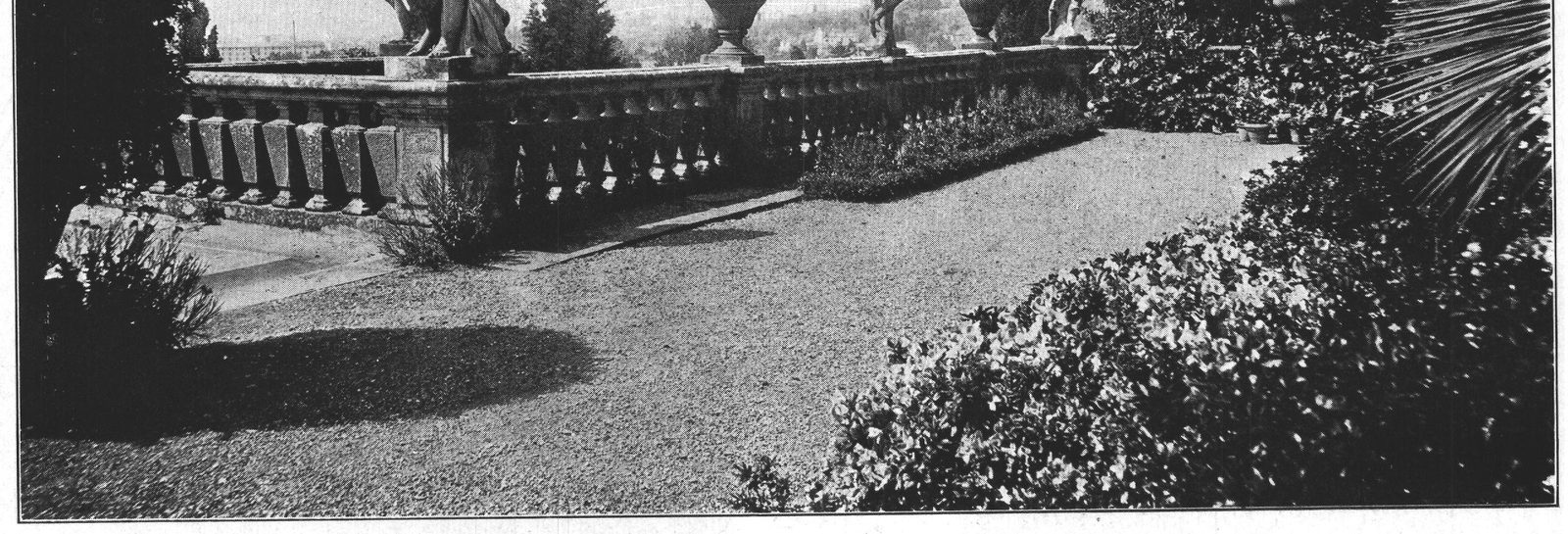
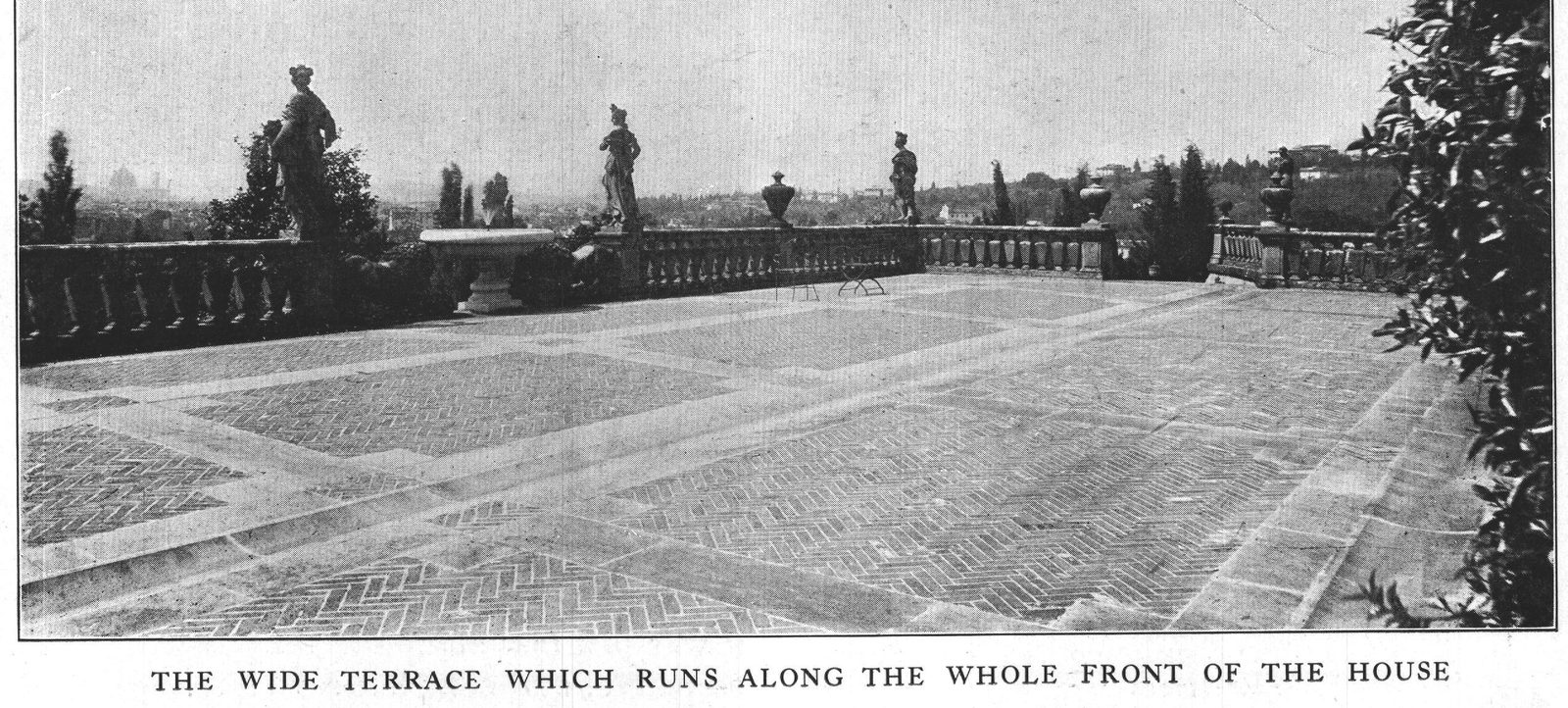
The wide terrace which runs along the whole south front of the house is sufficiently seen in the illustration to need little description. It is a garden in itself, for by the middle of April the palm trees have been freed from their winter coverings and the two long flower beds, which run along in front of the windows, are all ablaze with the bloom of Indian azaleas. On each side stone-paved "mule steps" sweep round in a fine curve from the terrace above to the garden below. A stone balustrade, massive as that round the terrace, borders it on each side. The space under the terrace is used as an orange house. The garden immediately below the terrace is small and walled in. It has been left as it was except that roses and creepers have grown over every inch of wall and blurred the lines of masonry with bloom and leaf. The beds and grass plots and gravel paths and lemon trees in plots make a formal design with the circular fountain as a center. The beds, about two feet deep, are bordered with box and themselves form a border to the grass plots. A formal pattern is made by the box border and forget-me-nots, tulips, Silene rosea and pinks fill in the design in colors blue, pink, yellow and white. Palms and flowery shrubs, such as the Weigela rosea, are dotted here and there and one or two large pots of Pittosporum Tobira scent the air. At the foot of the wall and on the side most protected from the sun a deep border of lilies-of-the-valley has been planted. Among the roses the most noticeable is the large snow-white flower of the Gloire Lyonnaise, the delicate shaded yellow of William Allen Richardson and the beautiful Reine Olga. Then there is a very small single white rose of which I did not find out the name, which had grown to a great height up the pillars of the gates. Other creepers on the wall were the sweet-scented Rhynchospermum jasminoides, not yet in bloom, Ficus repens, clematis, white and purple, and Akebia quinata.
Iron gates surmounted with the arms of the Palmieri, a palm tree between rampant lions, leads from this, the original garden of the villa, to the more modern pleasure grounds. The ground begins to rise from this point, till it reaches the level of San Domenico, the old road from Florence to that place running along the boundary of the Dowager Countess of Crawford's property to the east.
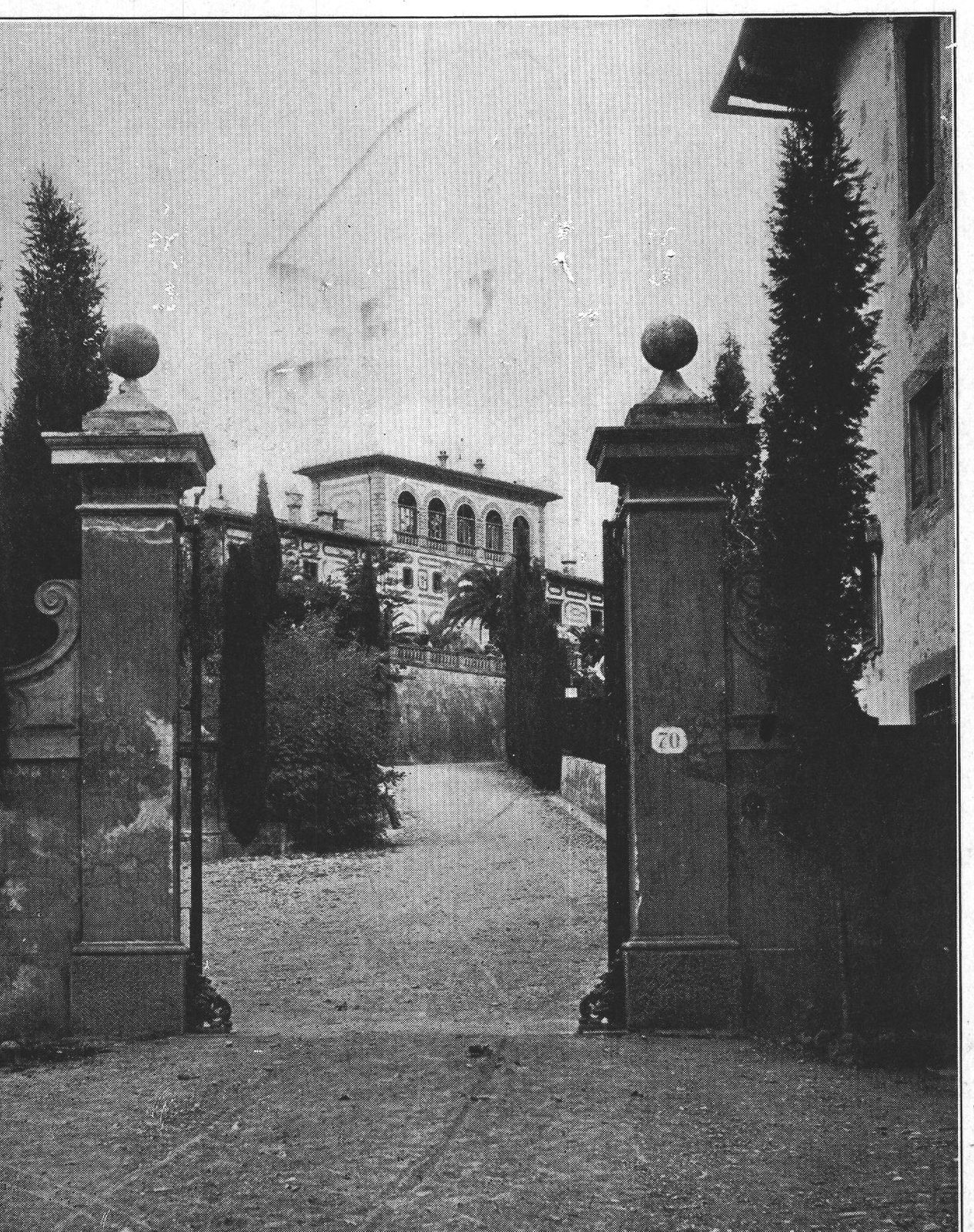
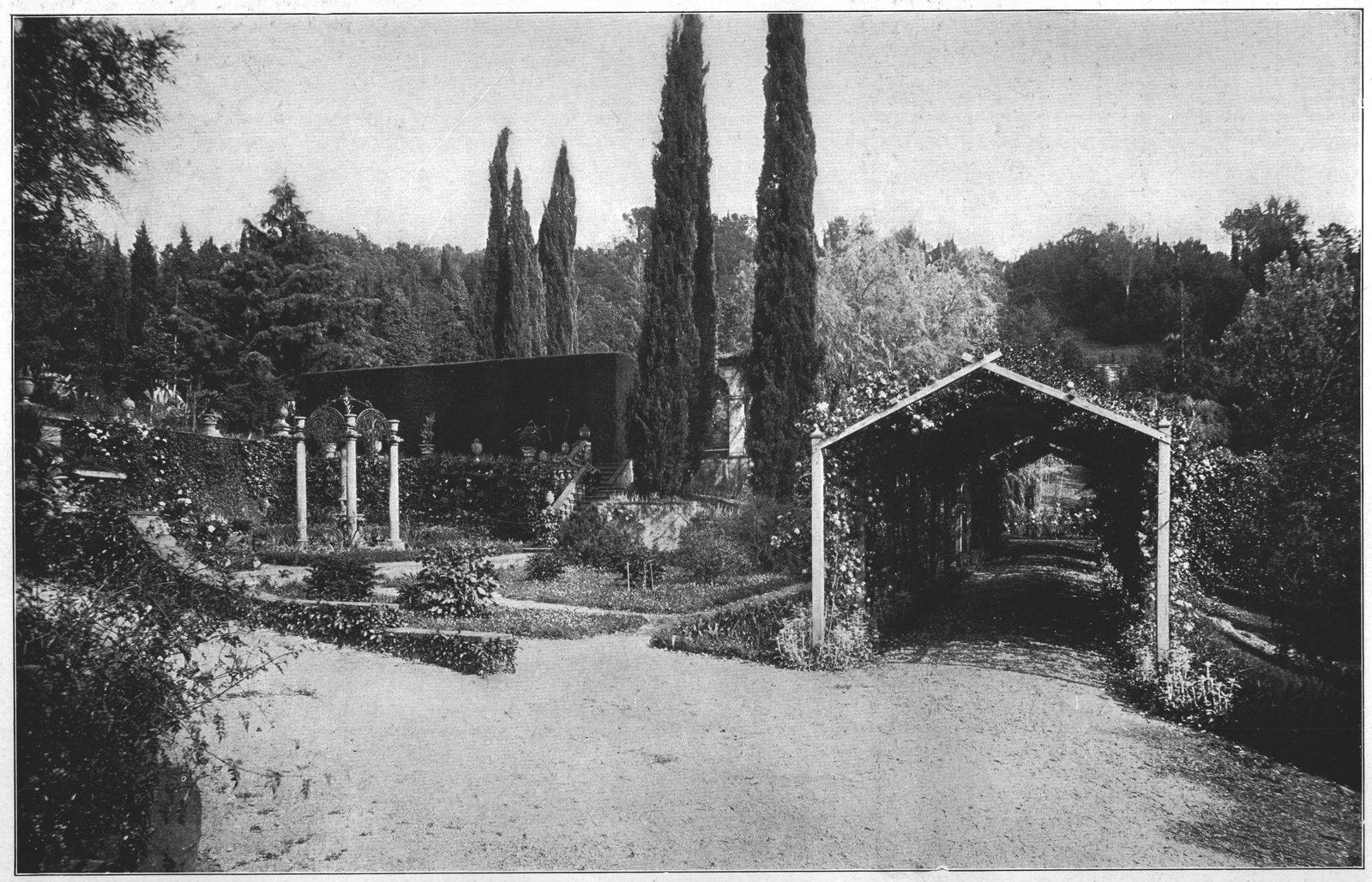
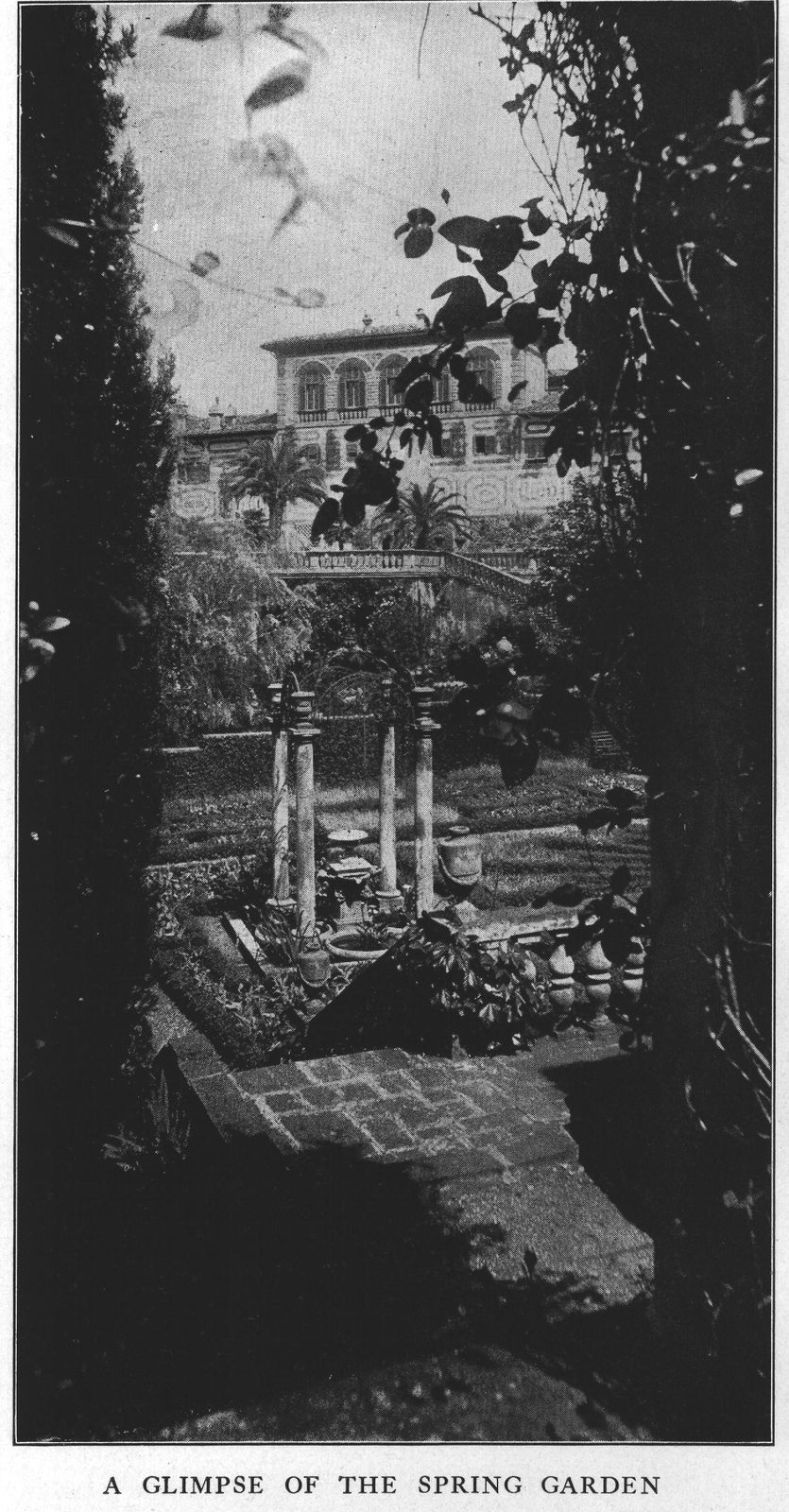
A spring garden, sheltered by thick cypress hedges, has been made on a lower terrace; a few steps higher we reach the lawn-tennis ground, also shut in on three sides by cypress hedges. To the southwest, and where the view is loveliest, a loggia of arches and columns has been built over the large rose-bordered vasca. This loggia was always a very favorite resting place of the late Queen of England when spending some of the spring months of 1888 and of 1893, at Villa Palmieri, lent to her by Lady Crawford.
The steep hill beyond the lawn-tennis ground is covered with grass, with here and there a path winding up its side, disappearing and then reappearing again among the clumps of trees and flowering shrubs which, planted some thirty years ago by the late Earl of Crawford and Balcarres, have grown apace to attain their present height in so short a time.
There is so much besides that is beautiful in the grounds. Pages might be filled with the description of this and that spot; of a pergola under which monthly roses and daffodils had bloomed in the early spring; a path characteristically Florentine, leading from the lawn-tennis ground back to the chapel between roses and irises backed by the severe leaves of the agave; the quaintly formal columns of clipped cypresses that seem to support the lower side of the walled-in garden. The flowering shrubs of all kinds, from the guelder-roses, forsythia, spiræa, beautiful in spring, to the great bushes of oleander that will glow with color in the hot sun of July. At every turn there is something to delight the eye. The illustrations give the form; imagination or memory must supply the color, the sunshine, the life and light.
The history of the villa is well known and has been given at some length by Mrs. Ross in her book on Florentine villas. In 1454 Matteo di Marco Palmieri bought it from the Tolomei. Matteo added to the house, but it was in 1670-80 that his descendant, Palmiero Palmieri made the villa what it is now and threw an arch across the old road to Fiesole, thus widening the splendid terrace in front of the house, until it connected the house with the grounds beyond, which before that, had been separated by the road. The sexagon chapel to the east of the house is of far earlier date, even the loggia which runs round it was added towards the end of the fifteenth century by Matteo Palmieri. It was for this Matteo Palmieri, remarkable both as a citizen and a man of letters, that Botticelli painted his famous picture of the "Coronation of the Virgin," now in the National Gallery in London. This picture, painted, it is said, from a design of Matteo's, was placed in the family chapel of the Palmieri in San Pietro Maggiore. There it remained during Matteo's life and for some five years longer. Until then no one had found any but words of praise for the great master's work or for his patron. Now, however, was published Matteo's poem the Città di Vita, which during his life had lain in the Medicean Library, read only by a few sympathetic friends. Now it fell into the hands of many who, envious of the dead man's great name, envious of the living painter's fame, were rejoiced to find that both poem and picture could be condemned as heretical. Matteo had written that those angels who remained neutral during the strife with Lucifer, had been punished by losing their immortality and having to enter the bodies of men. Botticelli in his great picture had given form to this heretical doctrine for there, what did he depict but the joyful reunion of angels above and their once fallen, now redeemed, brethren. Friends of both poet and painter vainly pleaded the innocent intention of both. The orthodox party was too strong. The poem was prohibited and the picture removed from its place in the chapel and taken up to the villa and built in a recess in the south wall of the library, where it remained concealed until the beginning of the nineteenth century. It was then discovered and sold. Later it passed into the possession of the then Duke of Hamilton and was bought in 1882, by the National Gallery of London.
The villa remained in the possession of the Palmieri till 1824 when Miss Mary Farhill bought it. She bequeathed it to the Grand Duchess Marie Antoinette of Tuscany who sold it in 1874 to the late Earl of Crawford and Balcarres.
Villa Palmieri is said to be one of those chosen by Boccaccio for the retreat of his youths and maidens. A very different villa it must have been in the fourteenth century, and yet, according to him, even then, "a most beautiful and magnificent palace." It has not shared the unhappy fate of so many fine villas in Italy. It has never gone through a long period of decay, or needed, at least since Matteo's time, the kind of restoration which is bound to destroy the characteristics of a building. In the eighteenth century we hear of it as the scene of the splendid hospitality of the Earl Cowper so often mentioned in Horace Walpole's correspondence.
Lord Crawford, while adding numberless beauties to the grounds, was careful to do nothing that in any way altered their character or interfered with the architectural unity of house and garden. Matteo Palmieri himself, though he might shake his shrewd Florentine head at so much hillside, basking unprofitable in the hot sun, growing nothing but fine trees and beautiful shrubs, when it might be bringing in barile upon barile of good Tuscan wine, would most surely end by agreeing that it was just that alteration that made the whole scene so perfect and complete a picture.