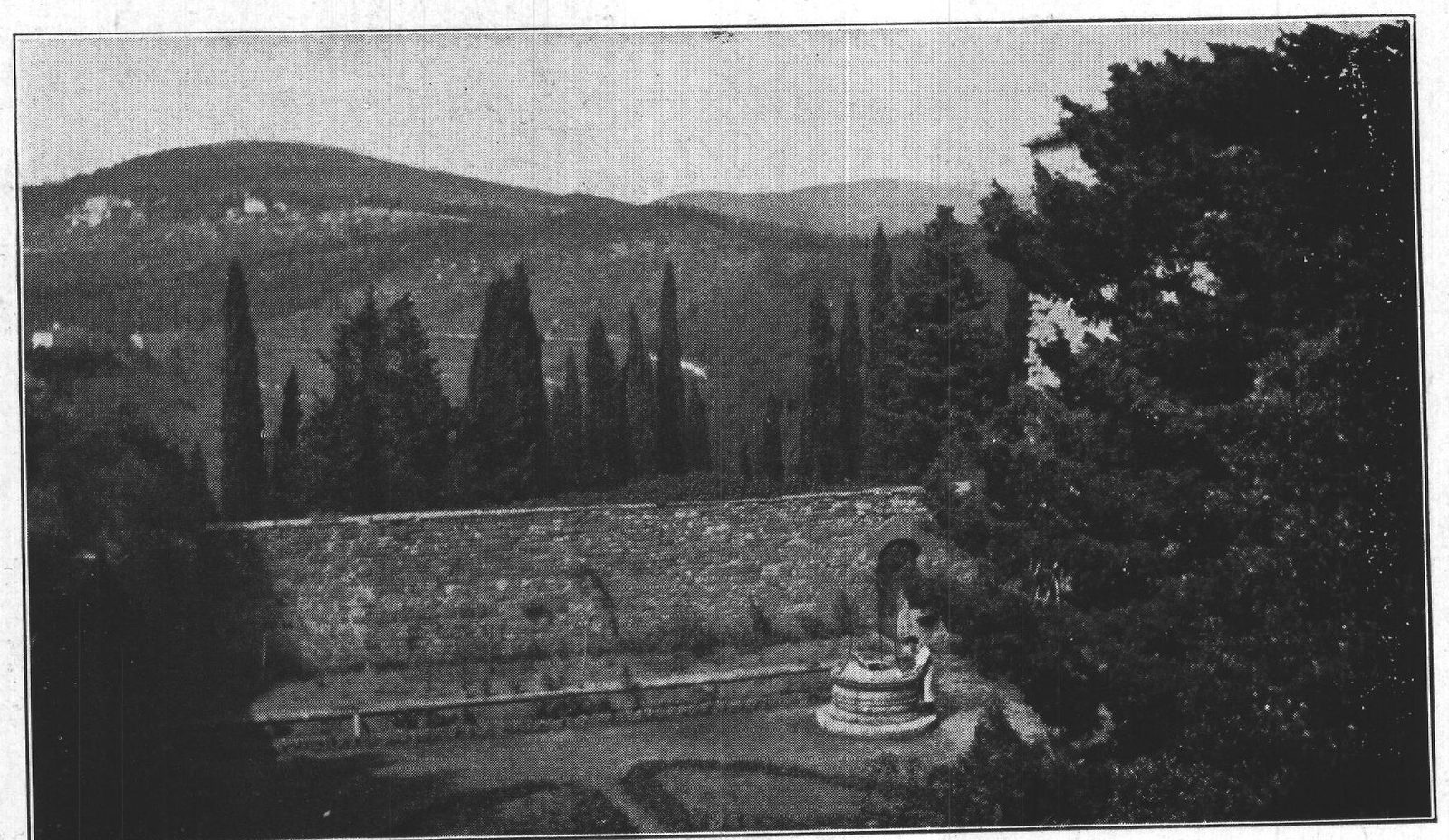
Spain can boast a wealth of gardens, especially in Andalusia, where the Moor has left the clearest and most exquisite traces of his ancient reign. The high-bred Caliphs, whose palaces and mosques shame Christian art by their airy loveliness, took a peculiar delight in gardens. Nothing was too precious for their enrichment. That fairy palace of Abd-er-Rahman III., in the environs of Cordova, possessed marvelous gardens abounding in jets of sparkling water, but these he chose to have outshone by a central fountain of quicksilver whose glitter in the sun was too dazzling for eye to bear. The Cordova palace and pleasure-grounds have vanished like a dream of the Arabian Nights, but the gardens of the Generalife in Granada, with their avenues of giant cypresses, and of the Alcázar in Seville, still whisper, when the wind blows from the south, memories of the beauty-loving Arab.
Upon the Alcázar gardens, as upon the palace, successive Catholic kings have set their stamp; but even Ferdinand, who so despised the learning and literature of the Moors as to burn, in an open square of Granada, more than one million Arabian books, all that he could collect throughout Spain, refrained from obliterating the work of the Alcázar artists.
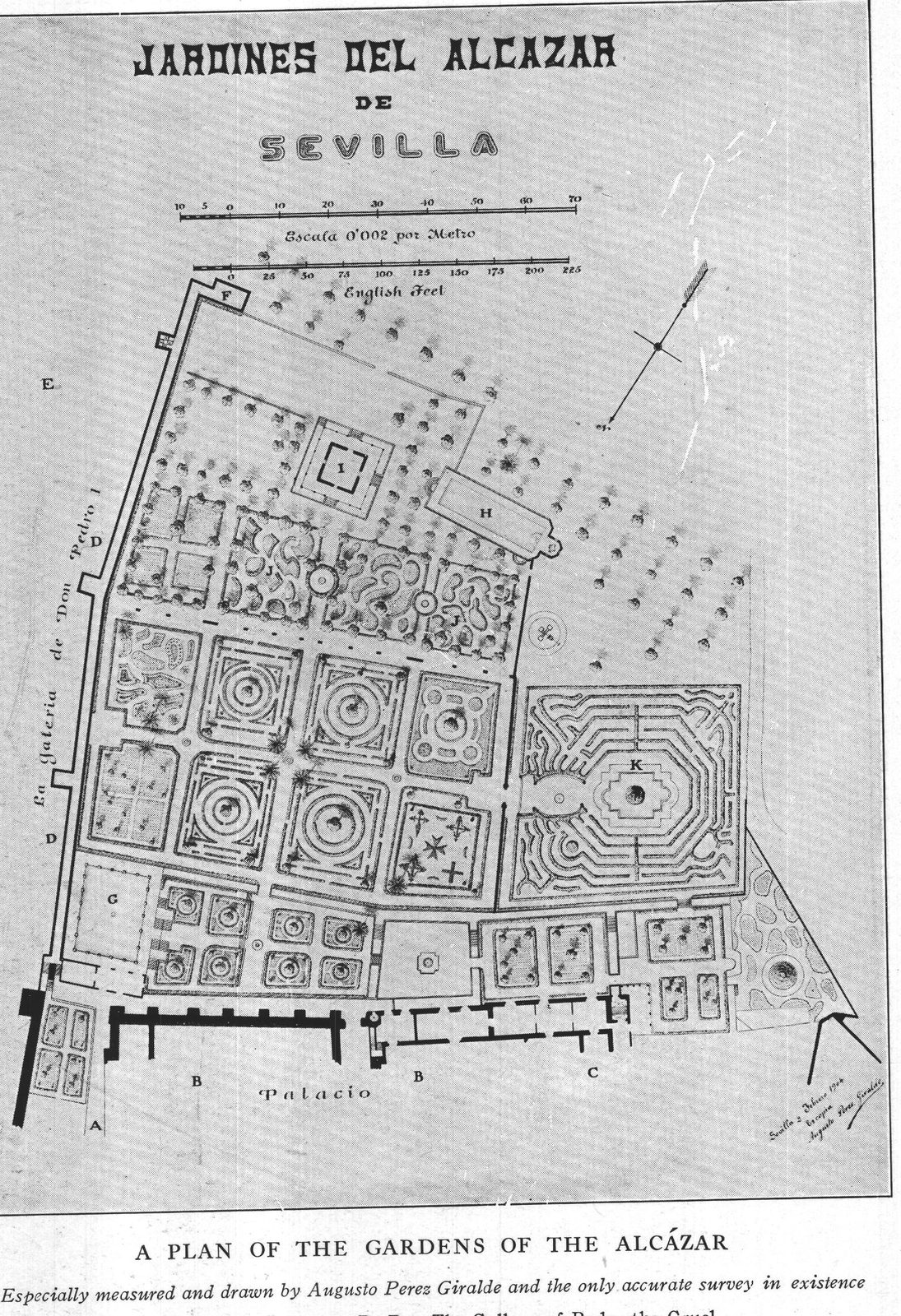
The Alcázar lies in the southeast corner of Seville. In the time of the Moors this royal residence covered a much larger area than at present, reaching to the banks of the Guadalquivir. The far-famed Torre del Oro, the Golden Tower, was one of the defenses of the outer wall—a wall of which some ruins may yet be seen. At present the gardens form an irregular triangle. To the eastward stretches away the partially open land given up to slaughter-house, barracks, cannon-foundry, railway-station and other such ugly adjuncts of the romantic city. Along the south side runs the street of San Fernando, separating the gardens from the immense tobacco factory, which covers more ground than the Cathedral and gives employment, such as it is, to five thousand women. Beyond the tobacco factory is the palace of Santelmo, with its own magnificent extent of parks and gardens, and beyond these the river. To the northwest of the Alcázar lies the city, the Cathedral conspicuous in the foreground.
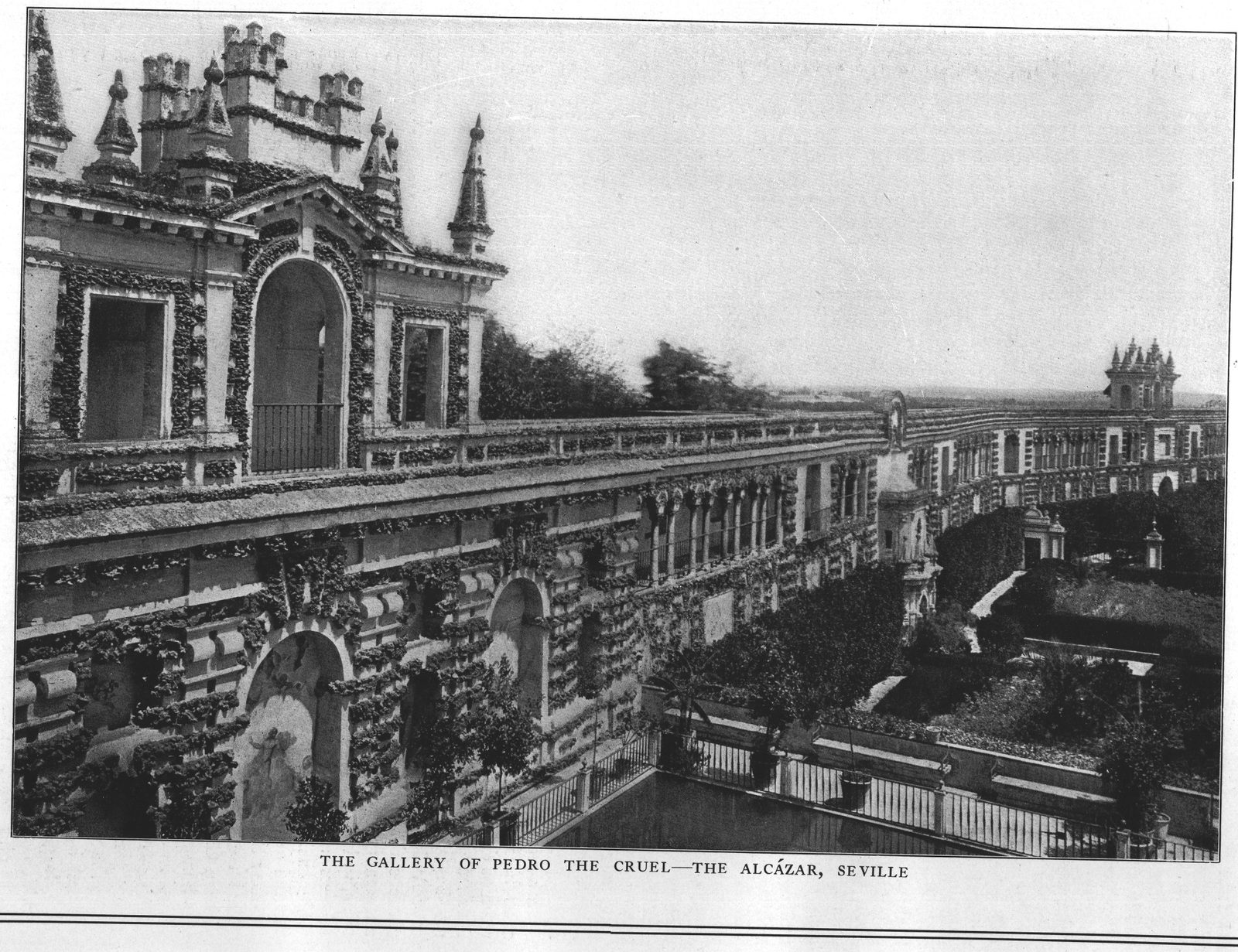
The southern façade of the Alcázar, overlooking the gardens, is shown in the illustration on the following page. Just behind soars the Giralda, the Moorish prayer-tower, dominating all Seville with irresistible beauty. The wall known as the Gallery of Pedro the Cruel forms the eastern boundary of the gardens, dividing them from the rambling old orchards also belonging to the Alcázar. This wall, exceedingly ornate, is shown again in several other illustrations. The one on page 234 is from a photograph taken from the angle where this gallery meets the Alcázar façade and looks across the gardens towards the south. The long, two-storied Fábrica de Tabácos is seen beyond the enclosure.
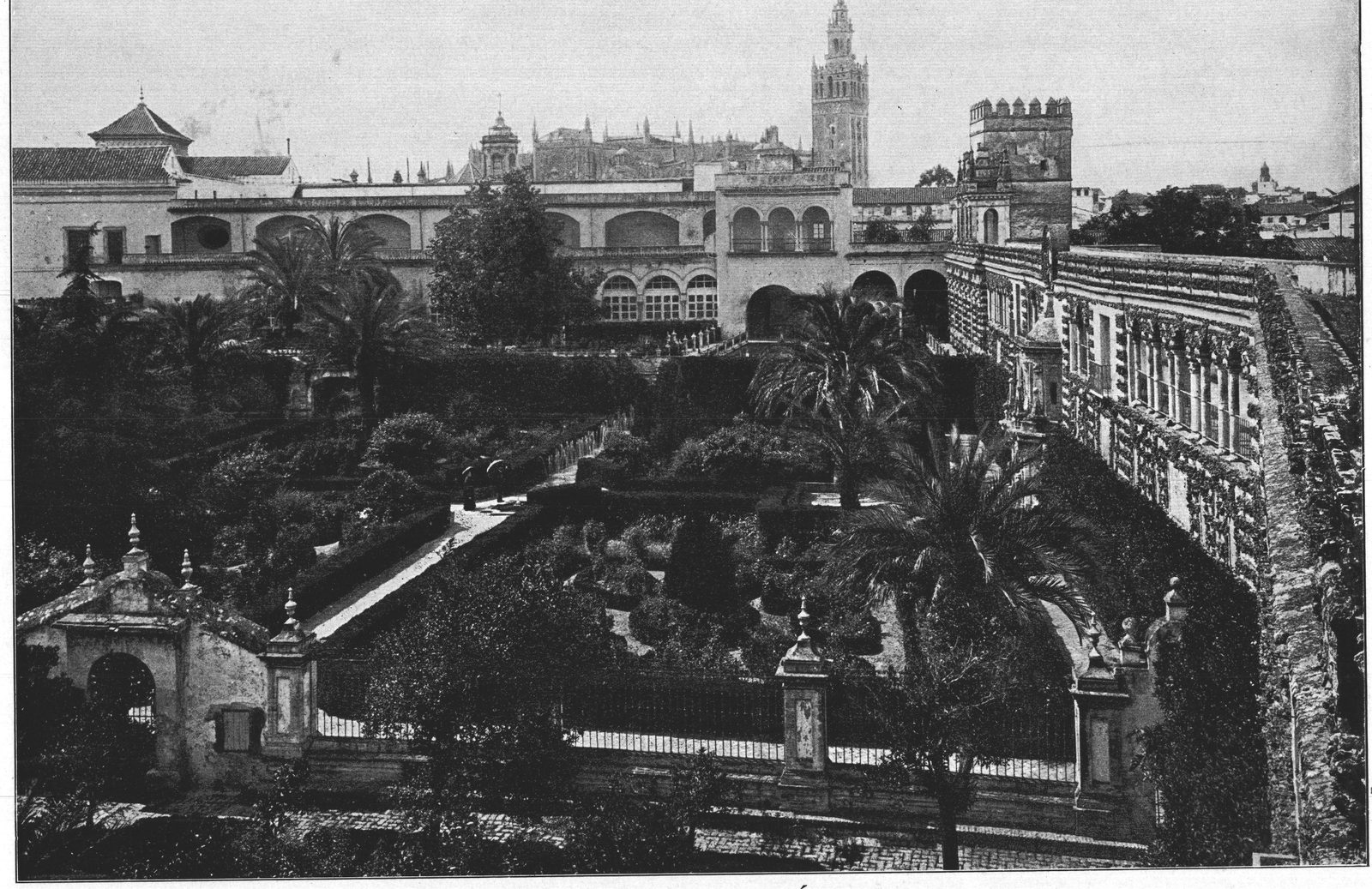
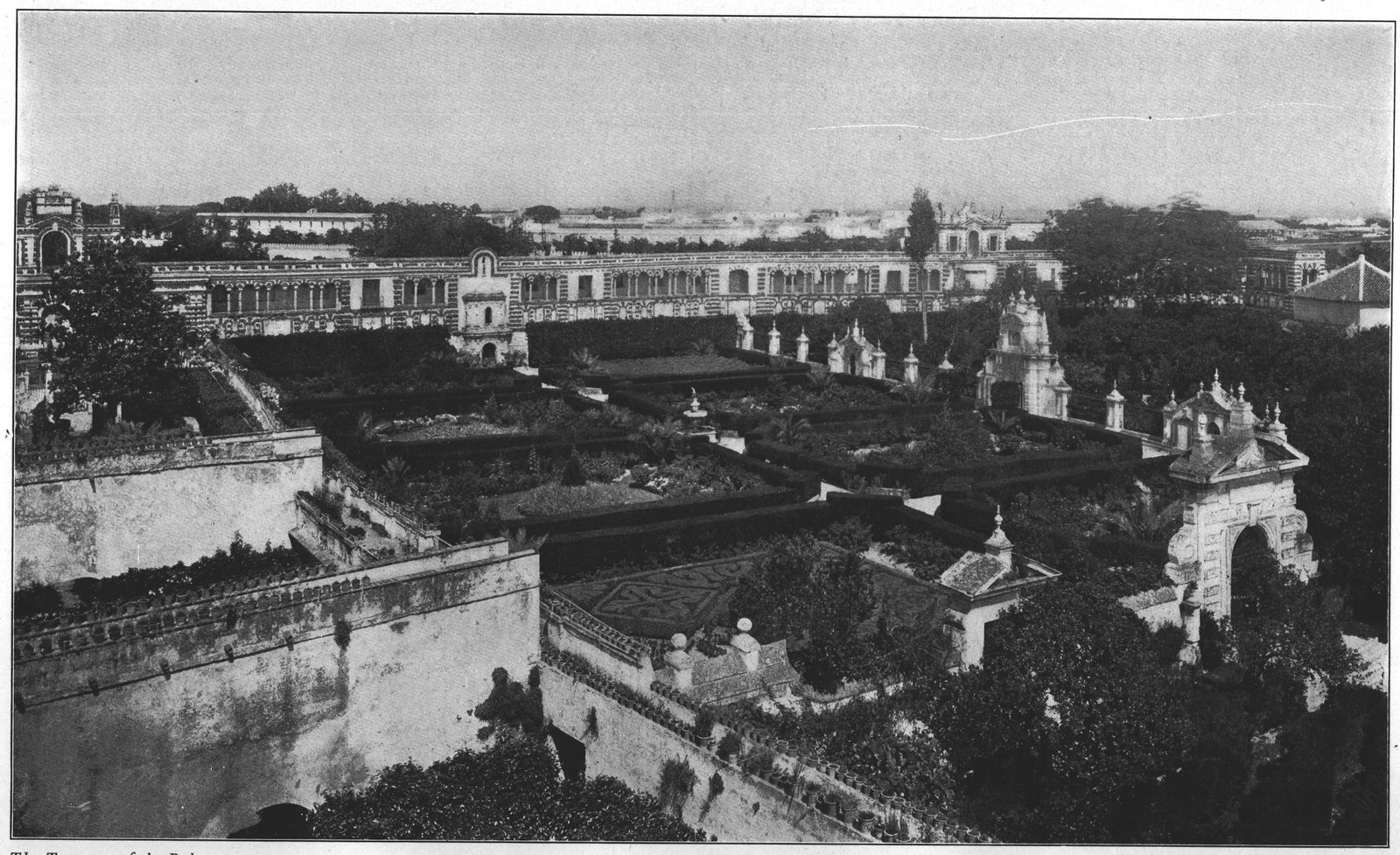
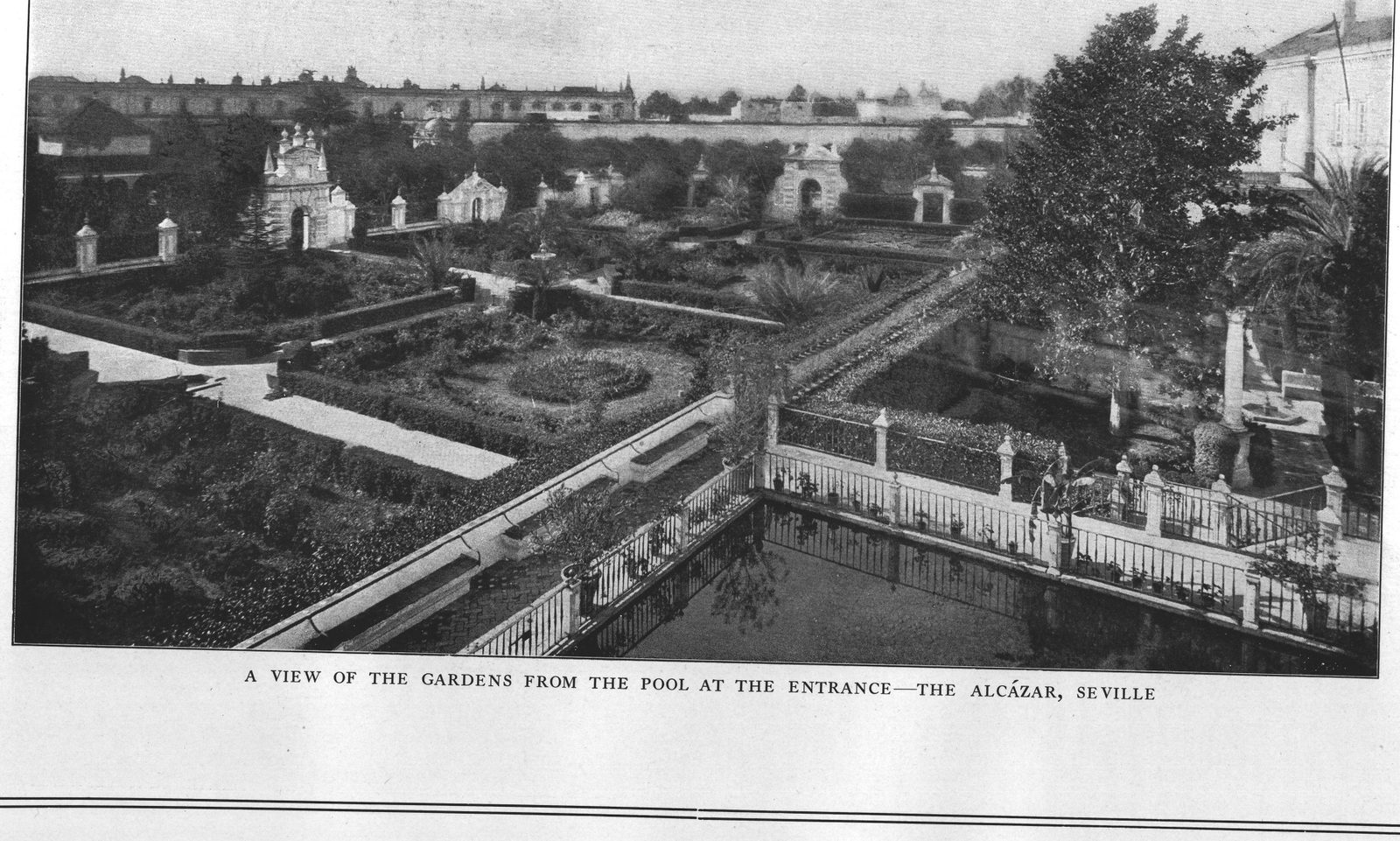
Within these boundaries, the gardens are marked off into squares, refreshed by fountains and parted from one another by walls of mixed brick and porcelain or by myrtle hedges. Walks of gay Moorish tiles, in patterns of stars, crescents and circles, bordered by box and shaded by mighty magnolias, lead to bath, grotto, labyrinth, arbor, pavilion. This checkered arrangement gives way, at the southern end, to an orange-grove interspersed with lemon-trees, whose paler fruit enhances the Hesperidean gold. The gardens, in their present aspect, were laid out by Charles V., who had the boxwood borders cut into the forms of his heraldic bearings, and the flower-plots so planted as to represent crowns, lions and eagles, but recent gardeners have not been careful to keep these features well distinguished. The flowers, especially, have been suffered to grow in such luxuriant confusion that the intricate designs of the beds are lost in a wilderness of beauty.
In thirsty Spain, the first essential of a garden is water. One of the popular Andalusian coplas runs:
Garden without water,
House without a roof,
Wife whose talk is all
Scolding and reproof,
Husband who forgets his home
In the tavern revel—
Here are four things
Ready for the Devil.
Of horticultural interest, too, is Saint Teresa's mystical parable of prayer: "A man is directed to make a garden in a bad soil overrun with sour grasses. The lord of the land roots out the weeds, sows seeds, and plants herbs and fruit trees. The gardener must then care for them and water them, that they may thrive and blossom, and that the lord may find pleasure in his garden and come to visit it. There are four ways in which the watering may be done. There is water which is drawn wearily by hand from the well. There is water drawn by the ox-wheel, more abundantly and with lighter labor. There is water brought in from the river, which will saturate the whole ground; and, last and best, there is rain from heaven. Four sorts of prayer correspond to these. The first is weary effort with small returns; the well may run dry; the gardener then must weep. The second is internal prayer and meditation upon God; the trees will then show leaves and flower-buds. The third is love of God. The virtues then become vigorous. We converse with God face to face. The flowers open and give out fragrance. The fourth kind cannot be described in words. Then there is no more toil, and the seasons no longer change; flowers are always blowing, and fruit ripens perennially."
However a Carmelite abbess might avail herself of the symbol, the fact remains that irrigation was one of the Moslem gifts to Spain. The vanished race has written its name in water all over Andalusia, and in the Alcázar gardens the name, as befits a royal autograph, is written large. Fountains, in basins of simple, pure design, lakelets and runnels make a veritable oasis to which legions of birds gather from far and near, flooding the air with song. Travelers who say that there are no birds in the Iberian peninsula have not learned to seek them in the gardens. Fernan Caballero, the pioneer novelist of Spain, who was honored for the last twenty years of her life with a residence in the Alcázar, noted how the many varieties of song-birds would turn the solemn cypresses into "green towers of Babel."
At the very entrance of the gardens, in the angle formed by the palace façade and by Pedro's Gallery, is a large cistern—shown partially on page 232—which collects the water necessary for irrigation. This pool, in which a fountain plays and water-lilies float, should still reflect the melancholy image of Philip V., who would fish here for hours together, imagining that he thus was realizing the peaceful existence of a monk. The marble Baths of Maria de Padilla, originally the Sultana's Bath, are beneath the palace, but the Bath of Joanna the Mad, the unhappy daughter of "the Catholic Kings," is pointed out in the southern part of the garden—an oblong tank wrought in colored tiles and screened only by the loyal orange-trees.
In the midst of the orange-grove and near the Bath of his mother, stands the Pavilion of Charles V., who seems to have had a genuine love for the gardens. It was in the Alcázar that he had wedded the bride of his youth, Isabella of Portugal, and at intervals throughout his stormy career he came back to Seville, widowed and world-weary, to be comforted, one likes to think, by the voices of his nightingales. His Pavilion—seen in the illustration on page 230, which also gives a partial view of his Labyrinth—is a square building, faced, within and without, with purple azulejos, except for the wooden roof. All round the outside of this ideal summer-house runs a raised mosaic bench, enclosed by a colonnade of white marble. The interior contains a table surrounded by seats. On the floor is wrought in bronze a miniature plan of the Labyrinth—a maze of the small-leaved myrtle, with a statue and a fountain in the center.
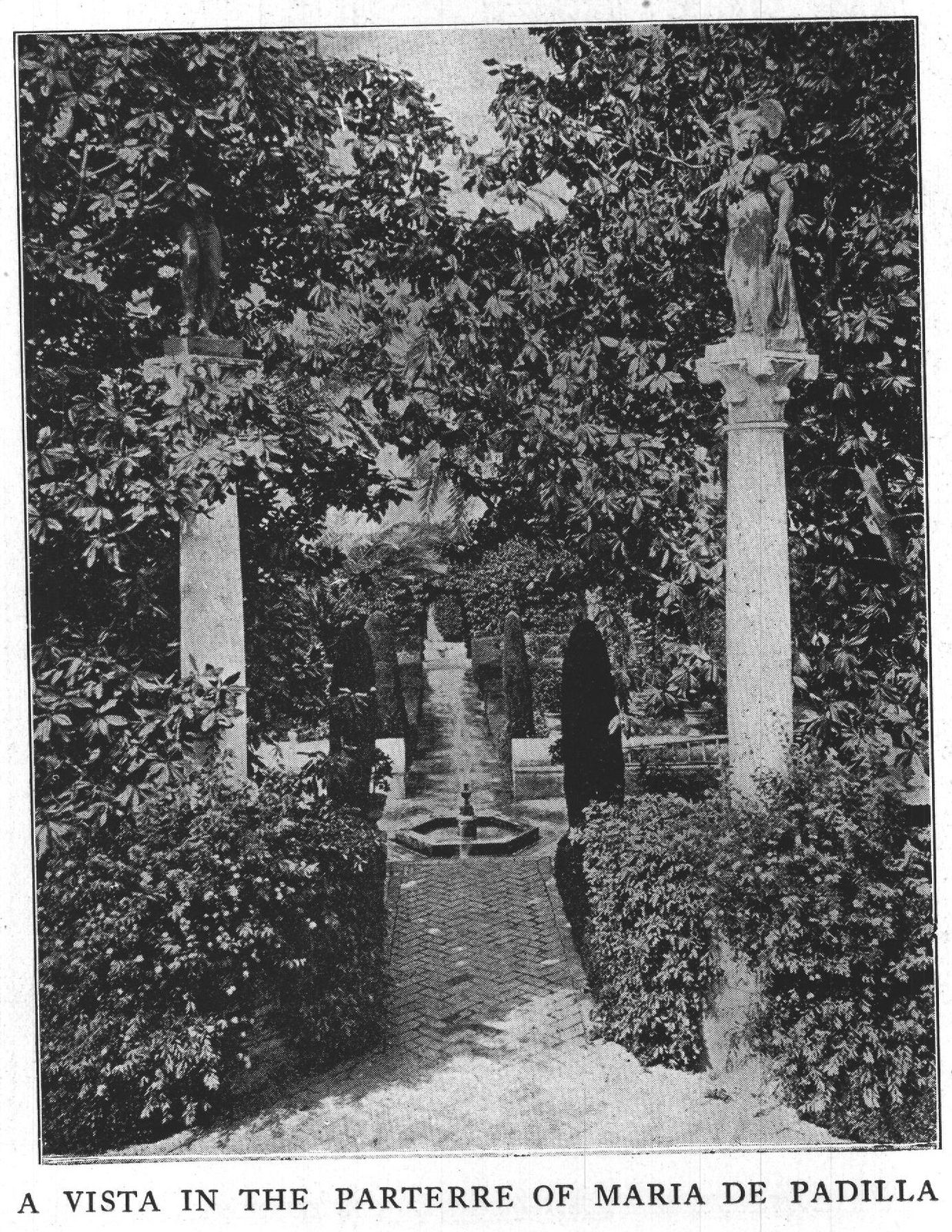
But if the garden itself is eloquent of Charles V., the arcaded wall echoes the terrible tread of Pedro the Cruel. He was the restorer, through Moorish architects summoned from Granada, of the Alcázar, which had been erected toward the close of the twelfth century on the site of a Roman prætor's palace. Pedro did his rebuilding (1353-64) a century and a half later, and although successive sovereigns tampered with his work, introducing incongruous Spanish features into the Arabian design, the Alcázar, as it stands, is Pedro's memorial. Halls and courts and gardens are replete with legends of his fantastic tyrannies and of his overweening passion for Maria de Padilla. Her apartments were at the west end of the south façade, overlooking the gardens, and her parterre was close against the palace. It may be distinguished by its pillars, not far beyond the fish pond, in the illustration on page 234, or by its towering magnolias shown below.
Pedro's own name is borne by the gallery, or covered walk, along the eastern wall. There is a terrace, as well as a lower promenade, running the length of the Alcázar façade which, as may be seen on page 229, is hollowed out into a series of alcoves. These are furnished with porcelain seats and, looking to the south as they do, must be delightful rooms in winter. When the visitor has paced the terrace to the eastern extremity of the palace front, he can turn to the south and continue his walk, on another open terrace, at the same elevation, the length of Don Pedro's wall. This upper walk is most clearly shown in the illustration on page 229. On rainy days he might prefer the lower walk, the gallery of Pedro the Cruel, which is closed on the outside, but opens toward the gardens in a series of rustic arches, formed of rugged stones such as are used for grottoes, dark brown in color. These arches are supported by fragments of antique marble columns, brought from the ruined Roman amphitheatre at Italica, five miles out of Seville. The wall itself is clad on the garden side, for a third of its height, by trained orange-trees. Behind the pavilion of Charles V., may be seen a square garden-house in which the terrace walk terminates. Here one may rest, in this bright-tiled, open-air parlor, and enjoy the far-reaching views, seeing how the Sultana of the South is clasped in the protecting arm of the Guadalquivir and looking far away over a landscape where the emerald green of the fig-trees, the bluish-green of the aloes and the ashen green of the olives are all lost, at last, in the purple of the Andalusian sky.
The garden is laid out on different levels, as is often done in Spain. The terraced Generalife thus secures continual refreshment of falling water, but in misty Galicia what is caused by such an arrangement is more of heat rather than of coolness. Señora Pardo Bazán, in one of her novels of Galician life, describes the garden of a rural proprietor as "a series of walls built one above another, like the steps of a stairway, sustaining narrow belts of earth. This disposition of the ground gave the vegetation an exuberance that was almost tropical. Camellias, peach-trees and lemon-trees grew in wild luxuriance, laden at once with leaves, fruits and blossoms."
The trees and shrubs of the Alcázar gardens are of many varieties—palm, magnolia, cypress, cedar, myrtle, orange, lemon, banana, oleander, pomegranate, medlar, citron, almond, and the leafless coral-tree, with its brilliant scarlet blossoms; but the box is most in evidence. As convent gardens prefer cypresses and palms, symbols of heavenward aspiration, so the gardens of the Spanish nobility cherish the boxwood. "The emblem among plants of aristocracy!" exclaims a high-born lady in Fernan Caballero's "Elia." "It is not found growing wild nor in the gardens of the common people. The box, whose fragrance has such distinction! It never stains the ground with fallen leaves, because the seasons find it unchangeable, as if for it there were no such thing as time. Serious plants which do not form their enormous balls without having lived for centuries in families that venerate them and on beholding them feel an impulse to question them about by-gone ancestors and entrust them with affectionate messages for great grandchildren."
In "Elia," too, is an amusing account of the indignation roused in a Sevillian dame of high degree by changes made under foreign influence in a relative's gardens: "She has taken away the rock from the fountain. As for the negro mounted on a crocodile, with a plate of pineapples in his hand, I believe that he has gone to Guinea to visit his kinsmen. The turtles, the snakes, the lizards, disposed with such art among the sea-shells, have disappeared, and no longer take comfort in the sun. The hedges of box which stood at the entrance, planted and trained so as to figure upon the soil the arms of the house,—these hedges of box which seem to have grown in honor of the family, they have been torn up without reverence or pity. There are no longer any fine and fragrant flowers; in their place have been planted the most common trees and shrubs. The paved walks have been destroyed, and winding, capricious paths, like ill-bred children, have been substituted. On rainy days it will be necessary to visit the garden in a coach, or to wear leather boots, like men."
The Alcázar gardens do not offend Sevillian prejudices by muddy paths. The porcelain-paved walks run not only along main avenues and under stately gateways, but here and there and everywhere. The tiles are kept fresh and bright by an ingenious system of hidden waterworks, called burladores, or jokers.
You would appreciate the point of the name if, as you were taking your dreamy way between borders of box, a shower should suddenly arise from the ground, instead of falling from the clouds, enveloping your astonished figure in jets of diamond spray. In the picture on page 229 may be seen, in a section of one of the walks, this graceful sport of the water,—that beautiful element which the Moors loved so well as to make of it a companion and a playmate.