Home › Introduction › Choosing the Location: New England
Choosing the Location: New England
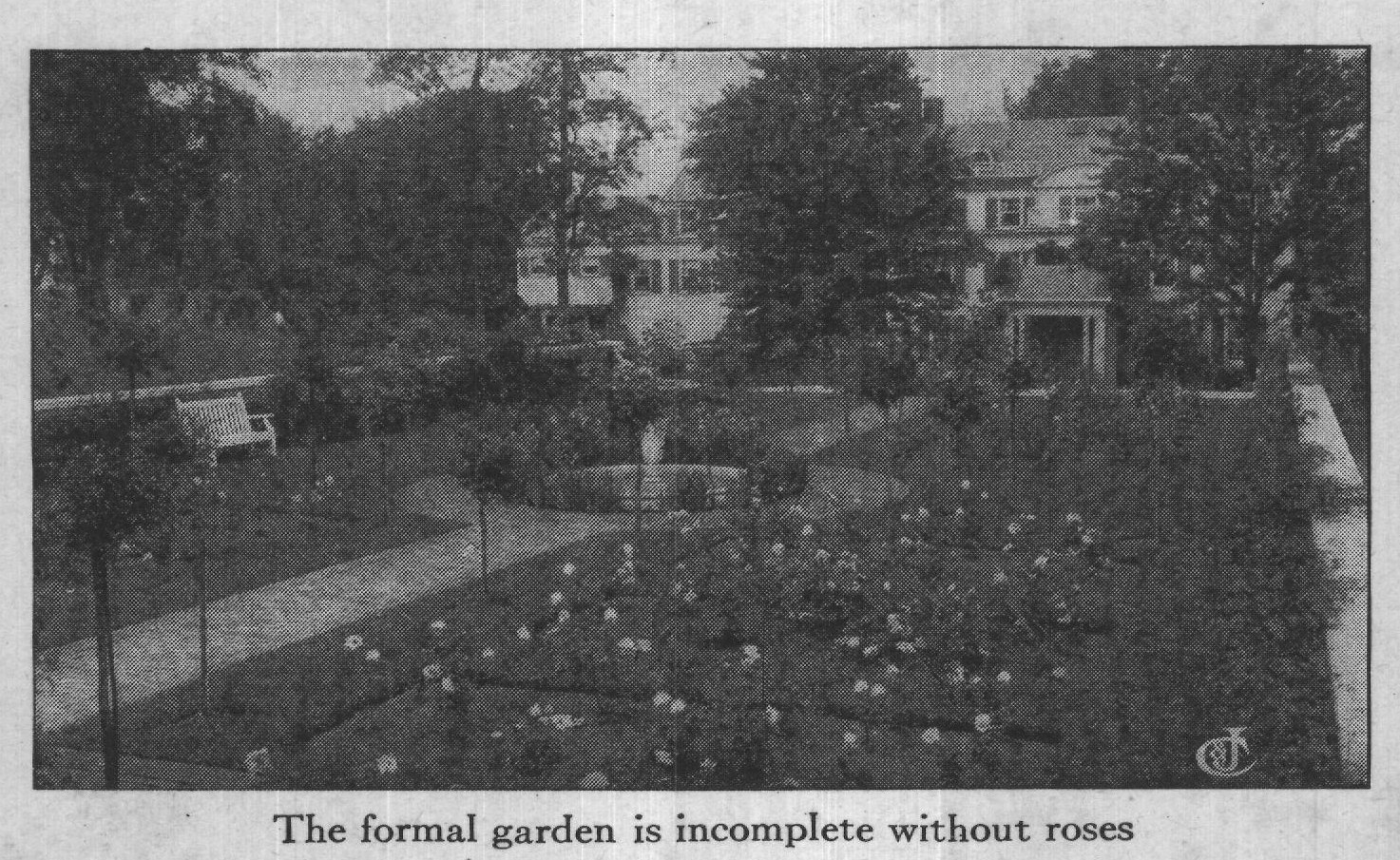
Note the avenue effect produced by the double row of Standard or Tree roses on either side of the walk, set from 4 to 10 feet apart. They remind one of the beautiful rosegardens in England. Up the wall on either side climbing roses have been started. The front bed on the left in the picture is 4½ feet square, and contains nine roses. The front bed on the right, if 4½ feet wide by 6 feet long, would contain twelve roses. The rear bed on the right of the walk is 4½ feet wide by 13 feet long, and contains twenty-four roses; and the long bed in the rear on the left, if 4½ feet wide by 20 feet long, would contain thirty-six roses.
The formal garden is incomplete without roses Preparing to Grow Roses Having chosen the location and decided upon the size and shape of your beds, you are next ready to prepare the soil. Rev. F. Page Roberts, an ex-president of the National Rose Society of England, has said: "After years of rose-growing in places far apart, I think it is not so much the soil and the climate, as the care and skill of the cultivator that wins success."
A very successful grower of roses in New York State once remarked to a meeting of his rose society: "I would rather plant a 15-cent rose in a 50-cent hole than plant a 50-cent rose in a 15-cent hole." He was wise. The author recalls visiting a successful private rose-garden in New England one day when the roses in one bed were being moved. Those roses had well-developed roots 3 feet long, because the bed in which they were growing had been prepared to that depth, and the top-growth and bloom had been luxuriantly magnificent, testifying to the value of deep and thorough soil-preparation.
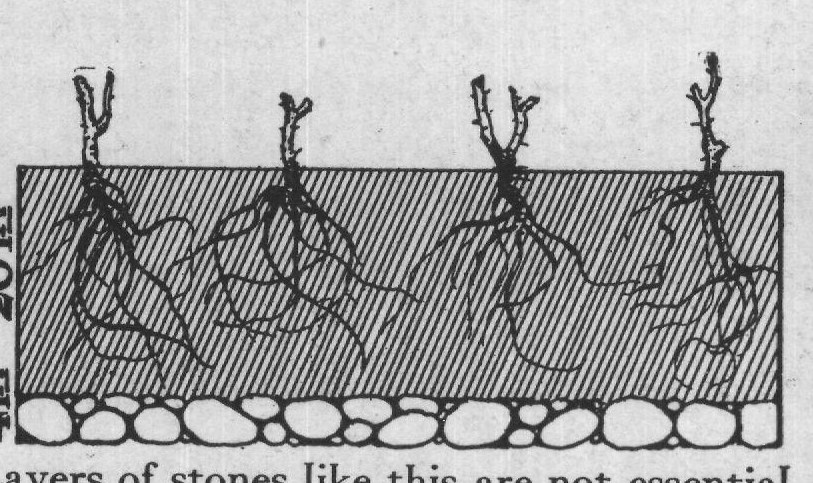
Drainage One thing, however, must be provided, if you are to court success, that is ample drainage. "Wet feet” for roses are no more conducive to health and happiness than for children. Examine your soil; if there seems a need, provide drainage, and remove the soil from your bed to the very bottom. Place there a layer from 4 to 6 inches deep of stones not larger than your fist, broken bricks, clinkers, or other suitable material that will readily "take" the water from above.
The soil is seldom so retentive as to require tiling to take the water away and, indeed, nine times out of ten no artificial drainage at all will be needed. 4IN 20 IN Layers of stones like this are not essential if the ground is naturally well drained