Home › Introduction › Choosing the Location
Choosing the Location
Where to Plant Roses Several available spaces for the rose-bed are usually to be found on the average home-grounds. The author has had the good fortune to visit a number of rose-gardens that are famous and others that deserve to be and this may be said of nearly all: that they lay on the genial, sunny side of a generous group of trees or copse, but were open to the gentler breezes, and were not shut in or shaded.
When buying a new property, the selection of the most suitable spot upon it for the house is scarcely more important than the selection of a site for your rose-garden. You will choose a sunny room, if possible, for the indoor nursery, where "the little fairies" in your home may romp and play on a wintry day; and so, too, will you wish to provide for the happiness and well-being of your rose-children, because only a few of them are prairie-born. Only a small section of this large family has been reared to bear the rigors of gusty, sweeping or whipping winds at any time of year, and from such, for the best results, they must be protected. It is not only the severe, cold winds of winter, or the raw, cutting swish of spring, but the hot, withering winds of summer, too, that may ruin the opening buds and spoil the almost ripe fruits of your labor.
Choose a place, therefore, or establish one, protected either by trees, a hedge, a wall, a building, or by some other windbreak. Even a hedge of roses, or climbers, upon a substantial trellis will avail, although a more dense screen is more effective. Choose, too, a place where the sun will shine for not less than one-half of the day, preferably the morning. By this you will see that a space opening away to the south or-southeast is to be preferred. We have noted equally successful rose-gardens entirely surrounded by hedges. Avoid the too close shade of trees, or the proximity of tree-roots; they are ravenous robbers. If the roots can possibly reach over to your rose-beds, they will do it and steal away the nourishment you have provided. Therefore, either keep entirely away from them or, if you must dig your bed IO near them, put in a partition on the tree side to keep back the roots. Boards will do for a time; a concrete wall, about 4 inches thick, will last longer.
Another point to remember is that "roses do not like wet feet." They seem to resent the ignominy of being subjected to standing in undrained ground. Avoid very low ground for this reason, and also because it is more subject to early or late frost, and has greater tendency to mildew. Try to combine in your choice as many of these conditions as possible, because, while no point is absolute, all are important. Don't stop or give up for the lack of some one of them. Be earnest about it, and you will soon provide the essentials. Mr. Chapman, the ornithologist, asked ex- President Roosevelt how he continually accomplished so much. Mr. Roosevelt answered that this had been his motto: "Do what you can, with what you have, where you are."
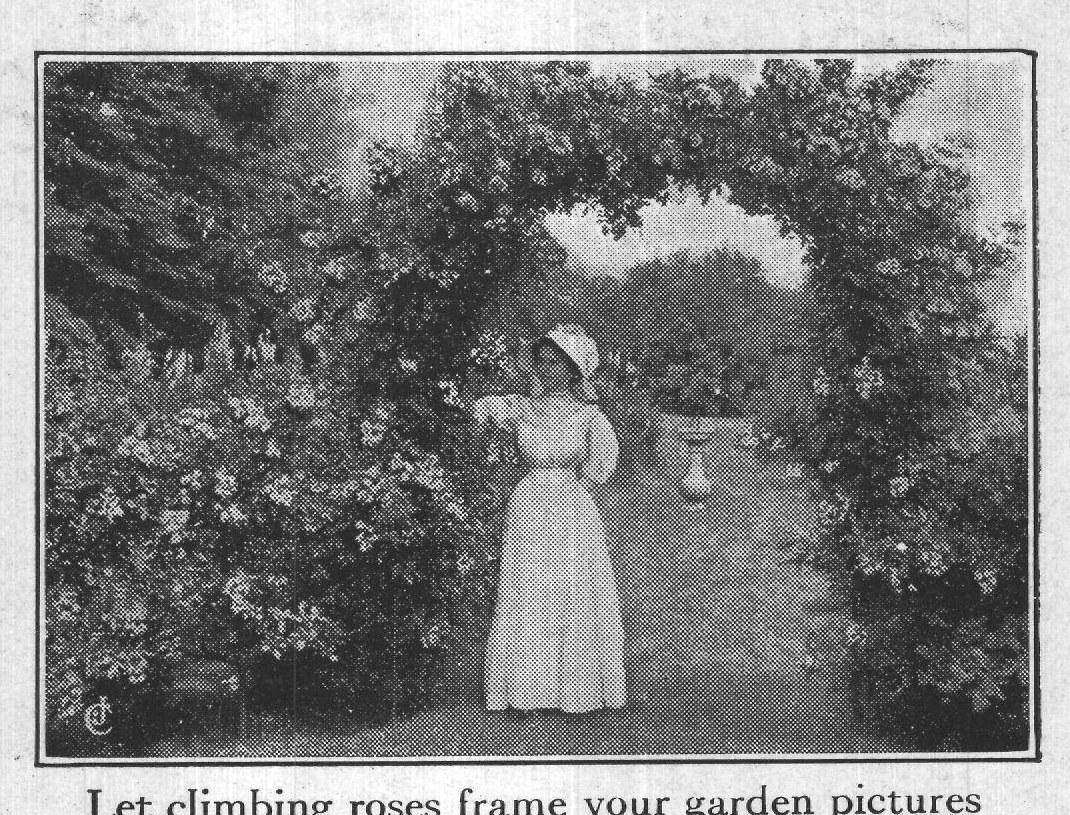
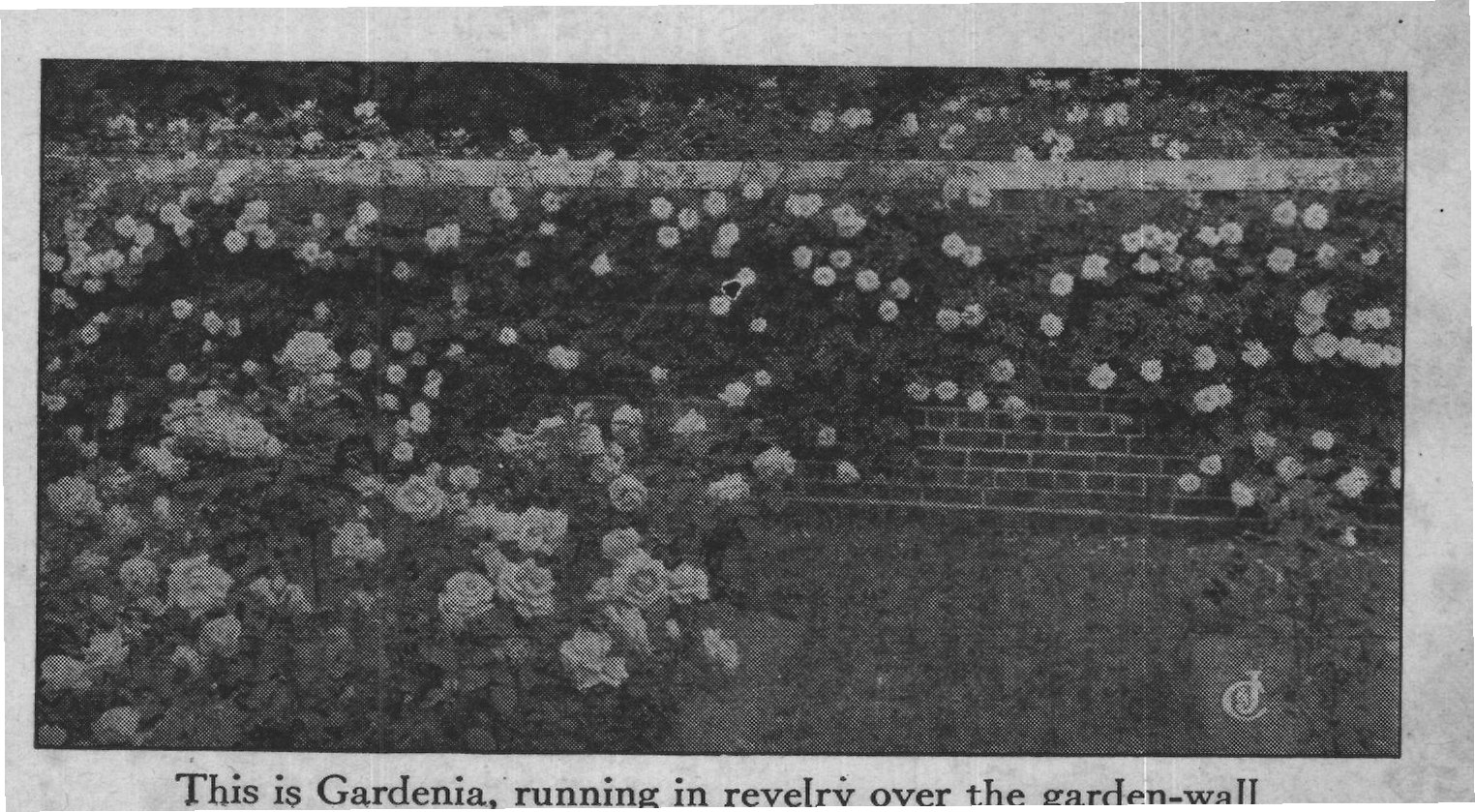
That motto will prove most useful for the rose-grower. It lacks, however, one essential, which has been expressed by no other so fittingly, in our estimation, as by Dean Hole: "He who would have beautiful roses in his garden must have beautiful roses in his heart. He must love them well and always. He must have not only the glowing admiration, This is Gardenia, running in revelry over the garden-wall MAKE A PICTURE OF YOUR LAWN II the enthusiasm and the passion, but the tenthe derness, the thoughtfulness, the reverence, the watchfulness of love." The rosarian of beloved memory understood the secret. And would that we Americans had Let climbing roses frame your garden pictures more, like him, to spread the love for beautiful roses, as well as for the wholesome pastime of planting and caring for the Queen of Flowers. "Make a picture of your lawn." This is the first principle of landscape-gardening. Leave open the center spaces and plant about and along the edges. Allow this rule to guide you, then select places for your roses where they will do best and give you the most pleasure.