Livistona
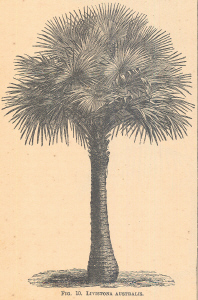
(named in honour of P. Murray, once of Livingston, near Edinburgh). SYN. Saribus. ORD. Palmae. A genus comprising fourteen species of very ornamental mostly stove palms, with unarmed stems, natives of Eastern tropical Asia, the Malayan Archipelago, New Guinea, and Eastern Australia. Flower-spikes branching, with several incomplete, leathery spathes. Leaves terminal, fan-shaped, divided into numerous segments, which are split at the apex, and frequently have threads hanging between them; footstalks sheathed at the base in a mass of netted fibres. The species thrive in a compost of two parts loam and one of peat, to which a little sand may be added. A liberal supply of water is needed throughout the summer. Several species are admirably adapted for various decorative purposes, and especially for sub-tropical gardening. Propagated by seeds, which should be sown in sandy soil, and placed in a gentle bottom heat.
L. altissima (very tall). l. bright shining green, fan-shaped, 1 1/2ft. to 2ft. from top of petiole to margin, divided into segments about one-third of the way down, each segment bifid at the apex; petiole 2ft. to 6ft. long, the upper part green, base brown, inclosed in a reddish-brown network of woody fibres, and armed on each edge with stout and sharp recurved black spines. Java, 1868.
L. australis (Southern).* l. dark green, nearly circular, much plaited, divided round the edge into narrow plicate segments; petioles stout, dark brown, inclosed in a network of fibrous matter at the base, and armed at the edges with stout spines. h. 80ft. Eastern Australia, 1824. SYN. Corypha australis. (B. M. 6274.) L. chinensis (Chinese).* l. large, over 5ft. broad, fan-shaped, with pendent marginal segments; petioles 4ft. to 5ft. long, rounded below, flat above; edges armed with short reflex spines, enveloped at the base in a network of brown fibrous tissue. h. 50ft. South China, 1818. A well-known and very handsome species, proving quite hardy in Cornwall, and nearly so in many less Southern districts. SYNS. L. mauritiana and Latania borbonica.
L. Hoogendorpii (Hoogendorp's). l. rich dark green, forming a complete circle, much plaited, deeply divided; petioles stout, blackish-brown, inclosed in a network of reddish-brown fibres, and armed at the edges with long, stout, and sharp spines. Indian Archipelago, 1874.
L. humilis (humble).* l. dark green, large, orbicular-cordate, spreading, deeply divided into narrow plicate segments, tapering to a fine point; petioles clothed at their edges with close-set spines. h. 6ft. to 30ft. Tropical Australia, 1824. A handsome species for decorative purposes, when young.
L. inermis (unarmed). A little-known plant, differing from L. humilis principally in having the petioles entirely without prickles. North Australia.
L. Jenkinsiana (Jenkins').* l. rich dark green, fan-shaped, 2ft. to 4ft. across, plaited; margin divided into somewhat broad segments; petioles from 2ft. to 10ft. in length, somewhat keeled below, flat above, armed at the edges with very stout, sharp spines, which are slightly recurved. h. 10ft. Assam and Sikkim, 1845. A beautiful greenhouse plant.
L. mauritiana (Mauritian). A synonym of L. chinensis.
L. olivaeformis (Olive-formed). l. dark green, rather reniform than flabellate, 2ft. to 3ft. from top of petiole to the margin, divided into pendulous segments for about one-third of the length; petioles 2ft. to 4ft. long, stout, brown at the base, inclosed in a tissue of dark brown netted fibres, armed with a few small reddish spines. Java. L. rotundifolia (round-leaved). l. dark green, with a sub-orbicular blade 3ft. to 5ft. in diameter, palmato-multifid, the elongate segments with bifid tips; petioles 6ft. to 7ft. long, margined with sharp spiny teeth. Stem 40ft. to 50ft. high. Malay Islands, &c. Pretty, in a young state, for stove decoration.