Chamaedorea
(from chamai, dwarf, and dorea, a gift; referring to the fruits of this Palm being easily reached). SYNS. Nunnezia, Nunnezharia. ORD. Palmae. A rather large genus of stove Palms, very extensively grown, and universally admired. Flowers dioecious, appearing below the crown of the leaves. Fruit a berry, generally a little larger than a pea, with a fine polish, and of a bright colour. Leaves usually pinnatisect, but in a few species entire. Trunk ringed, polished, scarcely thicker than a man's finger. Plant unarmed. The species are invariably found growing under the shade of tall forest-trees, and never in exposed situations. Essentials, therefore, to their successful culture in our stoves are shade and moisture. They succeed best in a compost of two parts spongy peat, one part loam, and one of sand; the whole well mixed together.
C. Arenbergiana (Arenberg's).* l. pinnate, 2ft. to 3ft. long; pinnae 12in. long and 4in. broad, pendent, tapering to a tail-like point, bright green. Stem slender. Guatemala. SYNS. C. latifrons and C. latifolia.
C. atrovirens (dark green). A synonym of C. Martiana.
C. brevifrons (short-fronded). l. pinnate, arching, 12in. to 18in. in length; pinnae sessile, 1in. to 2in. broad, tapering to a point, dark green. Stem slender. New Grenada. Very distinct.
C. desmoncoides (Desmoncus-like).* l. pinnate, 2ft. to 3ft. long; pinnae 12in. long, 1in. to 1 1/2in. broad, pendent, dark green. Stem slender and, as well as the petioles, glaucous. Mexico, 1846. An elegant species, which assumes a climbing habit after reaching a height of about 6ft. SYN. C. scandens.
C. eburnea (ivory). l. pinnate, broad, very bright green, which contrasts well with the ivory-white midrib which runs through the blade, and is apparent on both surfaces. Stems and petioles perfectly smooth and somewhat glaucous. Columbia, 1876.
C. elatior (taller). l. bright green, pinnate, with broad leaflets. South Mexico. This is perhaps the tallest-growing of all the Chamaedoreas. It is suitable for growing up the pillars, and training along under the roof, of a large stove.
C. elegans (elegant).* l. pinnate, 2ft. to 4ft. long, gracefully pendent; pinnae 6in. to 9in. long, 1in. broad in the centre, tapering towards each end, bright dark green; petioles somewhat carinate, sheathing at the base. Stem stout. h. 4ft. Mexico. SYNS. C. Helleriana and Kunthia Deppeana. (G. C. 1873, 508.)
C. Ernesti - Augusti (Ernest Augustus').* fl. spikes bright orange-scarlet, and extermely ornamental while they last. l. rich dark green, simple, 2ft. long, 1ft. broad, deeply bifid at the apex. New Grenada. SYN. C. simplicifrons. (B. M. 4831, 4837.)
C. formosa (beautiful).* l. pinnate; pinnae very numerous, alternate, linear-lanceolate, 18in. long, and about 3in. wide, elongated to a thread-like point; petiole smooth, with two channels on the face. Tolima, South America, 1876. (G. C. 1876, 724.)
C. fragrans (fragrant). fl. spikes in long drooping panicles. l. bright green, pinnate, gracefully recurved; pinnae numerous, narrow, acuminate. Mexico, 1850. SYN. Morenia fragrans. (B. M. 5492.)
C. geonomiformis (Geonoma-formed).* l. entire, bifid at the apex, 6in. to 12in. in length, 4in. to 5in. in breadth, dark green. Stem slender. h. 4ft. Guatemala, 1856. A very beautiful dwarf-growing species, SYN. Nunnezharia geonomiformis. (B. M. 6088.)
C. glauoifolia (glaucous-leaved).* l. long, pinnate; pinnae narrow, long, and slender, dark green, suffused with a glaucous hue. Guatemala. h. 20ft. An elegant slender-growing species, and one of the best for decorative purposes. C. graminifolia (Grass-leaved).* l. pinnate, 2ft. to 4ft. long, rich dark glaucous green, gracefully arched; pinnae upwards of 1ft. long, about 1/2in. broad. Stem reed-like. Costa Rica. This is described as probably the most graceful species of the genus, the whole plant having the appearance of a plume of feathers.
C. Helleriana (Heller's). A synonym of C. elegans.
C. latifolia (broad-leaved). A synonym of C. Arenbergiana.
C. latifrons (broad-fronded). A synonym of C. Arenbergiana.
C. Lindeniana (Linden's). l. pinnate, spreading; pinnae broadly oblong, or oblong-lanceolate, falcate, long acuminate; primary and secondary nerves eleven to thirteen. Mexico.
C. lunata (crescent-shaped). A synonym of C. oblongata.
C. macrospadix (large-spadix). l. pinnate, upwards of 4ft. long, gracefully curved; pinnae 12in. to 18in. long by 2in. broad, dark green. Stem somewhat stout. Costa Rica. A very handsome plant, and one of the largest-growing species in the present genus.
C. Martiana (Martius's). l. pinnate, spreading; pinnae pendent, 6in. to 8in. long, hardly 1in. broad, deep green. Chipias. A very useful dwarf spreading species, producing many little dichotomous stems. SYN. C. atrovirens.
C. mexicana (Mexican). A synonym of C. Sartorii.
C. microphylla (small-leaved).* l. pinnate, 6in. to 10in. long, prettily arched; pinnae ovate-cordate, about 4in. long and 1 1/2in. wide, very deep green. Stem slender, dark green, mottled with white dots. Tropical America. An elegant pigmy palm, The branching flower-spikes are produced from below the crown of leaves when the stem is only about 2in. high. C. oblongata (oblong). l. pinnate, long, dark green; pinnae somewhat lunate. Stem moderately stout. Tropical America. An elegant species, well adapted for decorative purposes. SYN. C. lunata.
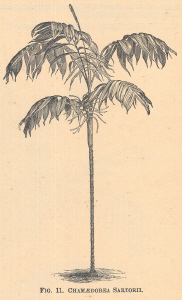
C. Sartorii (Sartor's).* fl. spikes bright red. l. longer, more numerous, and pinnules broader, than in C. elegans, which species it otherwise much resembles. Mexico. A very handsome species. SYNS. C. mexicana and Morenia oblongata conferta.
C. scandens (climbing). A synonym of C. desmoncoides.
C. simplicifrons (simple-fronded). A synonym of C. Ernesti-Augusti.
C. tenella (slender). fl. yellow, spiked, ebracteate and ebracteolate; male 1 1/2in. long. l. shortly petioled, 4in. to 5in. long by 3in. broad, spreading, convex, remotely obtusely serrate, bifid for one-third of their length; nerves eight or nine pairs. Spadices as long as the palm, drooping, slender, unbranched; males longest, with most numerous and much the largest flowers; rachis slender, but stouter than the peduncle, yellowish; peduncles very slender; spathes membranous. One of the most diminutive of all Palms. Mexico. (B. M. 6584.)
C. Tepejilote (native name). l. pinnate; pinnae rich deep green, pendent. Stem slender. h. 10ft. Mexico, 1860. A very graceful species, but somewhat rare in cultivation. (B. M. 6030.)
C. Warscewiozii (Warscewicz's). l. beautifully curved, long, pinnate; pinnae broad, sessile, tapering to a point; terminal pinnae broad, bifid. Guatemala.
C. Wendlandi (Wendland's).* l. pinnate; pinnae 1ft. long, upwards of 2in.broad, sessile; apex acuminate, rich shining green. Stem slender. Mexico. This is one of the best for decorative purposes.