Lotus
(from Lotos, the old Greek name given by Theophrastus and Dioscorides to some leguminous plants). Bird's-foot Trefoil. Including Pedrosia and Tetragonolobus. ORD. Leguminosae. A large genus (about 100 species have been described, although not more than fifty have any claim to specific rank) of greenhouse or hardy herbs or sub-shrubs, widely dispersed over the temperate regions of the Northern hemisphere in the Old World, the mountains of tropical Asia, and extra-tropical South Africa. Flowers yellow, red, purple, pink, or white, usually several together in an umbel, on an axillary peduncle. Leaves four or five-foliolate; leaflets entire. But few species are worth growing, and these are of very easy culture in almost any ordinary garden soil. L. jacobaeus is a greenhouse sub-shrubby plant, but it is very liable to die off in winter. It can be increased, during early summer, by cuttings, placed in an airy situation, and kept carefully watered. The species can also be raised annually from seeds, which are ripened freely in this country. L. gebelia and L. jacobaeus would probably prove hardy in the open air, if planted in a warm, sheltered spot.
L. albidus (whitish). A synonym of L. australis.
L. australis (Southern).* fl. usually pink, but varying from white to a purple-red. July. l., leaflets narrower than in L. corniculatus, and the stipulary ones dissimilar, but varying from obovate to linear. Stems diffuse, ascending, or erect. h. 2ft. Australia. Greenhouse perennial. (B. M. 1353.) SYN. L. albidus (L. B. C. 1063.) L. corniculatus (small-horned).* Common Bird's-foot Trefoil. fl. bright yellow, fading to an orange-colour; vexillum striped with red at the base in front; peduncles very long, each bearing three, four, five, or ten flowers at the apex in a kind of flat umbel. Summer and autumn. l., leaflets obovate, acute, entire; stipules ovate. Northern hemisphere (Britain). Plant procumbent. A very handsome dwarf herbaceous plant, well suited for growing on a rockwork. (Sy. En. B. 368.) The double-flowered form is very desirable.
L. gebelia (Gebel-cher).* fl. at first red, but ultimately pale rose, large; heads of long peduncles usually three-flowered. June and July. l., leaflets and stipules ovate, rather glaucescent. Stems decumbent. Asia Minor, 1816. Greenhouse perennial.
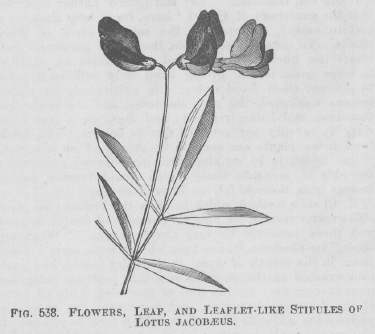
L. jacobaeus (St. Jago).* fl. dark purple, almost black, with the vexillum yellowish, corymbose; peduncles longer than the leaves. Summer and autumn. l., leaflets and stipules linear or linear-spathulate, rather pilose and canescent, mucronate. h. 1ft. to 3ft. Cape Verde Islands. Greenhouse perennial. (B. M. 79.)
L. peliorhynchus (pigeon's-beak).* fl. loosely crowded on short shoots towards the ends of the branches; corolla scarlet, 1in. long, with a very narrow-lanceolate standard, sharply recurved, like a hood. May. l. crowded, sessile, having subulate, spreading leaflets (as if fascicled). h. 2ft. Teneriffe, 1884. A singular and ornamental greenhouse shrub. (B. M. 6733.)
L. pinnatus (pinnate). A synonym of Hosackia bicolor.
L. Tetragonolobus (Tetragonolobus). fl. dark purple, solitary or twin; bracts longer than the calyx. June to August. l., leaflets obovate, entire; stipules ovate. h. 6in. to 12in. South Europe. Hardy annual. SYN. Tetragonolobus purpurea. (B. M. 151.)