Pancratium
(from pan, all, and kratys, potent; in allusion to supposed medicinal qualities). ORD. Amaryllideae. A genus comprising about a dozen species of stove, greenhouse, or hardy bulbous plants, natives of the West Indies, the Canary Islands, and the Mediterranean region. Flowers white, large, sessile or distinctly pedicellate, many in an umbel, or rarely only one or two; perianth funnel-shaped; tube mediocre, or often elongated into an enlarged throat; lobes narrow, erectopatent; cup (false corona) frequently produced into two teeth or lobes; involucral bracts two, membranous-scarious. Leaves linear or loriform. Pancratiums are of easy culture, in a compost of two parts good turfy loam, one part peat, and one part decayed leaf soil, to which some silver sand should be added. The indoor species should be placed in a light position; from the end of June until the middle of September they may be kept in a frame or pit. The less shifting and repotting is practised, the better, provided the plants remain healthy. Pancratiums may be grown singly, or three in a pot. When a shift is necessary, all the living roots should be carefully preserved, and any dead ones cut away. Water may be given freely throughout the growing season; when resting, it should be partially withheld, yet not sufficiently to cause flagging. The species grown outside require deep planting, and a protection of some sort in winter. When the plants have once started, their growth cannot well be too rapid, nor the supply of food too liberal. Propagation is effected by seeds, which should be sown in pans of light, sandy soil, in spring, and placed in heat. Water must only be sparingly given until the seedlings appear, and the latter should be potted off when large enough to handle. Propagated also from offsets, which may be collected at potting time. Young bulbs, if carefully grown on, will, in the course of two or three years, make good flowering plants. The only truly hardy species is P. illyricum; but P. maritimum is hardy enough in mild districts, such as many parts of the West of England. Elsewhere, it is advisable to grow these in a cool greenhouse or frame.
P. Amancaes (Amancaes). A synonym of Hymenocallis Amancaes.
P. amboinense (Amboynan). A synonym of Eurycles amboinensis.
P. amoenum (charming). A synonym of Hymenocallis amoena.
P. australasicum (Australian). A synonym of Eurycles amboinensis.
P. calathinum (basket-flowered). A synonym of Hymenocallis calathina.
P. carolinianum (Carolinian). A synonym of P. maritimum.
P. expansum (expanded). A synonym of Hymenocallis expansa.
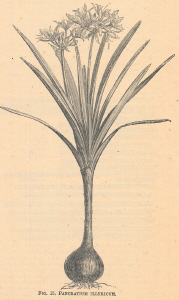
P. illyricum (Illyrian).* fl. fragrant, pedicellate, smaller, and with a shorter tube than in P. maritimum. June. l. broad, ligulate, deciduous, strongly veined. h. 1 1/2ft. South Europe, 1615. An exceedingly attractive plant, quite hardy in most situations.
P. littorale (sea-shore). A synonym of Hymenocallis littoralis.
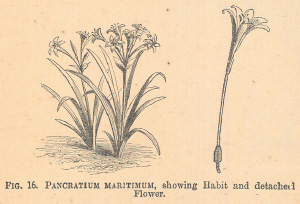
P. maritimum (sea).* fl. with long, filamentous outer segments, very fragrant, nearly sessile, disposed in large umbels. June. l. linear, persistent. h. 2ft. South Europe, &c., 1759. Hardy, or nearly so. (B. R. 161.) SYN. P. carolinianum (B. R. 927).
P. rotatum (rotate). A synonym of Hymenocallis rotata.
P. speciosum (showy). A synonym of Hymenocallis speciosa.
P. verecundum (ruddy). fl. sweet-scented, pedicellate; tube of corolla greenish, 2in. to 3in. long; limb campanulate; segments white inside, green without; scape 1ft. or more long. Summer. l. eight to ten, lorate, acute, convolute, channelled, 1 1/2ft. long 1/2in. or more broad. Bengal, &c. Stove. (B. R. 413.) P. zeylanicum (Cingalese). fl. solitary; laciniae longer than the tube, adherent below, revolute above; style longer than the stamens; spathe entire. June. l. lorate-lanceolate. Bulb ovate, h. 1ft. Ceylon, 1752, Stove. (B. M. 2536; B. R. 479.)