Panax
(an old Greek name, used by Theophrastus, and akin to panakes, a panacea, or remedy, for all complaints; applied to the present plant in reference to the stimulant drug, Ginseng, to which miraculous virtue is ascribed by the Chinese). ORD. Araliaceae. A genus comprising about twenty-five species of stove, green-house, or hardy, glabrous, or rarely woolly-tomentose trees or shrubs, natives of tropical and Eastern Asia, extending to Mandchuria, tropical Africa, the Pacific Islands, New Zealand, and Australia. Flowers often polygamous, in small umbels; umbels rarely in contracted heads, or in small, solitary, racemose or paniculate racemes; petals five; pedicels articulated beneath the flowers. Fruit compressed or rarely sub-globose, fleshy, or rarely sub-membranous. Leaves digitately or pinnately compound, or rarely undivided; leaflets entire, argutely toothed or cut. P. diffusum, P. dissectum, P. dumosum, P. fissum, P. laciniatum, P. plumatum, P. Victorioe, and others bearing specific names in gardens, though distinct enough for horticultural purposes, are, in all probability, mere forms of the variable P. fruticosum. These plants are of moderately free growth, and the majority are easy to manage. Those requiring stove treatment should be potted in sandy loam and peat, with the addition of a little leaf soil and sand. The stronger-growing kinds thrive in a richer compost. Propagation by cuttings of the roots is a common and successful method. The stems of plants from which the roots have been taken may also be cut into pieces 1in. or 1 1/2in. long, pressed into pots of sand or sandy soil, and plunged in bottom heat. If the stems are cut down without disturbing the roots, and the pots are plunged in bottom heat, and kept moderately watered, they will probably throw up several suckers or shoots. These, if taken off with a portion of root to each, will, with a little care, soon make useful plants.
P. armatum (armed). fl. numerously produced in umbellules, forming a long, downy panicle. l. bipinnate, on long stalks, which are prickly, like the stem; leaflets ovate-acuminate, membranous, serrated, beset on both surfaces with bristly hairs. Stems erect, prickly. India, 1876. A fine-looking, stove shrub. SYN. Aralia armata.
P. crassifolium (thick-leaved). A synonym of Pseudopanax crassifolium. P. diffusum (diffuse).* l. pale bright green, densely packed towards the apices of the jointed stems, triangular, bipinnate, crispy; primary divisions with linear-oblong, sometimes lobed, always spiny-toothed, bluntish secondary divisions, the teeth turned upwards. h. 2ft. South Sea Islands. An ornamental, compact-growing, bushy-habited, stove shrub.
P. dissectum (dissected). l. numerous, drooping, bipinnate, having obovate-cuneate leaflets, very greatly varied in size and outline, all furnished with long, marginal teeth. An evergreen stove shrub, of branching habit, very desirable and ornamental.
P. dumosum (bushy).* l. bright green, roundish-ovate, pinnately divided, of numerous, variously-shaped lobes, the pinnae furnished at the margins with incurved, spiny teeth; petioles brownish or olive-green, mottled with brighter green. Stem short-jointed, thickly clothed with leaves. h. 6in. to 18in. A very neat and compact-growing stove shrub.
P. elegans (elegant).* fl. produced in racemes, which are collected into a large, terminal, branched panicle. l. articulate, spreading, and variously divided, pinnate towards the point, with elliptic-oblong, stalked leaflets, while at the basal part they are bipinnate. Queensland, 1880. A pretty and effective, ornamental-leaved shrub (a large and handsome tree in its native habitat), probably hardy in mild districts.
P. fissum (cleft). l. tripinnate, the alternate segments linear-lanceolate, with a few incurved, whitish teeth on each margin. Stem erect-branched, flecked with small, elongate, pallid spots, the petioles being of the same colour. South Sea Islands, 1882. An elegant stove shrub.
P. fruticosum (shrubby). fl. in terminal, corymbose panicles, with the branches umbelliferous at the apex. l. pinnately decompound; leaflets petiolate, oval-oblong, acuminated, coarsely and dentately serrated, ultimate ones deeply trifld. h. 6ft. India, Java, &c., 1800. Stove shrub. (A. B. R. 595.) P. f. Delauana (Delau's). l. digitately compound, with divisions ternately or biternately divided; the segments varying from linear-cuneate to obliquely sub-elliptic, irregularly lobed and toothed, green, with whitish-tipped teeth. Polynesia, 1833. An ornamental, dwarf shrub. (I. H. 492.)
P. laciniatum (laciniate).* l. tinted, and indistinctly marked with pale olive-brown, bipinnate, nearly as broad as long, drooping; the segments very variable in size and form, presenting the appearance of a complex head of foliage, in which the lanceolate lobes have the preponderancy. South Sea Islands, 1877. An elegant and distinct, stove shrub.
P. longissimum (very long). A synonym of Pseudopanax crassifolium.
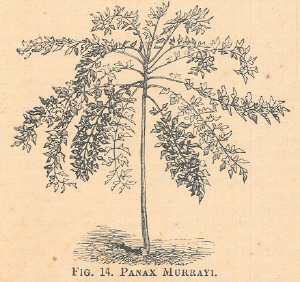
P. Murrayi (Murray's). fl., umbels many-flowered, pedunculate, in racemes or divaricately-branched panicles. l. simply pinnate, often several feet long; leaflets variable, obliquely lanceolate, entire or variously cut or toothed. Queensland, &c. A splendid tree.(B. M. 6978.) SYNS. P. sessiliflorum (of Carriere), Aralia splendidissima (of gardens). The species to which the name of sessiliflorum belongs has trifoliolate leaves, and is a native of Mandchuria.
P. plumatum (plumed).* l. forming a fine, crispy head, very elegantly divided; the leaflets long-stalked and more or less deeply lobed, the edges notched with more or less upcurved teeth. South Sea Islands, 1874. An elegant, small-growing, stove shrub, having the aspect of P. laciniatum, but being much more finely cut.
P. quinquefolium (five-leaved). Ginseng. fl. yellowish; peduncle of umbel shorter than the petiole. June. l. verticillate, petiolate, palmately decompound, the leaflets stalked from the top of the common petiole. h. 1 1/2ft. North America, 1740. Hardy, herbaceous. (B. M. 1333.) The proper name of this plant is Aralia quinquefolia.
P. sambucifolius (elder-leaved). fl. greenish, small, in umbels, which are collected into racemes, corymbs, or panicles. fr. bluish, transparent, attractive. l. pinnate, or bipinnate; leaflets elliptic or lanceolate, glaucous beneath. Branches slender. Greenhouse. (B. M. 6093.)
P. sessiliflorum (sessile-flowered), of Carriere. See P. Murrayi.
P. Victoriae (Queen Victoria's).* l. finely variegated, ternate or almost pinnate, the lateral leaflets forked or trifid, the upper and terminal one larger, simple, ovate, the edge lobed and spinosely toothed, and having the border prettily margined with white. South Pacific Islands. A distinct and graceful, variegated-leaved stove shrub, the leaves forming a dense, plumy, gracefully recurving mass of foliage. (G. C. n. s., xix. 405.)