Petunia
(from petun, the Brazilian name of tobacco; alluding to the affinity of this genus with Nicotiana). ORD. Solanaceae. A genus comprising about a dozen species of highly ornamental, hardy or half-hardy, annual or perennial herbs, often viscid-pubescent, branched; they inhabit Brazil and the Argentine Republic, one being broadly dispersed from Western South America to Brazil. Flowers violet or white, sometimes showy, sometimes small, on solitary pedicels; calyx deeply five-fid or nearly five-parted; corolla funnel or salver-shaped, the tube cylindrical, or swollen above; limb plicate, equal or oblique-spreading, the lobes short, broad, and loosely bilabiate and imbricating at the apex; stamens five, affixed below or at the middle of the tube. Leaves entire, usually small.
Petunias are very showy and popular plants, effective when grown in pots, and also in summer flower beds outside. P. nyctaginiflora and P. violacea are species from which the numerous garden varieties are supposed to have been obtained; as they were not introduced until early in the present century, the cultivation of the plant under notice does not extend any further back. For a long period, considerable attention was paid by florists to the improvement of Petunias, and excellent results were obtained. Less has been done of late years in selecting and naming varieties; still, the plant is far from being allowed to fall into neglect. In some parts, particularly in the West of England, it is most successfully cultivated for exhibition.
Petunias may be raised in any quantity from seeds, and named kinds readily propagated from cuttings. Seeds, which are very minute, should be sown, during March, in pans of light, finely-sifted soil, very slightly covered, and placed in a gentle warmth. They usually vegetate in a very short time, and, before the seedlings become crowded, they should be carefully pricked off in other pans or pots. Afterwards, when large enough, pot them off singly, pinch out the points before they get very high, to induce a compact habit, and keep growing on in an intermediate house, or a low pit. Early in May, those intended for planting out should be gradually inured to the open air, and others, retained for flowering inside, should receive the final potting, and be kept in frames where plenty of air can be admitted. The plants flower profusely at the latter part of summer and in autumn, when they prove very useful and effective for greenhouse decoration. Plants for providing cuttings in spring should be preserved through the winter in a warm greenhouse. They may be obtained by striking some cuttings, in autumn, for the purpose. Young shoots root readily in a close frame, during February and March, and plants thus obtained may be grown on with little trouble. Petunias succeed best in a compost of about two parts loam to one of manure. They require plenty of water all through the summer. Slender stakes are necessary, to keep the plants from falling about.
The three species known in gardens are described below.
P. acuminata (taper-pointed). A synonym of Nicotiana acuminata. P. intermedia (intermediate). fl. axillary or opposite the leaves; corolla 3/4in. long and broad, pubescent-glandular without; tube yellow-striated, longer than the calyx; limb large, purple, with a paler margin; peduncles 1/2in. to 1in. long, filiform. August. l. linear-oblong, sub-spathulate, obtuse, attenuated at base, entire, sessile, 1in. to 1 1/2in. long. Stem erect, branched, leafy. h. 1ft. Buenos Ayres, 1832. Half-hardy perennial, at length becoming sub-shrubby. (B. R. 1931.) SYNS. Nierembergia intermedia (P. M. B. ii. 219; S. B. F. G. ser. ii. 237), Salpiglossis linearis (B. M. 3256).
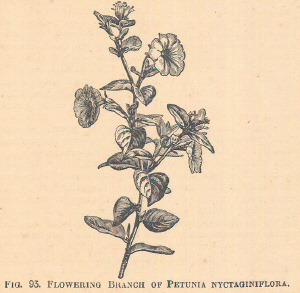
P. nyctaginiflora (Nyctaginia-flowered). fl. on axillary, solitary, one-flowered peduncles, far exceeding the leaves; corolla white, large, the tube cylindrical, three or four times as long as the calyx; limb very spreading. August. l., cauline ones solitary, ovate, oblong, slightly obtuse, nearly or quite sessile; floral ones sessile, cordate-ovate, twin, nearly opposite. h. 2ft. South America, 1823. A diffuse, villous-glandular, half-hardy annual. See Fig. 93. (B. M. 2552; P. M. B. ii. 173; S. B. F. G. 119.)
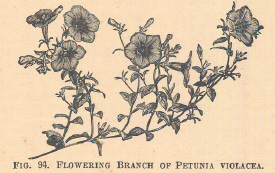
P. violacea (violet). fl. on pedicels 2in. long; corolla purplish-violet, very elegant, 1in. or more long, infundibuliform-campanulate, with a ventricose tube and a sub-equal limb. August. l. ovate, shortly petiolate, ovate-lanceolate, acute; floral ones twin. Stems numerous, 6in. to 10in. long, prostrate, erect and slightly branched at apex. Buenos Ayres, 1831. Half-hardy perennial. See Fig. 94. (B. M. 3556; B. R. 1626; P. M. B. i. 7.) SYNS. Nierembergia phaenicea (S. B. F. G. ser. ii. 193), Salpiglossis integrifolia (B. M. 3113).
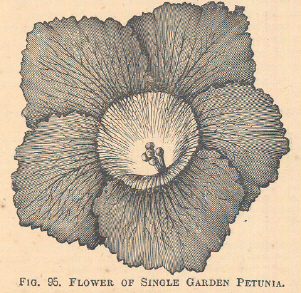
Varieties. Named varieties of Petunias are not met with nearly so often of late years as formerly, the more general system of culture now being that of growing plants from seed annually. In the single varieties, represented in Fig. 95, there is a great diversity of colouring; some are selfs, others are beautifully veined, striped, or marked in various ways. Only single varieties were grown at first; afterwards, semi-double forms began to appear; and now the latter are numerous, very full, and also beautifully fimbriated, as shown in Fig. 96. A selection of named varieties is subjoined. Those with double flowers do not succeed well outside; they should be grown in pots, under glass.
Double Varieties. ADONIS, white, suffused and blotched purple, fringed. AIDA, deep rose-purple, blotched white; large. ALICE, rosy-purple, splashed and suffused white, beautifully fringed. BAYARD, maroon-purple, self. BEAUTY OF MANNAMEADE, white, blotched and tipped claret-purple. BEAUTY OF RUNNYMEDE, rich purple-plum, tipped and blotched white CONCOLORE, pearly-white, blotched light purple; large, beautifully fimbriated; distinct and fine. DE CANDOLLE, deep crimson-purple, edged and blotched white; free. HIBERNIA, rosy-purple, edged green; peculiar. LABYRINTH, white, edged and tipped with rosy-purple, full, and fringed. MADAME HENGIST, purple, edged white. M. A. LOHIER, pure white blotched deep magenta, beautifully fimbriated; fine. MINNIE EVANS, rosy-purple, mottled and flaked white. MRS. WEBB, deep lilac-mauve, beautifully veined with crimson-purple, fringed; very large. OPHELIA, pure white, marked with deep purplish-crimson; large and fine. PERFECTION, deep rose; very double and effective. POSTHUMIA, white, beautifully blotched rosy-purple; fine. ROMULUS, rose, suffused white, veined crimson; large. Single Varieties. AVALANCHE, white, tipped and tinged rose; medium size, distinct. BEAUTY, white, edged and barred purple; large. BOULE DE NEIGE, satiny-white, throat slightly tinted lavender; free and effective. CANNELL'S FAVOURITE, rosy-red, suffused purple; very large, of good substance. CHARMER, crimson, suffused purple, edged and striped white; large and fine. CLAIRVOYANT, white, distinctly edged and barred crimson and maroon; large. DELICATA, white, barred purple. DR. DANIEL, crimson-maroon, white throat; free, and of good habit. DR. HOGG, deep magenta, white throat, heavily veined purple; large. DR. TUCKER, rosy-purple, large throat, veined and netted. ELEGANS, white, suffused and barred purple-crimson, fimbriated. LITTLE PET, soft pink, veined maroon; pretty and distinct. MISS MINNEY, deep lilac, edged white, veined purple. MRS. A. MAYES, white, marked with bars of purple from centre; good habit. MRS. S. HIBBERD, white, striped from centre with maroon; fine. MRS. W. ELDER, white, edged with bright purple, fine shape. PURPLE KING, deep plum-purple, black throat; very rich and distinct colour. SPITFIRE, intense bright purple, shaded crimson; a good bedder.