Panicum
(the old Latin name, derived by Pliny from paniculum, a panicle; alluding to the usual form of inflorescence). Panick-Grass. SYN. Thalasium. ORD. Gramineae. An extensive genus of stove, greenhouse, or hardy, annual or perennial grasses, of variable habit, chiefly natives of tropical and sub-tropical regions of the globe. Nearly 800 supposed species have been described, but the total number fairly distinct as such can scarcely be estimated at much above 250 (Bentham). Many supposed genera, amongst which are Digitaria and Echinochloa, have been at times separated from Panicum, but these are now united by the authors of the "Genera Plantarum." Spikelets ovate, acuminate or obtuse, rarely globose, articulated with the pedicels, loosely or densely paniculate, or in undivided spikes with a terminal hermaphrodite flower, and usually a lower male one; glumes usually four, much shorter than the spikelets, in a few species evanescent; stamens (? always) three; style distinct, or shortly connate at base; stigma feathery. Several members of this genus are of economic value, but few are found in gardens. Two species--P. Crus-galli and P. glabrum--are British. The under-mentioned are hardy, except where otherwise stated, and thrive in any moderately good garden soil. Propagated by seeds.
P. altissimum (very tall). fl., panicle large, 1ft. to 1 1/2ft. long, all the branches whorled, simple, racemiform, naked below. l. 1ft. to 1 1/4ft. long, lanceolate-linear, acuminate, glabrous. h. 6ft. to 30ft. West Indies, &c. Plant woody, arborescent.
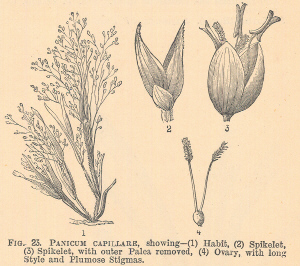
P. capillare (hair-panicled).* fl., panicles large, pyramidal, produced in great profusion, and borne both at the ends of the stems and in the axils of the stem-leaves. Summer. h. 1 1/2ft. to 2ft. Europe, Asia, North America, 1758. A pretty annual. See Fig. 23.
P. colonum (colonial). fl., spikelets four to six-seriate, very shortly pedicellate, scabrous-pubescent; sterile glumes mucronate, the lowest short, the two superior equalling or shortly exceeding the fertile flower; spikes 1/2in. to 1in. long. l. linear, acuminate, glabrous. h. 1ft. to 1 1/2ft. West Indies, &c. Half-hardy annual.
P. italicum (Italian). fl. in a panicle, about 1in. in diameter; cylindrical, at length nodding at the summit; spikelets elliptical-oblong. l. broad. Branches contiguous with, or a little distant below, the panicle, ovate or oblong. h. 2ft. to 4ft. West Indies. A tall annual, now naturalised in many European and other countries.
P. maximum (largest). fl., spikelets elliptic-oblong, glabrous; lowest glume short, the two upper ones little exceeding the fertile flower; panicle 1in. to 1 1/2in. long, the lower branches whorled, usually bearing a few bristles. l. linear or lanceolate, acuminate, ciliated at the base and ligule; nodes usually villous. h. 5ft. to 10ft. West Indies, &c. A stout, stove perennial.
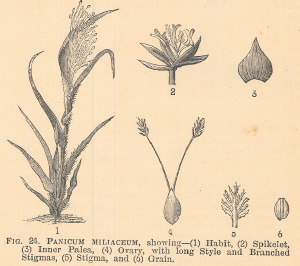
P. miliaceum (Millet-like).* Little Millet. fl. in a much-divided, nodding panicle; spikelets numerous, pedicellate, ovoid. l. rather broad, hairy. h. 2ft. An erect annual, cultivated in the Mediterranean region. See Fig. 24.
P. plicatum niveo-vittatum (plaited, snowy-striped).* l. finely banded with longitudinal stripes of pure white, broad-plaited. 1868. A prettily marked, strong-growing, garden variety, thriving in the stove or greenhouse. (F. d. S. 1743-4.)
P. spectabile (remarkable). Caapim de Angola. fl., spikes numerous, the superior ones exceeding their internodes; spikelets four to six-seriate. * l. long, lanceolate, acuminate, glabrescent. Jamaica, Brazil, &c.
P. variegatum (variegated).* l. white-striped and pink-tinted, lanceolate, with gracefully-waved margins. Tropical Asia, &c., 1867. An elegant little greenhouse variegated perennial, extremely pretty when grown in a basket. It should be kept in heat during winter. Propagated freely from cuttings. The correct name of this plant is Oplismenus Burmanni variegatus.
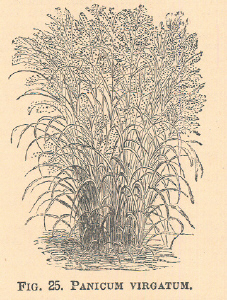
P. virgatum (twiggy).* fl., panicle branches at first erect or ascending, afterwards extensively spreading or drooping. Summer. l. linear, flat, very long. h. 3ft. to 5ft. North America, 1781. A very ornamental perennial species, growing in large, handsome tufts. See Fig. 25.