Pansy
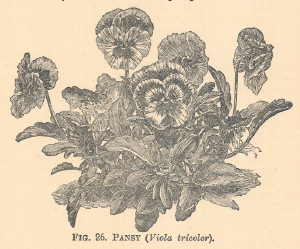
(Viola tricolor). Under the name of Heartsease, and several other popular designations, this plant has long been grown in gardens, where its flowers have been amongst those most generally favoured by rich and poor alike. This can scarcely be wondered at, considering the ease with which Pansies may be grown by almost anyone, the wonderful diversity in colour and marking which the different flowers exhibit, and the ornamental and floriferous habit the plants assume. Even those who are not sufficiently interested in Pansies to grow a collection of named varieties, may procure a packet of mixed seeds, and raise any quantity of plants, that will scarcely be less ornamental for the hardy flower garden or mixed border.
Propagation. Pansies are readily multiplied by seeds, cuttings, and, sometimes, by layers. Seeds may be sown at almost any time of year; but, as planting out is best performed in spring or early autumn, it is advisable to sow with a view to preparing plants for these two seasons--namely, in June for transplanting in autumn, and in August or September, for spring. The seeds should be sown in pans of light soil, covered slightly, and placed in a very gentle heat, or in a cold frame. They soon germinate, and the seedlings, when large enough to handle, should be pricked out in an unheated frame, or in boxes. Before planting outside, it is important that good roots be formed, and that balls of soil should adhere to them; on this condition, much of the after-success depends. Pansy cuttings strike readily towards the latter part of summer, in cold frames, or in a cool, shady border, such as that alongside a wall or hedge, facing north. Side-shoots are to be preferred for cuttings; they may frequently be procured from the base with roots already formed. The soil should be of a sandy nature, and it should be pressed firmly around the cuttings at the time of inserting. Plants so obtained may be placed in their permanent quarters in autumn, or in a prepared border, with a view to lifting them again with better roots and with balls of soil. Layering may be recommended for increasing good varieties that produce but few base shoots; and division of the old plants, in August and September, is, in some instances, a profitable method, because such a quantity of rooted plants may be obtained. Where a large stock of Pansies has to be kept up, it will be necessary to keep inserting cuttings all through the season. Cultivation. Pansies, for ordinary garden decoration, will thrive in almost any soil, without special treatment, provided the position is neither too hot nor too dry. It is principally on account of their preference for a cool, moist bottom that the plants succeed so much better, generally, in the northern parts of Britain than in the southern. If good culture and generous treatment are accorded by the special preparation of beds for, at least, all the choicer varieties, flowers of greater size and substance may be obtained, and the flowering season may also be considerably prolonged thereby. This becomes well-nigh a necessity, if exhibiting is attempted, as only large flowers with all their qualities properly developed are of any use. Fibry loam, thoroughly decomposed cowmanure, or horse droppings, and some sharp sand or road grit, should be used for digging in with the ordinary soil, which it is essential should also be of a good depth. A mulching of old potting soil, leaf mould, and other manure may be given as a top-dressing, so soon as the flowering season begins, and again later on. Such mulchings have a wonderful effect in dry, hot weather by keeping the ground cool, and, to a great extent, preventing evaporation. Deep planting is also recommended, as it places the roots in a much cooler and more moist medium than if they were near the surface. A position neither too much exposed to the mid-day sun, nor over-shadowed by trees, should, if possible, be selected for growing Pansies, when fine flowers are desired. When a southern aspect is, for some reason, unavoidable, a light shading of tiffany is sometimes employed for a few hours each hot day along the sunny side. Strong plants for early flowering, placed in their permanent quarters in September, should be protected, in case of severe weather, with some light litter. Spring planting should be attended to as early as weather permits, say, the end of February, or early in March, in order that the roots may become the better established before hot weather arrives. When watering is necessary in summer, a good soaking should be given, and this only in the evening. Slight waterings are frequently more injurious than beneficial. If flowers for exhibition are required, only about four or six main shoots should be allowed each plant; others being pinched off occasionally as they are formed. All blossoms may also be removed until about three weeks before a show; this tends to strengthen the plants, and increase the size of their flowers.
Culture in Pots. Where this method of growing Pansies is adopted, strong plants should be inserted in 4in. pots early in October, and be placed in a cold frame, with a south aspect. Plenty of air and light are essential. During mild weather, the sashes should be removed: when it is frosty, coverings are preferable to artificial heat. In February, the plants should be transferred into 7in. or 8in. pots, using plenty of drainage, and a rich, open soil. By keeping the shoots tied out, and the flower-buds pinched off, good plants soon develop. From April onwards, frames with a northern aspect would be better, on account of being cooler.
Varieties. Of these the number may almost be said to be legion, so great a variation in colour and markings do the plants represent. See Fig. 26. There are two sections into which Pansies are divided, namely, Fancy and Show. Varieties of the latter are further sub-divided, according to the colour of their flowers, into three classes, termed respectively Selfs, White Grounds, and Yellow Grounds. The Selfs are either black, maroon, primrose, white, or yellow. White Grounds have a large, central, dark blotch round the eye, then a ring, either of white or cream-colour, and an outer band of bronze, purple, or maroon. Fancy, or Belgian, Pansies have various colours and tints curiously blended in their different flowers, the petals being blotched, flamed, and edged, and quite distinct from those of the Show section. A third section is sometimes made on behalf of Bedding varieties. These are usually self-coloured, and are distinguished by their compact and floriferous habit, and, as a rule, rather small flowers. They are more the offspring of V. cornuta and V. lutea than of the Pansy, V. tricolor, and are more generally known as Violas. The line of demarcation, however, between a Viola and a Pansy is now practically undefinable. Subjoined is a list, which comprises varieties of Fancy and Show Pansies of excellent quality in every respect; some new ones of 1885 are denoted by daggers (??). For a selection of floriferous Bedding varieties, see Viola.
Fancy Pansies.
ALEXANDER GRANT, dagger?? dense brown blotches; upper petals bright yellow, margined and flaked crimson. ALEX, KIRK, yellow, with mulberry blotches on all the petals. ALEX. M'COMB, violet blotches; upper petals and margins claret; distinct and fine. BEAUTY, dagger?? dark rosy-crimson blotch; side and upper petals laced with white; fine form. CAMPBELL-BANNERMAN, white, purple blotches; upper petals purple-edged; fine. CAPTAIN HOUSTOUN, mulberry blotches; upper petals crimson; large. CATHERINE AGNES, purple, edged white. COLINSBURGH, dagger?? yellow, dense maroon blotches; extra. COLONEL WELSH, mulberry blotches; upper petals violet, primrose margin; fine form. DAVID FINDLAY, dark violet blotches; upper petals claret, primrose margin. EFFIE WELSH, violet blotches on all the petals, white margin. EVELYN BRUCE, blotches mulberry; upper petals yellow, with crimson margins; extra. JAMES GRIEVE, dagger?? yellow, flaked with red, dense, dark blotches; large; extra good. JOHN GOLD, pale crimson, dense, black blotches. MAGGIE COCHRA, dagger?? blotches bluish-purple, edged white; upper petals white, rayed rosypurple; extra. MARTHA M'INTOSH, dagger?? dense blue blotches; upper petals puce, edged white; fine eye. MAY FERGUSON, dagger?? blotches dark blue; upper petals white, flaked purple, edged pure white. MAY TATE. yellow, shaded red. MISS BLISS, yellow self, dense blotches; extra. MRS. DALGETY, upper petals and blotches violet, white lacing. MRS. G. P. FRAME, dark blotches, shaded crimson, white lacing. MRS. HUTT, yellow self, dense mulberry blotches; extra. MRS. M. H. MILLER, upper petals flamed carmine, edged gold. MRS. T. M'COMB, mulberry blotches; upper petals purple; extra. MRS. W. D. BLACK, dagger?? rich maroon blotch; upper and side petals shaded rosy-purple, edged with white. MRS. WELSH, very dark violet self, pure white margin; extra fine. MRS. WM. M. WELSH, violet blotch, edged carmine; distinct. PERFECTION, mulberry blotch; upper petals violet. PILRIG, dagger?? mulberry blotches; fine eye; upper petals yellow, margined with crimson. PLORA GEM, dense, dark blotches, clear white margin round all the petals. ROYAL QUEEN, deep orange, edged rosy-purple; one of the largest fancies. SUNBEAM, light cream self, with solid blue blotches; fine. T. M'COMB, rich crimson; extra. WM. CUTHBERTSON, yellow, shaded crimson. WM. DICK, dagger?? dense maroon blotches, fine eye, margined with golden yellow. WM. HOWIE dagger??, dense maroon blotches; upper petals flaked crimson and orange, golden-yellow edge; extra fine. Show Pansies.
Class I. Selfs.--A. FOX, dark and smooth. BLACK PRINCE, very dark; fine form. COUNTESS OF ROSEBERRY, dagger?? primrose, dark blotch and eye; extra fine. DR. GRAY, azure-blue, dense blotch, distinct. GOMAR, deep yellow; fine. ISA CRAIG, primrose, dense blotch. ISA SMITH, cream; very smooth. JAMES SKINNER, dagger?? rich mulberry, fine eye; one of the best of its class. JANEY ANDERSON, white, large. JOHN DONALDSON, velvety-maroon. LEITH WALK BEAUTY, dark mulberry. MRS. DOBBIE, white, smooth. MRS. GOODALL, white, dense blotch. MRS. TOM SMITH, dagger?? pure white, large; fine for competition. PARAGON, dagger?? rich yellow, fine blotch; extra. PILRIG GEM, maroon. PRIMROSE GEM, dagger?? primrose, dense solid blotch, fine eye; distinct and constant. ROBERT BLACK, black; extra. W. J. CLARK, white, solid blotch; good substance.
Class II. White Grounds. DEVONIA, purple belt. JANE GRIEVE, purple belt; extra fine. JESSIE FOOTE, purple belt. JOHN CLARK, dark purple blotch and belt; fine exhibition flower. LIZZIE DONALDSON, dagger?? large, white circular field, fine dark purple belt; extra fine. M. H. MILLER, violet-purple belt, solid blotch; fine. MISS KATE SUTHERLAND, dark purple belt; fine show flower. MRS. A. PEEBLES, violet-purple belt, large; of fine form. MRS. GLADSTONE, rich purple belt; fine form. MRS. J. BUSH, dagger?? white, solid purple belt; fine form and substance. MRS. R. LAIDLAW, purple belt. MRS. TODD, cream, dark purple belt. N. H. POWNALL, purple belt; extra. THE MEDE, broad purple belt.
Class III. Yellow Grounds. ALEX. SMITH, dagger?? medium shade of yellow, dark purple belt; good form and substance. CHANCELLOR, gold, maroon belt. DR. ROBERTSON, yellow, maroon belt. ELLA MURRAY, yellow, bronze belt. JAMES COOK, golden-yellow ground, yellow-ruby belt; extra. J. B. DOWNIE, bronze belt. LORD F. CAVENDISH, deep golden-yellow ground, rich bronzy-purple margins; flowers very large. MARY M'COMB, maroon belt. PILRIG KING, mulberry blotch, reddish-bronze belt; fine. R. DONALDSON, maroon belt; fine. ROBERT BURNS, lemon, chocolate belt; large, constant. T. M'COMB, purple belt; large.