Parsnip
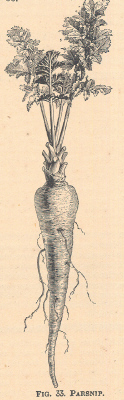
(Peucedanum sativum). A hardy biennial, a native of Europe (Britain) and Siberia. It has been cultivated since the time of the Romans for its roots, which are eaten as a vegetable, and used for various purposes, not the least being that of the preparation of an excellent wine. Parsnips are very nutritious, but not so much so as Potatoes, a vegetable for which they have been recommended as a substitute. Potatoes are also more productive, and their flavour far more generally liked, than Parsnips; still, the latter are much esteemed, and form a portion of the crops in almost every kitchen and also cottage garden, whether large or small. In the Channel Islands, this vegetable is successfully cultivated, the soil there being peculiarly adapted to its requirements. The roots are in greater request, at certain seasons, in Roman Catholic countries than in others.
Cultivation. Parsnips succeed best in an open situation, where the soil is not too stiff yet is rich, and of a good depth. A somewhat sandy loam is most suitable, and it is best if tolerably free from stones, which tend to divert the roots from a straight downward course. Land in preparation, and intended for the vegetable under notice, should be deeply trenched the previous autumn, and manure added then, if necessary--its addition in spring invariably results in the production of forked, instead of straight, roots. Ridges of soil left for the winter should be levelled down in February, or very early in March, and the seed sown thinly, yet regularly, in shallow drills, 18in. or 20in. apart. Before the young plants become drawn, they should be thinned, partially at first, and finally, in due course, to distances of 12in. or 15in. apart, according to the size they are likely to attain. An occasional hoeing will be all that is necessary until the leaves die in autumn, when the roots will be fit for use, and a stock may be lifted and stored in a cool shed, for that purpose being covered with sand or light soil. Parsnips are, however, much better if dug from the ground as required for use; consequently, only enough should be stored inside for maintaining a supply in frosty weather up till February, or until growth recommences, when the whole stock must be dug up. A Parsnip, with a portion of its leaves removed, is represented
Seed Saving. Parsnip seed does not satisfactorily retain its germinative powers longer than one year. If seed is to be raised, a few of the best roots should be carefully planted in a sheltered position early in the year. The seed will ripen in quantity during the latter part of summer, when it may be dried and stored in the ordinary way.
Sorts. These are not numerous. The following are the best: HOLLOW-CROWNED, large, heavy, and of excellent quality; best for general use. LARGE GUERNSEY, roots large, long, and tapering; a variety extensively cultivated in the Channel Islands. THE STUDENT, medium size, of superior flavour and good quality.
There is a variety called Turnip-rooted, because of its roots resembling Turnips in shape and growing principally above ground. It is not much cultivated, but has been recommended for shallow soils, on which the other sorts do not properly succeed.
Pests. The Parsnip is occasionally liable to the attacks of Fungi, of which, probably, the worst are Erisyphe Martii and Peronospora nivea; but the crop seldom suffers much from these causes. Means of prevention and of remedy will be found under the headings Mildew, Oidium, and Peronospora
The insects that most frequently injure Parsnips also affect various allied plants, notably the Carrot, and they will be found mentioned under the following headings: Carrot Blossom Moth (Depressaria daucella or D. nervosa), Carrot Grubs (Psila Rosae), Celery Fly (Tephritis Onopordinis), Flat-body Moth (Depressaria applana or D. cicutella), Parsnip-Seed Moth (D. Heracleana), and Purple Carrot-Seed Moth (D. depressella). Their appearance, habits, and modes of doing damage, and the best remedies against each, will be found in detail under these heads, but may be summarised here as follows:
Psila Rosae is a small, two-winged fly, the grubs of which are slender, white or yellowish, and about 1/4in. long. They burrow into the tap-roots of Parsnips and of Carrots, forming narrow, irregular galleries. The diseased plants show the injury by the outer leaves drooping and turning yellow. It has been found useful, as a remedy, to water the plants with solutions of paraffin (one ounce to one gallon of water) or of alum, or liquid manure; and gas-lime, soot, or sand prepared with tar (one gallon to a barrowful of sand), are all useful applications if dug into the soil.
Tephritis Onopordinis is harmful, inasmuch as the grubs burrow between the surfaces of the leaves of Parsnips, producing large, pale patches, in which the surfaces are separated from each other. These patches are useless for the nutrition of the plant; hence, when numerous, much injury is done to the leaves. One or more grubs are present in each patch. When full-fed, they generally bore through the skin of the leaf, and into the soil, and in it they turn into brown, oval pupae; but sometimes they become pupae in the discoloured patches of the leaves. From the pupae, in a fortnight or so in summer, or after the winter, emerge brown or yellowish two-winged flies, about the size of house flies, with brown-spotted wings and green eyes. The best remedy is to crush the spots, when they are small, between the finger and thumb, or pick off and burn the diseased leaves. The leaves may also be sprinkled with lime, or gas-lime, or soot, to prevent deposition of the eggs. The pupae may be destroyed by digging gas-lime into the soil in autumn and winter, or by paring off and burning 3in. or 4in. of the surface soil.
All the moths that need be noticed here belong to the genus Depressaria, a rather large group of insects, included in the Tineina (which see for characters). They vary from a little over 1/2in. to 1in. across the wings. The fore wings are cut square at the tips, and the hind margin of the hind wings is generally notched near the base. The insects are usually grey, reddish-brown, or brown, and the fore wings bear darker spots or streaks. Several of these moths live on umbelliferous plants, in the umbels of flowers, or in pieces of the leaves so rolled as to form tubes. The parts occupied by them are spun together by means of silk, and thus afford them protection from enemies of every kind. When the web is torn, or even if the plant is shaken, the larvae wriggle to the exterior, and drop to the ground, to re-ascend at leisure. When full-fed, they usually bore into stems of the food-plant, and in them become pupae. In this state they frequently hibernate, though some live through the winter as moths. Those larvae that feed on the leaves do comparatively little harm, but those that feed in the umbel eat the flowers and fruits, and do much mischief to the seed crop. The best remedy is hand-picking, or shaking the affected umbels. The larvae readily fall out, and should be trampled upon and crushed before they can crawl away, or again reach the umbels.