Passiflora
(from passio, passion, and flos, floris, a flower; a name given by the early missionaries in South America, in allusion to a fancied representation in the blossoms to the implements of the Crucifixion). Passion Flower. Including Disemma and Murucuja. ORD. Passifloreae. A genus comprising about 120 species of stove, greenhouse, or hardy, climbing, or rarely erect, herbs or shrubs; they are mostly American, but a few are found in Asia and Australia. Flowers hermaphrodite, very rarely unisexual, often showy, axillary, solitary, or racemose; calyx tube short, urceolate, the lobes four or five, linear-oblong or linear, often coloured on the inside; petals four or five, or none, almost equal to the calyx lobes and more-coloured; corona simple or duplex, the exterior of many, one or two-seriate filaments, or membranous and tubular, the interior tubular or absent; gynophore elongated, girded at the base by a thick pitcher; stamens four or five, adnate to the filaments of the gynophore, free at the tips; anthers linear-oblong, versatile. Fruits ovoid or globose, juicy or pulpy, sometimes almost three-valved, many-seeded, in a few species edible. Leaves alternate, rarely opposite, entire, lobed, or parted; petioles often glandulose; tendrils lateral, undivided, rarely absent; stipules two or none, sometimes leafy. One or more of the species of Passiflora should always be included amongst plants selected for covering the roof or rafters of either a stove or greenhouse. They are best adapted for large structures; in small houses, close pruning becomes necessary, and the plants, consequently, cannot properly develop their true characters. The flowers are very beautiful in some species; in all, they are of singular form and extremely interesting.
Propagation is readily effected from cuttings of young shoots, about 6in. long, taken in spring with a heel, and inserted singly in small pots of sandy soil. They should be placed in a close propagating frame, or under a bell glass, where they will root in due course pretty freely. Once rooted, and gradually inured to the open house, the plants grow rapidly, and when repotting rather large shifts may be safely allowed. They may eventually be permanently planted out, and the growth trained over the roof or rafters, or cultivated for a similar purpose in large pots or tubs. Passifloras usually grow freely, and are not over-fastidious regarding soil, provided there is good drainage, and plenty of water is given throughout the growing season. If planted in borders, the roots should be partially restricted, and a depth of soil not exceeding a foot will be sufficient. This should be composed of turfy loam with a small portion of peat and some sharp sand intermixed. Very rich soils are apt to cause an over-luxuriant growth at the expense of the floriferous habit which the plants usually assume. Attention should be devoted to training the shoots and preventing overcrowding by cutting the weakest away, allowing the terminal points of others to hang gracefully. When flowering is over, the main growth may be regulated, thinned, if necessary, and cut in. Both stove and greenhouse species thrive under very similar treatment, except that the latter do not require so much heat as the former, and do not generally grow quite so rapidly. P. caerulea succeeds in favourable localities outside. If trained to a south wall, it grows rapidly, and soon covers a large surface. The numerous orange-coloured fruits that ripen towards autumn are as ornamental as the flowers which precede them.
Except where indicated otherwise, the undermentioned species are climbers, and require stove treatment.
P. Actinia (Sea-anemone-like). fl., petals nearly white, oblong, rather longer than the calyx; calyx with a short tube, and a limb of five greenish, oblong lobes; crown of numerous spreading, worm-like filaments, deeply banded with red, blue, and white, inclosing three circles of very minute processes; peduncles axillary, single-flowered. November and February. l. about 3in. long, ovate, obtuse, emarginate, the petioles scarcely half as long. Organ Mountains, 1842. (B. M. 4009.) P. adiantifolia (Adiantum-leaved). A form of P. Banksii.
P. alata (winged-stemmed).* fl. very sweet-scented; upper side of calyx and petals deep crimson; rays variegated with purple, white, and crimson; pedicels terete; bracts slightly toothed. April to August. l. glabrous, somewhat cordate, ovate, acute; petioles bearing four glands; stipules lanceolately-falcate, somewhat serrated. Branches tetragonally winged. Peru, 1772. (B. M. 66; L. B. C. 246.) P. Buonapartea is probably a hybrid between this species and P. quadrangularis.
P. a. brasiliana (Brazilian). fl. solitary, axillary; sepals oblong, very convex, coloured at the edges, each bearing below the end a little bristle; petals longer, but similar, within deep scarlet, outwardly deep violet, with a white streak along the middle; crown about as long as the petals, composed of several rows of tapering processes, which are collected into a cylinder, and are white, with crimson bands on the lower half, deep rich violet on the upper half. September. l. about 6in. long, oblong, abruptly pointed; petiole over 1 1/2in. long, with two yellow, conical glands at the upper end; stipules narrow. 1831. SYN. P. phoenicea (B. R. 1603).
P. alato-caerulea (winged-blue). fl., petals white inside; calyx lobes rose-coloured on the outside; crown triple; outer filamentous appendages variegated with black, blue, and white; pedicels terete, much longer than the petioles. June to October. l. glabrous, cordate, three-lobed; lobes quite entire, ovate-lanceolate; petioles bearing two to four glands. 1823. A garden hybrid between P. alata and P. coerulea. (B. R. 848.)
P. alba (white).* fl. white; superior peduncles longer than the leaves. May. l. glabrous, glaucescent beneath, somewhat cordate at base, five-nerved, trilobed; lobes oval, somewhat glandularly serrated at base; petioles biglandular in the middle. Brazil, 1830. SYN. P. atomaria. (G. C. n. s. xix., p. 693; R. H. 1883, Fig. 39.)
P. albida (whitish). A synonym of P. mucronata.
P. albo-nigra (white and black). fl., petals white; corona blackish-purple below, white above. Summer. l. palmately five-lobed. This is said to be a cross between P. alata and P. Raddiana. (R. G. 1852, 8.)
P. amabilis (lovely).* fl., sepals and petals red within, conformed; filaments of the corona almost quadriseriate, white, shorter than the perianth; peduncles solitary, one-flowered. May. l. membranous, ovate, acute, entire; stipules ovate, acuminate, entire, shorter than the glandulose petioles. Stem slender, terete. South America, 1848. (B. M. 4406.)
P. amethystina (amethystine). fl. purplish; margins of corona inflexed; ovary tomentose; peduncles as long as the leaves; bracts absent. November. l. trilobed, cordate, glabrous; lobes oblong, obtuse, almost equal, obscurely serrulate; petioles bearing two or three glands. Brazil, 1827. (B. R. 1838, 21, under name of P. onychina.)
P. arborea (tree-like). fl. 2in. to 3in. broad; perianth tube 1 1/2in. to 2in. long, terete, green; sepals and petals similar and equal, greenish-white inside; corona triple; the outer of yellow filaments nearly two-thirds as long as the petals; the middle a ring of short filaments round the mouth of the tube; inner of fimbriate scales, pressing against the column; peduncles pendulous, three to six-flowered; bracts none. July. l. drooping, 6in. to 2 1/2ft. long, oblong, elliptic, or obovate; petioles stout, cylindric, 1in. to 1 1/2in. long. Stem slender, erect, terete, 1ft. to 14ft. high, sparingly branched; branches horizontal or drooping. New Grenada, &c., 1807. An interesting species, from its erect habit and peculiar appearance. SYN. P. glauca (of Humboldt). (B. M. 5864.)
P. atomaria (dotted). A synonym of P. alba.
P. atropurpurea (dark purple). fl. 3in. in diameter; tube short, white inside; sepals reddish-violet; petals crimson; coronal threads violet, spotted with white. 1883. Garden hybrid. Greenhouse.
P. aurantia (orange). A synonym of P. Banksii.
P. Banksii (Banks'). fl. sometimes pale on first opening, but soon becoming brick-red or dull scarlet, on pedicels much shorter than the leaves; calyx lobes 1 1/2in. or more long; petals scarcely 3/4in. long, narrow; inner corona broadly tubular, plicated, and shortly lobed at the orifice; outer one of a single row of filaments. July. l. broad, usually under 3in. long, with three broad, obtuse lobes, rarely divided to the middle of the leaf, each lobe sometimes two or three-lobed. Australia. Greenhouse. SYNS. P. aurantia (A. B. R. 295), Disemma aurantia (B. M. 4140). P. adiantifolia (B. R. 233; L. C. B. 36, under name of Murucuja Baueri) is a mere form of this species.
P. Belottii (Belotti's). fl. large and showy; sepals flesh-coloured, tinged with green; petals delicate light rose-colour; rays of the corona blue, with indistinct transverse purple bars. Summer. l. large, glabrous, alternate, deeply three-lobed; lobes acuminate, entire. Stems round, tendrilled. 1847. A robust hybrid between P. caeruleo-racemosa and P. quadrangularis. (G. M. B. i. 9.)
P. biflora (two-flowered). A synonym of P. lunata.
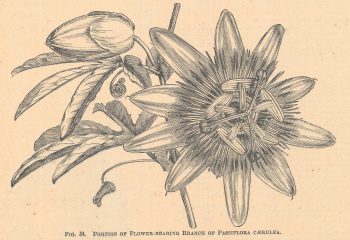
P. caerulea (blue-flowered).* fl. faintly scented, lasting but one day; calycine segments pale greenish-white, the petals of nearly the same shape and size; styles purplish; rays of the corona in two circles, purple at the bottom, white in the middle, and blue at the ends; bracts ovate, entire. June to October. fr. egg-shaped, yellow when ripe. l. glabrous, five-parted; lobes oblong, quite entire; petioles bearing four glands at the apex; stipules falcate. Brazil and Peru, 1699. Hardy. See Fig. 34. (B. M. 28.) P. chinensis (of gardens) and P. Mayana are probably forms of this species. P. Hartwiesiana is probably a seedling variety with white flowers. CONSTANCE ELLIOTT is a fine seedling form with white-scented flowers, raised by Lucombe and Pince, Exeter.
P. c. Colvillei (Colville's). fl. whitish; petals tinged with blue; outer corona variegated with purple, white and blue. l. with oblong-lanceolate, serrulated lobes; petioles biglandular at apex. Said to be a hybrid between P. caerulea and P. incarnata. (S. B. F. G. 126.) P. caeruleo-kermesina (blue and carmine). This is probably a hybrid between P. caerulea and P. Raddiana.
P. caeruleo-racemosa (blue-racemose).* fl. purple; pedicels axillary, solitary, one-flowered. June to October. l. quite glabrous, rather coriaceous, three to five-lobed; lobes undulated, somewhat toothed at the base; petioles bearing four glands. A hybrid between P. caerulea and P. racemosa. Greenhouse or nearly hardy. (L. B. C. 573.)
P. capsularis (capsular). fl. yellow and green; pedicels solitary, ovary elliptic-oblong, and, as well as the fruit, acutely hexagonal, glabrous. June and July. fr. purple when ripe, small. l. downy, cordate at base, two-lobed, with an awn in the recess between the lobes, and, as well as the petioles, glandless. Tropical America, &c., 1820. (B. M. 2868.)
P. c. acutiloba (acutely-lobed). l. deeply two-lobed, hardly pubescent above, painted with white.
P. c. geminiflora (twin-flowered). fl., pedicels twin. l. glabrous, hardly cordate at base. Branches triangular.
P. cincinnata (curled).* fl. pale violet-purple, bold, showy, axillary; corona of long and singularly curled and twisted, dark violet ciliae, marked with alternate bands of white and purple near the base. August. l. deeply digitately lobed, glossy dark green. Stems glabrous. Brazil, 1868. Greenhouse. (B. M. 5737; G. C. 1868, p. 966.)
P. cinnabarina (cinnabar-red).* fl. scarlet, axillary, solitary, widely spreading, 2 1/2in. in diameter; outer corona of a single series of erect filaments; inner shorter, membranous, deeply plicate. March. l. usually deeply trifid, occasionally five-lobed, subcordate or distinctly cordate at the base, with a wide sinus; lobes ovate or ovate-elliptical, entire, or the medium lobe with a broad, obtuse, lateral tooth on each side. Australia. (B. M. 5911.) P. coccinea (scarlet-flowered).* fl. scarlet, with orange-coloured rays; bracts ovate, sub-serrated, velvety. June to November. fr. full of sweet, juicy, edible pulp. l. glabrous, ovate, coarsely toothed, slightly acute; petioles bearing four to six glands. British Guiana, Brazil, and Peru, 1820. (B. H. xvi., xiii., under name of P. fulgens.)
P. cuprea (coppery). fl. orange-coloured, with a purple calyx; petals oblong-linear, shortly exceeded by the calyx; coronal leaflets linear, blunt; pedicels single, much exceeding the petiole, the uppermost racemose. July. l. roundish-oval, entire, mucronulate, shortly petioled, reticulated on both sides. Bahamas, 1724.
P. Decaisneana (Decaisne's). fl. about 4in. in diameter; sepals and petals brilliant carmine on the inside; rays of the corona barred with purplish and white below, deep bluish-purple and white towards the tips. Summer. l. about 3in. long; petioles stout, bearing three pairs of glands; stipules elliptic. A hybrid between P. alata and P. quadrangularis. (F. d. S. viii. 848.)
P. discolor (discoloured). A synonym of P. Maximiliana.
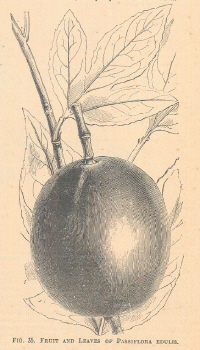
P. edulis (edible).* fl. white, tinged with purple, ragrant; corona about equal in length to the calyx lobes; ovary glabrous; bracts glandularly serrated. July and August. fr. livid-purple when ripe, elliptic, 1 1/2in. in diameter, edible; pulp orange-coloured, with an acid taste resembling the flavour of an orange. l. glabrous, trilobed, serrated; petioles biglandular at the apex. Brazil. The fruit of this species is produced in abundance. (B. M. 1989; B. R. 152, under name of P. incarnata var.)
P. e. verrucifera (warted). fl. very curious and pretty; sepals white within, twice as broad as the white petals; coronal rays dark purple, two-seriate, equal, shorter than the petals; bracts and sepals warted. April. l. glabrous, three-lobed, serrated, obtuse or cuneate at base; petioles biglandular at the apex, twice as long as the peduncles; stipules setaceous, almost equalling the peduncles. Brazil, 1837. Greenhouse. (B. R. 1840, 52, under name of P. verrucifera.) P. filamentosa (filamentous). fl. with whitish petals and blue corona coloured similarly to those of P. caerulea; corona longer than, or nearly equalling, the calyx; bracts serrated. July to October. l. glabrous, five-parted, serrated; petioles biglandular in the middle. South America, 1817. (B. M. 2023; B. R. 584.) SYN. P. palmata (L. B. C. 97).
P. foetida (stinking). Wild Water Lemon. fl. whitish, the corona variegated with purple and blue. May to October. l. villous on both surfaces, five-nerved, cordate at base, three-lobed; lobes nearly entire, lateral ones very short, middle one acuminated; petioles, as well as the stems, hispid. Tropical America, &c., 1731. Annual, or rarely perennial. SYNS. P. hircina (of gardens), P. hirsuta. (L. B. C. 138.)
P. f. ciliata (ciliate-leaved). fl., petals greenish on the outside, red within; rays of corona variegated with white and purple; stipes of ovary deep purple, with darker spots. July to September. l. glabrous, somewhat five-nerved, cordate at base, trifid; lobes acuminated, ciliated. Jamaica, 1783. (B. M. 288.)
P.f. nigelliflora (Nigella-flowered). fl., segments five, palegreen without, white within, oblong; petals white, the same shape; filaments of nectary white, bluish at the tip, inclosing a double circular disk; involucre of three pinnatifid leaves. September. l. cordate, five-lobed, hairy, or almost silky on both sides, emitting a foetid odour when bruised. Stem and petioles hairy. Mexico, 1835. (B. M. 3635, under name of P. nigelliflora.)
P. fulgens (shining). A synonym of P. coccinea.
P. glauca (glaucous), of Aiton. A synonym of P. stipulata.
P. glauca (glaucous), of Humboldt. A synonym of P. arborea. P. gracilis (slender). fl. whitish; rays of corona blue and white; peduncles axillary, solitary. August. fr. egg-shaped. l. subcordate, glabrous, three-lobed; lobes roundish, beset with two to four glands; petioles bearing two glands. 1823. (B. R. 870.)
P. Hahnii (Hahn's).* fl. white, 3in. across, with a double yellow corona. Summer. l. peltate, oval, bright green above, reddish on the under surface. Mexico, 1870. Greenhouse. (G. C. n. s., x. 305, xii. 504; R. H. 1869, 430, under name of Disemma Hahnii.)
P. Herbertiana (Lady Carnarvon's). fl. solitary or in pairs, rather large, on pedicels shorter than the leaves; calyx lobes greenish-white or pale orange-yellow, nearly 1 1/2in. long; petals narrow, scarcely 3/4in. long; inner corona about 1/2in. long, crenate or shortly lobed; outer one rather shorter, of a single row of filaments. July to September. l. broad, truncate or slightly cordate at base, with three triangular, almost acute, lobes, pubescent on both sides; petioles biglandular. Australia, 1821. SYN. Disemma Herbertiana. (B. R. 737.)
P. hircina (goat-scented). A garden synonym of P. faetida.
P. hirsuta (hairy). A synonym of P. faetida.
P. holosericea (wholly-silky). fl. white, spotted with red; rays of corona variegated with purple and white. May to August. l. ovate, somewhat trilobed, aristately toothed at the base; petioles biglandular. Vera Cruz, 1733. Plant clothed with soft, velvety down. (B. M. 2015; B. R. 59.)
P. Hulletti (Hullett's). A garden synonym of P. macrocarpa. P. Imperatrice Eugenie (Empress Eugenie's). fl. about 4in. across; petals white, tinged on the inside with reddish-lilac; rays of the corona white, with regular transverse bars of blue, which become reddish-purple towards the base. Summer. l. deeply three-lobed, the lobes slightly mucronate. 1858. Apparently a cross between P. caerulea and P. quadrangularis or P. alata. (I. H. 1858, 175.)
P. incarnata (flesh-coloured).* May Apple. fl. sweet-scented; petals white; corona having a double circle of purple rays; bracts glandularly serrated; ovary villous; calyx lobes pale green. July and August. fr. orange-coloured, about the size of an apple, with a sweetish, yellow pulp. l. glabrous, somewhat cuneate at base, five-nerved, deeply trifid; Iobes Ianceolate, serrated; petioles biglandular at apex. Southern United States, 1929. A greenhouse perennial, sending up annually a number of herbaceous shoots. (B. M. 3697.)
P. Innesii (Innes').* fl. very handsome; sepals white internally; petals whitish, thickly speckled with red; corona in many rows, white, banded with red at the base, violet-spotted above the middle, and white at the apex. 1870. A fine garden hybrid between P. alata and P. macrocarpa.
P. insignis (remarkable). A synonym of Tacsonia insignis.
P. jorullensis (Jorullo). fl. orange, twin, small; calyx segments five, expanded; corolla connate with the calyx, five-fid, the laciniae revolute-deflexed, much shorter than the calyx; corona double; peduncles above 1in. long, articulated at apex. June. l. bilobed; lobes reniform, obtuse, mucronulate, broadly rotundate, purplish-glaucescent beneath; stipules linear, small. Central America, 1852. SYN. P. Medusaea. (B. M. 4752; F. d. S. v. 528; L. & P. F. G. i., f. 59.)
P. kermesina (carmine). A synonym of P. Raddiana.
P. laurifolia (Laurel-leaved). Jamaica Honeysuckle; Water Lemon. fl. red and violet, sweet-scented; bracts obovate, glandularly serrate at the apex. June and July. fr. yellow, with white spots, the size of a hen's egg, but rather more elongated, containing a whitish, watery, edible pulp. l. glabrous, ovate-oblong, entire; petioles biglandular at the apex; stipules setaceous, the length of the petioles. West Indies and South America, 1690. (B. R. 13.) SYN. P. tinifolia (B. M. 4958).
P. Lawsoniana (Lawson's) fl. 3in. to 4in. across; calyx lobes reddish-brown in the interior; petals reddish, oblong-obtuse, shorter than the sepals; corona in many rows, the outer filamentous. Summer. l. sub-peltate, rather thick, ovate-oblong, slightly cordate, acuminate, entire. 1868. A hybrid between P. alata and P. racemosa.
P. ligularis (strap-shape-stipuled). fl. green and purple, particoloured; bracts ovate, entire. September. l. glabrous, cordate, acuminate, entire; petioles bearing four to six cylindrical glands; stipules ovate-lanceolate, acuminated, Peru, 1819. (B. M. 2967.) SYN. P. Lowei (R. G. 1852, 9).
P. Lowei (Lowe's). A synonym of P. ligularis.
P. lunata (lunate). fl. white, the rays of the corona yellow; pedicels twin, jointed above the middle; calyx exceeding the corolla. June to August. l. glabrous, glandular beneath, cordate at base, three nerved, trucate, somewhat bi-or trilobed; petioles short, glandless. West Indies and South America, 1800. (B. M. 2354; B. R. 577.) SYN. P. biflora.
P. lutea (yellow). fl. pale yellow, on twin pedicels; filaments of the corona in three rows, shorter than the sepals. May and June. l. almost glabrous, cordate, trifid; lobes ovate, mucronate by a bristle, and, as well as the petioles, glandless. North America, 1714. Hardy. (B. R. 79.) P. macrocarpa (large-fruited). fl. white and purple. Summer fr. of a delicate flavour, and acquiring a weight of 8lb. and upwards. l. large, oval, obtuse. Stem quadrangular. Rio Negro, 1866. A vigorous-growing climber. SYN. P. Hulletti (of gardens).
P. maculata (spotted). fl. greenish; pedicels solitary or twin, rather pilose. June and July. l. glabrous, deeply three-lobed, painted with white on the upper surface; lobes nearly equal, oblong, acute, upper ones bluntly trifid, intermediate one larger than the others; petioles glandless. Curassoa, 1820.
P. maliformis (Apple-form-fruited). Sweet Calabash. fl. of various shades, sweet-scented, large, and beautiful; petals white; rays blue; outer divisions of flower red; bracts ovate, acute, joined at the base, larger than the flower. July to November. fr. dingy yellow, round, smooth, about 2in. in diameter, full of agreeable, gelatinous, pale yellow pulp. l. glabrous, ovate, somewhat cordate at base, acuminated, entire; petioles biglandular. Tropical America, &c., 1731. (B. R. 94.)
P. marmorea (marbled). A garden synonym of Ophiocaulon cissampeloides.
P. Maximiliana (Prince Maximilian's). fl. greenish, with a white corona; pedicels solitary or twin, longer than the petioles. May and June. l. glabrous, divaricately bilobed, drawn out a little in the middle, somewhat cordate at base, red and biglandular beneath; petioles glandless. Brazil, 1800. SYNS. P. discolor (L. B. C. 565), P. vespertilio (B. R. 597).
P. Medusaea (Medusa's). A synonym of P. jorullensis.
P. Mooreana (Moore's). fl., calyx tube short; limb of five oblong segments; petals white; corona with the outer ray blue, nearly as long as the petals, variegated below with white and darker blue; intermediate one deep blue, very short; inner one red-purple, erect; peduncles one-flowered. July. l. almost sessile, 3in. to 5in. long, cuneate, deeply palmato-trifid, obscurely serrate; stipules large, ovate. Buenos Ayres, 1837. (B. M. 3773.) P. mucronata (mucronate). fl. white, with a yellowish corona; column inclined; stamens secund; pedicels twice the length of the leaves; bracts soon falling off. August and September. l. glabrous, roundish-cordate, entire; petioles biglandular in the middle; stipules ovate-lanceolate, setosely apiculated. Brazil, 1816. (B. R. 677, under name of P. albida.)
P. Munroi (Munro's). fl. 2in. to 3in. across; petals five, whitish externally, violet within, oblong, as long as the calyx lobes; corona in several series, violet, rich purple, and whitish. Summer. l. 3in. to 5in. long, 4in. to 6in. broad, palminerved, cordate at base, deeply three-lobed. 1868. A very elegant greenhouse hybrid between P. alata and P. caerulea.
P. Murucuia (Murucuia). fl. deep red, solitary, axillary. July. fr. flesh-coloured when ripe, size of a pigeon's egg. l. glabrous, glandular beneath truncately two-lobed at the apex; lobes obtuse, divaricate. West Indies, 1730. SYN. Murucuja ocellata. (B. R. 574.)
P. onychina (onyx-coloured). A synonym of P. amethystina.
P. organensis (Organ Mountains). fl. greenish-white, having a violet-coloured corona, tipped with white. Summer. l. having ovate, obtuse, lateral lobes, and a broad, very obtuse, central one, the under surface claret-coloured. Brazil, 1869.
P. o. marmorata (marbled). l., upper surface prettily mottled with whitish or yellowish blotches. Brazil, 1869.
P. palmata (palmate). A synonym of P. filamentosa.
P. peltata (peltate-leaved). fl. greenish; calyx pale, large; corona filamentous; pedicels solitary, jointed about the middle. August and September. l. pubescent above, glandless, three-nerved, rather peltate, three-lobed beyond the middle; lobes lanceolate, divaricated; petioles biglandular in the middle. West Indies, &c., 1778. (B. R. 507.) P. penduliflora (pendulous-flowered). fl. pale yellow and green; crown one-seriate, twelve to fourteen-partite; segments orange-coloured, much exceeded by the petals; pedicels simple, solitary or twin, often elongated, pendulous. August. l. roundish, slightly trilobed at the sinuate or sub-truncate top; lobes broadly rounded, mucronulate, erect. West Indies, 1848. (B. M. 4565.)
P. perfoliata (perfoliate-leaved). fl. on pedicels much exceeding the petioles; calyx crimson; petals oblong-lanceolate, exceeding the calyx; rays fleshy-green, with blunt, scarlet tips. April to September. l. velvety, cordate at base, two-lobed, with an awn in the recess between the lobes, glandless beneath, and on the petioles. West Indies, &c., 1831. (B. R. 78.)
P. phaenicea (crimson). A synonym of P. alata brasiliana.
P. picturata (painted-leaved). fl. red; calyx lobes reflexed, twice the length of the filamentous crown; outer crown beautifully variegated with blue and white. September. l. sub-peltate, reddish beneath, three-lobed; lobes quite entire, mucronate by a bristle; recesses and petioles bearing four glands. Brazil, 1820. (B. R. 673; L. B. C. 1050.)
P. princeps (princely). A synonym of P. racemosa.
P. punctata (dotted), of Loddinges. A synonym of P. tuberosa.
P. quadrangularis (quadrangular-stemmed).* Granadilla. fl. highly odoriferous; calycine lobes white within; petals of the same shape, red within, and white outside; corona five-fold, the outer rays in a doubel row, longer than the petals, round, white, and variegated with violet; bracts entire. August and September. fr. greenish-yellow, oblong, about 6in. in diameter, containing a succulent, purple, edible pulp, of a sweet and slightly acid flavour. l. glabrous, cordate at base, ovate, acuminated; petioles bearing four or six glands; stipules ovate, entire. Branches tetragonally winged. Nicaragua, 1768. Largely cultivated in the tropics. (B. R.14.) The variety aucubifolia has variegated leaves.
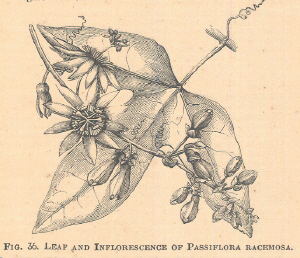
P. racemosa (racemose).* fl. of a deep red or scarlet colour; pedicels twin, forming terminal, pendulous racemes; in consequence of the upper leaves becoming abortive. March to October. l. quite glabrous, rather peltate, glaucous beneath, for the most part trilobed; petioles usually bearing four glands. Brazil, 1815.(B. M. 2001; B. R. 285.) SYN. P. princeps (L. B. C. 84). P. Madonna is said to be a cross between P. racemosa and P. Buonapartea, the latter itself a hybrid between P. alata and P. quadrangularis. BIJOU is said to be a hybrid between P. racemosa and P. Raddiana.
P. Raddiana (Raddi's).* fl. richly coloured, produced in great abundance; calyx blood-colour, the segments linear-oblong, acute, the tube short; petals the same colour, and equal or slightly larger, flat, very spreading, at length reflexed; corona in one series of short, spreading, purple filaments; peduncles solitary, axillary, slender, much longer than the leaves. Autumn. l. trilobed, cordate, dark shining green above, vinous beneath; lobes serrulate at base; petioles terete, biglandular; stipules leaf-like, semi-cordate, sub-cirrhose at apex. Brazil. 1831.(B. M. 3503; B. R. 1633, under name of P.kermesina.) P. Loudoni is considered by Dr. Masters to be a cross between this species and P. racemosa. P Comte Woronzoff is said to be a form of P. Raddiana.
P. rubra (red-berried). fl. greenish-yellow; calyx exceeding the corolla; crown three-seriate, the exterior filaments reddish, nearly as long as the petals; pedicels solitary; ovary hairy April to September. fr. red, hairy, ovoid or sub-globose. l. velvety, cordate at base, two-lobed, with an awn in the recess between the lobes, glandless beneath and on the petioles. Tropical America, 1831. (B. R. 95.)
P. sanguinolenta (blood-red). fl. reddish-violet, small, axillary, solitary; corona violet-coloured below, white at the tips. Summer. l. five-nerved, bilobed, with the lobes divergent. Columbia and Peru, 1868. A slender-growing climber.
P. serratifolia (saw-edge-leaved). fl. with purple petals, the filaments of the crown pale purple at the base, and thence bluish; pedicels pubescent. May to October. l. pubescent beneath, ovate-lanceolate, acute, serrulated, feather-nerved; petioles pubescent, bearing four glands. Mexico, &c., 1731. (B.M. 651.)
P. sicyoides (Sicyos-like). fl. whitish, very fragrant; peduncles twin; bracts filiform, small, approximating the flower. July. l. cordate, three-lobed, sharply sub-dentate or quite entire, glaucous beneath, hairy, biglandular in the recesses, smoothish above; lobes triangularly acuminated, the middle one longest; petioles hairy, biglandular in the middle; glands large, clavate. Mexico and Brazil, 1838.
P. stipulata (stipuled). fl. whitish, the crown variegated with purple and white; peduncles about equal to the petioles; bracts entire. August and September. l. glabrous, glaucous beneath, cordate at base, five-nerved, trifid; lobes ovate, entire; petioles bearing two or four glands; stipules oblong, somewhat auricled, mucronate, entire. Brazil, &c., 1779. SYN. P. glauca (of Aiton). (B. R. 88.)
P. suberosa (cork-barked). fl. of a greenish-yellow colour, the short crown purple at the bottom; pedicels twin. June to September. fr. purple when ripe, ovoid. l. glabrous, somewhat ciliated, five-nerved at the base, ovate, somewhat cordate, usually three-lobed; lobes ovate, acute, the middle one larger than the rest; petioles biglandular above the middle. West Indies, &c., 1759.
P. s. angustifolia (narrow-leaved). fl. yellowish, with the rays purple at the base; pedicels solitary or twin. June to September. l. glabrous, glandless, somewhat peltate; lower ones ovate, the rest lanceolate, two or three-lobed; petioles short, biglandular above the middle. West Indies, 1773. (B. M. 1983; B. R. 188.) P. s. minima (least). fl. greenish-yellow, with white rays; nectary fourfold; inner one with an entire, brown rim; outer plaited, of a dusky purple colour; another ciliated with capillary, black hairs, with yellow tips, the outermost one having the filamentous appendages twice as long as the others, dark purple at base, and yellow from the middle to the tip; pedicels twin. July and August. l. glabrous, glandless, five-nerved, trifid; lobes ovate, the middle one drawn out most; petioles biglandular at the apex. Tropical America, 1690. (B. R. 144.)
P. s. pallida (pale-flowered). fl. yellowish-green, small; corona short; pedicels one to three together. August and September. l. glabrous, ovate, acuminated, three-nerved; petioles biglandular above the middle. Florida and West Indies. (B. R. 660.)
P. tinifolia (Laurestine-leaved). A synonym of P. laurifolia.
P. trifasciata (three-banded). fl. white, fragrant. Summer. l. trilobate, evergreen, marked down the centre of each lobe by a broad irregular band of reddish-purple, the back of the leaf being of a dark sanguineous hue. Para, 1868. (I. H. 544.)
P. tuberosa (tuberous-rooted). fl. greenish-white; outer corona green at the base, tipped with purple and white; style purple; pedicels twin. June to October. l. glabrous, glandular beneath, rounded at the base, three-nerved, three-lobed at the apex; the lower ones usually painted with white on the upper surface; lobes oblong, acute, the middle one very small; petioles glandless. Branches of root tuberous. South America, 1810. (B. R. 432.) SYN. P. punctata (L. B. C. 101).
P. tucumanensis (Tucuman). fl. about 2in. in diameter; petals white; corona doubly filamentous, the outer series white, barred with purplish-blue, equalling the petals; inner series white, tipped with blue, very short; bracts almost equalling the calyx segments, loosely cordate, serrate; pedrncles one-flowered, tribracteate. July. l. broadly cordate, petiolate, trilobed; lobes oblong, deeply glandulose-serrate, glaucous beneath. Brazil, &c., 1836. Plant very glabrous. (B. M. 3636.)
P. vespertilio (bat-like). A synonym of P. Maximiliana.
P. vitifolia (Vine-leaved). fl. yellowish; outer corona orange-coloured; inner corona white; bracts glandularly toothed. July. l. downy beneath, cordate, deeply three-lobed; lobes ovate, acuminated, sharply toothed, with the sinuses biglandular; petioles biglandular at the base, pubescent. South America, 1823.
P. Weberiana (Weber's). fl. white, 2in. in diameter; filaments of corona banded with white; ovary densely setose; peduncles axillary, solitary. Summer. l. large, 3in. to 5in. long, 4 1/2in. to 9in. broad, three-lobed; lobes broadly ovate-oblong, acute, sinuate-toothed, the base deeply cordate; stipules leafy, falcate-oblong. Stem covered with glandular hairs. Argentine Republic, 1885.