Trachycarpus
(from trachys, rough, and karpos, fruit; probably in allusion to the rough, hairy fruit). ORD. Palmae. A small genus (four species) of greenhouse or half-hardy, unarmed Palms; two inhabit the mountains of North India and Burmah, the third is Chinese, and the fourth Japanese. Flowers yellowish, small; spathes many, rather large, compressed, obliquely cut, thickly coriaceous, tomentose; spadices many, short or elongated, robust, densely or loosely flowered. Fruit yellowish, small, globose, ellipsoid, or sub-reniform, one-seeded. Leaves terminal, orbicular or semi-orbicular, deeply plicate-multifid; segments narrow, induplicately bifid; rachis none; ligule very short; petioles biconvex; sheath entire. Caudices solitary and tall, or dwarf and tufted. The species are of very easy culture in a compost of rich, strong loam, to which is added a small portion of vegetable mould and sand. Perfect drainage, and copious supplies of water throughout the summer, are most essential to success. Propagation may be effected by suckers, which generally appear in considerable quantities; or by seeds.
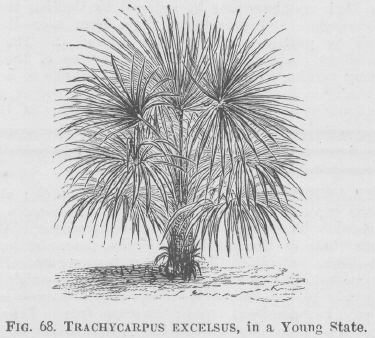
T. excelsus (tall).* fl., spadix 1ft. long, duplicately branched; spathes membranous, fuscous, tubular, bifid at apex. l. in young specimens oblong, in adults transversely oblong, concave, digitately multipartite, 1 1/2ft. in diameter; segments fifteen to sixty, linear, somewhat obtuse, bidentate or shortly bifid, the teeth or segments obtuse; petioles above loosely concave, below convex, 1 1/2ft. long, the margins smooth or armed with small teeth. h. 24ft. China and Japan, 1844.(F. d. S. 2368.) SYN. Chamoerops excelsa. T. Fortunei (Fortune's).* fl. yellow; inflorescence densely paniculate, more than 9in. long. l. semi-orbicular, flabellate, 1 1/2ft. long and broad, cut half-way or more down; segments 3/4in. to 1in. broad, pendulous towards their tips; petioles 1 1/2ft. or more long, unarmed, or the margins very obscurely toothed. Caudex 8ft. to 12ft. high, the lower portion marked with the scars of fallen leaves. China, 1849. Hats, brooms, brushes, cordage, sandals, and whole dresses, are made of the fibrous sheaths of old leaves. (G. C. n. s., xxiv., p. 305.) This is now regarded as identical with T. excelsus. SYN. Chamoerops Fortunei (B. M. 5221).
T. khasyanus (Khasyan). fl. spadix 2ft. long, the lower half concealed by the spathes, of which there are three; branches of the spadix exserted, quite naked. l. flabelliform, reniform, 2ft. long, 3 1/2ft wide; segments about sixty-five, the lateral ones shortest, 12in. to 14in. long, but more deeply divided than the others, linear, their segments 2 1/2in. to 3in. long, narrow, acute; petioles 1 1/2ft. long, with irregular, denticulate margins. Trunk 5in. in diameter. h. 9ft. Khasya Mountains. SYN. Chamoerops khasyana.
T. Martiana (Martius'). fl., spadices many, in adults much-branched, spreading, many-flowered. fr. ovate, sub-solitary, lepidoted. l. palmately multifid; segments bifid at apex; sheath cylindrical, obliquely truncate. Caudex 26ft. high, cylindrical above, 4in. to 6in. in diameter, fusco-cinereous, marked with the scars of fallen leaves. Himalayas. SYN. Chamoerops Martianus.