Important: Safety Warning
This page recommends pest-control substances such as arsenic compounds, strychnine, or cyanide — in some cases applied to food crops. These substances are lethal to humans and animals, and their use is now banned or strictly controlled.
In addition, this page describes additives or treatments for food or drink that are now known to be toxic and are prohibited in food today.
This information has been left in for historical purposes but should not be acted upon.
Pea
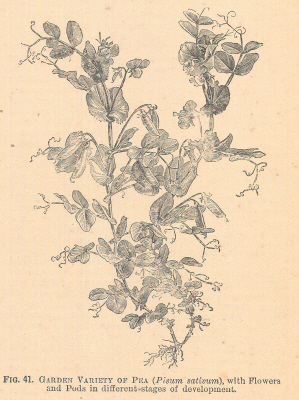
(Pisum sativum). A hardy annual, one of the most valuable and best known of leguminous plants, and one which has been in cultivation from remote antiquity. Its origin is unknown; probably, however, the early home of the species was Western Asia. It is supposed to have been introduced into this country from the South of Europe, about the time of Henry VIII. The uses to which the seeds are put, as an article of food, both in a young, green state, and after being matured and dried, are familiar to everyone. Used in either way, they are very nutritious. Dried Peas, in days long past, formed a more important article of food than at the present time, especially amongst the working classes. They have been replaced very considerably by Potatoes since the cultivation of that vegetable has become so generally adopted. It is to the production and supply of green Peas that cultivators now more particularly devote their attention, and a continued succession of crops becomes necessary in order to maintain an unbroken supply. Green Peas, very early in the season, are justly considered a great delicacy, and gardeners vie with each other in using every means in their power to supply a dish as early as possible. To this end, it is important that only suitable early varieties be grown, and that they should receive more than ordinary attention in spring, and until their produce is fit to gather. Mid-season and late varieties bear longer in succession than early ones, and various heights also make considerable difference respecting the time taken in perfecting their crops. CULTIVATION. The Pea crop is best provided for by a rich, loamy soil, amongst which plenty of calcareous matter, such as lime, chalk, &c., should be incorporated. It should be of a good depth, in order that the roots may penetrate for a supply of moisture, should the surface become dry. This is of great importance in summer, as then the plants require plenty of moisture, and if the supply is insufficient, mildew invariably attacks the leaves, and the pods rarely fill satisfactorily. Manure is best suited for Peas when applied to a previous crop; should ground of such a description be unavailable, or the position unsuitable, it would be best to thoroughly trench, and add horse, or ordinary farmyard, manure at about 1ft. beneath the surface. Some cultivators prepare trenches, in which such manure is laid at the bottom, and covered in with the soil previously taken out. For main and late crops, this plan has been found very successful, because by it the roots are provided with an extra amount of nutriment and moisture at a time when they most require it. Efficient drainage is, however, important, and the surface should be kept open for the reception of all the rainwater available. The treatment varies somewhat with the seasons, the time when the seeds of successional crops are sown, and when they are intended to come to perfection. For the earliest supply, a warm, rather lighter soil, and a more sheltered position, are requisite, compared with what is suitable later in the season. Drills for Peas should be drawn flat and rather wide, say 6in. at the bottom, and at a uniform depth of about 2 1/2 in., or a little deeper for large-seeded kinds. When sown in autumn, too, a greater depth is recommended than for spring; but the soil filled in should first be rendered somewhat fine, in order that the young seedlings may readily find their way through it. If the seeds are good, they should not be sown too thickly, particularly the strong-growing, late sorts. As a general guide, a pint of good seed of an early or medium-growing Pea should sow from twelve to fifteen yards run, a similar quantity of a late sort being equalised over a further length of about ten yards; provided that, in either case, most of the seeds are likely to grow. The distance apart for the rows depends on the height to which the variety is expected to grow, and the space available. Rows of Peas, sown some distance from each other, and the intervening space occupied with another crop, is an excellent system, much practised, with the result that a more abundant yield is obtained than when the rows are very near each other. This plan does not, however, answer so well for early supplies, because the necessary shelter would not be insured. For these, a sunny south border is requisite, and, in order to subject each row to an equal amount of sunshine, and also utilise the whole border, so far as the quantity of seed reaches, it is generally most convenient to sow in an oblique direction across the border, allowing the lines to run in the direction from south-east to north-west, the space allowed between each two rows being about equal to the estimated height that the sort of Peas sown will reach. When Peas are provided with sticks on which to climb, as is usually the case with those grown in gardens, it is very important that the plants should not be allowed to fall about or become bent before the sticks are inserted, else they seldom take hold properly. Earthing-up should first be practised, lightly, when the seedlings are a little above ground, and again before the sticks are inserted. When dwarf sorts are cultivated, and allowed to grow on the ground--a plan not in any case recommended, except for field or market-garden culture on a large scale--the earth should be drawn more to one side than the other, in order to encourage all the plants to turn in one (the opposite) direction. The seeds of Peas require some protection against the depredations of mice; otherwise, they are in danger of being entirely demolished even before germination takes place. To prevent this, various plans have been devised. Some merely cover the seeds of early sowings with a little good soil, and then with, say, 2in. of sharp sand or sifted coal ashes, these substances not being readily burrowed into by mice. As a preventive, the seeds should always be placed in a little sweet oil, and afterwards covered with dry red lead, which will then adhere to their surface; powdered resin has also been recommended for use in a somewhat similar way. For other methods of lessening the harm done by mice, see Mice. Small birds are very destructive to the young plants when they are just issuing from the ground, by clipping off a great part, or sometimes the whole, of their heads. Pea-guards, made by fixing ordinary wire netting on a framework with semi-circular iron hoops attached, are most useful for placing over the rows until danger is past. Failing these, small black threads, fixed a couple of inches above the young plants, and stretched as tightly as the material admits, will often prove an effectual preserver. The smaller and more invisible such threads are, the better, as, if they are large enough to be easily seen, small birds pass under them unscared, and carry on their disastrous practices underneath. In some localities, particularly near shrubberies and large trees, birds are very destructive to the Pea crop when it begins to be fit for gathering. Numerous plans are adopted for lessening the amount of destruction by scaring the birds, but it is seldom altogether prevented when once commenced, except by covering the whole with netting; this is usually kept at a fair distance off by the Pea-sticks themselves. An occasional discharge of a gun has also proved instrumental in warding off such unwelcome visitors amongst green Peas as hawfinches, blue tits, and sparrows. Earliest Crops. In gardens generally, some time during the month of May is as early as a gathering of green Peas can be expected, and not unfrequently, in an unfavourable season, June has considerably advanced before many dishes are procurable. As before stated, great attention is accorded to early Pea culture, but, at times, the very earliest crops are exceedingly precarious. There are many methods of forwarding and protecting; but, first of all, it is imperative that only suitable early sorts must be sown. Dwarf Peas are sometimes forced in large pots under glass, but the system is scarcely worth pursuing, except for the possibility of securing a satisfactory result, the latter being by no means certain. Nothing approaching a high temperature should be allowed, nor must a close atmosphere be permitted. Failure is not unfrequent, in consequence of the flowers failing to set in winter time. In spring, some pots might be utilised, and an early--though very limited--supply obtained in advance of any from outside. Forcing of Peas under glass must not be attempted before the pods are set; they will not withstand anything beyond forwarding in a cool, airy, and light situation. For earliest crops outside, a south border, duly sheltered by a high wall, or fence, may be selected, the ground prepared, and seeds sown about the middle of November. With a view to providing for mishaps through winter, it is advisable to sow more thickly at this season than has been already recommended. As the young plants appear, some of the earth on either side should be drawn up to form a slight ridge, which should be increased in height by a similar process when a little more growth has been made. Shelter must also be afforded, especially on the northern side, by the insertion of short sticks, or branches of evergreens. Young Pea-plants will, under certain circumstances, bear considerable frost without injury, but they can ill withstand a cutting wind. In very severe weather, a light covering of dry bracken, or similar material, should be thrown over them to prevent the ground becoming much frozen. Staking affords of itself a great amount of shelter, and should be attended to so soon as the plants are sufficiently high. A few evergreen branches will still prove valuable on the more exposed sides of the rows. Should this sowing succeed, and make satisfactory progress, the spaces between the rows should be deeply hoed early in spring, when the surface is in a fairly dry condition, and has become somewhat warmed by sunshine. Another sowing should be made in January, should weather and circumstances permit, and still an equally well-sheltered situation should be chosen. It not unfrequently happens, in a favourable spring, that this sowing nearly overtakes that sown in autumn by the time the produce is fit for gathering. Still, a few days are then generally considered of great importance. Where space and plenty of 4in. pots are available, it is a tolerably common practice to sow under glass early in February, with the intention of transplanting outside in March. Half-fill the pots with any fairly rich soil, scatter from eight to twelve seeds over the surface, then fill up with soil, and stand the pots in a cold frame, where air may be admitted on all favourable occasions. Treated in this way, the plants become much sturdier than when artificial heat is applied, and may be eventually planted out with a far greater chance of success. Favourable weather should be selected for transferring them outside, and, in planting, the balls may be inserted intact, or gently pulled in halves, and the latter planted separately. A warm position is necessary for Peas thus started at the commencement; earthing-up and protection are also essential so soon as they are planted out. Young seedling Peas transplant readily; consequently, it is advisable to fill up blanks, and make rows good, so far as the stock at command admits.
Successional and Main Crops. Once the supply of green Peas is commenced, it is most important that it should be kept up so far as possible. To this end, varieties, differing in height and description, and successional sowings, must, collectively, be made to contribute. Successional sowings of one sort during the two first months of the year and part of March will, as a rule, vary but little in the time of bearing, whereas if three or four sorts, varying in height and other particulars, are sown at the same time, a succession in bearing is more likely to be assured. From the end of March until June, sowings for main crops should be made at intervals of about three weeks, according to locality, and other circumstances not under control. Some make a sort of rule to sow again when the previous sowing is just appearing above ground; but this is not always a certain guide, as the weather would have a variable effect in different seasons and localities. For successional and main crop Peas, a position in one of the best parts of the garden quarters should be reserved, and the ground previously prepared, if unfit for their requirements. The drills for these should proceed in a direction from north to south. When earthing-up, the soil should be drawn just up to the plants, and left in a ridge on either side, with a view to retaining all rain or other water, instead of allowing any to run off.
Late Crops. To continue the succession into autumn, and maintain a supply, is not always an easy matter; still, it is very important that every attempt at doing so should be made. Strong-growing, tall and dwarf Marrow Peas are best suited for the purpose; and the trench system, with manure placed beneath, in the way already described, is the best method of cultivation. The great cause of failure is mildew on the plants, and this may be considerably prevented by providing a good depth of soil, and plenty of moisture beneath, where the roots penetrate. A mulching of rotten manure is of material help in preventing evaporation; it should be about 3in. deep, and laid on the surface for 1ft. or more on each side of the rows. In favoured localities, sowings for late crops may be made from the middle till the end of June; but, in northern parts, the beginning of June is sufficiently late for allowing the plants to blossom and bear anything like a crop. Some cultivators sow second early sorts late in the season, because of the likelihood of their turning in more quickly; but the plants lack the strength of late kinds, and the produce is also much inferior in quality. Tall sorts, grown late, should be stopped when about 4ft. high, in order to promote fruitfulness at an earlier stage than would be likely under ordinary circumstances. A sowing of late sorts should also be made, first in April, and secondly in May.
All Peas are benefited by an occasional dressing of soot and a little lime on the surface, previous to and at the time when they are pushing through the ground. It tends greatly to ward off slugs, and is by no means agreeable to birds and mice. Should watering become necessary in summer, a thorough soaking should be given, and this applied at too late a stage is but of little use. When gathering Peas for use, only such as are fit should be selected, the whole stock of one sort being looked over each time, in preference to picking a portion severely, and leaving others alone possibly to become too old. Pea-sticks should be as strong and thin in proportion as may be procurable, and used at about the heights different sorts are calculated to reach. They should be firmly inserted in a slanting direction, the set on one side pointing in an opposite direction to the other, yet at about the same angle. The leaf-tendrils clasp and retain a firmer hold on sticks thus arranged than they do on others inserted vertically. A few small branches near the base are instrumental in assisting the plants to commence climbing. SORTS. Varieties of Peas are become exceedingly numerous, and several new ones are still annually put into commerce. Few vegetables have been so greatly improved during the last few years as Peas, particularly in the direction of introducing the superior-flavoured Marrows amongst the earlier sorts that were originally all small and round-seeded. There are different methods adopted for arranging Peas in classes for reference and distinction. Formerly, the smooth or round-seeded kinds were far more numerous than those with wrinkled seeds; now they are nearly equally represented. White, green, and blue wrinkled Marrows are severally distinguished by their dried seeds being compressed, wrinkled, and of the colours given. Sorts with their dried seeds round or roundish in shape are mostly either white or blue; in some, they are small, with thin skins; others are large, and have thick skins. Peas retain their germinative powers for three years, some sorts for a longer period. Wrinkled seeds do not germinate so readily as round ones, nor do they keep good so long. The habit of growth and mode of bearing which Peas assume is represented. Respecting the periods when sorts which are sown at different times may generally be expected to produce their crops, much depends on the season, locality, soil, and various other circumstances. The earliest round Peas, sown in autumn, or very early in January, may be expected to be ready by about the end of May; others, sown in January and February, should follow about the middle of June. Dwarf Marrows, sown during the early part of March, should come in early in July; and sowings of tall Marrows, made in succession from about the beginning of April, should similarly succeed each other in bearing from the middle of July onwards. Subjoined is a limited selection from amongst the principal sorts in cultivation, arranged for convenience according to the different seasons in which they come in bearing. An asterisk denotes a sort specially recommended.
Earliest Sorts.
Alpha (Laxton's).* Wrinkled blue Marrow. Pods produced singly, occasionally in pairs, long, narrow, much curved and pointed, each containing from six to nine good-sized peas, of fine quality. h. 3ft. to 3 1/2ft. One of the best early wrinkled Marrows.
American Wonder.* Wrinkled Marrow. Pods produced singly or in pairs, about 2in. long, straight, well-filled. h. 9in. to 12in. An excellent first-early variety, of compact habit and fine flavour.
Beck's Gem. Seeds round, white, smooth. Pods generally in pairs, straight, nearly round, containing about six tolerably large peas. h. seldom exceeding 1ft. Very prolific.
Blue Prussian. Seeds round, light blue, smooth. Pods mostly in pairs, seldom solitary, about 3 1/2in. long. h. 3ft. to 3 1/2ft. An old, very prolific variety, grown extensively for market.
Daniel O'Rourke.* Seeds round, white, smooth. Pods straight, solitary, generally from eight to ten on a plant; peas rather large. h. 2ft. to 2 1/2ft. A well-known early variety, sometimes called SANGSTER'S No. 1.
Dr. Hogg.* Wrinkled green Marrow. Pods borne singly or in pairs, long, much curved, containing from seven to nine large peas, of excellent quality. h. 3 1/2ft. to 4ft. One of the earliest wrinkled Marrows.
Earliest of All (Laxton's). Seeds round, blue. Pods produced in pairs. h. 2ft. to 2 1/2ft. A heavy cropper, of excellent quality. The earliest round blue variety.
Early Dwarf Frame. Seeds round, white, smooth. Pods mostly solitary, about 2in. long, slender. h. about 10in. A dwarf, productive variety, suited for culture in frames.
Early Frame. Seeds small, very round, white. Pods straight, well filled, generally containing six peas in each, of excellent quality. h. 3ft. to 3 1/2ft. An early, hardy variety, with numerous synonyms.
Early Sunrise (Day's).* White wrinkled Marrow. Pods long, nearly straight; peas large for an early variety. h. 2 1/2ft. to 3ft. Compact, bushy habit; hardy, and very prolific.
Maclean's Blue Peter. Seeds round, blue. Pods sometimes single, sometimes in pairs, rather over 2in. in length, each containing from six to eight very large peas. h. not exceeding 1 1/2ft. A very dwarf variety, with dark green foliage. A few days later than the EARLY DWARF FRAME.
Maclean's Little Gem.* Green wrinkled Marrow. Pods produced in pairs, broadish, nearly straight, well filled. h. 1ft. to 1 1/2ft. An excellent cropper, dwarf, very early, and of good quality. Fine for forcing.
Ringleader.* Seeds round, white, smooth. Pods straight, usually solitary, each containing six or seven peas. h. 2 1/2ft. to 3ft. Habit slender. This is considered one of the best early smooth Peas for outside culture, and is rather a remarkable variety, inasmuch as the first flowers either do not expand properly, or remain until those above are also ready to open. The flowering and bearing seasons are thus limited, the whole crop turning in nearly at once. A good early sort, extensively cultivated; also known as CARTER'S FIRST CROP. DICKSON'S FIRST AND BEST is rather larger, and perhaps more productive, than RINGLEADER; it is, however, much like it, but a few days later.
William the First.* Smooth, green-seeded Marrow. Pods borne singly and in pairs, nearly 3in. long, narrow, curved at the point; they are deep green, covered with a thick bloom, and each contains from seven to nine good-sized peas, of excellent flavour. h. 4ft. to 5ft. An exceedingly valuable variety; one of the earliest and best Marrows.
Second Early and Main Crop.
Advancer (Maclean's).* Wrinkled blue Marrow. Pods generally in pairs, slightly curved, containing about eight very large, compressed peas, which are of first-class quality. h. 2ft. to 2 1/2ft. An excellent early Marrow, which turns in a few days after Laxton's ALPHA.
Champion of England.* Wrinkled blue Marrow. Pods sometimes solitary, but generally produced in pairs, long, slightly curved and flattened, each containing from six to nine peas, closely packed and compressed. h. 5ft. to 6ft. A strong-growing, abundant-bearing, climbing Pea, of great excellence; one of the best for general use.
Dickson's Favourite. Seeds round, smooth-skinned. Pods generally in pairs, medium-sized, long, well filled. h. 4ft. to 5ft. An abundant bearer and good sort.
Dr. Maclean.* Blue wrinkled Marrow. Pods very large, handsome, well filled with about nine very large peas of excellent quality. h. 3 1/2ft. to 4ft. One of the finest wrinkled Marrows, coming in after ADVANCER. Very robust in habit.
Duke of Albany. Wrinkled green Marrow. Pods usually produced in pairs, nearly 4in. long, straight, very thick, well filled with about ten large peas. h. 5ft. to 6ft. Vigorous growing and productive.
Fillbasket (Laxton's). Seeds round, light green when ripe. Pods generally in pairs, very long, curved and pointed at the end, closely filled with from seven to nine good-sized peas. h. 3ft. Of vigorous growth, with branched stems and distinct, large, yellowish-green leaves.
G. F. Wilson (Carter's).* Wrinkled blue Marrow. Pods borne singly and in pairs, large, nearly straight, from 2in. to 3in. long, usually containing not more than from six to eight peas, which are, however, very large, oblong, and somewhat flattened. h. 4ft. An excellent cropper, of robust habit.
Gladiator.* Wrinkled Marrow. Handsome pods, produced in pairs, long, curved, closely filled with medium-sized, deep green peas, of excellent quality. h. 3ft. A remarkably prolific and distinct main crop variety. Plant of robust, vigorous habit.
Maclean's Wonderful. Wrinkled Marrow. h. 3ft. A productive variety, with large pods; good cropper, and of excellent flavour.
Marvel (Laxton's).* Wrinkled white Marrow. Pods produced singly and in pairs, large, much curved, and pointed, containing from seven to nine large peas, which are very green. h. 3ft. An excellent and productive main crop variety, of fine quality.
Prodigy. Green wrinkled Marrow. Pods generally in pairs, nearly straight, extra long and broad, each containing about ten large peas, of excellent quality and flavour. h. about 5ft. Plant robust, vigorous, branching; said to be very productive. A fine new variety, sent out in 1886.
Stratagem (Carter's).* Wrinkled Marrow. Pods of enormous size, and sometimes upwards of 6in. in length, each containing from nine to eleven very large peas. l. dark green. h. 2ft. to 2 1/2ft. Habit robust. One of the best dwarf, wrinkled Marrows in cultivation.
Supreme (Laxton's).* Smooth, green-seeded Marrow. Pods from 3in. to 3 1/2in. in length, straight, with an abruptly curved point, well filled; peas large, and of fine flavour. h. 4ft. to 5ft. A hardy and productive second early variety. The pods swell to an unusual size in advance of the peas, which causes them to appear ready for gathering long before they really are.
Telegraph (Culverwell's).* Wrinkled Marrow. Pods very numerous, long, broad. Peas large, nine to eleven in a pod, of a fine deep green colour and excellent flavour when cooked. h. 5ft. to 6ft. An excellent, well-known sort, of robust habit.
Telephone (Carter's).* Wrinkled Marrow. Pods solitary or in pairs, very large and broad, each containing from eight to eleven large peas, of first-rate quality. h. 5ft. to 6ft. A splendid wrinkled variety, selected from CULVERWELL'S TELEGRAPH. One of the finest second early sorts. Veitch's Perfection.* Wrinkled blue Marrow. Pods large, usually borne in pairs, straight, containing seven or eight large, compressed peas, of superior quality. h. 3ft. An excellent cropper; highly esteemed as being one of the best sorts.
Late Crop.
British Queen.* Wrinkled white Marrow. Pods usually in pairs, very long and nearly straight, each containing about eight very large, tender peas. h. about 6ft. Plant of vigorous growth and branching habit. A good late sort.
Culverwell's Giant Marrow.* Blue wrinkled Marrow. Pods immense, broad, and upwards of 7in. long, well filled with large peas, of finest quality. h. 5ft. to 6ft. Exceedingly productive and fine.
King of the Marrows. Wrinkled green Marrow. Pods generally in pairs, broad, from 2in. to 3in. long, containing from six to eight large, oblong peas. h. 6ft. to 6 1/2ft. One of the very latest and tallest-growing sorts.
Maclean's Best of All. Wrinkled green Marrow. Pods produced in pairs, over 3in. long, broad, gradually narrowed at both ends. They contain from five to eight large peas in each, but are not regularly filled. h. about 3ft. A rather late sort, productive, and of good quality.
Ne Plus Ultra.* Wrinkled green Marrow. Pods nearly always in pairs, fine dark glaucous green, curved, narrowed towards the stalk; peas very large, from seven to nine in a pod, of first-rate quality. h. from 6ft. to 7ft. An abundant bearer, and one of the best late Peas in cultivation.
Omega (Laxton's).* Wrinkled green Marrow. Pods usually in pairs, long, narrow, very closely filled with from eight to ten very large, dark green peas, of excellent quality. h. about 2 1/2ft. Very prolific. This might be termed a dwarf NE PLUS ULTRA.
Prizetaker Green Marrow. Smooth, green-seeded Marrow. Pods nearly 3 1/2in. long, slightly curved, of a deep bluish-green, covered with thick bloom. Each pod contains from six to ten large peas, which become misshapen from being compressed. h. 4ft.to 5ft.
Sturdy (Laxton's).* Wrinkled green Marrow. Pods produced in pairs, long, nearly straight, containing from six to nine large, dark green peas, of excellent quality. h. about 3ft. One of the latest sorts, robust, strong growing, much branched.
EDIBLE-PODDED OR SUGAR PEAS. All the sorts of Peas that have been already noticed are grown in gardens, principally for the use of their produce in a young or green state. They are termed Shelling Peas, and the pods are of no use when once their contents are extracted, because they are lined with a hard and tough, stringy membrane, which renders them unfit for food. In the other class, now under notice, the pods are usually destitute of this stringy substance, and readily snap, like those of Kidney Beans. If prepared and cooked, when young, in a similar way to the lastnamed vegetable, they are considered to form an excellent dish, one which is more appreciated on the Continent dish, one which is more appreciated on the Continent than in this country. Edible-podded Peas are not much cultivated in Britain; not so extensively, perhaps, as their merits deserve. Subjoined are the names of a few sorts.
Butter Pea. Pods from 2in. to 2 1/2in. long, produced singly, and in pairs, deeply curved; the sides are very fleshy, thick, and succulent. h. 3ft. to 4ft.
Dwarf Dutch. Pods often solitary, narrow, crooked, thick, and fleshy; seeds white, large, from five to seven in a pod. A very dwarf variety.
Early Dwarf Brittany.* Pods generally in pairs, about 2in. long, narrow, fleshy, quite free from membrane. h. about 2 1/2ft.
Forty Days' Edible-Podded. Pods generally in pairs, straight, free from membrane; peas medium-sized, slightly compressed, white when ripe. h. about 4ft. A climbing variety, which produces its flowers over a long period.
Giant Sugar Pea.* Pods sometimes 6in. in length, larger than those of any variety of this class, much twisted; peas large, distinctly seen from the outside of the pod. h. 4ft. to 5ft. Should be used when young.
Large Crooked Sugar Pea.* Pods very large, sometimes 5in. long, broad, often crooked, free from membrane, and exceedingly tender when young. h. about 5ft. One of the best sorts, more extensively grown than any of the others.
FUNGI. The Fungi parasitic on Peas are chiefly two species, which resemble each other in forming whitish coatings on the leaves and other parts of the plants; but they are not difficult to distinguish, even with the unaided eye. In both, the whitish coat is formed of rows of cells, forming threads too slender to be seen distinctly, even with a lens. Both belong to the forms included under the general name of Mildew (which see); but they represent widely different groups of Fungi. Erysiphe Martii (Pea Mildew) is the commoner of the two. It possesses conidia of the type described under Oidium and also spores in asci which lie in the perithecia. The plants are, at times, wholly covered with this Fungus, and the result is stoppage of their growth, and loss of the seeds. Unfortunately, this Fungus grows on many other plants also, so that it can hardly be exterminated from gardens. Peronospora Viciae (Pea Mould) is more plentiful on Tares than on Peas. On both, it grows on the lower surface of the leaves; and it differs from the Pea Mildew in sending its filaments through the Pea's tissues, thus living inside the hostplant. It differs also in the reproductive processes. The conidia are of the kind described under Peronospora; and so also are the resting, or sexually mature, spores. The latter are formed within the tissues of the Peas, and serve to reproduce the Fungus in the following spring. Plants attacked by this Fungus are pierced by it in all directions, though only the branches that bear conidia are to be seen on the outer surface of the host-plant. The diseased tissues become brown, and ultimately rotten, and fall to pieces. P. Viciae appears in early summer; it attacks many leguminous plants. Remedies should be directed rather to insure prevention of injury to subsequent crops than in trying to save those plants already diseased. All refuse, especially Pea stalks, and other rubbish of that nature, must be collected and burned, to prevent the diseases being transmitted by such means from the crop of one year to that of the next. The remedies recommended under Mildew and Oidium would help to check Pea Mildew (which is quite superficial in its growth), but would not be of any use for Pea Mould.
Peas, along with Beans and Vetches, are also subject to the attacks of Pea and Bean Rust (Uromyces appendiculatus, var. Pisi). Plants diseased from this cause assume a dull, rusty-brown hue, which, in bad attacks, may almost conceal the green of the leaves, but usually only modifies it more or less. This colour is due to very numerous, small, rust-coloured spots, distributed over the surface, none of them usually exceeding 1/10in. across; though, occasionally, two or more may meet, and join into one spot. Under the microscope, the spots are seen to be made up of a crowded mass of minute, egg-shaped cells, of a rusty-brown colour, each supported on a long, slender stalk. These cells are the spores of the Fungus, and ripen towards the end of summer, or in autumn. In spring, each pushes out a blunt, slender tube, on which form three or four very small sporidia; and these, if they fall on a suitable food-plant, push a tube into it. This tube branches and spreads through the tissues, and forms, in turn, new spots of spores bursting through the epidermis, or skin, of the leaf. It is believed, by some botanists, that this Fungus appears also in another form on one of the Spurges, Euphorbia Cyparissias. Plants attacked by Rust should be burned as soon as possible, to prevent the disease from spreading. The position of the mycelium in the tissues of the host-plants renders any direct means of destroying the Fungus hopeless, without involving the host-plant in the demolition. Such plants as favour its spread, and give it support, e.g., Vetches, should be kept as far from the Pea crop as possible.
INSECT PESTS. The Pea is exposed to the attacks of not a few insects. Some of these injure the leaves and the young stems; others feed in the fruit, eating the Peas, either while young and soft, or after they have been stored in the granary, and leaving them mere hollow shells, pierced at one side with a hole. The seeds are frequently damaged by Millipedes (see Myriapoda) while they are sprouting, especially in wet seasons, and, like all garden produce, they are eaten by slugs and snails. Among their worst foes are the Pea and Bean Weevils (see Sitona), which, as beetles, gnaw the leaflets, leaving the margins notched; or the whole leaflet is more or less completely eaten away. In very bad attacks, the whole crop may be destroyed. These beetles also feed on Beans, Clover, Lucern, and other leguminous plants. The most hurtful species are the Striped Pea Weevil S. lineata), and the Spotted Pea Weevil (S.crinita). They are about 1/6in. long, elliptical, black, covered with minute scales, which are clay-coloured, rosy-greyish, or whitish; the beak is short and stout; and the wing-covers bear ten lines of minute pits from end to end. S. crinita may be known by having short bristles on the wingcovers behind, and by its slightly smaller size. These insects feed during the day, but are readily overlooked, since, when alarmed, they at once fall from the plants to the earth. They begin their ravages even in March, and may be met with throughout the summer.
The larvae of several kinds of moths are destructive to Pea-plants. as well as to other garden produce (see Mamestra, Plusia, and Potherb Moths). The larvae of a small fly (see Phytomyza) burrow between the surfaces of the leaf, and make winding, white tracks, in which they change to pupae, and thereafter into flies; but these mines can scarcely be said to weaken the plants.
The roots are liable to be eaten by larvae that live underground (see Noctua and Wireworms). The young shoots and branches are occasionally smothered, or nearly so, by swarms of Green Fly (see Aphides), usually of the species Siphonophora Pisi and Aphis Papaveris.
Bees, but more particularly Humble Bees (which see), at times, do considerable harm, by boring holes, from which to suck the honey, without effecting the fertilisation of the ovules by transferring pollen from flower to flower. The larvae of a tiny midge (Cecidomyia Pisi) may, at times, be found feeding, in large numbers, in the young pods, eating the unripe Peas, and causing the pods to be spotted with yellow. The larvae are white, and reach about 1/3in. in length. They bore out of the pods, when full-fed, fall to the ground, and become pupae in the earth.
The larvae of certain beetles, and of two or three moths, feed on the seeds in pods approaching ripeness, as well as in dried Peas. The more noteworthy are: Tychius quinque-punctatus and Bruchus Pisi and B. granarius among beetles; and Grapholitha pisana, Guen. (Endopisa proximana of Stainton's "Manual"), and, to a less extent, Endopisa nigricana (of the same "Manual") among the moths.
Tychius quinque-punctatus is a Weevil about 1/5in. long, elongate-ovate; the beak tapers from base to tip, is rather long, and curves downwards; the colour is black, covered with coppery-red scales. The lower surface is pure white; the thorax is rounded, the thighs rather thick, toothed, and black; the rest of the legs, and the antennae, dull red. The beetles appear in late autumn, live through the winter, and in spring and early summer lay eggs in the young pods of various Leguminosae. The larvae feed in the pods. They are yellowish-white and smooth. When full-fed, they fall to the ground, and become pupae in the soil.
The Bruchidae differ from Weevils in having the beak short, broad, and flattened, the antennae straight and gradually becoming thicker, the wing-cases shorter than the abdomen, and the hind legs long and strong. B. Pisi is about 1/5in. long, oval, black, with a dense coat of silky hairs, which are bright brown above, paler beneath; thorax variegated with orange hairs; lateral teeth white; wing-cases striated, with some paler spots and obscure streaks; tarsi and tibiae, in parts, and four basal joints of antennae dull red. This beetle has been most injurious in Southern Europe. It is believed to be a native of North America. Though often imported with Peas, it has not fully established itself anywhere in Britain. The beetles pair while the Peas are in flower; and the females deposit their eggs in the Peas, in which the larvae live all winter, hollowing them out; finally becoming perfect beetles, and boring out from them in the ensuing spring and summer. B. granarius is slightly smaller than B. Pisi, but is otherwise much like that species, though with a thinner coat of hair. The teeth on the sides of the thorax are less distinct; and there are white dots on the back. The wingcases are sprinkled with whitish hairs, and there is a brown stripe near the base of the wing-cases. The first pair of legs, and the four basal joints of the antennae, are pale red; and the second and third pairs of legs are dark throughout. B. granarius is common in Peas, and also in pods of Beans, Broom, Furze, and Vetches. In habits, it is much like B. Pisi. It has been asserted that Peas and Beans containing the larvae injure the health of persons, and of domestic animals, who partake of them.
The moths hurtful, in the larval state, to Peas are included in the great group of Tortricina (which see), and are now referred to the genus Grapholitha, though Stainton, in his "Manual," includes them in the genus Endopisa. Of these, the most common is the Pea Moth (G.pisana, Guen.= Endopisa proximana of Stainton's "Manual"). This insect measures about 1/2in. across the front wings, which are olive-brown in colour, with a row of short, pale yellowish lines along the front margin, directed backwards. Near the hind margin is a silvery ring, inclosing a spot in which are three or four short, black lines. The moths fly in June; they lay eggs on the young pods, and the larvae bore into the pods to reach the seeds. When full-fed, they are about 1/4in. long, rather stout, and yellowish, with a black head, and brown dots on the rings. They eat their way out of the seeds when full-fed, and creep underground to become pupae. The moths appear in the following June. Nearly allied to this species is another, G. tenebrosana, Dp. (E. nigricana of Stainton), which differs in its darker brown ground-colour, and only faintly yellowish tip; in its whitish and pale yellow scales, scattered over the wings; and in the spot near the hind margin being very little yellower than the rest, and inclosing mere dots instead of streaks. The larva of this species also feeds in Peas.
Remedies. These differ with the habits of the various insects, and other foes. For measures to get rid of Millipedes, see Millipedes and Myriapoda; and see also Slugs and Snails for remedies against the attacks of those creatures. The Pea Weevils (Sitona lineata and S. crinita) may be best prevented from doing serious damage by using all means to promote the rapid growth of the plants, as they are thus protected against the loss of all their leaves. Good soil, well prepared and well manured, is one of the best means for obtaining a good crop of Peas. A dressing of coal ashes along the rows also favours growth. It is recommended that Peas should follow Cabbages or root-crops. All kinds of shelter for the beetles should be abolished. To free the plants when attacked, a dressing of lime, or of soot, sprinkled on the wet plants, has proved useful; and gas-lime, or sand mixed with paraffin, scattered on the soil along the rows, would probably help considerably. Harrowing, or hoeing the Peas when wet, is also said to be of marked benefit. Shaking the plants over tarred canvas, or over sheets, from which the beetles can be swept up and destroyed, will materially help in reducing their numbers. For means of preventing ravages of root-feeding larvae, see Noctua and Wireworms.
The mining larvae of the fly Phytomyza do so little harm, that, as a rule, it is unnecessary to take means against them; the only method of cure seems to be crushing the larvae, while in the leaves, between the finger and thumb. For means to be employed against the larvae of the larger moths, see Mamestra and Potherb Moths.
If Aphides appear on the young shoots, the best treatment is to nip these off at once and burn them, and thus prevent the Aphides from increasing and spreading to the remaining parts of the plants. To free a few plants from Green Fly, dressings of soot on the wet plants, or of soap-suds, would be advantageous.
Humble Bees are seldom so hurtful to Pea flowers as to render their destruction needful, more especially since they do good by effecting, or, at least, aiding in securing the advantages of, cross-fertilisation. If it should become desirable to reduce their numbers in any garden, this can only be done by catching the individual bees, and by seeking out and destroying their nests, hidden in holes, under moss, &c.
The Pea Midge (Cecidomyia Pisi) seldom does much evident harm; the only methods of limiting its ravages are: Picking the diseased, yellow-spotted pods, and digging down the surface soil to destroy the pupae.
Against all the larvae that feed in the seeds, the most useful remedy is to expose the latter for a time to a heat of about 125 deg. Fahr. This heat will destroy the larvae, but will not injure the seeds.
Pea-straw should be removed and burned as early in the autumn as possible. Since the beetles and moths alike burrow into the ground to become pupae, whatever may help to destroy the pupae in the earth will be of service. Trenching the soil is of special value, since it throws many of the pupae too deep to allow the insects to reach the surface, and other pupae are exposed to the eyes of birds. Applications to the plants of soot, or of any other disagreeable substances, might prevent the female insects from laying their eggs thereon.