Peperomia
(from Peperi, Pepper, and omoios, similar; in allusion to its close relation to that plant). Pepper Elder. Including Micropiper. ORD. Piperaceae. A vast genus (nearly 400 species have been described) of mostly stove, annual or perennial, herbaceous plants, usually fleshy and creeping, broadly dispersed over the warmer regions of the globe, but mostly American. Flowers minute, variously disposed, scattered and crowded; perianth wanting; stamens two. Leaves alternate, opposite, or verticillate, entire, slightly fleshy, succulent, or slender and membranous, often pellucid-dotted; stipules none. Peperomias are very interesting, small-growing, ornamental-leaved plants, suitable for culture in small pots; some of the species that are of trailing habit are also well adapted for hanging baskets. Although, properly, the species described below are stove subjects, they may be placed in vases for the temporary decoration of the sitting-room, as their stout, succulent leaves enable them to successfully withstand the change. They should be grown in good, fibrous peat and loam, with the addition of some silver sand. Shade from sunshine throughout the summer is requisite; but an abundance of light should be allowed in dull weather, and shading dispensed with altogether in winter. Propagated by cuttings, and by seeds when obtainable. Cuttings consisting of short pieces of the shoots, or single joints with a leaf attached, root readily in spring, if inserted in pans of sandy peat; these should be plunged in a propagating house, but not in a frame: they are liable to damp off if confined. Keep shaded, and only a little moist, until roots are formed. Even when established, Peperomias do not require so much water as many stove subjects. The species described below are grown for the beauty of their foliage. They are perennials except where otherwise specified. P. arifolia (arum-leaved). l. variegated green and grey, ovate, acuminate. Brazil, 1864.
P. a. argyreia (silver-striped). A synonym of P. Saundersii.
P. Botterii (Botteri's). fl. borne in slender, cylindrical catkins. l. ovate, pubescent, growing in whorls of three. Stems slender, sparingly branched. Mexico, 1869. (Ref. B. 211.)
P. brevipes (short-stalked). l. beautifully variegated with brown and light green, round, on long, thread-like stems. 1879. A pretty and slender-growing basket-plant. SYN. P. prostrata (of gardens). (G. C. n. s., xi. 717.)
P. clusiaefolia (Clusia-leaved).* fl., peduncles terminal, smooth, red, bearing one or two long, cylindrical spikes. May. l. 4in. to 6 in. long, between coriaceous and fleshy, shortly petiolate, obovate, tapering downwards and somewhat auricled at the very base, concave and channelled above, the margins dark red and recurved, the extremity often emarginate. Stems much-branched, red, wrinkled, decumbent at base. h. 1ft. West Indies, 1817. Evergreen. (B. M. 2943.)
P. eburnea (ivory-petioled). l. of a brilliant green, veined with emerald-green, borne on finely tomentose petioles of an ivory-white. h. 12in. to 15in. New Grenada, 1871. A beautiful perennial, of close, tufted habit.
P. incana (hoary). fl., catkins terminal, elongated, thrice as long as the leaves, dense-flowered. February. l. petiolate, orbicular, slightly cordate, or ovate, thick, fleshy, opaque, white-tomentose on both sides, shining above. h. 1ft. Brazil, 1815. A white-tomentose, fleshy sub-shrub. (H. E. F. 66.)
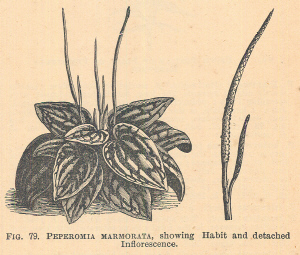
P. maculosa (spotted).* l. very fleshy, ovate-lanceolate, bright shining green; petioles beautifully spotted with purple. Tropical America, &c. P. marmorata (marbled).* fl. in an erect, tail-like catkin. l. of a rich bright green, beautifully variegated with white, the colours somewhat marbled or reticulated; thick, fleshy, somewhat ovate, acuminated. South Brazil, 1866. An elegant species. See Fig. 79. (B. M. 5568.)
P. microphylla (small-leaved). fl. in short, terminal spikes. l. small, obovate-oblong, usually in whorls of four. Stems slender, succulent, much-branched. Mexico, 1869. Trailer. (Ref. B. 41.)
P. nummulariaefolia (Moneywort-leaved).* fl. in terminal spikes. l. alternate, roundish, stalked, similar to those of Nummularia. Stems thread-like, fleshy, much branched, creeping to an indefinite length. Jamaica, &c., 1866. This species is eminently adapted for covering the sides of hanging baskets. (Ref. B. 13.)
P. obliqua (oblique). fl. in dense, axillary and terminal catkins. l. shortly petiolate, oblique, oblong-ovate, attenuated at apex, acute, glabrous, fleshy. Peru. (B. M. 1882, as Piper acuminatum.)
P. peltaeformis (shield-like). l. dark green, marked with a few longitudinal bands of grey, thick, ovate, poised on a somewhat slender stalk, peltately attached. Brazil, 1864.
P. prostrata (prostrate). A garden name of P. brevipes.
P. pubifolia (downy-leaved). l. marked with a central grey bar, small, ovate, fleshy in texture. 1865. A pretty, perennial creeper, suitable for basket culture.
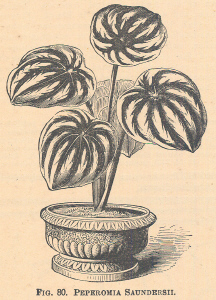
P. resedaeflora (Reseda-flowered). fl. white, fragrant, collected into numerous divaricate, filiform, clavate, and sulcately nodose catkins, which form erect, pyramidal, loose, terminal panicles. l. dark green, entire, cordate-orbicular; radical ones rosulate and long-stalked; cauline ones irregularly whorled. New Grenada, 1870. (B. M. 6619; I. H. ser. iii. 26.) P. Saundersii (Saunders').* l. orbicular or ovate, about 5in. long, thick and fleshy, the colour along the veins bright green, the interstices being a metallic white. h. 8in. to 10in. Brazil, 1866. A handsome plant, of very compact habit. SYNS. P. arifolia argyreia (B. H. 1867, 2; B. M. 5634) and P. Verschaffeltii (I. H. 598). See Fig. 80.
P. velutina (velvety). l. dark green, longitudinally ribbed and banded with grey. Stems red, fleshy. Ecuador, 1872. (I. H. n. s. 89.)
P. Verschaffeltii (Verschaffelt's). A synonym of P. Saundersii.