Persica
(so named in allusion to the Peach being supposed to come originally from Persia). Peach. ORD. Rosaceae. A small genus of hardy or half-hardy fruit-trees, now included, by Bentham and Hooker, under Prunus; they are natives of Europe and the warmer parts of Asia. Flowers almost sessile, solitary or twin, rising from the scaly buds earlier than the leaves. Leaves conduplicate when young. P. vulgaris, and its variety below described, are well known and much esteemed fruits. For culture, &c., see Nectarine and Peach respectively.
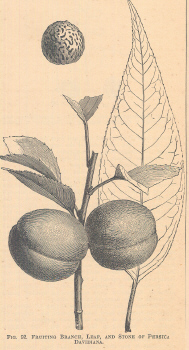
P. Davidiana (Abbe David's). fl. light rose or white. Spring (as soon as, or earlier than, the Almond). fr. small, spherical; skin downy, greyish-white, changing to yellow at maturity. l. glandular, regularly attenuated towards the base; margins very finely serrated. China. Only of use as an ornamental tree, but its flowering season being so early, the blossoms are frequently destroyed by frosts. See Fig. 92.
P. vulgaris (common).* Peach. fl. pale or dark red, sessile. Spring. fr. clothed with a velvety tomentum. l. lanceolate, glabrous, serrated. h. 15ft. Probably Eastern Asia, 1562. SYN. Prunus Persica. Of this species, there are several very desirable and ornamental varieties, including some with double flowers, and others with variegated and purple leaves. P.v. laevis (smooth). Nectarine. fl. red. Spring. fr. smooth, glabrous. h. 15ft. 1562. The Nectarine is distinguished from the Peach by its smooth, and rather firmer, more plump fruit. SYN. Prunus laevis.