Phacelia
(from phakelos, a fascicle; in allusion to the disposition of the flowers). SYNS. Aldea, Eutoca, Microgenetes, Whitlavia. ORD. Hydrophyllaceae. A genus comprising fifty species of mostly hardy, annual or perennial herbs, usually scabrous-pubescent or hispid, sometimes erect, tall, and simple or branched, occasionally dwarf, diffuse, and much-branched or tufted; they are mostly natives of Western North America, Mexico, and the Chilian Andes. Flowers blue, violet, or white, disposed in terminal cymes, which are usually pedunculate or reduced to a simple raceme; calyx lobes linear, lanceolate, or oblong; corolla campanulate or sub-rotate, rarely tubular or funnel-shaped; stamens five, exserted or included. Leaves pinnately lobed or dissected, rarely undivided, deeply toothed, or entire. The species thrive in any ordinary garden soil. The perennials may be increased by divisions, and the annuals by seeds. The best-known species, some of which are rather ornamental, are described below; they are annuals, except where otherwise stated.
P. campanularia (bell-flowered).* fl. deep blue, with a white spot at the base of each sinus, large, broadly campanulate. l. stalked, roundish-oblong, crenate. h. 6in. to 8in. California, 1882 Plant much-branched. (B. M. 6735; G. C. n. s., xx. 135.)
P. congesta (crowded). fl., corolla blue, campanulate, almost twice as long as the calyx; racemes corymbose, rather loose, almost equalling the leaves. June. l. 1in. to 2in. long, pinnatisect; segments one to four on both sides, unequal, the terminal one larger, and three-lobed. Stem 8in. to 15in. high, erect, flexuous. Texas, 1835. (B. M. 3452.) P. divaricata (spreading). fl. light violet, sub-sessile; corolla rotate-campanulate; racemes many-flowered, elongated, unilateral, longer than the leaves, sometimes axillary, sometimes opposite the leaves. May. l. alternate, petiolate, ovate or oblong, entire, slightly obtuse, 1in. to 3in. long. Stems dichotomously divaricating, fragile, decumbent. California, 1833. (B. M. 3706 and B. R. 1784, under name of Eutoca divaricata.)
P. d. Wrangeliana (Wrangel's). A variety with sometimes three-lobed, radical leaves. (S. B. F. G. ser. ii. 362, under name of Eutoca Wrangeliana.)
P. Franklinii (Franklin's). fl. blue, sub-sessile; corolla spreading-campanulate; racemes spike-formed, short. May. l. 1in. to 3in. long; radical ones clustered, cauline ones alternate, all lanceolate, pinnate-parted; lobes seven to ten, oblong, entire or irregularly two to five-lobed. Stem 6in. to 10in. high. Shores of Lake Superior, &c., 1827. (B. M. 2985, under name of Eutoca Franklinii.)
P. grandiflora (large-flowered). fl. light violet-purple, subsessile; corolla 1in. to 1 1/2in. in diameter; racemes circinate at apex. Early summer. l. broadly ovate, 1 1/2in. long, dentate, subcordate at base, wrinkled, and, as well as the stem and calyx, hispid. h. 5ft. California. (B. M. 5029, under name of Cosmanthus grandiflorus.)
P. Menziesii (Menzies'). fl. purple, sub-sessile; corolla 1/2in. to 3/4in. in diameter, spreading-companulate, twice as long as the calyx. June. l. hispid, linear, entire, trifid, or pinnatifid, with few, unequal, oblong or linear lobes. Stem erect. h. 1ft. North-west America, 1826. (B. M. 3762 and S. B. F. G. ser. ii. 334, under name of Eutoca Menziesii; B. R. 1180, under name of E. multiflora.)
P. Parryi (Dr. Parry's). fl. dark violet-blue; corolla 1in. in diameter, almost rotate; tube very short; limb expanded, with rounded lobes; cymes many-flowered, exceeding the leaves. Summer. l. stalked, ovate or ovate-oblong, hairy on both surfaces; petiole 2in. to 4in. long. h. 6in. to 12in. Southern California. A viscid annual. (B. M. 6842.) P. sericea (silky). fl. bluish-purple; corolla sub-campanulate, as long as the calyx; racemes spike-formed, compound, terminal, much longer than the leaves, dense-flowered. June. l., lower ones approximating pinnatifid, silky on both sides, the lower lobes lanceolate, extrorse incised; upper leaves entire, linear. Stem 10in. high. Rocky Mountains, 1827. Perennial. (B. M. 3003, under name of Eutoca sericea.)
P. tanacetifolia (Tansy-leaved). fl. bluish-pink; corolla rather longer than the calyx, campanulate; racemes spike-formed, elongated, dense-flowered, corymbose. June. l. pinnatisect, 2in. to 6in. long; segments three to seven each side, with a terminal one, oblong, unequally cut-toothed, the lobes or teeth ovate, acute. Stem sub-erect. h. 2ft. California, 1832. This species is frequently grown as a bee plant. (B. M. 3703; B. R. 1696; S. B. F. G. ser. ii. 360.)
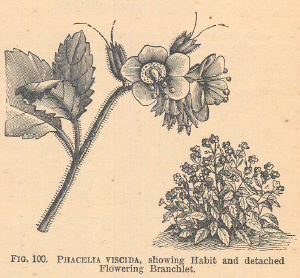
P. viscida (viscid).* fl. blue, purplish; corolla about 3/4in. broad; racemes opposite the leaves, erect, many-flowered, 4in. to 8in. long. July. l. broadly ovate, 1 1/2in. to 3in. long, shortly petiolate, sub-cordate, angulate, serrate; upper ones deeply or simply toothed. Stem erect, 1ft. high, branched. California, 1834. Plant glandular, pilose, viscous.(B. M. 3572, under name of Eutoca viscosa; B. R. 1808 and S. B. F. G. ser. ii. 368, under name of E. viscida.)
P. Whitlavia (Whitlavia).* fl. large, in terminal, many-flowered racemes; calyx deeply cut to the base; corolla rich blue, with an ample tube and a nearly equal limb of five spreading lobes. June. l. alternate, nearly deltoid or ovate-deltoid, coarsely and doubly serrated, hairy-pubescent; petioles generally longer than the leaves. h. 2ft. California, 1854. (B. M. 4813.)