Phoenix
(the old Greek name of the tree, used by Theophrastus). Date Palm. SYNS. Elate, Fulchironia, Phoniphora. ORD. Palmae. A genus comprising about a dozen species of stove or greenhouse palms, natives of tropical and sub-tropical Asia and Africa. Flowers yellow, mediocre; spikes growing out from amongst the leaves, and bearing flowers of one sex only, the two sexes being upon different trees. Both kinds have a cup-shaped, three-toothed calyx, and a corolla of three petals, with their edges valvate in the male, and overlapping in the female; the former containing usually six (very rarely three or nine) stamens, with hardly any filaments, and narrow, erect anthers, and the latter three distinct ovaries, with sessile, hooked stigmas. Only one of the ovaries, however, comes to perfection, and ripens into a one-seeded, fleshy fruit, the seed being composed of horny albumen, with a groove down the front, and the embryo placed at the back. Leaves terminal, spreading and recurved, unequally pinnate; segments somewhat fascicled or almost equidistant, elongate-lanceolate or ensiform, acuminate, with entire margins. Trunks, when present, usually rising to a great height, and covered thickly with the scars of fallen leaves.
The species are readily raised from imported seeds, sown in a sandy soil, in a mild hotbed. After the seedlings have attained a sufficient size, pot off singly into small pots, using the same kind of soil in which the seeds were sown. For later shifts, good turfy loam will be better. In the South of France, many of the species are largely grown in the open air, to supply the demand in Paris, &c., for well-grown specimens for the decoration of apartments. The method pursued is this: the plants are taken up, the soil shaken from the roots, packed in bundles, and forwarded to Paris, where each one is firmly placed in as small a pot as possible; they are then plunged in a mild hotbed in a warm house, which is kept shaded and syringed until new roots have formed, when shading is gradually removed, and the plants hardened off. By these means, much better specimens are more rapidly and cheaply obtained than would be possible under a system of pot-culture from the seedling stage onwards.
P. acaulis (stemless).* l. pinnate, 1ft. to 3ft. or more long, spreading; pinnae dark green, narrow, swollen at the base, the lower ones reduced to broad, flat spines. Stem very low, or entirely wanting. h. about 12ft. Central India, 1816. An ornamental, low palm, with a short, thick stem, like a bulb. It is valuable for decorative purposes.
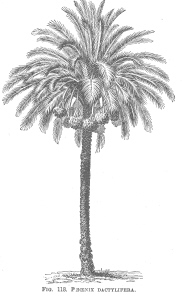
P. dactylifera (date-bearing). Common Date Palm. fl., male panicles white, compact, 6in. to 9in. long, on a short peduncle, the flowers sweet-scented; female spikes 1ft. to 2ft. long. fr. generally reddish or yellowish-brown when ripe, oblong, 1in. to 3in. long; pulp fleshy, sweet. l. grey, longer than those of P. sylvestris; pinnae 8in. to 16in. long, regularly distichous, often approximate in twos or threes on the same side of petiole, which is grey, laterally compressed, almost flat. Trunk covered with the persistent bases of petioles, the foot often surrounded by a dense mass of root suckers. h. 100ft. to 120ft. (in this country, rarely over 30ft.). India, Levant, 1597. A handsome, erect-growing palm, the fruit of which is well known in this country as an article of luxury. In its native regions, nearly every part of this plant is applied to some useful purpose. See Fig. 118.
P. farinifera (mealy). l. pinnate, 3ft. to 4ft. long; pinnae ovate-acuminate, about 6in. long, terminating in a sharp mucrone, the lower ones reduced to spines. h. about 7ft. East Indies, 1800. An elegant, compact-growing species.
P. leonensis (Sierra Leone). A synonym of P. spinosa.
P. Ouseleyana (Ouseley's). fl., male spadices about 1ft., females 2ft. to 2 1/2ft. long. l. 2 1/2ft. to 3ft. long; pinnules entirely conduplicate, about 1ft. long, from the conduplication, about 1/5in. broad, subulate-acuminate; lowermost ones degenerated into short spines. Bulbous stems ovate, about 1ft. long and 6in. in diameter. India.
P. paludosa (marsh-loving). fl., males yellow, spadix about 1ft. long; females greenish, spadix 1 1/2ft. long. l. gracefully spreading, 8ft. to 10ft. long; pinnules bifarious, solitary, spreading, then curved downwards, not rigid, 2ft. long, eight lines wide, exceedingly acuminate, the lowest longest and narrowest; petioles covered with brownish, glaucescent scurf. Trunk 12ft. to 15ft. high, 3 1/2in. in diameter, annulate at base, otherwise covered with brown, armed petioles. India.
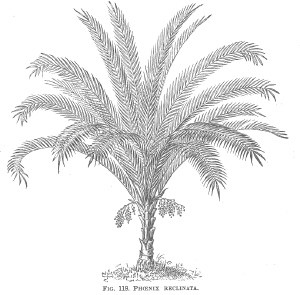
P. reclinata (learning).* l. pinnate; pinnae linear, somewhat triangular and spreading. Stem becoming stout with age. h. about 50ft. South-east Africa, 1792. A fine and large-growing species. See Fig. 119.
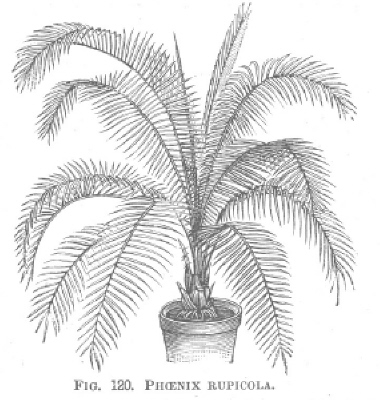
P. rupicola (rock-loving).* l. pinnate, arching, spreading, having a slender rachis and very short petiole, which is dilated at the base, and partially encircles the growing point; pinnae long, narrow, about 6in. in length, finely arched, the lower ones reduced to spines. h. 15ft. to 20ft. India, 1873. The handsomest species in the genus. See Fig. 120.
P. spinosa (spiny). fl., male peduncles 4in. to 8in. long. fr. about 1/2in. long, ovate-cylindrical, brownish, l., pinnae linear-lanceolate, acuminate, pungent-pointed, unequidistant, aggregated or scattered, ten to twelve lines wide at their broadest part. Trunk 6ft. to 10ft., or rarely 30ft. in height, soboliferous. Western tropical Africa. SYN. P. leonensis.
P. sylvestris (sylvan).* East Indian Wine Palm; Wild Date. fl. similar to those of P. dactylifera. fr. green at first, reddish-yellow when ripe, 1in. long. l. greyish-green, 7ft. to 12ft. long; pinnae very numerous, 6in. to 18in. long, alternate and opposite, not fascicled; petiole compressed in the leaf-bearing part, brown at base. h. 40ft. India, 1763. One of the hardiest. See Fig. 121.
P. tenuis (narrow).* A recent, but very elegant, addition to the genus; it resembles P. dactylifera in general appearance, but is more slender and finer in all its parts. Habitat unknown. See Fig. 122.