Phlox
(from phlox, flame; alluding to the general brilliancy of the flowers). ORD. Polemoniaceae. A genus comprising twenty-seven species of hardy, erect or diffuse, tall or tufted, perennial, or rarely half-hardy annual herbs, natives of North America and Russian Asia. Flowers red, violet, or white, usually showy, sometimes solitary, sessile or stalked, sometimes cymose, the cymes disposed in terminal, corymbose or thyrsoid panicles; calyx tubular-campanulate, with five acute or acuminate lobes; corolla salver-shaped, with equal obovoid, orbiculate, or obcordate lobes. Leaves entire; cauline ones opposite, or the uppermost ones alternate. The perennial species and varieties of Phlox may fairly be designated some of the best and most popular of garden plants. They are all very easily cultivated, and a selection from the genus is practically within the reach of everybody. Some of the species are dwarf, creeping plants, well adapted for the rockery, or front line of a mixed border. Where they can be obtained in sufficient quantity, they are sometimes employed with success for spring bedding. P. subulata and its varieties are the best known of the dwarf, creeping kinds; they may, therefore, be referred to as examples. None of these dwarf species seed freely; they are propagated chiefly by means of cuttings or divisions. Cuttings should be inserted in a cold frame about July, and kept shaded from bright sunshine. They will form good plants by the following spring, when they may be placed in permanent quarters outside for flowering. Large plants may be easily converted into numerous small ones by shaking some light soil amongst them in summer, and then dividing in autumn, when the trailing branches will be found to have rooted. Any well-drained ordinary soil will suit, but a sunny exposure is most desirable. Dwarf tufted species of Phlox are rarely injured by frost; but it is not unusual for large patches to die away in winter when the weather is very mild and damp. Other distinct groups or sections which are much more generally cultivated than those already referred to, are the early or summer-flowering, and the autumn or late-flowering, tall-growing varieties. These are highly attractive, and, as they succeed each other in flowering, it is a good arrangement to plant some of both alternately. They may be propagated from seed; by cuttings of the young stems, shoots, or roots; and by division. Seeds preserved with a view to raising new varieties should only be gathered from extra good plants. They should be sown, when collected, in pans filled with sandy loam, and be kept in a warm greenhouse or pit until spring, when the young plants will appear. These should be grown on, and eventually hardened, to plant out in April or May, if strong enough. Many will flower the first season, but not so strongly as in the second. Oftentimes, the seeds germinate irregularly, especially if they are kept long before being sown. Cuttings root very readily at almost any season, in a little warmth; they may be procured at the end of March, in large quantities, from the base of old plants. For increasing new or scarce varieties, cuttings may be made of pieces of root. These may be cut into short lengths and treated somewhat like seeds. Propagating by division simply consists in lifting the plants in early spring, cutting them at the base into small pieces, and replanting. These tall-growing perennials succeed best in rather heavy soil, and where it is of a good depth; they will, however, thrive fairly well in any good border or bed. A thick top-dressing of manure, in summer, is of great help, both by preventing evaporation and affording nutriment. If the weather is dry, a heavy drenching of water occasionally is also recommended, as it tends to considerably prolong the flowering season. The plants are very attractive in beds by themselves, or in mixed borders along with other perennials. They are also well adapted for culture in pots, if provided with a rich soil, and grown in a cool, slightly-shaded frame, through the summer.
P. Drummondii is one of the most beautiful and useful half-hardy annuals in cultivation. It may readily be raised from seeds, which should be sown in a little heat, during March, in pans, boxes, or on a partially-spent hotbed. As soon as the seedlings become large enough to handle, they should be pricked off in other boxes, and grown on in frames until May, when they may be gradually inured to the open air. When about 3in. high, the points should be pinched out, with a view to inducing a more compact habit. This species, and its varieties, in numerous colours, are fine for planting in flower-garden beds, amongst other tall-growing subjects that, maybe, are partially naked near the bottom. The plants require a rich soil and plenty of water; like the others, a mulching of manure, in summer, is of great help. Seedlings may also be grown, in pots, for greenhouse decoration; and cuttings may readily be struck for a similar purpose. They will thrive in any ordinary frame after the middle of April.
The most important species, from a garden standpoint, are described below. They are perennials, except where otherwise stated.
P. amoena (pleasing).* fl. purple or pink, seldom white, disposed in a compact corymb; corolla lobes obovate, entire, rarely emarginate. June. l. slightly erect, oblong, lanceolate, or linear-lanceolate, slightly acute or obtuse. Stem ascendent, simple, 6in. to 15in. high. Virginia to Florida, 1809. Plant softly hairy or villous. SYN. P. pilosa amaena. (B. M. 1308.)
P. aristata (awned), of Michaux. A form of P. subulata.
P. canadensis (Canadian). A synonym of P. divaricata.
P. candida (white). A form of P. maculata.
P. carnea (flesh-colour). A form of P. glaberrima suffruticosa.
P. Carolina (Carolina). A form of P. ovata.
P. cordata (heart-shaped). A synonym of P. paniculata. P. corymbosa (corymbose). A synonym of P. paniculata.
P. crassifolia (thick-leaved). A synonym of P. reptans.
P. decussata. See P. maculata.
P. divaricata (spreading).* fl. pale lilac or bluish, in forked corymbs, the lobes of the corolla obcordate or cuneate, notched at the end, or sometimes entire, equalling or longer than the tube. Spring and early summer. l. oval-lanceolate, superior ones alternate. h. 9in. to 16in. North America, 1746. (B. M. 163.) SYN. P. canadensis (S. B. F. G. 221).
P. Drummondii (Drummond's).* fl. red, varying to rose, purple, or white, with a darker eye, on very short pedicels; panicle trichotomously corymbose. August. l. ovate-lanceolate, half stem-clasping, all mucronate and downy, lower ones opposite, upper ones alternate. Stems erect, simple at bottom, but a little branched at top, beset with spreading hairs. h. 1ft. Texas, &c., 1835. A lovely half-hardy annual.(B. M. 3441; B. R. 1949; S. B. F. G. ser. ii. 316.)
P. frondosa (leafy). A synonym of P. subulata frondosa.
P. glaberrima (very glabrous).* fl. red, disposed in a corymbose, few-flowered panicle; calyx teeth very acute. July. l. lanceolate or linear-lanceolate, the uppermost ones narrowly ovatelanceolate, firm in texture, almost veinless, bright green and glossy above, often with revolute margins. Stem slender, erect, 1ft. to 2ft. high. Ohio to Florida, 1725. (S. B. F. G. ser. ii. 36.)
P. g. suffruticosa (sub-shrubby).* fl. rose, disposed in a clustered, few-flowered, corymbose panicle; lobes of corolla ovate, entire. April. l., upper ones broadly lanceolate, somewhat rigid, slightly pilose or glabrous. Stem more rigid than those of the type, smooth or scabrous, 2ft. high. South United States, 1834. (B. M. 1344 and S. B. F. G. 190, under name of P. Carolina.) SYN. P. suffruticosa (B. R. 68). P. carnea (B. M. 2155) is a smooth form.
P. linearifolia (linear-leaved). fl. flesh-colour, corymbose; corolla tube slightly exceeding the calyx, the lobes obovatecuneate, entire, rarely retuse. July. l. very narrow-linear, 1in. to 2in. long. Stem suffruticose at base, erect or adsurgent, slightly rigid. h. 9in. to 12in. Columbia River, &c., 1826. (B. R. 1351, under name of P. speciosa.)
P. longiflora (long-flowered). A synonym of P. maculata candida.
P. maculata (spotted).* fl. purple in the type, disposed in oblong-thyrsoid or sub-pyramidal panicles; corolla tube more or less incurved, the segments orbiculate, obtuse or retuse. July. l., lower ones lanceolate, uppermost ones ovate, cordate at base, rather thick, glabrous or slightly scabrous. Stem erect, almost simple h. 2ft. Pennsylvania, Iowa, and Florida, 1740. This species is very near P. paniculata, differing in its narrower oblong panicle and scarcely-pointed calyx lobes. The stems are dwarfer, and spotted with purple, and the flowers sweet-scented. The normal tint of the flowers is purple, but they vary in colour. Then there is the form with a more pyramidal inflorescence, called P. pyramidalis (S. B. F. G. 233). The garden varieties of this and P. paniculata, generally referred to in nursery catalogues under the name of P. decussata, are so blended and intermixed that it is now impossible to refer them to their respective species. Moreover, the typical plants are almost unknown out of botanical collections. Other forms are: P. odorata (S. B. F. G. 224), P. penduliflora (S. B. F. G. ser. ii. 46), P. reflexa (S. B. F. G. 232). P. candida is a white-flowered form, generally with a spotless stem. SYNS. P. longiflora (S. B. F. G. ser. ii. 31), P. suaveolens.
P. Nelsoni (Nelson's). A form of P. subulata.
P. nivalis (snowy). A form of P. subulata.
P. ovata (ovate-leaved).* fl. reddish-purple, in small, terminal, crowded cymes, with undulated, retuse petals. Spring. l., radical ones ovate, acute, rather fleshy; cauline ones ovate-oblong. h. 1ft. to 1 1/2ft. North America, 1759. Plant erect, glabrous or nearly so, never viscid. (B. M. 528.) SYN. P. triflora (S. B. F. G. 293). P. Carolina is a taller form, with narrower, more tapering leaves, and pointed calyx teeth, approaching P. glaberrima. (B. M. 1344.)
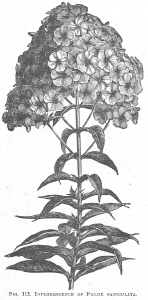
P. paniculata (panicled).* fl. pink-purple, varying to white, in large, terminal, pyramidal-corymbose panicles; the segments of the corolla roundish; calyx teeth subulate setaceous. August. l. oblong-lanceolate and ovate-lanceolate, tapering at the base, or the uppermost more or less cordate. Plants erect, smooth, rough, or hairy. h. 3ft. to 4ft. United States, 1732.SYNS. P. cordata (S. B. F. G. ser. ii. 13), P. corymbosa (S. B. F. G. ser. ii. 114), P. scabra (S. B. F. G. 248).
P. p. acuminata (acuminate). A variety with the stems and under side of the leaves hairy; the latter are also broader and more pointed. (B. M. 1880.)
P. pilosa (pilose).* fl. pink, purple, rose, or sometimes white, in nearly sessile fascicles; corolla lobes ovate, entire. May. l. linear or lanceolate, short, villous, pilose or pubescent, sometimes glabrous. Stem erect, slender, 1ft. to 2ft. high. Carolina, 1759. A very elegant species. (B. M. 1307; L. B. C. 1251.)
P. p. amoena (pleasing). A synonym of P. amoena.
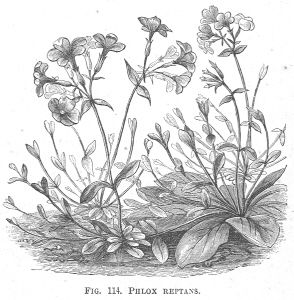
P. procumbens (procumbent). fl. lilac, with violet marks near the eye, disposed in terminal, few-flowered panicles, composed of one or two-flowered peduncles. Summer. l. lanceolate, acute, attenuated at the base, smoothish, ciliated on the edges. Stems procumbent, branched; branches downy. North America, 1827. This is regarded by Asa Gray as a hybrid between P. amoena and P. subulata; it is unknown as a wild plant. (L. B. C. 1722; S. B. F. G. ser. ii. 7.) P. reptans (creeping).* fl. purple or violet, in few-flowered corymbs; tube of corolla 1in. long, limb about 1in. broad. Spring. l., radical ones obovately-spathulate; cauline ones lanceolate. Alleghany region, 1800. Plant creeping, stoloniferous, downy. A neat and dwarf-growing species, with showy flowers. SYNS. P. crassifolia (L. B. C. 1596), P. stolonifera (B. M. 563; S. B. F. G. ser. ii. 293).
P. scabra (scabrous). A synonym of P. paniculata.
P. setacea (bristly-leaved). A synonym of P. subulata.
P. stolonifera (stolon-bearing). A synonym of P. reptans.
P. suaveolens (sweet-smelling). A synonym of P. maculata candida.
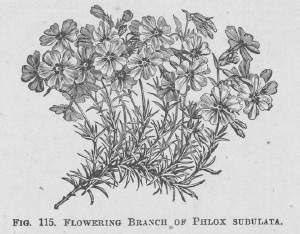
P. subulata (subulate-leaved).* Ground or Moss Pink. fl. pinkish, with a darker centre, disposed in few-flowered corymbs; lobes of corolla wedge-shaped, notched. April. l. from 1/4in. to 1/2in. long, awl-shaped, linear, pungent, ciliated. South New York to Florida, &c., 1786.(B. M. 411.) SYN. P. setacea (B. M. 415). Of this elegant and profuse-flowering, densely tufted species, there are white forms in cultivation, under the names of P. aristata (L. B. C. 1731), P. Nelsoni, and P. nicalis (L. B. C. 780; S. B. F. G. 185).
P. s. frondosa (leafy). A very vigorous variety, with lilac-rose flowers. SYN. P. frondosa.
P. suffruticosa (sub-shrubby). A synonym of P. glaberrima suffruticosa.
P. triflora (three-flowered). A synonym of P. ovata. Varieties. These are very numerous, and are annually increased in number by the selection and naming of seedlings for distribution as improved forms in one or another particular. In gardens, they are generally divided into two sections, early-flowering and late-flowering, which are termed respectively Suffruticosa and Decussata. The latter have been chiefly obtained from P. maculata and P. paniculata; the other from P. glaberrima suffruticosa. Many of the varieties have flowers of the purest white, others vary much in colour; and almost all are exceedingly beautiful and effective. Varieties of P. Drummondii come true from seed, but it is not usual to keep them separately named, except for seed-production; they are generally mixed together before being sown. The following is a selection from the two sections to which reference has been made.
Early-flowering Varieties (Suffruticosa Section). ALLAN M'LEAN, rosy-purple; of finest form and quality. ANNIE LOCK-HART, white, pink eye; large and fine. BEAUTY, white, rose eye; compact. BEAUTY OF EDINBURGH, pure white, with violet eye. BRIDESMAID, waxy-white; inflorescence large and compact. COUNTESS OF GALLOWAY, pure white, highly fragrant; finest form. DR. ROBERT BLACK, red, of finest quality; extra. DUCHESS OF ATHOLE, pure white, rosy-crimson eye; large and fine. GEORGE EYLES, rosy-purple; of fine form. HERCULES, rosy-purple; extra large flower. IDA, white, small rose eye; fine. LADY NAPIER, pure white, highly fragrant one of the best. LINNET, white, mottled rosy-lilac; distinct and good. MAGGIE LAUDER, white, violet eye. MALCOLM M'INTYRE, rosy-purple, dark eye. MISS ROBERTSON, pure white, dwarf; extra fine. MRS. CALDER, delicate white, with lilac eye; good dwarf habit. MRS. FORBES, white, shaded rose; fine form. MRS. GELLATLY, pure white, large eye. MRS. GREENSHELDS, white, purple eye; fine. MRS. HUNTER, pure white, large bright crimson eye. MRS. JAMES ROBERTSON, pure white, rich violet eye; extra fine. MRS. P. GUTHRIE, white, dark lilac eye. MRS. RITCHIE, rose-purple. PAULINE, clear white, deep rosy-crimson eye; a fine variety. PEARL, pure white; good form, highly fragrant. PRESIDENT, rich red, brilliant. PRIMA DONNA, pure white; compact. REDBRAES, white, crimson eye. SOCRATES, white, dark purple eye. THE DEACON, deep rosy-purple. THE SHAH, rosy-purple, very large; one of the finest. VAN HOUTTE, rose, distinctly striped white; free. VENUS, beautiful mauve; fine form. WM. KIRKPATRICK, rose-purple, large deep rose eye; extra fine. Late-flowering Varieties (Decussata Section). A. BORROW-MAN, mauve; distinct. AYTON CASTLE, vermilion, large; extra.
COCCINEA, rich vermilion; extra fine. COUNTESS OF ROSSLYN, snowy-white, rose eye. DAVID SYME, pure white, fine magenta eye. FLAMBEAU, dazzling amaranth, large flower; first-rate. GAVIN GREENSHIELDS, crimson, effective. GENERAL GORDON, light rosy-peach; very fine. GEORGE COUPAR, rich crimson self; fine form. GEORGE GOODFELLOW, deep rosy-crimson, with bright crimson eye; very large. GRAHAM MCCULLOCH, rich vermilion. HENRY CANNELL, mauve, rose centre; large and well formed. JAMES ALEXANDER, rich crimson self. JAMES COCKER, pure white, scarlet eye; fine. JAMES GRIEVE, crimson self, very bright, large flower and inflorescence. JANE WELSH, white, crimson eye; fine. JOHN FORBES, pink, dark crimson eye; large and good. JOHN HAMPTON, amaranth, large dense inflorescence. LOTHAIR, salmon-scarlet, dwarf; extra fine. MALCOLM DUNN, bright crimson, magenta eye; compact. MATTHEW MILLER, rich crimson self; dwarf. MRS. KEYNES, pure white; large and well formed, of great substance. MRS. LAING, soft rosy-lilac; dwarf, compact habit. MRS. SANDERSON, mauve, rose centre, large floret and inflorescence; extra. MRS. T. SPEEDY, white, shaded rose; distinct. OVID, white, shaded purple; large. PURPLE PRINCE, dark purple, maroon eye; very distinct. ROBERT LAIDLAW, crimson self; large and fine. SERAPH, white, red eye, neat flower; fine inflorescence. THE QUEEN, beautiful white, large; dwarf habit. THOMAS BOYD, rose-amaranth; fine form and substance. THOMAS CHISHOLM, pure white; dwarf, fine. TOM WELSH, bright red, compact, novel shade; first-rate. TRIOMPHE DU PARC DE NEUILLY, brilliant red; fine form. T. S. WARE, lilac, bluish centre; very distinct. VESUVIUS, bright crimson-scarlet, dark crimson eye. WHITE LADY, pure white, very fine and distinct. WM. VEITCH, white, shaded rose, dark crimson eye; one of the best.