Phormium
(from phormos, a basket; referring to the uses made of the fibre). Flax Lily, or New Zealand Flax. SYN. Chlamydia. ORD. Liliaceae. A small genus (two species) of nearly or quite hardy, rigid herbs, with fleshy, fibrous roots, natives of New Zealand. Flowers dull red or yellow, large, panicled, erect, jointed on the pedicel; perianth tubular, curved, of six leaflets, the inner with spreading tips; stamens six, exserted; scapes leafless, variable in height, from 5ft. to 15ft., branched and bracteate. Leaves radical, linear-ensiform, distichous, coriaceous, very tough. The species and varieties are of easy culture in rich, loamy soil. They are well adapted for greenhouse decoration, for use as sub-tropical plants in summer, and, in the southern parts of the country, are sufficiently hardy to grow, uninjured, outside; they are however, more safe, if protected, in frosty weather, with some covering. In a greenhouse, the long, erect, sword-like leaves of New Zealand Flax are very distinct, when the plants are associated with others. Large specimens, in pots or tubs, have a very fine appearance in conservatories, or when placed, during summer, in prominent positions in the flower garden. Propagated, in spring, by division of the crowns before growth commences; also by seeds.
P. Colensoi (Colenso's). A synonym of P. Cookianum.
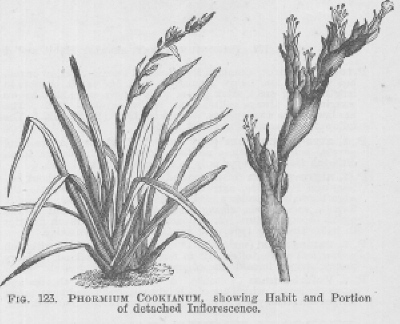
P. Cookianum (Cook's).* Small Flax Lily. fl. yellow, or with the outer segments greenish, 1in. to 1 1/2in. long; inner segments acuminate, reflexed; scapes 3ft. to 6ft. high. Summer. l. 2ft. to 3ft. long, more acuminate than in P. tenax (than which this species is smaller in all its parts), rarely split at the top. 1868. SYNS. P. Colensoi, P. Forsterianum. See Fig. 123.
P. C. variegatum (variegated).* l. narrowish, erect, pointed, lanceolate, coriaceous, dark green, elegantly banded at the margin with one, or sometimes two, narrow stripes of creamy-white. A beautiful, variegated-leaved plant, altogether smaller and more elegant than P. tenax. (R.H.1878,56.
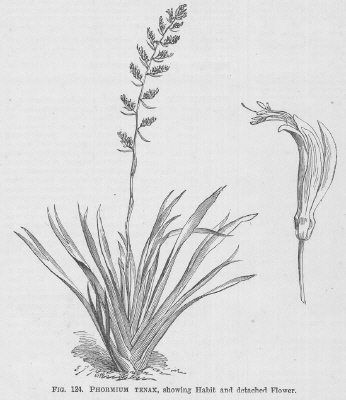
P. Forsterianum (Forster's). A synonym of P. Cookianum. P. tenax (tough).* Common New Zealand Flax. fl. yellow or red, but variable, 2in. long. August. l. from 3ft. to 6ft. or more in length, rigid, erect, dark green, with a narrow, reddish-brown margin, and always split at the tip when old. 1798. The hardier of the two species.(B. M. 3199.) The following are some of the best forms:
P. t. atro-purpureum (dark purple). l. wholly of a beautiful purple, suffused with a reddish tinge. A handsome form, differing from the type only in the colour of its leaves.
P. t. nigro-pictum (black-spotted). l. deep green, about 2ft. long and 1 1/4in. wide, narrowly edged with blackish-purple, the edge becoming broader and more distinct on the base, where it forms a conspicuous, zigzag line, elegantly spread out as the plants become mature. A compact-growing form, much dwarfer in habit than the type, and smaller also in the foliage.
P. t. variegatum (variegated).* l. dark green, striped with rich yellow and white, often 6ft. in length. New Zealand. A very pretty, striped form of the common species.
P. t. Veitchianum (Veitch's). A fine form, with shorter and narrower leaves, which are of a bright pea-green, and have broad stripes of a creamy-white, extending the entire length of each leaf.