Trollius
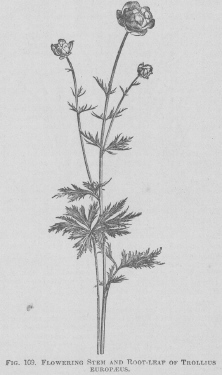
(said to be derived from an old German word trol, a globe). Globe Flower; Globe Ranunculus. ORD. Ranunculaceae. A genus comprising about nine species of hardy, perennial, erect herbs, inhabiting the temperate and frigid regions of the Northern hemisphere. Flowers yellow or lilac, ample, solitary or few; sepals five or indefinite, regular, petaloid, commonly deciduous; petals five to eight, small, clawed, rarely indefinite, long-linear. Leaves alternate, palmately lobed or dissected. The best-known species are here described. A rather heavy soil and moist situation are most generally suitable, but Globe Flowers succeed well in the front part of mixed borders, and in many other positions where the soil is fairly good. The plants are of very compact and floriferous habit. Propagation may be effected by divisions, which should preferably be made in September; or by seeds. The latter do not usually vegetate until the year after they are sown.
T. acaulis (stemless). fl. golden-yellow, 2in. in diameter; sepals seven, broadly oval, obtuse; petals fourteen, narrow-cuneate, 1/4in. long, with a very short claw. July l. five-partite, argutely cut. Stem dwarf, leafy above. Western Himalayas, 1841. (B. R. xxix. 32.)
T. altaicus (Altaian). fl. pale orange or yellow, 2in. in diameter; sepals ten, often fifteen to twenty, broad, obtuse, rarely acute, occasionally crenulate; petals five to fifteen, narrow-linear, obtuse. l. much divided, similar to those of T. europaeus. h. 1ft. to 1 1/2ft. 1857. (R. G. 188.)
T. americanus (American). A synonym of T. laxus.
T. asiaticus (Asiatic). fl. dark yellow; sepals ten, spreading; petals ten, longer than the stamens. May and June. h. 1ft. to 1 1/2ft. Siberia, 1817. This species closely resembles T. europaeus, but the stems are usually one-flowered. (B. M. 235; R. G. 403.)
T. caucasicus (Caucasian). fl. yellow; petals shorter than the stamens. Otherwise this species closely resembles T. asiaticus. Caucasus, 1817. T. europaeus (European).* Boits; Common Globe Flower; Golden Ball, &c. fl. pale yellow, globose, 1in. to 1 1/2in. in diameter; sepals orbicular, concave; petals oblong, equalling the short stamens. June to August. l., radical ones petiolate, sub-orbicular, five-partite, the segments cuneate, lobed and cleft; cauline ones smaller, sessile. Stem 6in. to 2ft. high, simple, leafy. Arctic Europe (Britain), &c. (Sy. En. B. 42.)
T. laxus (loose). fl. pale greenish-yellow or nearly white, twice the size of the common Buttercup; sepals five or six, spreading; petals fifteen to twenty-five, inconspicuous, much shorter than the stamens. May. l. palmately cut. h. 6in. to 9in. North America, 1805. SYN. T. americanus (B. M. 1988; L. B. C. 56).
T. patulus (spreading). fl. golden-yellow; sepals five, spreading; petals one to five, equalling the stamens. h. 3in. to 12in. Siberia, 1800.