Tropaeolum
(from tropaion, a trophy; the leaves are of the form of a buckler, and the flowers resemble an empty helmet). Golden Nasturtium; Indian Cress; Yellow Larkspur. ORD. Geraniaceae. A genus comprising about thirty-five species of very handsome, twining or rarely diffuse, greenhouse or hardy, South American, annual or perennial herbs. Flowers orange, yellow, or rarely purple or blue, irregular; sepals five, loosely imbricated or sub-valvate, connate at base, the dorsal one produced into a free spur; petals five, or fewer by abortion, loosely perigynous, imbricated, the two upper ones more or less dissimilar to the rest; stamens eight, free, unequal; peduncles axillary, one-flowered. Fruit consisting of indehiscent, hardened-fleshy, wrinkled, one-seeded carpels. Leaves alternate, peltate or palmately angled, lobed or dissected; stipules wanting, or rarely minute. Tropaeolums are mostly familiar twining plants, well adapted for growing in pots or planting out in greenhouses, and training up rafters, &c. They also succeed well outside during summer, but the foliage will not withstand the least frost without injury. For covering arbours, &c., or anything which is unsightly, the tall-growing annuals are not easily surpassed; T. Lobbianum, T. majus, and T. peregrinum are the best for the purpose. The dwarf varieties of Tropaelum are beautiful objects for mixed flower borders, and for placing in beds by themselves; they are exceedingly compact and floriferous. The annual species are readily raised from seeds, sown in the open border, in any moderately rich soil, in spring; or, as is best with T. peregrinum, they may be sown in pots, under glass, hardened off, and planted out at the end of May or beginning of June. The double varieties are practically perennials, as they must be increased by cuttings, which root readily in bottom heat; during winter, the plants must be kept in a light, airy situation. The tuberous-rooted section, such as T. azureum and T. tricolorum, thrive in sandy peat and leaf mould, or in turfy loam and peat, and do best under cool-house treatment. They are best grown singly in pots, and each plant trained over a little trellis; when in flower, they are exceedingly pretty and interesting. When growing, they require plenty of light, and abundance of water, when the stems die down, the pots should be stored away in some dry, cool spot, and water withheld until growth recommences, when the tubers must be carefully shaken out and repotted; this section may be increased from seeds, or by means of cuttings of the slender, wiry shoots, which callus and form small tubers in one season. T. speciosum requires a constantly moist and shaded position in a peat border, and is impatient of disturbance at the roots; it is propagated either from seeds, or by division of the long-creeping, underground rhizomes. T. polyphyllum likes a warm, sunny spot, rather dry than otherwise. Tropaeolums do not require a very rich soil; they flower more profusely if not encouraged to grow over-luxuriantly.
Except where otherwise stated, the under-mentioned species are perennial twiners.
T. aduncum (hooked). A synonym of T. peregrinum.
T. albiflorum (white-flowered). fl., petals whitish, within lined and dotted with gold and purple, large, plicate, undulated, the lower ones very long--and narrowly-unguiculate. Summer. l. small, glaucous, digitate; segments three to five. Stems very slender, elongated. Peru or Chili. Greenhouse. (F. d. S. 241.)
T. azureum (azure-blue).* fl. scarcely odorous; petals azure-blue, equal, obovate, attenuated into a long, greenish-white claw, deeply emarginate at apex. October. l. peltate, deeply five-lobed; lobes obovate or obversely lanceolate, the middle one larger and mucronate. Chili, 1842. Greenhouse. (B. R. xxxviii. 65; F. d. S. May, 1846; P. M. B. ix. 247.) grandiflorum is a large-flowered form. (F. d. S. 1160; I. II. iii. 85.)
T. azureum (azure-blue), of Hooker. A synonym of T. violaefolium.
T. Beuthii (Beuth's). fl., calyx segments apiculate, equalling the straight spur; petals yellow; peduncles filiform, twice as long as the leaves. June. l. sub-orbicular, deeply peltately cut, pale green beneath; leaflets five or six, obovate, the front one larger, retuse-apiculate at apex. Root tuberous. Bolivia, 1850. Half-hardy.
T. brachyceras (short-horned). fl., calyx segments obtuse; spur very short, obtuse; petals yellow, conformed. June. l. peltately cut; segments six or seven, oblong-obovate, entire, sessile. Root tuberous. Chili, 1830. Half-hardy. (B. M. 3851; B. R. 1926; F. d. S. 368; P. M. B. iv. 55; S. B. F. G. ser. ii. 370.) T. chrysanthum (golden-flowered). fl., petals golden-yellow, the two upper ones cuneate, shorter than the calyx and lined below with orange-red veins, the three lower ones longer, unguiculate, flabellately plicate. Summer. l. peltate, orbicular-triangular, truncate at base, angularly three-lobed at apex, the margins obsoletely repand-crenate. New Grenada, 1874. Greenhouse. (F. d. S. x. 1005; I. H. xix. 102.)
T. crenatiflorum (crenate-flowered). fl., petals yellow, obovate, spreading, sub-equal, truncate and somewhat bicrenate at apex, the two upper ones lined with blood-colour. June. l. peltate, semi-orbicular, five-lobed; lobes obtuse or retuse, mucronulate. Peru, 1844. Greenhouse. (B. M. 4245; F. d. S. 166.)
T. Deckerianum (Decker's). fl., calyx pubescent, longer than the straight, scarlet spur; petals blue, unequal, toothed, fimbriate-ciliate; filaments and anthers blue; style yellow. July. l. peltate, triangular, five to seven-lobed, transversely truncate at base. Venezuela, 1849. Greenhouse. (B. H. ii., p. 245; F. d. S. 490; L. & P. F. G. i. 16.)
T. digitatum (digitate-leaved). fl., sepals appendiculate at base; petals golden, dentate-ciliated. July. l. peltate, five to seven-lobed; lobes rounded, entire. Venezuela, 1850. Hardy annual. (R. G. 1146, bearing name of T. Gaertnerianum on plate, but T. digitatum in letter-press.)
T. edule (edible). fl., spur acuminate; petals orange and green, sub-conformed, obcordate, equalling the sepals. March. l. pseudo-compound, peltate, six-lobed; leaflets or segments oblong-lanceolate, attenuated at both ends, glabrous. Stems terete. Chili, 1841. Half-hardy. (B. 248; P. M. B. ix. 127.)
T. Gaertnerianum. See T. digitatum.
T. Jarrattii (Jarratt's).* fl., calyx bright orange-scarlet, spotted with yellow at base; petals bright yellow, the two upper ones pencilled with rich brown; pedicels 2 1/2in. to 3 1/2in. long. June. l. alternate, six or seven-lobed; petioles 1in. long, slender, twining. Santiago, 1836. Greenhouse. (P. M. B. v. 29.)
T. Lobbianum (Lobb's).* fl., calyx long-spurred, pilose; petals orange, obovate, the two upper ones entire, scarcely lobed, the three lower ones smaller, deeply toothed, fringed below, long-clawed. November. l. peltate-orbicular, obscurely lobed, glaucous beneath; lobes mucronulate; petioles (and peduncles) pilose. Columbia, 1843. Greenhouse. (B. M. 4097; F. d. S. ii. 3; P. M. B. xi. 271.)
T. L. fimbriatum (fringed). fl., petals fringed. l. lobed. Of hybrid origin. (R. H. 1856, p. 101.)
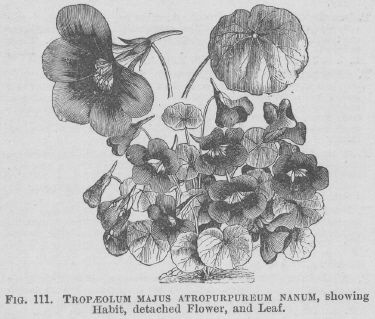
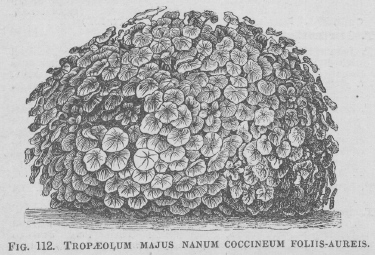
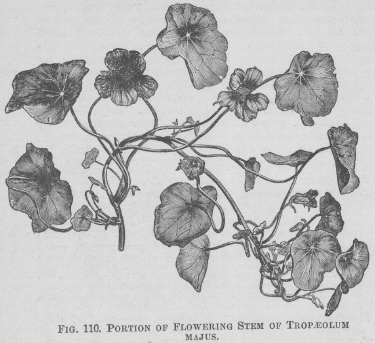
T. majus (greatest). Great Indian Cress or Nasturtium. fl. rich orange, large and showy, the two upper petals marked with deep reddish-brown, all obtuse; peduncles long. June to October. l. alternate, entire, nearly round pellate, sometimes undulated or lobed. Peru, 1686. Hardy annual. The flowers and young leaves are frequently used in salads, and the former also for garnishing. If gathered when young and quite green, the fruits make an agreeable pickle. In certain conditions of atmosphere, the flowers have the power of emitting electric sparks in the evening. (B. M. 23.) There are very many varieties of this species, including atropurpureum nanum (see Fig. 111; F. d. S. 1286), a dwarf sort, known in gardens as TOM THUMB; atrosanguineum (B. M. 3375; P. M. B. i. 176; S. B. F. G. ser. ii. 204), a form with dark blood-coloured flowers; and numerous double-flowered forms of which, perhaps, GRANDI-FLORUM PLENISSIMUM, double yellow, with a deep maroon blotch at the base of each petal, and HERMINE GRASHOFF (Gn. xx. 398), with scarlet flowers, are two of the best. A few of the finest dwarf kinds are: EMPRESS OF INDIA, bright crimson; GOLDEN KING, golden-yellow; KING OF TOM THUMBS, scarlet; KING THEODORE, very dark; PEARL, creamy-white; RUBY KING, rosy-scarlet. A TOM THUMB form, with golden leaves, is represented in Fig. 112. T. minus (smallest). Small Indian Cress or Nasturtium. fl. deep yellow, streaked with orange and red; petals each ending in a bristle-like point. June to October. l. somewhat repand. Peru, 1596. Hardy annual. This resembles T. majus, but is much smaller and weaker. The fruits, being smaller, are preferred to those of T. majus as a substitute for capers. (B. M. 98.)
T. Moritzianum (Moritz'). fl., spur dirty yellow, greenish towards the apex, straight; petals yellow, the upper ones margined and nerved with cinnabar-red, incised-ciliated. July. l. peltate, seven-lobed, transversely truncate at base, glabrous; lobes rounded, obsoletely mucronate. Caraccas, 1839. Greenhouse. (B. v. 221; B. M. 3844; P. M. B. viii. 199.)
T. pendulum (pendulous). fl. pendulous; calyx yellow, the spur straight; petals yellow, spathulate, the two upper ones marked with parallel, red lines and a dingy violet spot, the three lower ones self-coloured. July. l. peltate, glaucous beneath, rounded-truncate at base; lobes five, the middle one mucronate. Branches terete. Central America, 1852. Greenhouse.
T. pentaphyllum (five-leaved). Five-fingered Indian Cress. fl., calyx dull purple, 1 1/4in. long, the limb greenish, marked with deep purple within; petals bright vermilion, small, roundish, sub-unguiculate; peduncles 4in. long, solitary, axillary. June and July. l. about 2in. across, digitate, of five oblong, entire, petiolulate, soft, glabrous, spreading leaflets; petioles purple, 2in. long, twisted like tendrils. Stem purple, slender, greatly elongated, slightly twisted, branched. Root a large oblong tuber. Buenos Ayres, 1829. Half-hardy. (B. M. 3190.) SYN. Chymocarpus pentaphyllus.
T. peregrinum (exotic).* Canary-bird Flower; Canary Creeper. fl., petals yellow, scarcely longer than the calyx, the two upper ones lobed, mucronate, the three lower ones smaller, fringed; spur hooked, about the length of the upper petals. June to October. l. peltate-nerved, somewhat kidney-shaped, five to seven-lobed; lobes entire, mucronate. Peru and Mexico, 1810. Hardy annual or greenhouse perennial. (A. B. R. 597; B. M. 1351; B. R. 718; S. B. F. G. ser. ii. 134.) SYN. T. aduncum.
T. pinnatum (pinnate-flowered). fl. pinnate; petals yellow, wedge-shaped, toothed at the apex. June to November. l. somewhat peltate; lobes obtuse, unequal. Hybrid, raised in 1800. Greenhouse. (A. B. R. 535.)
T. polyphyllum (many-leaved).* Yellow Rock Indian Cress. fl., calyx with an attenuated spur; petals yellow, longer than the calyx, obcordate, the upper ones obovate, sessile, the lateral lower ones emarginate, clawed. June. l., leaflets ten to twelve, digitate, fleshy, oblong, entire, the middle one trifid. Chili, 1827. Plant prostrate. Hardy. (B. M. 4042; F. d. S. 2066; G. C. n. s., xx., p. 241; P. M. B. x. 175.)
T. sessilifolium (sessile-leaved). fl. on solitary or twin terminal peduncles; calyx with a long spur; petals red, shaded with violet, conformed, spathulate-obovate, emarginate, exceeding the calyx. Summer. l. sessile, five-lobed; lobes oblong, glabrous, glaucous. Chili, 1868. Plant prostrate. Greenhouse. (G. C. 1868, p. 842)
T. Smithii (Smith's). fl., spur of the calyx straight, twice as long as the corolla; petals yellow, all lobed and fringed. June. l. peltate-nerved, deeply palmately five-lobed. New Grenada, 1775. Hardy annual or greenhouse perennial. (B. M. 4385; F. d. S. 384.)
T. speciosum (showy).* Flame-flowered Nasturtium. fl., spur long; petals scarlet, obcordate, exceeding the calyx, the upper ones narrow-cuneate, the lower ones sub-orbicular. June. l. sub-peltate, six-lobed; lobes oblong, obtuse, pilose-pubescent beneath. Stems pilose-pubescent. Chili, 1846. Hardy. (B. M. 4323; F. d. S. 281; P. M. B. xiv. 173.) T. tricolorum (three-coloured).* fl. solitary, much shorter than the pedicels; calyx orange-scarlet, tipped with black, turbinate; petals orange, obovate, entire, equal, shorter than the slender, attenuated spur. June to October. l. peltately five or six-parted; segments obovate or oblong, obtuse. Chili, 1828. Half-hardy. A very showy plant. (B. M. 3169; B. R. 1935; F. d. S. 369, 1881; P. M. B. ii. 123; S. B. F. G. 270.) There are varieties of this species with yellow and green flowers, viz., T. t. Regelianum and T. t. Schultzii (R. G. 428.)
T. tuberosum (tuberous-rooted). Peruvian Nasturtium. fl., petals yellow and red, almost as long as the calyx, entire or toothed. September. l. peltate-nerved, five-lobed, transversely truncate at base, smooth. Roots tuberous, depressed, edible when boiled. Peru, 1827. Half-hardy. (B. H. ii. 36; B. M. 3714; F. d. S. 452; P. M. B. v. 49; R. H. 1853, 18.)
T. umbellatum (umbellate-flowered). fl. umbellate; calyx cylindrical, longer than the slightly curved, obtuse spur; petals orange-red, spathulate, straight, acute, three of them exceeding the calyx, the other two minute and scale-like. June. l. somewhat peltate, cordate, five-lobed. Quito, 1846. Greenhouse. (B. M. 4337; F. d. S. 302.)
T. violaefolium (Viola-leaved). fl., spur short, slightly curved; petals at first of a beautiful azure-blue, becoming paler, spreading, equal, obovate, deeply emarginate at apex, attenuated into long, whitish claws. October. l. peltate, deeply five-lobed; segments unequal, obovate or obversely lanceolate, obtuse, the middle one larger, mucronulate. Root tuberous. Chili. Greenhouse. (B. M. 3985, under name of T. azureum.)
T. Wagnerianum (Wagner's). fl., spur pink, straight, tubular, 1in. to 1 1/2in. long; petals violet, wedge-shaped, seven-toothed towards the apex; pedicels very slender, about 2in. long. July. l. peltate, oblong-triangular, rather obliquely-hastate, truncate at base, acuminate at apex, pale beneath. Venezuela, 1850. Green-house. (B. H. ii. 1; F. d. S. 553.)